Keizō Obuchi
In-game article clicks load inline without leaving the challenge.
Keizō Obuchi(Japanese: 小渕 恵三, Hepburn: Obuchi Keizō; 25 June 1937 – 14 May 2000) was a Japanese politician who served as Prime Minister of Japan and President of the Liberal Democratic Party (LDP) from 1998 to 2000.
Born in Gunma Prefecture, Obuchi graduated from Waseda University and was first elected to the National Diet in 1963, becoming one of the youngest legislators in Japanese history. He rose through the ranks of the LDP, serving as director of the Okinawa Development Agency from 1979 to 1980, chief cabinet secretary under Noboru Takeshita from 1987 to 1989, and foreign minister under Ryutaro Hashimoto from 1997 to 1998, where he distinguished himself during talks with Russia on the Kuril Islands dispute.
Obuchi became prime minister in 1998, and during his tenure attempted to conclude a peace treaty with Russia to formally end World War II and to revive Japan's stagnant economy by raising public spending and lowering income taxes. In 2000, Obuchi suddenly fell into a coma and died six weeks later.
Early life
Obuchi was born on 25 June 1937 in Nakanojō, Gunma Prefecture, the son of Mitsuhei Obuchi, one of four representatives in the National Diet for a district in Gunma. At the age of 13, Obuchi transferred to a private middle school in Tokyo and lived in the city for the rest of his life. In 1958, Obuchi enrolled at Waseda University as an English literature major, in hopes of becoming a writer. When his father died that same year, Obuchi decided to follow in his footsteps as a politician, and continued as a graduate student in political science after graduating with his Bachelor of Arts degree in English in 1962.
Between January and September 1963, Obuchi travelled to thirty-eight countries, completely circumnavigating the globe and taking odd jobs as he went, as he was short on money. These included being a dishwasher, an assistant aikido instructor and a TV camera crew assistant in Berlin which was the most physically demanding. While in the United States, Obuchi met Attorney-General Robert F. Kennedy, who had given a speech the previous year at Waseda University where Obuchi was a student. 36 years later, while on a trip to visit President Bill Clinton as the Prime Minister of Japan, he would again meet Kennedy's secretary who had helped to arrange the earlier visit.
Political career
That November, after being inspired by his meeting with Kennedy, Obuchi ran for the House of Representatives and was elected to a seat representing Gunma's 3rd district, making him the youngest legislator in Japanese history at 26 years of age. He served his first term in the Diet while pursuing graduate studies at Waseda University.
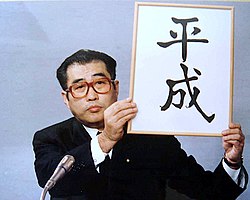
In 1979, Obuchi became the director of the Prime Minister's office and director of the Okinawa Development Agency, his first cabinet post. He served there for eight years before becoming Chief Cabinet Secretary in 1987. As Chief Cabinet Secretary, he announced the new era name "Heisei" on the day Emperor Akihito ascended the throne in 1989.
In 1991, Obuchi became secretary general of the Liberal Democratic Party (LDP), and in 1994 became its vice president. In 1997, Ryutaro Hashimoto appointed Obuchi as Minister of Foreign Affairs, where he distinguished himself in negotiations with Russia over Japanese claims in the Kuril Islands, as well as negotiations over the unification of Korea.
Premiership (1998–2000)

In 1998, Hashimoto resigned as LDP president when the party lost its majority in the House of Councillors, the upper house of the Diet, and Obuchi was named his successor. When the Diet designated a new prime minister, Obuchi became only the second LDP candidate not to win the support of the House of Councillors. However, the Constitution of Japan stipulates that if the two chambers cannot agree on a choice for prime minister, the choice of the House of Representatives is deemed to be that of the Diet. With the LDP's large majority in the lower house, Obuchi was formally appointed Prime Minister on 30 July.
During his term as prime minister, Obuchi was focused on two major issues: signing a peace treaty with Russia and reviving the Japanese economy of the Lost Decade. His solution to the latter was to increase public spending and lowering income taxes, which briefly slowed the recession but ultimately did very little to turn it around. One of his government actions was to give shopping coupons to 35 million citizens in the hope it would spark a consumer boom. Obuchi's Russia policy also eluded implementation before his death. Obuchi's fiscal policy focused on strengthening the core capital requirements for financial institutions while issuing more Japanese government bonds to finance public infrastructure, which boosted the rising Japanese public debt. His economic policies became known as "Obuchinomics".
Obuchi was known to have regularly enjoyed playing squash at the courts in the Canadian Embassy in Tokyo`s Azabu. Squash players tend to be very fit as it is excellent cardiovascular exercise, which was at odds with his depiction in Japanese media as gakeppuchi Obuchi(崖っぷち小渕, "Obuchi on the brink") which construed his poor physical health mirrored the precarious state of Japan's economy.
Death
On 1 April 2000, Obuchi suffered a massive stroke and slipped into a coma at Tokyo's Juntendo University Hospital while still in office. When it became apparent that he was unable to recover, he was replaced by Yoshirō Mori on 5 April. Obuchi died on 14 May at the age of 62; a state funeral was held in his honour at the Nippon Budokan on 8 June and was attended by foreign dignitaries from 156 countries and 22 organizations, including about 25 heads of state. Attendees at the funeral included UN Secretary General Kofi Annan, U.S. president Bill Clinton, and South Korean president Kim Dae-jung.
Personal life
Obuchi married environmental essayist Chizuko Ono in 1967. They were introduced by Tomisaburo Hashimoto, a Diet member and relative of Prime Minister Ryutaro Hashimoto. They had one son and two daughters. Their younger daughter, Yūko Obuchi, ran for and was elected to the former prime minister's Diet seat in the 2000 election. Obuchi was a great fan of the works of the late historical novelist Ryōtarō Shiba, and a particular admirer of Sakamoto Ryōma, a key figure in the events leading to the Meiji Restoration.
Obuchi also had the unusual hobby of collecting figures of oxen. It relates to the fact that he was born in the Year of the Ox, the second year of the Chinese zodiac. He started collecting the figures following his initial election to the Diet in 1963, and after three and a half decades, the collection numbered in the thousands. He was also devoted to aikido and enjoyed golf as well.
Honours
- Medal of Honour with Yellow Ribbon for Best Father (1999)
- Grand Cordon of the Order of the Chrysanthemum (14 May 2000; posthumous)
- Senior Second Rank (14 May 2000; posthumous)
- Golden Pheasant Award of the Scout Association of Japan (1998)
- Grand Cross of the Order of the Sun of Peru (1999)
Election history
| Election | Age | District | Political party | Number of votes | election results |
|---|---|---|---|---|---|
| 1963 Japanese general election | 26 | Gunma 3rd district | LDP | 47,350 | winning |
| 1967 Japanese general election | 29 | Gunma 3rd district | LDP | 61,543 | winning |
| 1969 Japanese general election | 32 | Gunma 3rd district | LDP | 50,185 | winning |
| 1972 Japanese general election | 35 | Gunma 3rd district | LDP | 37,258 | winning |
| 1976 Japanese general election | 39 | Gunma 3rd district | LDP | 76,012 | winning |
| 1979 Japanese general election | 42 | Gunma 3rd district | LDP | 62,375 | winning |
| 1980 Japanese general election | 42 | Gunma 3rd district | LDP | 59,647 | winning |
| 1983 Japanese general election | 46 | Gunma 3rd district | LDP | 49,028 | winning |
| 1986 Japanese general election | 49 | Gunma 3rd district | LDP | 75,289 | winning |
| 1990 Japanese general election | 52 | Gunma 3rd district | LDP | 76,932 | winning |
| 1993 Japanese general election | 56 | Gunma 3rd district | LDP | 89,440 | winning |
| 1996 Japanese general election | 59 | Gunma 5th district | LDP | 127,052 | winning |
External links
- "." Japanese Prime Minister's Office site ()
- onC-SPAN
| Party political offices | ||
|---|---|---|
| PrecededbyIchirō Ozawa | Secretary-General of the Liberal Democratic Party 1991 | SucceededbyTamisuke Watanuki |
| PrecededbyShin Kanemaru | Head of Heisei Kenkyūkai 1992–1998 | |
| Vice President of the Liberal Democratic Party 1994–1995 | SucceededbyTaku Yamasaki | |
| PrecededbyRyutaro Hashimoto | President of the Liberal Democratic Party 1998–2000 | SucceededbyYoshirō Mori |
| Political offices | ||
| PrecededbyAsao Mihara | Director General of the Prime Minister's Office 1979–1980 | SucceededbyTaro Nakayama |
| Director General of the Okinawa Development Agency 1979–1980 | ||
| PrecededbyKiichi Miyazawa | Chief Cabinet Secretary 1987–1989 | SucceededbyMasajuro Shiokawa |
| PrecededbyYukihiko Ikeda | Minister of Foreign Affairs 1997–1998 | SucceededbyMasahiko Kōmura |
| PrecededbyRyutaro Hashimoto | Prime Minister of Japan 1998–2000 | SucceededbyMikio Aoki Acting |