War artist
In-game article clicks load inline without leaving the challenge.

A war artist is an artist either commissioned by a government or publication, or self-motivated, to document first-hand experience of war in any form of illustrative or depictive record. War artists explore the visual and sensory dimensions of war, often absent in written histories or other accounts of warfare.

These artists may be involved in war as onlookers to the scenes, military personnel, or as specifically commissioned to be present and record military activity.
Artists record military activities in ways that cameras and the written word cannot. Their art collects and distills the experiences of the people who endured it. The artists and their artwork affect how subsequent generations view military conflicts. For example, Australian war artists who grew up between the two world wars were influenced by the artwork which depicted the First World War, and there was a precedent and format for them to follow.
Official war artists have been appointed by governments for information or propaganda purposes and to record events on the battlefield, but there are many other types of war artists. These can include combatants who are artists and choose to record their experiences, non-combatants who are witnesses of war, and prisoners of war who may voluntarily record the conditions or be appointed war artists by senior officers.
In New Zealand, the title of appointed "war artist" is "army artist". In the United States, the term "combat artist" has come to be used to mean the same thing.
Some examples and their background
- William Simpson was an artist-correspondent who sent artwork to London from the front during the Crimean War.
- Alfred Waud was an American Civil War pictorial newspaper illustrator.
- Ogata Gekkō and Tsuguharu Foujita created woodblock prints for Japanese publications.
- Ronald Searle recorded life in Japanese POW camps.
- Emmanuel Leutze's 1851 studio painting of Washington Crossing the Delaware is historically incorrect, and Leutze was born decades after the event his painting depicts, but this work has become an icon of popular culture.
War artists by nationality
Argentine
- Cándido López, 1840–1902, Paraguayan War
Australian

War artists have depicted all the conflicts in which Australians have been called to combat. The Australian tradition of "official war artists" started with the First World War. Artists were granted permission to accompany the Australian Imperial Force to record the activities of its soldiers. During the Second World War, the Australian War Museum, later called the Australian War Memorial, engaged artists. At the same time, the Royal Australian Navy, Australian Army, and Royal Australian Air Force appointed official war artist-soldiers from within their ranks. These embedded war artists have depicted the activities of Australian forces in Korea, Vietnam, East Timor, Afghanistan, and Iraq.
The ranks of non-soldier artists like George Gittoes continue to create artwork which becomes a commentary on Australia's military actions in war.
Selected artists A select list of representative Australian artists includes:
| Second Boer War William Dargie CBE, 1912–2003 First World War George Bell, 1878–1966 Charles Bryant, 1883–1937 Will Dyson, 1880–1938 A. Henry Fullwood, 1863–1930 George Lambert ARA, 1873–1930 Fred Leist, 1878–1945 John Longstaff, 1862–1941 Louis McCubbin, 1890–1952 Harold Septimus Power, 1877–1951 James Quinn, 1869–1951 Arthur Streeton, 1867–1943 | Second World War Stella Bowen, 1893–1947 Ernest Buckmaster, 1897-1968 Norma Bull, 1906-1980 Colin Colahan, 1897–1987 William Dargie CBE, 1912–2003 William Dobell OBE, 1899–1970 Russell Drysdale AC, 1912–1981 Richard Eurich OBE RA, 1903–1992 Murray Griffin, 1903–1992 Harold Herbert, 1891–1945 Ivor Hele, 1912–1993 Nora Heysen AM, 1911–2003 Frank Hodgkinson AM, 1919–2001 Rex Julius, 1914-1944 Alan Moore, 1914-2015 Sydney Nolan OM AC, 1917–1992 William Edwin Pidgeon, 1909–1981 Grace Cossington Smith AO, 1892–1984 | Recent conflicts Rick Amor, b. 1948, Peacekeeping in East Timor Conway Bown, b. 1966, Australian Army War Artist Peter Churcher, b. 1964, war on terrorism George Gittoes AM, b. 1949 Shaun Gladwell, b. 1972, War in Afghanistan Ivor Hele, 1912–1993, Korean War Ken McFadyen, 1932–1998, Vietnam War Lewis Miller, b. 1959, War in Iraq Frank Norton, 1916–1983, Korean War Wendy Sharpe, b. 1960, Peacekeeping in East Timor |
Austrian

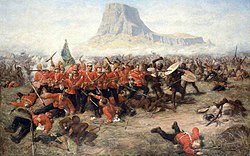
Belgian
First World War
- Alfred Bastien, 1873—1955
British
British participation in foreign wars has been the subject of paintings and other works created by Britain's war artists. Artwork like the 1688 painting,The Fleet at Sea by Willem van de Velde the Younger depict the Royal Navy in readiness for battle. The Ministry of Defence art collection includes many paintings showing battle scenes, particularly naval battles. Military art and portraiture has evolved along with other aspects of war. The British official war artists of the First World War created a unique account of that conflict. The British War Artists Scheme expanded the number of official artists and enlarged the scope of their activities during the Second War.
Significant themes in the chronicle of twentieth-century wars have been developed by non-military, non-official, civilian artists. For example, society portraitist Arabella Dorman's paintings of wounded Iraq War veterans inspired her to spend two weeks with three regiments in different frontline areas: the Green Jackets at Basra Palace, the Queen's Own Gurkhas at Shaibah Logistics Base ten miles south-west of Basra, and the Queen's Royal Lancers in the Maysaan desert. In the field, Dorman drew quick charcoal portraits of the men she met. Returning to England, the sketches she made helped her use art to "evoke the emotions and psychological impact of war," rather than depicting the "physical horror" of war.
Selected artists A select list of representative British artists includes:
| Napoleonic Wars Denis Dighton, 1792–1827 Robert Ker Porter, 1777–1842 John Christian Schetky, 1778–1874 Crimean War Jerry Barrett, 1824–1906 Oswald Brierly, 1817–1894 William Simpson, 1823–1899 Boer Wars John Henry Frederick Bacon, 1868–1914 René Bull, 1872–1942 Charles Edwin Fripp, 1854–1906 Godfrey Douglas Giles, 1857–1941 Ernest Prater, 1864–1950 Melton Prior, 1845–1910 Frederic Villiers, 1851–1922 William Barnes Wollen, 1857–1936 First World War Anna Airy, 1882–1964 Muirhead Bone, 1888–1953 Sydney Carline, 1888–1929 Colin Gill, 1892–1940 Eric Kennington RA, 1888–1960 Wyndham Lewis, 1882–1957 John Hodgson Lobley RA, 1878–1954 John Edmund Mace, 1889–1952 Olive Mudie-Cooke, 1890–1925 John Nash CBE RA, 1893–1977 Paul Nash, 1889–1946 C.R.W. Nevinson, 1889–1946 Sir William Orpen KBE RA RHA, 1878–1931 Sir Stanley Spencer RA, 1891–1959 | Second World War George Worsley Adamson RE, 1913–2005 Edward Ardizzone CBE RA, 1900–1979 Richard Eurich RA, 1903–1992 Edward Bawden RA, 1903–1989 Henry Carr RA, 1894–1970 Jack Bridger Chalker, 1918–2014 Leslie Cole, 1910–1976 Charles Cundall, 1890–1971 Amy Elton, 1904-1989 (working for the Department of External Affairs in India, 1942–1945) Reginald Eves, 1876–1941 Anthony Gross, 1905-1984 Bernard Hailstone, 1910–1987 Thomas Hennell, 1903–1945 Eliot Hodgkin, 1905–1987 Ley Kenyon, 1913-1990 Laura Knight DBE RA, 1877–1970 (Thomas) John Mansbridge, 1901–1981 Philip Meninsky, 1919–2007. John Mennie, 1911–1982 James Morris, 1908–1989 Ashley George Old, 1913–2001 Cuthbert Orde, 1888–1968 John Piper, 1903–1992 Roland Vivian Pitchforth, 1911–1999 Eric Ravilious, 1903–1942 Leo Rawlings, 1918-1990 Albert Richards, 1919–1945 Henry Rushbury KCVO RA, 1898–1968 Stella Schmolle, 1908–1975 Ronald Searle CBE RDI, 1920–2011 Ruskin Spear RA, 1911–1990 Sir Stanley Spencer RA, 1891–1959 Graham Sutherland OM, 1903–1980 Ernest Wallcousins, 1882–1976 Carel Weight CBE RA, 1908–1997 John Worsley, 1897–1991 Doris Zinkeisen, 1919–2000 | Recent conflicts Richard Johnson, b. 1966 Derek Eland, b. 1961 (Afghanistan, 2011) Fergus Greer, b. 1961, Kosovo Peter Howson, b. 1958 John Keane, b. 1954 Linda Kitson, b. 1945 (Falklands, 1982) Xavier Pick, b. 1972 (Iraq with British and US Forces, 2009–2011) Steve Mumford, b. 1960 (Iraq with US Forces) Paul Seawright, b 1965 (Afghanistan) Imperial War Museum Commission Barry John (artist), b 1974 (Northern Ireland) with Royal Welsh Portrait of POW "Dusty" Rhodes. A three-minute sketch by Ashley George Old painted in Thailand |
Canadian

Representative works by Canada's artists whose work illustrates and records war are gathered into the extensive collection of the Canadian War Museum. The earliest war art in Canada was rock art created by Indigenous peoples from all regions of the country. During the colonial period, large-scale, European-style paintings of war dominated New France and British North America. The First and Second World Wars saw a dramatic increase in the production of war art in every medium. A few First World War paintings were exhibited in the Senate of Canada Chamber, and artists studied these works as a way of preparing to create new artworks in the conflict in Europe which expanded after 1939.
"The war art commissions brought intense focus to the observation of Canada's role in international conflict... A driving need for a strong national identity urged First and Second World War artists toward symbolism. While these vivid images are of a now distant past, they continue to communicate their messages to us, and so never lose their relevance."
In the Second World War, Canada expanded its official art program; Canadian war artists were a kind of journalist who lived the lives of soldiers. The work of non-official civilian artists also became part of the record of this period. Canada supported Canadian official war artists in both the First World War and the Second World War; no official artists were designated during the Korean War.
Among Canada's embedded artist-journalist teams was Richard Johnson, who was sent by the National Post to Afghanistan in 2007 and 2011; his drawings of Canadian troops were published and posted online as part of the series "Kandahar Journal".
Prominent themes explored by Canadian war artists include commemoration, identity, women, Indigenous representation, propaganda, protest, violence, and religion.
Selected artists A select list of representative Canadian artists includes:
First World War
- John William Beatty, 1869–1941
- Alexander Young Jackson CC CMG, 1882–1974
- Wyndham Lewis, 1882–1957
- Arthur Lismer CC, 1885–1969 Capt. Will Ogilvie, Official army war artist, with some of his paintings, 9 February 1944
- Frederick Varley, 1881–1969
- Mabel May, 1877-1971
- Marion Long, 1882–1970
Second World War
- Eric Aldwinckle, 1909-1980
- Donald Kenneth Anderson, 1920–2009
- Harold Beament, 1898–1985
- Alan Brockman Beddoe OC OBE HFHS FHSC, 1893–1975
- Molly Lamb Bobak CM ONB, 1922–2014
- Paraskeva Clark, 1898-1986
- David Alexander Colville PC CC ONS, 1920–2013
- Charles Fraser Comfort OC, 1900–1994
- Charles Goldhamer, 1903–1985
- Paul Goranson, 1911–2002
- Lawren P. Harris, 1910–1994
- William Abernethy Ogilvie CM MBE, 1901–1989
- George Campbell Tinning RCA, 1910-1996
- Jack Shadbolt OC OBC, 1909–1998
Recent conflicts
- Richard Johnson, b. 1966
- Edward Zuber, 1932–2018
Chilean
- Nicolás Guzmán Bustamante, 1850–1928, chiefly painting the War of the Pacific and the Conquest of Chile
Chinese
Dutch

Finnish

World War II
- Kari Suomalainen, 1920–1999, Finland's most famous editorial cartoonist, worked as a war artist during World War II.
Flemish
- Vincent Adriaenssen
- Pieter van Bloemen
- Frans Breydel
- Karel Breydel
- Jasper Broers
- Laureys a Castro
- Nicolaas van Eyck
- Frans Geffels
- Robert van den Hoecke
- Lambert de Hondt the Elder
- Jan Baptist van der Meiren
- Adam Frans van der Meulen
- Pieter Meulener
- Arnold Frans Rubens
- Lucas Smout the Younger
- Peter Snayers
- Jan Snellinck
- Jan Peeter Verdussen
- Pieter Verdussen
- Sebastiaen Vrancx
- Cornelis de Wael
French


During the First World War, the work of artists depicting aspects of the military conflict were put on display in official war art exhibitions. In 1916 the Ministry of Beaux-Arts and the Ministry of War sponsored the Salon des Armées to show the work of the artists who had been mobilized. This one exhibition realized 60,000 francs. The proceeds supported needy artists at home and the disabled.
- Hippolyte Bellangé
- Nicolas Toussaint Charlet
- Eugène Chigot
- Edouard Detaille
- Antoine-Jean Gros
- Constantin Guys
- Eugène Louis Lami
- Louis-François, Baron Lejeune
- Jean-Louis-Ernest Meissonier
- Alphonse-Marie de Neuville
- Paul Philippoteaux
- Paul Alexandre Protais
- Denis Auguste Marie Raffet
- Carle Vernet
- Horace Vernet
- Antoine Watteau
- Adolphe Yvon
German
Franco-Prussian War
First World War
Second World War
Recent conflicts
- Frauke Eigen, b. 1969
Japanese
- Kubota Beisen, 1852–1906
- Toyohara Chikanobu, 1838–1912
- Tsuguharu Foujita, 1886–1968
- Ogata Gekkō, 1859–1920
- Toshihide Migita, 1862–1925
- Utagawa Yoshiiku, 1833–1904
Korean
- Kim Seong-hwan, 1932–2019
New Zealand
War artists have been appointed by the government to supplement the record of New Zealand's military history. The title of "war artist" changed to "army artist" when Ion Brown was appointed after the two world wars.
Conservators at the National Art Gallery considered the collection to be of historic rather than artistic worth; few were displayed. New Zealand's National Collection of War Art encompasses the work of artists who were working on commission for the Government as official war artists, while others created artworks for their own reasons.
Selected artists A select list of representative New Zealand artists includes:
First World War

Second World War
- James Boswell, 1906–1971
- Russell Clark, 1905–1966
- John McIndoe, 1898–1995
- Peter McIntyre OBE, 1910–1995
Recent conflicts
- Ion Brown, Bosnia and Croatia
- Matthew Gauldie, Solomon Islands and Afghanistan
Romanian

- Ion Stoica Dumitrescu
- Nicolae Grigorescu
- Carol Szathmari
Russian

- Mikhail Avilov
- Nikolai Baskakov
- Lev Chegorovsky
- Vladimir Chekalov
- Aleksandr Deyneka
- Nikolai Dmitriev-Orenburgsky
- Rudolf Frentz
- Nikolay Karazin
- Aleksey Kivshenko
- Victor Korovin
- Alexander Kotzebue
- Lev Lagorio
- Viktor Poltavets
- Franz Roubaud
- Nikolai Samokish
- Alexander Sauerweid
- Nikolay Sauerweid
- Vasily Vereshchagin
- Bogdan Willewalde
Serbian
- Mihailo Milovanović, 1879–1941, one of the most distinguished artists in World War I
- Veljko Stanojević, 1892–1967
- Kosta Miličević, 1877–1920
- Živorad Nastasijević, 1895–1966
- Nadežda Petrović, 1873–1915, succumbed to typhus fever in 1915
- Natalija Cvetković, 1888–1928
- Beta Vukanović, 1872–1972
- Rista Vukanović, 1873–1918, the husband Beta Vukanović
- Miodrag Petrović, 1888–1950
- Todor Švrakić, 1882–1931
- Vladimir Becić, 1886–1954
- Ana Marinković, 1881–1973
South African
- Neville Lewis (World War II)
Spanish

- Francisco de Goya, e.g., The Disasters of War, The Third of May 1808, 1810s
- Pablo Picasso, Guernica, 1937.
- Augusto Ferrer-Dalmau 1964
United States

The American panorama created by artists whose work focuses on war began with a visual account of the American Revolutionary War. The war artist or combat artist captures instantaneous action and conflates earlier moments of the same scene within one compelling image. Artists are unlike the objective camera lens, which records only a single instant and no more.
In 1917 the American military designated American official war artists who were sent to Europe to record the activities of the American Expeditionary Forces.
In World War II, the Navy Combat Art Program ensured that active-duty artists developed a record of all phases of the war and all major naval operations.
The official war artist continued to be supported in some military engagements. Teams of soldier-artists during the Vietnam War created pictorial accounts and interpretations for the annals of army military history. In 1992 the Army Staff Artist Program was attached to the United States Army Center of Military History as a permanent part of the Museum Division's Collections Branch.

The majority of combat artists of the 1970s were selected by George Gray, chairman of NACAL, Navy Air Cooperation and Liaison committee. Some of their paintings will be selected for the Navy Combat Art Museum in the capital by Charles Lawrence, director. In January 1978 the U.S. Navy chose a seascape specialist team: they asked Patricia Yaps and Wayne Dean, both of Milford, Connecticut, to capture air-sea rescue missions off of Key West while they were based at the nearby Naval Air Station Key West. They were among 78 artists selected that year to create works of art depicting Navy subjects.
Selected artists A select list of representative American artists includes:
Vietnam era
Soldier Artist Participants in the U. S. Army Vietnam Combat Artists Program
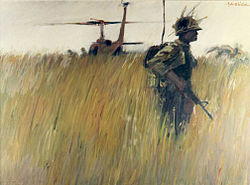

- CAT I, 15 Aug – 15 Dec 1966, Roger A. Blum (Stillwell, KS), Robert C. Knight (Newark, NJ), Ronald E. Pepin (East Hartford, CT), Paul Rickert (Philadelphia, PA), Felix R. Sanchez (Fort Madison, IA), John O. Wehrle (Dallas, TX), and supervisor, Frank M. Sherman
- CAT II, 15 Oct 1966 – 15 Feb 1967, Augustine G. Acuna (Monterey, CA), Alexander A. Bogdanovich (Chicago, IL), Theodore E. Drendel (Naperville, IL), David M. Lavender (Houston, TX), Gary W. Porter (El Cajon, CA), and supervisor, Carolyn M. O'Brien
- CAT III, 16 Feb – 17 June 1967, Michael R. Crook (Sierra Madre, CA), Dennis O. McGee (Castro Valley, CA), Robert T. Myers (White Sands Missile Range, NM), Kenneth J. Scowcroft (Manassas, VA), Stephen H. Sheldon (Los Angeles, CA), and supervisor, C. Bruce Smyser
- CAT IV, 15 Aug – 31 Dec 1967, Samuel E. Alexander (Philadelphia, MS), Daniel T. Lopez (Fresno, CA), Burdell Moody (Mesa, AZ), James R. Pollock (Pollock, SD), Ronald A. Wilson (Alhambra, CA), and technical supervisor, Frank M. Thomas
- CAT V, 1 Nov 1967 – 15 March 1968, Warren W. Buchanan (Kansas City, MO), Philip V. Garner (Dearborn, MI), Phillip W. Jones (Greensboro, NC), Don R. Schol (Denton, TX), John R. Strong (Kanehoe, HI), and technical supervisor, Frank M. Thomas
- CAT VI, 1 Feb – 15 June 1968, Robert T. Coleman (Grand Rapids, MI), David N. Fairrington (Oakland, CA), John D. Kurtz IV (Wilmington, DE), Kenneth T. McDaniel (Paris, TN), Michael P. Pala (Bridgeport, CT)
- CAT VII, 15 Aug – 31 Dec 1968, Brian H. Clark (Huntington, NY), William E. Flaherty Jr. (Louisville, KY), William C. Harrington (Terre Haute, IN), Barry W. Johnston (Huntsville, AL), Stephen H. Randall (Des Moines, IA), and supervisor, Fitzallen N. Yow
- CAT VIII, 1 Feb – 15 June 1969, Edward J. Bowen (Carona Del Mar, CA), James R. Drake (Colorado Springs, CO), Roman Rakowsky (Cleveland, OH), Victory V. Reynolds (Idaho Falls, ID), Thomas B. Schubert (Chicago, IL), and supervisor, Fred B. Engel
- CAT IX, 1 Sept 1969 – 14 Jan 1970, David E. Graves (Lawrence, KS), James S. Hardy (Coronado, CA), William R. Hoettels (San Antonio, TX), Bruce N. Rigby (Dekalb, IL), Craig L. Stewart (Laurel, MD), and supervisor, Edward C. Williams
Recent conflicts
- Kristopher Battles, Iraq and Afghanistan
- Henry Casselli
- Michael D. Fay, Iraq and Afghanistan
- Victor Juhasz, Afghanistan
See also
- War photography
- Commission (art) American official war artists Australian official war artists British official war artists Canadian official war artists German official war artists Japanese official war artists New Zealand official war artists
Notes
Further reading
External links
- Mémorial de Caen,
- Ministry of Defence (MoD),
- National Archives (UK),
- by Lance Nixon, Capital Journal, Vol 134 No. 27, 7 February 2014 pp C1-C6
- by Lance Nixon, Capital Journal, Vol 134 No. 32, 14 February 2014 pp C1-C6. See Harvey Dunn
- by Lance Nixon, Capital Journal, Vol 134 No. 57 pp C1-C6
- by Lance Nixon, Capital Journal (South Dakota), 17 January 2014.
- by Lance Nixon, Capital Journal (South Dakota), 23 January 2014.
- by Dave Askins, Capital Journal (South Dakota), 20 April 2018.
- by Kerri Lawrence, National Archives News, 9 April 2018
- by James Pollock, War, Literature & the Arts: An International Journal of the Humanities, free downloadable PDF South Dakota State University Open PRAIRIE repository/2009 Volume 21
- Karl Gehrke interviews James Pollock, 10 June 2015.
- Barry John artist