Old Turkic
In-game article clicks load inline without leaving the challenge.
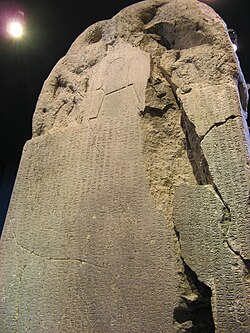
Old Turkic, also known as East Old Turkic, was a Siberian Turkic language spoken around East Turkistan and Mongolia. It was first discovered in inscriptions originating from the Second Turkic Khaganate, and later the Uyghur Khaganate, making it the earliest attested Common Turkic language. In terms of the datability of extant written sources, the period of Old Turkic can be dated from slightly before 720 AD to the Mongol invasions of the 13th century.
Classification and dialects
Old Turkic can generally be split into two dialects, the earlier Orkhon Turkic and the later Old Uyghur. There is a difference of opinions among linguists with regard to the Karakhanid language, some (among whom include Omeljan Pritsak, Sergey Malov, Osman Karatay and Marcel Erdal) classify it as another dialect of East Old Turkic, while others prefer to include Karakhanid among Middle Turkic languages; nonetheless, Karakhanid is very close to Old Uyghur. East Old Turkic and West Old Turkic together comprise the Old Turkic proper, though West Old Turkic is generally unattested and is mostly reconstructed through words loaned through Hungarian. East Old Turkic is the oldest attested member of the Siberian Turkic branch of Turkic languages, and several of its now-archaic grammatical as well as lexical features are extant in the modern Yellow Uyghur, Lop Nur Uyghur and Khalaj (all of which are endangered); Khalaj, for instance, has (surprisingly) retained a considerable number of archaic Old Turkic words despite forming a language island within Central Iran and being heavily influenced by Persian. Old Uyghur is not a direct ancestor of the modern Uyghur language, but rather the Western Yugur language; the contemporaneous ancestor of Modern Uyghur was the Chagatai literary language.
East Old Turkic is attested in a number of scripts, including the Old Turkic script, the Old Uyghur alphabet, the Brahmi script, and the Manichaean script. The Turkic runiform alphabet of Orkhon Turkic was deciphered by Vilhelm Thomsen in 1893.
Phonology
Vowel roundness is assimilated through the word through vowel harmony. Some vowels were considered to occur only in the initial syllable, but they were later found to be in suffixes. Length is distinctive for all vowels; while most of its daughter languages have lost the distinction, many of these preserve it in the case of /e/ with a height distinction, where the long phoneme developed into a more closed vowel than the short counterpart.
| Labial | Dental | Post- alveolar | Velar | Uvular | ||||||
|---|---|---|---|---|---|---|---|---|---|---|
| Nasal | m | n | ɲ | ŋ | ||||||
| Stop | p | b | t | d | tʃ | k | g | q | ɢ | |
| Fricative | s | z | ʃ | |||||||
| Tap/Flap | ɾ | |||||||||
| Approximant | ɫ | l | j |
Old Turkic is highly restrictive in which consonants words can begin with: words can begin with /b/, /t/, /tʃ/, /k/, /q/, /s/, /ɫ/ and /j/, but they do not usually begin with /p/, /d/, /g/, /ɢ/, /l/, /ɾ/, /n/, /ɲ/, /ŋ/, /m/, /ʃ/, or /z/. The only exceptions are 𐰤𐰀 (ne, "what, which") and its derivatives, and some early assimilations of word-initial /b/ to /m/ preceding a nasal in a word such as 𐰢𐰤 (men, "I").
Writing systems
The Old Turkic script (also known variously as Göktürk script, Orkhon script, Orkhon-Yenisey script) is the alphabet used by the Göktürks and other early Turkic khanates during the 8th to 10th centuries to record the Old Turkic language.
The script is named after the Orkhon Valley in Mongolia where early 8th-century inscriptions were discovered in an 1889 expedition by Nikolai Yadrintsev.
This writing system was later used within the Uyghur Khaganate. Additionally, a Yenisei variant is known from 9th-century Yenisei Kirghiz inscriptions, and it has likely cousins in the Talas Valley of Turkestan and the Old Hungarian alphabet of the 10th century. Words were usually written from right to left. Variants of the script were found in Mongolia and Xinjiang in the east and the Balkans in the west. The preserved inscriptions were dated between the 8th and 10th centuries.
Grammar
Cases
There are approximately 12 case morphemes in Old Turkic (treating 3 types of accusatives as one); the table below lists Old Turkic cases following Marcel Erdal’s classification (some phonemes of suffixes written in capital letters denote archiphonemes which sometimes are dropped or changed as per (East) Old Turkic phonotactics):
| Case Suffixes | Examples | Translation | |
|---|---|---|---|
| Nominative | ∅ (unmarked) | köñül-∅ | heart |
| Genitive | -niñ/-nıñ | Tämürniñ | Tämür’s |
| Accusative I (Pronominal Accusative) | -nı | bun'ı | this |
| Accusative II (Nominal Accusative) | -Ig/-Ug | qızlarığ, Qarluquğ | girls, Karluk |
| Accusative III | -(I)n | oglımın | my son’s |
| Dative | -ka | ordoqa | to palace |
| Directive / Allative | -gArU | əvgərü | towards home |
| Locative | -tA/-dA | ä əvdə, suvluqta | in house, in vessel |
| Directive-Locative / Partitive-Locative | -rA | asra, bara | below, at/towards/on head |
| Ablative | -dIn/-tIn -dAn | qañtın | from father |
| Equative-Lative | -çA | tükəğüçə | up to/till end |
| Instrumental | -In/-Un | okun | with arrow |
| Comitative | -lXgU -lUgUn | iniliğü | together with young brother |
| Similative | -lAyU | yultuzlayu | like star(s) |
Grammatical number
Old Turkic (like Modern Turkic) had 2 grammatical numbers: singular and plural. However, Old Turkic also formed collective nouns (a category related to plurals) by a separate suffix -(A)gU(n) e.g. tayağunuñuz ‘your colts’. Unlike Modern Turkic, Old Turkic had 3 types of suffixes to denote plural:
- -(X)t
- -An
- -lAr
Suffixes except for -lAr is limitedly used for only a few words. In some descriptions, -(X)t and -An may also be treated as collective markers. -(X)t is used for titles of non-Turkic origin, e.g. tarxat ←tarxan 'free man' <Soghdian, tégit ←tégin 'prince' (of unknown origin). -s is a similar suffix, e.g. ïšbara-s 'lords' <Sanskrit īśvara. -An is used for person, e.g. ərən 'men, warriors' ←är 'man', oğlan ←oğul 'son'.
Today, all Modern Turkic languages (except for Chuvash) use exclusively the suffix of the -lAr type for plural.
Verb
Finite verb forms in Old Turkic (i.e. verbs to which a tense suffix is added) always conjugate for person and number of the subject by corresponding suffixes save for the 3rd person, in which case person suffix is absent. This grammatical configuration is preserved in the majority of Modern Turkic languages, except for some such as Yellow Uyghur in which verbs no longer agree with the person of the subject.
Tense
Old Turkic had a complex system of tenses, which could be divided into six simple and derived tenses, the latter formed by adding special (auxiliary) verbs to the simple tenses.
| Tense | Positive | Negative |
|---|---|---|
| Imperfect Aorist | -Ur | -mAz |
| Preterite (Simple Past) | -dI | |
| Perfect Participle | -mış | -mAdOk |
| Future | -daçı | -mAčI |
| Vivid Past | -yOq | -mAyOk |
| Imminent Future | -gAlır |
Hapax legomena
Some suffixes are attested as being attached to only one word and no other instance of attachment is to be found. Similarly, some words are attested only once in the entire extant Old Turkic corpus.
Denominal
The following have been classified by Gerard Clauson as denominal noun suffixes.
| Suffix | Usages | Translation |
|---|---|---|
| -ça | ança | thus, like that |
| -ke | siğirke yipke | sinew string/thread |
| -la/-le | ayla tünle körkle | thus, like that yesterday, night, north beautiful |
| -suq/-sük | bağırsuq | (internal) organs |
| -ra/-re | içre | inside, within |
| -ya/-ye | bérye yırya | here north |
| -çıl/-çil | igčil | sickly |
| -ğïl/-gil | üçgil qırğıl | triangular grey haired |
| -nti | ékkinti | second |
| -dam/-dem | teñridem | god-like |
| tırtı:/-türti | ičtirti | inside, within |
| -qı:/-ki | aşnuqı üzeki ebdeki | former (being) on or above being in the house |
| -an/-en/-un | oğlan eren | children men, gentlemen |
| -ğu:/-gü | ençgü tuzğu buğrağu | tranquil, at peace food given to a traveller as a gift being like a camel stud, aggressive |
| -a:ğu:/-e:ğü: | üçeğü içeğü | three together being inside human body, internal organ |
| -dañ/-duñ | otuñ izdeñ | firewood track, trace |
| -ar/-er | birer azar | one each a few |
| -layu:/-leyü | börileyü | like a wolf |
| -daš/-deš | qarındaş yerdeş | kinsman compatriot |
| -mïš/-miš | altmış yetmiş | sixty seventy |
| -gey | küçgey | violent |
| -çaq/-çek and -çuq/-çük | ığırçaq | spindle-whorl |
| -q/-k (after vowels and -r) -aq/-ek (the normal forms) -ïq/-ik/-uq/-ük (rare forms) | ortuq | partner |
| -daq/-dek and(?) -duq/-dük | bağırdaq beligdek burunduq | wrap terrifying nose ring |
| -ğuq/-gük | çamğuq | objectionable |
| -maq/-mek | kögüzmek | breastplate |
| -muq/-a:muq | solamuk | left-handed (pejorative?) |
| -naq | baqanaq | "frog in a horse's hoof" (from baqa frog) |
| -duruq/-dürük | boyunduruq | yoke |
Deverbal
The following have been classified by Gerard Clauson as deverbal suffixes.
| Suffix | Usages | Translation |
|---|---|---|
| -a/-e/-ı:/-i/-u/-ü | oprı adrı keçe egri köni ötrü | hollow, valley branched, forked evening, night crooked straight, upright, lawful then, so |
| -ğa/-ge | kısğa öge bilge kölige tilge | short wise wise shadow slice |
| -ğma/-gme | tanığma | riddle, denial |
| -çı/-çi | otaçı: okıçı | healer priest, preacher |
| -ğuçı/-güçi | ayğuçı bitigüçi | councilor scribe |
| -dı/-di | üdründi öğdi alkadı sökti | chosen, parted, separated, scattered praised praised bran |
| -tı/-ti | arıtı uzatı tüketi | completely, clean lengthily completely |
| -du | eğdu umdu süktü | curved knife desire, covetousness campaigning |
| -ğu:/-gü | bilegü kedgü oğlağü | whetstone clothing gently nurtured |
| -ingü | bilingü etingü yeringü salıñu | being in the know being prepared disgusted sling |
| -ğa:ç/-geç | kışgaç | pincers |
| -ğuç/-güç | biçgüç | scissors |
| -maç/-meç | tutmaç | "saved" noodle dish |
| -ğut/-güt | alpağut bayağut | warrior merchant |
Media
Literary works
- Yenisei Inscriptions (8-10th centuries CE) - a group of texts in Old Turkic from Yenisei River basin.
- Uyuk-Tarlak inscription (date unknown) by an unknown writer (in Yenisei Kyrgyz)
- Elegest inscription (date unknown) by an unknown writer (in Yenisei Kyrgyz)
- Orkhon Inscriptions (732 and 735) by Yollıg Khagan (in Orkhon Turkic)
- Bain Tsokto inscriptions (716) by an unknown writer (in Orkhon Turkic)
- Ongin inscription (between 716 and 735) by an unknown writer (in Orkhon Turkic)
- Kul-chur inscription (between 723 and 725) a writer called "Ebizter" (in Orkhon Turkic)
- Altyn Tamgan Tarhan inscription (724) by an unknown writer (in Orkhon Turkic)
- Tariat inscriptions (between 753 and 760) by an unknown writer (in Old Uyghur)
- Choiti-Tamir inscriptions (between 753 and 756) by an unknown writer (in Old Uyghur)
- Sükhbaatar inscriptions (8th century) by an unknown writer (in Old Uyghur)
- Bombogor inscription (8th century) by an unknown writer (in Old Uyghur)
- Book of Divination (9th century) by an unknown writer (in Old Uyghur)
See also
Further reading
- Ö.D. Baatar, Old Turkic Script, Ulan-Baator (2008), ISBN 0-415-08200-5
- M. Erdal, Old Turkic word formation: A functional approach to the lexicon, Turcologica, Harassowitz (1991), ISBN 3-447-03084-4.
- M. Erdal, Old Turkic, in: The Turkic Languages, eds. L. Johanson & E.A. Csato, Routledge, London (1998), ISBN 978-99929-944-0-5
- , ISBN 90-04-10294-9.
- Erdal, Marcel (1 January 2004). . BRILL. ISBN 90-04-10294-9.
- L. Johanson, A History of Turkic, in: The Turkic Languages, eds. L. Johanson & E.A. Csato, Routledge, London (1998), ISBN 0-415-08200-5
- Talat Tekin, A Grammar of Orkhon Turkic, Uralic and Altaic Series Vol. 69, Indiana University Publications, Mouton and Co. (1968). (review: Gerard Clauson, Bulletin of the School of Oriental and African Studies, University of London, 1969); Routledge Curzon (1997), ISBN 0-7007-0869-3.
External links
- , pre-Islamic Old Turkic electronic corpus at uni-frankfurt.de.
- by Marcel Erdal
- (W. Schulze)
- by Gerard Clauson