Operation Downfall order of battle
In-game article clicks load inline without leaving the challenge.

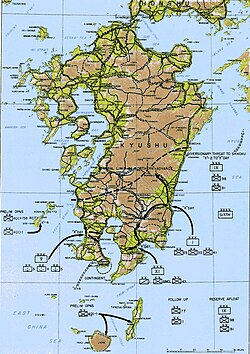
Operation Downfall was the proposed Allied plan for the invasion of the Japanese home islands near the end of World War II.
The operation had two parts, Operation Olympic, intended to capture the southern third of the southernmost main Japanese island, Kyūshū, and Operation Coronet, the planned invasion of the Kantō Plain, near Tokyo, on the main Japanese island of Honshu. Olympic was scheduled for November 1945, to be followed by Coronet in early 1946.
If Downfall had taken place, it would have been the largest amphibious operation in history, surpassing D-Day. The planned operation was canceled when Japan surrendered following the atomic bombings of Hiroshima and Nagasaki, the Soviet declaration of war, and the invasion of Manchuria.
Order of Battle for Olympic
Allied

Supreme Commander, Allied Forces Pacific General Douglas MacArthur
Ground forces
Should these four corps prove insufficient to accomplish the tasks assigned, elements earmarked for Coronet would be used to reinforce Sixth Army at the rate of three divisions per month beginning about 30 days after the initial landings.
General Walter Krueger Peripheral landings 40th Infantry Division (Landing on Yakushima and Koshikijima Islands) 158th Infantry Regiment (Landing on Tanegashima) I Corps (Landing at Miyazaki) Major General Innis P. Swift 25th Infantry Division 33rd Infantry Division 41st Infantry Division V Amphibious Corps (Landing at Kushikino) Major General Harry Schmidt, USMC 3rd Marine Division (Bougainville, Guam, Iwo Jima) 4th Marine Division (Kwajalein, Saipan/Tinian, Iwo Jima) 5th Marine Division (Iwo Jima) XI Corps (Landing at Ariake) Major General Charles P. Hall 1st Cavalry Division Americal Division 43rd Infantry Division IX Corps (Reserve afloat) Major General Charles W. Ryder 81st Infantry Division 98th Infantry Division Follow-up units: 11th Airborne Division 77th Infantry Division
Naval forces

Admiral William F. Halsey 20 fleet and light aircraft carriers 9 battleships 26 cruisers 75 destroyers incl. British Pacific Fleet 6 fleet and light carriers
Admiral Raymond A. Spruance 36 escort carriers 11 battleships 26 cruisers 387 destroyers and destroyer escorts 394 AKA, AP, APA, APD, APH 977 LSD, LSM, LST, and LSV
Admiral Thomas C. Kinkaid
Air forces

General George C. Kenney (119,000 men) – 14 bomber groups, 10 fighter groups Fifth Air Force Seventh Air Force Thirteenth Air Force
United States Strategic Air Forces in the Pacific
General Carl A. Spaatz
Major General Curtis E. LeMay Twentieth Air Force (Lt. Gen. Nathan Twining) (77,000 men) 1,000 B-29 Superfortresses Eighth Air Force (Lt. Gen. Jimmy Doolittle)
Commonwealth forces Tiger Force (detached from RAF Bomber Command): 480–580 Avro Lancaster bombers (about half to be used as tankers for in-flight refuelling) Australian First Tactical Air Force 20 fighter/attack squadrons from the Royal Australian Air Force
Japan
Ground forces

Field Marshal Shunroku Hata Sixteenth Area Army Lieut. General Yokoyama Isamu (600,000 men) Northern Kyūshū — 56th Army Lieut. General Ichiro Shichida (365,000) 145th Division 312th Division 351st Division 124th Independent Mixed Brigade 57th Division (20,000 men) 4th Tank Brigade Southeastern Kyūshū — 57th Army Lieut. General Nishihara Kanji (150,000 men) Tanegashima—109th Independent Mixed Brigade (5,900 men) Miyazaki—154th Division, 156th Division, 212th Division (55,000 men) Ariake—86th Division, 98th Independent Mixed Brigade, 1 regiment, 3 infantry battalions (29,000 men) 25th Division, 5th Tank Brigade, 6th Tank Brigade Southwestern Kyūshū — 40th Army Lieut. General Nakazawa Mitsuo (85,000 men) 303rd Division (12,000 men) (Sendai) 206th Division (Fukiage) 146th Division, 125th Independent Mixed Brigade (S. Satsuma Peninsula) 77th Division 1 tank regiment 216th Division 4 brigades
Air forces
General Masakazu Kawabe Sixth Air Army — Kyūshū 5,000 aircraft assigned as kamikazes, 5,000 aircraft available for kamikaze service, 7,000 aircraft in need of repair 100 Koryu-class midget submarines, 250 Kairyu-class midget submarines, 1,000 Kaiten manned torpedoes, 800 Shinyo suicide boats
Order of Battle for Coronet
Allied
Ground forces

General Courtney H. Hodges III Amphibious Corps 1st Marine Division (Guadalcanal, Peleliu, Okinawa) 2nd Marine Division (Tarawa, Saipan, Okinawa) 6th Marine Division (Okinawa) XXIV Corps 7th Infantry Division 27th Infantry Division 96th Infantry Division
Lieut. General Robert L. Eichelberger X Corps 24th Infantry Division 31st Infantry Division 37th Infantry Division XIV Corps 6th Infantry Division 32nd Infantry Division 38th Infantry Division XIII Corps (Reserve afloat) 13th Armored Division 20th Armored Division
United States Army Forces Pacific reserve 97th Infantry Division
Thirty days after the initial assault, each army would be reinforced by a corps of 3 divisions. Five days later an airborne division and a United States Army Forces Pacific Reserve Corps of 3 divisions would be made available. Strategic reserve for the entire operation would consist of a corps of 3 divisions located in the Philippines and divisions from the United States to permit reinforcement at the rate of 4 divisions per month.
Unsourced listing of the aforementioned reinforcements
For the U.S. First Army Unnamed follow-on corps 5th Infantry Division 44th Infantry Division 86th Infantry Division
For the U.S. Eighth Army Unnamed follow-on corps 4th Infantry Division 8th Infantry Division 87th Infantry Division
United States Army Forces Pacific reserve 11th Airborne Division Unnamed follow-on corps 2nd Infantry Division 28th Infantry Division 35th Infantry Division Strategic reserve 91st Infantry Division 95th Infantry Division 104th Infantry Division
British Commonwealth Ground Forces Commonwealth Corps (Lt. Gen. Charles Keightley) 3rd Infantry Division (United Kingdom) 6th Infantry Division (Canada) 10th Infantry Division (Australia)
Japan

All Japanese formations on Honshu were badly understrength and lacking in equipment. The American First Army's landings would likely have been opposed by the Japanese 52nd Army and the Eighth Army's landings by the Japanese 53rd Army.
Field Marshal Hajime Sugiyama Twelfth Area Army General Shizuichi Tanaka 36th Army – Urawa, Saitama 81st Division 93rd Division 201st Division 202nd Division 206th Division 214th Division 1st Tank Division 4th Tank Division 51st Army – Tsuchiura, Ibaraki 44th Division – Ogawa 151st Division – Mito 221st Division – Kashima 115th Independent Mixed Brigade – Shibasaki 116th Independent Mixed Brigade – Hokota 7th Independent Armored Brigade – Ogawa 52nd Army – Sakura, Chiba 3rd Imperial Guards Division – Naruto 147th Division – Mobara 152nd Division – Choshi 234th Division – Sōsa 3rd Independent Armored Brigade 8th Artillery Headquarters 53rd Army – Isehara, Kanagawa 84th Division – Odarawa 140th Division – Kamakura 316th Division – Isehara 117th Independent Mixed Brigade – Numazu 2nd Independent Armored Brigade – Tsudanuma 11th Artillery Headquarters – Hiratsuka Tokyo Bay Garrison – Choshi, Chiba 321st Division – Tokyoa