Opposing force
In-game article clicks load inline without leaving the challenge.
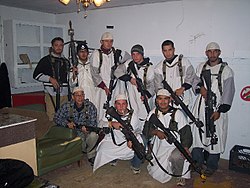
An opposing force (alternatively enemy force, abbreviated OPFOR or OpFor) is a military unit tasked with representing an enemy, usually for training purposes in war game scenarios. The related concept of aggressor squadron is used by some air forces.
At a basic level, a unit might serve as an opposing force for a single scenario, differing from its 'opponents' only in the objectives it is given. However, major armies commonly maintain specialized groups trained to accurately replicate real-life enemies, to provide a more realistic experience for their training opponents. (To avoid the diplomatic ramifications of naming a real nation as a likely enemy, training scenarios often use fictionalized versions with different names but similar military characteristics to the expected real-world foes.)
Units
Canada
The Canadian Armed Forces has OPFOR units from the Canadian Manoeuvre Training Centre.
China
France
In the French Army, a FORAD (FORce ADverse, enemy force) is used to train the army, in both the centre d'entraînement au combat (CENTAC, Combat Training Center) of Mailly-le-Camp and in the centre d'entraînement aux actions en zone urbaine (CENZUB, Urban Operations Training Centre). Declassed AMX-30 tanks were used to simulate Soviet T-72s, until 2018.
Republic of Korea
Japan
United States

There are three major training centers that utilize home-based OPFOR units for the US Army:
- The National Training Center (NTC) at Fort Irwin, California—home unit is the 11th Armored Cavalry Regiment (the Blackhorse)
- The Joint Readiness Training Center (JRTC) at Fort Polk, Louisiana—home unit is the 1st Battalion, 509th Parachute Infantry Regiment (the Geronimos)
- The Joint Multinational Readiness Center (JMRC)—formerly known as the Combat Maneuver Training Center (CMTC)—at Hohenfels, Germany—home unit is the 1st Battalion, 4th Infantry Regiment (Separate) (the Warriors)
Over time, the Army has patterned the OPFOR units after real or imagined opponents and given them various fictional names, even though the US Army denies any resemblance.

"Circle Triagonists" - patterned after the Wehrmacht from 1947 to 1978.
"Krasnovians" - patterned after the Soviet Red Army from 1978 to 1990 at the National Training Center in Fort Irwin.
The People's Republic of Pineland - a make believe foe for Army Special Forces candidates to face in their final test.
The Island of Aragon - an invasion scenario for troops to play out at the US Joint Readiness Training Center at Fort Polk, Louisiana.
Attica - a crisis to handle at White Sands Missile Range in New Mexico.
Various US military installations or major units have their own local versions of opposing force used for training exercises. The joint Australian–US military exercise "Crocodile '03" featured an Australian-led opposing force in which soldiers from a range of Australian units worked together with a US Marine Corps contingent.
Several state defense forces have served as OPFOR units when training with the National Guard. The California State Guard, the Georgia State Defense Force, and the New York Guard have provided OPFOR services to their respective National Guard counterparts. In 2018, the Georgia State Defense Force established the OPFOR Battalion to assist National Guard Soldiers with pre-deployment training.
Ranks
Officer ranks
| Rank group | General / flag officers | Senior officers | Junior officers | |||||||||
|---|---|---|---|---|---|---|---|---|---|---|---|---|
| Circle Trigonists Army (1953–1962) | ||||||||||||
| Marshal | General of army | General of corps | General of division | General of brigade | Colonel | Commandant | Major | Captain | Lieutenant | Sub-lieutenant | Warrant officer | |
| Circle Trigonists Army (1962–1978) | ||||||||||||
| Marshal | General of army | General of corps | General of division | General of brigade | Colonel | Commandant | Major | Captain | Lieutenant | Sub-lieutenant | Warrant officer | |
| Krasnovian Army (1978–present)[citation needed] | ||||||||||||
| Colonel | Lieutenant colonel | Major | Captain | Lieutenant | Junior lieutenant | |||||||
| Rank group | General / flag officers | Senior officers | Junior officers | |||||||||
| Circle Trigonists Air Force (1953–1962) | ||||||||||||
| Air marshal | General of air | General of air army | General of air corps | General of air division | Colonel | Commandant | Major | Captain | Lieutenant | Sub-lieutenant | Warrant officer | |
| Circle Trigonists Air Force (1962–1978) | ||||||||||||
| Air marshal | General of air | General of air army | General of air corps | General of air division | Colonel | Commandant | Major | Captain | Lieutenant | Sub-lieutenant | Warrant officer |
Circle Triagonist rank and collar tabs came in various colors - Red (rifle), White (artillery), Yellow (armor), Light Blue (airborne), Black (engineer), Tan (signal), Purple (chemical corps), Orange (propaganda)
Other ranks
| Rank group | Senior NCOs | Junior NCOs | Enlisted | ||||||
|---|---|---|---|---|---|---|---|---|---|
| Circle Trigonists Army (1953–1962) | No insignia | ||||||||
| Sergeant major | Staff sergeant | Senior sergeant | Platoon sergeant | Section sergeant | Corporal | Senior private | Private | ||
| Circle Trigonists Army (1962–1978) | |||||||||
| Sergeant major | Staff sergeant | Senior sergeant | Platoon sergeant | Section sergeant | Corporal | Senior private | Private | ||
| Krasnovian Army (1978–present)[citation needed] | |||||||||
| Sergeant major | Senior sergeant | Sergeant | Junior sergeant | Corporal | Private | ||||
| Rank group | Senior NCOs | Junior NCOs | Enlisted | ||||||
| Circle Trigonists Air Force (1953–1962) | No insignia | ||||||||
| Sergeant major | Staff sergeant | Senior sergeant | Platoon sergeant | Section sergeant | Corporal | Senior airman | Airman | ||
| Circle Trigonists Air Force (1962–1978) | No insignia | ||||||||
| Sergeant major | Staff sergeant | Senior sergeant | Platoon sergeant | Section sergeant | Corporal | Senior airman | Airman |
Often, the colour of the epaulette shows what specialisation the particular OPFOR soldier has. Green is worn by everyday soldiers, red by fusiliers, and blue by airborne forces.
Gallery
Personnel
- Dutch soldiers of 11 Pantserinfanteriebataljon Garderegiment Grenadiers wearing mohawk-style additions on their helmets to denote opposing force status.
- New Zealand Defence Force soldier denoting opposing force status by wearing Desert Disruptive Pattern Material (DPM) in a temperate environment.
- Scene from a simulated Royal Marines beach landing during the 2009 Bournemouth Air Festival; "opposing force" Marine is bareheaded and wears Desert DPM, "blue force" Marines in the background wear berets, camouflage face paint, and woodland DPM.
- Royal Marine "opposing force" members during a 2016 assault demonstration; they wear Tropentarn uniforms and soft hats while the assaulting "blue force" Marines would be wearing MTP uniforms with Mk 7 helmets.
- A sniper from the French CENZUB opposing force wearing a blue-and-gray version of Camouflage Central-Europe.
- 51st Fighter Wing airman denoting opposing force status by wearing his Battle Dress Uniform back to front (note the contrast of the uniform with the individual integrated fighting system vest that is also being worn).
- 4th Infantry Regiment soldiers wearing United States Army opposing force uniform (Battle Dress Uniform in black with olive 'OPFOR' shoulder title)
- Michigan National Guard OPFOR wearing tiger stripe camouflage uniform and carrying a simulated RPG-7.
- OPFOR rank insignia mimicking the Soviet style (used during the Cold War)
Vehicles
- 49th Royal Tank Regiment Matilda II with swastika and Iron Cross markings to denote opposing force status during a 1941 exercise in Dover.
- An OSV, visually modified M113 APC replicating a Soviet BMP at NTC, Fort Irwin, CA
- US Marines using a former Soviet MT-LB vehicle as part of the OPFOR during an exercise
- T-72M1 used by the 3rd Amphibious Assault Battalion, 1st Marine Division of US Marines at Camp Pendleton during Kernel Blitz 1997 exercise
- FV510 Warrior and other British vehicles in a green-and-tan paint scheme; while normally associated with BATUS, the paint scheme denotes opposing force status if used on the British mainland (as in this photograph).
Notes
Further reading
- (discusses the United States Army OPFOR units and post-Cold War changes to OPFOR.)
- , a summary of the opposing force Aggressor used by the United States Army from ca. 1946–1978