Timeline of first orbital launches by country
In-game article clicks load inline without leaving the challenge.

This is a timeline of first orbital launches by country. While a number of countries, incl. Canada, Australia, Germany, Brazil, Algeria, Kazakhstan, Turkey, Argentina, Italy, Indonesia, Poland, South Africa, the Philippines, Egypt, Spain, Mexico, Thailand and Chile, have built or launched satellites, as of 2025, thirteen countries, incl. the United States, Japan, China, India, Iran, Israel, France, the United Kingdom, South Korea and India have had the capability to send objects into orbit with their own launch vehicles. Russia and Ukraine inherited the capability of the space launchers and satellites from the Soviet Union, following its dissolution in 1991. Russia launches its rockets from its own and foreign (Kazakh) spaceports.
Ukraine launched only from foreign (Kazakh and Russian) launch facilities until 2015, after which political differences with Russia effectively halted Ukraine's ability to produce orbital rockets. France became a space power independently, launching a payload into orbit from Algeria, before joining space launcher facilities in the multi-national Ariane project. The United Kingdom became a space power independently following a single payload insertion into orbit from Australia.
Thirteen countries and one inter-governmental organization (ESA) presently have a proven orbital launch capability, as of March2025[update]. The former Soviet Union and the United Kingdom formerly had such an independent capability. In all cases where a country has conducted independent human spaceflights (as of 2021, three — China, the Soviet Union/Russia, and the United States), these launches were preceded by independent uncrewed launch capability.
The race to launch the first satellite was closely contested by the Soviet Union and the United States, and was the beginning of the Space Race. The launching of satellites, while still contributing to national prestige, is a significant economic activity as well, with public and private rocket systems competing for launches, using cost and reliability as selling points.
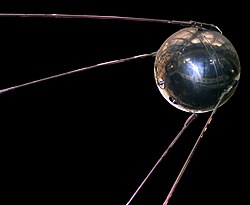
List of first orbital launches by country
Partial contributions to orbital launch systems
Italy had contributed in the creation of an orbital launch system prior to its 2012 launch.
| Order | Country | Sector | Satellite | Rocket | Location | Date (UTC) |
|---|---|---|---|---|---|---|
| 1 | Italy Italy | Governmental | San Marco 1 | Scout-X4 | San Marco platform, Kenya | 15 December 1964 |
Notes
Other launches and projects
The above list includes confirmed satellite launches with rockets produced by the launching country, like Algeria, Argentina, Australia, Brazil, Canada, Chile, China, Egypt, France, Germany, India, Iran, Israel, Italy, Japan, Kazakhstan, South Korea, Malaysia, Mexico, the Philippines, Poland, Russia, South Africa, Spain, Thailand, Turkey, Ukraine, the United Kingdom or the United States. Lists with differing criteria might include the following launches:
Failed launches
- Brazil had yet to launch a satellite into orbit independently and its space program suffered three satellite launch failures, the latest being the explosion of a VLS-1 rocket on 22 August 2003 at the Alcântara Launch Centre, which resulted in 21 deaths.
Launches of non-indigenous launch vehicles
Some countries have no self-developed rocket systems, but have provided their spaceports for launches of their own and foreign satellites on foreign launchers:
- Algeria with the first successful launch from Hammaguir of the French satellite Astérix on 26 November 1965 by French Diamant A. The last orbital launch from Hammaguir was on 15 February 1967 by French Diamant A and there are no further launches scheduled (the first Algerian satellite is AlSAT-1 launched by Russian Kosmos-3M from Plesetsk, Russia on 28 November 2002).
- Italy with the first successful launch from the San Marco platform of its satellite San Marco 2 on 26 April 1967 by US Scout B (the first Italian satellite is San Marco 1 launched by another Scout from Wallops, USA on 15 December 1964). The last orbital launch from San Marco was on 25 March 1988 by US Scout G-1 and there are no further launches scheduled.
- Australia with the first successful launch from Woomera Test Range of its first satellite WRESAT on 29 November 1967 by US Sparta. The second and final successful orbital launch from Woomera was performed on 28 October 1971 by the UK Black Arrow.
- Kazakhstan with the first launch after its independence from the Baikonur Cosmodrome on 21 January 1992 of the Russian Soyuz-U2 and Progress M-11 (the first Kazakh satellite is KazSat-1 launched by Russian Proton-K from Baikonur on 17 June 2006). Currently the spaceport continues to be utilized for launches of various Russian rockets.
- Spain; a single Pegasus-XL was launched from Orbital Sciences' Stargazer aircraft flying from Gran Canaria Airport in April 1997.
- Marshall Islands with a successful launch of a Pegasus-H rocket from Orbital Sciences' Stargazer aircraft flying from Kwajalein Atoll in October 2000. Five ground-based launches were made by SpaceX using Falcon 1 rockets between 2006 and 2009, with the first success on 28 September 2008. Three further Pegasus launches occurred between 2008 and 2012, using the Pegasus-XL configuration. Currently there are no plans announced for a Marshall Islands satellite.
Privately developed launch vehicles
- United States Orbital Sciences Corporation (USA) became the first company to launch a privately developed rocket into orbit, the Pegasus on April 5, 1990. Orbital subsequently developed the Minotaur rocket family. Orbital joined SpaceX as one of only two private entities to supply the International Space Station with its launch of the Cygnus Orb-D1 mission on its Antares rocket on September 28, 2013.
- United States SpaceX (USA) became the second company to launch a rocket into orbit using a rocket developed with private funds. Its first successful launch was performed on September 28, 2008, by Falcon 1 from the Omelek Island, Marshall Islands and its first launch from a US spaceport was Falcon 9 Flight 1 on June 4, 2010, from Cape Canaveral. Its Dragon spacecraft docked with the International Space Station on October 11, 2012, to deliver supplies. With a launch of Dragon 2 on May 30, 2020, SpaceX became the first company to launch humans to orbit.
- United States/New Zealand New Zealand-American private company Rocket Lab successfully launched its Electron rocket from Mahia Launch Center in New Zealand on January 21, 2018, carrying three cubesats into low Earth orbit. This was the first time that a rocket entered orbit after launching from a privately owned and operated spaceport.
- China Chinese private company i-Space successfully launched its Hyperbola-1 rocket from Jiuquan Satellite Launch Center and sent several small payloads, including the CAS-7B amateur radio satellite into Earth orbit on July 25, 2019.
- China Galactic Energy successfully launched its Ceres-1 solid rocket from Jiuquan Satellite Launch Center into Sun-synchronous orbit on November 7, 2020, becoming the second Chinese private company capable of launching satellites into orbit.
- United States Virgin Orbit successfully achieved orbit on January 17, 2021, using their LauncherOne vehicle to deploy 10 CubeSats into Low Earth orbit for NASA. But the company filed for bankruptcy after a launch failure in 2023.
- United States Astra Rocket 3.3 vehicle successfully reached orbit on November 20, 2021, after launching from Pacific Spaceport Complex – Alaska (PSCA) carrying the demonstration payload STP-27AD2 for the United States Space Force.
- United States Firefly Aerospace launched Firefly Alpha rocket, which successfully reached an orbit lower than the expected one, on October 1, 2022.
- China Space Pioneer successfully launched its first rocket Tianlong-2 into orbit on April 2, 2023. It was the first Chinese company that achieved the goal with the liquid rocket.
- China LandSpace became a private company with orbital launch capability by successfully launched Zhuque-2, world's first methane-fueled rocket to reach orbit, on July 12, 2023.
- China Orienspace was the fifth private company in China to reach orbit after the successful maiden launch of Gravity-1 on January 11, 2024.
- India Skyroot Aerospace became the first private company in India to successfully reach orbit and deploy satellites on it's maiden launch of Vikram-1 on July 18, 2026.
Abandoned projects
- Nazi Germany/Germany was developing larger designs in the Aggregat series as early as 1940. A combination of A9 to A12 components could have produced orbital capability as early as 1947 if work had continued. Further preliminary development of numerous rocket space launchers and re-usable launch systems (Sänger II, etc.) took place after WWII, although these were never realized as national or European projects. Also, in the late 1970s and early 1980s, the private German company OTRAG tried to develop low-cost commercial space launchers. Only the sub-orbital tests of the first prototypes of the rockets were carried out.[citation needed]
- United Kingdom did not proceed with a 1946 proposal to develop German V-2 technology into the "Megaroc" system to be launched in 1949. The UK also developed the Black Arrow rocket system and successfully launched a satellite in 1971, shortly after the program had been cancelled.
- Canada had developed the gun-based space launchers Martlet and GLO as the joint Canadian-American Project HARP in the 1960s. The rockets were never tested. In fact, in different periods, they worked in cooperation with Australia, Brazil, South Korea and the United Kingdom.[citation needed]
- South Africa developed the space launcher RSA-3 in the late 1980s in collaboration with Israel, years after Brazil and Argentina launched their first satellites. The rocket was tested three times without a satellite payload in 1989 and 1990. The program was postponed and later canceled in 1994.[citation needed]
- Iraq Iraq built and tested the Al-Abid, a three-stage space launch vehicle without a payload or its upper two stages on 5 December 1989. The rocket's design had a clustered first stage composed of five modified scud rockets strapped together and a single scud rocket as the second stage in addition to a SA-2 liquid-fueled rocket engine as the third stage. The video tape of a partial launch attempt which was retrieved by UN weapons inspectors, later surfaced showing that the rocket prematurely exploded 45 seconds after its launch.
- Argentina previous attempts at developing space launcher based on their Condor missile were scrapped in 1993.
- Brazil The VLS-1 was cancelled after decades of development and high expenditures with poor results and a failed association with Ukraine that slowed the program for years.
- Egypt tried to develop space launcher as part of its various ballistic missile programs in the second half of the 20th century. In different periods, they worked either independently or in cooperation with Algeria, Argentina, Canada, Iraq and North Korea.
- Spain developed the space launcher Capricornio (Capricorn) in the 1990s. The rocket was related to the Condor missile from Argentina and its test, scheduled for 1999/2000, was not conducted. As a result, in different periods, they worked in cooperation with Japan and the United States.
- Switzerland Swiss Space Systems company planned to develop the micro satellite launcher-spaceplane SOAR by 2018 but went bankrupt. Thus, in different periods, they worked in cooperation with Chile, Poland and Ukraine
- United Kingdom Orbex developed its Prime launch vehicle, whose first launch was planned in 2023 from Sutherland spaceport.
Other projects
- Argentina developed an orbital rocket called Tronador II, whose maiden flight is expected to take place in the next four years as of late 2020.[needs update]
- Australia's ATSpace developed an orbital launch vehicle called Kestrel, tentatively being launched in 2022 from Whalers Way.
- Australia's Gilmour Space Technologies developed an orbital launch vehicle called Eris, scheduled to be launched in 2023.
- Brazil announced that it would launch its VLM rocket from the Alcântara Launch Center in 2025.
- Romania planned to launch military and security satellites. The first phase began in 2022.
- Algeria planned to launch military and security satellites. The first phase began in 2024.
- Chile announced that it would launch some satellites in 2024 or any later year.
- United States Blue Origin developed its New Glenn launch vehicle, whose first launch was completed on January 16, 2025.
- Spain The private company PLD Space developed the Miura 1 and Miura 5 suborbital and orbital launch vehicles, whose firsts launches were respectively planned for 2024 and 2026.
- Philippines OrbitX, a private company of the Philippines, planned to develop Haribon, a biofuel-powered launch vehicle.
- Malaysia The private company of Malaysia Independence-X Aerospace developed an orbital launch vehicle called DNLV, being launched in 2023.
- Thailand Thai Space Consortium developed a satellite called TSC-Pathfinder, being launched in 2023.
- Poland's Institute Of Aviation developed a rocket named ILR-33 BURSZTYN (ILR-33 AMBER).
- Mexico announced that it would launch some satellites some time in 2024.
- Japan planned to launch several rockets starting in 2023.
- South Korea launched a rocket in early 2023 from the space center in Brazil.
- Turkey planned to launch some satellites beginning in 2024.
Satellite operators
Many other countries, such as Mexico, Poland, Chile, Japan and India (the latter two would develop orbital launchers soon after), launched their own satellites on one of the foreign launchers listed above, the first being British owned and operated; American-built satellite Ariel 1, which was launched by a US rocket in April 1962. In September 1962, the Canadian satellite, Alouette-1, was launched by a US rocket, but unlike Ariel 1, it was constructed by Canada.
See also
- List of orbital launch systems
- List of missiles by country
- Orbital spaceflight
- Satellite
- Spaceport (including timeline of first orbital launches by spaceport)
- Discovery and exploration of the Solar System (including exploration by country)
- Timeline of first artificial satellites by country
- Timeline of Solar System exploration
- Timeline of space exploration
External links
- , Anthony R. Curtis, Ph.D., Space Today Online, accessed 17 February 2006.
- , Ranger Associates, accessed 17 February 2006.
- , Kevin Orfall and Gaurav Kampani, with Michael Dutra, Center for Nonproliferation Studies, Monterey Institute of International Studies, accessed 17 February 2006.
- , United States Space Command, 8 September 1998, accessed 17 February 2006.
- , James P. Rubin, United States Department of State, 14 September 1998, accessed 17 February 2006.