Percolation threshold
In-game article clicks load inline without leaving the challenge.
The percolation threshold is a mathematical concept in percolation theory that describes the formation of long-range connectivity in random systems. Below the threshold a giant connected component does not exist; while above it, there exists a giant component of the order of system size. In engineering and coffee making, percolation represents the flow of fluids through porous media, but in the mathematics and physics worlds it generally refers to simplified lattice models of random systems or networks (graphs), and the nature of the connectivity in them. The percolation threshold is the critical value of the occupation probability p, or more generally a critical surface for a group of parameters p1, p2, ..., such that infinite connectivity (percolation) first occurs.
Percolation models
The most common percolation model is to take a regular lattice, like a square lattice, and make it into a random network by randomly "occupying" sites (vertices) or bonds (edges) with a statistically independent probability p. At a critical threshold pc, large clusters and long-range connectivity first appear, and this is called the percolation threshold. Depending on the method for obtaining the random network, one distinguishes between the site percolation threshold and the bond percolation threshold. More general systems have several probabilities p1, p2, etc., and the transition is characterized by a critical surface or manifold. One can also consider continuum systems, such as overlapping disks and spheres placed randomly, or the negative space (Swiss-cheese models).
To understand the threshold, you can consider a quantity such as the probability that there is a continuous path from one boundary to another along occupied sites or bonds—that is, within a single cluster. For example, one can consider a square system, and ask for the probability P that there is a path from the top boundary to the bottom boundary. As a function of the occupation probability p, one finds a sigmoidal plot that goes from P=0 at p=0 to P=1 at p=1. The larger the square is compared to the lattice spacing, the sharper the transition will be. When the system size goes to infinity, P(p) will be a step function at the threshold value pc. For finite large systems, P(pc) is a constant whose value depends upon the shape of the system; for the square system discussed above, P(pc)=1⁄2 exactly for any lattice by a simple symmetry argument.
There are other signatures of the critical threshold. For example, the size distribution (number of clusters of size s) drops off as a power-law for large s at the threshold, ns(pc) ~ s−τ, where τ is a dimension-dependent percolation critical exponents. For an infinite system, the critical threshold corresponds to the first point (as p increases) where the size of the clusters become infinite.
In the systems described so far, it has been assumed that the occupation of a site or bond is completely random—this is the so-called Bernoulli percolation. For a continuum system, random occupancy corresponds to the points being placed by a Poisson process. Further variations involve correlated percolation, such as percolation clusters related to Ising and Potts models of ferromagnets, in which the bonds are put down by the Fortuin–Kasteleyn method. In bootstrap or k-sat percolation, sites and/or bonds are first occupied and then successively culled from a system if a site does not have at least k neighbors. Another important model of percolation, in a different universality class altogether, is directed percolation, where connectivity along a bond depends upon the direction of the flow. Another variation of recent interest is Explosive Percolation, whose thresholds are listed on that page.
Over the last several decades, a tremendous amount of work has gone into finding exact and approximate values of the percolation thresholds for a variety of these systems. Exact thresholds are only known for certain two-dimensional lattices that can be broken up into a self-dual array, such that under a triangle-triangle transformation, the system remains the same. Studies using numerical methods have led to numerous improvements in algorithms and several theoretical discoveries.
Simple duality in two dimensions implies that all fully triangulated lattices (e.g., the triangular, union jack, cross dual, martini dual and asanoha or 3-12 dual, and the Delaunay triangulation) all have site thresholds of 1⁄2, and self-dual lattices (square, martini-B) have bond thresholds of 1⁄2.
The notation such as (4,82) comes from Grünbaum and Shephard, and indicates that around a given vertex, going in the clockwise direction, one encounters first a square and then two octagons. Besides the eleven Archimedean lattices composed of regular polygons with every site equivalent, many other more complicated lattices with sites of different classes have been studied.
Error bars in the last digit or digits are shown by numbers in parentheses. Thus, 0.729724(3) signifies 0.729724 ± 0.000003, and 0.74042195(80) signifies 0.74042195 ± 0.00000080. The error bars variously represent one or two standard deviations in net error (including statistical and expected systematic error), or an empirical confidence interval, depending upon the source.
Percolation on networks
For a random tree-like network (i.e., a connected network with no cycle) without degree-degree correlation, it can be shown that such network can have a giant component, and the percolation threshold (transmission probability) is given by
p c = 1 g 1 ′ ( 1 ) = ⟨ k ⟩ ⟨ k 2 ⟩ − ⟨ k ⟩ {\displaystyle p_{c}={\frac {1}{g_{1}'(1)}}={\frac {\langle k\rangle }{\langle k^{2}\rangle -\langle k\rangle }}}.
Where g 1 ( z ) {\displaystyle g_{1}(z)} is the generating function corresponding to the excess degree distribution, ⟨ k ⟩ {\displaystyle {\langle k\rangle }} is the average degree of the network and ⟨ k 2 ⟩ {\displaystyle {\langle k^{2}\rangle }} is the second moment of the degree distribution. So, for example, for an ER network, since the degree distribution is a Poisson distribution, where⟨ k 2 ⟩ = ⟨ k ⟩ 2 + ⟨ k ⟩ , {\displaystyle {\langle k^{2}\rangle =\langle k\rangle ^{2}+\langle k\rangle },} the threshold is at p c = ⟨ k ⟩ − 1 {\displaystyle p_{c}={\langle k\rangle }^{-1}}.
In networks with low clustering, 0 < C ≪ 1 {\displaystyle 0<C\ll 1}, the critical point gets scaled by ( 1 − C ) − 1 {\displaystyle (1-C)^{-1}} such that:
p c = 1 1 − C 1 g 1 ′ ( 1 ) . {\displaystyle p_{c}={\frac {1}{1-C}}{\frac {1}{g_{1}'(1)}}.}
This indicates that for a given degree distribution, the clustering leads to a larger percolation threshold, mainly because for a fixed number of links, the clustering structure reinforces the core of the network with the price of diluting the global connections. For networks with high clustering, strong clustering could induce the core–periphery structure, in which the core and periphery might percolate at different critical points, and the above approximate treatment is not applicable.
Percolation in 2D
Thresholds on Archimedean lattices

| Lattice | z | z ¯ {\displaystyle {\overline {z}}} | Site percolation threshold | Bond percolation threshold |
|---|---|---|---|---|
| 3-12 or super-kagome, (3, 122 ) | 3 | 3 | 0.807900764... = (1 − 2 sin (π/18))1⁄2 | 0.74042195(80), 0.74042077(2), 0.740420800(2), 0.7404207988509(8), 0.740420798850811610(2), |
| cross, truncated trihexagonal (4, 6, 12) | 3 | 3 | 0.746, 0.750, 0.747806(4), 0.7478008(2) | 0.6937314(1), 0.69373383(72), 0.693733124922(2) |
| square octagon, bathroom tile, 4-8, truncated square (4, 82) | 3 | - | 0.729, 0.729724(3), 0.7297232(5) | 0.6768, 0.67680232(63), 0.6768031269(6), 0.6768031243900113(3), |
| honeycomb (63) | 3 | 3 | 0.6962(6), 0.697040230(5), 0.6970402(1), 0.6970413(10), 0.697043(3), | 0.652703645... = 1-2 sin (π/18), 1+ p3-3p2=0 |
| kagome (3, 6, 3, 6) | 4 | 4 | 0.652703645... = 1 − 2 sin(π/18) | 0.5244053(3), 0.52440516(10), 0.52440499(2), 0.524404978(5), 0.52440572..., 0.52440500(1), 0.524404999173(3), 0.524404999167439(4) 0.52440499916744820(1) |
| ruby, rhombitrihexagonal (3, 4, 6, 4) | 4 | 4 | 0.620, 0.621819(3), 0.62181207(7) | 0.52483258(53), 0.5248311(1), 0.524831461573(1) |
| square (44) | 4 | 4 | 0.59274(10), 0.59274605079210(2), 0.59274601(2), 0.59274605095(15), 0.59274621(13), 0.592746050786(3), 0.5927460507896(1), 0.59274605079016(1), 0.59274621(33), 0.59274598(4), 0.59274605(3), 0.593(1), 0.591(1), 0.569(13), 0.59274(5) | 1⁄2 |
| snub hexagonal, maple leaf (34,6) | 5 | 5 | 0.579 0.579498(3) | 0.43430621(50), 0.43432764(3), 0.4343283172240(6), |
| snub square, puzzle (32, 4, 3, 4 ) | 5 | 5 | 0.550, 0.550806(3) | 0.41413743(46), 0.4141378476(7), 0.4141378565917(1), |
| frieze, elongated triangular(33, 42) | 5 | 5 | 0.549, 0.550213(3), 0.5502(8) | 0.4196(6), 0.41964191(43), 0.41964044(1), 0.41964035886369(2) |
| triangular (36) | 6 | 6 | 1⁄2 | 0.347296355... = 2 sin (π/18), 1 + p3 − 3p = 0 |
Note: sometimes "hexagonal" is used in place of honeycomb, although in some contexts a triangular lattice is also called a hexagonal lattice. z = bulk coordination number.
2D lattices with extended and complex neighborhoods
In this section, sq-1,2,3 corresponds to square (NN+2NN+3NN), etc. Equivalent to square-2N+3N+4N, sq(1,2,3). tri = triangular, hc = honeycomb.
| Lattice | z | Site percolation threshold | Bond percolation threshold |
|---|---|---|---|
| sq-1, sq-2, sq-3, sq-5 | 4 | 0.5927... (square site) | |
| sq-1,2, sq-2,3, sq-3,5... 3x3 square | 8 | 0.407... (square matching) | 0.25036834(6), 0.2503685, 0.25036840(4) |
| sq-1,3 | 8 | 0.337 | 0.2214995 |
| sq-2,5: 2NN+5NN | 8 | 0.337 | |
| hc-1,2,3: honeycomb-NN+2NN+3NN | 12 | 0.300, 0.300, 0.302960... = 1-pc(site, hc) | |
| tri-1,2: triangular-NN+2NN | 12 | 0.295, 0.289, 0.290258(19) | |
| tri-2,3: triangular-2NN+3NN | 12 | 0.232020(36), 0.232020(20) | |
| sq-4: square-4NN | 8 | 0.270... | |
| sq-1,5: square-NN+5NN (r ≤ 2) | 8 | 0.277 | |
| sq-1,2,3: square-NN+2NN+3NN | 12 | 0.292, 0.290(5) 0.289, 0.288, 0.2891226(14) | 0.1522203 |
| sq-2,3,5: square-2NN+3NN+5NN | 12 | 0.288 | |
| sq-1,4: square-NN+4NN | 12 | 0.236 | |
| sq-2,4: square-2NN+4NN | 12 | 0.225 | |
| tri-4: triangular-4NN | 12 | 0.192450(36), 0.1924428(50) | |
| hc-2,4: honeycomb-2NN+4NN | 12 | 0.2374 | |
| tri-1,3: triangular-NN+3NN | 12 | 0.264539(21) | |
| tri-1,2,3: triangular-NN+2NN+3NN | 18 | 0.225, 0.215, 0.215459(36) 0.2154657(17) | |
| sq-3,4: 3NN+4NN | 12 | 0.221 | |
| sq-1,2,5: NN+2NN+5NN | 12 | 0.240 | 0.13805374 |
| sq-1,3,5: NN+3NN+5NN | 12 | 0.233 | |
| sq-4,5: 4NN+5NN | 12 | 0.199 | |
| sq-1,2,4: NN+2NN+4NN | 16 | 0.219 | |
| sq-1,3,4: NN+3NN+4NN | 16 | 0.208 | |
| sq-2,3,4: 2NN+3NN+4NN | 16 | 0.202 | |
| sq-1,4,5: NN+4NN+5NN | 16 | 0.187 | |
| sq-2,4,5: 2NN+4NN+5NN | 16 | 0.182 | |
| sq-3,4,5: 3NN+4NN+5NN | 16 | 0.179 | |
| sq-1,2,3,5 asterisk pattern | 16 | 0.208 | 0.1032177 |
| tri-4,5: 4NN+5NN | 18 | 0.140250(36), | |
| sq-1,2,3,4: NN+2NN+3NN+4NN (r ≤ 5 {\displaystyle r\leq {\sqrt {5}}}) | 20 | 0.19671(9), 0.196, 0.196724(10), 0.1967293(7) | 0.0841509 |
| sq-1,2,4,5: NN+2NN+4NN+5NN | 20 | 0.177 | |
| sq-1,3,4,5: NN+3NN+4NN+5NN | 20 | 0.172 | |
| sq-2,3,4,5: 2NN+3NN+4NN+5NN | 20 | 0.167 | |
| sq-1,2,3,5,6 asterisk pattern | 20 | 0.0783110 | |
| sq-1,2,3,4,5: NN+2NN+3NN+4NN+5NN (r ≤ 8 {\displaystyle r\leq {\sqrt {8}}}, also within a 5 × 5 square) | 24 | 0.164, 0.164, 0.1647124(6) | |
| sq-1,2,3,4,6: NN+2NN+3NN+4NN+6NN (diamond r ≤ 3 {\displaystyle r\leq 3}) | 24 | 0.16134, | |
| tri-1,4,5: NN+4NN+5NN | 24 | 0.131660(36) | |
| sq-1,...,6: NN+...+6NN (r≤3) | 28 | 0.142, 0.1432551(9) | 0.0558493 |
| tri-2,3,4,5: 2NN+3NN+4NN+5NN | 30 | 0.117460(36) 0.135823(27) | |
| tri-1,2,3,4,5: NN+2NN+3NN+4NN+5NN | 36 | 0.115, 0.115740(36), 0.1157399(58) | |
| sq-1,...,7: NN+...+7NN (r ≤ 10 {\displaystyle r\leq {\sqrt {10}}}) | 36 | 0.113, 0.1153481(9) | 0.04169608 |
| sq lat, diamond boundary: dist. ≤ 4 | 40 | 0.105(5) | |
| sq-1,...,8: NN+..+8NN (r ≤ 13 {\displaystyle r\leq {\sqrt {13}}}) | 44 | 0.095, 0.095765(5), 0.09580(2), 0.0957661(9) | |
| sq-1,...,9: NN+..+9NN (r≤4) | 48 | 0.086 | 0.02974268 |
| sq-1,...,11: NN+...+11NN (r ≤ 18 {\displaystyle r\leq {\sqrt {18}}}) | 60 | 0.02301190(3) | |
| sq-1,...,23 (r ≤ 7) | 148 | 0.008342595 | |
| sq-1,...,32: NN+...+32NN (r ≤ 72 {\displaystyle r\leq {\sqrt {72}}}) | 224 | 0.0053050415(33) | |
| sq-1,...,86: NN+...+86NN (r≤15) | 708 | 0.001557644(4) | |
| sq-1,...,141: NN+...+141NN (r ≤ 389 {\displaystyle r\leq {\sqrt {389}}}) | 1224 | 0.000880188(90) | |
| sq-1,...,185: NN+...+185NN (r≤23) | 1652 | 0.000645458(4) | |
| sq-1,...,317: NN+...+317NN (r≤31) | 3000 | 0.000349601(3) | |
| sq-1,...,413: NN+...+413NN (r ≤ 1280 {\displaystyle r\leq {\sqrt {1280}}}) | 4016 | 0.0002594722(11) | |
| sq lat, diamond boundary: dist. ≤ 6 | 84 | 0.049(5) | |
| sq lat, diamond boundary: dist. ≤ 8 | 144 | 0.028(5) | |
| sq lat, diamond boundary: dist. ≤ 10 | 220 | 0.019(5) | |
| 2x2 touching lattice squares* (same as sq-1,2,3,4) | 20 | φc = 0.58365(2), pc = 0.196724(10), 0.19671(9), | |
| 3x3 touching lattice squares* (same as sq-1,...,8)) | 44 | φc = 0.59586(2), pc = 0.095765(5), 0.09580(2) | |
| 4x4 touching lattice squares* | 76 | φc = 0.60648(1), pc = 0.0566227(15), 0.05665(3), | |
| 5x5 touching lattice squares* | 116 | φc = 0.61467(2), pc = 0.037428(2), 0.03745(2), | |
| 6x6 touching lattice squares* | 220 | pc = 0.02663(1), | |
| 10x10 touching lattice squares* | 436 | φc = 0.63609(2), pc = 0.0100576(5) | |
| within 11 × 11 square (r=5) | 120 | 0.01048079(6) | |
| within 15 × 15 square (r=7) | 224 | 0.005287692(22) | |
| 20x20 touching lattice squares* | 1676 | φc = 0.65006(2), pc = 0.0026215(3) | |
| within 31 × 31 square (r=15) | 960 | 0.001131082(5) | |
| 100x100 touching lattice squares* | 40396 | φc = 0.66318(2), pc = 0.000108815(12) | |
| 1000x1000 touching lattice squares* | 4003996 | φc = 0.66639(1), pc = 1.09778(6)E-06 |
Here NN = nearest neighbor, 2NN = second nearest neighbor (or next nearest neighbor), 3NN = third nearest neighbor (or next-next nearest neighbor), etc. These are also called 2N, 3N, 4N respectively in some papers.
- For overlapping or touching squares, p c {\displaystyle p_{c}}(site) given here is the net fraction of sites occupied ϕ c {\displaystyle \phi _{c}} similar to the ϕ c {\displaystyle \phi _{c}} in continuum percolation. The case of a 2×2 square is equivalent to percolation of a square lattice NN+2NN+3NN+4NN or sq-1,2,3,4 with threshold 1 − ( 1 − ϕ c ) 1 / 4 = 0.196724 ( 10 ) … {\displaystyle 1-(1-\phi _{c})^{1/4}=0.196724(10)\ldots } with ϕ c = 0.58365 ( 2 ) {\displaystyle \phi _{c}=0.58365(2)}. The 3×3 square corresponds to sq-1,2,3,4,5,6,7,8 with z=44 and p c = 1 − ( 1 − ϕ c ) 1 / 9 = 0.095765 ( 5 ) … {\displaystyle p_{c}=1-(1-\phi _{c})^{1/9}=0.095765(5)\ldots }. The value of z for a k × k square is (2k+1)2-5.
2D distorted lattices
Here, one distorts a regular lattice of unit spacing by moving vertices uniformly within the box ( x − α , x + α ) , ( y − α , y + α ) {\displaystyle (x-\alpha ,x+\alpha ),(y-\alpha ,y+\alpha )}, and considers percolation when sites are within Euclidean distance d {\displaystyle d} of each other.
| Lattice | z ¯ {\displaystyle {\overline {z}}} | α {\displaystyle \alpha } | d {\displaystyle d} | Site percolation threshold | Bond percolation threshold |
|---|---|---|---|---|---|
| square | 0.2 | 1.1 | 0.8025(2) | ||
| 0.2 | 1.2 | 0.6667(5) | |||
| 0.1 | 1.1 | 0.6619(1) |
Overlapping shapes on 2D lattices
Site threshold is number of overlapping objects per lattice site. k is the length (net area). Overlapping squares are shown in the complex neighborhood section. Here z is the coordination number to k-mers of either orientation, with z = k 2 + 10 k − 2 {\displaystyle z=k^{2}+10k-2} for 1 × k {\displaystyle 1\times k} sticks.
| System | k | z | Site coverage φc | Site percolation threshold pc |
|---|---|---|---|---|
| 1 × 2 dimer, square lattice | 2 | 22 | 0.54691 0.5483(2) | 0.17956(3) 0.18019(9) |
| 1 × 2 aligned dimer, square lattice | 2 | 14(?) | 0.5715(18) | 0.3454(13) |
| 1 × 3 trimer, square lattice | 3 | 37 | 0.49898 0.50004(64) | 0.10880(2) 0.1093(2) |
| 1 × 4 stick, square lattice | 4 | 54 | 0.45761 | 0.07362(2) |
| 1 × 5 stick, square lattice | 5 | 73 | 0.42241 | 0.05341(1) |
| 1 × 6 stick, square lattice | 6 | 94 | 0.39219 | 0.04063(2) |
The coverage is calculated from p c {\displaystyle p_{c}} by ϕ c = 1 − ( 1 − p c ) 2 k {\displaystyle \phi _{c}=1-(1-p_{c})^{2k}} for 1 × k {\displaystyle 1\times k} sticks, because there are 2 k {\displaystyle 2k} sites where a stick will cause an overlap with a given site.
For aligned 1 × k {\displaystyle 1\times k} sticks: ϕ c = 1 − ( 1 − p c ) k {\displaystyle \phi _{c}=1-(1-p_{c})^{k}}
Approximate formulas for thresholds of Archimedean lattices
| Lattice | z | Site percolation threshold | Bond percolation threshold |
|---|---|---|---|
| (3, 122 ) | 3 | ||
| (4, 6, 12) | 3 | ||
| (4, 82) | 3 | 0.676835..., 4p3 + 3p4 − 6 p5 − 2 p6 = 1 | |
| honeycomb (63) | 3 | ||
| kagome (3, 6, 3, 6) | 4 | 0.524430..., 3p2 + 6p3 − 12 p4+ 6 p5 − p6 = 1 | |
| (3, 4, 6, 4) | 4 | ||
| square (44) | 4 | 1⁄2 (exact) | |
| (34,6 ) | 5 | 0.434371..., 12p3 + 36p4 − 21p5 − 327 p6 + 69p7 + 2532p8 − 6533 p9 + 8256 p10 − 6255p11 + 2951p12 − 837 p13 + 126 p14 − 7p15 = 1 [citation needed] | |
| snub square, puzzle (32, 4, 3, 4 ) | 5 | ||
| (33, 42) | 5 | ||
| triangular (36) | 6 | 1⁄2 (exact) |
AB percolation and colored percolation in 2D
In AB percolation, a p s i t e {\displaystyle p_{\mathrm {site} }} is the proportion of A sites among B sites, and bonds are drawn between sites of opposite species. It is also called antipercolation.
In colored percolation, occupied sites are assigned one of n {\displaystyle n} colors with equal probability, and connection is made along bonds between neighbors of different colors.
| Lattice | z | z ¯ {\displaystyle {\overline {z}}} | Site percolation threshold |
|---|---|---|---|
| triangular AB | 6 | 6 | 0.2145, 0.21524(34), 0.21564(3) |
| AB on square-covering lattice | 6 | 6 | 1 − 1 − p c ( s i t e , s q ) = 0.361835 {\displaystyle 1-{\sqrt {1-p_{c}(site,sq)}}=0.361835} |
| square three-color | 4 | 4 | 0.80745(5) |
| square four-color | 4 | 4 | 0.73415(4) |
| square five-color | 4 | 4 | 0.69864(7) |
| square six-color | 4 | 4 | 0.67751(5) |
| triangular two-color | 6 | 6 | 0.72890(4) |
| triangular three-color | 6 | 6 | 0.63005(4) |
| triangular four-color | 6 | 6 | 0.59092(3) |
| triangular five-color | 6 | 6 | 0.56991(5) |
| triangular six-color | 6 | 6 | 0.55679(5) |
Site-bond percolation in 2D
Site bond percolation. Here p s {\displaystyle p_{s}} is the site occupation probability and p b {\displaystyle p_{b}} is the bond occupation probability, and connectivity is made only if both the sites and bonds along a path are occupied. The criticality condition becomes a curve f ( p s , p b ) {\displaystyle f(p_{s},p_{b})} = 0, and some specific critical pairs ( p s , p b ) {\displaystyle (p_{s},p_{b})} are listed below.
Square lattice:
| Lattice | z | z ¯ {\displaystyle {\overline {z}}} | Site percolation threshold | Bond percolation threshold |
|---|---|---|---|---|
| square | 4 | 4 | 0.615185(15) | 0.95 |
| 0.667280(15) | 0.85 | |||
| 0.732100(15) | 0.75 | |||
| 0.75 | 0.726195(15) | |||
| 0.815560(15) | 0.65 | |||
| 0.85 | 0.615810(30) | |||
| 0.95 | 0.533620(15) |
Honeycomb (hexagonal) lattice:
| Lattice | z | z ¯ {\displaystyle {\overline {z}}} | Site percolation threshold | Bond percolation threshold |
|---|---|---|---|---|
| honeycomb | 3 | 3 | 0.7275(5) | 0.95 |
| 0. 0.7610(5) | 0.90 | |||
| 0.7986(5) | 0.85 | |||
| 0.80 | 0.8481(5) | |||
| 0.8401(5) | 0.80 | |||
| 0.85 | 0.7890(5) | |||
| 0.90 | 0.7377(5) | |||
| 0.95 | 0.6926(5) |
Kagome lattice:
| Lattice | z | z ¯ {\displaystyle {\overline {z}}} | Site percolation threshold | Bond percolation threshold |
|---|---|---|---|---|
| kagome | 4 | 4 | 0.6711(4), 0.67097(3) | 0.95 |
| 0.6914(5), 0.69210(2) | 0.90 | |||
| 0.7162(5), 0.71626(3) | 0.85 | |||
| 0.7428(5), 0.74339(3) | 0.80 | |||
| 0.75 | 0.7894(9) | |||
| 0.7757(8), 0.77556(3) | 0.75 | |||
| 0.80 | 0.7152(7) | |||
| 0.81206(3) | 0.70 | |||
| 0.85 | 0.6556(6) | |||
| 0.85519(3) | 0.65 | |||
| 0.90 | 0.6046(5) | |||
| 0.90546(3) | 0.60 | |||
| 0.95 | 0.5615(4) | |||
| 0.96604(4) | 0.55 | |||
| 0.9854(3) | 0.53 |
* For values on different lattices, see "An investigation of site-bond percolation on many lattices".
Approximate formula for site-bond percolation on a honeycomb lattice
| Lattice | z | z ¯ {\displaystyle {\overline {z}}} | Threshold | Notes |
|---|---|---|---|---|
| (63) honeycomb | 3 | 3 | p b p s [ 1 − ( p b c / ( 3 − p b c ) ) ( p b − p b c ) ] = p b c {\displaystyle p_{b}p_{s}[1-({\sqrt {p_{bc}}}/(3-p_{bc}))({\sqrt {p_{b}}}-{\sqrt {p_{bc}}})]=p_{bc}}, When equal: ps = pb = 0.82199 | approximate formula, ps = site prob., pb = bond prob., pbc = 1 − 2 sin (π/18), exact at ps=1, pb=pbc. |
Archimedean duals (Laves lattices)

Laves lattices are the duals to the Archimedean lattices. Drawings from. See also Uniform tilings.
| Lattice | z | z ¯ {\displaystyle {\overline {z}}} | Site percolation threshold | Bond percolation threshold |
|---|---|---|---|---|
| Cairo pentagonal D(32,4,3,4)=(2⁄3)(53)+(1⁄3)(54) | 3,4 | 3 1⁄3 | 0.6501834(2), 0.650184(5) | 0.585863... = 1 − pcbond(32,4,3,4) |
| Pentagonal D(33,42)=(1⁄3)(54)+(2⁄3)(53) | 3,4 | 3 1⁄3 | 0.6470471(2), 0.647084(5), 0.6471(6) | 0.580358... = 1 − pcbond(33,42), 0.5800(6) |
| D(34,6)=(1⁄5)(46)+(4⁄5)(43) | 3,6 | 3 3⁄5 | 0.639447 | 0.565694... = 1 − pcbond(34,6 ) |
| dice, rhombille tiling D(3,6,3,6) = (1⁄3)(46) + (2⁄3)(43) | 3,6 | 4 | 0.5851(4), 0.585040(5) | 0.475595... = 1 − pcbond(3,6,3,6 ) |
| ruby dual D(3,4,6,4) = (1⁄6)(46) + (2⁄6)(43) + (3⁄6)(44) | 3,4,6 | 4 | 0.582410(5) | 0.475167... = 1 − pcbond(3,4,6,4 ) |
| union jack, tetrakis square tiling D(4,82) = (1⁄2)(34) + (1⁄2)(38) | 4,8 | 6 | 1⁄2 | 0.323197... = 1 − pcbond(4,82 ) |
| bisected hexagon, cross dual D(4,6,12)= (1⁄6)(312)+(2⁄6)(36)+(1⁄2)(34) | 4,6,12 | 6 | 1⁄2 | 0.306266... = 1 − pcbond(4,6,12) |
| asanoha (hemp leaf) D(3, 122)=(2⁄3)(33)+(1⁄3)(312) | 3,12 | 6 | 1⁄2 | 0.259579... = 1 − pcbond(3, 122) |
2-uniform lattices
Top 3 lattices: #13 #12 #36 Bottom 3 lattices: #34 #37 #11

Top 2 lattices: #35 #30 Bottom 2 lattices: #41 #42

Top 4 lattices: #22 #23 #21 #20 Bottom 3 lattices: #16 #17 #15

Top 2 lattices: #31 #32 Bottom lattice: #33

| # | Lattice | z | z ¯ {\displaystyle {\overline {z}}} | Site percolation threshold | Bond percolation threshold |
|---|---|---|---|---|---|
| 41 | (1⁄2)(3,4,3,12) + (1⁄2)(3, 122) | 4,3 | 3.5 | 0.7680(2) | 0.67493252(36)[citation needed] |
| 42 | (1⁄3)(3,4,6,4) + (2⁄3)(4,6,12) | 4,3 | 31⁄3 | 0.7157(2) | 0.64536587(40)[citation needed] |
| 36 | (1⁄7)(36) + (6⁄7)(32,4,12) | 6,4 | 4 2⁄7 | 0.6808(2) | 0.55778329(40)[citation needed] |
| 15 | (2⁄3)(32,62) + (1⁄3)(3,6,3,6) | 4,4 | 4 | 0.6499(2) | 0.53632487(40)[citation needed] |
| 34 | (1⁄7)(36) + (6⁄7)(32,62) | 6,4 | 4 2⁄7 | 0.6329(2) | 0.51707873(70)[citation needed] |
| 16 | (4⁄5)(3,42,6) + (1⁄5)(3,6,3,6) | 4,4 | 4 | 0.6286(2) | 0.51891529(35)[citation needed] |
| 17 | (4⁄5)(3,42,6) + (1⁄5)(3,6,3,6)* | 4,4 | 4 | 0.6279(2) | 0.51769462(35)[citation needed] |
| 35 | (2⁄3)(3,42,6) + (1⁄3)(3,4,6,4) | 4,4 | 4 | 0.6221(2) | 0.51973831(40)[citation needed] |
| 11 | (1⁄2)(34,6) + (1⁄2)(32,62) | 5,4 | 4.5 | 0.6171(2) | 0.48921280(37)[citation needed] |
| 37 | (1⁄2)(33,42) + (1⁄2)(3,4,6,4) | 5,4 | 4.5 | 0.5885(2) | 0.47229486(38)[citation needed] |
| 30 | (1⁄2)(32,4,3,4) + (1⁄2)(3,4,6,4) | 5,4 | 4.5 | 0.5883(2) | 0.46573078(72)[citation needed] |
| 23 | (1⁄2)(33,42) + (1⁄2)(44) | 5,4 | 4.5 | 0.5720(2) | 0.45844622(40)[citation needed] |
| 22 | (2⁄3)(33,42) + (1⁄3)(44) | 5,4 | 4 2⁄3 | 0.5648(2) | 0.44528611(40)[citation needed] |
| 12 | (1⁄4)(36) + (3⁄4)(34,6) | 6,5 | 5 1⁄4 | 0.5607(2) | 0.41109890(37)[citation needed] |
| 33 | (1⁄2)(33,42) + (1⁄2)(32,4,3,4) | 5,5 | 5 | 0.5505(2) | 0.41628021(35)[citation needed] |
| 32 | (1⁄3)(33,42) + (2⁄3)(32,4,3,4) | 5,5 | 5 | 0.5504(2) | 0.41549285(36)[citation needed] |
| 31 | (1⁄7)(36) + (6⁄7)(32,4,3,4) | 6,5 | 5 1⁄7 | 0.5440(2) | 0.40379585(40)[citation needed] |
| 13 | (1⁄2)(36) + (1⁄2)(34,6) | 6,5 | 5.5 | 0.5407(2) | 0.38914898(35)[citation needed] |
| 21 | (1⁄3)(36) + (2⁄3)(33,42) | 6,5 | 5 1⁄3 | 0.5342(2) | 0.39491996(40)[citation needed] |
| 20 | (1⁄2)(36) + (1⁄2)(33,42) | 6,5 | 5.5 | 0.5258(2) | 0.38285085(38)[citation needed] |
Inhomogeneous 2-uniform lattice

This figure shows something similar to the 2-uniform lattice #37, except the polygons are not all regular—there is a rectangle in the place of the two squares—and the size of the polygons is changed. This lattice is in the isoradial representation in which each polygon is inscribed in a circle of unit radius. The two squares in the 2-uniform lattice must now be represented as a single rectangle in order to satisfy the isoradial condition. The lattice is shown by black edges, and the dual lattice by red dashed lines. The green circles show the isoradial constraint on both the original and dual lattices. The yellow polygons highlight the three types of polygons on the lattice, and the pink polygons highlight the two types of polygons on the dual lattice. The lattice has vertex types (1⁄2)(33,42) + (1⁄2)(3,4,6,4), while the dual lattice has vertex types (1⁄15)(46)+(6⁄15)(42,52)+(2⁄15)(53)+(6⁄15)(52,4). The critical point is where the longer bonds (on both the lattice and dual lattice) have occupation probability p = 2 sin (π/18) = 0.347296... which is the bond percolation threshold on a triangular lattice, and the shorter bonds have occupation probability 1 − 2 sin(π/18) = 0.652703..., which is the bond percolation on a hexagonal lattice. These results follow from the isoradial condition but also follow from applying the star-triangle transformation to certain stars on the honeycomb lattice. Finally, it can be generalized to having three different probabilities in the three different directions, p1, p2 and p3 for the long bonds, and 1 − p1, 1 − p2, and 1 − p3 for the short bonds, where p1, p2 and p3 satisfy the critical surface for the inhomogeneous triangular lattice.
Thresholds on 2D bow-tie and martini lattices
To the left, center, and right are: the martini lattice, the martini-A lattice, the martini-B lattice. Below: the martini covering/medial lattice, same as the 2×2, 1×1 subnet for kagome-type lattices (removed).

Some other examples of generalized bow-tie lattices (a-d) and the duals of the lattices (e-h):
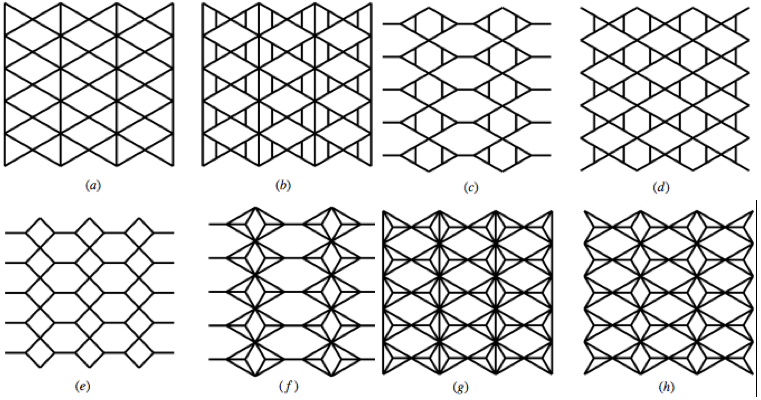
| Lattice | z | z ¯ {\displaystyle {\overline {z}}} | Site percolation threshold | Bond percolation threshold |
|---|---|---|---|---|
| martini (3⁄4)(3,92)+(1⁄4)(93) | 3 | 3 | 0.764826..., 1 + p4 − 3p3 = 0 | 0.707107... = 1/√2 |
| bow-tie (c) | 3,4 | 3 1⁄7 | 0.672929..., 1 − 2p3 − 2p4 − 2p5 − 7p6 + 18p7 + 11p8 − 35p9 + 21p10 − 4p11 = 0 | |
| bow-tie (d) | 3,4 | 3 1⁄3 | 0.625457..., 1 − 2p2 − 3p3 + 4p4 − p5 = 0 | |
| martini-A (2⁄3)(3,72)+(1⁄3)(3,73) | 3,4 | 3 1⁄3 | 1/√2 | 0.625457..., 1 − 2p2 − 3p3 + 4p4 − p5 = 0 |
| bow-tie dual (e) | 3,4 | 3 2⁄3 | 0.595482..., 1-pcbond (bow-tie (a)) | |
| bow-tie (b) | 3,4,6 | 3 2⁄3 | 0.533213..., 1 − p − 2p3 -4p4-4p5+156+ 13p7-36p8+19p9+ p10 + p11=0 | |
| martini covering/medial (1⁄2)(33,9) + (1⁄2)(3,9,3,9) | 4 | 4 | 0.707107... = 1/√2 | 0.57086651(33)[citation needed] |
| martini-B (1⁄2)(3,5,3,52) + (1⁄2)(3,52) | 3, 5 | 4 | 0.618034... = 2/(1 + √5), 1- p2 − p = 0 | 1⁄2 |
| bow-tie dual (f) | 3,4,8 | 4 2⁄5 | 0.466787..., 1 − pcbond (bow-tie (b)) | |
| bow-tie (a) (1⁄2)(32,4,32,4) + (1⁄2)(3,4,3) | 4,6 | 5 | 0.5472(2), 0.5479148(7) | 0.404518..., 1 − p − 6p2 + 6p3 − p5 = 0 |
| bow-tie dual (h) | 3,6,8 | 5 | 0.374543..., 1 − pcbond(bow-tie (d)) | |
| bow-tie dual (g) | 3,6,10 | 5 1⁄2 | 0.547... = pcsite(bow-tie(a)) | 0.327071..., 1 − pcbond(bow-tie (c)) |
| martini dual (1⁄2)(33) + (1⁄2)(39) | 3,9 | 6 | 1⁄2 | 0.292893... = 1 − 1/√2 |
Thresholds on 2D covering, medial, and matching lattices
| Lattice | z | z ¯ {\displaystyle {\overline {z}}} | Site percolation threshold | Bond percolation threshold |
|---|---|---|---|---|
| (4, 6, 12) covering/medial | 4 | 4 | pcbond(4, 6, 12) = 0.693731... | 0.5593140(2), 0.559315(1)[citation needed] |
| (4, 82) covering/medial, square kagome | 4 | 4 | pcbond(4,82) = 0.676803... | 0.544798017(4), 0.54479793(34)[citation needed] |
| (34, 6) medial | 4 | 4 | 0.5247495(5) | |
| (3,4,6,4) medial | 4 | 4 | 0.51276 | |
| (32, 4, 3, 4) medial | 4 | 4 | 0.512682929(8) | |
| (33, 42) medial | 4 | 4 | 0.5125245984(9) | |
| square covering (non-planar) | 6 | 6 | 1⁄2 | 0.3371(1) |
| square matching lattice (non-planar) | 8 | 8 | 1 − pcsite(square) = 0.407253... | 0.25036834(6) |


Thresholds on 2D chimera non-planar lattices
| Lattice | z | z ¯ {\displaystyle {\overline {z}}} | Site percolation threshold | Bond percolation threshold |
|---|---|---|---|---|
| K(2,2) | 4 | 4 | 0.51253(14) | 0.44778(15) |
| K(3,3) | 6 | 6 | 0.43760(15) | 0.35502(15) |
| K(4,4) | 8 | 8 | 0.38675(7) | 0.29427(12) |
| K(5,5) | 10 | 10 | 0.35115(13) | 0.25159(13) |
| K(6,6) | 12 | 12 | 0.32232(13) | 0.21942(11) |
| K(7,7) | 14 | 14 | 0.30052(14) | 0.19475(9) |
| K(8,8) | 16 | 16 | 0.28103(11) | 0.17496(10) |
Thresholds on subnet lattices

The 2 × 2, 3 × 3, and 4 × 4 subnet kagome lattices. The 2 × 2 subnet is also known as the "triangular kagome" lattice.
| Lattice | z | z ¯ {\displaystyle {\overline {z}}} | Site percolation threshold | Bond percolation threshold |
|---|---|---|---|---|
| checkerboard – 2 × 2 subnet | 4,3 | 0.596303(1) | ||
| checkerboard – 4 × 4 subnet | 4,3 | 0.633685(9) | ||
| checkerboard – 8 × 8 subnet | 4,3 | 0.642318(5) | ||
| checkerboard – 16 × 16 subnet | 4,3 | 0.64237(1) | ||
| checkerboard – 32 × 32 subnet | 4,3 | 0.64219(2) | ||
| checkerboard – ∞ {\displaystyle \infty } subnet | 4,3 | 0.642216(10) | ||
| kagome – 2 × 2 subnet = (3, 122) covering/medial | 4 | pcbond (3, 122) = 0.74042077... | 0.600861966960(2), 0.6008624(10), 0.60086193(3) | |
| kagome – 3 × 3 subnet | 4 | 0.6193296(10), 0.61933176(5), 0.61933044(32)[citation needed] | ||
| kagome – 4 × 4 subnet | 4 | 0.625365(3), 0.62536424(7) | ||
| kagome – ∞ {\displaystyle \infty } subnet | 4 | 0.628961(2) | ||
| kagome – (1 × 1):(2 × 2) subnet = martini covering/medial | 4 | pcbond(martini) = 1/√2 = 0.707107... | 0.57086648(36)[citation needed] | |
| kagome – (1 × 1):(3 × 3) subnet | 4,3 | 0.728355596425196... | 0.58609776(37)[citation needed] | |
| kagome – (1 × 1):(4 × 4) subnet | 0.738348473943256... | |||
| kagome – (1 × 1):(5 × 5) subnet | 0.743548682503071... | |||
| kagome – (1 × 1):(6 × 6) subnet | 0.746418147634282... | |||
| kagome – (2 × 2):(3 × 3) subnet | 0.61091770(30)[citation needed] | |||
| triangular – 2 × 2 subnet | 6,4 | 0.471628788 | ||
| triangular – 3 × 3 subnet | 6,4 | 0.509077793 | ||
| triangular – 4 × 4 subnet | 6,4 | 0.524364822 | ||
| triangular – 5 × 5 subnet | 6,4 | 0.5315976(10) | ||
| triangular – ∞ {\displaystyle \infty } subnet | 6,4 | 0.53993(1) |
Thresholds of random sequentially adsorbed objects
(For more results and comparison to the jamming density, see Random sequential adsorption)
| system | z | Site threshold |
|---|---|---|
| dimers on a honeycomb lattice | 3 | 0.69, 0.6653 |
| dimers on a triangular lattice | 6 | 0.4872(8), 0.4873, |
| aligned linear dimers on a triangular lattice | 6 | 0.5157(2) |
| aligned linear 4-mers on a triangular lattice | 6 | 0.5220(2) |
| aligned linear 8-mers on a triangular lattice | 6 | 0.5281(5) |
| aligned linear 12-mers on a triangular lattice | 6 | 0.5298(8) |
| linear 16-mers on a triangular lattice | 6 | aligned 0.5328(7) |
| linear 32-mers on a triangular lattice | 6 | aligned 0.5407(6) |
| linear 64-mers on a triangular lattice | 6 | aligned 0.5455(4) |
| aligned linear 80-mers on a triangular lattice | 6 | 0.5500(6) |
| aligned linear k ⟶ ∞ {\displaystyle \longrightarrow \infty } on a triangular lattice | 6 | 0.582(9) |
| dimers and 5% impurities, triangular lattice | 6 | 0.4832(7) |
| parallel dimers on a square lattice | 4 | 0.5863 |
| dimers on a square lattice | 4 | 0.5617, 0.5618(1), 0.562, 0.5713 |
| linear 3-mers on a square lattice | 4 | 0.528 |
| 3-site 120° angle, 5% impurities, triangular lattice | 6 | 0.4574(9) |
| 3-site triangles, 5% impurities, triangular lattice | 6 | 0.5222(9) |
| linear trimers and 5% impurities, triangular lattice | 6 | 0.4603(8) |
| linear 4-mers on a square lattice | 4 | 0.504 |
| linear 5-mers on a square lattice | 4 | 0.490 |
| linear 6-mers on a square lattice | 4 | 0.479 |
| linear 8-mers on a square lattice | 4 | 0.474, 0.4697(1) |
| linear 10-mers on a square lattice | 4 | 0.469 |
| linear 16-mers on a square lattice | 4 | 0.4639(1) |
| linear 32-mers on a square lattice | 4 | 0.4747(2) |
The threshold gives the fraction of sites occupied by the objects when site percolation first takes place (not at full jamming). For longer k-mers see Ref.
Thresholds of full dimer coverings of two dimensional lattices
Here, we are dealing with networks that are obtained by covering a lattice with dimers, and then consider bond percolation on the remaining bonds. In discrete mathematics, this problem is known as the 'perfect matching' or the 'dimer covering' problem.
| system | z | Bond threshold |
|---|---|---|
| Parallel covering, square lattice | 6 | 0.381966... |
| Shifted covering, square lattice | 6 | 0.347296... |
| Staggered covering, square lattice | 6 | 0.376825(2) |
| Random covering, square lattice | 6 | 0.367713(2) |
| Parallel covering, triangular lattice | 10 | 0.237418... |
| Staggered covering, triangular lattice | 10 | 0.237497(2) |
| Random covering, triangular lattice | 10 | 0.235340(1) |
Thresholds of polymers (random walks) on a square lattice
System is composed of ordinary (non-avoiding) random walks of length l on the square lattice.
| l (polymer length) | z | Bond percolation |
|---|---|---|
| 1 | 4 | 0.5(exact) |
| 2 | 4 | 0.47697(4) |
| 4 | 4 | 0.44892(6) |
| 8 | 4 | 0.41880(4) |
Thresholds of self-avoiding walks of length k added by random sequential adsorption
| k | z | Site thresholds | Bond thresholds |
|---|---|---|---|
| 1 | 4 | 0.593(2) | 0.5009(2) |
| 2 | 4 | 0.564(2) | 0.4859(2) |
| 3 | 4 | 0.552(2) | 0.4732(2) |
| 4 | 4 | 0.542(2) | 0.4630(2) |
| 5 | 4 | 0.531(2) | 0.4565(2) |
| 6 | 4 | 0.522(2) | 0.4497(2) |
| 7 | 4 | 0.511(2) | 0.4423(2) |
| 8 | 4 | 0.502(2) | 0.4348(2) |
| 9 | 4 | 0.493(2) | 0.4291(2) |
| 10 | 4 | 0.488(2) | 0.4232(2) |
| 11 | 4 | 0.482(2) | 0.4159(2) |
| 12 | 4 | 0.476(2) | 0.4114(2) |
| 13 | 4 | 0.471(2) | 0.4061(2) |
| 14 | 4 | 0.467(2) | 0.4011(2) |
| 15 | 4 | 0.4011(2) | 0.3979(2) |
Thresholds on 2D inhomogeneous lattices
| Lattice | z | Site percolation threshold | Bond percolation threshold |
|---|---|---|---|
| bow-tie with p = 1⁄2 on one non-diagonal bond | 3 | 0.3819654(5), ( 3 − 5 ) / 2 {\displaystyle (3-{\sqrt {5}})/2} |
Thresholds for 2D continuum models
| System | Φc | ηc | nc | |
|---|---|---|---|---|
| Disks of radius r | 0.67634831(2), 0.6763475(6), 0.676339(4), 0.6764(4), 0.6766(5), 0.676(2), 0.679, 0.674 0.676, 0.680 | 1.1280867(5), 1.1276(9), 1.12808737(6), 1.128085(2), 1.128059(12), 1.13,[citation needed] 0.8 | 1.43632505(10), 1.43632545(8), 1.436322(2), 1.436289(16), 1.436320(4), 1.436323(3), 1.438(2), 1.216 (48) | |
| Disks of uniform radius (0,r) | 0.686610(7), 0.6860(12), 0.680 | ρ c r 2 {\displaystyle \rho _{c}r^{2}} = 1.108010(7) | ||
| Ellipses, ε = 1.5 | 0.0043 | 0.00431 | 2.059081(7) | |
| Ellipses, ε = 5⁄3 | 0.65 | 1.05 | 2.28 | |
| Ellipses, ε = 2 | 0.6287945(12), 0.63 | 0.991000(3), 0.99 | 2.523560(8), 2.5 | |
| Ellipses, ε = 3 | 0.56 | 0.82 | 3.157339(8), 3.14 | |
| Ellipses, ε = 4 | 0.5 | 0.69 | 3.569706(8), 3.5 | |
| Ellipses, ε = 5 | 0.455, 0.455, 0.46 | 0.607 | 3.861262(12), 3.86 | |
| Ellipses, ε = 6 | 4.079365(17) | |||
| Ellipses, ε = 7 | 4.249132(16) | |||
| Ellipses, ε = 8 | 4.385302(15) | |||
| Ellipses, ε = 9 | 4.497000(8) | |||
| Ellipses, ε = 10 | 0.301, 0.303, 0.30 | 0.358 0.36 | 4.590416(23) 4.56, 4.5 | |
| Ellipses, ε = 15 | 4.894752(30) | |||
| Ellipses, ε = 20 | 0.178, 0.17 | 0.196 | 5.062313(39), 4.99 | |
| Ellipses, ε = 50 | 0.081 | 0.084 | 5.393863(28), 5.38 | |
| Ellipses, ε = 100 | 0.0417 | 0.0426 | 5.513464(40), 5.42 | |
| Ellipses, ε = 200 | 0.021 | 0.0212 | 5.40 | |
| Ellipses, ε = 1000 | 0.0043 | 0.00431 | 5.624756(22), 5.5 | |
| Superellipses, ε = 1, m = 1.5 | 0.671 | |||
| Superellipses, ε = 2.5, m = 1.5 | 0.599 | |||
| Superellipses, ε = 5, m = 1.5 | 0.469 | |||
| Superellipses, ε = 10, m = 1.5 | 0.322 | |||
| disco-rectangles, ε = 1.5 | 1.894 | |||
| disco-rectangles, ε = 2 | 2.245 | |||
| Aligned squares of side ℓ {\displaystyle \ell } | 0.66675(2), 0.66674349(3), 0.66653(1), 0.6666(4), 0.668 | 1.09884280(9), 1.0982(3), 1.098(1) | 1.09884280(9), 1.0982(3), 1.098(1) | |
| Randomly oriented squares | 0.62554075(4), 0.6254(2) 0.625, | 0.9822723(1), 0.9819(6) 0.982278(14) | 0.9822723(1), 0.9819(6) 0.982278(14) | |
| Randomly oriented squares within angle π / 4 {\displaystyle \pi /4} | 0.6255(1) | 0.98216(15) | ||
| Rectangles, ε = 1.1 | 0.624870(7) | 0.980484(19) | 1.078532(21) | |
| Rectangles, ε = 2 | 0.590635(5) | 0.893147(13) | 1.786294(26) | |
| Rectangles, ε = 3 | 0.5405983(34) | 0.777830(7) | 2.333491(22) | |
| Rectangles, ε = 4 | 0.4948145(38) | 0.682830(8) | 2.731318(30) | |
| Rectangles, ε = 5 | 0.4551398(31), 0.451 | 0.607226(6) | 3.036130(28) | |
| Rectangles, ε = 10 | 0.3233507(25), 0.319 | 0.3906022(37) | 3.906022(37) | |
| Rectangles, ε = 20 | 0.2048518(22) | 0.2292268(27) | 4.584535(54) | |
| Rectangles, ε = 50 | 0.09785513(36) | 0.1029802(4) | 5.149008(20) | |
| Rectangles, ε = 100 | 0.0523676(6) | 0.0537886(6) | 5.378856(60) | |
| Rectangles, ε = 200 | 0.02714526(34) | 0.02752050(35) | 5.504099(69) | |
| Rectangles, ε = 1000 | 0.00559424(6) | 0.00560995(6) | 5.609947(60) | |
| Sticks (needles) of length ℓ {\displaystyle \ell } | 5.637348(10), 5.63726(2), 5.6372858(6), 5.637263(11), 5.63724(18) | |||
| sticks with log-normal length dist. STD=0.5 | 4.756(3) | |||
| sticks with correlated angle dist. s=0.5 | 6.6076(4) | |||
| Power-law disks, x = 2.05 | 0.993(1) | 4.90(1) | 0.0380(6) | |
| Power-law disks, x = 2.25 | 0.8591(5) | 1.959(5) | 0.06930(12) | |
| Power-law disks, x = 2.5 | 0.7836(4) | 1.5307(17) | 0.09745(11) | |
| Power-law disks, x = 4 | 0.69543(6) | 1.18853(19) | 0.18916(3) | |
| Power-law disks, x = 5 | 0.68643(13) | 1.1597(3) | 0.22149(8) | |
| Power-law disks, x = 6 | 0.68241(8) | 1.1470(1) | 0.24340(5) | |
| Power-law disks, x = 7 | 0.6803(8) | 1.140(6) | 0.25933(16) | |
| Power-law disks, x = 8 | 0.67917(9) | 1.1368(5) | 0.27140(7) | |
| Power-law disks, x = 9 | 0.67856(12) | 1.1349(4) | 0.28098(9) | |
| Voids around disks of radius r | 1 − Φc(disk) = 0.32355169(2), 0.318(2), 0.3261(6) |


For disks, n c = 4 r 2 N / L 2 {\displaystyle n_{c}=4r^{2}N/L^{2}} equals the critical number of disks per unit area, measured in units of the diameter 2 r {\displaystyle 2r}, where N {\displaystyle N} is the number of objects and L {\displaystyle L} is the system size
For disks, η c = π r 2 N / L 2 = ( π / 4 ) n c {\displaystyle \eta _{c}=\pi r^{2}N/L^{2}=(\pi /4)n_{c}} equals critical total disk area.
4 η c {\displaystyle 4\eta _{c}} gives the number of disk centers within the circle of influence (radius 2 r).
r c = L η c π N = L 2 n c N {\displaystyle r_{c}=L{\sqrt {\frac {\eta _{c}}{\pi N}}}={\frac {L}{2}}{\sqrt {\frac {n_{c}}{N}}}} is the critical disk radius.
η c = π a b N / L 2 {\displaystyle \eta _{c}=\pi abN/L^{2}} for ellipses of semi-major and semi-minor axes of a and b, respectively. Aspect ratio ϵ = a / b {\displaystyle \epsilon =a/b} with a > b {\displaystyle a>b}.
η c = ℓ m N / L 2 {\displaystyle \eta _{c}=\ell mN/L^{2}} for rectangles of dimensions ℓ {\displaystyle \ell } and m {\displaystyle m}. Aspect ratio ϵ = ℓ / m {\displaystyle \epsilon =\ell /m} with ℓ > m {\displaystyle \ell >m}.
Failed to parse (syntax error): {\displaystyle \eta_c = \pi × N / (4 L^2 (x-2))} for power-law distributed disks with Prob(radius ≥ R ) = R − x {\displaystyle {\hbox{Prob(radius}}\geq R)=R^{-x}}, R ≥ 1 {\displaystyle R\geq 1}.
ϕ c = 1 − e − η c {\displaystyle \phi _{c}=1-e^{-\eta _{c}}} equals critical area fraction.
For disks, Ref. use Failed to parse (syntax error): {\displaystyle \phi_c = 1 - e^{-\pi × / 2} } where x {\displaystyle x} is the density of disks of radius 1 / 2 {\displaystyle 1/{\sqrt {2}}}.
n c = ℓ 2 N / L 2 {\displaystyle n_{c}=\ell ^{2}N/L^{2}} equals number of objects of maximum length ℓ = 2 a {\displaystyle \ell =2a} per unit area.
For ellipses, n c = ( 4 ϵ / π ) η c {\displaystyle n_{c}=(4\epsilon /\pi )\eta _{c}}
For void percolation, ϕ c = e − η c {\displaystyle \phi _{c}=e^{-\eta _{c}}} is the critical void fraction.
For more ellipse values, see
For more rectangle values, see
Both ellipses and rectangles belong to the superellipses, with | x / a | 2 m + | y / b | 2 m = 1 {\displaystyle |x/a|^{2m}+|y/b|^{2m}=1}. For more percolation values of superellipses, see.
For the monodisperse particle systems, the percolation thresholds of concave-shaped superdisks are obtained as seen in
For binary dispersions of disks, see
Thresholds on 2D random and quasi-lattices


| Lattice | z | z ¯ {\displaystyle {\overline {z}}} | Site percolation threshold | Bond percolation threshold |
|---|---|---|---|---|
| Relative neighborhood graph | 2.5576 | 0.796(2) | 0.771(2) | |
| Voronoi tessellation | 3 | 0.71410(2), 0.7151* | 0.68, 0.6670(1), 0.6680(5), 0.666931(5) | |
| Voronoi covering/medial | 4 | 0.666931(2) | 0.53618(2) | |
| Randomized kagome/square-octagon, fraction r=1⁄2 | 4 | 0.6599 | ||
| Penrose rhomb dual | 4 | 0.6381(3) | 0.5233(2) | |
| Gabriel graph | 4 | 0.6348(8), 0.62 | 0.5167(6), 0.52 | |
| Random-line tessellation, dual | 4 | 0.586(2) | ||
| Penrose rhomb | 4 | 0.5837(3), 0.0.5610(6) (weighted bonds) 0.58391(1) | 0.483(5), 0.4770(2) | |
| Octagonal lattice, "chemical" links (Ammann–Beenker tiling) | 4 | 0.585 | 0.48 | |
| Octagonal lattice, "ferromagnetic" links | 5.17 | 0.543 | 0.40 | |
| Dodecagonal lattice, "chemical" links | 3.63 | 0.628 | 0.54 | |
| Dodecagonal lattice, "ferromagnetic" links | 4.27 | 0.617 | 0.495 | |
| Delaunay triangulation | 6 | 1⁄2 | 0.3333(1) 0.3326(5), 0.333069(2) | |
| Uniform Infinite Planar Triangulation | 6 | 1⁄2 | (2√3 – 1)/11 ≈ 0.2240 |
*Theoretical estimate
Thresholds on 2D correlated systems
Assuming power-law correlations C ( r ) ∼ | r | − α {\displaystyle C(r)\sim |r|^{-\alpha }}
| lattice | α | Site percolation threshold | Bond percolation threshold |
| square | 3 | 0.561406(4) | |
| square | 2 | 0.550143(5) | |
| square | 0.1 | 0.508(4) |
Thresholds on slabs
h is the thickness of the slab, h × ∞ × ∞. Boundary conditions (b.c.) refer to the top and bottom planes of the slab.
| Lattice | h | z | z ¯ {\displaystyle {\overline {z}}} | Site percolation threshold | Bond percolation threshold |
|---|---|---|---|---|---|
| simple cubic (open b.c.) | 2 | 5 | 5 | 0.47424, 0.4756 | |
| bcc (open b.c.) | 2 | 0.4155 | |||
| hcp (open b.c.) | 2 | 0.2828 | |||
| diamond (open b.c.) | 2 | 0.5451 | |||
| simple cubic (open b.c.) | 3 | 0.4264 | |||
| bcc (open b.c.) | 3 | 0.3531 | |||
| bcc (periodic b.c.) | 3 | 0.21113018(38) | |||
| hcp (open b.c.) | 3 | 0.2548 | |||
| diamond (open b.c.) | 3 | 0.5044 | |||
| simple cubic (open b.c.) | 4 | 0.3997, 0.3998 | |||
| bcc (open b.c.) | 4 | 0.3232 | |||
| bcc (periodic b.c.) | 4 | 0.20235168(59) | |||
| hcp (open b.c.) | 4 | 0.2405 | |||
| diamond (open b.c.) | 4 | 0.4842 | |||
| simple cubic (periodic b.c.) | 5 | 6 | 6 | 0.278102(5) | |
| simple cubic (open b.c.) | 6 | 0.3708 | |||
| simple cubic (periodic b.c.) | 6 | 6 | 6 | 0.272380(2) | |
| bcc (open b.c.) | 6 | 0.2948 | |||
| hcp (open b.c.) | 6 | 0.2261 | |||
| diamond (open b.c.) | 6 | 0.4642 | |||
| simple cubic (periodic b.c.) | 7 | 6 | 6 | 0.3459514(12) | 0.268459(1) |
| simple cubic (open b.c.) | 8 | 0.3557, 0.3565 | |||
| simple cubic (periodic b.c.) | 8 | 6 | 6 | 0.265615(5) | |
| bcc (open b.c.) | 8 | 0.2811 | |||
| hcp (open b.c.) | 8 | 0.2190 | |||
| diamond (open b.c.) | 8 | 0.4549 | |||
| simple cubic (open b.c.) | 12 | 0.3411 | |||
| bcc (open b.c.) | 12 | 0.2688 | |||
| hcp (open b.c.) | 12 | 0.2117 | |||
| diamond (open b.c.) | 12 | 0.4456 | |||
| simple cubic (open b.c.) | 16 | 0.3219, 0.3339 | |||
| bcc (open b.c.) | 16 | 0.2622 | |||
| hcp (open b.c.) | 16 | 0.2086 | |||
| diamond (open b.c.) | 16 | 0.4415 | |||
| simple cubic (open b.c.) | 32 | 0.3219, | |||
| simple cubic (open b.c.) | 64 | 0.3165, | |||
| simple cubic (open b.c.) | 128 | 0.31398, |
Percolation in 3D
| Lattice | z | z ¯ {\displaystyle {\overline {z}}} | filling factor* | filling fraction* | Site percolation threshold | Bond percolation threshold |
|---|---|---|---|---|---|---|
| (10,3)-a oxide (or site-bond) | 23 32 | 2.4 | 0.748713(22) | = (pc,bond(10,3) – a)1⁄2 = 0.742334(25) | ||
| (10,3)-b oxide (or site-bond) | 23 32 | 2.4 | 0.233 | 0.174 | 0.745317(25) | = (pc,bond(10,3) – b)1⁄2 = 0.739388(22) |
| silicon dioxide (diamond site-bond) | 4,22 | 2 2⁄3 | 0.638683(35) | |||
| Modified (10,3)-b | 32,2 | 2 2⁄3 | 0.627 | |||
| (8,3)-a | 3 | 3 | 0.577962(33) | 0.555700(22) | ||
| (10,3)-a gyroid | 3 | 3 | 0.571404(40) | 0.551060(37) | ||
| (10,3)-b | 3 | 3 | 0.565442(40) | 0.546694(33) | ||
| cubic oxide (cubic site-bond) | 6,23 | 3.5 | 0.524652(50) | |||
| bcc dual | 4 | 0.4560(6) | 0.4031(6) | |||
| ice Ih | 4 | 4 | π √3 / 16 = 0.340087 | 0.147 | 0.433(11) | 0.388(10) |
| diamond (Ice Ic) | 4 | 4 | π √3 / 16 = 0.340087 | 0.1462332 | 0.4299(8), 0.4299870(4), 0.426+0.08 −0.02, 0.4297(4) 0.4301(4), 0.428(4), 0.425(15), 0.425, 0.436(12) | 0.3895892(5), 0.3893(2), 0.3893(3), 0.388(5), 0.3886(5), 0.388(5) 0.390(11) |
| diamond dual | 6 2⁄3 | 0.3904(5) | 0.2350(5) | |||
| 3D kagome (covering graph of the diamond lattice) | 6 | π √2 / 12 = 0.37024 | 0.1442 | 0.3895(2) =pc(site) for diamond dual and pc(bond) for diamond lattice | 0.2709(6) | |
| Bow-tie stack dual | 5 1⁄3 | 0.3480(4) | 0.2853(4) | |||
| honeycomb stack | 5 | 5 | 0.3701(2) | 0.3093(2) | ||
| octagonal stack dual | 5 | 5 | 0.3840(4) | 0.3168(4) | ||
| pentagonal stack | 5 1⁄3 | 0.3394(4) | 0.2793(4) | |||
| kagome stack | 6 | 6 | 0.453450 | 0.1517 | 0.3346(4) | 0.2563(2) |
| fcc dual | 42,8 | 5 1⁄3 | 0.3341(5) | 0.2703(3) | ||
| simple cubic | 6 | 6 | π / 6 = 0.5235988 | 0.1631574 | 0.307(10), 0.307, 0.3115(5), 0.3116077(2), 0.311604(6), 0.311605(5), 0.311600(5), 0.3116077(4), 0.3116081(13), 0.3116080(4), 0.3116060(48), 0.3116004(35), 0.31160768(15) | 0.247(5), 0.2479(4), 0.2488(2), 0.24881182(10), 0.2488125(25), 0.2488126(5), |
| hcp dual | 44,82 | 5 1⁄3 | 0.3101(5) | 0.2573(3) | ||
| dice stack | 5,8 | 6 | π √3 / 9 = 0.604600 | 0.1813 | 0.2998(4) | 0.2378(4) |
| bow-tie stack | 7 | 7 | 0.2822(6) | 0.2092(4) | ||
| Stacked triangular / simple hexagonal | 8 | 8 | 0.26240(5), 0.2625(2), 0.2623(2) | 0.18602(2), 0.1859(2) | ||
| octagonal (union-jack) stack | 6,10 | 8 | 0.2524(6) | 0.1752(2) | ||
| bcc | 8 | 8 | 0.243(10), 0.243, 0.2459615(10), 0.2460(3), 0.2464(7), 0.2458(2) | 0.178(5), 0.1795(3), 0.18025(15), 0.1802875(10) | ||
| simple cubic with 3NN (same as bcc) | 8 | 8 | 0.2455(1), 0.2457(7) | |||
| fcc, D3 | 12 | 12 | π / (3 √2) = 0.740480 | 0.147530 | 0.195, 0.198(3), 0.1998(6), 0.1992365(10), 0.19923517(20), 0.1994(2), 0.199236(4) | 0.1198(3), 0.1201635(10) 0.120169(2) |
| hcp | 12 | 12 | π / (3 √2) = 0.740480 | 0.147545 | 0.195(5), 0.1992555(10) | 0.1201640(10), 0.119(2) |
| La2−x Srx Cu O4 | 12 | 12 | 0.19927(2) | |||
| simple cubic with 2NN (same as fcc) | 12 | 12 | 0.1991(1) | |||
| simple cubic with NN+4NN | 12 | 12 | 0.15040(12), 0.1503793(7) | 0.1068263(7) | ||
| simple cubic with 3NN+4NN | 14 | 14 | 0.20490(12) | 0.1012133(7) | ||
| bcc NN+2NN (= sc(3,4) sc-3NN+4NN) | 14 | 14 | 0.175, 0.1686,(20) 0.1759432(8) | 0.0991(5), 0.1012133(7), 0.1759432(8) | ||
| Nanotube fibers on FCC | 14 | 14 | 0.1533(13) | |||
| simple cubic with NN+3NN | 14 | 14 | 0.1420(1) | 0.0920213(7) | ||
| simple cubic with 2NN+4NN | 18 | 18 | 0.15950(12) | 0.0751589(9) | ||
| simple cubic with NN+2NN | 18 | 18 | 0.137, 0.136, 0.1372(1), 0.13735(5),[citation needed] 0.1373045(5) | 0.0752326(6) | ||
| fcc with NN+2NN (=sc-2NN+4NN) | 18 | 18 | 0.136, 0.1361408(8) | 0.0751589(9) | ||
| simple cubic with short-length correlation | 6+ | 6+ | 0.126(1) | |||
| simple cubic with NN+3NN+4NN | 20 | 20 | 0.11920(12) | 0.0624379(9) | ||
| simple cubic with 2NN+3NN | 20 | 20 | 0.1036(1) | 0.0629283(7) | ||
| simple cubic with NN+2NN+4NN | 24 | 24 | 0.11440(12) | 0.0533056(6) | ||
| simple cubic with 2NN+3NN+4NN | 26 | 26 | 0.11330(12) | 0.0474609(9) | ||
| simple cubic with NN+2NN+3NN | 26 | 26 | 0.097, 0.0976(1), 0.0976445(10), 0.0976444(6) | 0.0497080(10) | ||
| bcc with NN+2NN+3NN | 26 | 26 | 0.095, 0.0959084(6) | 0.0492760(10) | ||
| simple cubic with NN+2NN+3NN+4NN | 32 | 32 | 0.10000(12), 0.0801171(9) | 0.0392312(8) | ||
| fcc with NN+2NN+3NN | 42 | 42 | 0.061, 0.0610(5), 0.0618842(8) | 0.0290193(7) | ||
| fcc with NN+2NN+3NN+4NN | 54 | 54 | 0.0500(5) | |||
| sc-1,2,3,4,5 simple cubic with NN+2NN+3NN+4NN+5NN | 56 | 56 | 0.0461815(5) | 0.0210977(7) | ||
| sc-1,...,6 (2x2x2 cube ) | 80 | 80 | 0.0337049(9), 0.03373(13) | 0.0143950(10) | ||
| sc-1,...,7 | 92 | 92 | 0.0290800(10) | 0.0123632(8) | ||
| sc-1,...,8 | 122 | 122 | 0.0218686(6) | 0.0091337(7) | ||
| sc-1,...,9 | 146 | 146 | 0.0184060(10) | 0.0075532(8) | ||
| sc-1,...,10 | 170 | 170 | 0.0064352(8) | |||
| sc-1,...,11 | 178 | 178 | 0.0061312(8) | |||
| sc-1,...,12 | 202 | 202 | 0.0053670(10) | |||
| sc-1,...,13 | 250 | 250 | 0.0042962(8) | |||
| 3x3x3 cube | 274 | 274 | φc= 0.76564(1), pc = 0.0098417(7), 0.009854(6) | |||
| 4x4x4 cube | 636 | 636 | φc=0.76362(1), pc = 0.0042050(2), 0.004217(3) | |||
| 5x5x5 cube | 1214 | 1250 | φc=0.76044(2), pc = 0.0021885(2), 0.002185(4) | |||
| 6x6x6 cube | 2056 | 2056 | 0.001289(2) |
Filling factor = fraction of space filled by touching spheres at every lattice site (for systems with uniform bond length only). Also called Atomic Packing Factor.
Filling fraction (or Critical Filling Fraction) = filling factor * pc(site).
NN = nearest neighbor, 2NN = next-nearest neighbor, 3NN = next-next-nearest neighbor, etc.
kxkxk cubes are cubes of occupied sites on a lattice, and are equivalent to extended-range percolation of a cube of length (2k+1), with edges and corners removed, with z = (2k+1)3-12(2k-1)-9 (center site not counted in z).
Question: the bond thresholds for the hcp and fcc lattice agree within the small statistical error. Are they identical, and if not, how far apart are they? Which threshold is expected to be bigger? Similarly for the ice and diamond lattices. See
| System | polymer Φc |
|---|---|
| percolating excluded volume of athermal polymer matrix (bond-fluctuation model on cubic lattice) | 0.4304(3) |
3D distorted lattices
Here, one distorts a regular lattice of unit spacing by moving vertices uniformly within the cube ( x − α , x + α ) , ( y − α , y + α ) , ( z − α , z + α ) {\displaystyle (x-\alpha ,x+\alpha ),(y-\alpha ,y+\alpha ),(z-\alpha ,z+\alpha )}, and considers percolation when sites are within Euclidean distance d {\displaystyle d} of each other.
| Lattice | z ¯ {\displaystyle {\overline {z}}} | α {\displaystyle \alpha } | d {\displaystyle d} | Site percolation threshold | Bond percolation threshold |
|---|---|---|---|---|---|
| cubic | 0.05 | 1.0 | 0.60254(3) | ||
| 0.1 | 1.00625 | 0.58688(4) | |||
| 0.15 | 1.025 | 0.55075(2) | |||
| 0.175 | 1.05 | 0.50645(5) | |||
| 0.2 | 1.1 | 0.44342(3) |
Overlapping shapes on 3D lattices
Site threshold is the number of overlapping objects per lattice site. The coverage φc is the net fraction of sites covered, and v is the volume (number of cubes). Overlapping cubes are given in the section on thresholds of 3D lattices. Here z is the coordination number to k-mers of either orientation, with z = 6 k 2 + 18 k − 4 {\displaystyle z=6k^{2}+18k-4}
| System | k | z | Site coverage φc | Site percolation threshold pc |
|---|---|---|---|---|
| 1 × 2 dimer, cubic lattice | 2 | 56 | 0.24542 | 0.045847(2) |
| 1 × 3 trimer, cubic lattice | 3 | 104 | 0.19578 | 0.023919(9) |
| 1 × 4 stick, cubic lattice | 4 | 164 | 0.16055 | 0.014478(7) |
| 1 × 5 stick, cubic lattice | 5 | 236 | 0.13488 | 0.009613(8) |
| 1 × 6 stick, cubic lattice | 6 | 320 | 0.11569 | 0.006807(2) |
| 2 × 2 plaquette, cubic lattice | 2 | 0.22710 | 0.021238(2) | |
| 3 × 3 plaquette, cubic lattice | 3 | 0.18686 | 0.007632(5) | |
| 4 × 4 plaquette, cubic lattice | 4 | 0.16159 | 0.003665(3) | |
| 5 × 5 plaquette, cubic lattice | 5 | 0.14316 | 0.002058(5) | |
| 6 × 6 plaquette, cubic lattice | 6 | 0.12900 | 0.001278(5) |
The coverage is calculated from p c {\displaystyle p_{c}} by ϕ c = 1 − ( 1 − p c ) 3 k {\displaystyle \phi _{c}=1-(1-p_{c})^{3k}} for sticks, and ϕ c = 1 − ( 1 − p c ) 3 k 2 {\displaystyle \phi _{c}=1-(1-p_{c})^{3k^{2}}} for plaquettes.
Dimer percolation in 3D
| System | Site percolation threshold | Bond percolation threshold |
|---|---|---|
| Simple cubic | 0.2555(1) |
Thresholds for 3D continuum models
All overlapping except for jammed spheres and polymer matrix.
| System | Φc | ηc |
|---|---|---|
| Spheres of radius r | 0.289, 0.293, 0.286, 0.295. 0.2895(5), 0.28955(7), 0.2896(7), 0.289573(2), 0.2896, 0.2854, 0.290, 0.290, 0.2895693(26) | 0.3418(7), 0.3438(13), 0.341889(3), 0.3360, 0.34189(2) [corrected], 0.341935(8), 0.335, |
| Oblate ellipsoids with major radius r and aspect ratio 4⁄3 | 0.2831 | 0.3328 |
| Prolate ellipsoids with minor radius r and aspect ratio 3⁄2 | 0.2757, 0.2795, 0.2763 | 0.3278 |
| Oblate ellipsoids with major radius r and aspect ratio 2 | 0.2537, 0.2629, 0.254 | 0.3050 |
| Prolate ellipsoids with minor radius r and aspect ratio 2 | 0.2537, 0.2618, 0.25(2), 0.2507 | 0.3035, 0.29(3) |
| Oblate ellipsoids with major radius r and aspect ratio 3 | 0.2289 | 0.2599 |
| Prolate ellipsoids with minor radius r and aspect ratio 3 | 0.2033, 0.2244, 0.20(2) | 0.2541, 0.22(3) |
| Oblate ellipsoids with major radius r and aspect ratio 4 | 0.2003 | 0.2235 |
| Prolate ellipsoids with minor radius r and aspect ratio 4 | 0.1901, 0.16(2) | 0.2108, 0.17(3) |
| Oblate ellipsoids with major radius r and aspect ratio 5 | 0.1757 | 0.1932 |
| Prolate ellipsoids with minor radius r and aspect ratio 5 | 0.1627, 0.13(2) | 0.1776, 0.15(2) |
| Oblate ellipsoids with major radius r and aspect ratio 10 | 0.0895, 0.1058 | 0.1118 |
| Prolate ellipsoids with minor radius r and aspect ratio 10 | 0.0724, 0.08703, 0.07(2) | 0.09105, 0.07(2) |
| Oblate ellipsoids with major radius r and aspect ratio 100 | 0.01248 | 0.01256 |
| Prolate ellipsoids with minor radius r and aspect ratio 100 | 0.006949 | 0.006973 |
| Oblate ellipsoids with major radius r and aspect ratio 1000 | 0.001275 | 0.001276 |
| Oblate ellipsoids with major radius r and aspect ratio 2000 | 0.000637 | 0.000637 |
| Spherocylinders with H/D = 1 | 0.2439(2) | |
| Spherocylinders with H/D = 4 | 0.1345(1) | |
| Spherocylinders with H/D = 10 | 0.06418(20) | |
| Spherocylinders with H/D = 50 | 0.01440(8) | |
| Spherocylinders with H/D = 100 | 0.007156(50) | |
| Spherocylinders with H/D = 200 | 0.003724(90) | |
| Aligned cylinders | 0.2819(2) | 0.3312(1) |
| Aligned cubes of side ℓ = 2 a {\displaystyle \ell =2a} | 0.2773(2) 0.27727(2), 0.27730261(79) | 0.3247(3), 0.3248(3), 0.32476(4) 0.324766(1) |
| Randomly oriented icosahedra | 0.3030(5) | |
| Randomly oriented dodecahedra | 0.2949(5) | |
| Randomly oriented octahedra | 0.2514(6) | |
| Randomly oriented cubes of side ℓ = 2 a {\displaystyle \ell =2a} | 0.2168(2) 0.2174, | 0.2444(3), 0.2443(5) |
| Randomly oriented tetrahedra | 0.1701(7) | |
| Randomly oriented disks of radius r (in 3D) | 0.9614(5) | |
| Randomly oriented square plates of side π r {\displaystyle {\sqrt {\pi }}r} | 0.8647(6) | |
| Randomly oriented triangular plates of side 2 π / 3 1 / 4 r {\displaystyle {\sqrt {2\pi }}/3^{1/4}r} | 0.7295(6) | |
| Jammed spheres (average z = 6) | 0.183(3), 0.1990, see also contact network of jammed spheres below. | 0.59(1) (volume fraction of all spheres) |
η c = ( 4 / 3 ) π r 3 N / L 3 {\displaystyle \eta _{c}=(4/3)\pi r^{3}N/L^{3}} is the total volume (for spheres), where N is the number of objects and L is the system size.
ϕ c = 1 − e − η c {\displaystyle \phi _{c}=1-e^{-\eta _{c}}} is the critical volume fraction, valid for overlapping randomly placed objects.
For disks and plates, these are effective volumes and volume fractions.
For void ("Swiss-Cheese" model), ϕ c = e − η c {\displaystyle \phi _{c}=e^{-\eta _{c}}} is the critical void fraction.
For more results on void percolation around ellipsoids and elliptical plates, see.
For more ellipsoid percolation values see.
For spherocylinders, H/D is the ratio of the height to the diameter of the cylinder, which is then capped by hemispheres. Additional values are given in.
For superballs, m is the deformation parameter, the percolation values are given in., In addition, the thresholds of concave-shaped superballs are also determined in
For cuboid-like particles (superellipsoids), m is the deformation parameter, more percolation values are given in.
Void percolation in 3D
Void percolation refers to percolation in the space around overlapping objects. Here ϕ c {\displaystyle \phi _{c}} refers to the fraction of the space occupied by the voids (not of the particles) at the critical point, and is related to η c {\displaystyle \eta _{c}} by ϕ c = e − η c {\displaystyle \phi _{c}=e^{-\eta _{c}}}. η c {\displaystyle \eta _{c}} is defined as in the continuum percolation section above.
| System | Φc | ηc |
|---|---|---|
| Voids around disks of radius r | 22.86(2) | |
| Voids around randomly oriented tetrahedra | 0.0605(6) | |
| Voids around oblate ellipsoids of major radius r and aspect ratio 32 | 0.5308(7) | 0.6333 |
| Voids around oblate ellipsoids of major radius r and aspect ratio 16 | 0.3248(5) | 1.125 |
| Voids around oblate ellipsoids of major radius r and aspect ratio 10 | 1.542(1) | |
| Voids around oblate ellipsoids of major radius r and aspect ratio 8 | 0.1615(4) | 1.823 |
| Voids around oblate ellipsoids of major radius r and aspect ratio 4 | 0.0711(2) | 2.643, 2.618(5) |
| Voids around oblate ellipsoids of major radius r and aspect ratio 2 | 3.239(4) | |
| Voids around prolate ellipsoids of aspect ratio 8 | 0.0415(7) | |
| Voids around prolate ellipsoids of aspect ratio 6 | 0.0397(7) | |
| Voids around prolate ellipsoids of aspect ratio 4 | 0.0376(7) | |
| Voids around prolate ellipsoids of aspect ratio 3 | 0.03503(50) | |
| Voids around prolate ellipsoids of aspect ratio 2 | 0.0323(5) | |
| Voids around aligned square prisms of aspect ratio 2 | 0.0379(5) | |
| Voids around randomly oriented square prisms of aspect ratio 20 | 0.0534(4) | |
| Voids around randomly oriented square prisms of aspect ratio 15 | 0.0535(4) | |
| Voids around randomly oriented square prisms of aspect ratio 10 | 0.0524(5) | |
| Voids around randomly oriented square prisms of aspect ratio 8 | 0.0523(6) | |
| Voids around randomly oriented square prisms of aspect ratio 7 | 0.0519(3) | |
| Voids around randomly oriented square prisms of aspect ratio 6 | 0.0519(5) | |
| Voids around randomly oriented square prisms of aspect ratio 5 | 0.0515(7) | |
| Voids around randomly oriented square prisms of aspect ratio 4 | 0.0505(7) | |
| Voids around randomly oriented square prisms of aspect ratio 3 | 0.0485(11) | |
| Voids around randomly oriented square prisms of aspect ratio 5/2 | 0.0483(8) | |
| Voids around randomly oriented square prisms of aspect ratio 2 | 0.0465(7) | |
| Voids around randomly oriented square prisms of aspect ratio 3/2 | 0.0461(14) | |
| Voids around hemispheres | 0.0455(6) | |
| Voids around aligned tetrahedra | 0.0605(6) | |
| Voids around randomly oriented tetrahedra | 0.0605(6) | |
| Voids around aligned cubes | 0.036(1), 0.0381(3) | |
| Voids around randomly oriented cubes | 0.0452(6), 0.0449(5) | |
| Voids around aligned octahedra | 0.0407(3) | |
| Voids around randomly oriented octahedra | 0.0398(5) | |
| Voids around aligned dodecahedra | 0.0356(3) | |
| Voids around randomly oriented dodecahedra | 0.0360(3) | |
| Voids around aligned icosahedra | 0.0346(3) | |
| Voids around randomly oriented icosahedra | 0.0336(7) | |
| Voids around spheres | 0.034(7), 0.032(4), 0.030(2), 0.0301(3), 0.0294, 0.0300(3), 0.0317(4), 0.0308(5) 0.0301(1), 0.0301(1) | 3.506(8), 3.515(6), 3.510(2) |
Thresholds on 3D random and quasi-lattices
| Lattice | z | z ¯ {\displaystyle {\overline {z}}} | Site percolation threshold | Bond percolation threshold |
|---|---|---|---|---|
| Contact network of packed spheres | 6 | 0.310(5), 0.287(50), 0.3116(3), | ||
| Random-plane tessellation, dual | 6 | 0.290(7) | ||
| Icosahedral Penrose | 6 | 0.285 | 0.225 | |
| Penrose w/2 diagonals | 6.764 | 0.271 | 0.207 | |
| Penrose w/8 diagonals | 12.764 | 0.188 | 0.111 | |
| Voronoi network | 15.54 | 0.1453(20) | 0.0822(50) |
Thresholds for other 3D models
| Lattice | z | z ¯ {\displaystyle {\overline {z}}} | Site percolation threshold | Critical coverage fraction ϕ c {\displaystyle \phi _{c}} | Bond percolation threshold |
|---|---|---|---|---|---|
| Drilling percolation, simple cubic lattice* | 6 | 6 | 0.6345(3), 0.6339(5), 0.633965(15) | 0.25480 | |
| Drill in z direction on cubic lattice, remove single sites | 6 | 6 | 0.592746 (columns), 0.4695(10) (sites) | 0.2784 | |
| Random tube model, simple cubic lattice† | 0.231456(6) | ||||
| Pac-Man percolation, simple cubic lattice | 0.139(6) |
∗ {\displaystyle ^{*}} In drilling percolation, the site threshold p c {\displaystyle p_{c}} represents the fraction of columns in each direction that have not been removed, and ϕ c = p c 3 {\displaystyle \phi _{c}=p_{c}^{3}}. For the 1d drilling, we have ϕ c = p c {\displaystyle \phi _{c}=p_{c}}(columns) p c {\displaystyle p_{c}}(sites).
† In tube percolation, the bond threshold represents the value of the parameter μ {\displaystyle \mu } such that the probability of putting a bond between neighboring vertical tube segments is 1 − e − μ h i {\displaystyle 1-e^{-\mu h_{i}}}, where h i {\displaystyle h_{i}} is the overlap height of two adjacent tube segments.
Thresholds in different dimensional spaces
Continuum models in higher dimensions
| d | System | Φc | ηc |
|---|---|---|---|
| 4 | Overlapping hyperspheres | 0.1223(4) | 0.1300(13), 0.1304(5), 0.1210268(19) |
| 4 | Aligned hypercubes | 0.1132(5), 0.1132348(17) | 0.1201(6) |
| 4 | Voids around hyperspheres | 0.00211(2) | 6.161(10) 6.248(2), |
| 5 | Overlapping hyperspheres | 0.0544(6), 0.05443(7), 0.0522524(69) | |
| 5 | Aligned hypercubes | 0.04900(7), 0.0481621(13) | 0.05024(7) |
| 5 | Voids around hyperspheres | 1.26(6)×10−4 | 8.98(4), 9.170(8) |
| 6 | Overlapping hyperspheres | 0.02391(31), 0.02339(5) | |
| 6 | Aligned hypercubes | 0.02082(8), 0.0213479(10) | 0.02104(8) |
| 6 | Voids around hyperspheres | 8.0(6)×10−6 | 11.74(8), 12.24(2), |
| 7 | Overlapping hyperspheres | 0.01102(16), 0.01051(3) | |
| 7 | Aligned hypercubes | 0.00999(5), 0.0097754(31) | 0.01004(5) |
| 7 | Voids around hyperspheres | 15.46(5) | |
| 8 | Overlapping hyperspheres | 0.00516(8), 0.004904(6) | |
| 8 | Aligned hypercubes | 0.004498(5) | |
| 8 | Voids around hyperspheres | 18.64(8) | |
| 9 | Overlapping hyperspheres | 0.002353(4) | |
| 9 | Aligned hypercubes | 0.002166(4) | |
| 9 | Voids around hyperspheres | 22.1(4) | |
| 10 | Overlapping hyperspheres | 0.001138(3) | |
| 10 | Aligned hypercubes | 0.001058(4) | |
| 11 | Overlapping hyperspheres | 0.0005530(3) | |
| 11 | Aligned hypercubes | 0.0005160(3) |
η c = ( π d / 2 / Γ [ d / 2 + 1 ] ) r d N / L d . {\displaystyle \eta _{c}=(\pi ^{d/2}/\Gamma [d/2+1])r^{d}N/L^{d}.}
In 4d, η c = ( 1 / 2 ) π 2 r 4 N / L 4 {\displaystyle \eta _{c}=(1/2)\pi ^{2}r^{4}N/L^{4}}.
In 5d, η c = ( 8 / 15 ) π 2 r 5 N / L 5 {\displaystyle \eta _{c}=(8/15)\pi ^{2}r^{5}N/L^{5}}.
In 6d, η c = ( 1 / 6 ) π 3 r 6 N / L 6 {\displaystyle \eta _{c}=(1/6)\pi ^{3}r^{6}N/L^{6}}.
ϕ c = 1 − e − η c {\displaystyle \phi _{c}=1-e^{-\eta _{c}}} is the critical volume fraction, valid for overlapping objects.
For void models, ϕ c = e − η c {\displaystyle \phi _{c}=e^{-\eta _{c}}} is the critical void fraction, and η c {\displaystyle \eta _{c}} is the total volume of the overlapping objects
Thresholds on hypercubic lattices
| d | z | Site thresholds | Bond thresholds |
|---|---|---|---|
| 4 | 8 | 0.198(1) 0.197(6), 0.1968861(14), 0.196889(3), 0.196901(5), 0.19680(23), 0.1968904(65), 0.19688561(3) | 0.1600(1), 0.16005(15), 0.1601314(13), 0.160130(3), 0.1601310(10), 0.1601312(2), 0.16013122(6) |
| 5 | 10 | 0.141(1),0.198(1) 0.141(3), 0.1407966(15), 0.1407966(26), 0.14079633(4) | 0.1181(1), 0.118(1), 0.11819(4), 0.118172(1), 0.1181718(3) 0.11817145(3) |
| 6 | 12 | 0.106(1), 0.108(3), 0.109017(2), 0.1090117(30), 0.109016661(8) | 0.0943(1), 0.0942(1), 0.0942019(6), 0.09420165(2) |
| 7 | 14 | 0.05950(5), 0.088939(20), 0.0889511(9), 0.0889511(90), 0.088951121(1), | 0.0787(1), 0.078685(30), 0.0786752(3), 0.078675230(2) |
| 8 | 16 | 0.0752101(5), 0.075210128(1) | 0.06770(5), 0.06770839(7), 0.0677084181(3) |
| 9 | 18 | 0.0652095(3), 0.0652095348(6) | 0.05950(5), 0.05949601(5), 0.0594960034(1) |
| 10 | 20 | 0.0575930(1), 0.0575929488(4) | 0.05309258(4), 0.0530925842(2) |
| 11 | 22 | 0.05158971(8), 0.0515896843(2) | 0.04794969(1), 0.04794968373(8) |
| 12 | 24 | 0.04673099(6), 0.0467309755(1) | 0.04372386(1), 0.04372385825(10) |
| 13 | 26 | 0.04271508(8), 0.04271507960(10) | 0.04018762(1), 0.04018761703(6) |
For thresholds on high dimensional hypercubic lattices, we have the asymptotic series expansions
p c s i t e ( d ) = σ − 1 + 3 2 σ − 2 + 15 4 σ − 3 + 83 4 σ − 4 + 6577 48 σ − 5 + 119077 96 σ − 6 + O ( σ − 7 ) {\displaystyle p_{c}^{\mathrm {site} }(d)=\sigma ^{-1}+{\frac {3}{2}}\sigma ^{-2}+{\frac {15}{4}}\sigma ^{-3}+{\frac {83}{4}}\sigma ^{-4}+{\frac {6577}{48}}\sigma ^{-5}+{\frac {119077}{96}}\sigma ^{-6}+{\mathcal {O}}(\sigma ^{-7})}
p c b o n d ( d ) = σ − 1 + 5 2 σ − 3 + 15 2 σ − 4 + 57 σ − 5 + 4855 12 σ − 6 + O ( σ − 7 ) {\displaystyle p_{c}^{\mathrm {bond} }(d)=\sigma ^{-1}+{\frac {5}{2}}\sigma ^{-3}+{\frac {15}{2}}\sigma ^{-4}+57\sigma ^{-5}+{\frac {4855}{12}}\sigma ^{-6}+{\mathcal {O}}(\sigma ^{-7})}
where σ = 2 d − 1 {\displaystyle \sigma =2d-1}. For 13-dimensional bond percolation, for example, the error with the measured value is less than 10−6, and these formulas can be useful for higher-dimensional systems.
Thresholds in other higher-dimensional lattices
| d | lattice | z | Site thresholds | Bond thresholds |
|---|---|---|---|---|
| 4 | diamond | 5 | 0.2978(2) | 0.2715(3) |
| 4 | kagome | 8 | 0.2715(3) | 0.177(1) |
| 4 | bcc | 16 | 0.1037(3) | 0.074(1), 0.074212(1) |
| 4 | fcc, D4, hypercubic 2NN | 24 | 0.0842(3), 0.08410(23), 0.0842001(11) | 0.049(1), 0.049517(1), 0.0495193(8) |
| 4 | hypercubic NN+2NN | 32 | 0.06190(23), 0.0617731(19) | 0.035827(1), 0.0338047(27) |
| 4 | hypercubic 3NN | 32 | 0.04540(23) | |
| 4 | hypercubic NN+3NN | 40 | 0.04000(23) | 0.0271892(22) |
| 4 | hypercubic 2NN+3NN | 56 | 0.03310(23) | 0.0194075(15) |
| 4 | hypercubic NN+2NN+3NN | 64 | 0.03190(23), 0.0319407(13) | 0.0171036(11) |
| 4 | hypercubic NN+2NN+3NN+4NN | 88 | 0.0231538(12) | 0.0122088(8) |
| 4 | hypercubic NN+...+5NN | 136 | 0.0147918(12) | 0.0077389(9) |
| 4 | hypercubic NN+...+6NN | 232 | 0.0088400(10) | 0.0044656(11) |
| 4 | hypercubic NN+...+7NN | 296 | 0.0070006(6) | 0.0034812(7) |
| 4 | hypercubic NN+...+8NN | 320 | 0.0064681(9) | 0.0032143(8) |
| 4 | hypercubic NN+...+9NN | 424 | 0.0048301(9) | 0.0024117(7) |
| 5 | diamond | 6 | 0.2252(3) | 0.2084(4) |
| 5 | kagome | 10 | 0.2084(4) | 0.130(2) |
| 5 | bcc | 32 | 0.0446(4) | 0.033(1) |
| 5 | fcc, D5, hypercubic 2NN | 40 | 0.0431(3), 0.0435913(6) | 0.026(2), 0.0271813(2) |
| 5 | hypercubic NN+2NN | 50 | 0.0334(2) | 0.0213(1) |
| 6 | diamond | 7 | 0.1799(5) | 0.1677(7) |
| 6 | kagome | 12 | 0.1677(7) | |
| 6 | fcc, D6 | 60 | 0.0252(5), 0.02602674(12) | 0.01741556(5) |
| 6 | bcc | 64 | 0.0199(5) | |
| 6 | E6 | 72 | 0.02194021(14) | 0.01443205(8) |
| 7 | fcc, D7 | 84 | 0.01716730(5) | 0.012217868(13) |
| 7 | E7 | 126 | 0.01162306(4) | 0.00808368(2) |
| 8 | fcc, D8 | 112 | 0.01215392(4) | 0.009081804(6) |
| 8 | E8 | 240 | 0.00576991(2) | 0.004202070(2) |
| 9 | fcc, D9 | 144 | 0.00905870(2) | 0.007028457(3) |
| 9 | Λ 9 {\displaystyle \Lambda _{9}} | 272 | 0.00480839(2) | 0.0037006865(11) |
| 10 | fcc, D10 | 180 | 0.007016353(9) | 0.005605579(6) |
| 11 | fcc, D11 | 220 | 0.005597592(4) | 0.004577155(3) |
| 12 | fcc, D12 | 264 | 0.004571339(4) | 0.003808960(2) |
| 13 | fcc, D13 | 312 | 0.003804565(3) | 0.0032197013(14) |
Thresholds in one-dimensional long-range percolation

In a one-dimensional chain we establish bonds between distinct sites i {\displaystyle i} and j {\displaystyle j} with probability p = C | i − j | 1 + σ {\displaystyle p={\frac {C}{|i-j|^{1+\sigma }}}} decaying as a power-law with an exponent σ > 0 {\displaystyle \sigma >0}. Percolation occurs at a critical value C c < 1 {\displaystyle C_{c}<1} for σ < 1 {\displaystyle \sigma <1}. The numerically determined percolation thresholds are given by:
| σ {\displaystyle \sigma } | C c {\displaystyle C_{c}} | Critical thresholds C c {\displaystyle C_{c}} as a function of σ {\displaystyle \sigma }. The dotted line is the rigorous lower bound. |
| 0.1 | 0.047685(8) | |
| 0.2 | 0.093211(16) | |
| 0.3 | 0.140546(17) | |
| 0.4 | 0.193471(15) | |
| 0.5 | 0.25482(5) | |
| 0.6 | 0.327098(6) | |
| 0.7 | 0.413752(14) | |
| 0.8 | 0.521001(14) | |
| 0.9 | 0.66408(7) |
Thresholds on hyperbolic, hierarchical, and tree lattices
In these lattices there may be two percolation thresholds: the lower threshold is the probability above which infinite clusters appear, and the upper is the probability above which there is a unique infinite cluster.


| Lattice | z | z ¯ {\displaystyle {\overline {z}}} | Site percolation threshold | Bond percolation threshold | ||
| Lower | Upper | Lower | Upper | |||
| {3,7} hyperbolic | 7 | 7 | 0.26931171(7), 0.20 | 0.73068829(7), 0.73(2) | 0.20, 0.1993505(5) | 0.37, 0.4694754(8) |
| {3,8} hyperbolic | 8 | 8 | 0.20878618(9) | 0.79121382(9) | 0.1601555(2) | 0.4863559(6) |
| {3,9} hyperbolic | 9 | 9 | 0.1715770(1) | 0.8284230(1) | 0.1355661(4) | 0.4932908(1) |
| {4,5} hyperbolic | 5 | 5 | 0.29890539(6) | 0.8266384(5) | 0.27, 0.2689195(3) | 0.52, 0.6487772(3) |
| {4,6} hyperbolic | 6 | 6 | 0.22330172(3) | 0.87290362(7) | 0.20714787(9) | 0.6610951(2) |
| {4,7} hyperbolic | 7 | 7 | 0.17979594(1) | 0.89897645(3) | 0.17004767(3) | 0.66473420(4) |
| {4,8} hyperbolic | 8 | 8 | 0.151035321(9) | 0.91607962(7) | 0.14467876(3) | 0.66597370(3) |
| {4,9} hyperbolic | 8 | 8 | 0.13045681(3) | 0.92820305(3) | 0.1260724(1) | 0.66641596(2) |
| {5,5} hyperbolic | 5 | 5 | 0.26186660(5) | 0.89883342(7) | 0.263(10), 0.25416087(3) | 0.749(10) 0.74583913(3) |
| {7,3} hyperbolic | 3 | 3 | 0.54710885(10) | 0.8550371(5), 0.86(2) | 0.53, 0.551(10), 0.5305246(8) | 0.72, 0.810(10), 0.8006495(5) |
| {∞,3} Cayley tree | 3 | 3 | 1⁄2 | 1⁄2 | 1 | |
| Enhanced binary tree (EBT) | 0.304(1), 0.306(10), (√13 − 3)/2 = 0.302776 | 0.48, 0.564(1), 0.564(10), 1⁄2 | ||||
| Enhanced binary tree dual | 0.436(1), 0.452(10) | 0.696(1), 0.699(10) | ||||
| Non-Planar Hanoi Network (HN-NP) | 0.319445 | 0.381996 | ||||
| Cayley tree with grandparents | 8 | 0.158656326 |
Note: {m,n} is the Schläfli symbol, signifying a hyperbolic lattice in which n regular m-gons meet at every vertex
For bond percolation on {P,Q}, we have by duality p c , ℓ ( P , Q ) + p c , u ( Q , P ) = 1 {\displaystyle p_{c,\ell }(P,Q)+p_{c,u}(Q,P)=1}. For site percolation, p c , ℓ ( 3 , Q ) + p c , u ( 3 , Q ) = 1 {\displaystyle p_{c,\ell }(3,Q)+p_{c,u}(3,Q)=1} because of the self-matching of triangulated lattices.
Cayley tree (Bethe lattice) with coordination number z : p c = 1 / ( z − 1 ) {\displaystyle z:p_{c}=1/(z-1)}
Thresholds for directed percolation


| Lattice | z | Site percolation threshold | Bond percolation threshold |
|---|---|---|---|
| (1+1)-d honeycomb | 1.5 | 0.8399316(2), 0.839933(5), = p c ( s i t e ) {\displaystyle ={\sqrt {p_{c}({\mathrm {site} })}}} of (1+1)-d sq. | 0.8228569(2), 0.82285680(6) |
| (1+1)-d kagome | 2 | 0.7369317(2), 0.73693182(4) | 0.6589689(2), 0.65896910(8) |
| (1+1)-d square, diagonal | 2 | 0.705489(4), 0.705489(4), 0.70548522(4), 0.70548515(20), 0.7054852(3), | 0.644701(2), 0.644701(1), 0.644701(1), 0.6447006(10), 0.64470015(5), 0.644700185(5), 0.6447001(2), 0.643(2) |
| (1+1)-d triangular | 3 | 0.595646(3), 0.5956468(5), 0.5956470(3) | 0.478018(2), 0.478025(1), 0.4780250(4) 0.479(3) |
| (2+1)-d simple cubic, diagonal planes | 3 | 0.43531(1), 0.43531411(10) | 0.382223(7), 0.38222462(6) 0.383(3) |
| (2+1)-d square nn (= bcc) | 4 | 0.3445736(3), 0.344575(15) 0.3445740(2) | 0.2873383(1), 0.287338(3) 0.28733838(4) 0.287(3) |
| (2+1)-d fcc | 0.199(2)) | ||
| (3+1)-d hypercubic, diagonal | 4 | 0.3025(10), 0.30339538(5) | 0.26835628(5), 0.2682(2) |
| (3+1)-d cubic, nn | 6 | 0.2081040(4) | 0.1774970(5) |
| (3+1)-d bcc | 8 | 0.160950(30), 0.16096128(3) | 0.13237417(2) |
| (4+1)-d hypercubic, diagonal | 5 | 0.23104686(3) | 0.20791816(2), 0.2085(2) |
| (4+1)-d hypercubic, nn | 8 | 0.1461593(2), 0.1461582(3) | 0.1288557(5) |
| (4+1)-d bcc | 16 | 0.075582(17), 0.0755850(3), 0.07558515(1) | 0.063763395(5) |
| (5+1)-d hypercubic, diagonal | 6 | 0.18651358(2) | 0.170615155(5), 0.1714(1) |
| (5+1)-d hypercubic, nn | 10 | 0.1123373(2) | 0.1016796(5) |
| (5+1)-d hypercubic bcc | 32 | 0.035967(23), 0.035972540(3) | 0.0314566318(5) |
| (6+1)-d hypercubic, diagonal | 7 | 0.15654718(1) | 0.145089946(3), 0.1458 |
| (6+1)-d hypercubic, nn | 12 | 0.0913087(2) | 0.0841997(14) |
| (6+1)-d hypercubic bcc | 64 | 0.017333051(2) | 0.01565938296(10) |
| (7+1)-d hypercubic, diagonal | 8 | 0.135004176(10) | 0.126387509(3), 0.1270(1) |
| (7+1)-d hypercubic,nn | 14 | 0.07699336(7) | 0.07195(5) |
| (7+1)-d bcc | 128 | 0.008 432 989(2) | 0.007 818 371 82(6) |
nn = nearest neighbors. For a (d + 1)-dimensional hypercubic system, the hypercube is in d dimensions and the time direction points to the 2D nearest neighbors.
Directed percolation with multiple neighbors

(1+1)-d square with z NN, square lattice for z odd, tilted square lattice for z even
| Lattice | z | Site percolation threshold | Bond percolation threshold |
|---|---|---|---|
| (1+1)-d square | 3 | 0.4395(3), | |
| (1+1)-d square | 5 | 0.2249(3) | |
| (1+1)-d square | 7 | 0.1470(2) | |
| (1+1)-d square | 9 | 0.1081(2) | |
| (1+1)-d square | 11 | 0.0851(2) | |
| (1+1)-d square | 13 | 0.0701(2) | |
| (1+1)-d tilted sq | 2 | 0.6447(2) | |
| (1+1)-d tilted sq | 4 | 0.3272(2) | |
| (1+1)-d tilted sq | 6 | 0.2121(3) | |
| (1+1)-d tilted sq | 8 | 0.1553(3) | |
| (1+1)-d tilted sq | 10 | 0.1220(2) | |
| (1+1)-d tilted sq | 12 | 0.0999(2) |
For large z, pc ~ 1/z
Site-Bond Directed Percolation
pb = bond threshold
ps = site threshold
Site-bond percolation is equivalent to having different probabilities of connections:
P0 = probability that no sites are connected = (1-ps) + ps(1-pb)2
P2 = probability that exactly one descendant is connected to the upper vertex (two connected together) = ps pb (1-pb)
P3 = probability that both descendants are connected to the original vertex (all three connected together)= ps pb2
Normalization: P0 + 2P2 + P3 = 1
| Lattice | z | ps | pb | P0 | P2 | P3 |
|---|---|---|---|---|---|---|
| (1+1)-d square | 3 | 0.644701 | 1 | 0.126237 | 0.229062 | 0.415639 |
| 0.7 | 0.93585 | 0.148376 | 0.196529 | 0.458567 | ||
| 0.75 | 0.88565 | 0.169703 | 0.166059 | 0.498178 | ||
| 0.8 | 0.84135 | 0.192304 | 0.134616 | 0.538464 | ||
| 0.85 | 0.80190 | 0.216143 | 0.102242 | 0.579373 | ||
| 0.9 | 0.76645 | 0.241215 | 0.068981 | 0.620825 | ||
| 0.95 | 0.73450 | 0.267336 | 0.034889 | 0.662886 | ||
| 1 | 0.705489 | 0.294511 | 0 | 0.705489 |
Isotropic/Directed Percolation
Here we have a cross between ordinary bond percolation (OP) and directed percolation (DP). On an oriented system such as shown in the figure "(1+1)d Square Lattice" above, we consider the down probability p↓ = p pd and the up probability p↑ = p(1 − pd ), with p representing the average bond occupation probability and pd controlling the anisotropy. When pd = 0 or 1, we have pure DP, while when pd = 1/2 we have the random diode model or essentially OP, with the threshold twice the OP value. For other values of pd, we have a mixture of the two types of percolation. For a given pd, the critical values of p = pc are given below:
| Lattice | d | z | pd | pc | p↓ | p↑ |
|---|---|---|---|---|---|---|
| (1+1)-d DP | 2 | 2 | 1 | 0.644700185(5) | 0.644700185(5) | 0 |
| diagonal square | 2 | 4 | 0.8 | 0.768708(1) | 0.614966 | 0.153742 |
| diagonal square | 2 | 4 | 0.6 | 0.929668(3) | 0.557801s | 0.371867 |
| 2d ordinary perc. | 2 | 4 | 0.5 | 1.0 | 0.5 | 0.5 |
| (2+1)-d diagonal DP | 3 | 3 | 1 | 0.38222462(6) | 0.38222462 | 0 |
| diagonal cubic | 3 | 6 | 0.8 | 0.430941(2) | 0.34475282 | 0.086188 |
| diagonal cubic | 3 | 6 | 0.6 | 0.481310(2) | 0.288786 | 0.192524 |
| 3d Ordinary perc. | 3 | 6 | 0.5 | 0.49762364(20) | 0.24881182 | 0.24881182 |
Exact critical manifolds of inhomogeneous systems
Inhomogeneous triangular lattice bond percolation
1 − p 1 − p 2 − p 3 + p 1 p 2 p 3 = 0 {\displaystyle 1-p_{1}-p_{2}-p_{3}+p_{1}p_{2}p_{3}=0}
Inhomogeneous honeycomb lattice bond percolation = kagome lattice site percolation
1 − p 1 p 2 − p 1 p 3 − p 2 p 3 + p 1 p 2 p 3 = 0 {\displaystyle 1-p_{1}p_{2}-p_{1}p_{3}-p_{2}p_{3}+p_{1}p_{2}p_{3}=0}
Inhomogeneous (3,12^2) lattice, site percolation
1 − 3 ( s 1 s 2 ) 2 + ( s 1 s 2 ) 3 = 0 , {\displaystyle 1-3(s_{1}s_{2})^{2}+(s_{1}s_{2})^{3}=0,} or s 1 s 2 = 1 − 2 sin ( π / 18 ) {\displaystyle s_{1}s_{2}=1-2\sin(\pi /18)}
Inhomogeneous union-jack lattice, site percolation with probabilities p 1 , p 2 , p 3 , p 4 {\displaystyle p_{1},p_{2},p_{3},p_{4}}
p 3 = 1 − p 1 ; p 4 = 1 − p 2 {\displaystyle p_{3}=1-p_{1};\qquad p_{4}=1-p_{2}}
Inhomogeneous martini lattice, bond percolation
1 − ( p 1 p 2 r 3 + p 2 p 3 r 1 + p 1 p 3 r 2 ) − ( p 1 p 2 r 1 r 2 + p 1 p 3 r 1 r 3 + p 2 p 3 r 2 r 3 ) + p 1 p 2 p 3 ( r 1 r 2 + r 1 r 3 + r 2 r 3 ) + r 1 r 2 r 3 ( p 1 p 2 + p 1 p 3 + p 2 p 3 ) − 2 p 1 p 2 p 3 r 1 r 2 r 3 = 0 {\displaystyle 1-(p_{1}p_{2}r_{3}+p_{2}p_{3}r_{1}+p_{1}p_{3}r_{2})-(p_{1}p_{2}r_{1}r_{2}+p_{1}p_{3}r_{1}r_{3}+p_{2}p_{3}r_{2}r_{3})+p_{1}p_{2}p_{3}(r_{1}r_{2}+r_{1}r_{3}+r_{2}r_{3})+r_{1}r_{2}r_{3}(p_{1}p_{2}+p_{1}p_{3}+p_{2}p_{3})-2p_{1}p_{2}p_{3}r_{1}r_{2}r_{3}=0}
Inhomogeneous martini lattice, site percolation. r = site in the star
1 − r ( p 1 p 2 + p 1 p 3 + p 2 p 3 − p 1 p 2 p 3 ) = 0 {\displaystyle 1-r(p_{1}p_{2}+p_{1}p_{3}+p_{2}p_{3}-p_{1}p_{2}p_{3})=0}
Inhomogeneous martini-A (3–7) lattice, bond percolation. Left side (top of "A" to bottom): r 2 , p 1 {\displaystyle r_{2},\ p_{1}}. Right side: r 1 , p 2 {\displaystyle r_{1},\ p_{2}}. Cross bond: r 3 {\displaystyle \ r_{3}}.
1 − p 1 r 2 − p 2 r 1 − p 1 p 2 r 3 − p 1 r 1 r 3 − p 2 r 2 r 3 + p 1 p 2 r 1 r 3 + p 1 p 2 r 2 r 3 + p 1 r 1 r 2 r 3 + p 2 r 1 r 2 r 3 − p 1 p 2 r 1 r 2 r 3 = 0 {\displaystyle 1-p_{1}r_{2}-p_{2}r_{1}-p_{1}p_{2}r_{3}-p_{1}r_{1}r_{3}-p_{2}r_{2}r_{3}+p_{1}p_{2}r_{1}r_{3}+p_{1}p_{2}r_{2}r_{3}+p_{1}r_{1}r_{2}r_{3}+p_{2}r_{1}r_{2}r_{3}-p_{1}p_{2}r_{1}r_{2}r_{3}=0}
Inhomogeneous martini-B (3–5) lattice, bond percolation
Inhomogeneous martini lattice with outside enclosing triangle of bonds, probabilities y , x , z {\displaystyle y,x,z} from inside to outside, bond percolation
1 − 3 z + z 3 − ( 1 − z 2 ) [ 3 x 2 y ( 1 + y − y 2 ) ( 1 + z ) + x 3 y 2 ( 3 − 2 y ) ( 1 + 2 z ) ] = 0 {\displaystyle 1-3z+z^{3}-(1-z^{2})[3x^{2}y(1+y-y^{2})(1+z)+x^{3}y^{2}(3-2y)(1+2z)]=0}
Inhomogeneous checkerboard lattice, bond percolation
1 − ( p 1 p 2 + p 1 p 3 + p 1 p 4 + p 2 p 3 + p 2 p 4 + p 3 p 4 ) + p 1 p 2 p 3 + p 1 p 2 p 4 + p 1 p 3 p 4 + p 2 p 3 p 4 = 0 {\displaystyle 1-(p_{1}p_{2}+p_{1}p_{3}+p_{1}p_{4}+p_{2}p_{3}+p_{2}p_{4}+p_{3}p_{4})+p_{1}p_{2}p_{3}+p_{1}p_{2}p_{4}+p_{1}p_{3}p_{4}+p_{2}p_{3}p_{4}=0}
Inhomogeneous bow-tie lattice, bond percolation
1 − ( p 1 p 2 + p 1 p 3 + p 1 p 4 + p 2 p 3 + p 2 p 4 + p 3 p 4 ) + p 1 p 2 p 3 + p 1 p 2 p 4 + p 1 p 3 p 4 + p 2 p 3 p 4 − u ( 1 − p 1 p 2 − p 3 p 4 + p 1 p 2 p 3 p 4 ) = 0 {\displaystyle 1-(p_{1}p_{2}+p_{1}p_{3}+p_{1}p_{4}+p_{2}p_{3}+p_{2}p_{4}+p_{3}p_{4})+p_{1}p_{2}p_{3}+p_{1}p_{2}p_{4}+p_{1}p_{3}p_{4}+p_{2}p_{3}p_{4}-u(1-p_{1}p_{2}-p_{3}p_{4}+p_{1}p_{2}p_{3}p_{4})=0}
where p 1 , p 2 , p 3 , p 4 {\displaystyle p_{1},p_{2},p_{3},p_{4}} are the four bonds around the square and u {\displaystyle u} is the diagonal bond connecting the vertex between bonds p 4 , p 1 {\displaystyle p_{4},p_{1}} and p 2 , p 3 {\displaystyle p_{2},p_{3}}.
Rigidity percolation
Assuming a finite graph with unbending bonds, rigidity percolation refers to a situation where the entire graph is rigid everywhere with respect to shear forces being put on it. Another way to say this is that constraints are sufficient to eliminate all zero-frequency vibrational modes, transforming a mechanically floppy network into one capable of supporting stress.
The Geiringer–Laman theorem gives a combinatorial characterization of generically rigid graphs in 2-dimensional Euclidean space
Generic lattices have bonds of different lengths, and can be made by randomly displacing the sites of a regular lattice.
Numerical results:
Feng, Sen (1984) pc = 0.58, f = 2.4 ± 0.4.
Lemieux, Breton, Tremblay (1985) pc= 0.649, f = 1.4
Sahimi, Goddard (1985) bond triangular pc=0.65
Arababi, Sahimi (1988): . 3d bond cubic elastic network pc = 0.2492,
Roux, Hansen (1988): central force elastic network: p* = 0.642(2), flv = 3.0(4) , glv = 0.97(2)
Jacobs and Thorpe (1996) Bond threshold, triangular lattice: pc = 0.6602(3), pc = 0.69755(3)
Site percolation, triangular lattice pc = 0.69755(3), 0.6975(3)
Correlation-length exponent: ν = 1.16(3), 1.19(1), 1.21(6), 1/ν = 0.850(3)
Arbibi Sahimi (1993): 2d bond tri: pc = 0.641(1), site: pc = 0.713(2).
Moukarzel and Duxbury (1995): 0.6975(3) 𝛼 = -0.48(5) β = 0.175(2)
Fractal dimension df = 1.86(2). 1.853(5), 1.850(2)
Backbone fractal dimension db = 1.80(3), 1.78(2)
Duxbury, Jacobs, Thorpe, Moukarzel (1999) Bethe lattice z = 6, pc = 0.656
Chubynsky and Thorpe (2007). 3d: bond fcc, pc = 0.495. bcc: pc = 0.7485
Javerzat (2024) 2d hull fractal dimension: df =1.355(10).
A fast algorithm for 2D Rigidity Percolation, Javerzat and Notarmuzi. (2026) ν = 1.1694(8), df = 1.8423(7), pc = 0.6602741(4).
Lu, Song, Shi, Li, Deng (2026) pc = 0.6602778(10), 1/ν = 0.850(3), and df = 1.850(2),