Pomacentridae
In-game article clicks load inline without leaving the challenge.
Pomacentridae is a family of ray-finned fish, comprising the damselfishes and clownfishes. This family were formerly placed in the order Perciformes or as indeterminate percomorphs, but are now considered basal blenniiforms. They are primarily marine, while a few species inhabit freshwater and brackish environments (e.g., Neopomacentrus aquadulcis, N. taeniurus, Pomacentrus taeniometopon, Stegastes otophorus). They are noted for their hardy constitutions and territoriality. Many are brightly colored, so they are popular in aquaria.
Taxonomy
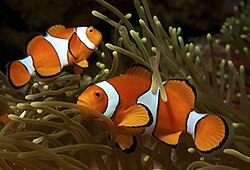
Around 385 species are classified in this family, in about 31 genera. Of these, members of two genera, Amphiprion and Premnas, are commonly called clownfish or anemonefish, while members of other genera (e.g., Pomacentrus) are commonly called damselfish.
The members of this family were traditionally classified in four subfamilies: Amphiprioninae, Chrominae, Lepidozyginae, and Pomacentrinae., although more recent phylogenetic analyses instead support the four subfamilies Chrominae, Glyphisodontinae, Microspathodontinae, and Pomacentrinae, with the clownfishes nested within the latter subfamily.
The earliest known fossil damselfish is †Chaychanus from the Early Paleocene of Chiapas, Mexico.
Etymology
The name of the family is derived from the Greek words; poma roughly translates to the English "cover", referring to the fishes' opercula, and kentron is Greek for sting. The name refers to the serrations found along the margins of the opercular bones in many members of this family.
Distribution and habitat

Pomacentrids are found primarily in tropical seas, with a few species occurring in subtropical waters (e.g., Hypsypops rubicundus). Most species are found on or near coral reefs in the Indo-West Pacific (from East Africa to Polynesia). The area from the Philippines to Australia hosts the greatest concentration of species. The remaining species are found in the Atlantic or eastern Pacific.[citation needed] Some species are native to freshwater or brackish estuarine environments.
Most members of the family live in shallow water, from 2 to 15 m (6 ft 7 in to 49 ft 3 in) in depth, although some species (e.g., Chromis abyssus) are found below 100 m (330 ft). Most species are specialists, living in specific parts of the reef, such as sandy lagoons, steep reef slopes, or areas exposed to strong wave action. In general, the coral is used as shelter, and many species can only survive in its presence.
Algae farming
The bottom-dwelling species are territorial, occupying and defending a portion of the reef, often centered on shelter. By keeping away other species of fish, some pomacentrids encourage the growth of thick mats of algae within their territories, leading to the common name farmerfish.
Characteristics

Most pomacentrids are relatively small. The tribe Microspathodontini includes the largest species and are collectively known as giant damselfishes, with the four largest species (Hypsypops rubicundus, Microspathodon bairdii, M. dorsalis and Nexilosus latifrons) reaching 30 cm (12 in) in length.
Pomacentrids have an orbiculate to elongated body shape, which is often laterally compressed. They have interrupted or incomplete lateral lines and they usually have a single nostril on each side (some species of Chromis and Dascyllus have two on each side). They have small- to medium-sized ctenoid scales. They have one or two rows of teeth, which may be conical or spatulate.
They display a wide range of colors, predominantly bright shades of yellow, red, orange, and blue, although some are a relatively drab brown, black, or grey. The young are often a different, brighter color than adults.
Pomacentrids are omnivorous or herbivorous, feeding on algae, plankton, and small bottom-dwelling crustaceans, depending on their precise habitats. Only a small number of genera, such as Cheiloprion, eat the coral where they live.
They also engage in symbiotic relationship with cleaner gobies of genus Elacatinus, allowing the gobies to feed on ectoparasites on their bodies. Clownfish also have mutualistic relationships with anemones. The anemone protects the clownfish while the clownfish rids parasites.
Lifecycle
Before breeding, the males clear an area of algae and invertebrates to create a nest. They engage in ritualised courtship displays, which may consist of rapid bursts of motion, chasing or nipping females, stationary hovering, or wide extension of their fins. After being attracted to the site, the female lays a string of sticky eggs that attach to the substrate. The male swims behind the female as she lays the eggs, and fertilises them externally. Varying by species, brood sizes range from 50 to 1000 eggs.
The male guards the nest for the two to seven days needed for the eggs to hatch. The transparent larvae are 2 to 4 mm (0.079 to 0.157 in) long. They go through a pelagic stage, which depending on the species, can last as little as a week or more than a month. When they arrive at a suitable environment, the young settle and adopt their juvenile colors.
In captivity, pomacentrids live up to 18 years, but they probably do not live longer than 10 to 12 years in the wild.
Genera
The 5th edition of Fishes of the World recognises 31 genera in three subfamilies in the family Pomacentridae:
† means extinct
- Subfamily Chrominae Allen, 1975 Acanthochromis Gill, 1863: Altrichthys Allen, 1999 Azurina D.S. Jordan & McGregor, 1898 Chromis Cuvier, 1814 Dascyllus Cuvier, 1829
- Subfamily Lepidozyginae Allen, 1975 Lepidozygus Günther, 1862
- Subfamily Pomacentrinae Bonaparte, 1831 Abudefduf Fabricius, 1775 Amblyglyphidodon Bleeker, 1877 Amblypomacentrus Bleeker, 1877 Amphiprion Bloch & Schneider, 1801 Cheiloprion M.C.W. Weber, 1913 Chrysiptera Swainson, 1839 Dischistodus Gill, 1863 Hemiglyphidodon Bleeker, 1877 Hypsypops Gill, 1861 Mecaenichthys Whitley, 1929 Microspathodon Günther, 1862 Neoglyphidodon Allen, 1991 Neopomacentrus Allen, 1975 Nexilosus Heller & Snodgrass, 1903 Parma Günther, 1862 Plectroglyphidodon Fowler & Ball, 1824 Pomacentrus Lacépède, 1802 Pomachromis Allen & Randall, 1974 Premnas Cuvier, 1816 Pristotis Rüppell, 1838 Similiparma Hemsley, 1986 Stegastes Jenyns, 1840 Teixeirichthys J. L. B. Smith, 1953
- †Palaeopomacentrus Bellwood & Sorbini, 1996
Other authorities recognise 4 subfamilies and classify the family as follows:
- Subfamily Chrominae Azurina Chromis Dascyllus Pycnochromis Fowler, 1941
- Subfamily Glyphisodontinae Abudefduf
- Subfamily Microspathodontinae Lepidozygus Mecaenichthys Parma Plectroglyphidodon Stegastes Tribe Microspathodontini Hypsypops Microspathodon Nexilosus Similiparma
- Subfamily Pomacentrinae Tribe Amphiprionini Amphiprion Premnas Tribe Cheiloprionini Cheiloprion Chrysiptera Dischistodus Pomachromis Tribe Hemiglyphidodontini Acanthochromis Altrichthys Amblyglyphidodon Hemiglyphidodon Neoglyphidodon Tribe Pomacentrini Amblypomacentrus Neopomacentrus Pomacentrus Pristotis Teixeirichthys
- †Palaeopomacentrus
- Abudefduf sexfasciatus
- Acanthochromis polyacanthus
- Amblyglyphidodon curacao
- Chromis viridis
- Chrysiptera hemicyanea
- Dascyllus trimaculatus
- Hypsypops rubicundus
- Microspathodon chrysurus
- Neoglyphidodon melas
- Parma kermadecensis
- Plectroglyphidodon johnstonianus
- Pomacentrus caeruleus
- Premnas biaculeatus
- Stegastes nigricans
External links
- Froese, Rainer; Pauly, Daniel (eds.). . FishBase. January 2007 version.
- Smith, J.L.B. 1960. Department of Ichthyology, Rhodes University, Grahamstown, South Africa.