Gurjars in Punjab
In-game article clicks load inline without leaving the challenge.
Gurjars in Punjab or Punjabi Gujjars, are a community native to the larger region of Punjab now divided into Punjab, Pakistan and Punjab, India. They are descended from Gurjars who moved into this region during medieval times. They are scattered across almost all districts of Pakistani and Indian Punjab; They are densely populated in Rawalpindi, Sialkot, Lahore, Gujranwala, Gujrat, Jhelum, Faislabad, Bhakkar, Attock, Murree, Sargodha, Sahiwal, Dera Ghazi Khan, Mianwali, Multan, Okara, Hoshiarpure, Pathankot, Ludhiana, Rupnagar (Ropar), Nawanshahr, Amritsar, Firozpur, Jalandhar, Patiala, Kapurthala, Faridkot, and Malerkotla districts, while Barnala and Rajanpur have the smallest Gujjar population. They adopted Islam in the medieval period, mostly through the influence of Sufism, from the 11th century to the 16th century. Now in Punjab the majority of Gurjars are Muslims, with Hindu and Sikh Gurjars as minority ethnoreligious groups.
They accounted among the largest ethnic group in Pakistani Punjab, and in 1961 census of India, they were the 8th largest ethnic group in Indian Punjab. Gurjars make up majority in the western parts (West Punjab) and Jats make up majority in the eastern part (East Punjab) of the Punjab region.
In historical era they ruled and gave names to several places in Punjab region: these places include Gujrat, Gujranwala, Gujar Khan, and Gojra.
In Indian Punjab, Muslim Gurjars live in isolation and have not maintained marital relationships with Sikh and Hindu Gurjars, whereas Sikh and Hindu Gurjars often have marital ties with each other.
Gurjar is a major landholding and agricultural ethnic group of the Punjab region along with Arain, Rajput, Jat, and other Punjabi communities.
According to the 1931 census of British India, which was the last census to systematically count caste, the Gurjar population in the Punjab region was 6,96,442. Breaking down the population by religion, Muslim Gurjars made up about 75% (5,21,347), Hindu Gurjars accounted for around 24.5% (1,70,439), and Sikh Gurjars totalled about 0.5% (4,446).
In Punjab, they are part of the larger Punjabi community, holding a similar social standing to Rajputs, Jats, and other Punjabi communities, with no inherent hierarchy placing one above the others.
Etymology and origin
Etymology
The word Gurjar is derived from two Sanskrit words: Gur (meaning enemy) and Jar (meaning destroyer). The phrase's literal meaning is "enemy destroyer".
Origin
Historian Upendra Thakur has stated that the Gurjars of the Punjab region ethnically belong to the Aryan race.
According to historian Ahmad Hasan Dani, Gurjars came to Pakistan and Punjab along with Huns (Hunas) from Central Asia, and some ruling families of Gurjars used to call themselves as Kushan-Gurjars during their rule. He also notes that Gurjars' culture in Pakistan reflects the historical connection between Pakistan and Central Asia, shaped by migrations like those of the Kushans and Huns.
Some historians believe the term 'Gujjar' is linked to word 'Gusar' mentioned in the coins of the Kushan kings, and Kalputra, meaning an individual born into a respected or noble family. The Kushan clan of Gujjars found in Pakistan and India is also linked to this historical context.
Historian Richard V. Weekes, said that, Gurjars made their homes in Punjab, Kashmir, and parts of northwestern India. Places likes Gujranwala and Gujarat, now located in Punjab, Pakistan, still carry names that reflect the Gurjars's early presence in these regions, serving as evidence of their historical settlements.
History
According to legends original name of the Gujrat was Udanagari. The old town of Udanagari was built in 7th century by a Gurjar king named Ali Khan or Ala Khana, ruler of the Taank kingdom in the Central Punjab region of present-day Punjab, Pakistan. Between 863- 901 AD, Shanker Verman (ruler of Lohara dynasty) attacked the Taank kingdom and destroyed the old town of Gujrat. The city was again ravaged in 1303 AD, a year known for the Mangol Invasion under the rule of sultan Alauddin Khilji.
Some accounts suggest that the town of Gujrat was rebuilt by Gurjar rulers during the reign of Mughal emperor Akbar in the 16th century.
Scholar David H. Turner notes that around 100 B.C, Gurjar tribes formed the "Gujara Kingdom" in north India, blending in with the local Indian cultures. Over time, the kingdom weakened and eventually broke apart in the 14th century due to invasions by Mahmud of Ghazni, Mughals and Afghans. As a result, the Gurjars migrated to areas like Jammu, forest areas of Punjab, and the Himaylayas foothills in Himachal Pradesh.
Dynasties/states
Taank kingdom

Punjab region was a battleground for many notable dynasties in the 9th century. The Gurjar-Pratihars of Kanauj, Gurjar king Ala-Khana of Taank Kingdom, Laliya Shahi (Hindu Shahis), Utpala dynasty, and the Turk Shahis we're all fighting for the control of Punjab. In the 9th century, Ala-khana or Alkhana was a Gurjar king of Taank Kingdom in the Gandhara region, in present-day Central Punjab, Pakistan. His territory was known as Takadesa (Takka territory). He teamed up with Hindu Shahid to fight against Arabs, but they couldn't stop the Kashmiri ruler of Utpala dynasty (Harsha) Shankar Varman from taking over Takadesa. Shankar Varman wanted to conquer Takadesa, so he defeated Alkhana Gurjar and took Takka territory. The area is also mentioned as Takadesa or Takkavisya in Kalhana's Rajtarangani.
Historian Sukhvir Singh Gahlot, notes that In the 9th century, north India was under the control of Gurjar rulers. He states that a king named Alakhana from the Gurjar community ruled over much of the Punjab, Pakistan, specially from Takkada (Takadesa) near the Indus River.
Alkhana, the Gurjar ruler of the Taank kingdom, is mentioned in the kalhana's Rajatarangani as follows:
He dug up in battle the fortune of Alakhana, the king of the Gurjaras, which was firmly rooted, in an instant and planted prolonged misery. 149 By ceding to him with humility the territory of Takka, the ruler of the Gurjaras, like one’s own body at the cost of the finger, saved his realm. 150
— Ranjit Sitaram Pandit, Rajatarangini: The Saga of the Kings of Kásmīr
Nawabs of Gujrat
During the 1857 unrest, Sultan Ali, a Gujjar leader of the Kalas clan in Ajnala, Gujrat, kept his area safe from looters. The British government rewarded him with land and the title of Safed Posh for his bravery. His son, Fazal-e-Ali, continued doing good work by building schools, hospitals, and banks. People loved and respected him so much that the British government gave him the title of Nawab. He was popularly known as Sir Syed of the Punjab region. Nawab Fazal Ali had two sons Nawab Mehdi Ali and Nawab Asghar Ali. Nawab Mehdi Ali died in 1958. Nawab Asghar Ali held several positions, including chairman of the District Board and Central Co-operative Bank. He also contributes to education by developing Zamindara High school into a degree college.
Chiefs of Jhelum
In the 17th century in Punjab, Gurjars cleared the Chahal forest areas and established some settlements. Two Gurjar brothers of Poswal clan names Akbar and Shakar, arrived in Gujrat from the Jhelum area and founded two villages, Akbarpur and Shakarpur. Queen Sada Kaur wife of Gurbaksh Singh Kanhaiya merged these villages naming combined area "Kala", a term used in early Punjabi language to describe a large settlement. In Later years, Suleman Poswal, a Gurjar from the same family, established his power in the areas of "Kala" in present-day Gujrat and Jhelum cities. Suleman Poswal had seven sons: Jalal, Jamal, Handhal, Mubarak, Essa, Musa, and Habib.
According to scholar Mehakraj, Suleman Poswal Gurjar was a brave ruler of the Kala Gujran area, and he fought against the Gakhars of Jhelum and Janjuas for a long period. He ruled Kala Gujran, and areas near the Rohtas Fort were also under his control. It's said that when Ahmad Shah Abdali came to Punjab, one of Suleman Poswal 's elders, Abdul Rahim Poswal and Raja Himat Khan Gakhar attended Abdali's court. He was by their influence in their areas and he appointed Abdul Rahim and Himat Khan as his servants, assigning them some duties in Punjab.
Nawab of Dera Ghazi Khan
In the 18th century, Mahmud Khan Gujjar (or Mehmood) served as the de facto ruler and governor of the Dera Ghazi Khan from around 1738 to 1772. He was the son of Yusuf Khan. Previously he served as a grand wazir under Mirranis. He teamed up with the Durranis to overthrow Mirranis and then initiated a project to build and restore canals in D.G Khan. Punjab Government Gazetteer credit him with founding the settlement of Mahmud Kot and initiating canal works in the region.
Mughal period
It is believed that Gurjars in the Sutlej, Beas, and Kandi regions of Indian Punjab came from Delhi during the Mughal rule in India, when Delhi was part of the Punjab region.
In 1519, Babar Mughal, during his Punjab campaign, captured Bhera and the next year (1520) he invaded again, taking control of the territory up to Sialkot. He also forced the Gakhars and Gurjars to submission.
According to some historical accounts, when first Mughal emperor Babur invaded India in 1525, he found that the Gurjars of Punjab, especially in the northern parts, had already embraced Islam religion. The conversion of Gurjars to Islam in Punjab region continued until the 1700s, during the reign of the Mughal emperor Aurangzeb, suggesting a prolonged period of religious transitions in the region.
Babur's own account in the Babarnama of 1525, highlights the challenges he faced in Punjab. He noted that the Gurjars and Jats continued to resist even after he captured Sialkot district, targeting people affiliated with his camp. According to Babur, these groups would attack and loot travelers including the vulnerable, as they moved towards his camp. He wrote:
"The Jats and Gujjars come in huge numbers from the hills and plains to steal cattle. They attacked poor people leaving Sialkot for our camp and took everything they had."
— Babur,
In 1526, Babur arrived in Lahore and then headed towards Delhi in Punjab region. Although he faced significant challenges, including Ibrahim Khan Lodi's large army of 1,000 elephant and 100,000 soldiers, Babur's focus remained on reaching Delhi. Meanwhile, he received news of Uzbek attacks on Kabul and other rebellions in his Afghan territories. Additionally, his army was constantly harassed by "Gurjars of the Punjab" region. Babur prioritized his Delhi campaign, deciding not to Get sidetracked these problems right away, since he knew it would ruin his whole plan.
A Mughal-era historian, Abul Fazl, writes that Gurjars lived along the route through Sialkot (now Sialkot district of Punjab, Pakistan). Records from that era also show people in Bhimber and Sialkot districts complained about the Gurjars in these areas.
Conflict with Sikh gurus

In the 17th and 18th centuries, the Muslim Gurjars of eastern Punjab, along with the Ranghar Rajputs, were involved in a major conflict with the Sikh Gurus. They formed alliances with the hill chiefs of the Hill States in northern Punjab and the Mughal army. The Gurjars were led by a prominent leader named Azmatullah in this conflict. During the emergences of Sikhism in the Punjab region, there were Muslim Gurjars and Ranghars who often clashed with Sikh nobles. In the 17th century Ajmer Chand, the ruler of the Bilaspur state, got Gurjars and Rangars to join his army to fight against the Sikhs. These groups were Muslim by faith and loved in villages near present-day Anandpur Sahib in Punjab, India in his territory. They were organized into various clans, each with a leader, and had a history of causing trouble and robbing Sikhs traveling to Anandpur area. Ajmer Chand likely appealed to their communal feelings and tendency to cause trouble to get them to work together again the Sikhs.
Thereafter, the Mughal troops returned to Sirhind with unsure satisfaction of achieving although at a great cost, the limited objective of expelling the Khalsa from the territory of Ajmer Chand on the Eastern side of the River Sutlej. The Hill Rajas also withdrew to their respective states. Once Guru Gobind Singh and his family put up at the residence of the Raja while beautiful canopies were pitched in the suburb of the town for accommodating the Khalsa soldiers. The Guru stayed at Basoli for some days, resting and enjoying hunting and other sports. Soon, the Guru took initiative against Ajmer Chand leading incursions into his territory on the North of River Sutlej. He reached towards Anandpur. Later Guru Gobind Singh and his family stayed at the Raja's place, while fancy tents were set up outside the town for the Khalsa soldiers. The Gobind hung out in Basoli for a bit, chilling and doing some hunting and stuff. Before long, he started raiding Ajmer Chand's territory north of the Sutlej River.
Something else happened in Bajraur village of Anandpur that's important to Sikh history. Some Gurjars and Ranghars from Bajraur attacked a group of Sikhs heading to Anandpur Sahib in 1701, stealing all their stuff. The Sikhs with nothing and told Guru Gobind Singh what happened. Gobind Singh slowly made his way to Anandpur. At that time Gurjars and Ranghars from Kamlot village attacked the village. Jiwan Singh a notable Sikh general, died in the fight. Since Wazir Khan had left for Sirhind, Amjeer Chand thought he'd gotten rid of the Guru, But Gobind Singh returned to Anandpur, succeed in repairing damage, and restored the Anandpur's status as the headquarter of the Khalsa. The Hill chiefs had to retreat, but the hill chiefs were still dead set on kicking the Guru out. They got ready for war, roped in the Gurjars and Rangars, and asked the Mughals for help. The Mughals had been keeping and eye on the Sikhs and they directly got involved in the war.
Contributions for Punjabi literature
Gurjar personalities of Muslim Punjabi identity play an important role in the development of Punjabi literature.
Afarin Lahori (full name Faqirullah Afarin Lahori) was a 17th century Punjabi poet from Lahore, born around 1660 and died in 1741. He's famous for his poem "Nāz - o - niaz or Hir-o-ranjha Ranjha, which tells the story of Heer and Ranjha. He mostly wrote in Punjabi and one book in Persian. He is respected in Punjab, Azad Kashmir and Hazara for his work for his contributions for Punjabi literature. He was born 1660 in Lahore, Punjab during the Mughal Empire, into the Juiya clan of Punjabi Muslim Gurjar family.
Ahmad Shah Gujjar was a 17th century Punjabi poet. He's known writing a version of the Heer Ranjha story offering a unique twist on the tale. "Here Ahonad", was popular among later Muslim poets, including Waris Shah, who wrote his famous version about 30 years later. Ahmad Gujjar was the first Muslim writer to create a poetic version of this story. He was born in a Punjabi speaking Gurjar family in 1617 AD.

Ghulam Rasool Alampuri was a 19th century Punjabi poet. He was born on January 29, 1849 and passed away on 7 March 1892. He's known for his notable works like "Dastan-i Amir Hamza" and Ahsan al-qasas", which showcase his spiritual and literary contributions in Punjabi. He was born in Alampur village in Hoshiarpur district of Punjab, India in a Punjabi speaking family of Muslim Gurjars.

Mian Muhammad Bakhsh was a 19th-century Punjabi Gujjar Sufi poet from Khari Sharif, Azad Kashmir. He wrote total 18 books, including Saif-ul-Maluk and Mirza Sahiban, mostly in Punjabi, with one Book in Persian. He was born around 1830 in Khari Sharif, a place in what is now Azad Kashmir, Pakistan. He belonged to a Punjabi Muslim Gurjar family of the Poswal clan, originally from Gujrat district of Punjab, Pakistan.
British period
According to William Crooke, Gujjars are an important agricultural and pastoral tribe. They are found in many areas including: Gujjar Khan, Gujrat and Gujranwala, which are named after Gujjar ethnic community. They are also found in areas like Rawalpindi and Jalandhar where they mainly work as farmers.
Several British-colonial era writers praise the Gujjars for their farming skills and good behavior. David Thomson says the Gujjars in Jhelum District are skilled farmers. Carolyn Stedman describes the Gujjars in Rawalpindi district as excellent as cultivating. In Hoshiarpur district of Punjab, India Gujjars are known for being peaceful and well-behaved.
In 1857, Gurjars took arms against the Britishers in Punjab and the United province; the chaos gave locals a chance to loot business areas. The British government's presence vanished instantly. Apparently, the Muslim Gurjars and Ranghars put the Muslim green flags, and all sorts of troublemakers gathered around them.
In 1900, the British administrators in Punjab region introduced the "Punjab Alienation of Land Act", labeling certain groups as agricultural communities. This act created 'statutory casteism' by designating specific castes as castes as 'zamindar or agricultural tribes', effectively making Zamindar' synonymous with members of these agricultural castes. The goal was to protect Punjab's peasantry, who were heavily indebted and losing land to moneylenders, mainly from non-cultivating trading classes. This was crucial since these peasants were key recruits for the British army and their instability could threaten British Raj. In the region of Punjab, the agricultural communities were identified as Gurjar, Rajput, Jat, Sayed, Moghal, Ahir and some other communities of Punjab. In later years, Taga, Arain, Ahir, Saini, Chauhan, Gaud Brahman, and Qureshi were also included, distinguishing them from non-agriculturist groups like Brahman, Khatris, Banians, and Scheduled Caste groups.

Lieutenant-colonel J.M. Wikeley, a recruiting officer for Punjabi Muslims, In 1915, wrote a handbook on the 'martial race' of Punjabi Muslims. He said term "Punjabi Musalman" refers to Muslim communities in a specific area of Punjab and West Frontier Province, bounded by the Indus and Sutlej rivers, and south of the Himaylayas. This region includes Hazara district, Rawalpindi district, and parts of Jammu and Poonch in Kashmir. It's a label used for British military recruitment, not an ethnic classification. These communities can be grouped into total four classes: Rajput, Jat, Gurjars , and other foreign tribes.
Lieutenant Colonel McMunn describes Gurjars, Jats, and Ahirs as distinct Hindu communities found in south-east Punjab, nearby Rajasthan, and western United Provinces (UP). He notes that Gurjars tend to be sturdy and are swarthier than Jats and Ahirs.
In the 1920s the Shuddhi movement by Arya Samaj in the Punjab region focused on purifying higher-caste converts like Muslim Gurjars, Muslim Jats, and Muslim Rajputs, aiming to reintegrate them into their original Hindu community. Many of these converts still practiced Hindu traditions, making reintegration seems feasible. However, despite purification rituals, they faced rejection from their original Hindu caste biradari, leading to humiliation. This rejection contributed to the movements failure and hundred attitudes among converted communities, pushing some back to Islam religion.
In the British colonial era, the Gujjar community was divided into various clans that played an important role in their social organization. British administrator Denzil Ibbetson, in his work "Castes of Punjab", notes a total of nineteen notable clans of Gujjars in British Punjab. These clans include: Tanwar, Chokhar, Rawal, Kalsian, Khatana, Kasana, Kalas, Gorsi, Chechi, Dhodar, Poswal, Lawi, Bijar, Khaindar, Melu, Thakaria, Chauhan, Monana, and Bhumls. According to Horace Arthur Rose, Chechi and Kasana were the major clans of Gujjars in the region of British Punjab.

In 1930s, Choudhry Rahmat Ali, a Punjabi Gurjar was a key figure in the independence movement of Pakistan, he credited with coining the term "Pakistan" for a separate Muslim country in British India. He was born in Balachaur, Hoshiarpure district, Punjab, he pursued education in Lahore before moving to the Cambridge university. In 1933 he published a influential pamphlet title "Now or Never; Are we to Live or Perish Forever?", referred to as the "Pakistan Declaration ". This pamphlet was aimed at British and Indian delegates attending the Third Round Table Conference in London. Initially, his ideas failed to gain traction with politicians and delegates, taking nearly a decade to gain recognition.
Demographics
Punjab, Pakistan

In Pakistani Punjab Gurjars scattered across almost all ten divisions including Rawalpindi, Lahore, Gujranwala, Gujrat, Multan, Dera Ghazi Khan, Sargodha, Bahawalpur, Faisalabad, and Sahiwal.

Gurjars make a majority population or significant population in Jhelum, Chakwal, Attock, Khanewal Sialkot, Narowal, Mandi Bahauddin, Gujrat and Gujranwala districts of Punjab, Pakistan.
Historical population
Population of Gujjars recorded in different census reports of the British India for present-day Punjab, Pakistan.
| Year | Pop. | ±% p.a. |
|---|---|---|
| 1911 | 201,995 | — |
| 1921 | 208,078 | +0.30% |
| 1931 | 227,015 | +0.87% |
| source: 1911 census - 1921 census - 1931 census |
Punjab, India

In Indian Punjab Gurjars scattered across almost all five divisions including: Jalandhar, Patiala, Firozepur, Faridkot, and Ropar (Rupnagar). The permanent settlements of Hindu and Muslim Gurjars' are located in the Beas, Kandi, and Shivalik hills regions of Punjab.
Gurjars population is distributed across various districts, with Muslim Gurjars being predominantly found in Hoshiarpure, Jalandhar, Firozepur, Pathankot, Gurdaspur, and Jalandhar districts. In contrast, Hindu Gurjars are mainly concentrated in Ropar, Hoshiarpure and Nawanshahr districts, whereas Sikh Gurjars are primarily located in Jalandhar and Ludhiana districts.
Historical population
Population of Gujjars recorded in different census reports of Indian Punjab.
| Year | Pop. | ±% p.a. |
|---|---|---|
| 1911 | 183,144 | — |
| 1921 | 202,402 | +1.00% |
| 1931 | 230,474 | +1.31% |
| 1951 | 291,601 | +1.18% |
| source: 1911 census - 1921 census - 1931 census - 1951 census |
In recent decades some tribal Gujjar families migrated from Jammu and Kashmir and Himachal Pradesh to Punjab, now they settled in the areas of Chabbewal, Chamkaur Sahib, Garshankar, Hoshiarpure, Ludhiana, Manchhiwara, Ropar, Nawanshahr, and Pathankot. Now some got settled permanently and obtained voting rights and Adhaar cards. But they weren't able to secure special rights like ST status or forest rights that they had in Himachal Pradesh or Kashmir.
When these Gurjars moved to Punjab plain, they socially were accepted as the part of already existing larger landlord Gurjar community of the area in Punjab, India by the non-Gujar communities.
Social status
Social status of the Gurjars in Punjab, Pakistan is generally equal to all other ethnic groups of the region including, Rajputs and Jats. In Indian Punjab Gurjars of all religious backgrounds are classified as other backward classes (OBC). In 1974, Gurjars in Indian Punjab were given OBC status for a period of 5 years, and then in 1979, this status was made permanent by the Government of Punjab, India.
Demands for ST status
Tribal Gurjars who have migrated in recent decades from Jammu and Kashmir are now settled in the northern areas of Punjab, India. They have demanded Scheduled Tribe status, but the Government of Punjab, India hasn't fulfill their demands yet.
In 2009, the Government of Punjab, India released a survey report based on 12 communities. Report said eight tribes, including Tribal Gurjars and seven others qualify as Scheduled tribes (ST) in Punjab, India.
Clan system
Gurjars have a system of clans called gotras (tribes), which are passed down through the father's line. They believe these clans connect them to a shared ancestor. The gotra (clan) a person belongs to determines who they can marry.
Among Punjabi Gurjars, there are Dhai gots (clans), especially Kushan (Kasana), Gorsi, and Barkat (Bargar). Mostly these gots don't have strict rules against marrying within them a Gurjar person can marry someone from the same clan or from the different clan.
Clans
- Bajar (Bajjar)
- Bhumla (Bhoomla)
- Chechi
- Meelu
- Awana (Awan)
- Kushan (Kasana)
- Bhargar
- Bhatia
- Bhadana
- Baharwal
- Chaprana
- Chhabri
- Doi
- Khatana
- Miana
- Karhana
- Sardhana
- Chockar
- Gorsi
- Lodha
- Rawal
District wise
District wise population of some notable Gurjar clans in undivided region of Punjab.
| District | clan | population | clan | population | clan | population | clan | population | clan | population | clan | population | clan | population |
|---|---|---|---|---|---|---|---|---|---|---|---|---|---|---|
| Ludhiana | Khatana | 749 | Kushan | 695 | Kalas | 1,175 | Gorsi | 3,462 | Cherhi | 3,285 | Chockar | 0 | Rawal | 0 |
| Jalandhar | Khatana | 546 | Kushan | 388 | Kalas | 565 | Gorsi | 1,457 | Chechi | 1,152 | Chockar | 0 | Rawal | 0 |
| Amritsar | Khatana | 153 | Kushan | 134 | Kalas | 0 | Gorsi | 180 | Chechi | 645 | Chockar | 0 | Rawal | 0 |
| Gurdaspur | Tanwar | 1,140 | Chockar | 336 | Khatana | 2,750 | Kushan | 1,133 | Kalas | 0 | Gorsi | 17,72 | Chechi | 4,010 |
| Lahore | Chockar | 1 | Rawal | 13 | Khatana | 445 | Kushan | 82 | Kalas | 0 | Gorsi | 290 | Chechi | 1,020 |
| Rawalpindi | Chockar | 280 | Rawal | 0 | Khatana | 5,646 | Kushan | 612 | Kalas | 1,318 | Gorsi | 1,232 | Chechi | 3,207 |
| Jhelum | Chockar | 20 | Rawal | 0 | Khatana | 3,684 | Kushan | 882 | Kalas | 1,260 | Gorsi | 309 | Chechi | 1,621 |
| Sialkot | Chockar | 3 | Rawal | 10 | Khatana | 1,020 | Kushan | 349 | Kalas | 0 | Gorsi | 277 | Chechi | 692 |
| Gujranwala | Chockar | 0 | Rawal | 17 | Khatana | 125 | Kushan | 25 | Kalas | 60 | Gorsi | 38 | Chechi | 205 |
| Firozepur | Chockar | 0 | Rawal | 0 | Khatana | 1,138 | Kushan | 312 | Kalas | 166 | Gorsi | 870 | Chechi | 779 |
| Gujrat | Chockar | 269 | Rawal | 0 | Khatana | 21,449 | Kushan | 3,048 | Kalas | 3,560 | Gorsi | 3,312 | Chechi | 8,092 |
Religion
In east Punjab they're divided into three Ethnoreligious groups: Muslim Gurjars, Hindu Gurjars and Hindu Gurjars. Muslim Gurjars are spread throughout the Punjab, Pakistan and can also be found in the Kandi, Majha, Doaba and Malwa regions of Punjab, India. Hindu and Sikh Gurjars found in southern and eastern parts of Punjab, India. Prior to the partition of Punjab, the Gurjars in the region practiced Islam, followed by Hinduism and Sikhism. Muslim Gurjars were predominantly located in western Punjab (present-day Punjab, Pakistan) and northern and western parts of present-day Punjab, India. The Hindu Gurjars were mainly found in the southeastern parts of Indian Punjab, and Sikh Gurjars were concentrated in Jalandhar and Ludhiana districts.
In Indian Punjab, some Hindu Gurjars also practice the tradition of ancestor worship. Every Gurjar clan have its own separate place of worship for ancestors.
Conversion
It is believed initially Gurjars of Punjab were Hindus. Later, they first embraced Islam between the 11th to 16th centuries, and then a small part of their community also embraced Sikhism in the 17th century.
Sir John Malcolm noted that the Jats, who largely made up the Sikh community, and the Gujars were among the primary groups that initially adopted Sikhism in the 17th century in Punjab. B.S Nijjar, noted that some Gurjars in certain areas of Hoshiarpure, Rupnagar, Nawanshahr districts in East Punjab became Sikh during and after Guru Gobind Singh's time in the 17th century, though they were relatively few in number.
In Punjab, they converted to Islam on different occasions, but most of their population converted to Islam in the 16th century. Hindu Gujjars of the Lahore district in present-day Punjab, Pakistan embraced Islam in the hands of Muslim saint Hazrat Data-Ali al-Hujwiri in the 11th century.
The Gurjars of the Gurdaspur and Jalandhar districts in Punjab, India embraced Islam during the rule of Mughal emperor Aurangzeb in the 17th century in Indian subcontinent.
Culture
'Gurjars of Punjab' follow different religious practices. Hindu Gurjars are mainly Shaivism or Shaktism and are very devoted to worshiping Shitala Bhawanj, the goddess of smallpox. They also worship some minor gods including Chamar Pyareji, Baba Mohan Raam and Baba Sabha. Muslim Gurjars follow all Islamic laws and traditions and all of them are mainly Sunni Muslims.
Food

"Gurjars in Punjab", like other Punjabi communities, typically eat a simple diet that includes flatbread (Chhapati) made from wheat or corn, potatoes, very spicy onion curry, and lentils, and they usually don't eat meat. But on special occasions like Eid or other Muslim festivals, Muslim Gurjars eat meat dishes. They mostly drink milk, Lassi, and also eat butter with rotis. Gurjars like their tea sweet, and while they don't drink alcohol, they love Hookah, cigarettes and betel leaf.
Shrine visit
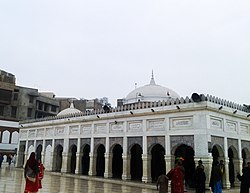
Muslim Gurjars visit shrines of different Muslim saints including the shrine of Rauza Mandhali Sharif, Panj Pir Shrine, Sakhi Sarwar, Sharine of Data Ali Hajveri and the Shrine of Baba Farid. Although Punjabi Gurjars of all faiths in Punjab also visit shrines of Muslim Sufi saints.
Historian Varinder Shastri said, Hindu Gurjars in Punjab region often visit shrines of Muslim saints and they light candles there. Interestingly, Punjabi Sikh Gurjars also visit shrines. It seems that visiting shrines is a common practice among Gurjars of all religious backgrounds.
After death
Muslim Gurjars in Punjab on Thursday evenings (Jume-raat), offer food to their deceased ancestors. When someone dies, their family feeds beggars, hopping the food will reach the desceased in the afterlife.
Marriages
Most marriages among Punjabi Gurjars are based on parental approval, and they mostly prefer arranged marriages. Gurjar marriages usually happen when the kids are between 9 to 16 years old. In Gurjar communities girls aren't allowed to make their own decisions about getting married, and if an unmarried girl does something considered wrong, she's cut off from the community. She might be able to return if her partner is part of the tribe and she provides food for the community.
Marriage practices
Punjabi Gurjars follow different traditional marriage practices. Like other Muslim Gurjars communities Muslim Gurjars of Punjab usually have a nikah ceremony for weddings. Even so, many still follow some of their old customs. For example, when the bride arrives at her new home, her mother-in-law waves a tray (Parachhan/Chhadhar) over her head to keep away bad spirits. The wedding ceremonies are different Hindu Gurjars, but they often include giving away the bride (Kanyadan) and a procession where the couple walks around the wedding area (bhanwari).
Wedding rituals
The Gurjars in Punjab have some unique customs for weddings and births that blend Hindu and Muslim traditions. In Hoshiarpure district of east Punjab, there's a custom called "mudda ji rupaiya" where rich Gurjars give money to musicians (Mirasis) at weddings. They even give double to pregnant women.This makes them super respected, and they're called "gharbhan ka datu". Another custom, "bhaji", is like a long-standing financial connction between families. In the area of Nakodar, they still do some old-school stuff like "Pindwalna", where the groom's crew tries to surround the bride's village, but her peeps try to stop them. And in " Jhalka-bathi", girls won't let the brother-in-law light the wedding fire till he gets them a gift.
In Gurdaspur district Muslim Gurjars they make a cow dung idol when a son is born and have Brahmins bless the dad with sacred grass. They give gifts like clothes or money to the kid's female relatives. At weddings, they groom sits on a basket before getting dressed up, and they don't marry within their own clan (got/qabila). Some groups, like the Bhatia, don't follow this rule anymore. In Gujrat district of west Punjab, Muslim Gurjars follow similar customs with Muslim Jats. On Dhanteras, the mom takes a bath, and a Brahmin makes a Sacred square with a lamp. They. share food like rotis and halwa with clan members, but married daughters don't eat it since they're part of another clan group. At weddings, they do things differently than Hindu Gurjars.
Polygamy and Polyandry
In Punjab, Muslim Gurjars are mostly monogamous, but some also practice polygamy, where a man can have multiple wives. In contrast, Hindu Gurjars have traditionally practiced polyandry where a woman can have multiple husbands. Scholar Krishan Lal says that Hindu Gurjars used to practice polyandry where one woman would marry multiple brothers. This happened likely because of there weren't enough women in the tribe. The reason for this shortage was that people used to kill baby girls, a practice known as female infanticide, which was pretty common before the government made it illegal in 1870.
Cousins marriages
In Punjab, Muslim Gurjars often practice a type of marriage where people marry their cross-cousins, which creates repeating patterns of relationships between groups. With large families, it's not always possible to marry cross-cousins, so they look for more distant relatives or make new connections setting up future cross-cousins marriage.
Gender role
Men role
Men of the Gurjar communities typically spend their time looking after their fields, livestock, preparing food for them, selling dairy products, milk, and buying supplies from the market. The oldest man in the family is usually in charge, and older people are highly respected, getting to enjoy a more relaxed life compared to others. Many men take the lead in making decisions about religion and politics, but in some families, the oldest woman is the one who really calls the shots and has a lot of influence.
Women role
Gurjar women have a big role in their communities, and in traditional stories, they're often portrayed as brave and amazing. Gurjar women are in charge of cooking and cleaning. Often, each sister-in-law has her own cooking area in the hut, with continue to health issues like respiratory problems. While women fetch water, clean up, and cook, men typically relax, smoke, and sing. Women play a big role in family rituals and festivals, and they also pitch in with farm work, caring for animals, and gathering fuel when needed. The younger Gurjar women work really hard - they're up before anyone else and go to bed last. They cook meals, do laundry by hand, wash dishes, collect firewood, get food for the livestock, and do lots of other tasks throughout the day.
Language
The majority of 'Punjabi Gurjars' speak Punjabi as their primary language, with many also speaking additional languages such as Saraiki, Pahari-Pothwari, Hindi and Urdu. In northwestern areas of Punjab, Pakistan, some Gurjars also speak Gujari. In Punjab India certain Gurjar communities who have migrated from Jammu and Kashmir and Himachal Pradesh use Gujari as their mother tongue. Meanwhile, in southern areas of Punjab, Pakistan some Gurjars communicate in the Sarakai dialect of Punjabi.
In the 2011 Indian census, the Gujari-speaking population in Punjab, India was recorded as 7,024, spoken by Muslim Gujjars in the Hoshiarpur, Ludhiana, Amritsar, Gurdaspur, and Pathankot districts.
Ragani
Gujari Ragani or Gujari is a traditional melody associated with the Punjabi Gurjar community, who have a long history in Punjab. According to tradition, Hindu Gurjars were devotees of Lord Krishna. This particular melody is typically sung during morning worship regardless of the season. It's a style that reflects the character of a robust and down-to-earth people known for their straightforwardness and simplicity.
Gujari (raga)
Gujari, Gurjari, or Gujri Raga is a Raag in Indian classical music. It was originated in the Punjab region among the Punjabi Gurjars. It's also believed that the name of the raga is based on the traditional folk music of the tribal Gujars of Punjab region.
Population
In 1951 census of India, the total Gurjar population in Punjab, India was 4,37,706. As per same census, 66.62% of the Gurjars followed Islam, while 33.38% were Hindus. The total Muslim Gujjar population was 2,91,601, (out of Punjab's total population of 91,60,500).
In recent decades, some tribal Gurjars migrated from Jammu and Kashmir and Himachal Pradesh to Punjab, India. Now there are approximately 4,000 Gurjars living in Indian Punjab, mainly belonging to the Bakarwal tribe.
In the northern parts of Pakistani Punjab, particularly in the Pothohar region, a total of 23,00,000 Gurjars reside there.
Education
In East Punjab, most Tribal Gurjars lack basic education. Their kids often don't go to formal school. If they do, they usually don't go regularly. The problem is, school isn't taught in their native language, and it's hard for them to attend because they move around a lot. The teachers are also from different backgrounds and not from the Gurjar community. The few who start school tend to drop out because they aren't interested, their families need them to work, they can't afford things like transport and uniforms, or they get married young.
See also
Notables
Politics
- Fazal Elahi Chaudhry, Pakistani politicians who served as President of Pakistan from (1973-1978)
- Chaudhary Rehmat Ali, founder of Pakistan's independence movement
- Fayyaz ul Hassan Chohan, politicians from Rawalpindi
Literature
- Afarin Lahori, Punjabi poet from Lahore
- Ahmad Shah Gujjar, Punjabi poet
- Mian Muhammad Bakhsh, Punjabi poet from Gujrat
- Ghulam Rasool Alampuri, Punjabi poet from Hoshiarpure
- Sahir Ludhianvi, Urdu poet from Ludhiana
Military
- Sawar Khan, former four-star general of the Pakistan Army and Governor of Punjab from Rawalpindi
- Fazal Din, British army officer in 7th Battalion, 10th Baluch Regiment British army from Hoshiarpure from Hoshiarpure
- Tufail Mohammad, Pakistan military officer from Hoshiarpure
- Kuldip Singh Chandpuri, Indian army officer from Sahiwal
Cricket
Sources
Bibliography
- Singh, Mamta (2016). Gujjar kabile da Sabyachaar [Cultural Aspects of Gurjar tribe] (in Punjabi). Gracious Books, Patiala.
- Sukhadewa Siṅgha, Sekhoṃ (2003). Gujjara kabīle dā loka sāhita: Saṅkalana, khoja te wishaleshaṇa (in Punjabi). Wārisa Shāha Phāuṇḍeshana.
- Bīta de gujjarāṃ dā sabbhiācāra (in Punjabi (Gurmukhi)). Pabalīkeshana Biūro Pañjābī Yūnīwarasiṭī (Publication Bureau Punjabi University, India). 2010.
{{cite book}}: CS1 maint: date and year (link) CS1 maint: unrecognized language (link) - Bharadwaj, A. N. (1994). . Jay Kay Book House.
- Sharma, J. C., (1984). "Gujars". In Muslim Peoples: A World Ethnographic Survey. Vol. 1. edited by Richard V. Weekes. Westport, Conn.: Greenwood Press.
- Singh, Pritam; Thandi, Shinder S. (1996). Globalisation and the region : explorations in Punjabi identity. Coventry, United Kingdom: Association for Punjab Studies (UK).
{{isbn}}: required identifier missing (help): 978-1-874699-05-7. - Sohrdvi, Kamran Azam (2012). [Gujjar tribes] (in Urdu).
- Azam, Kamran (2012). .