Red triangle (Palestinian symbol)
In-game article clicks load inline without leaving the challenge.

During the Gaza war, an inverted red triangle has been used as a symbol of support for Palestine. The symbol originates from combat footage published by Hamas during the war that uses inverted red triangles as arrows to indicate Israel Defense Forces (IDF) targets, such as tanks, shortly before they are attacked or destroyed. The historical significance of the symbol, or whether it holds significance at all, is not entirely clear. The symbol has appeared at protests against the Gaza war and in graffiti in support of Palestine around the world. It has also been used in incidents of vandalism against individuals or establishments. Interpretations of the triangle are varied; it is sometimes seen as a symbol of resistance or instead as one of antisemitism.
Historical connections
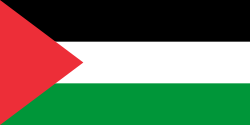
The red triangle has been connected to the flag of Palestine, which features a similar symbol. The red triangle that appears in the flag represents the Hashemite dynasty's role in the Arab Revolt and the blood of those killed in the struggle for Arab and Palestinian liberation. Red is one of the four pan-Arab colors, along with black, white, and green. Some media, including i24NEWS, The Telegraph, and Commentary, have alternatively linked the triangle to Nazi concentration camp badges, where political prisoners were identified with a red triangle.
Use since 2023
Contemporary use of the symbol originates from combat footage published by Al-Qassam Brigades (the military wing of Hamas) during the Gaza war, which began on 7 October 2023, that uses inverted red triangles as arrows to indicate Israel Defense Forces (IDF) targets, such as tanks, shortly before they are attacked or destroyed. In these videos, the destruction of military targets denoted by the red triangle is often followed by chants like "God is great" and "Palestine will be free". In the early months of the Gaza war, some social media users connected the shape with other symbols of Palestinian resistance, such as a headscarf or slingshot. Palestinian journalist Ramzy Baroud wrote that its connotation as a symbol of resistance (including its resemblance to the triangle on the Palestinian flag) may have been intentional when it was first created or that the design may have simply been a functional choice by "a young Palestinian tech-savvy fighter".
Since its establishment as a symbol of Palestinian resistance, depictions of the red triangle have appeared at Gaza war protests and been incorporated in graffiti in support of Palestine in countries around the world, including Australia, Bahrain, Canada, Germany, Lebanon, and the United States. It has also appeared as graffiti in Hebron in the West Bank. In December 2025, it was displayed on a banner in Palestine Square, Tehran, Iran, alongside an image of former Hamas spokesperson Abu Obeida, with the words "Juden-Nazis spill blood, the fire grows, and the phoenix returns" in Hebrew and Persian. The Cyber Isnaad Front, an anti-Israel hacker group identified as possibly Iranian-backed by the Foundation for Defense of Democracies, uses a modified version of the triangle when posting about its alleged victims.

The symbol has sometimes been used to target private individuals or establishments. In the summer of 2024, in New York, United States, it was spray-painted on the residences of board members of the Brooklyn Museum, as well as that of its director Anne Pasternak; and that of Columbia University's chief operating officer, Cas Holloway. Messages left by the vandals at the residences of Pasternak and Holloway specifically targeted them for allegedly being a "white supremacist Zionist" and contributing to the suppression of protests at Columbia University, respectively. Pasternak is Jewish, and several New York political figures described the incidents as antisemitic. Also that summer, the triangle was spray-painted on the Pittsburgh synagogue Chabad of Squirrel Hill, near the Tree of Life – Or L'Simcha Congregation where a white supremacist attack took place in 2018. In October of that year, on Yom Kippur, a Jewish-owned bakery in Surry Hills, Sydney, Australia, was spray-painted with a red triangle and the word "Beware". A note reading "Be careful" was slid under the door. In January 2026, Andreas Büttner, a commissioner against antisemitism in the state of Brandenburg, Germany, was the target of an arson attack, whose perpetrators also spray-painted the symbol. This represented the second attack against Büttner in 16 months — his car had previously been vandalized with swastikas.
In 2024, some social media users accused French politician Manuel Bompard of supporting Hamas after he appeared in a televised debate wearing an inverted red triangle pin. An investigation by France 24 instead connected the symbol to the Nazi concentration camp badge for political dissidents, the significance of which is explained by Bompard's party, La France Insoumise, on their website. Furthermore, an image was found of Bompard wearing a similar pin before the start of the Gaza war. Ravan Jaafar al-Taie, a candidate in the 2025 election for the Wikimedia Foundation Board of Trustees, faced backlash from Israeli scholar of knowledge Shlomit Aharoni Lir for her perceived anti-Israel activity. The Jerusalem Post investigated al-Taie's social media history, which included multiple posts featuring the red triangle.
Use by Israel
Avichay Adraee, then-head of the Arab media division of the IDF Spokesperson's Unit, uploaded a video during the first month of Israel's invasion of the Gaza Strip that used the red triangle to indicate Palestinian targets before their destruction. The video ends with the message in Arabic "Our triangle is stronger than yours, Abu Obeida". This prompted criticism from pro-Palestine social media users. Another video published by Adraee in December 2023 used a blue triangle, along with the Star of David and blue circles. He declared that the IDF would continue to "dismantle Hamas and attack its ISIS members".
Bans
In July 2024, the Senate of Berlin voted to ban the red triangle following an urgent motion filed by the Christian Democratic Union and the Social Democratic Party (SPD). Niklas Schrader, a member of Die Linke, cautioned that banning the symbol could unintentionally lead to the outlawing of other organizations. The Association of Persecutees of the Nazi Regime displays the triangle on their flag accompanied by prisoner stripes, a design that has been seen at pro-Israel demonstrations. The Palestine Chronicle emphasized that while Martin Matz[de] of the SPD justified the decision by stating that Hamas uses the symbol to mark people as targets, he did not specify that all targets shown in the organization's videos are military in nature.
A red triangle emoji (U+1F53B🔻 DOWN-POINTING RED TRIANGLE) has been widely used by supporters of Palestine on social media. In October 2024, it was reported that Meta had decided to begin removing posts that used the symbol in the context of the Israeli–Palestinian conflict, according to internal guidelines obtained by The Intercept. The policy stated that it would only be enforced on posts flagged by the moderation system, which would lead to the deletion of material containing the triangle followed by possible further disciplinary action. Multiple experts interviewed by The Intercept expressed concern that the ban could limit free speech, including by inadvertently blocking the usage of the triangle in contexts other than supporting Hamas. Meta did not respond to requests for comment by journalists.
Symbolism
Ramzy Baroud has described the red triangle as a symbol of resistance and the need for action on a global scale. He likened it to a visual indicator guiding the world's attention to the Palestinian struggle. The website of the Anti-Defamation League states that the symbol is often associated with antisemitism, but not necessarily so. Or Shaked of the Jewish Virtual Library has taken a critical perspective of the symbol, writing that it glorifies violence. Experts interviewed by CBC News for an article about the red triangle acknowledged that symbols can be interpreted in different ways and that their meanings and significance can vary.