Roméo LeBlanc
In-game article clicks load inline without leaving the challenge.
Roméo-Adrien LeBlanc (December 18, 1927 – June 24, 2009) was a Canadian journalist and politician who served as the 25th governor general of Canada from 1995 to 1999.
LeBlanc was born and educated in New Brunswick, and also studied in France prior to becoming a teacher and then a reporter for Radio-Canada. He was elected to the House of Commons in 1972, whereafter he served as a minister of the Crown until 1984, when he was moved to the Senate and became that chamber's Speaker.
In 1995, he was appointed as governor general by Queen Elizabeth II, on the recommendation of Prime Minister of Canada Jean Chrétien, to replace Ramon John Hnatyshyn as viceroy, and he occupied the post until succeeded by Adrienne Clarkson in 1999, citing his health as the reason for his stepping down. His appointment as the Queen's representative caused some controversy, due to perceptions of political favouritism, though he was praised for raising the stature of Acadians and francophones, and for returning Rideau Hall to the centre of life in Ottawa. [citation needed]
On August 8, 1974, LeBlanc was sworn into the Queen's Privy Council for Canada. He died of Alzheimer's disease on June 24, 2009, aged 80.
Early life

LeBlanc was born on December 18, 1927, in Memramcook, New Brunswick, where he was raised, the youngest of seven children of Marie Lucie Claire LeBlanc and Philias LeBlanc. LeBlanc obtained bachelor degrees in arts and education from the Collège St-Joseph before studying French civilization at the Université de Paris. He then moved on to teaching for nine years— at Drummond's high school from 1951 to 1953 and the New Brunswick Teachers' College in Fredericton from 1955 to 1959— after which he obtained work between 1960 and 1967 as a journalist with the Canadian Broadcasting Corporation's French language broadcaster, Radio-Canada, serving in the bureaus in Ottawa, the United Kingdom, and the United States.
His first marriage, to Joslyn "Lyn" Carter, with whom LeBlanc had two children (Genevieve and Dominic), lasted from 1966 to 1981; in 1994, he married Diana Fowler, who also had two children from a previous marriage.
Early political career
LeBlanc stepped into the realm of politics when he became the press secretary for successive prime ministers Lester B. Pearson and Pierre Trudeau. He then went further, winning in the 1972 federal election a seat in the House of Commons as the Liberal Party representative for Westmorland-Kent, paving the way for his appointment as the Minister of Fisheries and Oceans in the Cabinet chaired by Trudeau.
LeBlanc was a key figure in Canada's imposition of a 200-mile fishing zone; the establishment of a new fisheries licensing system; the widespread use of quotas and zones that protected Canadian fishermen from overexpansion and competition from trawlers owned by large companies; the owner-operator rule, requiring licence holders to operate vessels themselves; the separate-fleet rule, preventing corporations from obtaining licences for an under-65-foot fleet; and for creating an additional system of advisory committees that permitted fishermen a larger voice in fisheries management.
On one occasion, LeBlanc also persuaded Trudeau to advise the Governor General to close Canadian ports to Soviet fishing vessels, a headline-grabbing diplomatic thrust that resulted in better co-operation, and forbade all foreign corporations from holding commercial fishing licences in Canada.
On the Pacific coast, LeBlanc oversaw the creation of the Salmonid Enhancement Program, which aimed at doubling salmon production, and quelled plans by Alcan that were deemed to threaten salmon rivers at the time.
Late in 1982, LeBlanc became Minister of Public Works for two years before being nominated by Trudeau to then Governor General Jeanne Sauvé for appointment to the Senate on June 29, 1984. He was then selected in 1993 by Prime Minister Jean Chrétien as Governor General Ray Hnatyshyn's appointee as that chamber's speaker.
Governor General of Canada
LeBlanc's time as the Queen's viceregal representative was considered to have been low key and largely uneventful, especially in comparison to that of his successor, Adrienne Clarkson. He was, however, the first governor general of Acadian heritage, which earned praise from the Acadian community, and he was also the first from the Canadian Maritimes to be appointed as viceroy.
As governor general-designate
It was announced from the Office of the Prime Minister of Canada on November 22, 1994, that Queen Elizabeth II had approved Prime Minister Jean Chrétien's choice of LeBlanc to succeed Ray Hnatyshyn as the Queen's representative.
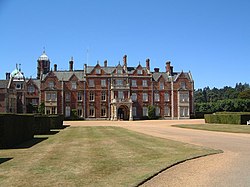
Thereafter, LeBlanc was invited to an audience with the Queen at Sandringham House, and he was said to have been impressed and inspired by the devotion to duty on the part of both Elizabeth and her mother.
The commission appointing LeBlanc under the royal sign-manual and Great Seal of Canada was issued on January 16, 1995.
The greatest publicity LeBlanc attracted in his career came immediately after the announcement of his appointment as Governor General: although previous honorees had worked as politicians prior to and after serving as viceroy, the recommendation of a prominent Liberal Party politician and organiser was criticised as being little more than a patronage gift from the Prime Minister to a loyal party member.
In the 1993 federal election, LeBlanc had been one of the chief architects of the Liberal Party's election strategy, and was a strong party loyalist. In protest, both Reform Party of Canada leader Preston Manning and Bloc Québécois leader Lucien Bouchard refused to attend LeBlanc's installation ceremony.
In office
As with each governor general, LeBlanc took on unofficial and personal mandates, choosing for himself: voluntarism, the teaching of Canadian history, Canada's Aboriginal peoples, and the military. He spoke often about the generosity, tolerance, and compassion of Canadians, and admired the dignity and abilities of the common citizen.
To recognize the "unsung heroes" who volunteer their time and effort to help others, LeBlanc initiated in 1996 the Governor General's Caring Canadian Award, and, on June 21, of the same year, was proud to issue a royal proclamation inaugurating National Aboriginal Day as an annual observance.
As well, in 1996 LeBlanc formed the Governor General's Award for Excellence in Teaching Canadian History, in 1999 partnered with the Canada Council for the Arts to create the Governor General's Awards in Visual and Media Arts, oversaw the issuance of the Governor General's Canadian History Medal for the Millennium, and established the Governor General's Millennium Edition of the Map of Canada, which was taken into space in 1999 by Julie Payette.
LeBlanc travelled to all parts of Canada and had a special affinity for small towns and cities, making himself particularly visible in those parts of Quebec after the province's referendum on secession in 1995. He participated in more than 2,000 events, including the annual New Year's Levée, which he moved to various locations around the country, seeing the party organised at Ottawa, Ontario, in 1996; Quebec City, Quebec, in 1997; Winnipeg, Manitoba, in 1998; and St. John's, Newfoundland and Labrador, in 1999.
Over the same years, LeBlanc also had public access to Rideau Hall and its grounds expanded and improved— including opening a dedicated visitors' centre in 1997— so that the number of visitors increased threefold to approximately 125,000 people per year. In keeping with his respect for the First Peoples of Canada, LeBlanc placed a totem pole and inukshuk prominently on the royal property.[citation needed]
Amongst numerous other official and ceremonial duties, the Governor General proclaimed in force three amendments to the constitution, on April 21, 1997, December 19, 1997, and January 8, 1998. He issued the statutory proclamation announcing the creation of the territory of Nunavut on April 1, 1999. LeBlanc welcomed to Rideau Hall the Queen, Prince Philip, Duke of Edinburgh, and Prince Charles, Prince of Wales, along with a host of foreign dignitaries such as United States president Bill Clinton and his wife, Hillary; King Hussein and Queen Noor of Jordan, and later Hussein's son, King Abdullah II, and his wife Queen Rania; as well as President of South Africa Nelson Mandela; and President of China Jiang Zemin. Further, he undertook eight state visits, becoming the first governor general of Canada to make such trips to the Czech Republic, India, Pakistan, the Ivory Coast, Tanzania, Mali, and Morocco.
Legacy
As governor general, LeBlanc was viewed as having been a role model for Acadians, and was complimented for having drawn the attention of the country to Acadian history and culture. As such, he was seen as a symbol for reconciliation, given the past relations between the Acadians and the Canadian Crown's predecessor. At the same time, LeBlanc was also credited for returning Rideau Hall to a status closer to that which it held a century previous, when it was the centre of life in the national capital.

Although LeBlanc enjoyed all the provinces and territories, his visits touching small towns as well as big cities, he travelled to events in his home province to a degree that some saw as disproportionate. Moreover, LeBlanc never sought media coverage, with the result that many Canadians were unaware of who he was, and his down-to-earth demeanour was thought by some to have been too "folksy" for the post. The accusations of political patronage also failed to evaporate during LeBlanc's governorship; while LeBlanc was viceroy, his son, Dominic, continued to work for the prime minister's office until 1997, when he ran for election to the House of Commons in LeBlanc's old riding, where the Governor General had a series of events planned the very week he dropped the election writs. Further, LeBlanc's daughter maintained employment as a political assistant to Liberal Cabinet ministers, and some of the Governor General's staff had close Liberal Party connections.
Personal touches were also left on the symbol of the Canadian viceregal office, from which LeBlanc removed the claws and tongue of the crowned lion, saying that they were impolite and un-Canadian. Though the change did not gather much attention until near the end of LeBlanc's tenure, the reaction, when it came, was generally unfavourable, and the modifications were undone by his successor.
Post-viceregal life and death

After being released from the Queen's service, LeBlanc returned to New Brunswick. There, after a lengthy battle with Alzheimer's disease, he died on June 24, 2009, in Grande-Digue.
He was, as is protocol for all incumbent and former governors general, accorded a state funeral, which took place on July 3 of the same year, in Memramcook. The casket's path through the community was lined with officers from the Department of Fisheries and Oceans, paying homage to LeBlanc's time as minister of the Crown with that portfolio, and the sitting governor general, Michaëlle Jean, her prime minister, Stephen Harper, and LeBlanc's former prime minister, Jean Chrétien, all attended.
Canada Post featured LeBlanc on a postage stamp released on February 8, 2010.
Honours and arms
Honours
Ribbon bars of Roméo LeBlanc
Appointments
- Canada January 4, 1973 – July 9, 1984: Member of Parliament (MP)
- Canada August 8, 1974 – June 24, 2009: Member of the Queen's Privy Council for Canada (PC)
- Canada February 8, 1995 – October 8, 2000: Chancellor and Principal Companion of the Order of Canada (CC) October 8, 1999 – June 24, 2009: Companion of the Order of Canada (CC)
- Canada February 8, 1995 – October 8, 2000: Chancellor and Commander of the Order of Military Merit (CMM) October 8, 1999 – June 24, 2009: Commander of the Order of Military Merit (CMM)
- Canada February 8, 1995 – October 8, 2000: Knight of Justice, Prior, and Chief Officer in Canada of the Most Venerable Order of the Hospital of Saint John of Jerusalem October 8, 1999 – June 24, 2009: Knight of Justice of the Most Venerable Order of the Hospital of Saint John of Jerusalem

- Canada February 8, 1995 – October 8, 2000: Chief Scout of Canada
- Canada 1995 – June 24, 2009: Honorary Member of the Royal Military College of Canada Club
- New Brunswick August 1, 2005 – June 24, 2009: Member of the Order of New Brunswick (ONB)
Medals
- Canada 1992: Commemorative Medal for the 125th Anniversary of the Confederation of Canada
- Canada February 8, 1995: Canadian Forces' Decoration (CD)
- Canada 2002: Queen Elizabeth II Golden Jubilee Medal
Foreign honours
- France 2002 – June 24, 2009: Grand officier de l'Ordre national du Mérite
Honorary military appointments
- Canada February 8, 1990 – October 8, 2000: Colonel of the Governor General's Horse Guards
- Canada February 8, 1990 – October 8, 2000: Colonel of the Governor General's Foot Guards
- Canada February 8, 1990 – October 8, 2000: Colonel of the Canadian Grenadier Guards
Honorary degrees
- New Brunswick 1977: Mount Allison University, Doctor of Civil Law (DCL)
- New Brunswick 1979: University of Moncton, Doctor of Public Administration (DPA)
- Nova Scotia 1995: Université Sainte-Anne, Doctor of Laws (LLD)
- Ontario 1996: Ryerson University, Doctor of Letters (DLitt)
- Ontario 1996: University of Ottawa, Doctor of the university (DUniv)
- New Brunswick 1997: St. Thomas University, Doctor of Laws (LLD)
- Newfoundland and Labrador 1997: Memorial University of Newfoundland, Doctor of Laws (LLD)
- Quebec 1997: McGill University, Doctor of Laws (LLD)
- New Brunswick 1999: University of New Brunswick, Doctor of Laws (LLD)
Honorific eponyms
Geographic locations
- New Brunswick: LeBlanc Park, Memramcook
- New Brunswick: Greater Moncton Roméo LeBlanc International Airport, Dieppe
Arms
| Notes Just prior to his installation as Governor General, LeBlanc was granted a personal coat of arms that depicted his Acadian and Canadian roots. Adopted January 1, 1995 Crest Four eagle feathers within a circlet of Micmac quill decoration Gules Escutcheon Argent on a pile Gules the Star of Acadia ensigned by a representation of the Royal Crown Or. Supporters Two dolphins Argent each gorged with a collar of maple leaves Gules and fleurs de lys Or, pendant there from a plate Azure, dexter surmounted by a steam locomotive wheel Or, sinister surmounted by a book Or Compartment Issuant from a mound set with maple leaves all Gules flanked by waves proper Motto SEMPER AMISSOS MEMINISSE DECET (It is right to remember the forgotten) Orders The ribbon and insignia of a Companion of the Order of Canada. DESIDERANTES MELIOREM PATRIAM (They desire a better country) Symbolism The use of white recalls the LeBlanc family name, while the pile refers to the Memramcook Valley, where LeBlanc was born, and the dolphins evoke the Rivière Dauphin (now Annapolis River), where LeBlanc's ancestors settled in the mid 17th century, as well as LeBlanc's maritime heritage and his service as the minister of fisheries. The star is a symbol long used by the Acadians, as are the fleurs de lys representative of LeBlanc's roots in that community, and the royal crown represents LeBlanc's appointment as the representative of the Canadian sovereign. The eagle feathers, symbols of peace, honour the Canadian First Nations, and the number represents LeBlanc's four children. More family links are depicted in the steam locomotive wheel – representing LeBlanc's father's service on the Canadian railways – and the book evoking LeBlanc's training and work as a teacher. The compartment symbolises a multi-ethnic Canada between two seas, and recalls the Micmac origin of the word Memramcook, meaning multi-coloured landscape. |
See also
External links
| Government offices | ||
|---|---|---|
| Preceded byRay Hnatyshyn | Governor General of Canada February 8, 1995 – October 6, 2000 | Succeeded byAdrienne Clarkson |
| Political offices | ||
| 20th Canadian Ministry (1968–1979) – First cabinet of Pierre Trudeau | ||
| Cabinet posts (5) | ||
| Predecessor | Office | Successor |
| New title | Minister of Fisheries and Oceans April 2, 1979 – June 3, 1979 | James McGrath |
| Himself as acting minister | Minister of the Environment September 14, 1976 – April 1, 1979 styled as Minister of Fisheries and the Environment | Leonard Stephen Marchand |
| Jean Marchand | Minister of the Environment (acting) July 1, 1976 – September 13, 1976 | Himself as minister |
| Jeanne Sauvé | Minister of the Environment (acting) December 5, 1975 – January 21, 1976 | Jean Marchand |
| n/a | Minister of State (Fisheries) August 8, 1974 – September 13, 1976 | n/a |
| 22nd Canadian Ministry (1980–1984) – Second cabinet of Pierre Trudeau | ||
| Cabinet posts (2) | ||
| Predecessor | Office | Successor |
| Paul James Cosgrove | Minister of Public Works September 30, 1982 – June 29, 1984 | Charles Lapointe |
| James McGrath | Minister of Fisheries and Oceans March 3, 1980 – September 29, 1982 | Pierre de Bané |
| Special Cabinet Responsibilities | ||
| Predecessor | Title | Successor |
| n/a | Minister responsible for the Canada Mortgage and Housing Corporation September 30, 1982 – June 29, 1984 | n/a |
| Parliament of Canada | ||
| Preceded byGuy Charbonneau | Speaker of the Senate of Canada December 7, 1993 – November 21, 1994 | Succeeded byGildas Molgat |
| Preceded byGuy F. Crossman | Member of Parliament for Westmorland—Kent October 30, 1972 – June 29, 1984 | Succeeded byFernand Robichaud |