Royal Institution Christmas Lectures
In-game article clicks load inline without leaving the challenge.
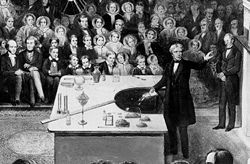
The Royal Institution Christmas Lectures are a series of lectures on a single topic each, which have been held at the Royal Institution in London each year since 1825. The lectures present scientific subjects to a general audience, including young people, in an informative and entertaining manner. The Managers of the Royal Institution conceived and initiated the Christmas Lecture series in 1825, at a time when organised education for young people was scarce. Many of the Christmas Lectures were published.
History

The Royal Institution's Christmas Lectures were first held in 1825, and have continued on an annual basis since then except for four years during the Second World War. They have been hosted each year at the Royal Institution itself, except in 1929 and between 2005 and 2006, each time due to refurbishment of the building. Michael Faraday was the most famous lecturer, hosting the series on nineteen occasions. Recent series have toured Japan, Korea and Singapore among other countries.
The Nobel laureate Sir William Bragg gave the Christmas lectures on four occasions, and his co-laureate son Sir Lawrence Bragg gave them twice. Other notable lecturers have included Desmond Morris (1964), Eric Laithwaite (1966 & 1974), Sir George Porter (1969 & 1976), Sir David Attenborough (1973), Heinz Wolff (1975), Carl Sagan (1977), Richard Dawkins (1991), Susan Greenfield (1994), Dame Nancy Rothwell (1998), Monica Grady (2003), Sue Hartley (2009), Alison Woollard (2013), Danielle George (2014), and Saiful Islam (2016).
In 1994, Professor Susan Greenfield became the first female scientist to present the Christmas Lectures. The first non-white science lecturer was Kevin Fong in 2015, and in August 2020 it was announced that Professor Christopher Jackson would jointly present the 2020 lecture series, thus becoming the first black scientist to do so.
The props for the lectures are designed and created by the Royal Institution's science demonstration technician, a post which Faraday previously held. A popular technician, with the advent of television, serving from 1948 to 1986, was Bill Coates. The technician is informed of the general subject of the lectures during spring, but the specifics are not settled until September, with the recordings made in mid-December. By 2009, the lectures had expanded to a series of five sessions each year. However, in 2010 the Royal Institution cut back on costs, as it had become over £2 million in debt, and this resulted in a reduction from five lectures to three.
Television
A 15-minute preview of a Christmas Lecture by G. I. Taylor was the first to be televised, in December 1936, on the BBC's fledgling Television Service. This was the first scientific experiment shown on television. Occasional lectures were broadcast in the subsequent decades, and each series was broadcast in its entirety on BBC Two from 1966 to 1999 and Channel 4 from 2000 to 2004. In 2000, one of the lectures was broadcast live for the first time.
Following the end of Channel 4's contract to broadcast the lectures, there were concerns that they might simply be dropped from scheduling as the channel was negotiating with the Royal Institution over potential changes to the format, while the BBC announced that "The BBC will not show the lectures again, because it feels the broadcasting environment has moved on in the last four years." Channel Five subsequently agreed to show the lectures from 2005 to 2008, an announcement which was met with derision from academics. The lectures were broadcast on More4 in 2009. In 2010, the lectures returned to the BBC after a ten-year absence from the broadcaster, and have been shown on BBC Four each year since then.

In January 2022, the RI launched an appeal to trace copies of those televised lectures which are missing from the BBC's archives, these being the complete series of five lectures each from 1966, 1967, 1969, 1970 and 1971, plus one episode of David Attenborough's 1973 lectures, "The language of animals".
List of Christmas lectures
1825 to 1965
The following is a complete list of the Christmas Lectures from 1825 to 1965:
| Year | Lecturer(s) | Title of series |
|---|---|---|
| 1825 | John Millington | Experimental Philosophy, including Dynamics, Mechanics, Pneumatics, Hydrostatics, Optics, Magnetism, Electricity, and Astronomy. |
| 1826 | John Wallis | Astronomy |
| 1827 | Michael Faraday | Chemistry |
| 1828 | George John Wood | The History, Architecture, Rites, Ceremonies, Manners, Customs &c. of the Ancient World |
| 1829 | Michael Faraday | Electricity |
| 1830 | Thomas Webster | Geology |
| 1831 | James Rennie | Zoology |
| 1832 | Michael Faraday | Chemistry |
| 1833 | John Lindley | Botany |
| 1834 | William Thomas Brande | Chemistry |
| 1835 | Michael Faraday | Electricity |
| 1836 | William Thomas Brande | Chemistry of the Gases |
| 1837 | Michael Faraday | Chemistry |
| 1838 | John Wallis | Astronomy |
| 1839 | William Thomas Brande | The Chemistry of the Atmosphere and the Ocean |
| 1840 | John Frederic Daniell | The First Principles of Franklinic Electricity |
| 1841 | Michael Faraday | The Rudiments of Chemistry |
| 1842 | William Thomas Brande | The Chemistry of the Non-Metallic Elements |
| 1843 | Michael Faraday | First Principles of Electricity |
| 1844 | William Thomas Brande | The Chemistry of the Gases |
| 1845 | Michael Faraday | The Rudiments of Chemistry |
| 1846 | John Wallis | The Rudiments of Astronomy |
| 1847 | William Thomas Brande | The Elements of Organic Chemistry |
| 1848 | Michael Faraday | The Chemical History of a Candle |
| 1849 | Robert Walker | The Properties of Matter and the Laws of Motion |
| 1850 | William Thomas Brande | The Chemistry of Coal |
| 1851 | Michael Faraday | Attractive Forces |
| 1852 | Chemistry | |
| 1853 | Voltaic Electricity | |
| 1854 | The Chemistry of Combustion | |
| 1855 | The Distinctive Properties of the Common Metals | |
| 1856 | Attractive Forces | |
| 1857 | Static Electricity | |
| 1858 | The Metallic Properties | |
| 1859 | The Various Forces of Matter and their Relations to Each Other | |
| 1860 | The Chemical History of a Candle | |
| 1861 | John Tyndall | Light |
| 1862 | Edward Frankland | Air and Water |
| 1863 | John Tyndall | Electricity at Rest and Electricity in Motion |
| 1864 | Edward Frankland | The Chemistry of a Coal |
| 1865 | John Tyndall | Sound |
| 1866 | Edward Frankland | The Chemistry of Gases |
| 1867 | John Tyndall | Heat and Cold |
| 1868 | William Odling | The Chemical Changes of Carbon |
| 1869 | John Tyndall | Light |
| 1870 | William Odling | Burning and Unburning |
| 1871 | John Tyndall | Ice, Water, Vapour and Air |
| 1872 | William Odling | Air and Gas |
| 1873 | John Tyndall | The Motion and Sensation of Sound |
| 1874 | John Hall Gladstone | The Voltaic Battery |
| 1875 | John Tyndall | Experimental Electricity |
| 1876 | John Hall Gladstone | The Chemistry of Fire |
| 1877 | John Tyndall | Heat, Visible and Invisible |
| 1878 | James Dewar | A Soap Bubble |
| 1879 | John Tyndall | Water and Air |
| 1880 | James Dewar | Atoms |
| 1881 | Robert Stawell Ball | The Sun, the Moon and the Planets |
| 1882 | John Tyndall | Light and the Eye |
| 1883 | James Dewar | Alchemy in Relation to Modern Science |
| 1884 | John Tyndall | The Sources of Electricity |
| 1885 | James Dewar | The Story of a Meteorite |
| 1886 | The Chemistry of Light and Photography | |
| 1887 | Robert Stawell Ball | Astronomy |
| 1888 | James Dewar | Clouds and Cloudland |
| 1889 | Arthur Rücker | Electricity |
| 1890 | James Dewar | Frost and Fire |
| 1891 | John Gray McKendrick | Life in Motion; or the Animal Machine |
| 1892 | Robert Stawell Ball | Astronomy |
| 1893 | James Dewar | Air: Gaseous and Liquid |
| 1894 | John Ambrose Fleming | The Work of an Electric Current |
| 1895 | John Gray McKendrick | Sound, Hearing and Speech |
| 1896 | Sylvanus Phillips Thompson | Light, Visible and Invisible |
| 1897 | Oliver Lodge | The Principles of the Electric Telegraph |
| 1898 | Robert Stawell Ball | Astronomy |
| 1899 | Charles Vernon Boys | Fluids in Motion and at Rest |
| 1900 | Robert Stawell Ball | Great Chapters from the Book of Nature |
| 1901 | John Ambrose Fleming | Waves and Ripples in Water, Air and Aether |
| 1902 | Henry Selby Hele-Shaw | Locomotion : On the Earth, Through the Water, in the Air |
| 1903 | Edwin Ray Lankester | Extinct Animals |
| 1904 | Henry Cunynghame | Ancient and Modern Methods of Measuring Time |
| 1905 | Herbert Hall Turner | Astronomy |
| 1906 | William Duddell | Signalling to a Distance |
| 1907 | David Gill | Astronomy, Old and New |
| 1908 | William Stirling | The Wheel of Life |
| 1909 | William Duddell | Modern Electricity |
| 1910 | Silvanus Phillips Thompson | Sound: Musical and Non-Musical |
| 1911 | Peter Chalmers Mitchell | The Childhood of Animals |
| 1912 | James Dewar | Christmas Lecture Epilogues |
| 1913 | Herbert Hall Turner | A Voyage in Space |
| 1914 | Charles Vernon Boys | Science in the Home |
| 1915 | Herbert Hall Turner | Wireless Messages from the Stars |
| 1916 | Arthur Keith | The Human Machine Which All Must Work |
| 1917 | John Ambrose Fleming | Our Useful Servants : Magnetism and Electricity |
| 1918 | D'Arcy Wentworth Thompson | The Fish of the Sea |
| 1919 | William Henry Bragg | The World of Sound |
| 1920 | John Arthur Thomson | The Haunts of Life |
| 1921 | John Ambrose Fleming | Electric Waves and Wireless Telephony |
| 1922 | Herbert Hall Turner | Six Steps Up the Ladder to the Stars |
| 1923 | William Henry Bragg | Concerning the Nature of Things |
| 1924 | Francis Balfour-Browne | Concerning the Habits of Insects |
| 1925 | William Henry Bragg | Old Trades and New Knowledge |
| 1926 | Archibald Vivian Hill | Nerves and Muscles: How We Feel and Move |
| 1927 | Edward Andrade | Engines |
| 1928 | Alexander Wood | Sound Waves and their Uses |
| 1929 | Stephen Glanville | How Things Were Done in Ancient Egypt |
| 1930 | Arthur Mannering Tyndall | The Electric Spark |
| 1931 | William Henry Bragg | The Universe of Light |
| 1932 | Alexander Oliver Rankine | The Round of the Waters |
| 1933 | James Hopwood Jeans | Through Space and Time |
| 1934 | William Lawrence Bragg | Electricity |
| 1935 | Charles Edward Kenneth Mees | Photography |
| 1936 | Geoffrey Ingram Taylor | Ships |
| 1937 | Julian Huxley | Rare Animals and the Disappearance of Wild Life |
| 1938 | James Kendall | Young Chemists and Great Discoveries |
| 1939–1942 | No lectures due to the Second World War | |
| 1943 | Edward Andrade | Vibrations and Waves |
| 1944 | Harold Spencer Jones | Astronomy in our Daily Life |
| 1945 | Robert Watson-Watt | Wireless |
| 1946 | Hamilton Hartridge | Colours and How We See Them |
| 1947 | Eric Keightley Rideal | Chemical Reactions: How They Work |
| 1948 | Frederic Bartlett | The Mind at Work and Play |
| 1949 | Percy Dunsheath | The Electric Current |
| 1950 | Edward Andrade | Waves and Vibrations |
| 1951 | James Gray | How Animals Move |
| 1952 | Frank Sherwood Taylor | How Science Has Grown |
| 1953 | John Ashworth Ratcliffe | The Uses of Radio Waves |
| 1954 | Frank Whittle | The Story of Petroleum |
| 1955 | Harry W. Melville | Big Molecules |
| 1956 | Harry Baines | Photography |
| 1957 | Julian Huxley and James Fisher | Birds |
| 1958 | John Ashworth Ratcliffe, James M. Stagg, Robert L. F. Boyd, Graham Sutton, George E. R. Deacon, Gordon de Quetteville Robin | International Geophysical Year |
| 1959 | Thomas Allibone | The Release and Use of Atomic Energy |
| 1960 | Vernon Ellis Cosslett | Seeing the Very Small |
| 1961 | William Lawrence Bragg | Electricity |
| 1962 | R. E. D. (Richard Evelyn Donohue) Bishop | Vibration |
| 1963 | Ronald King | Energy |
| 1964 | Desmond Morris | Animal Behaviour |
| 1965 | Bernard Lovell, Francis Graham-Smith, Martin Ryle, Antony Hewish | Exploration of the Universe |
Since 1966
The following is a list of televised Christmas Lectures from 1966 onward as of December 2025[update]:
| Year | Lecturer(s) | Title of series | Lecture titles | Network |
|---|---|---|---|---|
| 1966 | Eric Laithwaite | The Engineer in Wonderland | 1. The White Rabbit 2. Only the Grin was Left3. The Caucus Race4. Curiouser and Curiouser5. If only I were the right size to do it6. It's the Oldest Rule in the Book | BBC Two |
| 1967 | Richard L. Gregory | The Intelligent Eye | 1. Ancient Eyes and Simple Brains 2. Learning to See Things3. Playing with Illusions4. How Illusions Play Games with Us5. Human Eyes in Space6. The Future-Machines that See? | |
| 1968 | Philip Morrison | Gulliver's Laws: The Physics of Large and Small | 1. The World of Captain Gulliver 2. Meat and Drink Sufficient...3. A Prodigious Leap?4. Lilliput and Brobdingnag since the Industrial Revolution5. Dwarf and Giant Numbers6. Beyond the Map | |
| 1969 | George Porter | Time Machines | 1. In the Beginning... 2. Clockwork Harmony3. The Tick of the Atom4. Big Time, Little Time5. Faster, Faster6. To the Ends of Time | |
| 1970 | John Napier | Monkeys Without Tails: A Giraffe's Eye-view of Man | 1. Man has a very short neck and no tail 2. Man comes in several different sizes and shapes3. Fancy having to climb trees in order to eat4. Man chooses a sensible place to live at last5. Why choose to walk on two legs when it is much safer on four?6. What's the idea of shooting at us? | |
| 1971 | Charles Taylor | Sounds of Music: The Science of Tones and Tune | 1. Making and Measuring the Waves 2. From Small Beginnings3. Growing and Changing4. Craftsmanship and Technology5. On the Way to the Ear6. The End of the Journey | |
| 1972 | Geoffrey G. Gouriet | Ripples in the Ether: The Science of Radio Communication | 1. How It All Began 2. Getting Rid of the Wires3. The Sound of Broadcasting4. Pictures With and Without Wires5. But Electrons aren't Coloured!6. Vision of the Future | |
| 1973 | David Attenborough | The Language of Animals | 1. Beware! 2. Be Mine3. Parents and Children4. Simple Signs and Complicated Communications (lost from archives )5. Foreign Languages6. Animal Language, Human Language | |
| 1974 | Eric Laithwaite | The Engineer Through the Looking Glass | 1. Looking Glass House 2. Tweedledum and Tweedledee3. Jam Yesterday, Jam Tomorrow4. The Jabberwock5. The Time has come the Walrus said6. It's my own Invention | |
| 1975 | Heinz Wolff | Signals from the Interior | 1. You as an engine 2. Pumps pipes and flows3. Spikes and waves4. Probes, sondes and sounds5. Looking through your skin6. Signals from the mind | |
| 1976 | George Porter | The Natural History of a Sunbeam | 1. First Light 2. Light and Life3. A Leaf from Nature4. Candles from the Sun5. Making Light Work6. Survival Under the Sun | |
| 1977 | Carl Sagan | The Planets | 1. The Earth as a Planet 2. The Outer Solar System and Life3. The History of Mars4. Mars before Viking5. Mars after Viking6. Planetary Systems Beyond Our Sun | |
| 1978 | Erik Christopher Zeeman | Mathematics into Pictures | 1. Linking and Knotting 2. Numbers and Geometry3. Infinity and Perspective4. Games and Evolution5. Waves and Music6. Catastrophe and Psychology | |
| 1979 | Eric M. Rogers | Atoms for Engineering Minds: A Circus of Experiments | 1. Getting to Know Atoms 2. Molecules in Motion3. Electrified Atoms4. Atoms that Explode5. Atoms and Energy6. Seeing Atoms at Last | |
| 1980 | David Chilton Phillips with Max Perutz in Lecture 5 | The Chicken, the Egg and the Molecules | 1. What are chickens made of? 2. Machine tools of life3. Muscle power4. Eggs, genes and proteins5. Haemoglobin: the breathing molecule6. Molecules at work | |
| 1981 | Reginald Victor Jones | From Magna Carta to Microchip | 1. Principles, Standards and Methods 2. The Measurement of Time3. More and More About Less and Less4. Onwards to the Stars5. Measurement and Navigation in War6. Some Impacts of Measurement on Life: And Can We Take it too Far? | |
| 1982 | Colin Blakemore | Common Sense | 1. Making Sense 2. The Sound of Silence3. The Sixth Sense – and the Rest4. Show Me the Way to Go Home5. Vive la différence6. Enchanted Loom | |
| 1983 | Leonard Maunder | Machines in Motion | 1. Driving Forces 2. Gathering Momentum3. Vibration4. Under Control5. Fluids and Flight6. Living Machines | |
| 1984 | Walter Bodmer | The Message of the Genes | 1. We're All Different 2. The Spice of Life3. Genetic Engineering4. Bodies and Antibodies5. Normal Cells and Cancer Cells6. When Will Pigs Have Wings? | |
| 1985 | John David Pye | Communicating | 1. No Man is an Island 2. Animal Talk3. The Bionic Bat4. The Pace of Technology5. The Integrated Body6. Computers | |
| 1986 | Lewis Wolpert | Frankenstein's Quest: Development of Life | 1. First Take an Egg... 2. The Medium and the Message3. The Right Stuff4. Genes and Flies5. Chain of Command6. Growing Up and Growing Old | |
| 1987 | John Meurig Thomas and David Phillips | Crystals and Lasers | 1. The Micro-world 2. The architecture of crystals3. Crystal Miracles4. Constructing a LASER5. The Light Fantastic6. Crystals, lasers and the human body | |
| 1988 | Gareth Roberts | The Home of the Future | 1. Appliance Science 2. Home, Safe Home3. Electronics for Pleasure4. Home, Smart Home5. Mixers, Meters and Molecules | |
| 1989 | Charles Taylor | Exploring Music | 1. What Is Music? 2. The Essence of an Instrument3. Science, Strings and Symphonies4. Technology, Trumpets and Tunes5. Scales, Synthesisers and Samplers | |
| 1990 | Malcolm Longair | Origins | 1. The Grand Design 2. The Birth of the Stars3. The Origin of Quasars4. The Origin of the Galaxies5. The Origin of the Universe | |
| 1991 | Richard Dawkins | Growing Up in the Universe | 1. Waking Up in the Universe 2. Designed and Designoid Objects3. Climbing Mount Improbable4. The Ultraviolet Garden5. The Genesis of Purpose | |
| 1992 | Charles J. M. Stirling | Our World Through the Looking Glass | 1. Man in the Mirror 2. Narwhals, Palindromes and Chesterfield Station3. The Handed Molecule4. Symmetry, Sensation and Sex5. In the Hands of Giants | |
| 1993 | Frank Close | The Cosmic Onion | 1. A is for Atoms 2. To the Centre of the Sun3. Invaders from Outer Space4. Anti-Matter Matters5. An Hour to Make the Universe | |
| 1994 | Susan Greenfield | Journey to the Centre of the Brain | 1. The Electric Ape 2. Through a Glass Darkly3. Bubble Bubble Toil and Trouble4. The Seven Ages of the Brain5. The Mind's I | |
| 1995 | James Jackson | Planet Earth, An Explorer's Guide | 1. On the Edge of the World 2. Secrets of the Deep3. Volcanoes: Melting the Earth4. The Puzzle of the Continents5. Waterworld | |
| 1996 | Simon Conway Morris | The History in our Bones | 1. Staring into the Abyss 2. The Fossils Come Alive3. The Great Dyings: Life after Death4. Innovations And Novelty5. Feet on the Ground, Head in the Stars: The History of Man | |
| 1997 | Ian Stewart | The Magical Maze | 1. Sunflowers and Snowflakes 2. The Pattern of Tiny Feet3. Outrageous Fortune4. Chaos and Cauliflowers5. Fearful Symmetry | |
| 1998 | Nancy Rothwell | Staying Alive | 1. Sense and Sensitivity 2. Fats and figures3. Chilling out4. Times of our lives5. Pushing the limits | |
| 1999 | Neil F. Johnson | Arrows of Time | 1. Back to the Future 2. Catching the Waves3. The Quantum Leap4. Edge of Chaos5. Shaping the Future | |
| 2000 | Kevin Warwick | Rise of the Robots | 1. Anatomy of an Android 2. Things That Think3. Remote Robots4. Bionic Bodies5. I, Robot | Channel 4 |
| 2001 | John Sulston | The Secrets of Life | 1. What is life? 2. How do I grow?3. What am I?4. Can we fix it?5. Future of life? | |
| 2002 | Tony Ryan | Smart Stuff | 1. The Spider that Spun a Suspension Bridge 2. The Trainer That Ran Over The World3. The Phone that Shrank the Planet4. The Plaster that Stretches Life5. The Ice Cream that Will Freeze Granny | |
| 2003 | Monica Grady | Voyage in Space and Time | 1. Blast Off 2. Mission to Mars3. Planet Patrol4. Collision Course5. Anybody Out There? | |
| 2004 | Lloyd Peck | Antarctica | 1. Ice People 2. Ice Life3. Ice World | |
| 2005 | John Krebs | The Truth About Food | 1. The ape that cooks 2. Yuck or yummy?3. You are what you eat4. When food goes wrong5. Food for the future | Channel Five |
| 2006 | Marcus du Sautoy | The Num8er My5teries | 1. The curious incident of the never-ending numbers 2. The quest to predict the future3. The story of the elusive shapes4. The case of the uncrackable code5. The secret of the winning streak | |
| 2007 | Hugh Montgomery | Back from the Brink: The Science of Survival | 1. Peak Performance 2. Completely Stuffed3. Grilled and Chilled4. Fight, Flight and Fright5. Luck, Genes and Stupidity | |
| 2008 | Christopher Bishop | Hi-tech Trek | 1. Breaking the Speed Limit 2. Chips with Everything3. The Ghost in the Machine4. Untangling the Web5. Digital Intelligence | |
| 2009 | Sue Hartley | The 300-Million-Year War | 1. Plant Wars 2. The Animals Strike Back3. Talking Trees4. Dangerous to Delicious5. Weapons of the Future | More4 |
| 2010 | Mark Miodownik | Size Matters | 1. Why Elephants Can't Dance but Hamsters Can Skydive 2. Why Chocolate Melts and Jet Planes Don't3. Why Mountains Are So Small | BBC Four |
| 2011 | Bruce Hood | Meet Your Brain | 1. What's in your head? 2. Who's in charge here anyway?3. Are you thinking what I'm thinking? | |
| 2012 | Peter Wothers | The Modern Alchemist | 1. Air: the elixir of life 2. Water: the fountain of youth3. Earth: the philosopher's stone | |
| 2013 | Alison Woollard | Life Fantastic | 1. Where do I come from? 2. Am I a Mutant?3. Could I live forever? | |
| 2014 | Danielle George | Sparks will fly: How to Hack your Home | 1. The light bulb moment 2. Making contact3. A new revolution | |
| 2015 | Kevin Fong | How to survive in space | 1. Lift off! 2. Life in Orbit3. The next frontier | |
| 2016 | Saiful Islam | Supercharged: Fuelling the future | 1. Let there be light! 2. People Power3. Fully charged | |
| 2017 | Sophie Scott | The Language of Life | 1. Say it with Sound 2. Silent Messages3. The Word | |
| 2018 | Alice Roberts Aoife McLysaght | Who am I? | 1. Where Do I Come From? 2. What Makes Me Human?3. What Makes Me, Me? | |
| 2019 | Hannah Fry | Secrets and Lies: The Hidden Power of Maths | 1. How to Get Lucky 2. How to Bend the Rules3. How Can We All Win? | |
| 2020 | Christopher Jackson Helen CzerskiTara Shine | Planet Earth: A user's guide | 1. Earth Engine 2. Water World3. Up in the Air | |
| 2021 | Jonathan Van-Tam | Going viral: How Covid changed science forever | 1. The Invisible Enemy 2. The Perfect Storm3. Fighting Back | |
| 2022 | Sue Black | Secrets of Forensic Science | 1. Dead Body 2. Missing Body3. Living Body | |
| 2023 | Michael Wooldridge | The Truth about AI | 1. How to Build an Intelligent Machine 2. My AI Life3. The Future of AI: Dream or Nightmare? | |
| 2024 | Chris van Tulleken | The Truth About Food | 1. From Tastebuds to Toilet 2. How Food Makes Us3. The Big Food Hack | |
| 2025 | Maggie Aderin-Pocock | Is There Life Beyond Earth? | 1. Destination Moon 2. Searching the Solar System3. To the Stars and Beyond |
External links
- (The Ri Channel)
- at BBC Online