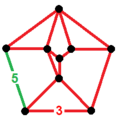
The runcinated 120-cell or small disprismatohexacosihecatonicosachoron is a uniform 4-polytope. It has 2640 cells: 120 dodecahedra, 720 pentagonal prisms, 1200 triangular prisms, and 600 tetrahedra. Its vertex figure is a nonuniform triangular antiprism (equilateral-triangular antipodium): its bases represent a dodecahedron and a tetrahedron, and its flanks represent three triangular prisms and three pentagonal prisms.
Sections of an omnitrucated 4D 600/120-cell 97 frames (=48x2 L/R+1 Center) shown in 4D to 3D Flatlander views. The center section is highlighted by also showing it as a combined set of convex hulls.
Models
The first complete physical model of a 3D projection of the omnitruncated 120-cell was built by a team led by Daniel Duddy and David Richter on August 9, 2006 using the Zome system in the London Knowledge Lab for the 2006 .
Full snub 120-cell
Vertex figure for the omnisnub 120-cell
The full snub 120-cell or omnisnub 120-cell, defined as an alternation of the omnitruncated 120-cell, can not be made uniform, but it can be given Coxeter diagram , and symmetry [5,3,3]+, and constructed from 1200 octahedrons, 600 icosahedrons, 720 pentagonal antiprisms, 120 snub dodecahedrons, and 7200 tetrahedrons filling the gaps at the deleted vertices. It has 9840 cells, 35040 faces, 32400 edges, and 7200 vertices.
Related polytopes
These polytopes are a part of a set of 15 uniform 4-polytopes with H4 symmetry:
, edited by F. Arthur Sherk, Peter McMullen, Anthony C. Thompson, Asia Ivic Weiss, Wiley-Interscience Publication, 1995, ISBN 978-0-471-01003-6 (Paper 22) H.S.M. Coxeter, Regular and Semi-Regular Polytopes I, [Math. Zeit. 46 (1940) 380-407, MR 2,10] (Paper 23) H.S.M. Coxeter, Regular and Semi-Regular Polytopes II, [Math. Zeit. 188 (1985) 559-591] (Paper 24) H.S.M. Coxeter, Regular and Semi-Regular Polytopes III, [Math. Zeit. 200 (1988) 3-45]
J.H. Conway and M.J.T. Guy: Four-Dimensional Archimedean Polytopes, Proceedings of the Colloquium on Convexity at Copenhagen, page 38 und 39, 1965
N.W. Johnson: The Theory of Uniform Polytopes and Honeycombs, Ph.D. Dissertation, University of Toronto, 1966