Deportivo Saprissa
In-game article clicks load inline without leaving the challenge.
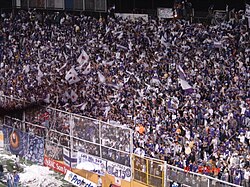
Deportivo Saprissa is a Costa Rican sports club, mostly known for its football team. The club is based in San Juan de Tibás, San José, and play their home games at the Estadio Ricardo Saprissa Aymá. Their colours are burgundy and white. It is the main team representing the capital, but with the distinction of being massively followed throughout the whole country and overseas. The club was founded in 1935 and has competed in the Costa Rican first division since 1949. The name of the team comes from one of the club's main founders, Ricardo Saprissa Aymá. One of the most popular nicknames for the team El Monstruo Morado (The Maroon Monster) can be traced back to 1987, when the Costa Rican newspaper Diario Extra gave the team the nickname during a derby, because of the club's enormous following. A reporter commented that the sea of fans in the stands at the Estadio Ricardo Saprissa Aymá in Tibás wearing purple, and the tremendous noise they were generating, made him feel like he was "in the presence of a thousand headed monster". Saprissa immediately adopted the nickname El Monstruo Morado. It remains the most lauded football team in the whole region.
Saprissa has won 40 Primera División de Costa Rica championships, including six consecutive national titles in the 70s. It stands as one of the more successful teams in the CONCACAF region as well, having won the CONCACAF Champions' Cup three times – in 1993, 1995, and 2005. Saprissa has also won five Central American crowns in 1972, 1973, 1978, 1998, and 2003.
For the period 1 September 2007 to 31 August 2008 the club was ranked the 106th best team in the world by the International Federation of Football History & Statistics, an organization recognized by FIFA.
Saprissa has regularly appeared in the CONCACAF Champions Cup finals in recent decades, with three first-place finishes and four runners-up finishes. One of the club's most notable moments came in 2005 when Saprissa became the second club in CONCACAF to finish third in the FIFA Club World Cup together with the Mexican club Necaxa who accomplished it in 2000 and were joined by two more Mexican clubs, in 2012 by C.F. Monterrey and in 2017 by C.F Pachuca.
The club was chosen by the IFFHS as the CONCACAF team of the 20th Century. This event gave Saprissa worldwide recognition. Their main partner is a Costa Rican Investment Consortium named Horizonte Morado (Purple Horizon), composed mainly of Juan Carlos Rojas Callán, Edgar Zurcher, and Televisora de Costa Rica.
History
Deportivo Saprissa was founded on 16 July 1935, by Roberto Fernández who named his team after the man who sponsored their uniform, Don Ricardo Saprissa Aymá. The club entered the Costa Rican Third Division as Saprissa F.C. They were promoted to the Primera División de Costa Rica, making their debut in the top flight on 21 August 1949. That year Saprissa actually won the first final match against Gimnástica Española with 0–3 score, then lost the away game by 6–2 to be defeated again 2–1 in a third game. They were accepted in 1st category as a favor granted by the administrative entity of that time. One of the most notable achievement of their early years, was to win the third and second division titles undefeated. The club has remained in the Costa Rican top flight ever since.
Recent events
In 2003, the majority of the club's stock was bought by Mexican entrepreneur Jorge Vergara, the then owner of Mexican football club Club Deportivo Guadalajara and later owner of Major League Soccer club Chivas USA.
Saprissa won the 2005 CONCACAF Champions Cup, beating Mexican club UNAM in the final over two legs, in May 2005. This was the last time a Central American club won the Champions Cup.
As CONCACAF club champions they qualified for the 2005 FIFA Club World Championship, held in Japan in December 2005. They beat Australian club Sydney FC in the quarter-finals thanks to a goal by Christian Bolaños. In the semi-finals they were beaten 3–0 by English club Liverpool, who were the Champions League holders that year, making it the strongest team in Europe. In the third place match they beat Al Ittihad of Saudi Arabia 3–2. Álvaro Saborío scored two goals, and Rónald Gómez scored an astonishing free-kick final goal in the 89th minute to seal the win. After this "late goal" Costa Rican people start calling the late-game goal "La Saprihora" (The Sapritime) in honor to this late goal even though this event happened in 2005 people still using this name for most of the Saprissa goals scored after the minute 85. They finished the competition in third place behind São Paulo of Brazil and Liverpool. Saborío was joint top scorer, and Bolaños was awarded the Bronze Ball by FIFA as third best player of the championship out of 5 teams.
In 2008, Saprissa also reached the Champions Cup final, but lost to Pachuca. This was the last Central American appearance at the final.
In 2012, Saprissa inaugurated its 1st division female team.
Team colours
Even though the original colours were red and white, the team is known by their purple-burgundy colour. Red and white were utilised very briefly, and Ricardo Saprissa's influence from the Polo Club of Barcelona had the team try red and blue instead, even though this is the origin of the colour used throughout all of its history. When the new kit for 1937 (red and blue) was being manufactured, some of the threads got mixed evenly along the sides of the jerseys, producing a type of purple, resembling a burgundy/maroon colour. This new colour went down well with everyone involved, it reflected class and originality, and it was selected as the team's official colour. It was decided that the team's shield would appear on the chest of the uniform, with a notable bold white letter "S".
Saprissa utilizes a purple/burgundy jersey with white and grey details, and white shorts with burgundy and grey details for home games. For away games, a white jersey with burgundy and grey details is used, and white shorts with burgundy and grey details.
Kit history
Jersey Suppliers
Stadium

Saprissa plays home games at the Estadio Ricardo Saprissa Aymá named after Ricardo Saprissa. They originally played at the Costa Rica National Stadium, which they rented and shared.
A new site for a stadium was bought in 1965 and on 27 August 1972 after six years of construction and upgrades, Estadio Ricardo Saprissa was officially opened. The first match was between Deportivo Saprissa and Comunicaciones of Guatemala. The match ended in a 1–1 draw with Peter Sandoval of Comunicaciones scoring the first goal at the new stadium.
The stadium is called Estadio Ricardo Saprissa Aymá, named after the founder of the club. There is a bust of Don Ricardo in one of the corners of the stadium. The stadium is also nicknamed La Cueva del Monstruo (The Monster's Cave/Lair) or La Cueva (The Lair), after the nickname of the club, El Monstruo Morado ("The Purple Monster"). It has a seating capacity of 24,000 and is overlooked by local mountains and downtown San Jose.
The stadium has great fame internationally, especially with all the national teams that play against Costa Rica.
The stadium celebrated its 50th anniversary in 2022, having hosted over 1,500 official matches.
Supporters
La Ultra Morada (The Purple Ultra) is the club's most radical supporters group, even though it is not recognized as an official or formal part of the club. This group is always set on the south side of the stadium. La Ultra Morada is categorized as an "ultras group" or "ultras movement", being similar to what is more commonly known to outsiders as "hooligans"; even though members of La Ultra Morada, or simply La Ultra, emphasize their support for the club by creating a passionate atmosphere during matches. The group was the first Ultras group in Costa Rica, formed in 1995 when then-Saprissa president Enrique Artiñano brought fans from the Chilean football club Universidad Católica to help build a similar ultras group to their Los Cruzados for Saprissa. In the mid-to-late 1990s the Ultras began to develop the image of being football hooligans when violence began to break out with opposition fans during games. Due to the negative atmosphere and press coverage, Saprissa officials stepped in to restore order to a group that they had help create. The group is sub-divided in smaller groups called peñas. They maintain the style of a classic Ultras group, with chants, choreos[clarification needed], pyro shows (flares and gunpowder), abundant flags, giant banners, and the constant beat of an oversized bass drum.
There are, however, several different other supporter group that are legally recognized by the club. These groups occupy different zones in the stadium, and they are mainly groups that get organized with transportation, original merchandise, and massive displays for the team during a game (confetti, balloons, banners, flares, etc.)
Mascot
The official mascot of the team is a cartoonish purple dragon, which was based on the Dragon Elliot from Pete's Dragon, and similar to one from Dragon Tales[clarification needed] and many other dragons from children's shows. Because of this, many of the fans call the mascot Un monstruo amigable which means "a friendly monster". The mascot was meant to appeal to children in general, but it ended up being loved by the entirety of the fans. This caused it to be present in all kinds of paraphernalia and merchandise. It is the most recognizable and appreciated mascot in all the region. However, in early 2010, a new mascot was introduced. The mascot was designed in Mexico and many club supporters felt that it was a campy, superhero-like purple monster. As a result, the new mascot was highly rejected by the fans, claiming that "No queremos un dinosaurio super héroe, queremos al espíritu del equipo" (We don't want a super hero dinosaur, we want the original spirit of the team). The new mascot was replaced immediately after the strong rejection, and the team now has a new mascot that resembles the original. The new costume was manufactured by Fernando Thiel, a widely recognized Argentina-born puppeteer who lives in Costa Rica.
Rivalries
El Clásico
When Deportivo Saprissa faces Alajuelense, it is known as El Clásico. Saprissa is the team from Tibás, in San José, while Alajuelense is from Alajuela. The first duel between these teams was on October 12, 1949, in a match where Alajuelense won by 6–5. The current score of victories is 139 for Saprissa, 107 for Alajuelense and 109 draws.

Honours
National
- Primera División de Costa Rica Champions (40): 1952, 1953, 1957, 1962, 1964, 1965, 1967, 1968, 1969, 1972, 1973, 1974, 1975, 1976, 1977, 1982, 1988, 1989, 1993–94, 1994–95, 1997–98, 1998–99, 2003–04, 2005–06, 2006–07, Invierno 2007, Verano 2008, Invierno 2008, 2010 Verano, 2014 Verano, 2014 Invierno, 2015 Invierno, 2016 Invierno, Clausura 2018, Clausura 2020, Clausura 2021, Apertura 2022, Clausura 2023, Apertura 2023, Clausura 2024 Runners-up (19): 1950, 1956, 1958, 1959, 1961, 1963, 1966, 1970, 1971, 1984, 1991, 1992, 1996–97, 1999–00, 2002–03, Verano 2017, Apertura 2018, Clausura 2019, Apertura 2021
- Torneo de Copa de Costa Rica Champions (6): 1950, 1960, 1963, 1970, 1972, 2013,2026 Runners-up (7): 1953, 1954, 1961, 1963, 1967, 2014, 2023
- Supercopa de Costa Rica Champions (3): 1976, 2021, 2023 Runners-up (2): 2020, 2024
- Recopa de Costa Rica Champions (2): 1963, 2023 Runners-up (1): 2024
- Segunda División de Costa Rica Champions (1): 1948
- Tercera División de Costa Rica Champions (1): 1947
International
Worldwide
- FIFA Club World Cup Third place (1): 2005
Intercontinental
- Copa Interamericana Runners-up (2): 1993, 1995
Continental
- CONCACAF Champions Cup Champions (3): 1993, 1995, 2005 Runners-up (3): 1973, 2004, 2008
- CONCACAF League Champions (1): 2019 Runners-up (1): 2020
Regional
- Copa Fraternidad/Torneo Grandes de Centroamérica/Copa Interclubes UNCAF Champions (5): 1972, 1973, 1978, 1998, 2003 Runners-up (7): 1971, 1974, 1996, 1997, 2001, 2004, 2007
Friendly
- Torneo Relámpago de Fútbol de Costa Rica: 1949, 1957
- Copa Mayid Barzuna: 1954
- Trofeo Vuelta al Mundo: 1959
- Copa Ricardo Saprissa: 1982, 1989
- Copa Camel: 1985
- Copa 90 Minutos por la Vida: 1999, 2004, 2007, 2009, 2011
Awards
- CONCACAF League Fair Play Winners (1): 2019
Performance in CONCACAF competitions
- CONCACAF Champions Cup: 38 appearances
| 1963 – Semi-finals 1965 – 1969 – Semi-finals 1970 – Semi-finals 1971 – Second round 1973 – Runners-up 1974 – First round 1975 – Semi-finals 1977 – Semi-finals 1978 – Third round 1983 – First round 1986 – First round 1987 – Quarter-finals | 1991 – Fourth round 1992 – First round 1993 – Champion 1995 – Champion 1996 – Second round 1998 – Third place 1999 – Quarter-finals 2002 – Round of 16 2004 – Runners-up 2005 – Champion 2006 – Semi-finals 2008 – Runners-up | 2008–09 – Group stage 2009–10 – Group stage 2010–11 – Semi-finals 2014–15 – Quarter-finals 2015–16 – Group stage 2016–17 – Quarter-finals 2018 – Round of 16 2019 – Round of 16 2020 – Round of 16 2021 – Round of 16 2022 – Round of 16 | 2024 – First Round 2025 – First Round |
- CONCACAF Central American Cup: 3 appearances
2023 – Quarter-finals 2024 – Quarter-finals 2025 – Group stage
- CONCACAF League: 3 appearances
2019 – Champion 2020 – Runners-up 2021 – Quarter-finals
Player records
| # | Name | Career | Apps | Goals |
|---|---|---|---|---|
| Appearances # Name Career Apps Goals 1 Evaristo Coronado 1981–95 537 148 2 Víctor Cordero 1991–11 478 3 Jervis Drummond 1995–10 452 4 Walter Centeno 1995–12 449 89 5 Enrique Díaz 1983–96 444 6 Carlos Santana 1972–84 419 7 Vladimir Quesada 1985–99 412 8 Francisco Hernández 1967–83 401 74 9 Erick Lonnis 1993–03 362 10 Heriberto Rojas 1963–77 336 | Goalscorers # Player Career Apps Goals 1 Evaristo Coronado 1981–95 537 148 2 Edgar Marín 108 3 Eduardo Chavarría 104 4 Álvaro Saborío 2001–06, 2017 155 96 5 Jorge Monge 1953–67 136 93 6 Alonso Solís 1996–12 93 7 Walter Centeno 1995–12 449 89 8 Rodolfo Herrera 84 9 Víctor Ruíz 78 10 Francisco Hernández 1967–83 401 74 | |||
| 1 | Evaristo Coronado | 1981–95 | 537 | 148 |
| 2 | Víctor Cordero | 1991–11 | 478 | |
| 3 | Jervis Drummond | 1995–10 | 452 | |
| 4 | Walter Centeno | 1995–12 | 449 | 89 |
| 5 | Enrique Díaz | 1983–96 | 444 | |
| 6 | Carlos Santana | 1972–84 | 419 | |
| 7 | Vladimir Quesada | 1985–99 | 412 | |
| 8 | Francisco Hernández | 1967–83 | 401 | 74 |
| 9 | Erick Lonnis | 1993–03 | 362 | |
| 10 | Heriberto Rojas | 1963–77 | 336 | |
| # | Player | Career | Apps | Goals |
| 1 | Evaristo Coronado | 1981–95 | 537 | 148 |
| 2 | Edgar Marín | 108 | ||
| 3 | Eduardo Chavarría | 104 | ||
| 4 | Álvaro Saborío | 2001–06, 2017 | 155 | 96 |
| 5 | Jorge Monge | 1953–67 | 136 | 93 |
| 6 | Alonso Solís | 1996–12 | 93 | |
| 7 | Walter Centeno | 1995–12 | 449 | 89 |
| 8 | Rodolfo Herrera | 84 | ||
| 9 | Víctor Ruíz | 78 | ||
| 10 | Francisco Hernández | 1967–83 | 401 | 74 |
Current squad
As of 22 February 2026
Note: Flags indicate national team as defined under FIFA eligibility rules; some limited exceptions apply. Players may hold more than one non-FIFA nationality.
Out on loan
Note: Flags indicate national team as defined under FIFA eligibility rules; some limited exceptions apply. Players may hold more than one non-FIFA nationality.
| No. | Pos. | Nation | Player |
|---|---|---|---|
| No. Pos. Nation Player |
Non-playing staff
| Name | Role |
|---|---|
| Costa Rica Vladimir Quesada | Head coach |
| Costa Rica | Assistant coach |
| Costa Rica | Head Athletic Trainer |
| Costa Rica Róger Mora | Goalkeeping coach |
| Costa Rica Esteban Campos | Team Doctor |
| Costa Rica José Francisco Porras | |
| Costa Rica Juan Gabriel Rodríguez |
List of coaches
- Costa Rica Roberto Fernández "Beto" (1936–47)
- Costa Rica José Francisco García "Pachico" (1947–50)
- Brazil Otto Bumbel (1951–53)
- Costa Rica José Francisco García "Pachico" (1953–55)
- Costa Rica Alfredo Piedra "Chato" (1955–56)
- Argentina Carlos Peucelle (1957–58)
- Spain Eduardo Viso Abella (1958–61)
- Brazil Jorge Thomas (1961)
- Costa Rica Alfredo Piedra "Chato" (1962–64)
- Costa Rica Mario Cordero "Catato" (1964–67)
- Argentina José Ramos Costa (1967)
- Costa Rica Mario Cordero "Catato" (1968–70)
- Costa Rica Marvin Rodríguez (1971–76)
- Slovakia Jozef Karel (1977–79)
- Costa Rica Giovanni Rodríguez (1979–80)
- Brazil Marcos Pavlovsky (1980)
- Costa Rica Mario Cordero "Catato" (1980)
- Costa Rica Wálter Elizondo (1981–82)
- Costa Rica Giovanni Rodríguez (1982–83)
- Chile Javier Mascaró (1983)
- Uruguay José Mattera (1984–85)
- Costa Rica Marvin Rodríguez (1985–86)
- Peru Walter Ormeño (1986)
- Costa Rica Rigoberto Rojas "Feo" (1986)
- Costa Rica Guillermo Hernández "Coco" (1986–87)
- Uruguay Raúl Higinio Bentancor (1987–88)
- Czech Republic Josef Bouska (1988–91)
- Brazil Odir Jacques (1991)
- Costa Rica Rolando Villalobos (1991–92)
- Brazil Odir Jacques (1992–93)
- Italy Fabrizio Poletti (1993)
- Uruguay Julio César Cortés "Pocho" (1993)
- Costa Rica Carlos Watson (1993–94)
- Uruguay Carlos Linaris (1994–95)
- Colombia Luis García "Chiqui" (1995–96)
- Costa Rica Carlos Watson (1996)
- Argentina Jorge Olguín (1996–97)
- Costa Rica Alexandre Guimarães (1997–99)
- Costa Rica Carlos Santana (1999)
- Costa Rica Jorge Flores (1999)
- Costa Rica Alexandre Guimarães (1999–00)
- Peru Miguel Company (2000)
- Costa Rica Jorge Flores (2000)
- Brazil Valdeir Vieira "Badú" (3 Nov 2000–01)
- Costa Rica Evaristo Coronado (2001)
- Costa Rica Enrique Rivers (2001)
- Argentina Patricio Hernández (2001–02)
- Costa Rica Vladimir Quesada (2002)
- Uruguay Manuel Keosseian (10 May 2002 – 30 June 2003)
- Costa Rica Hernán Medford (1 July 2003 – 30 October 2006)
- Costa Rica Jeaustin Campos (1 July 2007 – 2 November 2009)
- Costa Rica Roy Myers (1 Jan 2010 – 31 December 2010)
- Mexico Juan Manuel Álvarez (1 Jan 2011 – 30 June 2011)
- Costa Rica Alexandre Guimarães (1 July 2011 – 31 May 2012)
- Uruguay Daniel Casas (1 July 2012 – 31 December 2012)
- Costa Rica Rónald González Brenes (1 Jan 2013 – 30 September 2014)
- Costa Rica Jeaustin Campos (30 September 2014 – 17 September 2015)
- Costa Rica Douglas Sequeira (18 September 2015 – 15 October 2015)
- Costa Rica Carlos Watson (15 Oct 2015 – 17 December 2017)
- Costa Rica Vladimir Quesada (18 Dec 2017 – 3 February 2019)
- Costa Rica Walter Centeno (3 Feb 2019 – 7 February 2021)
- Costa Rica Roy Myers (8 Feb 2021 – 18 April 2021)
- Costa Rica Mauricio Wright (20 Apr 2021 – 9 November 2021)
- Spain Iñaki Alonso (10 Nov 2021 – 13 Jul 2022)
- Costa Rica Jeaustin Campos (14 July 2022 – March 28, 2023)
- Costa Rica Vladimir Quesada (30 March 2023 – 6 Oct 2024)
- Argentina José Giacone (7 Oct 2024 - 3 March 2025)
- Costa Rica Paulo Wanchope (5 March 2025 - 22 August 2025)
- Costa Rica Vladimir Quesada (22 August 2025 – 30 January 2026)
- Costa Rica Hernán Medford (2 February 2026 – )
Notes
See also
- CONCACAF Champions Cup and Champions League records and statistics
- List of Deportivo Saprissa players