Sh 2-185
In-game article clicks load inline without leaving the challenge.
Sh 2-185 is an H II region centered on the massive star system Gamma Cassiopeiae (γ Cas) in the northern constellation of Cassiopeia. It was included in the second Catalogue of H II Regions, published in 1959 by Stewart Sharpless. Sh 2-185 is located at a distance of approximately 10,500 ly (3.23 kpc) from the Sun. The region is surrounded by a dust shell, and displays several infrared point sources that are a characteristics of young stellar objects.
This H II region includes the reflection and emission nebulae IC 59 and IC 63. Both nebulae have a cometary shape, with IC 63 being the brighter of the two. The difference in appearance between the two nebulae is a consequence of their physical distance from γ Cas. IC 63 displays a well-defined ionization front, while this is lacking in IC 59. The nebulae are the closest photodissociation regions to the Sun.
IC 59
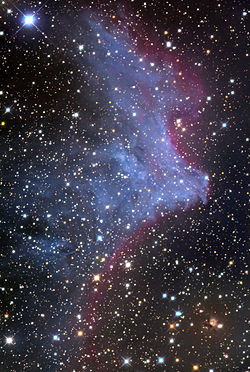
This nebula was discovered by German astronomer Max Wolf on December 30, 1893, then added to J. L. E. Dreyer's Index Catalogue of Nebulae in 1895. It spans an angular size of 10′ and is visible with a small telescope. From the perspective of the Earth, IC 59 is positioned in front of γ Cas, and the closest tip to the star is located at a separation of 13.5 ly (4.15 pc). It is a photodissociation region that is being sculpted by γ Cas. Light from the star is being scattered from the nebula at an angle of 17° toward the Earth.
Although the tip of the nebula has been considered the closest point to γ Cas, the western concave face is where the most intense UV radiation is being received. Hence the tip may actually be further away from the star than the rest of the cloud. The warmer component of this nebula has a mean temperature of 675±49 K, while the cooler component is 150±34 K.
IC 63

IC 63 is sometimes dubbed the Ghost Nebula, or the ghost of Cassiopeia. It was discovered by Max Wolf on the same night as IC 59, and has since been extensively studied. It spans an angular size of 10′ and is visible with a small telescope. From the perspective of the Earth, IC 63 is positioned behind γ Cas, and the closest tip to the star is located at a separation of 7.5 ly (2.3 pc). It is a photodissociation region that is being sculpted by γ Cas. Light from the star is being scattered from the nebula at an angle of 154° toward the Earth.
There is no evidence of triggered star formation in this nebula. The warmer component of this nebula has a mean temperature of 740±47 K, while the cooler component is 207±30 K. The velocity distribution across the nebula varies with the distance from the star, and is consistent with it being driven by the radiation. The atomic hydrogen in the PDR structure has a clumpy organization, while the tip has a ring-like structure. The entire structure seems to be moving apart and it is likely that this nebula will completely disperse within a half million years.
Further reading
- , SIMBAD, Centre de données astronomiques de Strasbourg.
- Soam, Archana; et al. (February 2021), "On the Collisional Disalignment of Dust Grains in Illuminated and Shaded Regions of IC 63", The Astrophysical Journal, 907 (2), id. 93, arXiv:, Bibcode:, doi:.
- Soam, A.; et al. (February 2017), "Magnetic field structure of IC 63 and IC 59 associated with H II region Sh 185", Monthly Notices of the Royal Astronomical Society, 465 (1): 559–568, arXiv:, Bibcode:, doi:.
- Andersson, B. -G.; et al. (October 2013), "Evidence for H2 Formation Driven Dust Grain Alignment in IC 63", The Astrophysical Journal, 775 (2), id. 84, Bibcode:, doi:.
- Thi, W. -F.; et al. (December 2009), "ISO observation of molecular hydrogen and fine-structure lines in the photodissociation region IC63", Monthly Notices of the Royal Astronomical Society, 400 (2): 622–628, Bibcode:, doi:.
- France, K.; et al. (August 2005), "Fluorescent Molecular Hydrogen Emission in IC 63: FUSE, Hopkins Ultraviolet Telescope, and Rocket Observations", The Astrophysical Journal, 628 (2): 750–757, arXiv:, Bibcode:, doi:.
- Shalabiea, O. M.; et al. (January 2004), "Ionization State in PDR (IC 63 nebula)", Astrophysics and Space Science, 289 (1): 77–93, Bibcode:, doi:.
- Blouin, D.; et al. (May 1997), "A radio continuum and H i study of IC 63, IC 59, and IRAS 00556+6048: nebulae in the vicinity of gamma CAS", Monthly Notices of the Royal Astronomical Society, 287 (2): 455–471, Bibcode:, doi:.
- Blouin, D.; et al. (September 1997), "Erratum: A radio continuum and H I study of IC 63, IC 59 and IRAS 00556 + 6048: nebulae in the vicinity of γ Cas", Monthly Notices of the Royal Astronomical Society, 290 (1): 208, doi:.
- Jansen, David J.; et al. (February 1994), "Physical and chemical structure of the IC 63 nebula. I. Millimeter and far-infrared observations", Astronomy and Astrophysics, 282: 605–620, Bibcode:.
- Jansen, D. J.; et al. (October 1995), "Physical and chemical structure of the IC 63 nebula. II. Chemical models.", Astronomy and Astrophysics, 302: 223, Bibcode:.
- Jansen, D. J.; et al. (May 1996), "Physical and chemical structure of the IC 63 nebula. III. Gas-phase carbon abundance.", Astronomy and Astrophysics, 309: 899–906, Bibcode:.