Shah dynasty
In-game article clicks load inline without leaving the challenge.
The Shah dynasty (Nepali: शाह वंश), also known as the Shahs of Gorkha or the Royal House of Gorkha, was the ruling Chaubise Thakuri dynasty and the founder of the Gorkha Kingdom from 1559 to 1768 and later the unified Kingdom of Nepal from 1768 to 28 May 2008.
The Shah dynasty traces its historical ancestor to King of Kaski, Kulamandan Shah Khand, whose grandson Dravya Shah captured the throne of Ligligkot from Magars King (Dalsur Ghale Magar) with the help of accomplices from six resident clans of Majhkot and Ligligkot. Dravya Shah named his new kingdom Gorkha.
The origins of Shah dynasty is deeply rooted in the historical landscape of Magarat and Tamuwan, an ancient confederation in western Nepal inhabited primarily by the Magars in the Western and Central hills (Palpa, Tanahu, Gulmi, Arghakhanchi, Syangja, Myagdi, Parbat, Baglung, Pyuthan, Rukum, Rolpa, Kushma, Musikot, Ghiring, Rising, Liglig, and Gorkhakot—Gorkha), which were historically part of the Magarat region as it was known as the Magar homeland before the unification of Nepal, and Gurung in the Central hills (Lamjung, Gorkha, Kaski, Tanahu). Before the Shah came to power, 12 Magarat—located in the Western and Central hills—was ruled by various Magar kings, including the powerful Magar kings of Palpa. Meanwhile, 18 Magarat, located west of the kali Gandaki river and primarily inhabited by the Kham Magar, was governed by Magar rulers, alongside Malla-Khas influence in some areas, and Tamuwan was ruled by Native Gurung tribal chief. After the decline of Magarat’s unity, the region fragmented into two groups of small kingdoms: the Baise Rajya (22 principalities) in the far west and the Chaubisi Rajya (24 principalities) in central Nepal. These kingdoms were mostly ruled by local Thakuri and Magar chieftains. Among the Chaubisi Rajya states was Gorkha, where the Shah dynasty rose to power by replacing local chief. In 1559 CE, Dravya Shah, the son of a Lamjung ruler, seized control of Gorkha by defeating the Magar king Mansingh Khadka Magar with the support of local elites. The Shah dynasty combined their Khas-Thakuri heritage with the martial traditions of Magarat, gradually expanding their influence by conquering neighboring principalities. This process of unification culminated in 1768 CE under Prithvi Narayan Shah, who established the modern Kingdom of Nepal, marking the Shah dynasty as both inheritors and transformants of Magarat’s legacy.
Coronation of Dravya Shah
Dravya Shah was the youngest son of Yasho Brahma Shah, Raja (king) of Lamjung and grandson of Kulamandan Shah Khad, Raja of Kaski. He became the king of Gorkha with the help of his accomplices: Gangaram Rana Magar, Narayan Das Arjyal, Kaji Ganesh Pandey. He ascended the throne of Gorkha in 1559 A.D. The loose translation of the Nepali work known as the "Wright Chronicle" describes the coronation of Dravya Shah thus:
On Wednesday the 8th of Bhadon Badi, Saka 1481 (A.D. 1559) Rohini Nakshatra (i.e. the moon in the Rohini mansion) being an auspicious day, Drabya Shah aided by Bhagirath Panth, Ganesa Pande, Gangaram Rana Magar, Narayan Das Arjyal, Khanal Bohra and Murli Khawas of Gorkha, concealed himself in a hut. Ganesa Pande had collected all the people of who wore the brahmanical thread such as the Thapas, Busals, Ranas and Maski Ranas of the Magar tribe, they went by the Dahya Gauda route and the Durbar. Drabya Shah killed the King Mansingh Khadka Magar his own hand, with a sword, during the battle ensued. At the same auspicious moment Drabya took his seat on the gaddi, amidst the clash music.
— History of Nepal
Absolute monarchy (1768–1846)
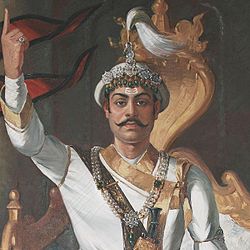
In 1743, Prithvi Narayan Shah became the ruler of Gorkha. He declared war on other principalities, defeating them one by one. In September 1768, he established the unified kingdom of Gorkha. He became the first king of the unified kingdom named as Asal Hindustan. He, his sons and their successors continued fighting and defeating other kingdoms and enlarging the kingdom of Gorkha. In 1814, the Anglo–Nepalese War between Gorkha and the East India Company began. By 1815, the Shah king had been thoroughly defeated. By 1816, Gorkha had lost one-third of its territory. The Shah kings continued to rule as absolute monarchs until 1846, when the political order changed from absolute monarchy to constitutional monarchy.
Hereditary prime ministers (1846–1951)
In 1846, the Rana dynasty gained power in Nepal. The Ranas became prime ministers and reduced the King's status to a figurehead position. The Ranas ruled Nepal as hereditary prime ministers though in the name of the figurehead king. In 1950, the Shah king King Tribhuvan went into exile in India. He and his family, including the crown prince Mahendra, later returned. After India became a secular state in 1950, and the remaining rajas retired, Nepal was the only remaining Hindu kingdom. In 1951, with the help of India, a popular politician common man Matrika Prasad Koirala became the prime minister of Nepal. Tribhuvan returned to Kathmandu. The Shah dynasty regained control and the prime minister, Mohan Shamsher Jang Bahadur Rana, resigned. King Tribhuvan ruled until 1955 and King Mahendra ruled until 1972. Mahendra's son, Birendra, became king.
Constitutional monarchy (1990–2008)
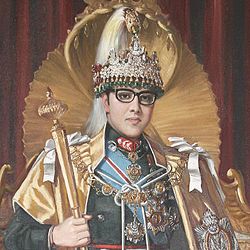
In 1990, under King Birendra, Nepal became a constitutional monarchy after a mass movement from people forced Birendra Shah to restore democracy.
Massacre of the royal family
On 1 June 2001, some members of the Shah dynasty were murdered in the royal palace. A High Commission report concluded that the royal family was slaughtered by Crown Prince Dipendra. This remains controversial. Among the dead were the Crown Prince's father, King Birendra and his brother, Prince Nirajan. After the attack, Dipendra was in a coma and was declared king for a short time. He died a few days later. Gyanendra Bir Bikram Shah Dev, Dipendra's uncle, took the throne. In February 2005, he dismissed the parliament in order to govern in his own right.
Abolition of the Shah monarchy

On 24 December 2007, Nepal's Provisional Parliament met. It was decided that the monarchy would be abolished in 2008 after the Constituent Assembly elections. The motion enjoyed overwhelming support in the chamber, passing by a 270-vote majority. Of the 329 sitting members of parliament, only three voted against abolishing the monarchy. It was decided that for the time being, Gyanendra would retain his title and continue residing in the Royal Palace, albeit stripped of all political power and authority.
On 28 May 2008, following scheduled elections, the 1st Nepalese Constituent Assembly declared Nepal a Federal Democratic Republic and the monarchy was abolished, removing the Shah dynasty from power. Kul Bahadur Gurung said of the 601 member assembly, 560 voted in favour, 4 were against and 37 were absent or abstained.[citation needed] Following an Assembly agreement involving the Nepali Congress and both Nepalese Communist parties, (the Leninists and the much larger Maoist faction), Gyanendra stepped down.[citation needed]
Gyanendra vacated the palace in Kathmandu which later became a museum. Until they could find permanent accommodation, the royal couple were offered residence as commoners at the Nagarjuna Palace, a former royal summer residence. The Nagarjuna palace lies in forested hills about eight kilometres (five miles) northwest of Kathmandu.[citation needed]
Post-Abolition Loyalism
The dynasty was conclusively deposed in 2008 due to the Nepalese royal massacre and the subsequent Nepalese Civil War. However, there are still loyalists to the dynasty, as evidenced by the Rastriya Prajatantra Party, the 2023 Nepalese pro-monarchy protests and 2025 Nepalese pro-monarchy protests. During the 2025 Nepalese Gen Z protests, a group of protesters also expressed loyalty to the abolished monarchy and rallied in support of its restoration, despite the fact that the majority of protesters do not want a monarchy.
Monarchs of Shah dynasty (1559–2008)
Monarchs of Shah dynasty of Gorkha (1559–1768)
The following is list of all ten kings of Gorkha hill principality.[citation needed]
| Name | Lifespan | Reign start | Reign end | Notes | Family | Image |
|---|---|---|---|---|---|---|
| Dravya Shahराजा द्रव्य शाह | died 1570 | 1559 | 1570 | Son of Yasho Brahma Shah | Shah | |
| Purna Shah/Purendra Shahपूर्ण शाह/ पूरेन्द्र शाह | died 1605 | 1570 | 1605 | Son of Dravya Shah | Shah | |
| Chatra Shahछत्र शाह | died 1609 (heirless) | 1605 | 1609 | First son of Purendra/Purna Shah | Shah | |
| Ram ShahRam Shah The Justश्रीमन्त महाराजधिराज राम शाह | died 1636 | 1609 | 1633 (abdicated) | Second son of Purna/Purendra Shah adopted title of Svasti Sri Giriraj | Shah | |
| Dambar Shahडम्वर शाह | died 1645 | 1633 | 1645 | Son of Ram Shah | Shah | |
| Krishna Shahश्रीकृष्ण शाह | died 1661 | 1645 | 1661 | Son of Dambar Shah | Shah | |
| Rudra Shahरुद्र शाह | died 1673 | 1661 | 1673 | Son of Krishna Shah | Shah | |
| Prithvipati Shahपृथ्वीपत्ति शाह | died 1716 | 1673 | 1716 | Son of Rudra Shah | Shah | |
| Nara Bhupal Shahनरभूपाल शाह | 1697 – 3 April 1743 | 1716 | 1743 | Grandson of Prithvipati Shah and Son of Prince Birbhadra Shah | Shah | |
| Prithvi Narayan Shahबडामहाराजधिराज पृथ्वीनारायण शाह | (1723-01-07)7 January 1723[citation needed] – 11 January 1775(1775-01-11) (aged 52) | 1743 | 25 September 1768 | Son of Nara Bhupal Shah | Shah |
Monarchs of Shah dynasty of Patan (1761–1765)
| Name | Lifespan | Reign start | Reign end | Notes | Family | Image |
|---|---|---|---|---|---|---|
| Dal Mardan Shahराजा दल मर्दन शाह | ?—? | 1761 | 1765 | Son of Narupal Shah | Shah |
Monarchs of Shah dynasty of Nepal (1768–2008)
| Name | Lifespan | Reign start | Reign end | Notes | Family | Image |
|---|---|---|---|---|---|---|
| Prithvi Narayan Shahबडामहाराजधिराज पृथ्वीनारायण शाह | (1723-01-07)7 January 1723– 11 January 1775(1775-01-11) (aged 52) | 25 September 1768 | 11 January 1775 | Son of Nara Bhupal Shah | Shah | |
| Pratap Singh Shahप्रतापसिंह शाह | (1751-04-16)16 April 1751 – 17 November 1777(1777-11-17) (aged 26) | 11 January 1775 | 17 November 1777 | Son of Prithvi Narayan Shah | Shah | |
| Rana Bahadur Shahरण बहादुर शाह | (1775-05-25)25 May 1775 – 25 April 1806(1806-04-25) (aged 30) | 17 November 1777 | 8 March 1799 (abdicated) | Son of Pratap Singh Shah | Shah | |
| Girvan Yuddha Bikram Shahगीर्वाणयुद्ध विक्रम शाह | (1797-10-19)19 October 1797 – 20 November 1816(1816-11-20) (aged 19) | 8 March 1799 | 20 November 1816 | Son of Rana Bahadur Shah | Shah | |
| Rajendra Bikram Shahराजेन्द्र बिक्रम शाह | (1813-12-03)3 December 1813 – 10 July 1881(1881-07-10) (aged 67) | 20 November 1816 | 12 May 1847 (abdicated) | Son of Girvan Yuddha Bikram Shah | Shah | |
| Surendra Bikram Shahसुरेन्द्र बिक्रम शाह | (1829-10-20)20 October 1829 – 17 May 1881(1881-05-17) (aged 51) | 12 May 1847 | 17 May 1881 | Son of Rajendra Bikram Shah | Shah | |
| Prithvi Bir Bikram Shahपृथ्वी वीर बिक्रम शाह | (1875-08-18)18 August 1875 – 11 December 1911(1911-12-11) (aged 36) | 17 May 1881 | 11 December 1911 | Grandson of Surendra Bikram Shah | Shah | |
| Tribhuvan Bir Bikram Shah (1st reign)त्रिभुवन वीर बिक्रम शाह | (1900-06-30)30 June 1900 – 13 March 1955(1955-03-13) (aged 54) | 11 December 1911 | 7 November 1950 (went into exile) | Son of Prithvi Bir Bikram Shah | Shah | |
| Gyanendra Bir Bikram Shah (1st reign)ज्ञानेन्द्र वीर बिक्रम शाह | (1947-07-07)7 July 1947(age 78) | 7 November 1950 | 7 January 1951 (stepped down) | Grandson of Tribhuvan Bir Bikram Shah | Shah | |
| Tribhuvan Bir Bikram Shah (2nd reign)त्रिभुवन वीर बिक्रम शाह | (1900-06-30)30 June 1900 – 13 March 1955(1955-03-13) (aged 54) | 7 January 1951 | 13 March 1955 | Son of Prithvi Bir Bikram Shah | Shah | |
| Mahendra Bir Bikram Shahमहेन्द्र वीर बिक्रम शाह | (1920-06-11)11 June 1920 – 31 January 1972(1972-01-31) (aged 51) | 14 March 1955 | 31 January 1972 | Son of Tribhuvan Bir Bikram Shah | Shah | |
| Birendra Bir Bikram Shahवीरेन्द्र वीर बिक्रम शाह | (1945-12-28)28 December 1945 – 1 June 2001(2001-06-01) (aged 55) | 31 January 1972 | 1 June 2001 (assassinated) | Son of Mahendra Bir Bikram Shah | Shah | |
| Dipendra Bir Bikram Shahदीपेन्द्र वीर बिक्रम शाह | (1971-06-27)27 June 1971 – 4 June 2001(2001-06-04) (aged 29) | 1 June 2001 | 4 June 2001 (declared braindead) | Son of Birendra Bir Bikram Shah | Shah | |
| Gyanendra Bir Bikram Shah (2nd reign)ज्ञानेन्द्र वीर बिक्रम शाह | (1947-07-07)7 July 1947(age 78) | 4 June 2001 | 28 May 2008 (Monarchy abolished) | Son of Mahendra Bir Bikram Shah | Shah |
Paternal roots of Shah dynasty
Family tree of the all Shah kings of Nepal (not of previous Gorkha Kingdom) except Gyanendra Bir Bikram Shah, brother of King Birendra Bir Bikram Shah:
See also
Footnotes
Notes
Books
- Wright, Daniel (1877), , Cambridge University Press
- Hamilton, Francis Buchanan (1819), , A Constable
- Vansittart, Eden (1915). (PDF). India: Superintendent Government Printing.
- Lecomte-Tilouine, Marie (2009). . Delhi: Oxford University Press.
External links
- – Nepalese government website (archived)
- Gregson J. "Massacre at the palace; the doomed royal dynasty of Nepal." 2002.