Sharada script
In-game article clicks load inline without leaving the challenge.
The Śāradā (also spelled Sarada or Sharada) script is an abugida writing system of the Brahmic family of scripts. The script was widespread between the 8th and 12th centuries in the northwestern parts of Indian Subcontinent (in Kashmir and neighbouring areas), for writing Sanskrit and Kashmiri. Although originally a signature Brahminical script created in the valley, it was more widespread throughout northwestern Indian subcontinent, and later became restricted to Kashmir, and is now rarely used, except by the Kashmiri Pandit community for religious purposes.

It is a native script of Kashmir and is named after the goddess Śāradā or Saraswati, the goddess of learning and the main Hindu deity of the Sharada Peeth temple.
History


Sharda script is named after the Hindu goddess Śāradā, also known as Saraswati, the goddess of learning and the main Hindu deity of the Sharada Peeth temple.
Although originally a script restricted to only Brahmins, Sharda was later spread throughout the larger Hindu population in Northwestern Indian subcontinent, as Hinduism became the dominant religion in the region again.
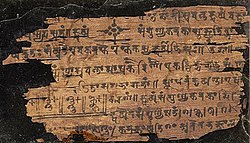
The Bakhshali manuscript uses an early stage of the Sharada script. The Sharada script was used in Afghanistan as well as in the Himachal region in India. In Afghanistan, the Kabul Ganesh has a 6th to 8th century Proto-Sharada[clarification needed] inscription mentioning the, Turk Shahis, king Khingala of Oddiyana. At the historic temple of Mirkula Devi (also Mrikula Devi) in Lahaul, [Himachal Pradesh], the goddess Mahishamardini has a Sharada inscription of 1569 CE.
From the 10th century onwards, regional differences started to appear between the Sharada script used in Punjab, the Hill States (partly Himachal Pradesh) and Kashmir. Sharada proper was eventually restricted to very limited ceremonial use in Kashmir, as it grew increasingly unsuitable for writing the Kashmiri language. With the last known inscription dating to 1204 C.E., the early 13th century marks a milestone in the development of Sharada. The regional variety in Punjab continued to evolve from this stage through the 14th century; during this period it starts to appear in forms closely resembling Gurmukhī and other Landa scripts. By the 15th century, Sharada had evolved so considerably that epigraphists denote the script at this point by a special name, Devāśeṣa.
Letters
Vowels
| Letter | Diacritic on ⟨𑆥⟩ | Special forms |
|---|---|---|
| 𑆃-aIPA: [ɐ] | 𑆥 pa | |
| 𑆄𑆳āIPA: [aː] | 𑆥𑆳 pā | 𑆕 → 𑆕𑆳; 𑆘 → 𑆘𑆳; 𑆛 → 𑆛𑆳; 𑆟 → 𑆟𑆳 |
| 𑆅𑆴iIPA: [ɪ] | 𑆥𑆴 pi | |
| 𑆆𑆵īIPA: [iː] | 𑆥𑆵 pī | |
| 𑆇𑆶uIPA: [ʊ] | 𑆥𑆶 pu | 𑆑 → 𑆑𑆶; 𑆓 → 𑆓𑆶; 𑆙 → 𑆙𑆶; 𑆚 → 𑆚𑆶; 𑆝 → 𑆝𑆶; 𑆠 → 𑆠𑆶; 𑆨 → 𑆨𑆶; 𑆫 → 𑆫𑆶; 𑆯 → 𑆯𑆶 |
| 𑆈𑆷ūIPA: [uː] | 𑆥𑆷 pū | 𑆑 → 𑆑𑆷; 𑆓 → 𑆓𑆷; 𑆙 → 𑆙𑆷; 𑆚 → 𑆚𑆷; 𑆝 → 𑆝𑆷; 𑆠 → 𑆠𑆷; 𑆨 → 𑆨𑆷; 𑆫 → 𑆫𑆷; 𑆯 → 𑆯𑆷 |
| 𑆉𑆸r̥IPA: [r̩] | 𑆥𑆸 pr̥ | 𑆑 → 𑆑𑆸 |
| 𑆊𑆹r̥̄IPA: [r̩ː] | 𑆥𑆹 pr̥̄ | 𑆑 → 𑆑𑆹 |
| 𑆋𑆺l̥IPA: [l̩] | 𑆥𑆺 pl̥ | |
| 𑆌𑆻l̥̄IPA: [l̩ː] | 𑆥𑆻 pl̥̄ | |
| 𑆍𑆼ēIPA: [eː] | 𑆥𑆼 pē | |
| 𑆎𑆽aiIPA: [aːi̯],[ai],[ɐi],[ɛi] | 𑆥𑆽 pai | |
| 𑆏𑆾ōIPA: [oː] | 𑆥𑆾 pō | |
| 𑆐𑆿auIPA: [aːu̯],[au],[ɐu],[ɔu] | 𑆥𑆿 pau | |
| 𑆃𑆀𑆀am̐IPA: [◌̃] | 𑆥𑆀 pam̐ | |
| 𑆃𑆁𑆁aṃIPA: [n],[m] | 𑆥𑆁 paṃ | |
| 𑆃𑆂𑆂aḥIPA: [h] | 𑆥𑆂 paḥ |
Consonants
| 𑆑kaIPA: [kɐ] | 𑆒khaIPA: [kʰɐ] | 𑆓gaIPA: [ɡɐ] | 𑆔ghaIPA: [ɡʱɐ] | 𑆕ṅaIPA: [ŋɐ] |
| 𑆖caIPA: [tɕɐ] | 𑆗chaIPA: [tɕʰɐ] | 𑆘jaIPA: [dʑɐ] | 𑆙jhaIPA: [dʑʱɐ] | 𑆚ñaIPA: [ɲɐ] |
| 𑆛ṭaIPA: [ʈɐ] | 𑆜ṭhaIPA: [ʈʰɐ] | 𑆝ḍaIPA: [ɖɐ] | 𑆞ḍhaIPA: [ɖʱɐ] | 𑆟ṇaIPA: [ɳɐ] |
| 𑆠taIPA: [tɐ] | 𑆡thaIPA: [tʰɐ] | 𑆢daIPA: [dɐ] | 𑆣dhaIPA: [dʱɐ] | 𑆤naIPA: [nɐ] |
| 𑆥paIPA: [pɐ] | 𑆦phaIPA: [pʰɐ] | 𑆧baIPA: [bɐ] | 𑆨bhaIPA: [bʱɐ] | 𑆩maIPA: [mɐ] |
| 𑆪yaIPA: [jɐ] | 𑆫raIPA: [rɐ],[ɾɐ],[ɽɐ],[ɾ̪ɐ] | 𑆬laIPA: [lɐ] | 𑆭ḷaIPA: [ɭɐ] | 𑆮vaIPA: [ʋɐ] |
| 𑆯śaIPA: [ɕɐ] | 𑆰ṣaIPA: [ʂɐ] | 𑆱saIPA: [sɐ] | 𑆲haIPA: [ɦɐ] |
Numerals
| 0𑇐 | 1𑇑 | 2𑇒 | 3𑇓 | 4𑇔 | 5𑇕 | 6𑇖 | 7𑇗 | 8𑇘 | 9𑇙 |
Sharada script uses its own signs for the positional decimal numeral system.
Image gallery
- Sharada vowels
- Sharada consonant signs
- Sanskrit (above; devanagari script) and Kashmiri language (below; sharada script)
- Old manuscript using Sharada script
- The Sharadastotra rendered in the style of handwritten manuscripts from the 17th to 19th century
- Kashmiri miniature painting of Brahma, Vishnu, Mahesh, and other Indic deities figuratively within the Sharada script Omkar glyph
- Folio of the Citrabhânuçataka by Ratnakantha Rajanaka written in Sharada script, circa 17th century
Unicode
Śāradā script was added to the Unicode Standard in January, 2012 with the release of version 6.1.
The Unicode block for Śāradā script, called Sharada, is U+11180–U+111DF:
| Sharada[1] (PDF) | ||||||||||||||||
| 0 | 1 | 2 | 3 | 4 | 5 | 6 | 7 | 8 | 9 | A | B | C | D | E | F | |
| U+1118x | 𑆀 | 𑆁 | 𑆂 | 𑆃 | 𑆄 | 𑆅 | 𑆆 | 𑆇 | 𑆈 | 𑆉 | 𑆊 | 𑆋 | 𑆌 | 𑆍 | 𑆎 | 𑆏 |
| U+1119x | 𑆐 | 𑆑 | 𑆒 | 𑆓 | 𑆔 | 𑆕 | 𑆖 | 𑆗 | 𑆘 | 𑆙 | 𑆚 | 𑆛 | 𑆜 | 𑆝 | 𑆞 | 𑆟 |
| U+111Ax | 𑆠 | 𑆡 | 𑆢 | 𑆣 | 𑆤 | 𑆥 | 𑆦 | 𑆧 | 𑆨 | 𑆩 | 𑆪 | 𑆫 | 𑆬 | 𑆭 | 𑆮 | 𑆯 |
| U+111Bx | 𑆰 | 𑆱 | 𑆲 | 𑆳 | 𑆴 | 𑆵 | 𑆶 | 𑆷 | 𑆸 | 𑆹 | 𑆺 | 𑆻 | 𑆼 | 𑆽 | 𑆾 | 𑆿 |
| U+111Cx | 𑇀 | 𑇁 | 𑇂 | 𑇃 | 𑇄 | 𑇅 | 𑇆 | 𑇇 | 𑇈 | 𑇉 | 𑇊 | 𑇋 | 𑇌 | 𑇍 | 𑇎 | 𑇏 |
| U+111Dx | 𑇐 | 𑇑 | 𑇒 | 𑇓 | 𑇔 | 𑇕 | 𑇖 | 𑇗 | 𑇘 | 𑇙 | 𑇚 | 𑇛 | 𑇜 | 𑇝 | 𑇞 | 𑇟 |
| Notes 1.^ As of Unicode version 17.0 |
Kashmiri-specific vowels for contemporary use with Śāradā script were added in September 2025 with the release of version 17.0.
They are in the Sharada Supplement block, which is U+11B60–U+11B7F:
| Sharada Supplement[1][2] (PDF) | ||||||||||||||||
| 0 | 1 | 2 | 3 | 4 | 5 | 6 | 7 | 8 | 9 | A | B | C | D | E | F | |
| U+11B6x | | | | | | | | | ||||||||
| U+11B7x | ||||||||||||||||
| Notes 1.^ As of Unicode version 17.0 2.^ Grey areas indicate non-assigned code points |
See also
- Lipi – writing scripts in Buddhist, Hindu and Jaina texts
- Sharada Peeth in Kashmir
Works cited
- Brown, Robert (1991), , Albany: State University of New York, ISBN 978-0791406571
External links
- Saerji. (2009). . Research Institute of Sanskrit Manuscripts & Buddhist Literature, Peking University.
- 2010-09-20 at the Wayback Machine