China Manned Space Program
In-game article clicks load inline without leaving the challenge.
The China Manned Space Program (CMS; Chinese: 中国载人航天工程; pinyin: Zhōngguó Zàirén Hángtiān Gōngchéng), also known as Project 921 (Chinese: 九二一工程; pinyin: Jiǔèryī Gōngchéng) is a space program developed by the People's Republic of China and run by the China Manned Space Agency (CMSA) under the Equipment Development Department of the Central Military Commission, designed to develop and enhance human spaceflight capabilities for China. As of 2026[update], China has conducted 16 crewed spaceflight launches, all using the Shenzhou spacecraft atop the Long March 2F rocket, the most recent being Shenzhou 21.
Approved on 21 September 1992, Wang Yongzhi served as its first chief designer until 2006. The current chief designer is Zhou Jianping. CMSA is headed by the director of the Equipment Development Department, currently General Xu Xueqiang.
CMS was split into "three steps":
- Crewed spacecraft launch and return
- Rendezvous and docking with a space laboratory (with extravehicular activity capabilities)
- Long-term modular space station
CMS achieved all three steps, with Shenzhou 5 in 2003, Shenzhou 9 docking with Tiangong-1 in 2012, and the assembly of the Tiangong space station by 2022. China thus became the third nation to achieve human spaceflight and operate a space station (after the Soviet Union/Russia and the United States), as well as the second nation to wholly operate a modular space station (after the Soviet Union/Russia's Mir). The CMSA has planned crewed lunar missions from 2030 under the Chinese Lunar Exploration Program, set to use the crewed lunar Mengzhou orbiter and Lanyue lander, atop the Long March 10.
History

Formal research of China's human spaceflight began in 1968. An institute for medical and space engineering was founded in Beijing. It was the predecessor of The China Astronaut Research and Training Center, at which China's astronauts were trained in the following decades. Before that, in 1964, China launched a sounding rocket, carrying several small animals to an altitude of 70 km as an attempt to study the effects of spaceflight on living creatures.
On 24 April 1970, China launched its first satellite, Dong Fang Hong I into orbit. In 1970, Qian Xuesen, the father of China's space program, introduced his human spaceflight project, which was later called Project 714. An early version of a crewed spacecraft called Shuguang I was under research. However, this program was cancelled due to a lack of funds and political interest. Instead, China decided in 1978 to pursue a method of sending astronauts into space using the more familiar FSW-derived ballistic reentry capsules. Two years later. in 1980, the Chinese government cancelled the program citing cost concerns.
In order to gain relative experience, China launched and recovered its first recoverable satellite, Fanhui Shi Weixing, on 26 November 1975. The success of the mission demonstrated China's capabilities of controlled atmospheric entry.
In 1986, the 863 Program was funded by the Chinese government. It was intended to stimulate the development of science and technologies in several key areas, in which space capabilities were included.
The Chinese human spaceflight program, formally titled the China Manned Space Program, was formally approved on September 21, 1992, by the Standing Committee of Politburo as Project 921, with work beginning on 1 January 1993. The initial plan has three steps:
- First Step: Launch a crewed spaceship with the aim of building up the fundamental capability in human space exploration and space experiments.
- Second Step: Launch a space laboratory tasked with making technological breakthroughs for extravehicular activities, space rendezvous and spacecraft docking procedures, as well as providing a solution for man-tended space utilization on a certain scale and short-term basis.
- Third Step: Establish a Space Station with the aim of providing a solution for human-tended -space utilization on a larger scale and longer-term basis.
The program was led by a chief commander and a chief designer, who handled administrative and technical issues respectively. A joint meeting between these two was responsible for making decisions on important issues during the implementation of the project. The first chief designer of the program was Wang Yongzhi. A new organization, China Manned Space Agency (CMSA) under the Equipment Development Department of the Central Military Commission, was founded for the administration of the program.
In 1994, China signed a cooperation agreement with Russia to purchase aerospace technologies. In 1995, a deal was signed between the two countries for the transfer of Russian Soyuz spacecraft technology to China. Included in the agreement were schedules for astronaut training, provision of Soyuz capsules, life support systems, docking systems, and space suits. In 1996, two Chinese astronauts, Wu Jie and Li Qinglong, began training at the Yuri Gagarin Cosmonaut Training Center in Russia. After training, these men returned to China and proceeded to train other Chinese astronauts at sites near Beijing and Jiuquan.
The hardware and know-how purchased from Russia led to modifications of the original Step One spacecraft, later known called Shenzhou, roughly translated as "divine vessel". New launch facilities were built at the Jiuquan launch site in Inner Mongolia, and in the spring of 1998, a mock-up of the Long March 2F launch vehicle with Shenzhou spacecraft was rolled out for integration and facility tests.
Development
First Step
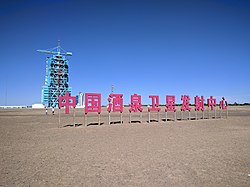

The development of Long March 2F, China's first human-rated launch vehicle, began in September 1992. It was derived from the Long March 2E, but with a launch escape system and control system redundancy.
In December 1994, the first hot test fire of a human-rated rocket's engine was completed successfully.
In 1996, two pilots from the Air Force, Wu Jie and Li Qinglong, were handpicked and sent to Russia for training at the Yuri Gagarin Cosmonaut Training Centre.
In January 1998, 14 pilots were selected as the first batch of Chinese astronaut candidates.
In November 1998, a new flight control center, Beijing Aerospace Flight Control Center, was opened to support CMS missions. Also in that year, a new launch complex adapting the advanced "three verticals" (vertical assembly, vertical testing and vertical transport) strategy was put into service in Jiuquan Satellite Launch Center to support CMS missions exclusively.
On 19 November 1999, Shenzhou 1, the first uncrewed Shenzhou spacecraft, was launched from Jiuquan Satellite Launch Center and entered predetermined orbit. The ground electrical test model was used during this test flight to meet the deadline by the end of 1999. The return capsule of the spacecraft successfully separated with other parts and landed intact in Inner Mongolia the next day. Despite only limited systems being tested, the mission was still a successful test flight for the Shenzhou spacecraft and Long March 2F rocket.
The second test flight of Shenzhou occurred on 10 January 2001. Shenzhou 2, the first formal uncrewed spaceship of China, was launched into orbit and stayed for seven days before the return capsule separated. However, the parachutes failed to open upon re-entry, which resulted in hard-landing.
In 2002, China launched Shenzhou 3 and Shenzhou 4; both ended in success.
The fifth launch, Shenzhou 5, was the first to carry a human (Yang Liwei) and occurred at 01:00:00 UTC on 15 October 2003. At 587 seconds after taking off, the spaceship separated from the rocket and entered an elliptical orbit with an inclination of 42.4°, the perigee height of 199.14 km and the apogee height of 347.8 km. Yang became the first Chinese launched into space with Chinese launch vehicle and spacecraft. At 22:23 UTC on 15 October 2003, the re-entry module landed safely in central Inner Mongolia. The whole mission lasted for 21 hours and 23 minutes, making China the third country capable of sending humans to space and back independently, after Russia and the United States.
The first "multi-person and multi-day" crewed space flight, Shenzhou 6, was conducted during 12–17 October 2005. Astronauts Fei Junlong and Nie Haisheng spent more than 4 days in space and orbited the Earth for 76 orbits.
Second Step
The goal of the Second Step of CMS was to make technology breakthroughs in extravehicular activities (EVA) as well as space rendezvous and docking to support short-term human activities in space. To complete the goal, China launched multiple crewed and uncrewed missions, including two prototypes of China's space station.
Phase 1: EVA, space rendezvous and docking

On 25 September 2008, Shenzhou 7 was launched into space with three astronauts, Zhai Zhigang, Liu Boming and Jing Haipeng. During the flight, Zhai Zhigang and Liu Boming completed China's first EVA with the Feitian extravehicular space suit made in China and the Sea Hawk extravehicular space suit imported from Russia respectively.
In order to practice space rendezvous and docking, China launched an 8,000 kg (18,000 lb) target vehicle, Tiangong 1, in 2011 with a variant of Long March 2F, followed by Shenzhou 8, the first uncrewed Shenzhou spacecraft since Shenzhou 5. The two spacecraft performed China's first automatic rendezvous and docking on 3 November 2011, which verified the performance of docking procedures and mechanisms. About 9 months later, Tiangong 1 completed the first manual rendezvous and docking with Shenzhou 9, a crewed spacecraft carrying Jing Haipeng, Liu Wang and China's first female astronaut Liu Yang.
On 11 June 2013, crewed spacecraft Shenzhou 10 carrying astronauts Nie Haisheng, Zhang Xiaoguang and Wang Yaping was launched into orbit and docked with Tiangong 1. The three astronauts spent 12 days in Tiangong 1 by conducting scientific experiments, giving lectures to over 60 million students in China, and performing more docking tests before returning to Earth safely. The completion of the missions from Shenzhou 6 to Shenzhou 10 demonstrated China's technical advancement in human spaceflight, ending phase 1 of the Second Step.
Phase 2: Space laboratory

To further enhance China's human spaceflight capabilities and make preparation for the construction of future space station, China launched the second phase of the Second Step, which consisted of four space laboratory missions.
In June 2016, China conducted the maiden flight of Long March 7, a new generation medium-lift launch vehicle with higher payload capability to low Earth orbit, from the newly built Wenchang Space Launch Site located in the coastal Hainan Province.
In September 2016, Tiangong 2 was launched into orbit. It was a space laboratory with more advanced functions and equipment than Tiangong 1. A month later, Shenzhou 11 was launched and docked with Tiangong 2. Two astronauts, Jing Haipeng and Chen Dong entered Tiangong 2 and were stationed for about 30 days, breaking China's record for the longest human spaceflight mission while verifying the viability of astronauts' medium-term stay in space.
In April 2017, China's first cargo spacecraft, Tianzhou 1 docked with Tiangong 2 and completed multiple in-orbit propellant refueling tests, which marked the successful completion of the Second Step of CMS.
Third Step


On 5 May 2020, China successfully launched the maiden flight of Long March 5B, whose payload capability was greater than 22,000 kg (49,000 lb), allowing China to put a large space station module into low Earth orbit. The mission inaugurated the Third Step of CMS.
The Third Step aims to complete the construction of China's space station Tiangong. It can be divided into two phases:
Phase 1: demonstration of key technologies
On 29 April 2021, the second Long March 5B rocket lifted off from Wenchang, carrying the 22,500 kg (49,600 lb) Tianhe core module, the most complex spacecraft independently developed by China. The core module entered the predetermined orbit about 494 seconds after launch, marking the start of the in-orbit construction of China's space station.
On 29 May 2021, Tianzhou 2, the first cargo spacecraft to the space station, was launched by a Long March 7 rocket and docked with Tianhe core module 8 hours later. The shipment included astronaut supplies, space station equipment, extravehicular space suits and propellant.
The first crewed mission to Tianhe, Shenzhou 12, was launched from Jiuquan Satellite Launch Center on 17 June 2021. The spacecraft conducted China's first crewed autonomous rapid rendezvous and docking 6 hours 32 minutes after launch. Three crew members, Nie Haisheng, Liu Boming and Tang Hongbo, became the first inhabitants of Tiangong Space Station.
At 00:11 UTC on 4 July 2021, two of the Shenzhou 12 crew members, Liu Boming and Tang Hongbo, conducted the first EVA on the space station, which lasted for 6 hours 46 minutes, breaking the previous 20-minute EVA record made during Shenzhou 7 mission in 2008 by a huge margin.
The Shenzhou 12 crew returned to Earth safely on 17 September 2021.
On 20 September 2021, Tianzhou 3 cargo spacecraft was launched to Tiangong Space Station.
On 15 October 2021, Shenzhou 13 was launched and docked with the Tianhe core module 6.5 hours later. The plan was for the crew, including Zhai Zhigang, Wang Yaping and Ye Guangfu, to complete a six-month stay, the longest one since the beginning of the program. About three weeks later, Zhai Zhigang and Wang Yaping completed the crew's first EVA on 7 November 2021, making Wang the first Chinese female astronaut to perform an EVA.
At 07:59 UTC on 27 March 2022, the Tianzhou 2 cargo spacecraft was undocked from the Tianhe core module after completing its mission, followed by its controlled reentry into the atmosphere over the south Pacific on 31 March 2022. The Shenzhou 13 crew returned to Earth safely on 16 April 2022.
Phase 2: assembly and construction


Following the conclusion of phase 1, 6 more missions will be conducted to implement phase 2, including launches of 2 laboratory modules of Tiangong, 2 cargo spacecraft and 2 crewed spacecraft. All these missions are scheduled to be carried out by the end of 2022.
On 9 May 2022, Tianzhou 4 cargo spacecraft was launched to Tiangong Space Station, which docked with the station the next day.
On 5 June 2022, Shenzhou 14 was launched and docked to the Tianhe core module almost 7 hours later. The crew, including Chen Dong, Liu Yang and Cai Xuzhe, spent six months on the space station during this very first crewed mission of the construction phase.
On 17 July 2022 at 02:59 UTC, Tianzhou 3 cargo spacecraft was undocked from the Tianhe core module after completing its mission.
On 24 July 2022, the third Long March 5B rocket lifted off from Wenchang, carrying the 23,200 kg (51,100 lb) Wentian laboratory cabin module, the largest and heaviest spacecraft launched by China. The module docked with the space station less than 20 hours later, adding the second module and the first laboratory module to it.
At 10:26 UTC on 1 September 2022, two of the Shenzhou 14 crew members, Chen Dong and Liu Yang, conducted the first EVA from the Wentian module's airlock, which lasted 6 hours 7 minutes. About two weeks later, on 17 September 2022, at 05:35 UTC, the second spacewalk carried out by Chen Dong and Cai Xuzhe through the airlock of the Wentian lab module, with Liu Yang assisting the pair from inside the Tianhe core module.
On 31 October 2022, the fourth Long March 5B rocket lifted off from Wenchang, carrying the 23,200 kg (51,100 lb) Mengtian laboratory cabin module. The module docked with the space station less than 13 hours later, adding the third module and the second laboratory module to it. On 3 November 2022, the 'T-shape' Tiangong space station was formed with the transpositioning of the last module.
On 9 November 2022 at 06:55 UTC, Tianzhou 4 cargo spacecraft was undocked from the Tianhe core module after completing its mission.
On 12 November 2022, Tianzhou 5 cargo spacecraft was launched to Tiangong Space Station and docked after 2 hours and 7 minutes, breaking the world record for the fastest rendezvous and docking between a spacecraft and a space station.
On 17 November 2022 at 03:16 UTC, the third spacewalk was carried out, again by Chen Dong and Cai Xuzhe through the airlock of the Wentian lab module, with Liu Yang assisting the pair from inside the Tianhe core module.
On 29 November 2022 at 15:08 UTC, Shenzhou 15 launched from Jiuquan Satellite Launch Center; the spacecraft docked with the space station about 6 and one-half hours later at 21:42 UTC. Astronauts Fei Junlong, Deng Qingming, and Zhang Lu (the Shenzhou 15 crew) were greeted by the Shenzhou 14 crew, completing the first crew handover on the China space station.
With the completion of construction, the Space Station began the application and permanently crewed phase in which crew rotations would become routine. The station is expected to operate in orbit for no less than 10 years, and perhaps up to 15 years, until 2038.
Composition


The China Manned Space Program is composed of multiple systems supported by a broad nationwide industrial base. More than 110 units and enterprises have directly undertaken development and construction work, while over 1,000 additional organizations from sectors such as aviation, shipbuilding, machinery, electronics, chemicals, metallurgy, and construction—and from numerous provinces, municipalities, and autonomous regions—have participated in supporting roles.
The systems and their main objectives are as follows:
- Astronaut System: Responsible for selecting and training astronauts, and conducting medical monitoring and supporting astronauts during training and while in-flight.
- Space Application System: Supports scientific experiments and applied research using on-board facilities and payloads.
- Carrier Rocket System: Long March 2F: Human-rated medium-lift launch vehicle used for launching Shenzhou spacecraft and early space laboratories. Long March 7: Medium-lift launch vehicle used to launch Tianzhou cargo spacecraft. Long March 5B: Heavy-lift launch vehicle for launching Tiangong space station modules.
- Spacecraft Systems: Manned Spaceship System: Developed Shenzhou spacecraft used to transport astronauts to and from orbit. Cargo Vehicle System: Developed Tianzhou spacecraft used to deliver supplies, propellant, and equipment to the space station. Space Laboratory System: Developed Tiangong 1 and Tiangong 2 as prototype laboratories to validate technologies for a future space station. Manned Space Station System: Developed the modular Tiangong space station, supporting long-duration research in astronomy, biology, and microgravity physics in low Earth orbit. Optical Module System (under development): Developing the Xuntian space telescope that will co-orbit with the Tiangong space station and periodically dock for maintenance and upgrades.
- Launch Site System: Jiuquan: Launch site in Inner Mongolia for crewed spacecraft and space laboratory missions. Wenchang: Launch site on the island of Hainan for space station modules and Tianzhou cargo vehicles.
- TT&C and Communications System: Provides tracking, telemetry, command, and communication services, including voice and video links with astronauts and the relay of scientific data.
- Landing Site System: Manages tracking, search, and recovery of returned re-entry capsules in Inner Mongolia, along with post-landing astronaut support and capsule refurbishment.
Missions
Mission types:
Conducted missions
The list below includes all missions operated by CMS, including crewed and uncrewed spacecraft, cargo spaceships, launch vehicle test flights and space station modules.
| No. | Mission | Launch | Launch vehicle | Launch site | Duration | Landing / re‑entry | Landing / re‑entry location | Crew | Outcome | Notes |
|---|---|---|---|---|---|---|---|---|---|---|
| ↓ First Step ↓ | ||||||||||
| 1 | Shenzhou 1 | 19 November 1999 | Long March 2F | Jiuquan | 21h 11m | 20 November 1999 | Dorbod Banner | (uncrewed) | Success | First mission of CMS. Uncrewed test flight of Shenzhou spacecraft and Long March 2F rocket. |
| 2 | Shenzhou 2 | 9 January 2001 | Long March 2F | Jiuquan | 7d 10h 22m | 16 January 2001 | Dorbod Banner | (uncrewed) | Partial success | Carried scientific payload including monkey, dog, rabbit and other animals. |
| 3 | Shenzhou 3 | 25 March 2002 | Long March 2F | Jiuquan | 6d 18h 51m | 1 April 2002 | Dorbod Banner | (uncrewed) | Success | Carried a test dummy. |
| 4 | Shenzhou 4 | 29 December 2002 | Long March 2F | Jiuquan | 6d 18h 36m | 5 January 2003 | Dorbod Banner | (uncrewed) | Success | Carried two test dummies and several science experiments. |
| 5 | Shenzhou 5 | 15 October 2003 | Long March 2F | Jiuquan | 21h 22m | 15 October 2003 | Dorbod Banner | Yang Liwei | Success | First crewed spaceflight of China; flight completed 14 Earth orbits. With this flight, China became the third nation capable of independent human spaceflight, after Russia and the U.S. |
| 6 | Shenzhou 6 | 12 October 2005 | Long March 2F | Jiuquan | 4d 19h 33 m | 16 October 2005 | Dorbod Banner | Fei Junlong Nie Haisheng | Success | First two-person crew; first flight lasting multiple days. |
| ↓ Second Step, phase 1 ↓ | ||||||||||
| 7 | Shenzhou 7 | 25 September 2008 | Long March 2F | Jiuquan | 2d 20h 27 m | 28 September 2008 | Dorbod Banner | Zhai Zhigang Liu Boming Jing Haipeng | Success | First three-person crew; first Chinese spacewalk. |
| 8 | Tiangong 1 | 29 September 2011 | Long March 2F | Jiuquan | — | 2 April 2018 | Southern Pacific | (uncrewed) | Success | Target vehicle for space rendezvous and docking testing. |
| 9 | Shenzhou 8 | 31 October 2011 | Long March 2F | Jiuquan | 16d 13h 34m | 17 November 2011 | Dorbod Banner | (uncrewed) | Success | Uncrewed mission, completed China's first space rendezvous and docking with Tiangong-1. |
| 10 | Shenzhou 9 | 16 June 2012 | Long March 2F | Jiuquan | 12d 15h 24 m | 29 June 2012 | Dorbod Banner | Jing Haipeng (2) Liu Wang Liu Yang | Success | First Chinese woman in space; first crewed docking with Tiangong-1. |
| 11 | Shenzhou 10 | 11 June 2013 | Long March 2F | Jiuquan | 14d 14h 29 m | 26 June 2013 | Dorbod Banner | Nie Haisheng (2) Zhang Xiaoguang Wang Yaping | Success | Second Chinese woman in space, second crewed docking with Tiangong-1. |
| ↓ Second Step, phase 2 ↓ | ||||||||||
| 12 | Long March 7 test flight | 25 June 2016 | Long March 7 | Wenchang | — | 26 June 2016 | Jiuquan | (uncrewed) | Success | Long March 7 test flight carrying scale model of Mengzhou. |
| 13 | Tiangong 2 | 15 September 2016 | Long March 2F | Jiuquan | — | 19 July 2019 | Southern Pacific | (uncrewed) | Success | Space laboratory, capable of in-orbit refueling. |
| 14 | Shenzhou 11 | 17 October 2016 | Long March 2F | Jiuquan | 32d 6h 29 m | 18 November 2016 | Dorbod Banner | Jing Haipeng (3) Chen Dong | Success | First and only crewed docking with Tiangong-2. |
| 15 | Tianzhou 1 | 20 April 2017 | Long March 7 | Wenchang | — | 22 September 2017 | (burned up in atmosphere) | (uncrewed) | Success | First cargo spacecraft; first in-orbit propellant transfer. |
| ↓ Third Step ↓ | ||||||||||
| 16 | Long March 5B test flight | 5 May 2020 | Long March 5B | Wenchang | — | 8 May 2020 | Jiuquan | (uncrewed) | Success | Long March 5B test flight carrying Mengzhou test vehicle. |
| 17 | Tianhe | 29 April 2021 | Long March 5B | Wenchang | — | — | — | (uncrewed) | Success | First module of the Tiangong space station. |
| 18 | Tianzhou 2 | 29 May 2021 | Long March 7 | Wenchang | — | 31 March 2022 | (burned up in atmosphere) | (uncrewed) | Success | First cargo spacecraft to the space station. |
| 19 | Shenzhou 12 | 17 June 2021 | Long March 2F | Jiuquan | 92d 4h 11 m | 17 September 2021 | Jiuquan | Nie Haisheng (3) Liu Boming (2) Tang Hongbo | Success | First crewed mission to dock with the Tiangong space station. |
| 20 | Tianzhou 3 | 20 September 2021 | Long March 7 | Wenchang | — | 27 July 2022 | (burned up in atmosphere) | (uncrewed) | Success | |
| 21 | Shenzhou 13 | 15 October 2021 | Long March 2F | Jiuquan | 182d 9h 32 m | 16 April 2022 | Jiuquan | Zhai Zhigang (2) Wang Yaping (2) Ye Guangfu | Success | First spacewalk by a female Chinese astronaut. |
| 22 | Tianzhou 4 | 9 May 2022 | Long March 7 | Wenchang | — | 14 November 2022 | (burned up in atmosphere) | (uncrewed) | Success | |
| 23 | Shenzhou 14 | 5 June 2022 | Long March 2F | Jiuquan | 182d 9h 25m | 4 December 2022 | Jiuquan | Chen Dong (2) Liu Yang (2) Cai Xuzhe | Success | Crew saw docking of two lab modules, completing the construction of the station. |
| 24 | Wentian | 24 July 2022 | Long March 5B | Wenchang | — | — | — | (uncrewed) | Success | Laboratory Cabin Module I of the Tiangong space station. |
| 25 | Mengtian | 31 October 2022 | Long March 5B | Wenchang | — | — | — | (uncrewed) | Success | Laboratory Cabin Module II of the Tiangong space station. |
| 26 | Tianzhou 5 | 12 November 2022 | Long March 7 | Wenchang | — | 13 September 2023 | (burned up in atmosphere) | (uncrewed) | Success | Broke the record of shortest time from launch to docking (2 hours, 7 minutes). |
| 27 | Shenzhou 15 | 29 November 2022 | Long March 2F | Jiuquan | 186d 7h 25m | 3 June 2023 | Jiuquan | Fei Junlong (2) Deng Qingming Zhang Lu | Success | First crew to overlap with the prior crew so that the station remains continuously inhabited. |
| ↓ Space station application and development phase ↓ | ||||||||||
| 28 | Tianzhou 6 | 10 May 2023 | Long March 7 | Wenchang | — | 19 January 2024 | (burned up in atmosphere) | (uncrewed) | Success | First launch of improved Tianzhou. |
| 29 | Shenzhou 16 | 30 May 2023 | Long March 2F | Jiuquan | 153d 22h 41m | 31 October 2023 | Jiuquan | Jing Haipeng (4) Zhu Yangzhu Gui Haichao | Success | First mission with a civilian astronaut (payload specialist). |
| 30 | Shenzhou 17 | 26 October 2023 | Long March 2F | Jiuquan | 187d 6h 32m | 30 April 2024 | Jiuquan | Tang Hongbo (2) Tang Shengjie Jiang Xinlin | Success | |
| 31 | Tianzhou 7 | 17 January 2024 | Long March 7 | Wenchang | — | 17 November 2024 | (burned up in atmosphere) | (uncrewed) | Success | |
| 32 | Shenzhou 18 | 25 April 2024 | Long March 2F | Jiuquan | 192d 4h 25m | 3 November 2024 | Jiuquan | Ye Guangfu (2) Li Cong Li Guangsu | Success | |
| 33 | Shenzhou 19 | 29 October 2024 | Long March 2F | Jiuquan | 182d 8h 41m | 30 April 2025 | Jiuquan | Cai Xuzhe (2) Song Lingdong Wang Haoze | Success | |
| 34 | Tianzhou 8 | 15 November 2024 | Long March 7 | Wenchang | — | 8 July 2025 | (burned up in atmosphere) | (uncrewed) | Success | |
| 35 | Shenzhou 20 | 24 April 2025 | Long March 2F | Jiuquan | 269d 16h 16m | 19 January 2026 | Jiuquan | Launch: Chen Dong (3) Chen Zhongrui Wang JieLanding: Uncrewed | Partial failure | Launched crewed but landed uncrewed due to cracks in spacecraft's porthole caused by external space debris impact. Crew landed on Shenzhou 21. |
| 36 | Tianzhou 9 | 14 July 2025 | Long March 7 | Wenchang | 8 months (planned) | — | — | (uncrewed) | Ongoing | |
| 37 | Shenzhou 21 | 31 October 2025 | Long March 2F | Jiuquan | 13 days | 14 November 2025 | Jiuquan | Launch: Zhang Lu (2) Wu Fei Zhang HongzhangLanding: Chen Dong (3) Chen Zhongrui Wang Jie | Success | Landed with Shenzhou 20 crew due to cracks in Shenzhou 20 spacecraft's porthole caused by external space debris impact. Crew will land via Shenzhou 22. |
| 38 | Shenzhou 22 | 25 November 2025 | Long March 2F | Jiuquan | 150d (planned) | 2026 (planned) | Jiuquan | Launch: UncrewedLanding: Zhang Lu (2) Wu Fei Zhang Hongzhang | Ongoing | Launched uncrewed to take home crew of Shenzhou 21. |
Upcoming missions
| Mission | Launch (planned) | Launch Vehicle | Launch site | Duration | Landing/Re-entry | Landing/Re-entry Location | Crew | Notes |
|---|---|---|---|---|---|---|---|---|
| Shenzhou 23 | April 2026 | Long March 2F | Jiuquan | 180d | October 2026 | Jiuquan | TBA | |
| Shenzhou 24 | October 2026 | Long March 2F | Jiuquan | 180d | 2027 | Jiuquan | TBA | |
| Xuntian | Late 2026 | Long March 5B | Wenchang | — | — | — | (uncrewed) | Space telescope co-orbiting with the Tiangong space station. |
Astronauts (Taikonauts)
November 1996 trainer selection
There were two astronaut trainers selected for Project 921. They trained at the Yuri Gagarin Cosmonauts Training Center in Russia.
- Li Qinglong – born August 1962 in Dingyuan, Anhui Province and PLAAF interceptor pilot and space instructor at Star City
- Wu Jie – born October 1963 in Zhengzhou, Henan Province and PLAAF fighter pilot
January 1998 astronaut candidate selection
- Chen Quan – PLAAF pilot
- Deng Qingming – from Jiangxi Province and PLAAF pilot, back up on Shenzhou 11, flew on Shenzhou 15
- Fei Junlong – second Chinese astronaut, commander of Shenzhou 6 and Shenzhou 15
- Jing Haipeng – born October 1966 and PLAAF pilot, astronaut of Shenzhou 7, Shenzhou 9, Shenzhou 11 and Shenzhou 16
- Liu Boming – born September 1966 and PLAAF pilot, astronaut of Shenzhou 7 and Shenzhou 12
- Liu Wang – born in Shanxi Province and PLAAF pilot, flew on Shenzhou 9
- Nie Haisheng – back up in Shenzhou 5, flight engineer on Shenzhou 6, commander of Shenzhou 10 and Shenzhou 12
- Pan Zhanchun – PLAAF pilot
- Yang Liwei – first man sent into space by the space program of China on Shenzhou 5, made the PRC the third country to independently send people into space
- Zhai Zhigang – back up in Shenzhou 5, commander of Shenzhou 7 and Shenzhou 13
- Zhang Xiaoguang – born in Liaoning Province and PLAAF pilot, flew on Shenzhou 10
- Zhao Chuandong – PLAAF pilot
2010 astronaut candidate selection
- Cai Xuzhe – flew on Shenzhou 14 and Shenzhou 19
- Chen Dong – flew on Shenzhou 11, Shenzhou 14 and Shenzhou 20
- Liu Yang – first Chinese woman in space, flew on Shenzhou 9 and Shenzhou 14
- Tang Hongbo – flew on Shenzhou 12 and Shenzhou 17
- Wang Yaping – second Chinese woman in space, flew on Shenzhou 10 and Shenzhou 13
- Ye Guangfu – flew on Shenzhou 13 and Shenzhou 18
- Zhang Lu – flew on Shenzhou 15 and Shenzhou 21
2020 astronaut candidate selection
18 people - 17 men, 1 woman, 6 of whose names have yet to be revealed - had been selected as new astronauts. The positions were broken down as 7 spacecraft pilots ("aviators of the People's Liberation Army Air Force"), 7 flight engineers ("former researchers or technicians in aeronautics, astronautics and other related fields"), and 4 mission payload specialists ("those involved in space science and through applications for China's manned space program").
- Zhu Yangzhu - flew on Shenzhou 16 as spaceflight engineer
- Gui Haichao - flew on Shenzhou 16 as payload specialist
- Jiang Xinlin - flew on Shenzhou 17 as spaceflight engineer
- Tang Shengjie - flew on Shenzhou 17 as pilot
- Li Cong - flew on Shenzhou 18 as spaceflight engineer
- Li Guangsu - flew on Shenzhou 18 as pilot
- Song Lingdong - flew on Shenzhou 19 as pilot
- Wang Haoze - third Chinese woman in space, flew on Shenzhou 19 as spaceflight engineer
- Chen Zhongrui - flew on Shenzhou 20 as pilot
- Wang Jie - flew on Shenzhou 20 as spaceflight engineer
- Wu Fei - flew on Shenzhou 21 as spaceflight engineer
- Zhang Hongzhang - flew on Shenzhou 21 as payload specialist
2022 astronaut candidate selection
CMSA began selecting a fourth batch of astronauts in 2022. The agency had expected to select 7-8 spacecraft pilots ("aviators of the People's Liberation Army Air Force") and 5-6 spaceflight engineers ("former researchers or technicians in aeronautics, astronautics and other related fields"). Up to two of the latter group will become payload specialists ("those involved in space science and through applications for China's manned space program"). Candidacy was extended to include Hong Kong and Macau.
On 11 June 2024, CMSA announced that 10 new astronauts were selected after the completion of the 2022 selection process. 8 of the 10 new astronauts are pilots while the remaining 2 are payload specialists. Notably, the two new payload specialists are China's first astronauts from Hong Kong and Macao special administrative regions; in addition, the payload specialist from Hong Kong SAR is female. The new astronauts will undergo two years of basic training for space station missions as well as for crewed lunar missions.
International collaborations
In November 2011, the China National Space Administration and the Italian Space Agency signed an initial cooperative agreement, covering areas of collaboration within space transportation, telecommunications, Earth observation, and so on.
In 2016, the China Manned Space Agency (CMSA) signed a Framework Agreement and a Funding Agreement with the United Nations Office for Outer Space Affairs (UNOOSA) to increase cooperation on a future Chinese space station.
On 22 February 2017, the CMSA and the Italian Space Agency (ASI) signed an agreement to cooperate on long-term human spaceflight activities. The agreement holds importance due to Italy's leading position in the field of human spaceflight with regards to the creation and exploitation of the International Space Station (Node 2, Node 3, Columbus, Cupola, Leonardo, Raffaello, Donatello, PMM, etc.) and it signified Italy's increased anticipation in China's developing space station programme. The European Space Agency (ESA) started human spaceflight training with CMSA in 2017, with the ultimate goal of sending ESA astronauts to Tiangong. To prepare for the future missions, selected ESA astronauts lived together with their Chinese counterparts and engaged in training sessions such as splashes-down survival, language learning, and spacecraft operations. However, in January 2023, ESA announced that the agency will not send its astronauts to China's space station due to political and financial reasons.
On 28 May 2018, UNOOSA and CMSA announced an initiative to accept applications from United Nations member state to conduct experiments onboard China's space station.
On 12 June 2019, the winners of the competition were announced. Nine projects, involving 23 institutions from 17 member states of the United Nations, were selected by experts.
- ESA astronaut Matthias Maurer undergoing sea survival training in China, 2017
- ESA astronaut Samantha Cristoforetti on the Shenzhou training capsule
See also
Citations
Sources
- . Archived from on 13 October 2005.
- . BBC. 7 March 2003. from the original on 27 October 2020.
- . Archived from on 8 April 2007.
- . Space.com. Archived from on 2 June 2008.