Australian Labor Party National Conference
In-game article clicks load inline without leaving the challenge.
The Australian Labor Party National Conference, sometimes referred to as the Commonwealth Conference or the Federal Conference, is the highest representative and decision-making body of the Australian Labor Party, incorporating all of the party’s state and territory branches. The National Conference takes place triennially and is hosted in Australian cities on a rotating basis. The 49th and most recent National Party Conference was held on 17–19 August 2023 at the Brisbane Convention & Exhibition Centre and was attended by over 2,000 party members along with 399 elected delegates.
The previous National Party Conference was the 48th conference held in Adelaide in 2018, which was attended by 397 party delegates, and the pivotal 2011 National Conference held on 3 December 2011. The conference following the 48th in 2018 was intended to take place in March 2021. However, this was cancelled due to Covid-19 precautions, thus the 49th National conference was not held until August 2023.

The National Conference approves a statement of party policy, called the National Platform. This document is drafted in the lead-up to the National Conference by the ALP's National Policy Forum, co-chaired by the parliamentary leader and the national president. In practice, however, Labor policy is ultimately determined by the leader of the Parliamentary Labor Party and the Australian Labor Party Caucus.
Decisions of the Conference are implemented by the National Executive. Twenty members of the National Executive are elected by the National Conference. The National Conference does not elect the party's parliamentary leaders, which since 2013 has been by a ballot of both the Parliamentary Caucus and by the Labor Party's rank-and-file members. The national president and vice-presidents are elected by a vote of party members. On many matters votes at the Conference take place on a factional basis. In the past, the Labor Right faction held a majority at the National Conference, though it lost the majority at the 2015 National Conference.
Delegates
The Australian Labor Party National Constitution outlines the process for the nomination and election of conference delegates, including ex-officio non-voting delegates. The national constitution is re-approved at each conference, and amendments to the constitution can be proposed as individual motions. A simple majority of voting delegates is required to pass motions amending the national platform and national constitution.
Size of delegations
The current national constitution, adopted in 2023 by the 49th National Conference, outlines the following process for determining the total number of delegates:
15 (a) National Conference shall consist of the following delegates: (i) four delegates being the Leader and Deputy Leader of the FPLP and the Leader and Deputy Leader of the Party in the Senate (ii) six delegates elected from and by the FPLP; (iii) delegations from each state consisting of: (A) the state Parliamentary Leader, (B) a base component of 12 persons, and (C) a supplementary component of a number of persons equal to twice the number of House of Representatives electorates in that state as at the previous 31 December; (iv) delegations from each territory consisting of: (A) the territory Parliamentary Leader, (B) a base component of 2 persons, and (C) a supplementary component of a number of persons equal to twice the number of House of Representatives electorates in that territory as at the previous 31 December; and (v) three delegates from Australian Young Labor.
| ALP Conference Delegate Allocations | ||||||||||
|---|---|---|---|---|---|---|---|---|---|---|
| New South Wales | Victoria | Queensland | Western Australia | South Australia | Tasmania | Australian Capital Territory | Northern Territory | Federal Caucus | Party Leadership | Young Labor |
| 105 | 89 | 73 | 45 | 33 | 23 | 9 | 7 | 6 | 4 | 3 |
Notable actions and policy positions
Conscription
Socialist objective and nationalisation
The very first detailed and published Australian Labor Party National Platform was developed at the 2nd Commonwealth Conference in 1902. The platform held "Nationalisation of Monopolies" to be one of the party's top federal priorities, along with establishing a "commonwealth bank of deposit." Both policy priorities were signs of the strong democratic socialist values of the early Labor Party. The 1902 platform also called for the nationalisation of railways in Australia.
By 1921, the party's platform had become significantly more socialist, now including the primary objective of "the socialisation of industry, production, distribution and exchange" with the following implementation methods:
"(a) The constitutional utilisation of industrial and Parliamentary machinery; (b) The organisation of workers along the lines of industry; (C) Nationalisation of banking and all principal industries; (d) The municipalisation of such services as can best be operated in limited areas; (e) Government of nationalised industries by boards, upon which the workers in the industries and the community shall have representation (f) The establishment of an elective Supreme Economic Council by all nationalised industries; (g) The setting up of Labor research and Labor information bureaux and of Labor educational institutions in which the workers shall be trained in the management of the nationalised industries."
— Australian Labor Party, Platform and Constitution (As adopted by the 9th Commonwealth Conference), 1921
The emergence of the Cold War and a subsequent nationwide fear of communism in Australia led to the party platform's objective being amended from "The Socialisation of Industry, Production, Distribution and Exchange" in 1948 to "the Socialisation of Industry, Production, Distribution and Exchange — to the extent necessary to eliminate exploitation and other anti-social features in those fields" and 2 years later to "the Democratic Socialisation of Industry, Production, Distribution and Exchange—to the extent necessary to eliminate exploitation and other anti-social features in those fields." The same objective would remain unchanged until an amendment at the 1981 conference added "the Australian Labor Party is a democratic socialist party.".
Only once has a federal Labor government attempted to nationalise any industry (Ben Chifley's bank nationalisation of 1947), and that was held by the High Court to be unconstitutional. The Hawke and Keating governments of 1983–1996 had seen a dramatic shift in how the party handled the issues of nationalisation and privatisation, the most notable example being the privatisation of Qantas and The Commonwealth Bank following significant debate at the 1990 Special Conference.
From the 1998 platform onwards, primary party objectives speaking to socialisation or nationalisation of industries had been removed entirely and instead moved to the party's constitution.
The socialist objective was reviewed in 2015; however it still remains a part of the party's current constitution (adopted in 2023) subject to numerous modifications and clarifications present in a subsequent paragraph introduced in the 1980s.
| Year | Objective | Ref |
|---|---|---|
| 1948 | The Socialisation of industry, Production, Distribution end Exchange | |
| 1955 | The Socialisation of Industry, Production, Distribution and Exchange — to the extent necessary to eliminate exploitation and other anti-social features in those fields—in accordance with the Principles of Action, Methods and Progressive Reforms set out in this Platform. | |
| 1957 | The Democratic Socialisation of Industry, Production, Distribution and Exchange — to the extent necessary to eliminate exploitation and other anti-social features in those fields—in accordance with the Principles of Action, Methods and Progressive Reforms set out in this Platform. | |
| 1981 | The Australian Labor Party is a democratic socialist party and has the objective of the democratic socialisation of industry, production, distribution and exchange, to the extent necessary to eliminate exploitation and other anti-social features in these fields. | |
| 1998 | Providing security, creating opportunity, managing change |

Expulsion of the New South Wales branch
In March 1931, a Special Federal Conference was called in response to the actions of the New South Wales state executive, which was controlled by the Lang Labor faction. The New South Wales state leader, Jack Lang, had been openly defying the federal Labor government for several months. The most immediate trigger was the state party's actions at the East Sydney by-election, where it announced that its candidate, Eddie Ward, would be bound only by the decisions of the state executive, not the federal caucus. At the conference, which the New South Wales Branch boycotted, John Curtin successfully moved for the branch's expulsion; the motion was carried by 25 votes to four.
The conference also gave the Federal Executive the power to suspend or dissolve any other state branch "acting or having acted in a manner deemed [...] contrary to the Federal Constitution, Platform, and Policy of the Party". The conference subsequently moved for the establishment of a new ALP branch in New South Wales loyal to the Federal Executive, which became known as the "Federal Labor Party". As the Federal Executive had no power to dissolve the original branch (controlled by Lang), the two parties competed against each other at elections for several years. The rebellious branch was eventually re-admitted to the party at another Special Federal Conference in Melbourne in 1936.

White Australia Policy
The first meeting of the Federal Labor Party in January 1900 (referred to as the Political Labour League) had included a policy of "total exclusion of coloured and other undesirable races." This policy was formalised once again at the subsequent Australian Labor Party Commonwealth Conference in 1902, with "Maintenance of a White Australia" being the first item on the party's platform.


By 1921, the policy had developed into "The cultivation of an Australian sentiment, the maintenance of White Australia, and the development in Australia of an enlightened and self reliant community." The 1959 platform included the following explanation for the party's continued support for racially-motivated immigration restrictions:
"The maintenance of the White Australia policy by the encouragement of the entry of suitable immigrants which shall be strictly regulated so as not to impose any undue strain on the Australian economy or to imperil full employment or Australian industrial conditions through over-competition for available work. Immigration policy should be directed to creating further employment for Australians and opportunities for newcomers by the breaking up of large estates, the expansion of primary and secondary industries, and the promotion of national works."
— Australian Labor Party, Federal Platform and Objective (As adopted by the 23rd Commonwealth Conference), 1959

However, by the very next conference in 1961, the following section had been added:
"Labor welcomes to Australia the people of the countries concerned and will, in friendship, assist to its utmost their assimilation into the Australian nation. Maintenance of a White Australia shall provide the basis for immigration policy. This basis does not represent a racial prejudice or carry any suggestion of racial superiority. The policy rejects the `Asian quota system" on the grounds that it would make no material impact on overpopulated Asian countries, and would be harsher and more discriminating than the present regulations governing the entry of Asians into Australia for the purposes of trade and education."
— Australian Labor Party, Federal Platform and Objective (As adopted by the 24th Commonwealth Conference), 1961

The 1967 conference saw a major overhaul in a number of policy areas, thanks in no small part to the advocacy of progressive party members Gough Whitlam, Don Dunstan and Lionel Murphy. Any reference to "white Australia" was removed entirely, and the following section inserted:
"Convinced that increased population is vital to the future development of Australia, the Australian Labor Party will support and uphold a vigorous and expanding immigration programme administered with sympathy, understanding and tolerance."
— Australian Labor Party, Federal Platform and Objective (As adopted by the 27th Commonwealth Conference), 1967
The Whitlam government introduced a number of important national reforms in the area of multiculturalism and immigration, including the , and this progress continued under successive Labor governments. The Hawke government established the Advisory Council for Multicultural Affairs, the Keating government amended the Racial Discrimination Act to allow determinations of the Australian Human Rights Commission (established to monitor violations of the Act) to be registered by the Federal Court of Australia and given judicial force.
The most recent Australian Labor Party National Platform contains the following sections on Multiculturalism in Australia:
"41. The Labor Government will develop a new multicultural framework to advance a multicultural Australia, support our cohesive and inclusive multicultural society and ensure settings are fit for purpose to harness the talents of all Australians.42. Labor is committed to removing barriers to recent migrants’ participation in our economy and society, ensuring that diversity is measured and reflected in social, economic and political participation and that government services reflect the needs of all Australians. 43. Labor is very concerned by the rise of racism and of division, and will continue to oppose those who foster extremism, hatred, ethnic division or incitement to violence. Labor will combat racism with a zero-tolerance approach."
— Australian Labor Party, National Platform (As adopted by the 49th National Conference), 2023
The 2023 platform further states: "Australia is, and will remain, a society of people drawn from a rich variety of cultural, ethnic, linguistic and religious backgrounds. Australia is, and will remain, a multicultural society."
Uranium mining
Out of government from 1975 to 1983, the Labor Party was deeply divided over uranium mining, with tensions aggravated by continued French nuclear testing. The 1977 National Conference voted in favour of an indefinite moratorium on uranium mining. However, the 1982 National Conference changed the anti-uranium position in favour of a "one mine policy".
After the ALP won power in 1983, the 1984 National Conference adopted a "three mine policy". This referred to the then three existing uranium mines in Australia, Nabarlek, Ranger and Roxby Downs/Olympic Dam, and articulated ALP support for pre-existing mines and contracts, but opposition to any new mining. The three mine policy was abandoned by the Howard government after it won the 1996 Australian federal election.
At the 2007 national conference, Labor Leader Kevin Rudd supported a successful motion to remove the party's opposition to more than three mines, but adding "stringent restrictions." the platform reinforced restrictions on the export of ore to nations who had not guaranteed the uranium would not be used for nuclear weapons production:
"Labor will allow the export of uranium only to those countries which observe the Nuclear Non-Proliferation Treaty (NPT), are committed to non-proliferation policies, have ratified international and bilateral nuclear safeguards agreements and maintain strict safeguards and security controls over their nuclear power industries."
— Australian Labor Party, Platform and Constitution (As adopted by the 44th Commonwealth Conference), 2007
After returning to government following the 2007 Australian federal election, Labor approved a fourth uranium mine in July 2009, the Four Mile uranium mine in South Australia.
Same-sex Marriage
The 2011 National Conference voted in favour of recognition of same-sex marriage in Australia, and also formally endorsed a motion to allow Labor members of parliament the ability to vote in accordance with their consciences. Nonetheless, a subsequent bill to recognise same-sex marriage was defeated. Equal marriage was ultimately introduced following by a conscience vote held under the Turnbull Liberal government, following a postal survey.
Notable conference speeches
"The perfect illustration of the big lie"

Herbert Vere "Doc" Evatt was elected leader of the Labor Party in 1951 following the unexpected death of former prime minister Ben Chifley. He took over leadership of the party a month after the coalition government led by Robert Menzies secured another term and gained control over both houses of parliament. A significant issue during the 1951 election was the Communist Party Dissolution Act 1950 (which Labor had agreed to support), and the resulting High Court challenge which led to the legislation being declared unconstitutional. Several trade unions had supported the case against the anti-communist legislation, and the communist party was known to have had significant influence over officeholders in many trade unions across the country. The perceived relationship between the labour movement and communism created opportunities for the Menzies government to publicly attack the opposition and contributed significantly to the Australian Labor Party split of 1955.
At the 20th Commonwealth Conference in 1953, Evatt sought to solidify the Labor Party's stance against communist influence within the wider labour movement, and counter the very effective arguments made by the government in the lead up to the 1954 election. This included highlighting distinctions between the Marxist-communist theory of "seizing the means of production" and the longheld Labor Party objective of nationalising and/or dismantling monopolies.
"In previous campaigns there were false assertions that all businesses and industries, farms and homes would be nationalised by the Labor Government. This is the perfect illustration of the big lie. But the lie has been killed by the decision of the Labor Conference of 1951 declaring that the policy of Labor in relation either to socialisation or to social control was that Government intervention by such means would be sought only so far as it was necessary to prevent exploitation of the people or social injustice. That is the dominant principle of Labor's policy. It means that Australians do not believe in Government ownership of projects as an end in itself or as a cure-all. But if a powerful vested interest exploits the people and acts oppressively, Government intervention may become essential to prevent an obvious case of social injustice."
"On the side of sanity and in the cause of humanity"

Arthur Calwell had led the federal Labor Party since 1960, losing two elections before taking to the stage at the party's 1965 Commonwealth Conference to move a motion firmly stating Labor’s opposition to the Vietnam War. "I cannot promise you that easy popularity can be bought in times like these; nor are we looking for it," he told delegates. Calwell had opposed Australia's involvement from the start, labelling it in 1965 as a "dirty," "cruel," and "unjust" conflict.
The subsequent 1966 Australian federal election was a significant loss for Calwell and Labor. The Coalition government, led by Harold Holt, had taken advantage of Labor's opposition to the Australian contribution to the war, which was still viewed positively by much of the electorate. The Coalition had adopted the election slogan "Keep Australia secure and prosperous – play it safe," and played heavily on the electorate's fears of a communist-controlled South Vietnam. Despite electoral unpopularity, Labor maintained its opposition to the war, and Calwell strongly denounced a 1967 visit to Australia by South Vietnam leader Nguyen Cao Ky, calling him a “power-hungry opportunist,” a “little Quisling gangster”, a “miserable little butcher” and a “moral and social leper.”
"But if we are to have the courage of our convictions, then we must do our best to make the voice heard. I offer you the probability that you will be traduced, your motives will be misrepresented, your patriotism will be impugned and that your courage will be called into question. But I also offer you the sure and certain knowledge that we will be vindicated; that generations to come will record with gratitude that when a reckless government wilfully endangered the security of this nation, the voice of the Australian Labor Party was heard, strong and clear, on the side of sanity and in the cause of humanity and in the interests of Australia’s security."
"Equality of life and more quality in life"

Gough Whitlam addressed the 1969 Commonwealth Conference in Melbourne, two years after assuming the leadership of the parliamentary party from Arthur Calwell, and just three months before the 1969 Australian federal election. His address focused on outlining the significant suite of reforms the conference had just made, a result of a "new guard" of Labor delegates (including Whitlam, Don Dunstan and Lionel Murphy among others) pushing hard for Labor to become a truly reformist democratic socialist party.
Almost two-thirds of the Labor National Platform had been re-written, the most comprehensive review of their policies in decades. The new platform established the principles for universal healthcare (which would later become Medibank and then Medicare, federal aid for all schools, a national superannuation scheme, automatic annual pension increases, a welfare safety-net and ratification of the Nuclear Non-Proliferation Treaty. The same themes would continue throughout the election campaign, and the close result of the election would grant Whitlam momentum for further change at the 1971 conference. For Whitlam, his leadership's public focus on civil liberties, equity and fairness would begin at this conference 1969 and would continue throughout his two terms as prime minister and beyond.
In a very profound sense, the cause of Labor is the cause of national unity. Equality and quality of opportunity, equality of life and more quality in life, go together. Our opponents, by contrast, seek to divide, and thereby to rule. All too often, all too tragically, they have succeeded.
"If we fail, all Australians fail"
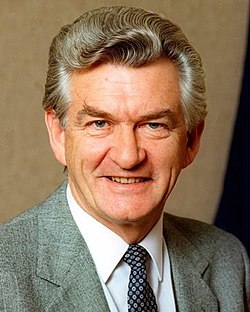
Bob Hawke won a landslide victory in the 1983 Australian federal election, and followed it up with 2 more victories in 1984 and 1987, making him the only Labor leader to win 3 consecutive elections. He would go on to win a fourth in 1990.
Hawke drew upon his wide popularity to win consensus for the government’s numerous systematic economic reforms. However, his prime ministership saw friction between himself and the grassroots of the Labor Party, who were unhappy at what they viewed as Hawke's iconoclasm and willingness to co-operate with business interests.
The key issues of the Hawke government were globalisation, micro-economic reform and industrial relations. The opening of Australian finance and industry to global competition and the restructuring of the role of trade unions represented one of the most extensive undertakings of micro-economic reform in Australia’s first century.
His speech at the 38th National Conference would serve as an important review of the government's achievements to date, which included floating the Australian dollar, the Prices and Incomes Accord, establishing Medicare, dismantling the restrictive tariff system and widening unemployment benefits and other welfare payments. However, it was also an important milestone in his efforts to maintain support within the party for continued reform into the 1990's.
"Most of all they would set aside the absolutely vital task of economic reconstruction. They would once again shirk the challenge of reform they simply do not have the capacity, wit or guts for the task. That, however, delegates, should make us not the more complacent but the more diligent in ensuring they stay in the wilderness. That is a task in which all of us share a responsibility from Cabinet Minister to branch member. I exclude none of us from this task. I pledge myself to it. We must bear the shared responsibility because the best interests of the Australian people demand it. In a very real sense, if we fail, all Australians fail."
"My name's Kevin, I'm from Queensland, I'm here to help"

Kevin Rudd had been elected leader of the Australian Labor Party in December 2006, just four months before their 44th National Conference. His speech to party faithful in April 2007 was widely reported at the time, with significant focus on the opening line "My name's Kevin, I'm from Queensland, I'm here to help" framing the conference as the beginning of a fresh approach for the party leading to the 2007 Australian federal election.
Rudd's speech touched on several themes that would continue into the election campaign, including the economic and geopolitical rise of China and India, the impacts of climate change, building long-term economic prosperity and national security. There was a strong focus on contrasting his own "forward-looking" approach with the "tired" Howard government, which had been in power for 11 years.
"There comes a time in the affairs of nations when they are forced to think afresh about the challenges they face for the future. Sometimes this happens at a time of crisis - such as when the very existence of the nation itself comes under threat. Other times it happens gradually - when changes evolve into challenges, and when challenges, if ignored, evolve into threats. One thing we know for certain is that the history of nations is made up of those who understand, anticipate and act on the challenges of the future. And those who do not. Those who instead bury their heads in the sand. Those who hope it will all just go away. And that, friends, is the crossroads we are approaching today, here in this great country of ours."
"It is a campaign for those we love"

Senator Penny Wong drew wide admiration for her July 2015 speech supporting marriage equality at Labor's 46th National Conference in Melbourne. Wong had been a strong supporter of including marriage equality in the National Platform for over a decade, and was instrumental in the successful 2011 vote to include a statement supporting changing federal law. She was seconding a motion to bind members of the parliamentary Labor Party to vote in favour of marriage equality in federal parliament. She received an immediate one minute standing ovation by conference attendees prior to speaking and was moved to tears.
Speaking on being bound to vote "no" on the question of marriage equality prior to the 2011 National Conference, Wong passionately reflected: "I was asked to vote for my own discrimination." Wong was the first openly lesbian member of Australian parliament when she took her senate seat in 2002.
“There is nothing to fear from equality. Progress is never easily won. Reform is never easily won. LGBTI Australians deserve equal treatment before the law. The aspiration for equality is remarkably persistent. We will continue until we win. Marriage equality is a campaign of hope. It is a campaign of justice. It is a campaign of equality, but most of all, delegates – and this is why we will win – it is a campaign for those we love.”
Ultimately, a compromise was achieved where the motion was passed but would not take immediate effect, meaning any vote to legalise same-sex marriage in parliament within the next term would not bind members to vote in favour. However as a result of the compromise, Labor Leader Bill Shorten pledged to introduce legislation to legalise same-sex marriage within 100 days of winning the next election, which followed his earlier introduction of a bill into the Australian House of Representatives to amend the Marriage Act.
List of National Conferences
- Known as the Commonwealth Conference from 1900 to 1971, and the Federal Conference in 1931, 1973
- A formal National Executive was not established until 1915. Until that time, there was no National President or National Secretary. At each conference, a president/chairman and secretary were elected from delegates present and served for the length of the conference.
Special conferences
Special Conferences are those which are not regularly scheduled biennial/triennial conferences, but are instead called by party leadership (either by the National Executive or the federal parliamentary caucus). These are usually called to resolve specific policy or structural party issues, and are often named as such.
| Conference | Conference Name | Issue/Policy |
|---|---|---|
| 2021 | Special Platform Conference | COVID-19 pandemic leading to postponement of 49th conference to 2023 (first ever completely virtual party conference) |
| 1990 | Special National Conference | Privatization of government-owned entities including QANTAS and Commonwealth Bank |
| July 1966 | Special Commonwealth Conference | Allegations of gross disloyalty against prominent party members regarding the issue of State Aid |
| March 1966 | Special Commonwealth Conference | Allegations of gross disloyalty against prominent party members regarding the issue of State Aid |
| 1963 | Special Commonwealth Conference on Foreign Affairs and Defence | Cold War diplomatic relations, Nuclear Non-proliferation |
| 1942-1943 | Special Commonwealth Conferences | Price-fixing, inflation, issues related to Australia's involvement in World War II and post-war reconstruction |
| August 1931 | Special Federal Conference | Australian Labor Party split of 1931 |
| March 1931 | Special Federal Conference | Australian Labor Party split of 1931 |
| October 1919 | Special Commonwealth Conference | Structural issues and rebuilding the ALP following the Australian Labor Party split of 1916 |
| 1916 | Special Commonwealth Conference Called to deal with matters arising out of the Conscription Issue | World War I conscription in Australia and subsequent Australian Labor Party split of 1916 |
Intercolonial Trades Union Congresses

Prior to federation and the subsequent creation of the Australian Labor Party, the labour movement consisted of dozens of trade unions organised around trades and labour councils. The first labour council in Australia was the Melbourne Trades Hall Committee, formed in 1856.
By the time of the First Intercolonial Trades Union Congress in 1879, there was a trades and labour council in each Australian capital city, along with several more in regional centres. The Intercolonial Trades Union Congresses were a means for Australian labour organisations to collectively organise themselves, discuss issues of concern to all unions and encourage the formation of parliamentary committees in each of the self-governing colonies. The First Congress report states that "it was established that the labour organisations of Australasia were practically unanimous in holding certain opinions in social politics."
Political reform remained high on the agenda of subsequent congresses, and they proved instrumental in the development of an Australian Labor Party. At the time of the first congress in 1879, there was no formalised Labor Party in any jurisdiction in Australia. By 1899, every colony had an established political labour party, with the exception of Tasmania which followed in 1903.
| Year | Conference Name | Location | Organising Body | Delegates | Issues/resolutions | Ref |
|---|---|---|---|---|---|---|
| 1898 | Eighth Intercolonial Trades Union Congress of Australasia | Adelaide, South Australia | United Trades and Labour Council of South Australia | 31 | Resolution supporting an Australian minimum wage | |
| 1891 | Seventh Intercolonial Trades Union Congress of Australasia | Ballarat, Victoria | Ballarat Regional Trades and Labour Council | 127 | Resolution passed accepting the constitution of the Australian Labour Federation | |
| 1889 | Sixth Intercolonial Trades Union Congress | Hobart, Tasmania | Hobart Trades & Labor Council | 58 | Resolution passed pronouncing that 'tradesmen' did not occupy a superior position to labourers | |
| 1888 | Fifth Intercolonial Trades Union Congress | Brisbane, Queensland | Trades and Labour Council | 64 | Resolution passed supporting the Single tax | |
| 1886 | Fourth Intercolonial Trades Union Congress | Adelaide, South Australia | United Trades and Labour Council of South Australia | 70 | Resolution passed supporting the direct representation of the labour movement in parliament | |
| 1885 | Third Intercolonial Trades Union Congress | Sydney, New South Wales | Trades & Labor Council of Sydney | 99 | ||
| 1884 | Second Intercolonial Trades Union Congress | Melbourne, Victoria | Melbourne Trades Hall Committee | 69 | Resolution passed supporting payment of Members of Parliament | |
| 1879 | First Intercolonial Trades Union Congress | Sydney, New South Wales | Trades & Labor Council of Sydney | 39 | Resolutions passed against non-white immigration |
List of ALP National Platforms
| Conference | Year | Platform Title | Ref |
|---|---|---|---|
| 49th | 2023 | ||
| Special | 2021 | ||
| 48th | 2018 | ||
| 47th | 2015 | ||
| 46th | 2011 | ||
| 45th | 2009 | ||
| 44th | 2007 | ||
| 43rd | 2004 | ||
| 42nd | 2000 | ||
| 41st | 1998 | ||
| 40th | 1994 | ||
| 39th | 1991 | ||
| Special | 1990 | ||
| 38th | 1988 | ||
| 37th | 1986 | ||
| 36th | 1984 | ||
| 35th | 1982 | ||
| 34th | 1981 | ||
| 33rd | 1979 | ||
| 32nd | 1977 | ||
| 31st | 1975 | ||
| 30th | 1973 | ||
| 29th | 1971 | ||
| 28th | 1969 | ||
| 27th | 1967 | ||
| Special | 1966 | ||
| Special | 1966 | ||
| 26th | 1965 | ||
| Special | 1963 | ||
| 25th | 1963 | ||
| 24th | 1961 | ||
| 23rd | 1959 | ||
| 22nd | 1957 | ||
| 21st | 1955 | ||
| 20th | 1953 | ||
| 19th | 1951 | ||
| 18th | 1948 | ||
| 17th | 1945 | ||
| 16th | 1943 | ||
| Special | 1942–1943 | ||
| 15th | 1939 | ||
| 14th | 1936 | ||
| 13th | 1933 | ||
| Special | August 1931 | ||
| Special | March 1931 | ||
| 12th | 1930 | ||
| 11th | 1927 | ||
| 10th | 1924 | ||
| 9th | 1921 | ||
| Special | October 1919 | ||
| 8th | June 1919 | ||
| 7th | 1918 | ||
| Special | 1916 | ||
| 6th | 1915 | ||
| 5th | 1912 | ||
| 4th | 1908 | ||
| 3rd | 1905 | ||
| 2nd | 1902 | ||
| 1st | 1900 |