Splashdown
In-game article clicks load inline without leaving the challenge.


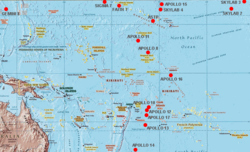
Splashdown is the method of landing a spacecraft or launch vehicle in a body of water, usually by parachute. This has been the primary recovery method of American capsules including NASA's Mercury, Gemini, Apollo and Orion along with the private SpaceX Dragon. It is also possible for the Boeing Starliner, Russian Soyuz, and the Chinese Shenzhou crewed capsules to land in water in case of contingency. NASA recovered the Space Shuttle solid rocket boosters (SRBs) via splashdown, as is done for Rocket Lab's Electron first stage.
As the name suggests, the vehicle parachutes into an ocean or other large body of water. Due to its low density and viscosity, water cushions the spacecraft enough that there is no need for a braking rocket to slow the final descent as is the case with Russian and Chinese crewed space capsules or airbags as is the case with the Starliner.
The American practice came in part because American launch sites are on the coastline and launch primarily over water. Russian launch sites such as Baikonur Cosmodrome are far inland, and most early launch aborts would descend on land.
History

The splashdown method of landing was used for Mercury, Gemini, and Apollo (including Skylab, which used Apollo capsules) missions, and is used for Artemis missions. Soyuz 23 unintentionally landed on a freezing lake with slushy patches of ice during a snowstorm.
On early Mercury flights, a helicopter attached a cable to the capsule, lifted it from the water and delivered it to a nearby ship. This was changed after the sinking of Liberty Bell 7. All later Mercury, Gemini and Apollo capsules had a flotation collar (similar to a rubber life raft) attached to the spacecraft to increase their buoyancy. The spacecraft would then be brought alongside a ship and lifted onto deck by crane.
After the flotation collar is attached, a hatch on the spacecraft is usually opened. At that time, some astronauts decide to be hoisted aboard a helicopter for a ride to the recovery ship and some decided to stay with the spacecraft and be lifted aboard ship via crane. All Gemini and Apollo flights (Apollos 7 to 17) used the former, while Mercury missions from Mercury 6 to Mercury 9, as well as all Skylab missions and Apollo-Soyuz used the latter, especially the Skylab flights as to preserve all medical data. During the Gemini and Apollo programs, NASA used MV Retriever for the astronauts to practice water egress.
Apollo 11 was America's first Moon landing mission and marked the first time that humans walked on the surface of another planetary body. The possibility of the astronauts bringing pathogens from the Moon back to Earth was remote, but not ruled out. To contain any possible contaminants at the scene of the splashdown, the astronauts donned special Biological Isolation Garments and the outside of the suits were scrubbed prior to the astronauts being hoisted aboard USS Hornet and escorted safely inside a Mobile Quarantine Facility.
Both the SpaceX Dragon 1 and Dragon 2 capsules were designed to use the splashdown method of landing. The original cargo Dragon splashed down in the Pacific Ocean off the coast of Baja California. At the request of NASA, both the crew and cargo variations of the Dragon 2 capsule splash down off the coast of Florida, either in the Atlantic Ocean or the Gulf of Mexico.
The early design concept for Orion (then known as the Crew Exploration Vehicle) featured recovery on land using a combination of parachutes and airbags, although it was also designed to make a contingency splashdown if needed. Due to weight considerations, the airbag design concept was dropped for Orion, and it conducts landings via splashdown in the Pacific Ocean off the coast of California.
Disadvantages
Perhaps the most dangerous aspect is the possibility of the spacecraft flooding and sinking. For example, when the hatch of Gus Grissom's Liberty Bell 7 capsule blew prematurely, the capsule sank and Grissom almost drowned. Since the spacecraft's flooding will occur from a location in its hull where it ruptures first, it is important to determine the location on the hull that experiences the highest loading. This location along the impacting side is determined by the surrounding 'air cushion' layer, which deforms the water surface before the moment of impact, and results in a non-trivial geometry of the liquid surface during first touch-down. Soyuz 23 was dragged under a frozen lake by its parachutes. The crew became incapacitated by carbon dioxide and were rescued after a nine-hour recovery operation.
If the capsule comes down far from any recovery forces, the crew may be stranded at sea for an extended period of time. As an example, Scott Carpenter in Aurora 7 overshot the assigned landing zone by 400 kilometers (250 mi). These recovery operation mishaps can be mitigated by placing several vessels on standby in different locations, but this can be an expensive option.
Exposure to salt water can have adverse effects on vehicles intended for reuse, such as Dragon.
Launch vehicles

Some reusable launch vehicles recover components via splashdown. This was first seen with the Space Shuttle SRBs, with STS-1 launching in 1981. Out of 135 launches, NASA recovered all but two sets of SRBs.
SpaceX has conducted propulsive splashdowns of the Falcon 9 first stage, Super Heavy booster, and Starship spacecraft. These vehicles are designed to land on land or modified barges and do not always survive intact after tipping over in the water; SpaceX has mainly conducted propulsive splashdowns for development flights. After the launch of CRS-16, the booster experienced a control issue and splashed down in the ocean instead of making an intended landing at Landing Zone 1.
Rocket Lab intended to catch the first stage of their Electron rocket with a helicopter as it descended under parachute, but abandoned this idea in favor of parachute splashdown. In 2020, Rocket Lab completed their first booster recovery.
List of spacecraft splashdowns
Crewed spacecraft
| # | Spacecraft | Agency | Landing date | Coordinates | Recovery ship | Miss distance (km) | Reference |
|---|---|---|---|---|---|---|---|
| 1 | Freedom 7 | NASA | May 5, 1961 | 27°13.7′N 75°53′W/27.2283°N 75.883°W/ 27.2283; -75.883(Freedom 7) | USS Lake Champlain | 5.6 km (3.5 mi) | |
| 2 | Liberty Bell 7 | NASA | July 21, 1961 | 27°32′N 75°44′W/27.533°N 75.733°W/ 27.533; -75.733(Liberty Bell 7) | USS Randolph | 9.3 km (5.8 mi) | |
| 3 | Friendship 7 | NASA | February 20, 1962 | 21°26′N 68°41′W/21.433°N 68.683°W/ 21.433; -68.683(Friendship 7) | USS Noa (USS Randolph**) | 74 | |
| 4 | Aurora 7 | NASA | May 24, 1962 | 19°27′N 63°59′W/19.450°N 63.983°W/ 19.450; -63.983(Aurora 7) | USS John R. Pierce (USS Intrepid**) | 400 | |
| 5 | Sigma 7 | NASA | October 3, 1962 | 32°06′N 174°28′W/32.100°N 174.467°W/ 32.100; -174.467(Sigma 7) | USS Kearsarge | 7.4 | |
| 6 | Faith 7 | NASA | May 16, 1963 | 27°20′N 176°26′W/27.333°N 176.433°W/ 27.333; -176.433(Faith 7) | USS Kearsarge | 8.1 | |
| 7 | Gemini 3 | NASA | March 23, 1965 | 22°26′N 70°51′W/22.433°N 70.850°W/ 22.433; -70.850(Gemini 3) | USS Intrepid | 111 | |
| 8 | Gemini 4 | NASA | June 7, 1965 | 27°44′N 74°11′W/27.733°N 74.183°W/ 27.733; -74.183(Gemini 4) | USS Wasp | 81 | |
| 9 | Gemini 5 | NASA | August 29, 1965 | 29°44′N 69°45′W/29.733°N 69.750°W/ 29.733; -69.750(Gemini 5) | USS Lake Champlain | 270 | |
| 10 | Gemini 7 | NASA | December 18, 1965 | 25°25′N 70°07′W/25.417°N 70.117°W/ 25.417; -70.117(Gemini 7) | USS Wasp | 12 | |
| 11 | Gemini 6A | NASA | December 16, 1965 | 23°35′N 67°50′W/23.583°N 67.833°W/ 23.583; -67.833(Gemini 6A) | USS Wasp | 13 | |
| 12 | Gemini 8 | NASA | March 17, 1966 | 25°14′N 136°0′E/25.233°N 136.000°E/ 25.233; 136.000(Gemini 8) | USS Leonard F. Mason (USS Boxer**) | 2 | |
| 13 | Gemini 9A | NASA | June 6, 1966 | 27°52′N 75°0′W/27.867°N 75.000°W/ 27.867; -75.000(Gemini 9A) | USS Wasp | 0.7 | |
| 14 | Gemini 10 | NASA | July 21, 1966 | 26°45′N 71°57′W/26.750°N 71.950°W/ 26.750; -71.950(Gemini 10) | USS Guadalcanal | 6 | |
| 15 | Gemini 11 | NASA | September 15, 1966 | 24°15′N 70°0′W/24.250°N 70.000°W/ 24.250; -70.000(Gemini 11) | USS Guam | 5 | |
| 16 | Gemini 12 | NASA | November 15, 1966 | 24°35′N 69°57′W/24.583°N 69.950°W/ 24.583; -69.950(Gemini 12) | USS Wasp | 5 | |
| 17 | Apollo 7 | NASA | October 22, 1968 | 27°32′N 64°04′W/27.533°N 64.067°W/ 27.533; -64.067(Apollo 7) | USS Essex | 3 | |
| 18 | Apollo 8 | NASA | December 27, 1968 | 8°7.5′N 165°1.2′W/8.1250°N 165.0200°W/ 8.1250; -165.0200(Apollo 8) | USS Yorktown | 2 | |
| 19 | Apollo 9 | NASA | March 13, 1969 | 23°15′N 67°56′W/23.250°N 67.933°W/ 23.250; -67.933(Apollo 9) | USS Guadalcanal | 5 | |
| 20 | Apollo 10 | NASA | May 26, 1969 | 15°2′S 164°39′W/15.033°S 164.650°W/ -15.033; -164.650(Apollo 10) | USS Princeton | 2.4 | |
| 21 | Apollo 11 | NASA | July 24, 1969 | 13°19′N 169°9′W/13.317°N 169.150°W/ 13.317; -169.150(Apollo 11) | USS Hornet | 3.13 | |
| 22 | Apollo 12 | NASA | November 24, 1969 | 15°47′S 165°9′W/15.783°S 165.150°W/ -15.783; -165.150(Apollo 12) | USS Hornet | 3.7 | |
| 23 | Apollo 13 | NASA | April 17, 1970 | 21°38′S 165°22′W/21.633°S 165.367°W/ -21.633; -165.367(Apollo 13) | USS Iwo Jima | 1.85 | |
| 24 | Apollo 14 | NASA | February 9, 1971 | 27°1′S 172°39′W/27.017°S 172.650°W/ -27.017; -172.650(Apollo 14) | USS New Orleans | 1.1 | |
| 25 | Apollo 15 | NASA | August 7, 1971 | 26°7′N 158°8′W/26.117°N 158.133°W/ 26.117; -158.133(Apollo 15) | USS Okinawa | 1.85 | |
| 26 | Apollo 16 | NASA | April 27, 1972 | 0°43′S 156°13′W/0.717°S 156.217°W/ -0.717; -156.217(Apollo 16) | USS Ticonderoga | 0.55 | |
| 27 | Apollo 17 | NASA | December 19, 1972 | 17°53′S 166°7′W/17.883°S 166.117°W/ -17.883; -166.117(Apollo 17) | USS Ticonderoga | 1.85 | |
| 28 | Skylab 2 | NASA | June 22, 1973 | 24°45′N 127°2′W/24.750°N 127.033°W/ 24.750; -127.033(Skylab 2) | USS Ticonderoga | ||
| 29 | Skylab 3 | NASA | September 25, 1973 | 30°47′N 120°29′W/30.783°N 120.483°W/ 30.783; -120.483(Skylab 3) | USS New Orleans | ||
| 30 | Skylab 4 | NASA | February 8, 1974 | 31°18′N 119°48′W/31.300°N 119.800°W/ 31.300; -119.800(Skylab 4) | USS New Orleans | ||
| 31 | Apollo CSM-111 | NASA | July 24, 1975 | 22°N 163°W/22°N 163°W/ 22; -163(ASTP Apollo) | USS New Orleans | 1.3 | |
| 32 | Soyuz 23 | USSR | October 16, 1976 | Lake Tengiz | Mi-8 helicopter | ||
| 33 | Crew Dragon Demo-2 | SpaceX | August 2, 2020 | 29°48′N 87°30′W/29.800°N 87.500°W/ 29.800; -87.500(Crew Dragon Demo-2) | GO Navigator | ||
| 33 | Crew Dragon Crew-1 | SpaceX | May 2, 2021 | 29°32′N 86°11′W/29.533°N 86.183°W/ 29.533; -86.183(Crew Dragon Crew-1) | GO Navigator | ||
| 34 | Inspiration4 | SpaceX | September 18, 2021 | GO Searcher | |||
| 35 | Crew Dragon Crew-2 | SpaceX | November 7, 2021 | GO Navigator | |||
| 35 | Axiom Mission 1 | SpaceX | April 25, 2022 | Megan | |||
| 36 | Crew Dragon Crew-3 | SpaceX | May 6, 2022 | Shannon | |||
| 37 | Crew Dragon Crew-4 | SpaceX | October 14, 2022 | Megan | |||
| 38 | Crew Dragon Crew-5 | SpaceX | March 11, 2023 | Shannon | |||
| 39 | Axiom Mission 2 | SpaceX | May 31, 2023 | Megan | |||
| 40 | Polaris Dawn | SpaceX | September 15, 2024 | ||||
| 41 | Artemis II | NASA | April 10, 2026 | USS John P. Murtha |
Uncrewed spacecraft
| Spacecraft | Agency | Landing date | Coordinates | Recovery ship | Miss distance | |
|---|---|---|---|---|---|---|
| Jupiter AM-18 (Able and Baker) | USAF | May 28, 1959 | 48 to 96 km (30 to 60 mi) N Antigua Island | USS Kiowa | 16 km (9.9 mi) | |
| Mercury-Big Joe | NASA | September 9, 1959 | 2,407 km (1,496 mi) SE Cape Canaveral | USS Strong | 925 km (575 mi) | |
| Mercury-Little Joe 2 Sam The Rhesus Monkey | NASA | December 4, 1959 | 319 km (198 mi) SE Wallops Island, Virginia | USS Borie | ? km | |
| Mercury-Redstone 1A | NASA | December 19, 1960 | 378.2 km (235.0 mi) SE Cape Canaveral | USS Valley Forge | 12.9 km (8.0 mi) | |
| Mercury-Redstone 2 | NASA | January 31, 1961 | 675.9 km (420.0 mi) SE Cape Canaveral | USS Donner | 209.2 km (130.0 mi) | |
| Mercury-Atlas 2 | NASA | February 21, 1961 | 2,293.3 km (1,425.0 mi) SE Cape Canaveral | USS Donner | 20.9 km (13.0 mi) | |
| Discoverer 25 (Corona 9017) | USAF | June 16, 1961 | mid-air recovery missed | |||
| Mercury-Atlas 4 | NASA | September 13, 1961 | 257.5 km (160.0 mi) E of Bermuda | USS Decatur | 64.4 km (40.0 mi) | |
| Mercury-Atlas 5 | NASA | November 29, 1961 | 804.7 km (500.0 mi) SE of Bermuda | USS Stormes | ? km | |
| Gemini 2 | NASA | January 19, 1965 | 16°33.9′N 49°46.27′W/16.5650°N 49.77117°W/ 16.5650; -49.77117(Gemini 2) 3,423.1 km (2,127.0 mi) downrange from KSC | USS Lake Champlain | 38.6 km (24.0 mi) | |
| AS-201 | NASA | February 26, 1966 | 8°11′S 11°09′W/8.18°S 11.15°W/ -8.18; -11.15(Apollo 201) 8,472 km (5,264 mi) downrange from KSC | USS Boxer | ? km | |
| AS-202 | NASA | August 25, 1966 | 16°07′N 168°54′E/16.12°N 168.9°E/ 16.12; 168.9(Apollo 202) 804.7 km (500.0 mi) southwest of Wake Island | USS Hornet | ? km | |
| Gemini 2-MOL | USAF | November 3, 1966 | 8,149.7 km (5,064.0 mi) SE KSC near Ascension Island | USS La Salle | 11.26 km (7.00 mi) | |
| Apollo 4 | NASA | November 9, 1967 | 30°06′N 172°32′W/30.1°N 172.53°W/ 30.1; -172.53(Apollo 4) | USS Bennington | 16 km (9.9 mi) | |
| Apollo 6 | NASA | April 4, 1968 | 27°40′N 157°59′W/27.667°N 157.983°W/ 27.667; -157.983(Apollo 6) | USS Okinawa | ? km | |
| Zond 5 | USSR | September 21, 1968 | 32°38′S 65°33′E/32.63°S 65.55°E/ -32.63; 65.55(Zond 5) | USSR recovery naval vessel Borovichy and Vasiliy Golovin | 105 km (65 mi) | |
| Zond 8 | USSR | October 27, 1970 | 730 km (450 mi) SE of the Chagos Archipelago, Indian Ocean | USSR recovery ship Taman | 24 km | |
| Cosmos 1374 | USSR | June 4, 1982 | 17°S 98°E/17°S 98°E/ -17; 98(Cosmos 1374) 560 km (350 mi) S of Cocos Islands, Indian Ocean | USSR recovery ship | ? km | |
| Cosmos 1445 | USSR | March 15, 1983 | 556 km (345 mi) S of Cocos Islands, Indian Ocean | USSR recovery ship | ? km | |
| Cosmos 1517 | USSR | December 27, 1983 | near Crimea, Black Sea | USSR recovery ship | ? km | |
| Cosmos 1614 | USSR | December 19, 1984 | ? km W of the Crimea, Black Sea | USSR recovery ship | ? km | |
| COTS Demo Flight 1 | SpaceX | December 8, 2010 | 800 km (500 mi) west of Baja California, Mexico, Pacific Ocean | ? | 0.8 km (0.50 mi) | |
| Dragon C2+ | SpaceX | May 31, 2012 | 26°55′N 120°42′W/26.92°N 120.7°W/ 26.92; -120.7(Dragon C2+) | ? | ? | |
| CRS SpX-1 | SpaceX | October 28, 2012 | ? | American Islander | ? | |
| CRS SpX-2 | SpaceX | March 27, 2013 | ? | American Islander | ? | |
| Exploration Flight Test 1 | NASA | December 5, 2014 | 23°36′N 116°24′W/23.6°N 116.4°W/ 23.6; -116.4(EFT-1), 443 kilometres (275 mi) west of Baja California | USS Anchorage | ||
| Crew Dragon Demo-1 | SpaceX | March 8, 2019 | In the Gulf of Mexico, off the coast of Pensacola, Florida | GO Searcher | ||
| SpaceX CRS-21 | SpaceX | January 14, 2020 | In the Gulf of Mexico, off the coast of Tampa, Florida | GO Navigator | ||
| Artemis I | NASA | December 11, 2022 | Pacific Ocean, west of Baja California | USS Portland | 4 nm | |
| IFT-4 | SpaceX | June 6, 2024 | Indian Ocean | |||
| IFT-5 | SpaceX | October 13, 2024 | Indian Ocean | |||
| IFT-6 | SpaceX | November 19, 2024 | Indian Ocean | |||
| IFT-10 | SpaceX | August 26, 2025 | Indian Ocean | |||
| IFT-11 | SpaceX | October 13, 2025 | Indian Ocean |
Gallery
- The Apollo 15 spacecraft splashed down safely despite a parachute failure. (NASA)
- Apollo 15 splashdown (NASA)
- Apollo 11 after splashdown (NASA)
- Apollo 13 hoisted onto ship (NASA)
- Gemini water egress training
- Recovery of the Dragon C2+ on May 31, 2012
- Recovery of the EFT-1 Orion, December 5, 2014
- Landing of SpaceX Demo-2, 2 August 2020
- Artemis II Orion capsule well dock Underway Recovery Test 10 (URT-10)
See also
- Apollo program – 1961–1972 American crewed lunar exploration program
- Apollo–Soyuz Test Project – First international crewed spaceflight missionPages displaying short descriptions of redirect targets
- Helicopter 66 – Individual United States Navy helicopter flown in support of NASA
- Project Gemini – 1961–1966 US human spaceflight program
- Project Mercury – Initial American crewed spaceflight program (1958–1963)
- Skylab – First space station launched and operated by NASA (1973–1979)
- SpaceX Dragon 1 – Partially reusable cargo space capsule
- SpaceX Dragon 2 – 2020s class of partially reusable spacecraft
- Water landing – Aircraft landing on a body of water
- Zond program – Series of Soviet robotic space probes launched between 1964 and 1970
Notes
Bibliography
- Ezell, Linda Neumann (1988), (PDF), vol. II Programs and Projects 1958 - 1968 (NASA SP-4012), (PDF) from the original on October 9, 2022
- Ezell, Linda Neumann (1988), (PDF), vol. III - Programs and Projects 1969 - 1978 (SP-4012), (PDF) from the original on October 9, 2022
- Orloff, Richard W., (PDF), p. 143, (PDF) from the original on October 9, 2022
External links
- The dictionary definition of splashdown at Wiktionary