Sunella
In-game article clicks load inline without leaving the challenge.
Sunella is an extinct genus of bivalved arthropod known from the Cambrian of China. It was described by Huo Shicheng in 1965. It is the type genus of the family Sunellidae. The type species is S. grandis.
Classification
In the original description (Huo, 1965), Sunella was considered to be an ostracod. Most later studies have identified it as an arthropod of uncertain affinities, though some studies historically considered it a bradoriid during the 1980s. Sunella has often been suggested to be closely related to Isoxys, a genus of Cambrian arthropods with a superficially similar bivalved carapace, though true understanding of Sunella's affinities was for a long time hampered by poor knowledge of its soft tissue. A 2026 description of soft tissue remains of Sunellla suggested that Sunella represented one of the earliest diverging members of the arthropod clade Deuteropoda, and that while morphologically similar, Isoxys was more closely related to living arthropods than to Sunella.

Species
Sunella grandis
Sunella grandis (Huo, 1965) is the type species of Sunella. It is known from the Chengjiang Biota of Yunnan, China. Probable sexual dimorphism has been observed.
Synonyms
- Sunella nanchengensis (Huo, 1965)
- Luella (Huo, 1965)
- Chiella (Huo, 1965)
Sunella nanchengensis
Sunella nanchengensis (Huo, 1965) is a probable sexual dimorph of S. grandis and is generally considered a synonym of S. grandis.
Sunella shensiella
Sunella shensiella (Huo,1965) is the only species of Sunella apart from S. grandis that is not considered a synonym of S. grandis or has been reassigned to a different genus. Probable sexual dimorphism has been observed. It is one of the species where soft anatomy has been preserved. Known from the Helinpu Formation of southwest China.
Sunella dimorphismus
Sunella dimorphismus (Liu et al, 2026) has preserved anatomy including trunk and appendages. Known from the Chengjiang Biota.
Tuzoia? (Sunella) parva
One former species is Sunella parva (Melnikova, 1988), which may be the larval form of a new species of Tuzoia, which was rejected from Sunella by Melnikova 1998 and may need to be assigned to its own genus. It has also been suggested to be a bradoriid (Melnikova, 1998)
Synonyms
Sunellidae, which Sunella belongs to originally included two other genera, Chiella (Huo, 1965) and Luella (Huo, 1965), but Chiella was later considered a separate species within Sunella, but afterHuo & Shu, 1985 Chiella was considered a junior synonym of Sunella and after Zhang & Shu, 2007 Luella was considered a probable sexual dimorph of Sunella.
Former species
Caudicaella (Sunella) bispinata
A species that previously belonged to Sunella, S. bispinata, was moved to a new genus, Caudicaella (Sun et al. 2021) as Caudicaella bispinata (Cui and Huo, 1990). Synonyms include Isoxys bispinata (Zhang et al., 2018) (not to be confused with Isoxys bispinatus) Isoxys sp. (Sun et al. 2021) (for the specimens from the Heatherdale shale, not the Shuijingtuo formation)
Distribution
Sunella fossils have been found in the Chengjiang biota (exact locality cannot be determined; dated to no older than 518 Ma), the Shuijingtuo formation (dated to around 526.5 Ma), the Qingjiang biota (dated to ~518 ma), the Niutitang formation ( generally Meishucunian (Cambrian Stage 2) to Nangaoan (Cambrian Stage 3) but may be up to as old as the Fortunian in some sections) and the Guojiaba formation (tentatively assigned to Cambrian Stage 3), all of which are in China. Similar fossils have been found at other formations in China but they are relatively uncommon and poorly studied and therefore cannot be confidently assigned to this genus or even Sunellidae. The former species Caudicaella bispinata is also known from the Heatherdale shale in Australia.
Preservation
Usually the only part of Sunella that is preserved is the carapace, but rarely (only twenty-two times in Sunella cf. shensiella and only six in the related Combinivalvula chenjiangensis) soft tissue is also preserved. When this occurs, the carapace usually adopts a "butterfly" position, possibly due to the decay of the adductor muscles that hold it together. Only the soft parts of Sunella cf. shensiella and the related Combinivalvula chenjiangensis (Hou, 1987) have been preserved.
Morphology
Carapace
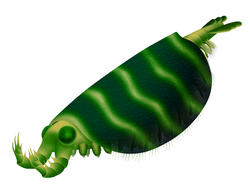
Sunella grandis had a bivalved elongate roughly semicircular carapace with an anterodorsal (on the upper front part of the carapace) sulcus (groove) and short cardinal spines (spines at the tip of the midline on the front and back edge of the carapace), a typical bodyplan for a sunellid, while S. cf. shensiella had a more oval shaped carapace, shorter cardinal spines and an anterodorsal sulcus pointing at a slightly lower angle. Both species have shorter cardinal spines than Caudicaella bispinata also Caudicaella bispinata is more similar to Isoxys than other sunellids which led to its assignment to Isoxys in Zhang et al. 2018. Jinningella differs from Sunella by the presence of anterodorsal nodes. Probable Sexual dimorphism has been recorded in both species.
The carapace of S. grandis is typically 6.5-8.5 mm. The largest specimen is over 15 mm (1.5 cm)(the largest recorded for a sunellid), while Combinivalvula and Jinningella reached roughly 10 mm (1 cm) and Caudicaella typically reached 10–12 mm (1-1.2 cm) due to its long cardinal spines compared to other sunellids. In comparison to other bivalved arthropods of the Cambrian, sunellids where medium-sized, larger than the bradoriids, which rarely reached above 10 mm (1 cm) and smaller than the Isoxyida which where often at least a few centimeters long with the exception of the dwarf I. carbonelli which grew to 11 mm (1.1 cm) and Surusicaris which grew to 14 mm (1.4 cm).
Distinguishing from similar arthropods

Sunella can be distinguished from Isoxys by the possession of an anterodorsal sulcus, shorter cardinal spines and different carapace shapes. Sunella be distinguished from the isoxyid Surusicaris by the lack of an anterodorsal sulcus and the lack of cardinal spines. Bradoriids, which share the possession of an anterodorsal sulcus (leading to the former assignment of Sunella to Bradoriida) can be distinguished from Sunella by the possession of cardinal spines.
Soft tissue anatomy

The soft part anatomy of Sunella was previously poorly known, but was thoroughly described for S. dimorphismus in a 2026 study. This study showed that S. dimorphismus had a pair of stalked eyes as well as a central medial eye attached to the head, to which was also attached a pair of upward and inward curling raptorial appendages similar to those of Isoxys. The raptorial appendages were composed of twelve segments, with the 9 segments furthest from the body each bearing a pair of upward-facing (endite) spines with the last segment bearing a terminal spine. Beneath the bivalved carapace was a segmented trunk made up of 8 segments, each of which likely had attached one pair of biramous (two-branched) limbs, composed of a stenopodous (stout) endopod (lower leg-like branch) with at least 7 segments (podomeres) and flap-like exopods (upper branches). This was followed by a posterior abdomen region with three segments each of which bore limbs only composed of the flap-like exopods. The body ended with a terminal paddle-shaped telson.
Ecology
The grasping raptorial appendages of Sunella have led to suggestions that it was an active and mobile predator of small-bodied prey, using its large eyes to detect prey, with its flap-like exopods serving to propel it through the water, with the endopods possibly sometimes used for walking along the seafloor. Due to its small size, Sunella was likely a relatively low level member of the food chain and predated upon by larger organisms.
Phylogeny
Cladogram after Liu et al; 2026: