Sweden Solar System
In-game article clicks load inline without leaving the challenge.

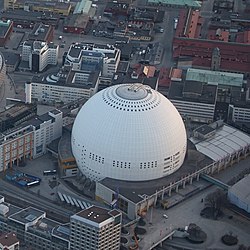
The Sweden Solar System is the world's largest permanent scale model of the Solar System. The Sun is represented by Avicii Arena in Stockholm (still known by most as Globen), the largest hemispherical building in the world. The inner planets can also be found in Stockholm but the outer planets are situated northward in other cities along the Baltic Sea. The system was started by Nils Brenning, professor at the Royal Institute of Technology in Stockholm, and Gösta Gahm, professor at the Stockholm University. The model represents the Solar System on the scale of 1:20 000 000, i.e. one metre represents 20,000 km.
The system
The bodies represented in this model include the Sun, the planets (and some of their moons), dwarf planets and many types of small bodies (comets, asteroids, trans-Neptunians, etc.), as well as some abstract concepts (like the Termination Shock zone). Because of the existence of many small bodies in the real Solar System, the model can always be further increased.
The Sun is represented by the Avicii Arena (Globen), Stockholm, which is the largest hemispherical building in the world, 110 m (360 ft) in diameter. To respect the scale, the globe represents the Sun including its corona.[citation needed]
Inner planets

- Mercury (25 cm (9.8 in) in diameter) is placed at Stockholm City Museum, 2,900 m (1.8 mi) from the Globe. The small metallic sphere was built by the artist Peter Varhelyi.
- Venus (62 cm (24 in) in diameter) is placed at Vetenskapens hus at the KTH Royal Institute of Technology, 5,500 m (3.4 mi) from the Globe. It was previously located at the Observatory Museum in Stockholm (now closed). A previous model, made by the United States artist Daniel Oberti, was inaugurated during a Venus transit on 8 June 2004 and placed at the KTH Royal Institute of Technology. It fell and shattered around 11 June 2011.
- Earth (65 cm (26 in) in diameter) is located at the Swedish Museum of Natural History, 7,600 m (4.7 mi) from the Globe. Satellite images of the Earth are exhibited beside the Globe. An elaborate model of the Moon (18 cm (7.1 in) in diameter) is also on display, about 20 metres (66 ft) from the model of Earth.
- Mars (35 cm (14 in) in diameter) is located at Mörby centrum, a shopping centre and Stockholm metro station in Danderyd, a suburb of Stockholm. It is 11.6 km (7.2 mi) from the Globe. The model, made in copper by the Finnish artist Heikki Haapanen, is connected by an "umbilical cord" to a steel plate on the floor having an Earth image. The globe also features marks that represent some typical Martian chemical elements.
Gas giants
- Jupiter (7.3 m (24 ft) in diameter) is placed inside the Clarion Hotel located at Stockholm Arlanda Airport in Sigtuna Municipality, 40 km (25 mi) from the Globe. Previously, it was made as a flower decoration, with different flowers representing different zones of the giant gas planet. Today, the planet is depicted as a ring light above a lobby.
- Saturn (6.1 m (20 ft) in diameter) is placed outside the old observatory of Anders Celsius, in the square Celsiustorget in the centre of Uppsala, 73 km (45 mi) from the Globe. Inaugurated during the International Year of Astronomy, the model is a mat with a picture of Saturn, but will eventually grow to crown a school planetarium in the city. In addition, several schools in Uppsala are to provide moons of Saturn: the first completed was Enceladus (diameter 2.5 cm or 0.98 in) at Kvarngärdesskolan. (Note: The model was taken down due to vandalism)
- Uranus (2.6 m (8 ft 6 in) in diameter) was vandalized and the new model was reconstructed behind Stora magasinet in Lövstabruk in 2012. It is an outdoor model made of blue steel bars. The rotation axis of the planet is marked in red.

- Neptune (2.5 m (8 ft 2 in) in diameter) is located by the river Söderhamnsån in Söderhamn, a coast town with tradition of fishing and sailing (which relates to Neptune being the deity of the seas). Placed 229 km (142 mi) from the Globe, the model is made of acrylic and, at night, shines with a blue light.
Trans-Neptunian objects
- Pluto (12 cm (4.7 in) in diameter) and its largest moon Charon are placed near the southern of the Dellen lakes, in Delsbo, 300 km (190 mi) from the Globe. The lakes are thought to be formed by a meteorite impact 90 million years ago. The two bodies' sculptures are supported by two gravelike pillars (as Pluto is the deity for death), made up with dellenite, a rare mineral formed at that place by the meteorite impact.
- Haumea (8.5 cm (3.3 in) in diameter) and its moons are depicted in the 2047 Science Centre, Borlänge, 200 km (120 mi) from the Globe.
- Quaoar (6 cm (2.4 in) in diameter) is located in the library in Gislaved, 340 km (210 mi) from the Globe.
- Ixion (6.5 cm (2.6 in) in diameter), a dwarf planet candidate, is located at Technichus, a science center in Härnösand, 360 km (220 mi) from the Globe. The sculpture is an orb held by a hand with the arm. This plutino was discovered by a team which included scientists from Uppsala.
- Makemake (7 cm (2.8 in) in diameter) is located at Slottsskogsobservatoriet, an observatory in Gothenburg, 400 km (250 mi) from the Globe.
- 'Oumuamua (0.3 mm (0.012 in) in diameter) is placed in the village of Plönninge, Halland, 440 km (270 mi) from the Globe.
- Gonggong (7.5 cm (3.0 in) in diameter) is placed near the Tycho Brahe Observatory in Oxie, Malmö Municipality, 500 km (310 mi) from the Globe.
- Eris (13 cm (5.1 in) in diameter) is located at Umeå Arts Campus, Umeå, 518 km (322 mi) from the Globe. Made by Theresa Berg, the golden model is inspired by the mythical story of Eris sparking a quarrel between three Greek goddesses with a golden apple bearing the inscription καλλίστῃ (kallistē, "to the most beautiful one").
- Sedna (10 cm (3.9 in) in diameter), another dwarf planet candidate, is located at Teknikens Hus, a science center in Luleå, 734 km (456 mi) from the Globe. This represents a distance of about 15 billion km (100 AU); Sedna has a highly elliptical orbit, its distance from the Sun varying between 11–140 billion km (74–936 AU).
Other bodies

- 471926 Jörmungandr a minor planet in Stockholm.
- The near-Earth ObjectEros is located at Mörbyskolan, a school in Danderyd Municipality (where Mars is located), 11 km (6.8 mi) from the Globe. It was created as a Valentine's Day project in gold, modeled after Eros, the god of love. The dimensions are 2 mm × 0.7 mm × 0.7 mm (0.079 in × 0.028 in × 0.028 in); (0.98 mm3 or 6.0×10⁻⁵ in3).
- The asteroid 36614 Saltis is located at Saltsjöbaden's Kunskapsskola, a school near the Stockholm Observatory. The asteroid was discovered by A. Brandeker in 2000, using a telescope at the observatory, and the body was named after the observatory's location, Saltsjöbaden.
- The asteroid Vesta is located at Åva gymnasium, a public secondary school in Täby.
- The asteroid 306367 Nut, a.k.a. 5025 PL for Palomar-Leiden, (0.2 mm (0.0079 in) in diameter) is located in a park in Knivsta Municipality, 60 km (37 mi) from the Globe. It is not a sculpture but a dot on a map of the System, placed in front of Erik Ståhl's monumental cosmic sculptures.
- Halley's Comet is located at Balthazar Science Center, in Skövde. Inaugurated on 16 December 2009, there are actually four models of the comet: three placed outdoors, based on schoolchildren's drawings, plus one indoors, consisting of a laser passing through a block of glass.
- Comet Swift-Tuttle is placed at Kreativum, a science center in Karlshamn. The comet's orbit is closest to the Globe in inner Stockholm and farthest in Karlshamn, 390 km (240 mi) away.
- The Termination Shock is at the edge of the heliosphere: it is the boundary where the solar wind transitions to subsonic velocity. No sculpture currently represents the termination shock, but a foundation for a future sculpture exists at the Institute of Space Physics, 950 km (590 mi) from the Globe, in Kiruna, above the Arctic Circle.
List of objects
| Object | Distance from Globen | Diameter | Location | Coordinates | Inauguration date |
|---|---|---|---|---|---|
| Sun | —N/a | 71 m (233 ft), the disk 110 m (361 ft), incl. the corona | Avicii Arena, Stockholm | 59°17′36.80″N 18°04′59.65″E/59.2935556°N 18.0832361°E/ 59.2935556; 18.0832361 | 19 February 1989 |
| 471926 Jörmungandr | 1.8 km (1.1 mi) | 0.05 mm | Ion Game Design office, Stockholm | 59°18′34.7″N 18°04′21.9″E/59.309639°N 18.072750°E/ 59.309639; 18.072750 | 23 September 2023 |
| Mercury | 2.99 km (1.86 mi) | 25 cm (9.8 in) | Stockholm City Museum, Stockholm | 59°19′10.8″N 18°04′16.8″E/59.319667°N 18.071333°E/ 59.319667; 18.071333 | 1998 |
| Venus | 6.76 km (4.20 mi) | 62 cm (24.4 in) | Vetenskapens hus, Stockholm | 59°21′10.38″N 18°03′30.78″E/59.3528833°N 18.0585500°E/ 59.3528833; 18.0585500 | 8 June 2004 |
| Earth and Moon | 8.58 km (5.33 mi) | 65 cm (25.6 in) and 18 cm (7.1 in) | Swedish Museum of Natural History, Stockholm | 59°22′08.48″N 18°03′12.34″E/59.3690222°N 18.0534278°E/ 59.3690222; 18.0534278 | before 2000 |
| (433) Eros | 11 km (6.8 mi) | 2.0 mm × 0.7 mm × 0.7 mm | Mörbyskolan, Danderyd | 59°23′38″N 18°02′41″E/59.39389°N 18.04472°E/ 59.39389; 18.04472 | 14 February 2000 |
| (36614) Saltis | 11 km (6.8 mi) | < 1 mm | Kunskapsskolan, Saltsjöbaden | 59°16′21″N 18°18′17″E/59.27250°N 18.30472°E/ 59.27250; 18.30472 | 14 January 2010 |
| Mars | 11.93 km (7.41 mi) | 35 cm (13.8 in) | Mörby centrum, Danderyd | 59°23′52.58″N 18°02′11.58″E/59.3979389°N 18.0365500°E/ 59.3979389; 18.0365500 | before 2000 |
| 4 Vesta | 16.4 km (10.2 mi) | 2.6 cm | Åva gymnasium, Täby | 59°26′24″N 18°03′47.16″E/59.44000°N 18.0631000°E/ 59.44000; 18.0631000 | 6 September 2017 |
| Jupiter | 40.6 km (25.2 mi) | 7.3 m (24 ft) | Stockholm Arlanda Airport | 59°38′58.52″N 17°55′50.38″E/59.6495889°N 17.9306611°E/ 59.6495889; 17.9306611 | before 2000 |
| (306367) Nut (5025 PL) | 60 km (37 mi) | 0.2 mm | Knivsta | 59°43′10″N 17°48′07″E/59.71944°N 17.80194°E/ 59.71944; 17.80194 | |
| Saturn | 67.9 km (42.2 mi) | 6.1 m (20 ft) | Celsiustorget, Uppsala | 59°51′34″N 17°38′14″E/59.85944°N 17.63722°E/ 59.85944; 17.63722 | 2025 (Titan has been removed) |
| Uranus | 124.8 km (77.5 mi) | 2.6 m (8.5 ft) | Stora magasinet, Lövstabruk | 60°24′31″N 17°52′37″E/60.40861°N 17.87694°E/ 60.40861; 17.87694 | 13 October 2012 |
| Haumea | 200 km (120 mi) | 10 cm | Borlänge | 60°29′18.1″N 15°25′51.5″E/60.488361°N 15.430972°E/ 60.488361; 15.430972 | |
| Halley's Comet | 204 km (127 mi) | Four representations, not scale models. | Balthazar Science Center, Skövde | 58°23′14″N 13°51′11″E/58.38722°N 13.85306°E/ 58.38722; 13.85306 | 16 December 2009 |
| Neptune | 230.9 km (143.5 mi) | 2.5 m (8.2 ft) | by the river Söderhamnsån, Söderhamn | 61°18′07″N 17°03′19″E/61.30194°N 17.05528°E/ 61.30194; 17.05528 | 29 October 1998 |
| Pluto and Charon | 291.4 km (181.1 mi) | 12 cm (4.7 in) and 6 cm (2.4 in) | by the lake Dellen South, Delsbo | 61°47′50.13″N 16°32′59.96″E/61.7972583°N 16.5499889°E/ 61.7972583; 16.5499889 | before 2000 |
| 50000 Quaoar | 340 km (210 mi) | 6 cm | Gislaved Library, Gislaved | 57°17′46.9″N 13°31′49.8″E/57.296361°N 13.530500°E/ 57.296361; 13.530500 | 18 November 2017 |
| (28978) Ixion | 360 km (220 mi) | 6.5 cm (2.6 in) | Technichus, Härnösand | 62°37′49″N 17°56′12″E/62.63028°N 17.93667°E/ 62.63028; 17.93667 | 18 April 2002 |
| 174567 Varda | 370 km (230 mi) | 33 mm | Bohusläns museum, Uddevalla | 58°20′57.4″N 11°55′44.0″E/58.349278°N 11.928889°E/ 58.349278; 11.928889 | 4 September 2021 |
| 109P/Swift-Tuttle comet | 390 km (240 mi) | < 1 cm | Kreativum, Karlshamn | 56°11′39″N 14°51′09″E/56.19417°N 14.85250°E/ 56.19417; 14.85250 | |
| Makemake | 400 km (250 mi) | 7 cm | Slottsskogsobservatoriet, Gothenburg | 57°41′28.3″N 11°56′36.4″E/57.691194°N 11.943444°E/ 57.691194; 11.943444 | 23 September 2017 |
| ʻOumuamua | 440 km (270 mi) | 0.3 mm | Halmstad Municipality | 56°44′04.8″N 12°44′42.8″E/56.734667°N 12.745222°E/ 56.734667; 12.745222 | August 2018 |
| 225088 Gonggong | 400 km (250 mi) | 7.5 cm | Tycho Brahe-observatoriet, Oxie | 55°32′33.9″N 13°05′04.0″E/55.542750°N 13.084444°E/ 55.542750; 13.084444 | 23 September 2017 |
| (136199) Eris | 510 km (320 mi) | 13 cm (5.1 in) | Umeå Arts Campus, Umeå | 63°49′14.2″N 20°16′34.1″E/63.820611°N 20.276139°E/ 63.820611; 20.276139 | 6 December 2007 |
| (90377) Sedna | 810 km (500 mi) | 10 cm (3.9 in) | Teknikens Hus, Luleå | 65°36′59.50″N 22°08′06.00″E/65.6165278°N 22.1350000°E/ 65.6165278; 22.1350000 | 8 December 2005 |
| Termination shock | 950 km (590 mi) | A plate | Institute of Space Physics, Kiruna | 67°50′27″N 20°24′34.5″E/67.84083°N 20.409583°E/ 67.84083; 20.409583 |
Gallery
- The Avicii Arena represents the Sun. The rest of the Solar System is scattered in, and north of, Stockholm.
- Mercury in Stockholm
- Venus in Stockholm
- Earth in Stockholm
- Luna/Moon in Stockholm
- Mars in Stockholm
- Jupiter in Stockholm Arlanda Airport
- Titan in Uppsala
- Uranus in Lövstabruk
- Neptune in Söderhamn
- Pluto in Delsbo
- Saltis in Saltsjöbaden
- Asteroid Vesta in Täby
- Ixion in Härnösand
- ʻOumuamua in Halland
- Eris in Umeå
- Sedna in Luleå
- The foundation for the sculpture of the Termination Shock in front of the Swedish Institute of Space Physics in Kiruna.