Ottoman dynasty
In-game article clicks load inline without leaving the challenge.
The Ottoman dynasty (Turkish: Osmanlı Hanedanı) consisted of the members of the imperial House of Osman (Ottoman Turkish: خاندان آل عثمان, romanized:Ḫānedān-ı Āl-i ʿOsmān), also known as the Ottomans (Turkish: Osmanlılar). According to Ottoman tradition, the family originated from the Kayı tribe branch of the Oghuz Turks, under the leadership of Osman I in northwestern Anatolia in the district of Bilecik, Söğüt. The Ottoman dynasty, named after Osman I, ruled the Ottoman Empire from c.1299 to 1922.
During much of the Empire's history, the sultan was the absolute regent, head of state, and head of government, though much of the power often shifted to other officials such as the Grand Vizier. During the First (1876–1878) and Second Constitutional Eras (1908–1920) of the late Empire, a shift to a constitutional monarchy was enacted, with the Grand Vizier taking on a prime ministerial role as head of government and heading an elected General Assembly.
The imperial family was deposed from power and the sultanate was abolished on 1 November 1922 immediately after the Turkish War of Independence. The Republic of Turkey was declared the following year. The living members of the dynasty were initially sent into exile as personae non-gratae, though some have been allowed to return and live as private citizens in Turkey. In its current form, the family is known as the Osmanoğlu family.
History
The Ottoman dynasty operated under several basic premises: that the sultan governed the empire's entire territory, that every male member of the dynastic family was hypothetically eligible to become sultan, and that only one person at a time could be the sultan. Such rules were fairly standard for monarchic empires of the time. The certain processes through which men rose to the sultanate, however, were very specific to the Ottoman Empire. To go into greater detail about these processes, the history of succession between sultans can be divided into two eras: the period between the reign of Orhan (1323–1362), the first person to inherit the Ottoman sultanate, and the reign of Ahmed I (1603–1617); and the period following Ahmed I's reign.
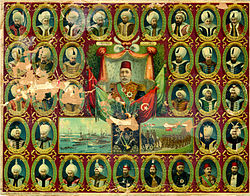

The succession process during the first period was dominated by violence and intra-familial conflict, in which the various sons of the deceased sultan fought until only one remained alive and, thus, inherited the throne. This tradition was known as fratricide in the Ottoman Empire but may have evolved from tanistry, a similar succession procedure that existed in many Turco-Mongolic dynasties predating the Ottomans. Sons of the sultan were often given provincial territories to govern until the sultan's death, at which point they would each vie for the throne. Each son had to, according to historian H. Erdem Cipa, "demonstrate that his fortune was superior to the fortunes of his rivals", a demonstration that often took the form of military accomplishment and ruthlessness. This violence was not considered particularly unexpected or unusual. As Cipa has noted, the Ottoman words for "successor" and "conflict" share the same Arabic root, and indeed, all but one of the successions in this roughly 200-year period involved a resolution by combat. Over time, the combat became increasingly prevalent and recognized, especially after a Janissary uprising negated Murad II's attempt to abdicate the throne peacefully to his son, Mehmed II, in 1444. During the eventual reign of Mehmed II (1451–1481), fratricide was legalized as an official practice; during the reign of Bayezid II (1481–1512), fratricide between Bayezid II's sons occurred before Bayezid II himself died; and after the reign of Murad III (1574–1595), his successor Mehmed III executed 19 brothers to claim the throne.
During the second period, the tradition of fratricide was replaced by a simpler and less violent procedure. Starting with the succession from Ahmed I to Mustafa I in 1617, the Ottoman throne was inherited by the eldest male blood relative – not necessarily the son – of the sultan, regardless of how many eligible family members were alive. The change in succession procedure was likely instigated by numerous factors, including fratricide's decline in popularity among Ottoman elites and Ahmed I's decision not to kill Mustafa when inheriting the throne from Mehmed III in 1603. With the door open for a policy change, a political debate arose between those who supported unrestricted sultanic privilege and those who supported a stronger, centralized law system that would supersede even the sultan's power to an extent. Historian Baki Tezcan has argued that the latter faction – with the help of the influential şeyhülislam Hocazade Esad Efendi – was able to prevail in this instance. The bloodless succession from Ahmed I to Mustafa I in 1617 "provided a reference for the eventual stabilization of the rule of Ottoman succession, the very regulation of which by an outside force was in effect a constitutional check on the dynastic prerogative," Tezcan has written. The precedent set in 1617 stuck, as the eldest living family member successfully inherited the throne in each of the following 21 successions, with relatively few instances of a son inheriting the throne.
Succession practices
From the fourteenth through the late sixteenth centuries, the Ottomans practiced open succession – something historian Donald Quataert has described as "survival of the fittest, not eldest, son". During their father's lifetime, all adult sons of the reigning Osmanoğlu family's sultan were given provincial governorships in order to gain experience in administration (a practice commonly found in Central Asian tradition), accompanied and mentored by their retinues and tutors. Upon the death of their father, the reigning sultan, these sons would fight amongst themselves for the succession until one emerged triumphant. The first son to reach the capital and seize control of the court would usually become the new ruler. The proximity of a Şehzade (Prince) to Constantinople improved his chances of success, simply because he could hear of his father's death, seize control of the Ottoman court in the capital, and declare himself sultan first.[citation needed] A sultan could thus hint at his preferred successor by giving a favourite son a closer governorship.[citation needed] Bayezid II, for instance, had to fight his brother Cem Sultan in the 1480s for the right to rule.[citation needed]
Occasionally, the half-brothers would begin the struggle even before the death of their father. Under Suleiman the Magnificent (1520–1566), strife between his sons Şehzade Mustafa and Şehzade Selim (later Selim II) caused such internal turmoil that Suleiman ordered the deaths of both Şehzade Mustafa and another son, Şehzade Bayezid, leaving Şehzade Selim the sole heir.[citation needed]
During the reigns of Suleiman I and Selim II, the Haseki Sultan (Ottoman Turkish: خاصکى سلطان) or chief consort rose to greater prominence. Gaining power within the Imperial Harem, the favourite was able to manoeuvre to ensure the succession for one of her sons. This led to a short period of effective primogeniture. However, unlike in the earlier period, when the sultan had already defeated his brothers and potential rivals for the throne in battle, these sultans had the problem of many half-brothers who could act as the focus for rival factions. Thus, to prevent attempts at seizing the throne, reigning sultans practiced fratricide upon accession, starting with Murad I in 1362. Both Murad III and his son Mehmed III had their half-brothers murdered. The killing of all the new sultan's brothers and half-brothers (who were usually quite numerous) was traditionally done by manual strangling with a silk cord. As the centuries passed, the ritual killing was gradually replaced by lifetime solitary confinement in the "Golden Cage" or kafes, a room in the harem from where the sultan's brothers could never escape, unless perchance they became heir presumptive. Some had already become mentally unstable by the time they were asked to reign.[citation needed]
Mehmed III was the last sultan to have previously held a provincial governorship. Sons now remained within the harem until the death of their father. This not only denied them the ability to form powerful factions capable of usurping their father but also denied them the opportunity to have children while their father remained alive. Thus, when Mehmet's son came to the throne as Ahmed I, he had no children of his own. Moreover, as a minor, there was no evidence he could have children. This had the potential to create a crisis of succession and led to a gradual end to fratricide. Ahmed had some of his brothers killed, but not Mustafa (later Mustafa I). Similarly, Osman II allowed his half-brothers Murad IV and Ibrahim to live. This led to a shift in the 17th century from a system of primogeniture to one based on agnatic seniority, in which the eldest male within the dynasty succeeded, also to guarantee adult sultans and prevent both fratricides as well as the sultanate of women. Thus, Mustafa succeeded his brother Ahmed; Suleiman II and Ahmed II succeeded their brother Mehmed IV before being succeeded in turn by Mehmed's son Mustafa II. Agnatic seniority explains why from the 17th century onwards a deceased sultan was rarely succeeded by his son, but usually by an uncle or brother. It also meant that potential rulers had to wait a long time in the kafes before ascending the throne, hence the old age of certain sultans upon their enthronement. Although attempts were made in the 19th century to replace agnatic seniority with primogeniture, they were unsuccessful, and seniority was retained until the abolition of the sultanate in 1922.
Chronology of sultans
List of heirs since 1922
The Ottoman dynasty was expelled from Turkey in 1924 and most members took on the surname Osmanoğlu, meaning "son of Osman". The female members of the dynasty were allowed to return after 1951, and the male members after 1973. Below is a list of people who would have been heirs to the Ottoman throne following the abolition of the sultanate on 1 November 1922. These people have not necessarily made any claim to the throne; for example, Ertuğrul Osman said "Democracy works well in Turkey."

| Name | Title | Claim | Period | Duration |
|---|---|---|---|---|
| Mehmed VI | Last Ottoman Sultan and Caliph (1918–1922) 36th Head of the House of Osman (1922–1926) | Son of Sultan Abdulmejid I, grandson of Sultan Mahmud II, younger brother of Murad V, Abdul Hamid II and Mehmed V. | 4 July 1918 – 16 May 1926 (including reign as Sultan) | 7 years, 316 days |
| Abdulmejid II | Last Ottoman Caliph (1922–1924) 37th Head of the House of Osman following Mehmed VI's death (1926–1944) | First cousin of Mehmed VI, son of Sultan Abdülaziz. | 16 May 1926 – 23 August 1944 | 18 years, 99 days |
| Ahmed Nihad | 38th Head of the House of Osman (1944–1954) | First cousin twice removed of Abdulmejid II, grandson of Sultan Murad V. | 23 August 1944 – 4 June 1954 | 9 years, 285 days |
| Osman Fuad | 39th Head of the House of Osman (1954–1973) | Younger half-brother of Ahmed Nihad, grandson of Sultan Murad V. | 4 June 1954 – 19 May 1973 | 18 years, 349 days |
| Mehmed Abdulaziz | 40th Head of the House of Osman (1973–1977) | Second cousin twice removed of Osman Fuad, grandson of Sultan Abdülaziz. | 19 May 1973 – 19 January 1977 | 3 years, 245 days |
| Ali Vâsib | 41st Head of the House of Osman (1977–1983) | Second cousin twice removed of Mehmed Abdulaziz, great-grandson of Sultan Murad V. | 19 January 1977 – 9 December 1983 | 6 years, 324 days |
| Mehmed Orhan | 42nd Head of the House of Osman (1983–1994) | Second cousin once removed of Ali Vâsib, grandson of Sultan Abdul Hamid II. | 9 December 1983 – 12 March 1994 | 10 years, 93 days |
| Ertuğrul Osman | 43rd Head of the House of Osman (1994–2009) | First cousin of Mehmed Orhan, grandson of Sultan Abdul Hamid II. | 12 March 1994 – 23 September 2009 | 15 years, 195 days |
| Bayezid Osman | 44th Head of the House of Osman (2009–2017) | Second cousin of Ertuğrul Osman, great-grandson of Sultan Mehmed V. | 23 September 2009 – 6 January 2017 | 7 years, 105 days |
| Dündar Ali Osman | 45th Head of the House of Osman (2017–2021) | Second cousin once removed of Bayezid Osman, great-grandson of Sultan Abdul Hamid II. | 6 January 2017 – 18 January 2021 | 4 years, 12 days |
| Harun Osman | 46th Head of the House of Osman (2021–present) | Younger brother of Dündar Ali Osman, great-grandson of Sultan Abdul Hamid II. | 18 January 2021 – present | 5 years, 89 days |
Family tree, showing relationships among the heads of the Ottoman dynasty since 1922
- Mahmud II (1785–1839; 30th Sultan and 23rd Ottoman Caliph: 1808–1839) Abdulmejid I (1823–1861; 31st Sultan and 24th Ottoman Caliph: 1839–1861) Murad V (1840–1904; 33rd Sultan and 26th Ottoman Caliph: 1876) Şehzade Mehmed Selaheddin (1861–1915) Ahmed Nihad (1883–1954; 38th Head of the House of Osman: 1944–1954) Ali Vâsib (1903–1983; 41st Head of the House of Osman: 1977–1983) Osman Fuad (1895–1973; 39th Head of the House of Osman: 1954–1973) Abdul Hamid II (1842–1918; 34th Sultan and 27th Ottoman Caliph: 1876–1909) Şehzade Mehmed Selim (1870–1937) Şehzade Mehmed Abdülkerim (1906–1935) Dündar Ali Osman (1930–2021): 45th Head of the House of Osman: 2017–2021) Harun Osman (born 1932): 46th Head of the House of Osman: (2021–present) Şehzade Mehmed Abdülkadir (1878–1944) Mehmed Orhan (1909–1994; 42nd Head of the House of Osman: 1983–1994) Şehzade Mehmed Burhaneddin (1885–1949) Ertuğrul Osman (1912–2009; 43rd Head of the House of Osman: 1994–2009) Mehmed V (1844–1918; 35th Sultan and 28th Ottoman Caliph: 1909–1918) Şehzade Mehmed Burhaneddin (1849–1876) Şehzade Ibrahim Tevfik (1874–1931) Bayezid Osman (1924–2017; 44th Head of the House of Osman: 2009–2017) Mehmed VI Vahideddin (1861–1926; 36th and last Sultan and 29th Ottoman Caliph: 1918–1922; 36th Head of the House of Osman: 1922–1926) Abdulaziz (1830–1876; 32nd Sultan and 25th Ottoman Caliph: 1861–1876) Abdulmejid II (1868–1944; 30th and last Ottoman Caliph: 1922–1924; 37th Head of the House of Osman: 1926–1944) Şehzade Mehmed Seyfeddin (1874–1927) Mehmed Abdulaziz (1901–1977; 40th Head of the House of Osman: 1973–1977)
See also
- Ottoman family tree (simplified)
- Ottoman family tree
- Turkic history
- Amuca tribe
- Osmanoğlu family, its current form
- List of admirals in the Ottoman Empire
- List of sultans of the Ottoman Empire
- List of Ottoman imperial consorts
- List of mothers of the Ottoman sultans
- List of Valide hatuns
- List of Valide sultans
- List of Ottoman princesses
- List of Ottoman grand viziers
- List of Kapudan Pashas
- Tughra
- Ottoman Empire
- Kadın (title)
Notes
External links
- Peirce, Leslie P. (1993). . New York: Oxford University Press US. ISBN 9780195086775. OCLC .
- Quataert, Donald (2005). (2nd ed.). Cambridge University Press. ISBN 9780521839105. OCLC .
- Karateke, Hakan T. (2005). "Who is the Next Ottoman Sultan? Attempts to Change the Rule of Succession during the Nineteenth Century". In Weismann, Itzchak; Zachs, Fruma (eds.). . London: I. B. Tauris. ISBN 9781850437574. OCLC .
In English
- 1 August 2005 at the Wayback Machine Everything about the history, culture and civilization of Ottoman Empire
In Turkish
In French
- on YouTube
| — Imperial house —House of Osman | ||
| New Dynasty Empire founded | Ruling house of the Ottoman Empire c. 1299 – 19 November 1922 | VacantMonarchy and Caliphate abolished |
| Preceded by‘Abbāsid dynasty | Caliphate dynasty 1517 – 3 March 1924 |