Culture of Ukraine
In-game article clicks load inline without leaving the challenge.

The culture of Ukraine comprises the material and spiritual values developed on Ukrainian territory over millennia. It rests on a layered historical substratum — from prehistoric Neolithic and steppe traditions through the medieval polity of Kievan Rus', whose center at Kyiv became a formative locus of literacy, liturgy and church architecture — and has been continually reshaped by local folk practice and external exchange.Family and religious life remain prominent social pillars; traditional expressive forms such as embroidered dress (vyshyvanka), ritual eggs (pysanky), folk song, dance, and oral narrative (kazka) are integral to communal identity and ceremony. Folk materials have fed literary, musical, and visual-art traditions and persist as living practices and museum relics, informing both regional customs and nationwide cultural revival movements.
Over subsequent centuries, Ukraine's culture absorbed and transformed influences from competing polities and empires while retaining distinct regional traditions. Contacts with the Polish–Lithuanian Commonwealth, the Austro-Hungarian Empire, the Russian Empire, and later the Soviet Union shaped political institutions, education, religious life, and artistic expression. At the same time, major urban centres such as Lviv, Odesa, and Kharkiv functioned as hubs of trade, publishing, scholarship, and the arts. This layered historical experience contributed to a wide-ranging cultural legacy, producing influential figures in literature, philosophy, art, music, science, and film. Among them are the poet Taras Shevchenko, whose work shaped modern Ukrainian literary language and national consciousness; the writer and thinker Ivan Franko; the poet and dramatist Lesya Ukrainka; the philosopher Hryhorii Skovoroda; avant-garde artists such as Kazimir Malevich and Oleksandra Ekster; film director Alexander Dovzhenko; and scientists and innovators including Volodymyr Vernadsky, Igor Sikorsky, and Sergei Korolev, whose contributions had international impact.
History
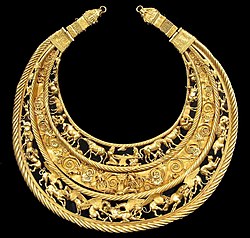

Although Ukraine has often struggled to preserve its independence its people have retained their cultural possessions and are proud of their cultural legacy. Ukrainian culture has experienced a notable resurgence since the country gained its independence in 1991.
The earliest evidence of cultural artefacts in region that is now Ukraine can be traced to decorated mammoth tusks in the Neanderthal era. Later, the nomadic tribes of the southern lands of the 4th century BCE, like the Scythians, produced finely worked gold ornaments such as the pectoral found in the Tovsta Mohyla mound.
The modern Ukrainian culture is believed to be formed as a descendant of the ancient state of Kievan Rus' centered in Kyiv as well the Kingdom of Galicia–Volhynia, both of which Ukrainians claim as their historical ancestors.[original research?] The Ukrainian historian Mykhailo Hrushevsky referred to Ukraine as Ukraine-Rus, emphasising Ukraine's historical claim to the ancient state of Kievan Rus'.
Traditional peasant folk art, embroidery and vernacular architecture are critical to Ukrainian culture, and its elements have often been determined by the resources available at the time. The country's strong tradition of folk art and embroidery continues to this day, with Ukrainian embroidery often considered an art form in itself.
Ukrainian customs are heavily influenced by the Ukrainian Greek Catholicism, Ruthenian Greek Catholicism and Eastern Orthodox Church and traditions from Slavic mythology. Prior to the Soviet Union, the Ukrainian culture has had heavy influence from other East Slavic cultures such as Russian and Belarusian culture.
Ukrainian culture has had to overcome numerous obstacles in order to survive and retain its originality, since foreign powers and empires who dominated the country and its people in the past often implemented policies aimed at assimilating the Ukrainian population into their own population, as well as trying to eradicate and purge elements of the culture. For example, the policy of Russification posed significant obstacles to the development of the culture.
Whilst progressing into modernity, Ukraine remains a highly traditional country, where the observance of certain customs and practices play a central role in its culture. Many significant Ukrainian holidays and events are based on the old Julian Calendar and so differ from their Gregorian counterparts. These include Christmas and New Year's Eve, both of which are highly important in Ukrainian culture.
During the invasion of Ukraine by Russia, damage was caused to 1,945 cultural infrastructure objects, according to Ukraine's Ministry of Culture and Information Policy. Cultural institutions that were damaged or destroyed by Russians include cultural clubs, libraries, museums, galleries, theatres, zoos, and art education institutions. It is estimated that rebuilding the damaged sites may take about 10 years.
Folklore
Ukrainian folklore comprises the traditional beliefs, customs, narrative genres, music, and dance that developed in Ukraine and among ethnic Ukrainians. Its origins include an early pan-Slavic layer of mythology and ritual that coexisted with later, regionally specific cultural developments. Folklore has played a central role in cultural identification and continuity, particularly where external political or cultural pressures threatened local practices.
Layers and regional variation
Folklore in Ukraine is commonly described as stratified. The oldest stratum is a pan-Slavic substrate shared with other Slavic peoples; above this lie traditions common to the Eastern Slavs; and above those are forms and customs that are distinctive to Ukraine. Local and regional communities — for example the Boykos, Hutsuls, Lemkos, Podolians, the historical Cossacks, and the Rusyns — contribute distinctive motifs, repertoire, and ritual forms.
Customs and rites
Customary practice is organised around two principal rhythms: the agricultural calendar and the human life cycle. Seasonal and productive rites relate to planting, herding, harvest, and seasonal festivals; life-cycle rites include birth, marriage, and funerary ceremonies. Many customs incorporate songs, dances, incantations, and processional or dramatic elements. Over centuries, pre-Christian rituals and Christian observance often combined to form hybrid practices. Under Soviet rule certain folk customs were discouraged or transformed, and a notable cultural revival of many rites has taken place in the post-Soviet period.
Music and dance
Music and dance are core components of Ukrainian folkloric expression. Song types include ritual songs (for example, carols and Kupala songs), harvest and wedding songs, historical and narrative songs, and lyrical songs concerned with family, social roles, and love. Symbolic imagery is frequent in song texts: birds, certain trees, and plants often carry specific associative meaning. Dance traditions are largely communal and frequently circular in form; some choreographies evolved into staged virtuoso dances performed by professional ensembles. Folk melodies and dances informed the work of national composers and arrangers in the late 19th and early 20th centuries, including Mykola Lysenko, Mykola Leontovych, and Kyrylo Stetsenko; they were also collected and adapted by visiting composers. Peter Tchaikovsky, Nikolai Rimsky-Korsakov, and Sergei Rachmaninoff are among those whose work incorporated Ukrainian melodic material.
Folk narrative and tales
The Ukrainian fairy tale (казка, kazka) and other narrative forms include animal tales, moral parables, and episodes reflecting agrarian and household life. Common motifs derive from pan-Slavic narrative traditions while retaining regionally specific elements. Folk narratives have been transmitted orally and through later printed and illustrated editions, and they have been used as source material for animation and children's literature.
Transmission, revival, and diaspora

Folk customs, songs, and tales continue to be practised in Ukraine and throughout the Ukrainian diaspora. Folklore has been adapted into multiple media, including early animation; for example, a 1927 Ukrainian animated retelling of The Fairy Tale of the Straw Bull is among the earliest examples of the form. Ukrainian tales have also reached international readers through translations and retellings, such as the English-language adaptation by Jan Brett of The Mitten. Diaspora communities, notably in Canada, have played a significant role in maintaining and reshaping folk practice
Language

In November 2016, a new rule came into force requiring Ukraine's radio stations to play a quota of Ukrainian-language songs each day. The law also requires TV and radio broadcasters to ensure 60% of programs such as news and analysis are in Ukrainian.
In September 2017, Ukraine instituted a similar policy on languages in public education. The law required that schools use Ukrainian, the national language, in all classes that did not require a second language. The exception from this being language classes that would be taught using "English or other official languages of the European Union." The new spelling version was adopted by the Cabinet of Ministers of Ukraine in May 2019.
As of 2022, 81% of the population of Ukraine speak the Ukrainian language in their personal life, at the same time 34% speak Russian, meaning that a significant portion of Ukrainian residents constituting 19% of people speak both languages regularly.
Political culture

Ukraine is a unitary state governed under a semi-presidential constitutional framework: the Constitution vests sovereignty in the people and divides power between a directly elected president (head of state), a prime minister and cabinet responsible to the Verkhovna Rada (unicameral parliament), and an independent judiciary.
Ukraine’s political culture is rooted in its Soviet legacy (centralized, authoritarian rule) and the experience of post‑1991 independence. In the post‑Soviet era sharp regional and cultural cleavages have been balanced by powerful civic movements. The 2004 Orange Revolution and the 2013–14 Euromaidan (Revolution of Dignity) saw mass protests demanding free elections, rule of law and closer European integration. These “people power” uprisings helped entrench democratic norms and a European‑oriented national identity. Russia’s annexation of Crimea in 2014 and the full‑scale invasion in 2022 have since further unified public opinion around resisting Russian influence. By 2023–24 polls showed overwhelming support for Euro‑Atlantic integration – roughly 89% of Ukrainians backed NATO membership and about 75% backed EU accession, with this pro‑Western orientation cutting across most regions.
Ukrainians exhibit high civic engagement but generally low confidence in government institutions. For example, by 2021 nearly half of citizens reported donating to charity and one-quarter volunteered for civic causes, and nearly half said they would join a demonstration if needed. At the same time only about 25% of Ukrainians (pre‑war) expressed confidence in the government, parliament or major parties. Recent surveys find that military and security forces enjoy high trust while civilian authorities do not (only ~16–19% trust parliament or the government). Corruption remains a top concern (cited by 81% of respondents), reflecting its persistence in politics. Major reforms such as administrative decentralization (launched in 2014) are very popular – about 77% of Ukrainians support the reform. Historically important cleavages – for example between Ukrainian‑speaking west/center and Russian‑speaking east/south – have narrowed in recent years, as virtually all regions now show broad support for democratic governance and European integration
Holidays and celebrations

Social gatherings like vechornytsi have a long history in Ukrainian culture, and so do traditional holidays like Ivan Kupala Night, Masliana (Masnytsia), Koliaduvannia, and Malanka, where people gather in large groups.
National symbols
The national symbols of Ukraine include a variety of official and unofficial symbols and other items that are used in Ukraine to represent what is unique about the nation, reflecting different aspects of its cultural life and history.
Religion
Religion is practiced throughout the country. Eastern Orthodox Christianity and Eastern Catholicism and Roman Catholicism are the three most widely practiced religions. The Ukrainian Orthodox Church is the largest in the country. Faithful of the Ukrainian Greek Catholic Church, the second largest, practice Byzantine rites, but are in communion with the Roman Catholic Church which means that they are also fully Catholic.
Arts
Clothing, fashion, and jewelry

The iconic embroidered shirt or blouse, the vyshyvanka, is the most recognizable part of Ukrainian national costume, and even has its own public celebration in May. For men, traditional dress also includes kozhukh, kontusz, żupan and sharovary. For women, traditional dress includes kozhushanka, ochipok for married women, and Ukrainian wreath for unmarried girls. Garments are made using elaborate structural design, complicated weaving techniques, extensive embroidery, and cutwork needlework.[citation needed]
Food and drink
Literature
Ukrainian literature had a difficult development because, due to constant foreign domination over Ukrainian territories, there was often a significant difference between the spoken and written language. At times the use of the Ukrainian language was even partly prohibited to be printed. However, foreign rule by Lithuania, Poland, Romania, Russia, Austria-Hungary, and the Ottoman Turkey, left behind new words thereby enriching Ukrainian. Despite tsarist and Soviet repression, Ukrainian authors were able to produce a rich literary heritage.
Many Ukrainians also contributed to the closely related literature in Russian language.
Russian book ban in Ukraine
In light of Russia's 2022 invasion on Ukraine, on 19 June 2022, the Ukrainian Parliament (Verkhovna Rada) adopted a law, according to which it became prohibited to import any books from the Russian Federation and Belarus, alongside the Ukrainian territories under Russian occupation. In addition, all imported Russian-language publications from third countries (that is, mainly other post-Soviet states) must be first screened for any anti-Ukrainian content before allowed for distribution and sale in Ukraine. President Zelenskyy signed the law on 22 June 2023.
Another stipulation (entering into force on 1 January 2023) states that, in Ukraine, it is permitted to publish books only in Ukrainian, the languages of Ukraine's indigenous ethnic groups (that is, Crimean Tatar, Karaim and Krymchak), alongside the official languages of the European Union. Furthermore, during the same seating, the Parliament adopted a law that bans importing, staging and broadcasting Russian and Russian-language music in Ukraine.
Prior to 2022, many Ukrainian publishing houses printed books in Russian. Several also publish English-language books alongside Ukrainian, including the Folio publishing house.
Performing arts
Dance
Cinema
Theatre
Music
Visual arts
Architecture
Different regions in Ukraine have their own distinctive style of vernacular architecture, based on local traditions and the knowledge handed down through generations. The Museum of Folk Architecture and Way of Life of Central Naddnipryanshchyna is located in Pereiaslav. The open-air museum contains 13 theme museums, 122 examples of national architecture, and over 30,000 historical cultural objects. The Museum of Decorative Finishes is one of the featured museums that preserves the handiwork of decorative architectural applications in Ukrainian architecture. Decorative finishes use ancient traditional design patterns.
Painting, drawing, and sculpture

On special occasions, every aspect of ordinary life is transformed into ornamental art form of artistic expression. Ornamentation and design motifs are steeped in symbolism, religious ritual and meaning. From the illuminated manuscripts of the Peresopnytsia Gospel to the famous pysanky and vytynanky, intricate details have ancient meaning. Much of the oral history was lost during the past 300 years of Russification of Ukraine when Ukrainian culture and language were forbidden. Organizations like the Ivan Honchar Museum, Pysanka Museum and the Ukrainian Museum are dedicated to historic preservation. Different regions of Ukraine have their own traditional ornamentation with their own variation of style and meaning. Examples can be seen in Ukrainian painting (Petrykivka, Kosiv, Opishnia, Bubnivka), ornamental architecture, Ukrainian embroidery, and textile motifs from various Ukrainian historical regions. Some of these works are inscribed in UNESCO and National lists of Intangible Cultural Heritage of Ukraine.
Photography
Media
Sports
Ukraine greatly benefitted from the Soviet emphasis on physical education, which left Ukraine with hundreds of stadiums, swimming pools, gymnasiums, and many other athletic facilities.
Football
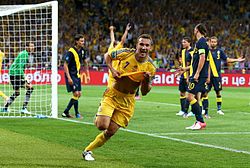
Football is the most popular sport in Ukraine. The top professional league is the Vyscha Liha, also known as the Ukrainian Premier League. The two most successful teams in the Vyscha Liha are rivals FC Dynamo Kyiv and FC Shakhtar Donetsk. Although Shakhtar is the reigning champion of the Vyscha Liha, Dynamo Kyiv has been much more successful historically, winning the UEFA Cup Winners' Cup two times, the UEFA Super Cup once, the USSR Championship a record 13 times, and the Ukrainian Championship a record 12 times; while Shakhtar only won four Ukrainian Championships and one and last UEFA Cup.[citation needed]
Many Ukrainians also played for the USSR national football team, most notably Igor Belanov and Oleg Blokhin, winners of the prestigious Golden Ball Award for the best footballers of the year. This award was only presented to one Ukrainian after the collapse of the Soviet Union, Andriy Shevchenko, the former captain of the Ukraine national football team. The national team made its debut in the 2006 FIFA World Cup, and reached the quarter-finals before losing to eventual champions, Italy [citation needed]
Boxing
Ukrainian brothers Vitaliy Klitschko and Wladimir Klitschko have held world heavyweight champion titles in boxing. Wladimir Klitschko is considered by many to be one of the best boxers of the 21st century. Oleksandr Usyk, a prominent Ukrainian boxer, is widely regarded as one of the greatest boxers of his generation and among the best of all time.
Other sports
Ukraine made its debut at the 1994 Winter Olympics. So far, Ukraine has been much more successful in the Summer Olympics (96 medals in four appearances) than in the Winter Olympics (Five medals in four appearances). Ukraine is currently ranked 35th by the number of gold medals won in the All-time Olympic Games medal count.
Other popular sports in Ukraine include handball, tennis, rugby union, basketball, gymnastics, and ice hockey.
Tourism
Ukraine attracts more than 20 million visitors a year from around the world. Seven Natural Wonders of Ukraine and Seven Wonders of Ukraine are popular destinations as well as modern urban cities, festivals, ecotourism, and medical tourism.
See also
- List of UNESCO World Heritage Sites in Ukraine
- Ukrainization
- The Seven Wonders of Ukraine are the seven historical and cultural monuments of Ukraine
- Ukrainian historical regions
- "Slava Ukraini"
Sources
- Dubrovskiy Visnyk. November 2007. "...I ne pereshkoda letu lita"
- Kurkov, Andrey, ed. (2022). Treasures of Ukraine: A Nation's Cultural Heritage. Translated by Jane Bugaeva and Nina Murray. London: Thames and Hudson. ISBN 978-0-500-02603-8.