Vithkuqi alphabet
In-game article clicks load inline without leaving the challenge.
The Vithkuqi alphabet, also called Büthakukye or Beitha Kukju after the appellation applied to it by German Albanologist Johann Georg von Hahn, was an alphabetic script invented for writing the Albanian language between 1825 and 1845 by Albanian scholar Naum Veqilharxhi.
History
Though the alphabet is sometimes erroneously claimed to be named after its inventor, as in Carl Faulmann's Das Buch der Schrift, the script's name is derived from Vithkuq, a village in the Korçë region where Veqilharxhi was born.
The alphabet never took hold because of its inventor's premature death and because of the prohibitive costs of cutting new type for the invented characters; nevertheless, a number of documents using the alphabet were published in the late 19th century. The alphabet was eventually overwhelmed by the Greek, Arabic and Latin scripts it had been designed to supplant, the last becoming the official one in 1909. Other original alphabets used for Albanian were the Elbasan alphabet and the Todhri alphabet of the 18th century. These similarly failed to see prolonged widespread usage.
Description
The Vithkuqi alphabet was specifically designed to be as religiously neutral as possible, avoiding the duplication of Greek, Latin, or Arabic characters. It had a near-perfect correspondence between letters and phonemes, but lacked characters for modern Albanian "gj", "rr", "xh", and "zh". Additionally, modern "b" and "h" were each represented by two characters- the lesser-used characters in each pair are transliterated as "bb" and "hh" below.
| Capital letter | Small letter | Modern Albanian | IPA | ||
|---|---|---|---|---|---|
| Image | Text | Image | Text | ||
| 𐕰 | 𐖗 | a | /a/ | ||
| 𐕱 | 𐖘 | bb | /b/ | ||
| 𐕲 | 𐖙 | b | /b/ | ||
| 𐕳 | 𐖚 | c | /t͡s/ | ||
| 𐕴 | 𐖛 | ç | /t͡ʃ/ | ||
| 𐕵 | 𐖜 | d | /d/ | ||
| 𐕶 | 𐖝 | dh | /ð/ | ||
| 𐕷 | 𐖞 | e | /ɛ/ | ||
| 𐕸 | 𐖟 | ë | /ə/ | ||
| 𐕹 | 𐖠 | f | /f/ | ||
| 𐕺 | 𐖡 | g | /ɡ/ | ||
| 𐕼 | 𐖣 | h | /h/ | ||
| 𐕽 | 𐖤 | hh | /h/ | ||
| 𐕾 | 𐖥 | i | /i/ | ||
| 𐕿 | 𐖦 | ie | /iɛ̯/ | ||
| 𐖀 | 𐖧 | j | /j/ | ||
| 𐖁 | 𐖨 | k | /k/ | ||
| 𐖂 | 𐖩 | l | /l/ | ||
| 𐖃 | 𐖪 | ll | /ɫ/ | ||
| 𐖄 | 𐖫 | m | /m/ | ||
| 𐖅 | 𐖬 | n | /n/ | ||
| 𐖆 | 𐖭 | nj | /ɲ/ | ||
| 𐖇 | 𐖮 | o | /ɔ/ | ||
| 𐖈 | 𐖯 | p | /p/ | ||
| 𐖉 | 𐖰 | q | /c͡ç/ | ||
| 𐖊 | 𐖱 | r | /ɹ/ | ||
| 𐖌 | 𐖳 | s | /s/ | ||
| 𐖍 | 𐖴 | sh | /ʃ/ | ||
| 𐖎 | 𐖵 | t | /t/ | ||
| 𐖏 | 𐖶 | th | /θ/ | ||
| 𐖐 | 𐖷 | u | /u/ | ||
| 𐖑 | 𐖸 | v | /v/ | ||
| 𐖒 | 𐖹 | x | /d͡z/ | ||
| 𐖔 | 𐖻 | y | /y/ | ||
| 𐖕 | 𐖼 | z | /z/ |
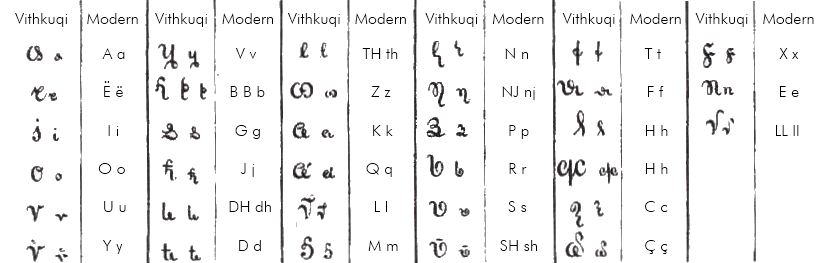
Typeface
The books by Veqilharxhi were lithographed in Bucharest by George Venrich, as was recently discovered. Though the alphabet was lithographed, in 1847 it was also cut for typographic use in Vienna, by the Austrian philologists and punchcutter Alois Auer. It was first used for a type specimen called Das Vaterunser in 206 Sprachen by the Imperial Printing Press (k.k. Hof- und Staatsdruckerei) in Vienna, under the direction of Auer. The same type was also used by Carl Faulmann in a different book a few years later. It is the first typeface to be cut for an original Albanian alphabet.
Unicode
Vithkuqi was added to the Unicode Standard in September 2021 with the release of version 14.0.
The Unicode block for Vithkuqi is U+10570–U+105BF:
| Vithkuqi[1][2] (PDF) | ||||||||||||||||
| 0 | 1 | 2 | 3 | 4 | 5 | 6 | 7 | 8 | 9 | A | B | C | D | E | F | |
| U+1057x | 𐕰 | 𐕱 | 𐕲 | 𐕳 | 𐕴 | 𐕵 | 𐕶 | 𐕷 | 𐕸 | 𐕹 | 𐕺 | 𐕼 | 𐕽 | 𐕾 | 𐕿 | |
| U+1058x | 𐖀 | 𐖁 | 𐖂 | 𐖃 | 𐖄 | 𐖅 | 𐖆 | 𐖇 | 𐖈 | 𐖉 | 𐖊 | 𐖌 | 𐖍 | 𐖎 | 𐖏 | |
| U+1059x | 𐖐 | 𐖑 | 𐖒 | 𐖔 | 𐖕 | 𐖗 | 𐖘 | 𐖙 | 𐖚 | 𐖛 | 𐖜 | 𐖝 | 𐖞 | 𐖟 | ||
| U+105Ax | 𐖠 | 𐖡 | 𐖣 | 𐖤 | 𐖥 | 𐖦 | 𐖧 | 𐖨 | 𐖩 | 𐖪 | 𐖫 | 𐖬 | 𐖭 | 𐖮 | 𐖯 | |
| U+105Bx | 𐖰 | 𐖱 | 𐖳 | 𐖴 | 𐖵 | 𐖶 | 𐖷 | 𐖸 | 𐖹 | 𐖻 | 𐖼 | |||||
| Notes 1.^ As of Unicode version 17.0 2.^ Grey areas indicate non-assigned code points |
See also
Sources
- Diringer, David. (1949). The Alphabet.
- Десницкая, Агния Васильевна. (1968). Албанский язык и его диалекты. Leningrad: Nauka.
- Десницкая, Агния Васильевна. (1987). Албанская литература и албанский язык. Leningrad: Nauka.
- Elsie, Robert. (1995). The Elbasan Gospel Manuscript (Anonimi i Elbasanit), 1761, and the struggle for an original Albanian alphabet.
- Faulmann, Karl. (1880). Das Buch der Schrift.
- Skendi, Stavro. 1960. The history of the Albanian alphabet: a case of complex cultural and political development. Südost-Forschungen: Internationale Zeitschrift für Geschichte, Kultur und Landeskunde Südosteuropas 19:263-284.
- Trix, Frances. 1997. Alphabet conflict in the Balkans: Albanian and the congress of Monastir. International Journal of the Sociology of Language 128:1-23.
- Veqilharxhi, Naum. (1845). Ëvetar Shqip Fort i Shkurtër.