Hypocnemis
In-game article clicks load inline without leaving the challenge.
Hypocnemis is a genus of passerine birds in the family Thamnophilidae that live and breed in tropical South America. Some Hypocnemis species are geographically separated, often by natural barriers such as Amazonian rivers, while others are sympatric and distinguished mainly by differences in songs and calls. Hypocnemis typically inhabit the forest understory, where they feed mainly on insects and other arthropods.
Etymology
The genus name Hypocnemis was introduced by the German ornithologist Jean Cabanis in 1847. The name combines the Ancient Greek words hupo "somewhat like" and knēmis "leggings" and likely refers to their leg plumage. The type species is Hypocnemis cantator, the Guianan warbling antbird.
The common names for members of the genus end with "warbling antbird" (or "warbling-antbird") in some sources and "antwarbler" in others.
Taxonomy
The genus was initially considered to contain two species, the yellow-browed antbird (Hypocnemis hypoxantha) and the warbling antbird (H. cantator sensu lato). In 2007, Isler et al. raised six subspecies of the warbling antbird to full species level; this group is referred to as the Hypocnemis cantator species complex.
This taxonomic revision was primarily based on songs and calls; members of the species complex have vocal differences comparable to sympatric species pairs elsewhere in the family Thamnophilidae. Some sympatric pairs differ markedly in their common calls (short calls given by both males and females), suggesting that these play a role in reproductive isolation. While there are plumage differences, particularly in crown colour and streaking patterns, these are relatively subtle.
An additional member of the H. cantator species complex, Manicoré warbling antbird (H. rondoni) was defined in 2013; previously it had been considered a subspecies of Spix's warbling antbird (H. striata).
Evolutionary history
The Amazon River and its tributaries (such as the Rio Negro and the Rio Branco) separate some Hypocnemis species. These geographical boundaries are thought to have contributed to species differentiation less than 2 million years ago. A study which tested the ability of Amazonian birds to cross rivers found that antbirds in general were among the least capable: the study included H. cantator and H. flavescens, both scored as unsuccessful. River-based vicariance is well-documented in Amazonian birds, with molecular studies showing genetic divergences across river barriers that correlate with vocal and plumage differences.
Other speciation mechanisms may be involved for sympatric species pairs. First-generation and backcross hybrids of H. striata and H. ochrogyna were readily found in their area of overlap, but second generation hybrids were rare. There was little sign of gene flow between the two species, suggesting that post-zygotic isolation (selection against hybrids) is a major factor in keeping the species separate. When species ranges overlap, habitat specialization may also contribute to maintaining species separation. H. subflava and H. peruviana are found in close proximity, even holding adjacent territories, but H. subflava tends to prefer bamboo and H. peruviana non-bamboo habitat in the area of overlap.
Mitochondrial DNA analysis suggests that some Hypocnemis speciation events are ancient. H. cantator sensu lato and H. hypoxantha mtDNA show a 9.3% genetic distance, comparable to the 7.2% between species in their sister genus, Drymophila. This study also found 5.7% genetic distance between two birds collected 350 km apart in continuous forest.
Hypocnemis species information table
| Image | Common name | Scientific name | Distribution | Map |
|---|---|---|---|---|
| Guianan warbling antbird | Hypocnemis cantator | Venezuela, French Guiana, Guyana, Suriname, Brazil | ||
| Imeri warbling antbird | Hypocnemis flavescens | Venezuela, Columbia, Brazil | ||
| Peruvian warbling antbird | Hypocnemis peruviana | Columbia, Ecuador, Peru, Brazil, Bolivia | ||
| Spix's warbling antbird | Hypocnemis striata | Brazil | ||
| Yellow-breasted warbling antbird | Hypocnemis subflava | Peru, Bolivia, Brazil | ||
| Rondônia warbling antbird | Hypocnemis ochrogyna | Bolivia, Brazil | ||
| Manicoré warbling antbird | Hypocnemis rondoni | Brazil | ||
| Yellow-browed antbird | Hypocnemis hypoxantha | Columbia, Ecuador, Peru, Brazil |
Distribution and habitat
Hypocnemis is distributed across the Amazon Basin, with species occupying distinct regions such as the Guiana Shield (e.g., H. cantator, the Guianan warbling antbird), western Amazonia (H. peruviana, the Peruvian warbling antbird), and southwestern Amazonia (H. subflava, the yellow-breasted warbling antbird). Their ranges are largely parapatric, separated by major rivers like the Amazon and Madeira, which act as barriers to gene flow and contribute to allopatric speciation.[failed verification]
Most Hypocnemis species inhabit moist forest and seasonally flooded forests or swamps. While they often favour breaks in the canopy due to fallen trees or streams, only H. cantator prefers forest edges. They are lowland birds; H. hypoxantha and H. striata are found at up to 800–900 metres (2,600–3,000 ft) elevation, and the others up to 1,300–1,400 metres (4,300–4,600 ft).
Behaviour
| Songs and calls |
Both males and females of Hypocnemis species produce sex-specific songs as well as shared common calls. Males initiate duets to which females respond. A song-playback study in H. cantator sensu lato showed that among paired birds, both males and females reacted most strongly to songs indicating a lone same-sex intruder, and neither reacted strongly to songs indicating paired intruders. This suggests that songs are used primarily for mate guarding, not territory protection.
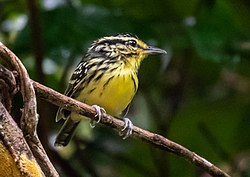
Hypocnemis species primarily forage in the forest understory, feeding on insects and other arthropods. At least four species have been observed to follow army ant swarms to capture prey disturbed by the ants: H. subflava, H. peruviana, H. cantator, and H. flavescens. All four are noted to back off when obligate ant-following birds arrive.
Hypocnemis construct pouch-shaped nests which are similar among the species, though egg color varies. In H. subflava, both parents participate actively in incubation and chick-rearing.
Conservation status
Although most members of the genus are classed as Least concern, all except H. cantator have decreasing populations. The Rondônia warbling antbird (H. ochrogyna) is classed as Vulnerable based on loss of over 30% of its population in the last three generations due to deforestation and habitat fragmentation. The Brazilian state of Rondônia, containing the majority of this bird's range, lost 28% of its humid forest area between 2002 and 2025.


BirdLife rates dependency on forest as Medium for H. cantator and H. hypoxantha but High for the other six species. A study of stress hormone levels in feathers found that H. cantator individuals confined to smaller islands of habitat showed increased stress compared to ones living in large islands or continuous forest.
The construction of the Belo Monte Dam resulted in the flooding of riparian habitats for H. striata.
| Common name | Scientific name | IUCN Status | Population Trend | Major threats |
|---|---|---|---|---|
| Guianan warbling antbird | Hypocnemis cantator | Least Concern | Stable | Deforestation, habitat fragmentation |
| Imeri warbling antbird | Hypocnemis flavescens | Least Concern | Decreasing | No information |
| Peruvian warbling antbird | Hypocnemis peruviana | Least Concern | Decreasing | No information |
| Spix's warbling antbird | Hypocnemis striata | Least Concern | Decreasing | Forest loss and disturbance |
| Yellow-breasted warbling antbird | Hypocnemis subflava | Least Concern | Decreasing | No information |
| Rondonia warbling antbird | Hypocnemis ochrogyna | Vulnerable | Decreasing | Deforestation, fragmentation |
| Manicoré warbling antbird | Hypocnemis rondoni | Least Concern | Decreasing | Possibly road construction and fragmentation |
| Yellow-browed antbird | Hypocnemis hypoxantha | Least Concern | Decreasing | No information |