Wild Card Series
In-game article clicks load inline without leaving the challenge.
The Wild Card Series (WCS; formerly known as the Wild Card Game (WCG) from 2012 to 2019 and in 2021) is the opening round of postseason play in Major League Baseball (MLB), featuring the American League Wild Card Series (ALWCS) and the National League Wild Card Series (NLWCS). A single wild card game was instituted in 2012. This became a best-of-three playoff wild card series in 2020 as a one-off, and became permanent (albeit with fewer teams playing than in the 2020 series) starting in the 2022 season.
The lowest-seeded division winner and three wild card teams in each league play in a best-of-three series after the end of the regular season. The winners of each league's wild card series advance to face the two-best division winners in that league's Division Series. This expansion of the postseason abolished any regular-season-extending tie-breaker games.
Format
Under the format adopted in 2022, six teams in each league are assigned seeds for the postseason. In each league, the three division winners are seeded #1–3, per their relative winning percentages. The lowest-seeded division winner is automatically given the No. 3 seed even if one or all other wild-card teams has a better record. Also in each league, the three teams with the best winning percentages among non-division winning teams are wild cards, seeded #4–6, per their relative winning percentages. Any ties are broken using a set of MLB tie-breaking procedures; as such, no tie-breaking games (colloquially known as "Game 163") are contested.
The top two division winners in each league receive first-round byes to the Division Series. The remaining four teams, seeds No. 3 through No. 6, play in two best-of-3 wild card series, with the higher seed hosting all games. These two series are: No. 3 hosting No. 6, and No. 4 hosting No. 5.
In the Division Series, the winner of the No. 4 vs. No. 5 series faces the No. 1 seed, and the winner of the No. 3. vs. No. 6 series faces the No. 2 seed. The bracket structure in each league looks as follows:
| Wild Card Series Best-of-3 | Division Series Best-of-5 | League Championship Series Best-of-7 | ||||||||||||
| 1 | Best record in league | |||||||||||||
| 4 | Wild Card team #1 | |||||||||||||
| 5 | Wild Card team #2 | |||||||||||||
| 2 | Second-best division winner | |||||||||||||
| 3 | Lowest seeded-division winner | |||||||||||||
| 6 | Wild Card team #3 |
History
One Wild Card team per league (1995–2011)
From 1969 through 1993, the division leaders in each league advanced to the League Championship Series, with the winners of each LCS meeting in the World Series. However, an expanding number of teams in MLB over the years made making the playoffs increasingly difficult. The new system was instituted in 1994 (but first used in 1995 because a players strike canceled the 1994 playoffs) when Major League Baseball expanded from two to three divisions per league. In the new three-division leagues, each league had four teams in the playoffs; in addition to the three division winners, the division runner-up with the best record received a wild card spot. This assured that the team with the second-best record in its league would qualify for the postseason even if it was not a division champion.
Thus, a third postseason round was added, the Division Series. From 1995 to 1997, a yearly rotation was used to decide the match-ups in the Division Series, although the wild card team was prevented from playing its own division's champion. Beginning in 1998, the team with the best record in the league would typically face the wild card team and the other two division winners would play each other, with second-best division winner having home-field. However, if the division winner with the league's best record and the wild card team came from the same division, the wild card would face the second-best division winner in the league.
Wild Card Game (2012–2019, 2021)
The Wild Card round was initially introduced in 2012 as a single-game playoff between two wild-card teams in each league, with the winner advancing to play the top seed in the Division Series. With the adoption of MLB's new collective bargaining agreement in November 2011, baseball commissioner Bud Selig announced that a new playoff system would begin within the next two years; the change was ultimately put into place in 2012. This format was used through the 2019 season.
Wild Card Series (2020, 2022–present)
For the 2020 postseason, following a shortened 60-game regular season due to the COVID-19 pandemic, MLB held a one-off Wild Card Series with eight teams in each league, thus a total of 16 playoff teams. Division champions were seeded 1–3 by record, the second-place teams seeded 4–6 by record, and the two teams with the next-best records were seeded seventh and eighth. Matchups were contested as best-of-three series rather than individual games.
MLB returned to the previous format of one Wild Card Game per league for the 2021 postseason. Starting with the 2022 postseason, MLB added a third wild card team in each league. In the current format of the Wild Card Series, the top two division winners in each league receive a bye to the Division Series, while the lowest-seeded division winner and three wild card teams play in this round. A best-of-three series takes place, with the higher seed hosting all three games. Due to the expansion of the postseason beginning in 2022, the regular season tie-breaker game format has been eliminated.
As of the beginning of the 2024 postseason, 29 of the 30 MLB franchises have reached the Wild Card round of the postseason (either a Wild Card Game or the Wild Card Series). The New York Yankees and the Tampa Bay Rays each have the most appearances with five, and have the most wins during the Wild Card round with three each. The Milwaukee Brewers, the Athletics, the St. Louis Cardinals and the Toronto Blue Jays each have the most losses during the Wild Card round, with three each. The Los Angeles Angels are the only franchise that has never played in the Wild Card round.
Analysis
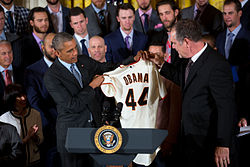
Through the 2021 postseason, Wild Card Game winners have gone on to compile an overall 9–9 record in League Division Series, with Wild Card Game winners going 4–5 in the ALDS and 5–4 in the NLDS. Two Wild Card Game winners have gone on to win the World Series (the 2014 Giants and the 2019 Nationals). The 2014 postseason featured the first series sweeps involving a Wild Card Game winner; both in favor of the AL Wild Card Kansas City Royals, who swept the Los Angeles Angels in the ALDS and the Baltimore Orioles in the ALCS. The Royals then met the San Francisco Giants in the 2014 World Series, the second all-Wild Card fall classic, which the Giants won in seven games. The first all-Wild Card World Series had also involved the Giants, who lost the 2002 World Series to the then-Anaheim Angels in seven games.
In the sixteen games played since the new Wild Card system began in 2012, five have been shutouts. In eight of the eleven others, the losing team scored three or fewer runs. There have only been two games in which the losing team scored more than six runs: the 2017 NL Wild Card Game in which the Arizona Diamondbacks defeated the Colorado Rockies by a score of 11–8; and the 2014 AL Wild Card Game which featured the Kansas City Royals beating the Oakland Athletics 9–8 in 12 innings. The margin of victory has been four runs or more in eight of the sixteen games played. Only three games have been decided by exactly one run: the 2014 Royals–Athletics game, the 2018 Rockies–Cubs game, and the 2019 Nationals–Brewers game.
Results
Through the 2021 postseason, visiting teams and home teams have each won nine of the 18 games played. There have been five shutouts, each of which has been won by the visiting team, including three consecutive shutouts in the 2014–2016 NL editions. Two of the three extra innings games have been won by the home team. Three games have ended in walk-off victory for the home team, with the 2021 NL edition being the only one in regulation.
| bold | Wild Card Game winner |
| ↓ | Lost tie-breaker game to reach Wild Card Game (arrow links to game) |
| ↑ | Won tie-breaker game to reach Wild Card Game (arrow links to game) |
| Reached League Championship Series | |
| Reached World Series | |
| Won World Series |
American League Wild Card Game
National League Wild Card Game
Wild Card Series
After the shortened 60-game regular season of 2020, the first round of the MLB postseason consisted of four Wild Card Series in each league, each series being a best-of-three hosted by the higher seed. Eight teams from each league participated: three division winners, three division runners-up, and two wild card teams (the two remaining teams with the best records, based on winning percentage). Thus, while each league's Wild Card Series featured a total of eight teams, there were still only two wild card qualifiers per league.
Starting in 2022, a modified version of the Wild Card Series was used. However, only three Wild Cards qualify along with the lowest-seeded division winner.
Until 2025, nearly every Wild Card Series held so far ended in a sweep, with only 4 of the 20 series needing a Game 3. Lower-seeded teams have won eight series out of 12.
| E1C1W1 | Division winners for East, Central, West |
| E2C2W2 | Division runners-up for East, Central, West |
| WC | Wild card teams |
| bold | Wild Card Series winner |
American League Wild Card Series
National League Wild Card Series
Appearances by team
In the sortable tables below, teams are ordered first by number of wins, then by number of appearances, and finally by year of first appearance. These records reflect series outcomes of the 2020 Wild Card Series, not individual games. In the "Season(s)" column, bold years indicate winning appearances.
American League
| Apps | Team | Wins | Losses | Win % | Season(s) |
|---|---|---|---|---|---|
| 6 | New York Yankees | 4 | 2 | .667 | 2015, 2017, 2018, 2020, 2021, 2025 |
| 5 | Tampa Bay Rays | 3 | 2 | .600 | 2013, 2019, 2020, 2022, 2023 |
| 3 | Houston Astros | 2 | 1 | .667 | 2015, 2020, 2024 |
| 2 | Kansas City Royals | 2 | 0 | 1.000 | 2014, 2024 |
| 2 | Detroit Tigers | 2 | 0 | 1.000 | 2024, 2025 |
| 4 | Athletics | 1 | 3 | .250 | 2014, 2018, 2019, 2020 |
| 4 | Toronto Blue Jays | 1 | 3 | .250 | 2016, 2020, 2022, 2023 |
| 4 | Cleveland Guardians | 1 | 3 | .250 | 2013, 2020, 2022, 2025 |
| 3 | Minnesota Twins | 1 | 2 | .333 | 2017, 2020, 2023 |
| 3 | Baltimore Orioles | 1 | 2 | .333 | 2012, 2016, 2024 |
| 2 | Texas Rangers | 1 | 1 | .500 | 2012, 2023 |
| 2 | Boston Red Sox | 1 | 1 | .500 | 2021, 2025 |
| 1 | Seattle Mariners | 1 | 0 | 1.000 | 2022 |
| 1 | Chicago White Sox | 0 | 1 | .000 | 2020 |
National League
| Apps | Team | Wins | Losses | Win % | Season(s) |
|---|---|---|---|---|---|
| 3 | Los Angeles Dodgers | 3 | 0 | 1.000 | 2020, 2021, 2025 |
| 4 | San Diego Padres | 3 | 1 | .750 | 2020, 2022, 2024, 2025 |
| 2 | San Francisco Giants | 2 | 0 | 1.000 | 2014, 2016 |
| 2 | Arizona Diamondbacks | 2 | 0 | 1.000 | 2017, 2023 |
| 2 | Philadelphia Phillies | 2 | 0 | 1.000 | 2022, 2023 |
| 4 | Chicago Cubs | 2 | 2 | .500 | 2015, 2018, 2020, 2025 |
| 4 | St. Louis Cardinals | 1 | 3 | .250 | 2012, 2020, 2021, 2022 |
| 3 | Pittsburgh Pirates | 1 | 2 | .333 | 2013, 2014, 2015 |
| 3 | Atlanta Braves | 1 | 2 | .333 | 2012, 2020, 2024 |
| 3 | New York Mets | 1 | 2 | .333 | 2016, 2022, 2024 |
| 2 | Colorado Rockies | 1 | 1 | .500 | 2017, 2018 |
| 2 | Miami Marlins | 1 | 1 | .500 | 2020, 2023 |
| 1 | Washington Nationals | 1 | 0 | 1.000 | 2019 |
| 3 | Cincinnati Reds | 0 | 3 | .000 | 2013, 2020, 2025 |
| 4 | Milwaukee Brewers | 0 | 4 | .000 | 2019, 2020, 2023, 2024 |
Game results by team
Updated through the 2025 postseason. These records reflect individual game results of the 2020 Wild Card Series.

| Team | League | Appearances | Individual games | ||
|---|---|---|---|---|---|
| Games | Series | Win–loss record | Winning pct. | ||
| Arizona Diamondbacks | NL | 1 | 1 | 3–0 | 1.000 |
| Atlanta Braves | NL | 1 | 2 | 2–3 | .400 |
| Baltimore Orioles | AL | 2 | 1 | 1–3 | .250 |
| Boston Red Sox | AL | 1 | 1 | 2–2 | .500 |
| Cincinnati Reds | NL | 1 | 2 | 0–5 | .000 |
| Chicago Cubs | NL | 2 | 2 | 3–4 | .429 |
| Chicago White Sox | AL | 0 | 1 | 1–2 | .333 |
| Cleveland Guardians | AL | 1 | 3 | 3–5 | .375 |
| Colorado Rockies | NL | 2 | 0 | 1–1 | .500 |
| Detroit Tigers | AL | 0 | 2 | 4–1 | .800 |
| Houston Astros | AL | 1 | 2 | 3–2 | .600 |
| Kansas City Royals | AL | 1 | 1 | 3–0 | 1.000 |
| Los Angeles Dodgers | NL | 1 | 2 | 5–0 | 1.000 |
| Miami Marlins | NL | 0 | 2 | 2–2 | .500 |
| Milwaukee Brewers | NL | 1 | 3 | 1–7 | .125 |
| Minnesota Twins | AL | 1 | 2 | 2–3 | .400 |
| New York Mets | NL | 1 | 2 | 3–4 | .429 |
| New York Yankees | AL | 4 | 2 | 6–3 | .667 |
| Athletics | AL | 3 | 1 | 2–4 | .333 |
| Philadelphia Phillies | NL | 0 | 2 | 4–0 | 1.000 |
| Pittsburgh Pirates | NL | 3 | 0 | 1–2 | .333 |
| San Diego Padres | NL | 0 | 4 | 7–4 | .636 |
| San Francisco Giants | NL | 2 | 0 | 2–0 | 1.000 |
| Seattle Mariners | AL | 0 | 1 | 2–0 | 1.000 |
| St. Louis Cardinals | NL | 2 | 2 | 2–5 | .286 |
| Tampa Bay Rays | AL | 2 | 3 | 4–4 | .500 |
| Texas Rangers | AL | 1 | 1 | 2–1 | .667 |
| Toronto Blue Jays | AL | 1 | 2 | 1–4 | .200 |
| Washington Nationals | NL | 1 | 0 | 1–0 | 1.000 |
The following current MLB teams have not yet appeared in a Wild Card playoff:
American League: Los Angeles Angels
Records
Single team
- Most runs scored: 12, New York Yankees vs. Cleveland Indians, Game 1 of the 2020 ALWC
- Most hits: 17, Arizona Diamondbacks vs. Colorado Rockies, 2017 NLWC
Both teams
- Most runs scored: 20, St. Louis Cardinals (9) vs. San Diego Padres (11), Game 1 of the 2020 NLWC
- Most hits: 30, Colorado Rockies (13) vs. Arizona Diamondbacks (17), 2017 NLWC
Other
- Largest run differential: 9, New York Yankees (12) vs. Cleveland Indians (3), Game 1 of the 2020 ALWC
- Longest game, by time: 297 minutes (4:57), Tampa Bay Rays vs. Cleveland Guardians, Game 2 of the 2022 ALWCS
- Longest game, by innings: 15, Tampa Bay Rays vs. Cleveland Guardians, Game 2 of the 2022 ALWCS