Wild man
In-game article clicks load inline without leaving the challenge.
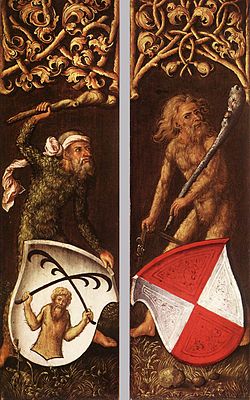
The wild man (German: Wilder Mann, der Wilde Mann), or wild man of the woods, is a mythical figure and motif resembling a hairy human that appears in the art and literature of medieval Europe. Generally they are considered a large-statured race of humans who are hairy all over their body, and live in the wilderness or woodlands. They are often thought to be covered with moss, or wear green or vegetative clothing, and iconically wield a club or hold an uprooted tree as a staff. They also occur in female versions as wild women.
The Wilde Mann (Middle High German: wilde man) is attested in Middle High German literature, particularly German heroic epics, while the female Wilde Weib (wildez wîp) figures in the Arthurian works, typically appear as adversaries. These beings are also called by names meaning "wood men" and in older forms of the language, "wood maiden", "wood wife", or "wood woman". In Middle English a corresponding term for the wild man is woodwose or wodewose.
In the folklore of German-speaking areas collected mainly in the 19th century, there are especially the Alpine wild men and wild women. These beings could be man-hunters or otherwise be sinister, but could also endow luck or bounty, exhibiting aspects of woodland spirits.
The folklore that had developed in the mining areas around Harz or Ore Mountains by the 16th century regarded the wild man of the mines (also known as "mountain monk") as potentially both dangerous and beneficent, guiding humans to the discovery of ore deposits. The house of the Princes of Brunswick-Wolfenbüttel (Brunswick-Lüneburg), which controlled one of the silver mines, minted silver thaler ('dollar') coinage with the wild man in their coat-of-arms, starting 1539.
These wild men had already frequently appeared in European family heraldic devices since the latter half of the 15th century. It also became commonplace to depict the wild man as shield-bearers of the family coat of arms (e.g., within a portrait painting by Albrecht Dürer, cf. image right). This period also roughly coincides with the popularization of the concept of the "noble wild man" or "noble savage" as can already be seen in Hans Sachs's "Lament of the Wild Men" (1530), and also reflected in artistic depictions of the wild folk from this period onward.
The wild man or wild woman in folklore was believed to be the protector of the (sustainability of) wild game, especially the chamois (German: Gemse), and stories tell of the hunter who breached the taboo being knocked off a precipice or turned into stone.
The defining characteristic of the figure is its "wildness"; iconography from the 12th century onward has consistently depicted the wild man as being covered with hair. Around the same transition period, biblical or other humans afflicted with madness came to be conventionally depicted with hairiness, and subsequently, literary figures who temporarily lose sanity and live in the wild (Merlin, Ywain) also came to be associated with wild men.
Terminology

"Wild man" is a technical term in use since the Middle Ages, applied to a hairy human-like creature with certain animal-like traits but which has not quite descended to the level of ape; it may have hairless spots around the face, palms, feet, sometimes elbows and knees, and around the breasts in case of the female "wild woman". If the creature exhibits additional animal-like traits, it may not be a wild man in question, but rather the satyr, faun, or the devil (Bernheimer's definition).
"Wild man" and its cognates in some languages are the common terms for the creature in most modern languages; it appears in German as wilder Mann, in French as homme sauvage. However, in Italian, uomo selvatico ("forest man") is often used (var. selvaggio).
The German wild man (Der Wilde) also occurs in a more modern folklore tradition, localized in a region spanning from Switzerland to Carinthia, Austria (and often Hesse in Germany) according to the Handwörterbuch des deutschen Aberglaubens[de] (HdA), registered under such names as wilde Frau, Wildfrau, -en, wilde Fraulein, Wildfräulein wilder Mann, Wildmannli, wilde Männle, Wildmännlein. Plural forms are: wilde Männer, or wilde Leute or wilde Menschen. Females are also called wildes Weib (pl. wilde Weiber).
The "wild man" is attested in Middle High German as wilde man in the 13th century, once in a lyrical poem alluding to the story of the giant Sigenot, i.e., an epic featuring both giant and wild man, from the Dietrich von Bern cycle. Another attestation occurs in the Arthurian romance Wigamur[de] which gives wilde man (v. 203), as well as the female form wildez wîp (vv. 112, 200, 227ff.) (For additional examples in MHG literature cf. § German epics below).
In Old High German, the term wildaz wîp (lit.'wild wife, wild woman') together with holzmuoja, holzmoia (lit.'wood maiden') occurs in a glossary under the heading of the Latin term lamia (female monster). The same glossary under the heading of Latin ulula (lit.'screech owl' but here understood to be equivalent to strix of mythology) gives the gloss wildiu wîp. There are also the forms holzwib (holzwîb), as well as holzvrouwe and numerous others.
Another old example is the mention of "ad domum wildero wîbo" ("house of the wild women"), a piece of landmark or toponymy somewhere in Hessen, mentioned in Codex Eberhardi[de] (c. 1150) by the monk Eberhard of Fulda or a redaction given by Johann Pistorius the Younger (d. 1608).
Wood-folk type synonyms
The wild man is referred to as waltluoder in Wolfdietrich, and in the same work, the title hero must deal with the advances of Rauhe Else[de] ("Shaggy Else"), classified as a wild woman (cf. § German epic below).
In the epic Laurin the wild man is referred to as a waltmann (lit.'wood man'). The same term waltman is used in Iwein to characterize the herdsman as a wild man, and he is also described as being as hairy as a walttôren (lit.'wood fool') (Cf. Iwein discussed below under § Medieval iconography).
A group of OHG glosses for wild woman (lamia, etc.) was already discussed above. In MHG, an attested synonym for wild woman is holz-wîp (lit.'wood wife').
In modern regional folklore, the creatures with sylvan (wood-related) names that correspond to the Alpine wild folk are the Holzleute or Moosleute (wood- or moss people) of Central Germany, Franconia, and Bavaria; Holzfräulein[de] aka Waldfräulein, Waldweiblein of the Bohemian Forest and the Upper Palatinate; the Waldweiblein and Moosweiblein[de] (lit.'moss maiden') of the Harz mountains region; the Lohjungfer (lit.'grove maiden'; pl.Lohjungfern) of Halle further east in Saxony; and the Buschweiblein (lit.'bush maiden') of Westphalia. Usage of names such as Lohjungfer, Holzfräulein, Mossweibchen extends further south in Saxon Vogtland.
Waldfänke is synonymous to wilder Mann, which is an exception, since Fang(e) and its extensions (cf. Fänge below) generally refer to females. The variant form Waldfenken-Geißler is also given in commentary. As for Geißler ("goatherd") or Kühler ("cowherd"), the wild man may be designated by the name of his profession in a narrative where he is engaged in the herding of livestock.
Cf. also the etymological relation between the term "sylvan" ("of the woods"), the French term sauvage meaning "wild", and the Sal- group of names for the wild men used in the Italian Alps (Trentino-Alto Adige/Südtirol) region under § Other aliases below. Cf. also "woodwose" under § English terms.
Other aliases
Folklore in Tyrol and German-speaking Switzerland into the 20th century refers to the wild woman called Fänge (var. Fängge/Faengge, Fankke, Fang, Fange, Fangge, Fangga, Fanggin), commented as being equivalent to Selige Fräulein (Salige Frau) This name is thought to be post-medieval neologism deriving from the Latin fauna, the feminine form of faun. The wild women of the Alpine region are "identical to or closely related to" the Fänggen or the Salige (Salige Frauen). The extended form Wild-Fang is considered a male noun (ein Wild-fang), but Wild-fang (var. Wildfangg) is still applied to a female.
The wild man is called a Bilmon (corruption of "wild man"), Salvadegh, or Salvanel in Wälsch-Tirol (present-day Trento Province), which may be spelt Salvan or Salvang, with usage extending to Lombardy. The wild man is called l'om salvadegh by Ladin language-speakers in Folgrait (Folgaria) and Trambileno; this is readily recognizable as equivalent to French l'homme sauvage, where Old French salvage derives from Latin silvāticus "sylvan, pertaining to forest". Hence the names in this grouping are related to Silvanus, the Roman tutelary god of gardens and the countryside. The (medieval Latin) term silvaticus was in fact used in the sense of "wild woman" by Burchard of Worms in the 10th century, and it has been suggested he was referring to beings who would have been called Selvang in dialect according to modern-day folklore.
The local name Frauberte or Frau Berta was supposedly current either in Ronchi near Ala, or the aforementioned Folgrait and Trambileno areas. Likewise there are a sort of wild women known as Berchtra or Perchta (diminutive: Perchtel) in Carinthia.
It is contended that the Norgg[de] or Orke or Orge; Lorgg or Lorge; or Nörglein, Nörkel, Örggele in folklore from parts of the Alps, particularly Tyrol, also may correspond to the wild man, with the proviso that these (especially diminutives) are names for "wild dwarf people". This appears to be connected to Italian orco (Neapolitan: huorco, pl.orci) in the sense of "subterraneans" (≈dwarfs or gnomes), or perhaps rather a "harmless wild folk" version of the orco such as appears in the literary fairy tales of the Pentamerone. The Italian orco is cognate to French ogre, as is modern literary orcs, and is related to Orcus, a Roman and Italic god of death.
The Rüttelweib, Rittelweibe (lit.'shaking wife'; pl.Rüttelweiber) of the Giant Mountains is also considered another regional fabulous being corresponding to the wild woman of the Alpine Region.
English terms
In Old English/Anglo-Saxon there has been recorded the term wude-wāsa meaning "satyr" or "faun", a compound of wude "woodland, forest" and wasa of uncertain etymology, though perhaps meaning "forest dweller"; or else it may perhaps be a compound formed from *wāsa "being", from the verb wesan, wosan "to be, to be alive".
From it has derived Middle English woodwose, wodewose, woodehouse. Variant spellings include wodewese, etc. The ME term wodehose was ambiguously singular or plural. The (modern) pronunciation of woodwose varies, and may end in an s-like or z-like stress.
As for examples of usage, Wycliffe's Bible (after 1382 [to 1395]), in Isaiah 13:21, used wodewoos (pl.wodewoosis rather than the King James Version's "satyr" to translate the original Hebrew שעיר (pronounced sa'ir, meaning "hairy [one]"). Latin translation gave pilosi, and LXX rendered as δαιμόνια (daimon).
In Sir Gawain and the Green Knight (c. 1390), Gawain is said to have fought with worms (dragons) as well as a "wodwos" that lived in the craggy rocks; this wild man (woodwose) has no relation to the Green Knight, but is just another enemy whom Sir Gawain happens to encounter in journey.
The Middle English word is first attested for the 1340s in the context of a decorative piece of art depicting a wild man, namely a piece of tapestry of the Great Wardrobe of Edward III, but as a surname it is found as early as 1251, of one Robert de Wudewuse. The Middle English term wodewose meaning "wild man" is found embedded in the Anglo-Norman caption to a painting in the Taymouth Hours (14th century) (cf. § Manuscript illuminations).
There has been continued use in modern English for "woodwose, woodhouse", though now obsolete, displaced in modern usage by "wild man". The surnames Wodehouse or Woodhouse may derive straightforwardly from "house in the woods", or as a corruption of woodwose.
Medieval literature


Verbal descriptions of the wild folk in medieval literature will be mainly discussed here. Visual depictions during the medieval period will be discussed under § Iconography.
German epic
That the German epic Sigenot (cf. image right) featuring both the giant named Sigenot and the wild man was certainly known in the 13th century, as the minnesinger Heinrich Frauenlob sings "Wa kam mit Parcivale /ris' Sigenot unt der wilde man? (Where came the giant Sigenot and the Wild Man, with Parzival?)", but the actual so-called elder Sigenot (13th century) is lost except in a fragmentary state, so the attestations come from the Younger Sigenot (15th century mss. and printed editions) as "wilde man, wild man.
The female character Rauhe Else[de] ("Shaggy Else") in Wolfdietrich is also considered a wild woman example. She is a hairy woman crawling on all fours trying to get Wolfdietrich to marry her, but when he does not comply, casts a spell that turns him into a madman roaming the woods. God commands her to reverse the spell, and Wolfdietrich is now willing to marry her ("so long as the wild woman gets baptized"). Fortunately for Wolfdietrich, when she dips into a spring she sheds her furry skin and transforms into a beautiful maiden, now calling herself Sigeminne. She (Rauch Elss, christened Sygemin) is also mentioned as being the first wife of Wolfdietrich in the Anhang zum Heldenbuch.
In the Arthurian Wigamur there is the wildez wîp (wild woman) who dwells in a hole in a rock. In another Arthurian epic Wigalois, the dwarf named Karriôz is explicitly stated to have a wildez wîp as his mother. In Wigalois there also appears a monstrous female of the woods named Rûel (cf. image right) as an adversary to the title hero, and though she is also described as a "wild woman" by modern commentators, she is not to be confused with Karriôz's mother.
French epic
In the epic Renaud de Montauban, the title hero Renaud turns rebel against Charlemagne, and as fugitives living in the Ardennes forest, they have turned "black and hairy like a bear [on a chain]", so that "neither stone nor rock could scathe" them. Renaud's band thus became chevalier sauvage ("savage knights") or wild men, in the sense that in medieval society, the outcast consigned to live in forests separating settlements were regarded as a sort of wild man.
The romance of Valentine and Orson, about a civilized brother separated from his bearlike brother Orson living in the wild, may count as an example of a wild man's tale, however, this might be more recognizable as a fictional treatment of the feral child.
Welsh and Irish literature
For the Myrddin Wyllt (mad Merlin) Suibhne Geilt (Mad Sweeney) driven to live in the wilderness and interpreted by some modern commentators as exhibiting the Wild Man of the Woods motif, cf. § Celtic mythology (under §Medieval parallels) below.
Medieval to Renaissance transition
As the name implies, the main characteristic of the wild man is his wildness. Civilized people regarded wild men as beings of the wilderness, the antithesis of civilization. Such had been the medieval view through the High Middle Ages. That is to say, the wild man had been something that civilized people strove to reject.
The regard for the wild man as such an abominable fearsome character began to blunt, and by the 14th century in the example of the Bal des Sauvages held by King Charles VI of France (cf. § In dance and festival) the wild man was being employed in costume, not so much as embodiment of evil and savagery, but as a toything of court nobles.
The paradigm had reversed and the Wild Man became the Noble Savage by the time of Spenser's The Faerie Queene (1590, 1596) and Hans Sachs's Klag der wilden holtzleut uber die ungetrewen welt ("Lament of the Wild Men about the Unfaithful World", 1530) and it became an iconic model. Bernheimer analyzes this as a backlash reaction by the nobility of having to live within the constraints of aristocratic conventions and chivalric code.
Although emergence of the concept of the "Noble Savage" (French: bon sauvage) had occurred post-discovery of the Americas, according to one observer not inconsistent with the foregoing 16th century examples, much of the scholarship on the Noble Savage pertains to thinking of the Enlightenment Period (18th century). The coinage of the term "noble savage" itself has often been (falsely) attributed to Jean-Jacques Rousseau, though refuted; as Rousseau never actually used that term himself, even though the philosopher did profusely use the construct of "savage" to critique various aspects of civilized society.
Modern folklore
The purported nature of these wild folk or wood people in folklore, like the lore of demons in general, is highly ambiguous, unpredictable and mutable.
When the wild men appear in solitary fashion, they are similar to giants and ogres, while the women tend to be more goddess-like.
Physical characteristics
Giants or dwarfs
The wild people can be dwarfish or be gigantic in size. And this may not necessarily be regional variations: the wild folk of Bernhardswald (in Schlüchtern Hesse) are purported to be giants or dwarfs depending on the season.
Widlman subtypes/aliases such as the Fankkenmanli of the highest Alpine regions or the Orgen and noerglein (Nörglein) of Tyrol (called by names on the diminutive case) are usually conceived of as dwarfs. Similar to the Orgen are the Dorgi, Doggi of Switzerland and the Doggele of Alsace, all supposedly corruptions of the name Orc/Ogre.
They can be of different temperaments, but they may exact vengeance on those who are frightened by them or mock them. In that case, the smaller wild folk are more easily appeased, while the giant types will tear their tormentors apart or curse them with "seven times seven generations of curses and woe".
Friedrich Ranke argues that the legends concerning the wild people in Central Germany became less frightening because the forests themselves shed much of their eeriness due to development and deforestation, so that only the low rolling hills remained. Thus in these regions, the folklore concerned the wild little folk of "harmless good nature".
Attire
The wild man stereotypically carries an uprooted fir tree, or an iron club or an iron pole, etc.
Alpine wild man
There are also the Alpine wild men recorded by modern folklorists, whose lore is generally found in the lore of Alps (mountainous Italian Tyrol and Italian and German-speaking parts of Grisons, Switzerland). The wild men of the Alps had the reputation of abducting women and devouring humans, particularly children. In Grisons, they are also accused of depositing their changeling child, swapping it with a human baby. Allegedly peasants in the Grisons tried to capture the wild man by getting him drunk and tying him up in hopes that he would give them his wisdom in exchange for freedom. This is noted as paralleling the capture of Silenus already described by Xenophon (d. 354 BCE), with Silenus being described as a satyr which Midas caught by getting him drunk with wine.
Legend also has it that humans were able to capture it once by getting it drunk, thereby learning the manufacture of cheese. The Salvanel is also considered to be a thief of milk, but who has taught humans how to produce butter and cheese in return.
A legend from Folgrait (Folgaria) has it that a certain man heard the noise of the wild man hunting, and called out to him in rhymed couplet to give him a share, and received half a human corpse at his doorstep, subsequently having to take the trouble to have the hunter take back the unwanted gift. There are also variant versions with different rhymes from Ritten and Barbian. However, in a cognate tale from Vallarsa, the wild hunter is not specified as a "wild man". It is comparable to a similar wild hunter myth from Northern Germany, that if anyone calls out to heckle the hunt, the hunter forces a "half portion" (Halb Part) of foul-smelling game or human part, reciting a couplet that if you join in the hunt, you must help out with the chewing.
A legend held that Wildmannli dwelled in the Gross Windgällen mountain in the canton of Uri, Switzerland that disapproved of humans hunting on Sundays, and a hunter who breached the taboo and shot a chamois was turned to stone. They were also styled Wildmandli, and according to another telling from the canto of Uri, these wild folk lived in areas called Ruosstalbalm (aka Heidenbalm) or Hornefeli in Isenthal. According to legend they provided chamois cheese that would grow back to size if not completely used up, but were driven away by advent of hunters who preyed on their chamois. They are said to have feet pointing backwards. Another tale from an informant of Isental told that a certain hunter had been promised by the Wildmandli he would be provided by a fresh buck every Saturday hung right as his door, in exchange for ceasing to hunt the chamois on his own. The hunter (which the informant insisted must have been an outsider, probably from the Canton of Nidwalden) broke the promise, and went hunting, and as punishment the man was bound up in white clothe by the Wildmandli and hurled down the cliff. According to lore, Wilde Mandl appear in high altitude regions of Tyrol, in the valleys of Ötztal, Stubaital, Zillertal, Tauerntal[de], and have spread to the The Dolomites.
Alpine wild woman

Meanwhile, the Tyrolian and Swiss Fängge (Faengge, Fankke) as well as the Austrian Salige Frau are (subtypes or aliases of the) wild woman.
The wild woman basically matches the female version of the wild man in appearance, and notably has drooping breasts (for which the Tyrolean wild woman has earned the nickname Langtüttin) however, she may appear in the form of beautiful women.
The wild woman, the Fängge, and the Salige Frau are all associated with protecting alpine game, especially the chamois. The legendary protectress called Kaiserfrau of Nachtberg (a peak situated between Thiersee and Brandenberg, Austria) is not explicitly called a wild woman in the original telling, but is classified as such. In the tale, the tall woman dressed in a green robe commands a shepherd to kill all poachers, otherwise she will destroy his entire flock. He obliges, and due to the reputation that the Kaiserfrau harms hunters, the stock of game in the forest rebounds.
The wild women of Styria, Austria were said to reside mostly on Mt. Schöckl. They have a hollow or trough-like back (hence comparable to the skogsnuva of Sweden), so they can pretend to be old tree trunks instantly by turning their backs, even when a hiker senses the presence of the beautiful wild woman. The wild women of Schöckl are said to be hunted by the Wild Hunt that travels on flying sleds carrying demons.
Central German wild folk
Some of the wild man lore around the Harz Mountain, Lower Saxony are associated with silver mining industry are discussed under § Numismatics below.
One folktale from Wilhelmsdorf, Thuringia tells of a Waldweibchen who dwelled with a peasant woman, and performed various chores of the maid, tending the fire, and baking the bread, but no sooner than delivering the baked loaves to their spot, the wood-womankin would be somewhere munching away at a fresh loaf. And if the peasant woman was boiling Knösse (dumplings) it would snatch away as much as half the pot when the woman turned her back. Finally the peasant woman could tolerate no more, and decided to "pip" (poke finger-holes in the dough) the entire lot (Mandel of 15) of bread and put caraway seeds in them, full knowing the forest spirited sang a little song indicating she abhorred that sort of bread. As expected, the pipped caraway bread disgusted the Waldweibchen which ran off, predicting ruin for the peasant woman, and surely enough, the woman's family became so poor they were wanting for any bread at all, seedless or otherwise.
Slavic folkore
Wild people of Russian folklore are called Russian: дикие (dikiye, lit.'"wild [ones"'; sing.дикий dikiy) or div'i (Russian: дивьи, дивы, plural only). The names derive from two related proto-Slavic roots *dik- and *div- that combine the meanings of "wild" and "amazing, strange". The latter (div- form) names especially are given to mythical forest creatures in the pan-Slavic folk demonology, and their cognates are Ukrainian: дивий (dyvyy); Bulgarian: див (div); Polish: dźiwy; Czech: divi; Slovak: diva žena, diva zona ("wild forest woman"); Moravian dialects: divížena (female) divižák (male). There is some latitude in the descriptions of this group, often close to the boginka of the West Slavs and vila of the South Slavs.
Wild people of the former (dik-) group are of somewhat different character. The wild man of this group are identifiable by such names as Дикарь, дикий , дикой (dikar, dikiy, dikoy) or дикенький мужичок, (dikenkiy muzhichok. "wild little fellow"), perhaps equitable or comparable to the leshy. In fact, dikar, dikoy, dikenkiy muzhichok are among the circumlocutions to refer to "leshy", which is taboo to name directly, according to ethnographer Dmitri Zelenin. This type according to the lore of the Saratov Oblast is a short man with a big beard and tail; which resembles the appearance of the Ukrainian лісови люди (lisovi lyudi) – old men with overgrown hair who give silver to those who rub their noses. These may also be compared to the дикий черт (dikiy chert, dikiy chort, "wild evil") of the Kostroma Oblast.
In the old Vyatka Governorate (now in Kirov_Oblast) the диконький (dikonkiy) was an unclean spirit that causes paralysis; the Ukrainian лыхый дыв (lihiy div, "evil div") was a marsh spirit blamed for outbreaks of fever; the Ukrainian and Carpathian діка баба (transl|dika baba) was an evil seductress captivating men with her allure; she also wore seven-league boots, stealing children and drinking their blood, while leaving changelings behind. The Belarusians of the Vawkavysk district tell of the дзікія людзі (dzikija ľudz, "wild people" ) which are "single-eyed and large-eared, tailed mythical creatures that eat people" dwelling over the sea, while Belarusians of Sokolsky Uyezd (around Sokółka) similarly told of the дзикий народ (dzikij narod, "wild folk") living overseas who are covered in fur, have a long tail and ears like an ox, and cannot speak, but only squeal.
East Slavic folklore of these mythical beings often coincide with accounts of the дивии люди (divyi lyudi "wondrous folk") found in the medieval romance of Alexander the Great. Russians from the Ural region believe that the divyi lyudi are short, beautiful, have a pleasant voice, live in caves in the mountains, and can predict the future.
Among the Bohemian populace, the wild man is known as lesní muž (pl. lesní mužove, lit.'forest man'), who abducts a girl to forcibly make her his married wife. The Bohemian wood woman (lesní panna; pl. panny) is also called or divý žena (var. divá žena pl. divé ženy). When she performs, her music is the storm song and her dance the whirlwind. According to one story, she abducted a girl who loved to dance, and danced with her from midday to sunset, three days in a row, but at the end of the ordeal, recompensed this girl by endowing her an inexhaustible supply of yarn. But had this dancing partner been a boy, the wood woman would have tickled him to death.
Iconography

In art, the wild man was depicted as completely covered with hair, except of the face, hands and feet; the wild woman likewise except her breasts were also stereotypically hairless (cf. fig. right). By the 12th century the wild folk were almost invariably described in this way, as hairy all over. To be more precise, the wild men were bearded but hairless above the chin, whereas the females bare-chinned (beardless) as well as having bared breasts.
Around the same 12th century, the conventions of hairiness came to be extended to certain legendary personages in mentally altered states. A prime example was the biblical Nebuchadnezzar II of Babylon who went mad and was no longer depicted as a smooth-bodied human but as a hairy creature. Other examples were ascetic saints (cf. § Christian parallels) or literary hermits such as the Merlin of the Welsh (cf. § Celtic mythology) or Arthurian Ywain who were overcome by a spell of madness or lovelorn dementia (cf. § Celtic mythology).
Bernheimer asserts that medieval paintings of Nebuchadnezzar came to be conventionally depicted as a wild man in crouching positions as according to contemporary ideas, even though that image contradicted the verbal biblical description in Daniel 4 (Book of Daniel, 2nd century BCE), which ascribed feather-like growths of hair like eagles, and bird-like claws.
The wild man was used as a symbol of mining in late medieval and Renaissance Germany. The town of Wildemann in the Upper Harz was founded during 1529 by miners; and the town was supposedly named after certain thieves discovered the wild man and wife clad in nothing but fir branches and moss living in the caves of a Harz mountain range. (For usage as heraldic devices in this town, this German mining area or elsewhere, cf. § Heraldry below.)
In costumery for dances and balls, this was simulated by wearing tights with numerous pieces of feathers or rags glued onto them (cf. Bal des Ardents) Masks in costumes were used to portray wild men in popular drama, also including the patrician mummers who participated in the Nuremberg Schembart Carnival (cf. § In dance and festival)

Some early sets of playing cards have a suit of Wild Men, including a pack engraved by the Master of the Playing Cards (active in the Rhineland c. 1430–1450), some of the earliest European engravings. A set of four miniatures on the estates of society by Jean Bourdichon of about 1500 includes a wild family, along with "poor", "artisan" and "rich" ones.
In medieval art
Manuscript illuminations

The wild folk are featured in the marginal paintings (drollery) in a number of illuminated manuscripts. There are wild men and women painted in the narrative border around the miniature of the Coronation of the Blessed Virgin Mary in the Book of hours at Syracuse University Library (cf. fig. left).
In the Taymouth Hours (14th century), there are a series of miniatures (bas-de-page illustrations) recounting a story of a wild man abducting a maiden. Though the captions in this work are written in Anglo-Norman French, the wild man is called wodewose, which is a Middle English term.
There is also the drollery of a wild man being baited by three dogs, in the Queen Mary Psalter (14th century).
Murals

The herdsman character who is only a mere peasant (vilain) in Chrétien's Old French Yvain, the Knight of the Lion (though described as a "wild man" in modern scholarship) is literally a wild man (waltman, "man of the woods") in Hartmann's Middle High German Iwein. The wild herdsman is depicted as a club-carrying wild man on one of the early 13th century fresco murals of the Iwein cycle at Rodenegg Castle[de] (Castello di Rodengo) in South Tyrol (cf. image right). The wild man is similarly painted on the mural at Schmalkalden Castle (Wilhelmsburg Castle). The man wears a skin with two paws attached to it, perhaps the influence of the Greek hero Hercules (wearing the lion skin).
There is a giantess room series among the Runkelstein Castle (Castel Roncolo) fresco murals, and the label "Fraw Riel" suggests identification with the female Rûel of Wigalois (mentioned above as being categorized as wild woman by some modern commentators). The Runkelstein frescos are themed on a set of triads: three heroes, three giantesses, three giants, etc. The giant Schrutan is one of them, who figures in the epic Rosengarten zu Worms as one of the single combat participants. Although clad in knightly armor, he holds an uprooted tree, and the Schrutan in this painting is "encoded as a giant-wild man hybrid" according to one art critic.
Engravings

Albrecht Dürer depicts the wild man pursuing the maiden in his "Coat of Arms of Death" (1503), of which it is commented that the wild man springs to life from the conventional immobile role as shield-bearer of heraldic device (cf. also another of his work discussed under § Wild Men as shield-bearer below).
English examples
A carved image of a group of wild men (woodwoses) engaged in battle with a beast form a roof boss in Canterbury Cathedral, and is grouped among a number of Green Man bosses present in the cathedral. There is also a furry wild man depicted in the crypt of the Canterbury Cathedral. The visual artistic depictions of the English wild man (woodwose) and the green man merged during the Middle Ages to form a single type.
Classical influences
There are instances where medieval depiction of satyr or faunus lose their beastly traits (hooves and horns), turning into creatures not so far apart from wild men.
Medieval myth and art also adopted a convention of depicting the Greek hero Heracles, clad in lion skin and carrying a club as a wild man, sometimes of a more conventional type or more outlandishly as a tailed monster with clawed feet. (e.g. painting at Schmalkalden, described above)
Gallery
- Knight saving a woman from a wild man, ivory casket, 14th century
- "Wild Man", c.1521/22, bronze by Paulus Vischer[wikidata]
- Tapestry: Wild Men and Moors, c.1440 (Museum of Fine Arts Boston)
- Gargoyle, Moulins Cathedral
- Wild family, miniature by Jean Bourdichon, from a set showing The Four States of Society
Heraldry
Wild Men as shield-bearer


By the second half of the fifteen century, it became widely conventional to have engravings made of a wild man holding up a shield (escutcheon) bearing the family's coat of arms (cf. images left). Particular examples include the Princes of Brunswick-Wolfenbüttel (cf. also § Numismatics below) and later by the royals of Brandenburg–Prussia.
To avail themselves to this needs, the engravers came up with the idea of having a prototype or template at hand of a wild man holding up a blank shield, so that the proper emblem can be filled in to cater to the particular patron. Martin Schongauer was one such engraver, four heraldic shield engravings of the 1480s which depict wild men holding heraldic shield (emblems of moor, greyhound, stag, and lion).
Dürer in his Portrait of Oswald Krell[fr] (1499) drew two wild men supporting family heraldic shields. The one on the left wears a green garment made of moss, the one on the right is hairy all over (see image at top of page).
The wild man appears in the coats of arms of e.g. Naila and of the aforementioned town of Wildemann.
- The coat of arms of the city of Lappeenranta, Finland features the "wild man"; since the Swedish name of the city Villmanstrand stood for ("Vildman strand", i.e., "wildman's strand").
- Coat of arms of the Finnish historical province, Lapland
- Coat of arms of the Swedish province, Lapland
- The city of Antwerp introduced supporters for its coat of arms during 1881, with a "wild woman" and a wild man
- Arms of Kostelec nad Černými lesy, Central Bohemia
- The German Glücksburg dynasty adopted Heracles into its coat-of-arms in 1863 when they became the royal family of Greece; the stylization of Heracles following the common usage of "wild man" in heraldry all over Europe.
- Coat of arms of the Dutch municipality of 's-Hertogenbosch (den Bosch), capital of the province of North Brabant
- Half-figure of a wild man or "demi-savage", on crest of Scottish clan Murray (Duke of Atholl)
Numismatics

The so-called Wildemannstaler[de] was a type of taler (thaler, "dollar") denomination coins featuring a standing wild man on the reverse, first struck by Duke Henry the Younger of Brunswick-Wolfenbüttel in 1539, using the silver mined from the Upper Harz mountains. Thus, much of this wild man is really part of silver-mining folklore, rather than alpine or forest region folklore. The standing wild man on the early coin (and some heraldic illustrations) depicts a wild man holding a club (uprooted tree) and a clump of burning flame in the other hand (cf. photo right). The folkloric explanation of the flame is that it represents a light source or beacon of light to guide humans through the dark mine tunnels to the ore source or silver vein, as clarified by the work of Gerhard Heilfurth[de] and Ina-Maria Greverus (1967). Heilfurth regards the wild man in this context to be a type of Berggeist or "mountain spirit" (which is really a generic term or class used by modern folklorists), better known as Bergmönch or "mountain monk" in the folklore of the Harz mountains. The explanation of the "monk" name comes from the historical fact that the neighboring Walkenried Monastery held control of the workings of the Harz mining operation at one time.
The lore of the mining spirit type wild man (or the Bergmönch) was localized mainly in the Harz and the Ore Mountains. The folklore is attested in the following piece of 16th century writing, which stated that in the community of Wildemann (town named after "wild man"):
helt man dafür, daß daß Closter von Walckenred sonderlichen den Wildemanner Zog inne gehabt, beleget vnd gebawet hat, weil sich der Daemon Metallicus, der Bergteuffel, den die Bergleut daß Berg Mänlein nennen, in einer gestalt eines großen Mönchs hat sehen laßen, fürnemlich auff der Zechen Wildemann, da viel guter leute denselbigen gesehen, auch offtmals großen schaden gethan vnd angericht. (It is believed that the Walkenried Monastery held, occupied, and built upon the Wildemann mine in particular, since the Daemon Metallicus or mountain devil, whom the miners call the "mountain manikin" (Bergmännlein, i.e. gnome), appeared in the form of a large monk, especially at the Wildemann mine, where many good people saw him, and he often caused great damage and destruction.
— Hardanus Hake, parish priest of Wildemann, in Bergchronik (1583)
There is also the political and polemical interpretation of the wild man and flame emblem, namely, Henry the Younger was insinuating threat of violence, even the burning down of townships. When Henry's less quarrelsome son Julius succeeded as duke, the flame on the coin was replaced by a candle or taper, and these coins are known as the Lichttaler or "Light taler" among numismatists. Later, Julius added other objects, the skull, the hourglass, and eyeglasses to the composition.
In dance and festival

Aspects of German folk traditions about the wild man were preserved in performances of Wildemannspiel ("wild man play") and Wildemanntanz (dance), which tended to be held during Shrovetide/Carnival season.
In the Morgestraich[de] of the Carnival of Basel a wild man would take the first dance alongside other masked figures; this wild man held an uprooted tree in hand, and was entwined with leaves around the head and loins. There is a 1435 account of the wild man dance in Basel featuring 23 such wild men (uomini selvatici).
In the 15th century Fastnachtspiel (carnival play) "Ein spil von holzmennern", two men of the woods quibble over the female (holzweip) of their kind. The Wildemannspiel has been traditionally performed in Etschland (Etschtal), Ulten, and Vinschgau in South Tyrol.. An example given of the Wildemannspiel conducted at Marling in South Tyrol: a youth and two younger boys are dressed up in beard moss hair with a jangling chain of snail shells and holding a young tree as staff, they waited in a cave towards St. Felix and dressed up schoolgirls were tasked to enter the forest and find the three of them.
More examples come from civic celebrations or processions. At the Schembart Carnival (Schembartlaufen) of Nuremberg there were participants (German: Läufer lit.'runners') dressed up as wild men (Holtzmendlein) holding up a dwarf (on a stick) as captive, together with a wild woman (Holtzfrewlein) (cf. image right). The bare-breasted "Wild Woman" in the procession was likely impersonated by a man. The Wild Woman may also throw her "baby" (a doll) into the crowd, and this is meant as a gesture of bestowing fertility (performer can retrieve the doll by tugging on the string tied to it, so that this schtick can be repeated).
In Swiss locales of Vitznau, Weggis, Gersau, and Küssnacht, there is the Schämeler or Tschämeler (dialect name for a "schemer" "disguiser" etc.) who enacts the wild man, i.e., the local folk dressing up using moss, bark, leaves, etc. and holding a whole tree as staff.
Outside of German-speaking regions, the (magnus) ludus de homine salvatico, a large-scale Pentecostal play about the wild man was put on in Padua, Italy in the year 1208 and 1224; not much is known about these except they featured giants (gigantibus). Another ludus was held in the canton of Aargau, Switzerland in 1399.


It also became fashionable at one time for participants in the carousels at court festivals to dress up as club-carrying wild men (cf. image right).
King Charles VI of France and five of his courtiers were dressed as wild men and chained together for a masquerade at the tragic Bal des Ardents (Bal des Sauvages) which occurred in Paris at the Hôtel Saint-Pol, 28 January 1393 (cf. image left). They were suited up "six quilts of fabric coated with pitch then stuck with flax (linen) fibers in the form and shape of hair", making themselves out to be "hommes sauvages, covered in hair from head right up to the soles of their feet". A careless torch set the costumers aflame, and all but one of the courtiers died; the king's own life saved by his aunt the Duchess of Berry, who covered him with her dress. There exist paintings of this scene in copies of Froissart's Chroniques (as green men; compare similar image right). It is supposed that "dyed tufted flax" was used to simulate the hair.
England's Henry VIII held a wild man dance on the Twelfthnight at the Great Hall of Greenwich in 1515.
The Burgundian court celebrated a pas d'armes known as the Pas de la Dame Sauvage ("Passage of arms of the Wild Lady") in Ghent in 1470. A knight held a series of jousts with an allegoric meaning in which the conquest of the wild lady symbolized the feats the knight must do to merit a lady.
Medieval parallels
While the schrat (q.v.) tended to denote a sort of household spirit in later periods, the creature known as schrat, scrato or scrazo in Old High German were glossed as equivalent to the fauni, silvestres, or pilosi in Latin, thus indicating that the earlier notion of the schrat had been close to hairy woodland beings, i.e., the wild men of the woods.
Versions of the divyi lyudi "wondrous folk") from the medieval Russian romance of Alexander the Great appear in later folklore, as aforementioned.
Celtic mythology
There are medieval Welsh, Irish, and Scottish mythical narratives about men going mad and living in the wilderness, considered as part of the Celtic Wildman tradition according to scholars.
The Welsh tradition regarding Myrddin Wyllt ("mad Merlin") is that he went mad after the Battle of Arfderydd which took place in 573 CE in the wake of the battle that resulted in the death of Gwenddoleu ap Ceidio who was the king he served. It is recorded as such in the annals, though it may not be historically accurate. Myrddin then fled to the forest, living life as a man of the woods, according to Giraldus Cambrensis (12th century). The battleground (Arfderydd) became identified as a place near the Scottish border, making plausible the legend that Merlin's flight took him to the Caledonian Forest in Scotland. Geoffrey of Monmouth recounts the Myrddin Wyllt legend in his Latin Vita Merlini of about 1150, and the attachment of the madness motif may or may not have been Geoffrey's invention.
The legend of the Scottish Lailoken who lost his wits in battle is so similar in background to the Myrddin legend, it is considered a version of the same myth, and in fact, there is an aside comment that Lailoken might have been Merlin of Britain though that cannot be ascertained in the source itself, namely the Lailoken fragment or more precisely the Latin fragmentary The Life of Saint Kentigern. There is also a geographical proximity of the battlegrounds involved, pinpointable as present-day Arthuret in Cumbria, England.
The Irish analogue is the legend of Suibhne Geilt ("mad Sweeny"), a king of the Dál nAraidi who himself went mad during the combat of the Battle of Mag Rath of 637 CE The legend is accounted for in Buile Shuibhne (The Frenzy of Sweeney, 9th century).
It is commented by James George O'Keeffe[wikidata] (1913) that the Welsh and Irish versions exhibit the dispersed Wild Man (of the Woods) tradition.
In Chrétien's Arthurian Romance Yvain, there is the development where the title hero (shocked by his estrangement from his lover Laudine) loses his wits and lives in the wilderness; this has been characterized as a wild man episode by modern commentators. Bernheimer lists Yvain, Lancelot, and Tristan among the Arthurian knights who chose to live as wild men in the aftermath of mental anguish having earned the disfavor of their beloved lady.
The fragmentary 16th-century Breton text An Dialog Etre Arzur Roe D'an Bretounet Ha Guynglaff (Dialog Between Arthur and Guynglaff) tells of a meeting between King Arthur and Guynglaff ("a sort of wild man of the woods"), who predicts events which will occur as late as the 16th century.
King's mirror
The notion of the Irish geilt, gelt (madness), which Grimm's notes glosses as equivalent to wilder mann or waldmann, is discussed in the Old Norse Konungs skuggsjá (Speculum Regale or "the King's Mirror", written in Norway about 1250), which points to the Northmen having learned about the Suibhne legend from Ireland.
Ancient parallels
Figures similar to the European wild man occur worldwide from very early times. The earliest recorded example of the type is the character Enkidu of the ancient Mesopotamian Epic of Gilgamesh.
Classical parallels
Classical wild races
"Classical antiquity like the Middle Ages, had its wild men", according to Bernheimer. This included savage races of (sometimes hairy) humans supposedly found in exotic places. Herodotus (c.484 – c.425 BCE),'s wild men and wild women supposedly lived in western Ancient Lybia (a vast region west of the Nile, not just the present-day nation) where there also lived marvels such as men with eyes in their chest (headless men) and dog-faced humanoids (cynocephaly). Ctesias's Indika (fl.5th century BCE) and Alexander the Great (d. 323 BCE)'s conquest influenced Europeans into thinking that such wild men (and the marvelous prodigies too) lived rather in the East, in the Indian subcontinent.
Megasthenes (died c.290 BCE), wrote of two kinds of men to be found in India whom he explicitly describes as wild: first, a creature brought to court whose toes faced backwards; second, a tribe of forest people who had no mouths and who sustained themselves with smells. Both Quintus Curtius Rufus and Arrian (1st and 2nd centuries CE) refer to Alexander himself meeting with a tribe of fish-eating savages while on his Indian campaign.
The wild man races described in erudite writings of ancient historians may have had influence on the Medieval wild man folklore but establishing the degree would be difficult given the separation in time. But one can catalogue which ancient pieces of writing were accessible to medieval men.
Distorted accounts of apes may have contributed to both the ancient and medieval conception of the wild man. In his Natural History Pliny the Elder describes a silvestres or forest tribe called the Choromandæ (Chromandi) in India, who had humanoid bodies but a coat of fur, fangs, and no capacity to speak – a description that fits gibbons indigenous to the area. The ancient Carthaginian explorer Hanno the Navigator (fl. 500 BCE) reported an encounter with a tribe of savage men and hairy women in what may have been Sierra Leone; their interpreters called them "Gorillae," a story which much later originated the name of the gorilla species and could indeed have related to a great ape. Similarly, the Greek historian Agatharchides describes what may have been chimpanzees as tribes of agile, promiscuous "seed-eaters" and "wood-eaters" living in Ethiopia.
Silvanus
The medieval wild man lends itself to easy comparison with a number of classical woodland divinities. However, the aforementioned definition laid out by Bernheimer clearly distinguishes the faun and satyr from the wild man. Grimm states that the German shaggy wood-sprite schrat answers to the classical faun, satyr, and perhaps even Silvanus. Old High or Middle High German glossaries equating forms of the word schrat with faunus or sylvestri hominus. Grimm speculates on the possibility schrat might have been a being of larger stature in olden times.
The medieval wild man typically depicted holding an uprooted tree may have derived from the classical Silvanus who is lord of the gardens and uprooter of trees, though the latter is more prone to be holding a cypress sapling he is about to transplant. The centaur is more likely to hold a club, though this creature is of course, half horse.
Christian parallels
Early Christian writings on Desert Fathers as found in the Apophthegmata Patrum ("Sayings of the Desert Fathers") are similar, but less outlandish: typically their head of hair has grown long enough to cover their naked bodies. A general term to describe such ascetics living in the wilderness was Grazers (Ancient Greek: βοσκοί, romanized:boskoí) coined among the Greek or Eastern Christians. There is the hypothesis that the notion of the "noble wild man" that emerged in the 15th century (after the European discovery of the Americas) may have been influenced by the notion of these "grazers".
Although not authentically the stuff of antiquity, regarding the Christian Saint John Chrysostom (died 407), there developed an apocryphal legend in the Late medieval period (15th century) that he began as a soul of a child in purgatory taken into tutelage by the Pope, but considering himself unworthy went to live a life of austerity in the wilderness. Later, in a fateful meeting with the emperor's daughter who had gone astray, he succumbs to temptation and not only has carnal knowledge with her but pushes her off a ravine in the aftermath, for the penance of this sin and crime, he lives life on all fours, eventually developing body hair (with vegetation growing about his body as well), when he is captured in order to perform a baptism for the Imperial prince, upon which the accumulated hair, etc. drops off. Accompanying illustrations may contradict the text and show a smooth, naked man on all fours, e.g., the Günther Zainer edition of Leben der Heiligen, vol. II (1471). Whereas Anton Koberger's edition of Leben der Heiligen (1488) depicts the crawling saint as a hairy man.
Werewolf syndrome
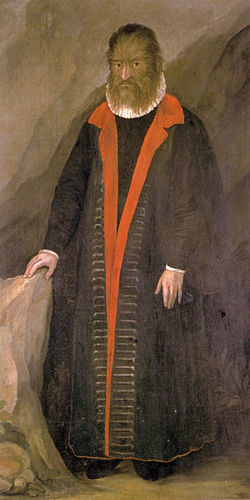
Petrus Gonsalvus (Pedro González, born 1537, cf. image right) was referred to by Ulisse Aldrovandi as "the man of the woods" or "wild man of the woods" and it was believed that a whole race of such hairy people lived in the Canary Islands, though his hairiness is presumed to be due to his condition, hypertrichosis (aka Ambras syndrome), by modern commentators. His daughter Antonietta or Magdalena inherited the trait.
The story of Pedro González and his marriage to the lady Catherine may have inspired the fairy tale Beauty and the Beast.
In modern fiction
In Shakespeare's The Winter's Tale (1611), the dance of twelve "Satyrs" conflates wild men and satyrs. The dance is held at the rustic sheep-shearing (IV.iv), described by a servant:
Masters, there is three carters, three shepherds, three neat-herds, three swine-herds, that have made themselves all men of hair, they call themselves Saltiers, and they have a dance which the wenches say is a gallimaufrey of gambols...
The term wood-woses or simply Woses is used by J. R. R. Tolkien to describe a fictional race of wild men, the Drúedain, in his books on Middle-earth. According to Tolkien's legendarium, other men, including the Rohirrim, mistook the Drúedain for goblins or other wood-creatures and referred to them as Púkel-men (Goblin-men). He allows the fictional possibility that his Drúedain were the "actual" origin of the wild men of later traditional folklore.
British poet Ted Hughes used the form wodwo as the title of a poem and a 1967 volume of his collected works.
The fictional character Tarzan from Edgar Rice Burroughs' 1912 novel Tarzan of the Apes has been described as a modern version of the wild man archetype.
See also
- Am Fear Liath Mòr
- Animal (Muppet)
- Basajaun
- Bigfoot
- Bugbear
- Caveman
- Enkidu
- Fangga
- Green Man
- Hamadryad
- Human zoo
- Jean de l'Ours
- Krampus
- Leshy
- List of hominid cryptids
- Moosmann[de]
- Moss people
- Nittaewo
- Noble savage
- Straw bear
- Tengu
- Valentine and Orson
- Wild Hunt
- Yamawaro
- Yeren
- Yeti
- Tarzanesque
Explanatory notes
Citations
Bibliography
- Bartra, Roger (1997). . Ann Arbor: The University of Michigan Press. ISBN 9780472107575.
- Bernheimer, Richard (1952). . Cambridge, MA: Harvard University Press; ; Reprint: New York : Octagon books, 1979, ISBN 0-374-90616-5
- Busk, Rachel Harriette (1874). . London: Longmans, Green and Company.
- Ellingson, Ter (2001). . University of California Press. pp. 115–138. ISBN 9780520925922.
- Fehrle, Eugen (1916). (in German). Leipzig: B.G. Teubner.
- Graber, Georg [in German], ed. (1914). . Sagen aus Kärnten (in German). Leipzig: Dieterich. pp. 73–95.
- Grimm, Jacob (1875). . Deutsche Mythologie (in German). Vol. 1 (4 ed.). Göttingen: W. Swan Sonnenschein & Allen. pp. 328–362, 363–428. Grimm, Jacob (1878). . Deutsche Mythologie (in German). Vol. 3 (4 ed.). Göttingen: W. Swan Sonnenschein & Allen. pp. 122–149. Grimm, Jacob (1880). . Teutonic Mythology. Vol. 1. Translated by James Steven Stallybrass. W. Swan Sonnenschein & Allen. pp. 396–488. Grimm, Jacob (1883). . Teutonic Mythology. Vol. 2. Translated by James Steven Stallybrass. W. Swan Sonnenschein & Allen. pp. 439–517. —— (1888). . Teutonic Mythology. Vol. 4. Translated by James Steven Stallybrass. W. Swan Sonnenschein & Allen. pp. 1407–1436.
- Hansen, Joseph; Franck, Johannes (1901). . (in German). Bonn: C. Georgi. pp. 614–670.
- Harte, Jeremy (2021). . In Cheeseman, Matthew; Hart, Carina (eds.). Folklore and Nation in Britain and Ireland. Routledge. ISBN 9781000440430.
- Heyl, Johann Adolf (1897). (in German). Berlin: Kath.-polit. Pressverein.
- Husband, Timothy (1980). . with the assistance of Gloria Gilmore-House. New York: The Metropolitan Museum of Art. ISBN 9780870992544. (@books.google).
- Leyen, Friedrich von der; Spamer, Adolf [in German] (1910). . (in German). Regensburg: J. Habbel. pp. 16–32.
- Mannhardt, Wilhelm (1875). (in German). Berlin: Gebrüder Borntraeger.
- Mannhardt, Wilhelm (1904) [1875]. (in German). Vol. 1 (2 ed.). Berlin: Gebrüder Borntraeger. (reprint: Elibron Classics, 2005, ISBN 978-1-42124740-3)
- Ranke, Friedrich (1924). . In Leyen, Friedrich von der (ed.). Die deutschen volkssagen. Vol. 4 (2 ed.). München: C. H. Becksche Verlagsbuchhandlung. pp. 176–195.
- Rushing, James A., Jr. (2016) [1875]. . University of Pennsylvania Press. ISBN 9781512809459.
- Schneller, Christian [in German], ed. (1867). . Märchen und Sagen aus Wälschtirol (in German). Innsbruck: Wagner'sche Buchhandlung.
- Schwarz (1941). . In Bächtold-Stäubli, Hanns [in German]; Hoffmann-Krayer, Eduard (eds.). Handwörterbuch des deutschen Aberglaubens. Vol. 9. Walter de Gruyter. pp. 968–980.
- Siebmacher, Johann [in German] (1885). Hefner, Otto Titan von [in German]; Clericus, Ludwig [in German] (eds.). . J. Siebmacher's grosses und allgemaines Wappenbuch 1 (in German). Nürnberg: Bauer und Raspe (E. Küster). doi:.( @ U. Heidelberg)
- Strasenburgh, Gordon R., Jr. (1975), "Perceptions and Images of the Wild Man", in Sprague, Roderick; Walker, Deward E., Jr. (eds.), , vol. 9, Moscow, Idaho: Northwest Anthropology, pp. 281–298
- Sumberg, Samuel Leslie (1941). . New York: Columbia University Press. ()
- Tatlock, Lynne (2015). . In Engelstein, Stefani; Niekerk, Carl (eds.). Contemplating Violence: Critical Studies in Modern German Culture. Cardiff: Rodopi. pp. 115–138. ISBN 9789042032958.
- Thomas, Neil (Spring 2000). "The Celtic Wild Man Tradition and Geoffrey of Monmouth's Vita Merlini: Madness or Contemptus Mundi?". Arthuriana. 10 (1/Essays on Merlin): 27–42. doi:. JSTOR .
- White, Hayden (1972). . In Dudley, Edward; Novak, Maximillian E. (eds.). The Wild Man Within: An Image in Western Thought from the Renaissance to Romanticism. University of Pittsburgh Press. pp. 3–38. ISBN 9780822975991.
- Yamamoto, Dorothy (2000). . Oxford: Oxford University Press. ISBN 9780198186748.
- Zaunert, Paul (1921). . Deutsche Natursagen: I. Von Holden und Unholden. Illustrated by Marie Braun. Jena: Eugen Dietrich. pp. 66–. (reprint: Paderborn: Salzwasser Verlag 2012, ISBN 978-3-84600253-7)
- Zingerle, Ignaz Vincenz (1855). . Zeitschrift für deutsche Mythologie und Sittenkunde. 3: 196–203.
- Zingerle, Ignaz Vincenz, ed. (1859). (1 ed.). Innsbruck: Wagnersche Universitäts-Buchhandlung.
- Zingerle, Ignaz Vincenz, ed. (1891). (2 ed.). Innsbruck: Wagnersche Universitäts-Buchhandlung.
Further reading
- Bartra, Roger (1994). . Ann Arbor: The University of Michigan Press. ISBN 9780472104772.
- Bergholm, Anna Aune Alexandra. "King, Poet, Seer: Aspects of the Celtic Wild Man Legend in Medieval Literature". In: FF Network. 2013; Vol. 43. pp. 4-9.
- Martin, Rebecca. Wild Men and Moors in the Castle of Love: The Castle-Siege Tapestries in Nuremberg, Vienna, and Boston, Thesis (Ph.D.), Chapel Hill/N. C., 1983