Glossary of Wing Chun terms
In-game article clicks load inline without leaving the challenge.
These are terms used in the Chinese martial art, Wing Chun. They are originally colloquial Cantonese (or Foshan spoken dialect). Thus, their meanings might be difficult to trace. Some of those terms are used in Jeet Kune Do, sometimes with a different meaning.[citation needed]
Forms
- Siu Nim Tau (simplified Chinese: 小念头; traditional Chinese: 小念頭; pinyin: xiǎo niàn tou; Jyutping: siu2 nim6 tau4; lit. 'little idea beginning') A small form holding the main ideas of the system. It emphasizes proper structure, occupying the centerline, and deflecting away from the centerline. It is purely handwork with no footwork. Other than basic training, at the advanced level it is often used as a qigong form to develop "nim ging" or idea power.
- Chum Kiu (simplified Chinese: 寻桥; traditional Chinese: 尋橋; pinyin: xún qiáo; Jyutping: cam4 kiu4; lit. 'seeking bridge'). This form fleshes out the static Siu Nim Tau form and makes it alive and realistic by adding turns, elbows, stepping, and kicks.
- Biu Ji (simplified Chinese: 镖指; traditional Chinese: 鏢指; pinyin: biāo zhǐ; Jyutping: biu1 zi2; lit. 'dart pointing'). A form that emphasizes emergency hands, techniques that are used to regain the centerline when one is put in a bad position. Reminiscent of the Chinese compass, aka the 'south pointing needle' 指南針. This form has no kicks.
- Muk Yan Jong (simplified Chinese: 木人桩; traditional Chinese: 木人樁; pinyin: mù rén zhuāng; Jyutping: muk6 jan4 zong1; lit. 'wooden man post'). A form more like traditional Chinese martial arts. It combines elements of Siu Nim Tao hand play with side stepping and kicks to facilitate throws and sweeps, as well as attacking from the side gate.
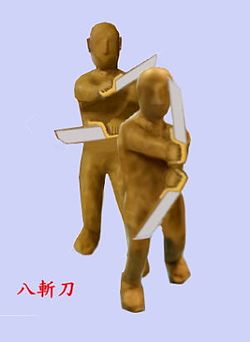
- Butterfly swords: Bat Cham Do (simplified Chinese: 八斩刀; traditional Chinese: 八斬刀; pinyin: bā zhǎn dāo; Jyutping: baat3 zaam2 dou1; lit. 'eight slashes blades'). The butterfly swords are the natural extension arms and of the Wing Chun system as a whole, using most of the same hand play and structures as the empty hand forms. The extra danger of handling dual blades is overcome by the long practice of the hand techniques. One could say everything in the Wing Chun system leads up to their usage.
- Staff: Luk Dim Bun Gwan (simplified Chinese: 六点半棍; traditional Chinese: 六點半棍; pinyin: liù diǎn bàn gùn; Jyutping: luk6 dim2 bun3 gwan3; lit. 'six and a half point staff'). A simple staff form for handling a long pole or spear. Due to the nature of the long weapon, the 6.5 Point Staff form is very different from typical Wing Chun body structures thus far, expanding the system into more traditionally Chinese deeply squatted structures and using the side body stance.
Family Lineage Titles or Terms
| As normally seen in English (from Cantonese) | Simp. char. | Trad. char. | Cantonese (Yale transcription) | Mandarin (Pinyin transcription) | Meaning(s) (in English) |
|---|---|---|---|---|---|
| Sidai | 师弟 | 師弟 | si1 dai6*2 | shī dì | junior male classmate |
| Simui | 师妹 | 師妹 | si1 mui6*2 | shī mèi | junior female classmate |
| Sihing | 师兄 | 師兄 | si1 hing1 | shī xiōng | senior male classmate |
| Sije | 师姐 | 師姐 | si1 je2 | shī jiě | senior female classmate |
| Gowlin | 教练 | 教練 | gaau3 lin6 | jiào liàn | instructor or coach |
| Sifu | 师父 | 師父 | si1 fu2 | shī fù | master |
| Sisuk | 师叔 | 師叔 | si1 suk1 | shī shū | master's junior male classmate ("叔" = junior uncle) |
| Sibak | 师伯 | 師伯 | si1 baak3 | shī bó | master's senior male classmate ("伯" = senior uncle) |
| Sigu (Rare) | 师姑 | 師姑 | si1 gu1 | shī gū | master's female classmate ("姑" = aunt) |
| Sigung | 师公 | 師公 | si1 gung1 | shī gōng | master's master |
| Sitaigung | 师太公 | 師太公 | si1 taai3 gung1 | shī tài gōng | master's master's master |
| Sijo | 师祖 | 師祖 | si1 jou2 | shī zǔ | Yim Wing-chun ("師祖" literally means "ancestral master") |
Limb names
| As normally seen in English (from Cantonese) | Simp. char. | Trad. char. | Cantonese (Yale transcription) | Mandarin (Pinyin transcription) | Meaning(s) (in English) |
|---|---|---|---|---|---|
| sao | 手 | (as simp.) | sau2 | shǒu | hand |
| kuen | 拳 | (as simp.) | kyun4 | quán | fist |
| jarn | 肘 | (as simp.) | zaau2 | zhǒu | elbow |
| gerk | 脚 | 腳 | geuk3 | jiǎo | foot; leg, kick |
Hand technique names


Basic Hands
| As normally seen in English (from Cantonese) | Simp. char. | Trad. char. | Cantonese (Yale transcription) | Mandarin (Pinyin transcription) | Meaning(s) (in English) | Form (Symbols: /\ upper gate, \/ lower gate, | straight or long bridge, -- Horizontal arm, O Circle) | Function |
|---|---|---|---|---|---|---|---|
| pak sao | 拍手 | (same) | paak3 sau2 | pāi shǒu | slapping Hand | /\ rising diagonal arm, palm forward | palm shooting forward to intercept and collapse bridge |
| lap sao | 拉手 | (same) | laap6 | là shǒu | pulling hand | | vertical arm with grabbing hand | pulls down opponent's bridge arm to open up their centerline |
| tan sao | 摊手 | 攤手 | taan1 sau2 | tān shǒu | spreading hand | /\ rising vertical arm, palm up | roller arm that spreads outside pressure away from centerline |
| bong sao | 膀手 | (same) | bong2 sau2 | bǎng shǒu | winging hand | \/ falling diagonal arm, palm hangs loosely facing away from centerline | deflecting force across centerline; rolling down on wrist pressure to cover center |
| fook sao | 伏手 | (same) | fuk6 sau2 | fú shǒu | taming hand | /\ rising diagonal arm, palm down or hand hangs loosely to the side | covering bridge from above, preventing forward and upward movement, and deflecting inside pressure across centerline |
| wu sao | 护手 | 護手 | wu6 sau2 | hù shǒu | protecting hand | /\ rising diagonal arm, palm facing centerline, fingers up | hand held in rear behind a lead hand. Intercepts forward when centerline is breached |
| hyun sao | 圈手 | (same) | hyun1 sau2 | quán shǒu | circle hand | O a wrist circle, with the hand dipping down and coming up or coming down on the opposite side | small circling around arm to change inside gate to outside gate or back |
Additional Techniques
| As normally seen in English (from Cantonese) | Simp. char. | Trad. char. | Cantonese (Yale transcription) | Mandarin (Pinyin transcription) | Meaning(s) (in English) | Form (Symbols: /\ upper gate, \/ lower gate, | straight or long bridge, -- Horizontal arm, O Circle) | Function |
|---|---|---|---|---|---|---|---|
| biu sao | 镖手 | 鏢手 | biu1 sau2 | biāo shǒu | darting hand | || long bridge arm, with fingers pointed forward | inserts inside or from below into opponent's gate. Peels hands off arms by thrusting. |
| fak sao | 拂手 | (same) | faak1 sau2 | fú shǒu | whisking hand | -- horizontal arm lashing forward | arm that lashes out forward toward the opponent from across the centerline toward their centerline |
| gang sao; garn sao | 耕手 | (as simp.) | gaang1 sau2 | gēng shǒu | ploughing hand | /\\/ diagonal chopping hand | covers side gate, chopping outward or chopping inward |
| gam sao | 揿手 | 撳手 | gam6 sau2 | qìn shǒu | pressing hand | \/ falling diagonal forearm, bent elbow, palm faces down | presses down on the opponent's bridge or body to pin them down |
| jam sao | 沉手 | (as simp.) | cam2 sau2 | chén shǒu | sinking hand | || pointing forward advancing arm | wrist snaps forward and down to sink opponent's brige |
| jip sao | 接手 | (as simp.) | jip3 sau2 | jiē shǒu | catching hand | /\ paired hands pointed forward catching in between | claps toward the centerline. Catches arms in between. Can catch upper and lower arm for controlling whole body, or wrist and elbow for locking. |
| jit sao | 切手 | (as simp.) | zip3 sau2 | qiè shǒu | cutting hand | /\ rising diagonal arm | forearm that cuts forward and down into the opponents bridge from outside to make an opening. |
| jong sao | 护手 | 樁手 | zong1 sau2 | chōng shǒu | post hand | || arm forward, fingers pointed forward | an arm that wedges forward along the centerline; the wu sao but extended forward |
| jut sao | 窒手 | (as simp.) | jat6 sau2 | zhì shǒu | stopping hand | || pointing forward retreating arm | wrist snaps back and down to make the opponent's bridge point downward away instead of incoming |
| kau sao | 扣手 | (same) | kau3 sau2 | kòu shǒu | scooping hand | O circle hand, elbow draw back, body turn | circles out to cup outside arm, jerks horizontally to turn opponent |
| kwan sao | 捆手 | (same) | kwan2 sau2 | kǔn shǒu | rolling hand | /\O\/ high wu hand, low bong hand | present forearms that block high and low gates, cycle arms in a vertical circle while body turning to switch sides. |
| lan sao | 拦手 | 攔手 | laan4 sau2 | lán shǒu | barring hand | -- horizontal arm | a horizontal arm that is used to frame on the opponent, or keep them away |
| man sao | 问手 | 問手 | man6 sau2 | wèn shǒu | asking hand | || pointing forward advancing arm | lead hand that preemptively shoots forward to invade opponent's space; also upward slash to cover side gate |
| po pai sao | 破排手 | (same) | po3 paai4 sau2 | pò pái shǒu | breaking frame hand | /\O\/ two palms on a line that circle around | double palms that circle around to the empty angle and push the opponent away, can be vertical, horizontal or diagonal |
| tai sao | 提手 | (as simp.) | tai4 sau2 | tí shǒu | raising hand | || long bridge arm moving vertically | arm the presses up on the opponent's bridge to raise it up out of the way |
| tok sao | 托手 | (as simp.) | tok3 sau2 | tuō shǒu | propping hand | \/ low rising arm, palm up | props upward and forward to uproot opponent, or make a steady base for a joint-lock. |
Drills


| Simp. char. | Trad. char. | Cantonese (Yale transcription) | Mandarin (Pinyin transcription) | Meaning(s) (in English) | |
|---|---|---|---|---|---|
| Daan Chi Sau | 单黐手 | 單黐手 | daan1 chi1 sau2 | dān chī shǒu | single sticky hands |
| Seung Chi Sau | 双黐手 | 雙黐手 | seung1 chi1 sau2 | shuāng chī shǒu | double sticky hands |
| Luk Sau | 碌手 | (as simp.) | luk1 sau2 | lù shǒu | rolling arms |
| Chi Geuk | 黐脚 | 黐腳 | chi1 geuk3 | chī jiǎo | sticky feet |
Other techniques:
- Lin wan kuen - chain punch
- One-inch punch
- Double punch
- Zao gek - hacking elbow strike
- Pai jarn - horizontal
- Kwan sau - rotating hand
- Yee jee kim yueng ma – horse stance, small adduction goat stance, or figure 2 stance
- Centerline training
- Iron palm training
See also
- Kung Fu (Ranking)