Bopomofo
In-game article clicks load inline without leaving the challenge.
Bopomofo, also called Zhuyin Fuhao (/dʒuːˌjɪnfuːˈhaʊ/ joo-YIN foo-HOW; 注音符號; Zhùyīn fúhào; 'phonetic symbols'), or simply Zhuyin, is a transliteration system for Standard Chinese and other Sinitic languages. It is the principal method of teaching Mandarin pronunciation in Taiwan. It consists of 37 characters and five tone marks, which together can transcribe all possible sounds in Mandarin Chinese.
Bopomofo was first introduced in China during the 1910s by the Beiyang government, where it was used alongside Wade–Giles, a romanization system which used a modified Latin alphabet. Today, Bopomofo is more common in Taiwan than on the mainland, and is used as the primary electronic input method for Taiwanese Mandarin, as well as in dictionaries and other non-official documents.
Terminology
Bopomofo is the name used for the system by the International Organization for Standardization (ISO) and Unicode. Analogous to how the word alphabet is derived from the names of the first two letters, alpha and beta, the name bopomofo derives from the first four syllabographs in the system's conventional consonant order: ㄅ, ㄆ, ㄇ, and ㄈ.
In Taiwan, the system is commonly known by its official name Zhuyin fuhao (注音符號; 'phonetic symbols'), or simply as zhuyin (注音; 'phonetic notation'). In official documents, it is occasionally called Mandarin Phonetic Symbols I (國語注音符號第一式), abbreviated as "MPS I" (注音一式), to distinguish it from the Mandarin Phonetic Symbols II (MPS II) system published in 1984. Formerly, the system was named Guoyin zimu (國音字母; 'national language alphabet') and Zhuyin zimu (注音字母; 'phonetic alphabet').
History
Origins
The Commission on the Unification of Pronunciation, led by Wu Zhihui from 1912 to 1913, created a system called Zhuyin Zimu, which was based on Zhang Binglin's shorthand. It was used as the official phonetic script to annotate the sounds of the characters in accordance with the Old National Pronunciation. A draft was released on 11 July 1913, by the Republic of China National Ministry of Education, but it was not officially proclaimed until 23 November 1928. It was first named Guóyīn Zìmǔ 'national pronunciation alphabet', but in April 1930 was renamed Zhùyīn Fúhào 'phonetic symbols' to address fears that the alphabetic system might independently replace Chinese characters.
Modern use

Bopomofo is the predominant phonetic system in teaching reading and writing in elementary school in Taiwan. In elementary school, particularly in the lower years, Chinese characters in textbooks are often annotated with Bopomofo as ruby characters as an aid to learning. Additionally, one children's newspaper in Taiwan, the Mandarin Daily News, annotates all articles with Bopomofo ruby characters.
It is also the most popular way for Taiwanese to enter Chinese characters into computers and smartphones and to look up characters in a dictionary.
In teaching Mandarin, Taiwan institutions and some overseas communities, such as Filipino Chinese, use Bopomofo.
Bopomofo is shown in a position secondary to that of Hanyu Pinyin in all editions of Xiandai Hanyu Cidian from the 1960 edition to the current 2016 edition (7th edition).
Bopomofo is also used to transcribe other Chinese languages, most commonly Taiwanese Hokkien and Cantonese; however, its use can be applied to practically any variety in handwriting (because not all letters are encoded). Outside of Chinese, Bopomofo letters are also used in Hmu and Ge languages by a small number of Hmu Christians.
Symbols

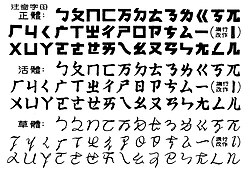
The Bopomofo characters were created by Zhang Binglin, taken mainly from "regularized" forms of ancient Chinese characters, the modern readings of which contain the sound that each letter represents. The consonants are listed in order of place of articulation, from the front of the mouth to the back, /b/, /p/, /m/, /f/, /d/, /t/, /n/, /l/, etc.
| Bopomofo | Origin | IPA | Pinyin | WG | Example |
|---|---|---|---|---|---|
| ㄅ | From 勹, the ancient form and current top portion of 包 bāo, "to wrap up; package" | p˭ | b | p | 包 bāo ㄅㄠ |
| ㄆ | From 攵, a variant form of 攴 pū, "to knock lightly". | pʰ | p | pʻ | 撲 pū ㄆㄨ |
| ㄇ | From 冂, the archaic character and current "cover" radical 冖 mì. | m | m | m | 冞 mí ㄇㄧˊ |
| ㄈ | From the "right open box" radical 匚 fāng. | f | f | f | 匪 fěi ㄈㄟˇ |
| ㄪ | From 万, a simplification of 萬 wàn, "ten thousand". No longer used in Mandarin transcription. | v | —N/a | v | 尾 wěi ㄨㄟˇ (ㄪㄟˇ) |
| ㄉ | From 𠚣, archaic form of 刀 dāo, "blade". Compare the Shuowen seal . | t˭ | d | t | 地 dì ㄉㄧˋ |
| ㄊ | From 𠫓 tū, an upside-down form of 子 zǐ and an ancient form of 突 tū ( and in seal script) | tʰ | t | tʻ | 提 tí ㄊㄧˊ |
| ㄋ | From /𠄎, ancient form of 乃 nǎi, "to be" (a copula in Classical Chinese). | n | n | n | 你 nǐ ㄋㄧˇ |
| ㄌ | From 𠠲, archaic form of 力 lì, "power". | l | l | l | 利 lì ㄌㄧˋ |
| ㄍ | From the obsolete character 巜 guì/kuài, "ditch". | k˭ | g | k | 告 gào ㄍㄠˋ |
| ㄎ | From the archaic character, now "breath" or "sigh" component 丂 kǎo. | kʰ | k | kʻ | 考 kǎo ㄎㄠˇ |
| ㄫ | From 兀 wù, "towering". No longer used in Mandarin transcription. | ŋ | ng | ng | 五 wǔ ㄨˇ (ㄫㄨˇ) |
| ㄏ | From the archaic character and current radical 厂 hǎn. | x~h | h | h | 好 hǎo ㄏㄠˇ |
| ㄐ | From the archaic character 丩 jiū. | tɕ˭ | j | ch | 叫 jiào ㄐㄧㄠˋ |
| ㄑ | From the archaic character 𡿨 quǎn, graphic root of the character 巛 chuān, "river" (modern 川). | tɕʰ | q | chʻ | 巧 qiǎo ㄑㄧㄠˇ |
| ㄬ | From the archaic character 广 yǎn, "dotted cliff". Not used in Mandarin anymore. | ɲ | gn | gn | 眼 yǎn ㄧㄢˇ (广ㄧㄢˇ) |
| ㄒ | From 丅, an ancient form of 下 xià, "under". | ɕ | x | hs | 小 xiǎo ㄒㄧㄠˇ |
| ㄓ | From /𡳿, archaic form of 之 zhī, a genitive marker in Classical Chinese. | ʈʂ˭ | zhi, zh- | ch | 知 zhī ㄓ; 主 zhǔ ㄓㄨˇ |
| ㄔ | From the character and radical 彳 chì | ʈʂʰ | chi, ch- | chʻ | 吃 chī ㄔ; 出 chū ㄔㄨ |
| ㄕ | From 𡰣, an ancient form of 尸 shī | ʂ | shi, sh- | sh | 是 shì ㄕˋ; 束 shù ㄕㄨˋ |
| ㄖ | Modified from the seal script form of 日 rì, "day" or "sun". | ɻ~ʐ | ri, r- | j | 日 rì ㄖˋ; 入 rù ㄖㄨˋ |
| ㄗ | From the archaic character and current radical 卩 jié, dialectically zié ([tsjě]; tsieh² in Wade–Giles) | ts˭ | zi, z- | ts | 字 zì ㄗˋ; 在 zài ㄗㄞˋ |
| ㄘ | From 𠀁, archaic form of 七 qī, dialectically ciī ([tsʰí]; tsʻi¹ in Wade–Giles). Compare semi-cursive form and seal-script . | tsʰ | ci, c- | tsʻ | 詞 cí ㄘˊ; 才 cái ㄘㄞˊ |
| ㄙ | From the archaic character 厶 sī, which was later replaced by its compound 私 sī. | s | si, s- | s | 四 sì ㄙˋ; 塞 sāi ㄙㄞ |
| Bopomofo | Origin | IPA | Pinyin | WG | Example |
|---|---|---|---|---|---|
| ㄚ | From 丫 yā | a | a | a | 大 dà ㄉㄚˋ |
| ㄛ | From the obsolete character 𠀀 hē, inhalation, the reverse of 丂 kǎo, which is preserved as a phonetic in the compound 可 kě. | o | o | o | 多 duō ㄉㄨㄛ |
| ㄜ | Derived from its allophone in Standard Chinese, ㄛ o | ɤ | e | o/ê | 得 dé ㄉㄜˊ |
| ㄝ | From 也 yě, "also". Compare the Warring States bamboo form | e | -ie/ê | eh | 爹 diē ㄉㄧㄝ |
| ㄞ | From 𠀅 hài, archaic form of 亥. | ai | ai | ai | 晒 shài ㄕㄞˋ |
| ㄟ | From 乁 yí, an obsolete character meaning 移 yí, "to move". | ei | ei | ei | 誰 shéi ㄕㄟˊ |
| ㄠ | From 幺 yāo | au | ao | ao | 少 shǎo ㄕㄠˇ |
| ㄡ | From 又 yòu | ou | ou | ou | 收 shōu ㄕㄡ |
| ㄢ | From the archaic character 𢎘 hàn "to bloom", preserved as a phonetic in the compound 犯 fàn | an | an | an | 山 shān ㄕㄢ |
| ㄣ | From 𠃉, archaic variant of 鳦 yǐ or 乚 yà (乚 is yǐn according to other sources) | ən | en | ên | 申 shēn ㄕㄣ |
| ㄤ | From 尢 wāng | aŋ | ang | ang | 上 shàng ㄕㄤˋ |
| ㄥ | From 𠃋, archaic form of 肱 gōng | əŋ | eng | êng | 生 shēng ㄕㄥ |
| ㄦ | From 儿, the bottom portion of 兒 ér used as a cursive and simplified form | ɚ | er | êrh | 而 ér ㄦˊ |
| ㄧ | From 一 yī, "one" | i | y, yi, -i | i | 以 yǐ ㄧˇ; 逆 nì ㄋㄧˋ |
| ㄨ | From 㐅, ancient form of 五 wǔ, "five". Compare the transitory form 𠄡. | u | w, wu, -u | u/w | 努 nǔ ㄋㄨˇ; 我 wǒ ㄨㄛˇ |
| ㄩ | From the ancient character 凵 qū, which remains as a radical | y | yu, -ü | ü/yü | 雨 yǔ ㄩˇ; 女 nǚ ㄋㄩˇ |
| ㄭ | From the character 帀. It represents the fricative vowel of ㄓ,ㄔ,ㄕ,ㄖ,ㄗ,ㄘ,ㄙ,though it is not used after them in transcription. | ɻ̩~ʐ̩, ɹ̩~z̩ | -i | ih/ŭ | 資 zī ㄗ; 知 zhī ㄓ; 死 sǐ ㄙˇ |
Writing
Stroke order
Bopomofo is written in the same stroke order rule as Chinese characters. However, the amount of strokes can differ from the derived character and the Bopomofo character. For example, ㄖ is written with three strokes, unlike the character from which it is derived (Chinese: 日; pinyin: rì), which has four strokes.
ㄧ can be written as a vertical line () or a horizontal line (); both are accepted forms. Traditionally, it should be written as a horizontal line in vertical writing, and a vertical line in horizontal writing. The People's Republic of China almost exclusively uses horizontal writing, so the vertical form (in the rare occasion that Bopomofo is used) has become the standard form there. Language education in Taiwan generally uses vertical writing, so most people learn it as a horizontal line, and use a horizontal form even in horizontal writing. In 2008, the Taiwanese Ministry of Education decided that the primary form should always be the horizontal form, but that the vertical form is an accepted alternative. Unicode 8.0.0 published an errata in 2014 that updates the representative glyph to be the horizontal form. Computer fonts may only display one form or the other, or may be able to display both if the font is aware of changes needed for vertical writing.
Bopomofo is occasionally unofficially handwritten as syllable blocks, similar to Hangul, however this is not considered an accepted form by the People's Republic of China nor the Republic of China, and it is unsupported by Unicode.
Tonal marks
As shown in the following table, tone marks for the second, third, and fourth tones are shared between bopomofo and pinyin. In bopomofo, the mark for first tone is usually omitted but can be included, while a dot above indicates the fifth tone (also known as the neutral tone). In pinyin, a macron (overbar) indicates the first tone, and the lack of a marker usually indicates the fifth (light) tone.
| Tone | Bopomofo | Pinyin | ||
|---|---|---|---|---|
| Tone Marker | Unicode Name | Tone Marker | Unicode Name | |
| 1 | ˉ | Modifier Letter Macron (usually omitted) | ◌̄ | Combining Macron |
| 2 | ˊ | Modifier Letter Acute Accent | ◌́ | Combining Acute Accent |
| 3 | ˇ | Caron | ◌̌ | Combining Caron |
| 4 | ˋ | Modifier Letter Grave Accent | ◌̀ | Combining Grave Accent |
| 5 | ˙ | Dot Above | · | Middle Dot (usually omitted) |
Unlike Hanyu Pinyin, Bopomofo aligns well with the Chinese characters in books whose texts are printed vertically, making Bopomofo better suited for annotating the pronunciation of vertically oriented Chinese text.
When used in conjunction with Chinese characters, Bopomofo is typically placed to the right of the Chinese character vertically in both vertical print and horizontal print or to the top of the Chinese character in horizontal print (see Ruby characters).
Example
Below is an example for the word "bottle" (pinyin: píngzi):
| 瓶 ㄆ ㄧ ㄥˊ 子 ˙ ㄗ | , | 瓶 ㄆ ㄧ ㄥˊ 子 ˙ ㄗ | or | ㄆㄧㄥˊ ˙ㄗ 瓶 子 |
| 瓶 | ㄆ ㄧ ㄥˊ | |||
| 子 | ˙ ㄗ | |||
| 瓶 | ㄆ ㄧ ㄥˊ | 子 | ˙ ㄗ | |
| ㄆㄧㄥˊ | ˙ㄗ | |||
| 瓶 | 子 |
Erhua transcription
Words rhotacized as a result of erhua are spelled with ㄦ attached to the syllable (like 歌兒(ㄍㄜㄦ) gēr). In case the syllable uses other tones than the 1st tone, the tone mark is attached to the penultimate letter standing for syllable nucleus, but not to ㄦ (e.g. 哪兒(ㄋㄚˇㄦ) nǎr; 一(ㄧ)點兒(ㄉㄧㄢˇㄦ) yīdiǎnr; 好(ㄏㄠˇ)玩兒(ㄨㄢˊㄦ) hǎowánr).
Comparison
Pinyin
Bopomofo and pinyin are based on the same Mandarin pronunciations; hence there is a one-to-one correspondence between the two systems:
| Rime | |||||||||||||||
|---|---|---|---|---|---|---|---|---|---|---|---|---|---|---|---|
| ㄚ | ㄛ | ㄜ | ㄝ | ㄞ | ㄟ | ㄠ | ㄡ | ㄢ | ㄣ | ㄤ | ㄥ | ㄦ | |||
| Medial | [ɨ] (ㄭ) 1 -i | [a] ㄚ a -a | [o] ㄛ 3 o -o 3 | [ɤ] ㄜ e -e | [ɛ] ㄝ ê | [ai̯] ㄞ ai -ai | [ei̯] ㄟ ei -ei | [ɑu̯] ㄠ ao -ao | [ou̯] ㄡ ou -ou | [an] ㄢ an -an | [ən] ㄣ en -en | [ɑŋ] ㄤ ang -ang | [ɤŋ] ㄥ eng -eng | [aɚ] ㄦ er | |
| ㄧ | [i] ㄧ yi -i | [i̯a] ㄧㄚ ya -ia | [i̯o] ㄧㄛ yo | [i̯ɛ] ㄧㄝ ye -ie | [i̯ai̯] ㄧㄞ yai | [i̯ɑu̯] ㄧㄠ yao -iao | [i̯ou̯] ㄧㄡ you -iu | [i̯ɛn] ㄧㄢ yan -ian | [in] ㄧㄣ yin -in | [i̯ɑŋ] ㄧㄤ yang -iang | [iŋ] ㄧㄥ ying -ing | ||||
| ㄨ | [u] ㄨ wu -u | [u̯a] ㄨㄚ wa -ua | [u̯o] ㄨㄛ 3 wo -uo 3 | [u̯ai̯] ㄨㄞ wai -uai | [u̯ei̯] ㄨㄟ wei -ui | [u̯an] ㄨㄢ wan -uan | [u̯ən] ㄨㄣ wen -un | [u̯ɑŋ] ㄨㄤ wang -uang | [u̯ɤŋ],[ʊŋ] ㄨㄥ weng -ong 4 | ||||||
| ㄩ | [y] ㄩ yu -ü 2 | [y̯ɛ] ㄩㄝ yue -üe 2 | [y̯ɛn] ㄩㄢ yuan -üan 2 | [yn] ㄩㄣ yun -ün 2 | [i̯ʊŋ] ㄩㄥ yong -iong |
1 Not written.
2 ⟨-ü⟩ is written as ⟨-u⟩ after ⟨j-⟩, ⟨q-⟩, ⟨x-⟩, or ⟨y-⟩.
3 ⟨ㄨㄛ⟩/⟨-uo⟩ is written as ⟨ㄛ⟩/⟨-o⟩ after ⟨ㄅ⟩/⟨b-⟩, ⟨ㄆ⟩/⟨p-⟩, ⟨ㄇ⟩/⟨m-⟩, ⟨ㄈ⟩/⟨f-⟩.
4 ⟨weng⟩ is pronounced [ʊŋ] (written as ⟨-ong⟩) when it follows an initial.
Chart
| IPA | a | ɔ | ɛ | ɤ | ai | ei | au | ou | an | ən | aŋ | əŋ | ʊŋ | aɹ |
|---|---|---|---|---|---|---|---|---|---|---|---|---|---|---|
| Pinyin | a | o | ê | e | ai | ei | ao | ou | an | en | ang | eng | ong | er |
| Tongyong Pinyin | ||||||||||||||
| Wade–Giles | eh | ê/o | ên | êng | ung | êrh | ||||||||
| Bopomofo | ㄚ | ㄛ | ㄝ | ㄜ | ㄞ | ㄟ | ㄠ | ㄡ | ㄢ | ㄣ | ㄤ | ㄥ | ㄨㄥ | ㄦ |
| example | 阿 | 喔 | 誒 | 俄 | 艾 | 黑 | 凹 | 偶 | 安 | 恩 | 昂 | 冷 | 中 | 二 |
| IPA | i | je | jou | jɛn | in | iŋ | jʊŋ | u | wo | wei | wən | wəŋ | y | ɥe | ɥɛn | yn |
|---|---|---|---|---|---|---|---|---|---|---|---|---|---|---|---|---|
| Pinyin | yi | ye | you | yan | yin | ying | yong | wu | wo/o | wei | wen | weng | yu | yue | yuan | yun |
| Tongyong Pinyin | wun | wong | ||||||||||||||
| Wade–Giles | i/yi | yeh | yu | yen | yung | wên | wêng | yü | yüeh | yüan | yün | |||||
| Bopomofo | ㄧ | ㄧㄝ | ㄧㄡ | ㄧㄢ | ㄧㄣ | ㄧㄥ | ㄩㄥ | ㄨ | ㄨㄛ/ㄛ | ㄨㄟ | ㄨㄣ | ㄨㄥ | ㄩ | ㄩㄝ | ㄩㄢ | ㄩㄣ |
| example | 一 | 也 | 又 | 言 | 音 | 英 | 用 | 五 | 我 | 位 | 文 | 翁 | 玉 | 月 | 元 | 雲 |
| IPA | p | pʰ | m | fəŋ | tjou | twei | twən | tʰɤ | ny | ly | kɤ | kʰɤ | xɤ |
|---|---|---|---|---|---|---|---|---|---|---|---|---|---|
| Pinyin | b | p | m | feng | diu | dui | dun | te | nü | lü | ge | ke | he |
| Tongyong Pinyin | fong | diou | duei | nyu | lyu | ||||||||
| Wade–Giles | p | pʻ | fêng | tiu | tui | tun | tʻê | nü | lü | ko | kʻo | ho | |
| Bopomofo | ㄅ | ㄆ | ㄇ | ㄈㄥ | ㄉㄧㄡ | ㄉㄨㄟ | ㄉㄨㄣ | ㄊㄜ | ㄋㄩ | ㄌㄩ | ㄍㄜ | ㄎㄜ | ㄏㄜ |
| example | 玻 | 婆 | 末 | 封 | 丟 | 兌 | 頓 | 特 | 女 | 旅 | 歌 | 可 | 何 |
| IPA | tɕjɛn | tɕjʊŋ | tɕʰin | ɕɥɛn | ʈʂɤ | ʈʂɨ | ʈʂʰɤ | ʈʂʰɨ | ʂɤ | ʂɨ | ɻɤ | ɻɨ | tsɤ | tswo | tsɨ | tsʰɤ | tsʰwo | tsʰɨ | sɤ | swo | sɨ |
|---|---|---|---|---|---|---|---|---|---|---|---|---|---|---|---|---|---|---|---|---|---|
| Pinyin | jian | jiong | qin | xuan | zhe | zhi | che | chi | she | shi | re | ri | ze | zuo | zi | ce | cuo | ci | se | suo | si |
| Tongyong Pinyin | jyong | cin | syuan | jhe | jhih | chih | shih | rih | zih | cih | sih | ||||||||||
| Wade–Giles | chien | chiung | chʻin | hsüan | chê | chih | chʻê | chʻih | shê | shih | jê | jih | tsê | tso | tzŭ | tsʻê | tsʻo | tzʻŭ | sê | so | ssŭ |
| Bopomofo | ㄐㄧㄢ | ㄐㄩㄥ | ㄑㄧㄣ | ㄒㄩㄢ | ㄓㄜ | ㄓ | ㄔㄜ | ㄔ | ㄕㄜ | ㄕ | ㄖㄜ | ㄖ | ㄗㄜ | ㄗㄨㄛ | ㄗ | ㄘㄜ | ㄘㄨㄛ | ㄘ | ㄙㄜ | ㄙㄨㄛ | ㄙ |
| example | 件 | 囧 | 秦 | 宣 | 哲 | 之 | 扯 | 赤 | 社 | 是 | 惹 | 日 | 仄 | 左 | 字 | 策 | 撮 | 次 | 色 | 索 | 斯 |
| IPA | ma˥ | ma˧˥ | ma˨˩˦ | ma˥˩ | ma |
|---|---|---|---|---|---|
| Pinyin | mā | má | mǎ | mà | ma |
| Tongyong Pinyin | ma | må | |||
| Wade–Giles | ma1 | ma2 | ma3 | ma4 | ma |
| Bopomofo | ㄇㄚ | ㄇㄚˊ | ㄇㄚˇ | ㄇㄚˋ | ˙ㄇㄚ |
| example (Chinese characters) | 媽 | 麻 | 馬 | 罵 | 嗎 |
Use outside Standard Mandarin
Bopomofo symbols for non-Mandarin Chinese varieties are added to Unicode in the Bopomofo Extended block.
Three letters no longer used for Mandarin are carried over from Old National Pronunciation:
Taiwanese Hokkien
In Taiwan, Bopomofo is used to teach Taiwanese Hokkien, and it is also used to transcribe it phonetically in contexts such as on storefront signs, karaoke lyrics, and film subtitles.
23 more letters were added specifically for Taiwanese Hokkien:
| Bopomofo | IPA | TL | Derivation |
|---|---|---|---|
| ㆠ | b | b | ㄅ with voicing circle |
| ㆣ | g | g | ㄍ with voicing circle |
| ㆢ | d͡ʑ | ji | ㄐ with voicing circle |
| ㆡ | d͡z | j | ㄗ with voicing circle |
| ㆨ | ɨ | ir | ㄨ and ㄧ combined (?) |
| ㆦ | ɔ | oo | from ㄛ |
| ㆤ | e | e | from ㄝ |
| ㆩ | ã | ann | ㄚ with nasal curl |
| ㆧ | ɔ̃ | onn | ㆦ with nasal curl |
| ㆥ | ẽ | enn | ㆤ with nasal curl |
| ㆪ/ㆳ | ĩ | inn | ㄧ with nasal curl |
| ㆫ | ũ | unn | ㄨ with nasal curl |
| ㆮ | ãĩ | ainn | ㄞ with nasal curl |
| ㆯ | ãũ | aunn | ㄠ with nasal curl |
| ㆰ | am | am | ㄚ and ㄇ combined |
| ㆱ | ɔm | om | ㆦ and ㄇ combined |
| ㆲ | ɔŋ | ong | |
| ㆬ | m̩ | m | ㄇ with syllabic stroke |
| ㆭ | ŋ̍ | ng | ㄫ with syllabic stroke |
| ㆴ | -p̚ | -p | small ㄅ |
| ㆵ | -t̚ | -t | small ㄉ |
| ㆻ/ㆶ | -k̚ | -k | small ㄍ (and variant small ㄎ) |
| ㆷ | -ʔ | -h | small ㄏ |
Two tone marks were added for the additional tones: ˪, ˫
Cantonese
The following letters are used in Cantonese.
If a syllable ends with a consonant other than -an or -aan, the consonant's letter is added, then followed by a final middle dot.
-ㄞ is used for [aːi] (aai) (e.g. 敗, ㄅㄞ baai6, "to be defeated").
-ㄣ is used for [ɐn] (an) (e.g. 跟, ㄍㄣ gan1, "to follow"), and -ㄢ is used for [aːn] (aan) (e.g. 間, ㄍㄢ gaan1, "within"). Other vowels that end with -n use -ㄋ· for the final ㄋ. (e.g. 見, ㄍㄧㄋ· gin3, "to see").
-ㄡ is used for [ɐu] (au). (e.g. 牛, ㄫㄡ, ngau4, "cow") To transcribe [ou] (ou), it is written as ㄛㄨ (e.g. 路, ㄌㄛㄨ lou6, "path").
ㄫ is used for both initial ng- (as in 牛, ㄫㄡ, ngau4) and final -ng (as in 用, ㄧㄛㄫ·, jung6 "to use").
ㄐ is used for [t͡s] (z) (e.g. 煑, ㄐㄩ zyu2, "to cook") and ㄑ is used for [t͡sʰ] (c) (e.g. 全, ㄑㄩㄋ· cyun4, "whole").
During the time when Bopomofo was proposed for Cantonese, tones were not marked.
Computer uses
Input method


Bopomofo can be used as an input method for Chinese characters. It is one of the few input methods that can be found on most modern personal computers without having to download or install any additional software. It is also one of the few input methods that can be used for inputting Chinese characters on certain cell phones.[citation needed]. On the QWERTY keyboard, the symbols are ordered column-wise top-down (e.g. 8+I+K+,)
Unicode
Bopomofo was added to the Unicode Standard in October 1991 with the release of version 1.0.
The Unicode block for Bopomofo is U+3100–U+312F:
| Bopomofo[1][2] (PDF) | ||||||||||||||||
| 0 | 1 | 2 | 3 | 4 | 5 | 6 | 7 | 8 | 9 | A | B | C | D | E | F | |
| U+310x | ㄅ | ㄆ | ㄇ | ㄈ | ㄉ | ㄊ | ㄋ | ㄌ | ㄍ | ㄎ | ㄏ | |||||
| U+311x | ㄐ | ㄑ | ㄒ | ㄓ | ㄔ | ㄕ | ㄖ | ㄗ | ㄘ | ㄙ | ㄚ | ㄛ | ㄜ | ㄝ | ㄞ | ㄟ |
| U+312x | ㄠ | ㄡ | ㄢ | ㄣ | ㄤ | ㄥ | ㄦ | ㄧ | ㄨ | ㄩ | ㄪ | ㄫ | ㄬ | ㄭ | ㄮ | ㄯ |
| Notes 1.^ As of Unicode version 17.0 2.^ Grey areas indicate non-assigned code points |
Additional characters were added in September 1999 with the release of version 3.0.
The Unicode block for these additional characters, called Bopomofo Extended, is U+31A0–U+31BF:
| Bopomofo Extended[1] (PDF) | ||||||||||||||||
| 0 | 1 | 2 | 3 | 4 | 5 | 6 | 7 | 8 | 9 | A | B | C | D | E | F | |
| U+31Ax | ㆠ | ㆡ | ㆢ | ㆣ | ㆤ | ㆥ | ㆦ | ㆧ | ㆨ | ㆩ | ㆪ | ㆫ | ㆬ | ㆭ | ㆮ | ㆯ |
| U+31Bx | ㆰ | ㆱ | ㆲ | ㆳ | ㆴ | ㆵ | ㆶ | ㆷ | ㆸ | ㆹ | ㆺ | ㆻ | ㆼ | ㆽ | ㆾ | ㆿ |
| Notes 1.^ As of Unicode version 17.0 |
Unicode 3.0 also added the characters U+02EA˪ MODIFIER LETTER YIN DEPARTING TONE MARK and U+02EB˫ MODIFIER LETTER YANG DEPARTING TONE MARK, in the Spacing Modifier Letters block. These two characters are now (since Unicode 6.0) classified as Bopomofo characters.
| Tonal marks for bopomofo Spacing Modifier Letters | |||
| Tone | Tone Marker | Unicode | Note |
| 1 Yin Ping (Level) | ˉ | U+02C9 | Usually omitted |
| 2 Yang Ping (Level) | ˊ | U+02CA | |
| 3 Shang (Rising) | ˇ | U+02C7 | |
| 4 Qu (Departing) | ˋ | U+02CB | |
| 4a Yin Qu (Departing) | ˪ | U+02EA | For Minnan and Hakka languages |
| 4b Yang Qu (Departing) | ˫ | U+02EB | For Minnan and Hakka languages |
| 5 Qing (Neutral) | ˙ | U+02D9 |
See also
- Chinese input methods for computers
- Fanqie
- Furigana
- Hangul
- Kana
- Ruby character
- Taiwanese Phonetic Symbols
- Zhuyin table
External links
- Unicode reference glyphs for (PDF). (69.6 KB) and (PDF). (61.6 KB)
- – adds inline and pop-up annotations with bopomofo pronunciation and English definitions to Chinese text or web pages.
- – needs Chinese font for Big5 encoding
- – converts between Pinyin, Bopomofo and other phonetic systems
- – converts between Hanyu Pinyin, Wade–Giles, Gwoyeu Romatzyh and other known or (un-)common Romanization systems
- National Phonetic Alphabet (bopomofo) spellings of words transliterated into the International Phonetic Alphabet. The vowel values have been verified against the official IPA site. See IPA help preview, SIL International website. See (Accessed 23 December 2010).
- – adds bopomofo (bopomofo) or pinyin on top of any Chinese text, prompts alternative pronunciations to homonyms, has the option of exporting into OpenOffice Writer for further editing
- – online keyboard for bopomofo which can turn it into Chinese characters