1st European Political Community Summit
In-game article clicks load inline without leaving the challenge.
The First European Political Community Summit was the inaugural meeting of the European Political Community held on 6 October 2022 in Prague, Czech Republic. It was attended by the heads of state or government of forty-four European countries. Russia and Belarus were not invited, while arrangements for Andorra, Monaco and San Marino were yet to be finalized.
Aims
The stated aims of the summit were as follows:
- To foster political dialogue and cooperation to address issues of common interest
- To strengthen the security, stability and prosperity of the European continent
Schedule and agenda
The summit took place on 6 October 2022 and was structured as follows:
- 12.00 - Arrivals, doorsteps and welcome
- 13.00 - Opening plenary session
- 14.00 - Roundtable discussions on either peace and security or energy, climate and the economic situation
- 16.00 - Bilateral meetings
- 19.30 - Closing plenary session
- 21.45 - Press conference
The summit was followed by an informal meeting of the European Council which took place the next day also at Prague Castle.
Participants
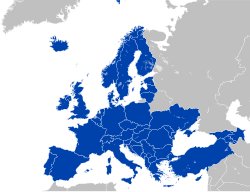


The following heads of state/heads of government participated in the summit:
Outcomes
Future summits
According to a press release issued after the summit, the main focus of discussions was in regard to security, the 2022 Russian invasion of Ukraine and the ongoing energy crisis in Europe. It was also agreed that the following summit will be held in the spring of 2023 in Moldova and would focus on securing key infrastructure such as pipelines, cables, and satellites; stepping up the fight against cyberattacks, creating a support fund for Ukraine, working out a common, pan-European energy policy and looking into the possibility of having more university and student exchanges.
Armenia-Azerbaijan relations
At the summit, Armenian Prime Minister Nikol Pashinyan and Azeri President Ilham Aliyev met in an attempt to resolve the long running Nagorno-Karabakh conflict and the recent Armenia–Azerbaijan border crisis. Following the meeting, the two parties re-affirmed their commitment to upholding the United Nations Charter and the Alma-Ata Protocol, through which they recognize each other's territorial integrity and sovereignty. They also agreed to the deployment of a European Union led mission to be deployed on the Armenian side of their shared border for a period of two months, starting in October 2022 with a view to build confidence and to contribute to the border delimitation process. This mission ultimately led to the deployment of a longer term European Union Mission in Armenia.
United Kingdom
At the summit, the United Kingdom agreed to re-engage with the North Seas Energy Cooperation (NSEC) which it had previously left in January 2020. At a fringe event, British Prime Minister Liz Truss committed to joining the Permanent Structured Cooperation (PESCO) and its Military Mobility programme. The summit also resulted in a resetting of the relations between the UK and France. During bilateral talks at the summit, Liz Truss and French President Emmanuel Macron reaffirmed the strong and historic ties between their two countries and the two agreed to hold a UK-France Summit in 2023. Prior to the summit, Truss had stated that "the jury was out" on whether Macron was a friend or foe, however during the summit Truss called Macron a friend.
Common youth policy
At the summit, the leaders of Albania, Serbia and Ireland suggested the idea of having a much more integrated university policy.
See also
- European integration
- Pan-European identity
- Politics of Europe
- 2022 Czech Presidency of the Council of the European Union
External links
Media related to 1st European Political Community Summit at Wikimedia Commons