Portugal
In-game article clicks load inline without leaving the challenge.
Portugal, officially the Portuguese Republic, is a country located on the Iberian Peninsula in Southwestern Europe. It is a unitary republic made up by mainland Portugal and two autonomous regions, with Lisbon as both its capital and largest city. It has a total population of over 10.7 million. The mainland is bordered by Spain to the north and east, with Madeira and the Azores in the Atlantic Ocean. The mainland includes the westernmost point of continental Europe.
The western Iberian Peninsula has been inhabited since prehistoric times, with the earliest signs of settlement dating to 5500 BC. Portugal was initially established as a county of the Kingdom of León in 868, and formally as a kingdom in 1179, resulting from the Reconquista against the Muslims. The kingdom later became one of the main participants of the Age of Discovery, made several seminal advancements in nautical science, and was among the first European countries to explore and discover new territories and sea routes, establishing settlements, colonies, and trading posts. After the kingdom became a republic in 1910, Portugal lived under a dictatorship from 1926 until the dictatorship's overthrow in 1974 enabled the full establishment of democracy in 1976.
It is a semi-presidential constitutional unitary republic and multi-party representative democracy with four separate sovereignty bodies: president, government, parliament, and judiciary. It has a unicameral national legislature known as the Assembly of the Republic. Portugal has developed a complex system to manage its territory, even though the mainland continues to remain highly centralized.
A developed country, Portugal has an advanced economy that chiefly relies upon services, industry, and tourism. Shaped by the various civilisations that have crossed its territory, Portugal developed a specific culture with a worldwide influence that allowed Portuguese to become the world's fifth-most spoken native language with more than 250 million native speakers. A member of numerous international organizations, Portugal maintains an active role in international political, cultural, economic, and military affairs.
Etymology
The word Portugal derives either from Latin Portus Cale, meaning 'port of Cale', or Latin Portus Gale, 'warm harbor', itself the origin of Porto. Cale was a town on the Douro. The second derivation would have referred to the fact that the harbor at Porto is always free of ice. The meaning and origin of the word Cale is unclear. The usual explanation is that it is an ethnonym derived from the Gallaeci peoples, who occupied the north-west of the Iberian Peninsula.
Around 136BC, the Romans, during the Second Punic War, conquered Cale from the Carthaginians, renaming it Portus Cale. During the Middle Ages, the region around Portus Cale became known by the Suebi and Visigoths as Portucale. The name Portucale evolved into Portugale during the 7th and 8th centuries, and by the 9th century it was used to refer to the region between the Douro and Minho rivers. By the 11th and 12th centuries, Portugale, Portugallia, Portugallo, or Portugalliae were already referred to as Portugal.
History
Prehistory
The region has been inhabited by humans since approximately 400,000 years ago. Later Neanderthals roamed the northern Iberian peninsula, and a humanoid tooth has been found at the Nova da Columbeira cave in Estremadura. Homo sapiens sapiens arrived in Portugal around 35,000 years ago and spread rapidly, with the earliest signs of human settlement dating to 5500 BC. Pre-Celtic tribes inhabited Portugal. The Cynetes developed a written language, leaving stele, which are mainly found in the south. The Lusitanians occupied central, inland regions. Celts mainly inhabited the north and center of Portugal, leaving lasting traces in the language and culture.
Antiquity and early Middle Ages

Romans first invaded the Iberian Peninsula in 219 BC. The Carthaginians, Rome's opponent in the Punic Wars, were soon expelled from their coastal colonies. During Julius Caesar's rule, almost the entire peninsula was annexed to Rome, facing resistance from local tribes, notably the Lusitanians led by Viriathus.
In 409, with the decline of the Roman Empire, the Iberian Peninsula was occupied by Germanic tribes. Western Iberia was initially integrated into the Suebian Kingdom, with its capital at Braga. The Visigoths eventually defeated the Suebi and ruled the entire peninsula until the early 8th century. The Iberian Peninsula was then invaded from the south by the Umayyad Caliphate and most of it became part of al-Andalus in 726.
After defeating the Visigoths, the Umayyad Caliphate expanded rapidly in the peninsula. Beginning in 726, the land that is now Portugal became part of the Umayyad Caliphate until the caliphate's collapse in 750. That year the western part of the caliphate gained its independence under Abd al-Rahman I, with the establishment of the Emirate of Córdoba, which lasted until 1031, with its dissolution into 23 small kingdoms. Most of present-day Portugal fell into the hands of the Taifa of Badajoz, and in 1022 the Taifa of Seville. Those petty kingdoms were conquered by the Almoravids in 1086, then by the Almohads in 1147.
Invasions from the north also occurred in this period, with Vikings raiding the coast, including Lisbon, between the 9th and 11th centuries. The Viking raids resulted in the establishment of small Norse settlements on the coastline between Douro and Minho.
Reconquista

The Reconquista was a series of military campaigns by northern Iberian Christian polities against Muslim-ruled al-Andalus. It begun in 718 with the Battle of Covadonga which lead to the establishment of the Kingdom of Asturias following the defeat of the Umayyad forces by Visigothic nobleman, Pelagius.
In 868, Porto was conquered from the Moors by Vímara Peres, a knight and nobleman, on the orders of King Alfonso III of Asturias, with Peres becoming the first Count of Portugal. Finding many towns in the region deserted, Peres decided to rebuild and repopulate them.
The region became known as Portucale, Portugale, and Portugália. With the forced abdication of Alfonso III in 910, the Kingdom of Asturias split into three separate kingdoms, which were reunited in 924 under the crown of León. The first County lasted until 1071, when the Kingdom of Galicia took over the region following the Battle of Pedroso. In 1096, Alfonso VI of León refounded the county and bestowed it on Henry of Burgundy, who married to Alfonso's illegitimate daughter, Teresa of León.
Independence
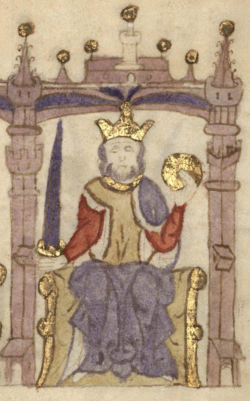
After the death of Count Henry, in 1112, a dispute erupted, culminating in the Battle of São Mamede, in 1128, where Afonso Henriques defeated the forces of his mother Countess Teresa and her lover Fernão Peres de Trava, establishing himself as sole leader of the county and achieving de facto independence. In 1129, the capital was transferred from Guimarães to Coimbra. Afonso's campaigns were successful, and in 1139, he was victorious in the Battle of Ourique, so was proclaimed King of Portugal by his soldiers. In 1143, Afonso was recognised as Afonso I, king of Portugal, by King Alfonso VII of León, and in 1179 by Pope Alexander III, with the papal bull Manifestis Probatum.
Afonso Henriques and his successors, aided by military monastic orders, continued pushing south until the capture of Algarve in 1249. With minor readjustments, Portugal's borders have since remained the same, making it one of the oldest established countries in Europe.
In 1348-49 Portugal, as with the rest of Europe, was devastated by the Black Death. In 1373, Portugal, during the reign of King Ferdinand I, in the midst of the Fernandine Wars, made an alliance with England, which would be later strengthened by the signing of the Treaty of Windsor, making it the oldest standing alliance in the world.
Age of Discovery

In 1383, John I of Castile and Beatrice of Portugal, the only surviving legitimate child of Ferdinand I of Portugal, claimed the throne of Portugal. John of Aviz led a revolt against them and defeated the Castilians in the Battle of Aljubarrota, with the House of Aviz becoming the ruling house that led Portugal into the limelight of European politics and culture.
Portugal spearheaded the European exploration of the world under the sponsorship of Prince Henry the Navigator, and made several seminal advancements in nautical science. The Portuguese explored the Indian Ocean, established trade routes in most of southern Asia, and sent the first direct European maritime trade and diplomatic missions to China and Japan. In 1415, Portugal acquired its first colonies by conquering Ceuta. Throughout the 15th century, Portuguese explorers sailed the coast of Africa, establishing trading posts for commodities that ranged from gold to slavery.

The Treaty of Tordesillas, signed in 1494, divided the newly located lands outside Europe between Portugal and Spain along a line west of Cape Verde. In 1500, Gaspar Corte-Real reached modern-day Canada and founded the town of Portugal Cove-St. Philip's. In 1500, Pedro Álvares Cabral landed in Brazil and claimed it for Portugal. Portuguese sailors set out to reach eastern Asia, landing in Taiwan, Japan, Timor, Flores, and the Moluccas.
Between 1519 and 1522, Ferdinand Magellan organised a Spanish expedition to the East Indies that resulted in the first circumnavigation of the globe. The Treaty of Zaragoza, signed in 1529, divided the Pacific Ocean between Spain and Portugal.
Iberian Union and Restoration
A succession crisis followed the deaths of King Sebastian and his grand-uncle King Henry, both of whom were without direct male heirs. Philip II of Spain claimed the throne in 1580, under the pretext that his mother, Isabella of Portugal, was a Portuguese princess, and he was crowned king of Portugal, forming a personal union of the two kingdoms, depriving Portugal of an independent foreign policy and leading to its involvement in the Eighty Years' War.

The Dutch-Portuguese War resulted in the loss of Portugal's Indian Ocean trade monopoly between 1595 and 1663. On 1 December 1640, John, Duke of Braganza, was proclaimed king following an uprising spearheaded by disgruntled nobles, ending 60 years of the Iberian Union under the House of Habsburg, and beginning the rule of the House of Braganza. Following its defeat in the Portuguese Restoration War, Spain recognized Afonso VI as king of Portugal. The reign of John V saw an influx of gold into the royal treasury, supplied largely by the royal fifth and a gold rush that saw one of the largest movements of people from Europe to an American colony.
Lisbon was struck by a major earthquake on 1 November 1755. Following the earthquake, King Joseph I gave his prime minister, Sebastião José de Carvalho e Melo, 1st Marquis of Pombal, overarching powers, with Pombai becoming an enlightened despot.
Constitutional monarchy

In 1807, Portugal refused Napoleon's demand to join the Continental System of embargo against the United Kingdom; an invasion led by French General Junot followed, and Lisbon was captured in 1807. During the Napoleonic invasions, the Portuguese royal family transferred the court to Rio de Janeiro, in Brazil, making it the capital between 1808 and 1821. British intervention in the Peninsular War helped support Portuguese independence, and all French troops were expelled by 1812.
In 1820, a constitutionalist insurrection began in Porto, which forced King John VI and his court to return to mainland Portugal in 1821. The death of John in 1826 led to a succession crisis. His eldest son, Pedro I of Brazil, briefly succeeded as Pedro IV of Portugal, but neither the Portuguese nor the Brazilians wanted a reunified monarchy. Consequently, Pedro abdicated the Portuguese crown in favour of his 7-year-old daughter, Maria da Glória.
Dissatisfaction at Pedro's constitutional reforms led the "absolutist" faction of landowners and the church to proclaim his brother Miguel king in February 1828. This led to the Liberal Wars, in which Pedro forced Miguel to abdicate in favour of Maria and to go into exile in 1834. Under the constitutional monarchy, the country faced economic crises, political instability, and several coups d'état. At the same time it expanded its colonies in Africa, but this culminated in the 1890 British Ultimatum, which thwarted Portugal's imperialist ambitions and represented a devastating blow to the monarchy.
First Republic and Estado Novo

In 1908, King Carlos I and his son and heir, Luís Filipe, Prince Royal, were assassinated by republican sympathizers. In 1910, the monarchy was replaced with a republic. During World War I, Portugal fought for the Allies; however, the war hurt its weak economy.
Political instability and economic weaknesses created chaos and unrest during the First Republic. These conditions led to its overthow in 1926 and the establishment of the Ditadura Nacional, which evolved into the right-wing dictatorship of the Estado Novo, under António de Oliveira Salazar, in 1933.
Portugal remained neutral in World War II. New economic development projects and relocation of mainland citizens into the overseas provinces in Africa were initiated. However, indigenous peoples already second-class citizens, were sidelined by those development projects, which led to the emergence of independence movements, in the 1960s, culminating in 1961 in the Portuguese Colonial War, which lasted until 1974.
Return to democracy

On 25 April 1974, the Carnation Revolution overthrew the Estado Novo beginning the transition to democracy, and the beginning of the dissolution of its colonial empire until 1999. Portugal was governed by a succession of provisional governments, with a lot of social and political tension, during the Ongoing Revolutionary Process (PREC), until the legislative election of 1976. After the transition to democracy, Portugal fluctuated between socialism and neoliberalism.
In 1986, Portugal joined the European Economic Community, which led to a considerable growth of its economy. The 2010–2014 Portuguese financial crisis led to an international bailout and intense austerity policies, resulting in social tensions.
Geography

Portugal occupies an area on the Iberian Peninsula and two archipelagos in the Atlantic Ocean: Madeira and the Azores. It lies between latitudes 30° and 42° N, and longitudes 32° and 6° W. The Portuguese territory covers 156,597 km2 (60,462 sq mi). The exclusive economic zone of Portugal covers an area of 1,727,408 km2 (666,956 mi2) being the 3rd largest exclusive economic zone of the European Union and the 20th largest in the world.
Continental Portugal is split by the Tagus River, which flows from Spain and disgorges into the Tagus Estuary, at Lisbon, which itself discharges into the Atlantic. The northern landscape is mountainous towards the interior with several plateaus indented by river valleys, whereas the south is characterised by rolling plains.
At an elevation of 2,351 metres (7,713 ft), the summit of Mount Pico, on Pico Island, is the highest point in the country. The archipelagos of Madeira and the Azores are scattered within the Atlantic Ocean: Madeira along a range formed by in-plate hotspot geology, and the Azores straddling the Mid-Atlantic Ridge on a tectonic triple junction. These islands were formed by volcanic and seismic events. The last terrestrial volcanic eruption occurred in 1957–58, and minor earthquakes occur sporadically.
Climate

The climate of Portugal is mainly Mediterranean. While the mainland and Madeira show a Mediterranean climate, the Azores mainly have a temperate oceanic climate. Portugal has a diverse variety of regional climates for a country of its size.
The Iberian Peninsula is located at the southern margin of the temperate zone and at the northern margin of the subtropical high-pressure zone. Additionally, Portugal's climate is influenced by the seasonal latitudinal shift of the jet stream, which directly impacts the trajectory of a polar front. Typically in the winter, the jet stream moves southwards and Portugal comes under the influence of the polar front, producing colder temperatures. When the polar front moves northward, Portugal comes under the influence of the stable atmospheric conditions that bring milder weather during the summer.
The high altitude zones of the Azorean islands have a temperate maritime climate while the western Azores have a humid subtropical climate. In parts of the Beja District and on Porto Santo Island the climate is semi-arid. In the Selvagens Islands the climate is that of a hot desert. Portugal is one of the warmest countries in Europe: the average temperature in mainland Portugal varies from 10–12 °C (50.0–53.6 °F) in the mountainous interior north to 17–19 °C (62.6–66.2 °F) in the south and on the Guadiana river basin, with variations from the highlands to the lowlands. Wildfires are a major issue, with Portugal, on average, having the highest percentage of burned area in the European Union, and its coastal area being vulnerable to climate change and severe weather.
Biodiversity

Portugal is located on the Mediterranean basin, the 3rd most diverse hotspot of flora in the world. It is home to 6 terrestrial ecoregions. Over 22% of its land area is included in the Natura 2000 network. Eucalyptus, cork oak, and maritime pine together make up 71% of the total forested area of continental Portugal.
Geographical and climatic conditions facilitate the introduction of exotic species that later turn out to be invasive and destructive to the native habitats. Around 20% of the total number of extant species in continental Portugal are exotic. Portugal is the 2nd country in Europe with the highest number of threatened animal and plant species. The country as a whole is an important stopover for migratory bird species.
The large mammalian species of Portugal such as deer, Iberian ibex, wild boar, red fox, Iberian wolf, and Iberian lynx were once widespread throughout the country, but intense hunting, habitat degradation, and growing pressure from agriculture and livestock largely reduced their populations in the 19th and early 20th century. Others species, such as the Portuguese ibex, became extinct. Today, many of these species are re-expanding their native range.
The Portuguese west coast is part of the four major Eastern Boundary Upwelling Systems of the ocean. This makes Portugal one of the largest per capita fish-consumers in the world. 73% of the freshwater fish occurring in the Iberian Peninsula are endemic, the largest out of any region in Europe. Some protected areas of Portugal include: the Serras de Aire e Candeeiros, the Southwest Alentejo and Vicentine Coast Natural Park, and the Montesinho Natural Park, which hosts some of the only populations of Iberian wolf and Iberian brown bear.
Government and politics

Portugal has been a semi-presidential representative democratic republic since the ratification of the Constitution of 1976, with Lisbon as its capital. The Constitution makes for a separation of powers among four sovereign bodies: the president, the government, the Assembly of the Republic, and the courts.
The head of state of Portugal is the president who is elected to a five-year term by direct, universal suffrage. Although largely a ceremonial post, presidential powers include the appointment of the prime minister and other members of the government, dismissing the prime minister, dissolving the parliament, vetoing legislation, and declaring war. The president also has supervisory and reserve powers and is the ex officio commander-in-chief of the armed forces. The president is advised by the Council of State. The president of Portugal is António José Seguro; he took office after winning the second round of the 2026 Portuguese presidential election.

Portugal's legislative body is the Assembly of the Republic, an unicameral parliament. It consists of a single chamber with a minimum of 180 seats and a maximum of 230, elected by popular vote every four years or when dissolved. There is universal suffrage for adults over 18 years of age, with a secret ballot for all elected offices. As the head of government, the prime minister leads the Council of Ministers which includes ministers and secretaries of state that have full executive powers, and is appointed by the president in light of electoral results after consulting with the parties with seats in the Assembleia da República. Portugal's prime minister is Luís Montenegro who took office after AD – PSD/CDS Coalition winning enough seats to form a minority government following the 2024 Portuguese legislative election. Portugal operates a multi-party system of competitive legislatures at the national, regional, and local levels. The Assembly of the Republic is dominated by three political parties, the Social Democratic Party (PSD), Chega (CH), and the Socialist Party (PS), while the PSD and PS continue to be the dominant parties in the regional parliaments and at the local level. There have been recent trends towards autocratization.
The Portuguese legal system is based on civil law. The Constitution is the supreme law of Portugal. In the Portuguese legal system, private law is regulated by the 1966 Civil Code and by the 1888 Commercial Code, criminal law is regulated by the 1982 Penal Code, and civil procedure is regulated by the 1961 Civil Procedure Code. In Portugal, courts are organised into several levels, among the judicial, administrative, and fiscal branches. The institution of last appeal is the Supreme Court of Justice. The Constitutional Court determines the constitutionality of the laws.
Administrative divisions
Continental Portugal is agglomerated into 18 districts, while the archipelagos of the Azores and Madeira are governed as autonomous regions; the largest units, established since 1976, are either mainland Portugal and the autonomous regions of Portugal (Azores and Madeira). Administratively, Portugal is divided into 308 municipalities (municípios or concelhos). Operationally, the municipalities, and freguesias, along with the national government, are the only legally local administrative units identified by the government of Portugal.
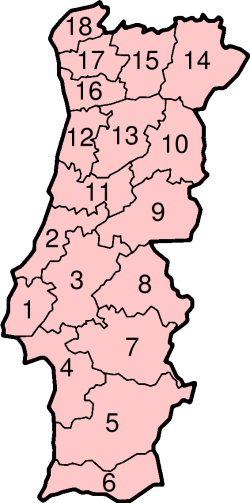
| District | Municipalities | Parishes | Pop. (2024) | Area (km2) | Density (/km2) | |
|---|---|---|---|---|---|---|
| 1 | Lisbon | 16 | 141 | 2,390,715 | 2,816 | 849 |
| 2 | Leiria | 16 | 116 | 486,583 | 3,506 | 139 |
| 3 | Santarém | 21 | 150 | 446,393 | 6,718 | 66 |
| 4 | Setúbal | 13 | 60 | 916,859 | 5,214 | 176 |
| 5 | Beja | 14 | 84 | 149,546 | 10,263 | 15 |
| 6 | Faro | 16 | 76 | 492,747 | 4,997 | 99 |
| 7 | Évora | 14 | 75 | 153,430 | 7,393 | 21 |
| 8 | Portalegre | 15 | 72 | 103,566 | 6,084 | 17 |
| 9 | Castelo Branco | 11 | 128 | 180,889 | 6,627 | 27 |
| 10 | Guarda | 14 | 245 | 142,210 | 5,535 | 26 |
| 11 | Coimbra | 17 | 161 | 423,432 | 3,974 | 107 |
| 12 | Aveiro | 19 | 174 | 734,762 | 2,801 | 262 |
| 13 | Viseu | 24 | 282 | 357,841 | 5,010 | 71 |
| 14 | Bragança | 12 | 226 | 122,360 | 6,599 | 19 |
| 15 | Vila Real | 14 | 200 | 184,707 | 4,307 | 43 |
| 16 | Porto | 18 | 275 | 1,860,255 | 2,332 | 798 |
| 17 | Braga | 14 | 371 | 867,537 | 2,706 | 321 |
| 18 | Viana do Castelo | 10 | 213 | 234,645 | 2,219 | 106 |
| Autonomous Region of Azores | 19 | 156 | 241,718 | 2,322 | 104 | |
| Autonomous Region of Madeira | 11 | 54 | 259,440 | 801 | 324 | |
| Total Portugal | 308 | 3,259 | 10,749,635 | 92,225 | 117 |
Within the European Union administrative system (NUTS), Portugal is divided into nine regions: the Azores, Alentejo, Algarve, Central Region, Lisbon, Madeira, North Region, Oeste e Vale do Tejo, and Setúbal Peninsula. With the exception of the Azores and Madeira, NUTS areas are subdivided into 24 subregions.
Foreign relations
A member state of the United Nations since 1955, Portugal is a member of numerous international organizations, and is among the countries that founded NATO in 1949, the OECD in 1961, EFTA in 1960, and the Community of Portuguese Language Countries (CPLP) in 1996, an international organisation of countries where Portuguese is an official language.
Portugal has hosted several international summits and events such as the first EU–Brazil summit in July 2007, the second EU–African Union summit in December 2007, the signing of the Treaty of Lisbon also in December 2007, and the NATO summit in November 2010. Portugal is a full member of the Latin Union (1983) and the Organisation of Ibero-American States (1949). It has a friendship alliance and dual citizenship treaty with Brazil. Portugal and the United Kingdom share the world's oldest active military accord through their Anglo-Portuguese Alliance, signed in 1386.
Portugal has two territorial disputes, both of which are with Spain: the Spanish town of Olivenza which is claimed by Portugal since the 19th century, and the Portuguese Savage Islands which have been claimed by Spain since 1911. Despite causing moments of tension between the two countries, the relationship between the two countries remains excellent.
Military

The Portuguese Armed Forces consist of three branches commanded by the Portuguese Armed Forces General Staff – Navy, Army, and Air Force. They serve primarily as a self-defence force whose mission is to protect the territorial integrity of the country but can also be used in offensive missions in foreign territories. In recent years, the Portuguese military have carried out several NATO and European Union missions in various territories. As of 2024, the three branches numbered 23,678 military personnel. The Portuguese military budget in 2023 was more than $4 billion, representing 1.48% of GDP.
The Army of 10,969 personnel comprises 3 brigades and other small units: an infantry brigade, a mechanized brigade, and a rapid reaction brigade. The Navy, the world's oldest naval force, has 5 frigates, 2 corvettes, 2 submarines, and 20 oceanic patrol vessels. The Air Force has the Lockheed F-16M Fighting Falcon as its main combat aircraft.
In addition to the three branches of the armed forces, there is the National Republican Guard, a gendarmerie force, comprising 23,287 personnel in 2023, under the authority of both the Defence and the Interior ministries. The Guard has provided detachments for international operations in Iraq and East Timor. The United States maintains a military presence, with 770 troops in the Lajes Air Base at Terceira Island, in the Azores.
Law enforcement

In Portugal, prosecution is conducted by the Public Prosecution Service which is headed by the prosecutor general[pt]. The main police organisations of Portugal are the National Republican Guard (GNR), a gendarmerie; the Public Security Police (PSP), a civilian police force that works in urban areas; and the Judicial Police (PJ), a highly specialised criminal investigation organization that is overseen by the Public Prosecution Service.
Portugal has 49 correctional facilities[pt] run by the Directorate-General for Reintegration and Prison Services[pt] (DGRSP). The facilities include seventeen central prisons, four special prisons, twenty-seven regional prisons, and one Cadeia de Apoio (Support Detention Centre). As of 2025, the prison population stood at 12,193 inmates, about 0.11% of the country's entire population, with the incarceration rate steadily declining between 2013 and 2021.
In 2001, Portugal became the first country in the world to decriminalize the personal possession and consumption of all drugs.
Human rights
Portugal has a tradition of a humanistic criminal justice. The Portuguese Consitution defines the country as being one that is based on human dignity. It abolished capital punishment and life imprisonment in the 19th century, and forbids extradition in the case of either sentence possibly being imposed. Portugal is the only country that considers any type of punishment for the duration of a convict's natural life a violation of human rights. The Portuguese Penal Code provides for a wide range of non-custodial sentences, with the aim of keeping a prison sentence a punishment of last resort. Portuguese penitentiary laws have traditionally been progressive, and based on rehabilitation as the main goal of the implementation of such a sentence.
Since the 2000s, numerous laws strengthening LGBT rights were passed in Portugal. Portugal faces issues such as police brutality, racism, and discrimination against Romani people.
Economy

Portugal is an high-income country with an advanced economy that follows the Mediterranean model. It has the EU's 14th-largest economy by nominal GDP and the 12th-largest economy by PPP-adjusted GDP. Its PPP-adjusted GDP per capita stood at to 81% of the EU average in 2025. The country's service sector contributes approximately 76.5% of the total GDP, the industrial sector 21.2%, and its agricultural sector 2.9%, in 2024. As of 2025, Portugal unemployment rate stands at 5.8%. As of 2024, its poverty rate after social transfers is 15.4% of the population while in 2023, the at-risk-of-poverty rate before social transfers stood at 40.3%. The national debt of Portugal is estimated at 89.5% relative to GDP as of 2025.
Portugal is part of the European single market which represents more than 450 million consumers. Portugal replaced the escudo with the euro, in 2002. Its monetary policy is set by the European Central Bank. The country has been a part of the Eurozone since its inception. Portugal's central bank is the Banco de Portugal and it is part of the European System of Central Banks. In 2024, Portugal had a combined share of exports and imports that amounted to 90% of its total GDP. In 2025, Portugal's main export markets were Spain at 26% and Germany at 13.9%. Its main exports are machinery and mechanical appliances, vehicles and other transportation equipment, base metals, and plastics. Portugal's main import markets in 2026 were Spain at 32.9% and Germany at 11.9%. Portugal's main imports are machinery and mechanical appliances, chemical products, agricultural products, and mineral fuels.
Since the 1990s, Portugal's economic model has been based on public consumption and economic development focused on exports, private investment and the development of its high-tech sector. Consequently, business services have overtaken more traditional industries such as wine and cork in export earnings. The PSI, Portugal's stock market index operated by the Euronext Lisbon, includes 16 major Portugal-based companies. Proeminent Portuguese companies include Sonae, Mota-Engil, Corticeira Amorim, The Navigator Company and EDP.
The European Innovation Scoreboard 2025, ranked Portugal-based innovation as 16th, with increases in R&D, government support, and resource produtivity. Portugal was ranked 31st on the Global Innovation Index in 2025. Among the largest non-state-run research institutions are the Gulbenkian Institute of Molecular Medicine, the International Iberian Nanotechnology Laboratory, and the Champalimaud Foundation, which is one of the leading research centres for neuroscience and oncology in the world.
Agriculture and fishery

The Portuguese agriculture secture accounts for 2.9% of the country's total GDP as of 2024. Only 10.1% of Portugal's land is suitable for cultivation as of 2023. Despite this, the presence of very distinct edaphoclimatic and agroecological conditions in the northern, central, and southern regions of Portugal enables the cultivation of various agricultural products such wheat, maize, rice with each one having an important role in the primary sector, and resulting in an agricultural self-sufficiency rate of about 81% as of 2012.
Portugal ranks sixth in the world in seafood consumption per capita with each Portuguese consuming on average 59.36 kilos of fish in 2020. The high fish consumption in Portugal is due to tradition and cultural roots, politics, dynamics of the fish market system, and geography which makes fisheries and the consumption of seafood products extremely valuable. While Portugal captured 185,000 metric tons of fish in 2019, down from the 222,000 metric tons in 2010, fish and seafood represent the single highest import of biocapacity from abroad, amounting to 1,600,000 global hectares in total.
Tourism

Portugal is among the top 20 most-visited countries in the world, receiving nearly 29 million foreign tourists in 2024. In 2014, Portugal was elected The Best European Country by USA Today. In 2017, Portugal was voted Europe's Leading Destination and in 2018 and 2019, World's Leading Destination
Travel and tourism is an important part of Portugal's economy. As of 2024, the tourism sector contributed 11.9%, worth €34 billion, to GDP, with tourism contributing and increase of 0.3% to an annual GDP growth of 1.9%.
Popular tourism destinations include: Lisbon, Cascais, Algarve, Madeira, Nazaré, Fátima, Óbidos, Porto, Braga, Guimarães, and Coimbra. Lisbon is the 9th most-visited city in Europe, with 6,7 million tourists occupying the city's hotels in 2024, of which 5,5 million were foreign.
Transport

Portugal has a 68,732 km (42,708 mi) road network, of which 3,065 km (1,905 mi) are part of a system of 48 motorways, making it the 8th largest motorway system among 42 European countries.
By 2024, Portugal had 37 civil airports. Five are the main international airports, with three located on the mainland – Lisbon (the busiest in the country), Porto, and Faro airports – with Funchal airport on Madeira, and Ponta Delgada airport in the Azores.
A national railway system, that extends throughout mainland Portugal and into Spain, is supported and administered by Comboios de Portugal (CP). Rail transport of passengers and goods is facilitated using the 2,527 km (1,570 mi) of railway lines currently in service, of which 1,791 km (1,113 mi) are electrified. The two largest metropolitan areas (Lisbon and Porto) have subway and tram systems.
The major seaports are located in Sines, Leixões, Lisbon, Setúbal, Aveiro, Figueira da Foz, and Faro.
Energy

As of 2023, oil made up 44% of Portugal's total energy supply. The country phased out coal-fired generation in 2021 and has been developing renewable energies such as hydopower and wind power and investing in public transport and electric vehicles.
Portugal has considerable wind and hydropower resources. In 2006, the world's then largest solar power plant, the Moura Photovoltaic Power Station, began operating, while the world's first commercial wave power farm, the Aguçadoura Wave Farm, opened in 2008 near Póvoa de Varzim, being, however, shut down a short time later. There are also offshore floating wind turbine projects, mainly on the coast of Viana do Castelo. In 2025, renewable energy resources were producing 68% of the nation's electricity. Since 2021, electricity imports, mainly from Spain, have outpaced exports by around 20% as of 2023, with most of the energy coming from renewable sources.
Demographics

As of 2024, Portugal had a population 10,749,635, of which 52.2% was female and 47.8% male, according to Statistics Portugal. In 2025, the median life expectancy reached 82.95 years, with United Nations projecting a rise of up to 90 years or more by 2100. The population historically has been relatively homogeneous, with most people adhering to Catholicism and speaking Portuguese. Between 2022 and 2023, 6.4 million people aged between 18 and 74 years old identified themselves as White (84.2%), more than 262,000 as Mixed-race (3.4%), nearly 169,200 as Black (2.2%), 56,600 as Asian (0.7%), and 47,500 as Romani (0.6%). Portuguese society displays relatively high rates of socioeconomic equality, with the country ranking 24th within the 41 countries of the EU and OECD in the 2019 Social Justice Index.
Portugal has had a fertility rate below the replacement rate of 2.1 since the 1980s. The total fertility rate (TFR) as of 2024[update] was estimated at 1.36 children born per woman, one of the lowest in the world. Consequently, Portugal's population has been steadily ageing and was the 11th oldest in the world in 2024, with a median age of 46.4 years and the fourth highest number of citizens over 65 years, at 21.8% of the total population. According to projections by the national statistics office, the population will fall to 7.7 million by 2080 and the population will continue to age. As of 2022, 60.2% of births were to unmarried women, and 24.5% of births were to foreign born women.
Historically a country of emigration, Portugal has been a net recipient of immigrants since the early 21st century. As of 2024, legal-resident foreigners number 1,543,697, or approximately 14% of the population; these figures do not include more than 340,000 resident foreigners who acquired Portuguese citizenship between 2008 and 2022—and thus constitute around 3.27% of the country's population in 2022. That year, almost 21,000 foreign residents acquired Portuguese citizenship, of which 11,170 were female and 9,674 were male.
Based on commuting patterns, OECD and Eurostat define eight metropolitan areas of Portugal. Only two have populations over 1 million, and since the 2013 local government reform, these are the only two that also have the legal administrative status of metropolitan areas: Lisbon and Porto. Several smaller metropolitan areas (Algarve, Aveiro, Coimbra, Minho, and Viseu) also held this status from 2003 to 2008, when they were converted into intermunicipal communities, whose territories are roughly based on the NUTS III statistical regions.
| Largest Municipalities in Portugal INE 2024 Estimate | |||||||
|---|---|---|---|---|---|---|---|
| Rank | Name | Region | Pop. | Rank | Name | Region | Pop. |
| 1 | Lisbon | Lisbon | 575,739 | 11 | Oeiras | Lisbon | 177,866 |
| 2 | Sintra | Lisbon | 400,947 | 12 | Seixal | Lisbon | 176,883 |
| 3 | Vila Nova de Gaia | North | 312,984 | 13 | Gondomar | North | 169,388 |
| 4 | Porto | North | 252,687 | 14 | Guimarães | North | 156,513 |
| 5 | Cascais | Lisbon | 222,339 | 15 | Odivelas | Lisbon | 156,278 |
| 6 | Loures | Lisbon | 209,877 | 16 | Coimbra | Central | 146,899 |
| 7 | Braga | North | 203,519 | 17 | Maia | North | 144,664 |
| 8 | Almada | Lisbon | 183,643 | 18 | Vila Franca de Xira | Lisbon | 140,711 |
| 9 | Amadora | Lisbon | 181,607 | 19 | Santa Maria da Feira | North | 140,568 |
| 10 | Matosinhos | North | 181,046 | 20 | Vila Nova de Famalicão | North | 136,704 |
Religion
- Catholicism (80.2%)
- Protestantism (2.10%)
- Other Christian (2.40%)
- Other religion (1.13%)
- No religion (14.1%)
Portugal is a secular state since 1911[pt], and it guarantees religious freedom. Despite not having any official religion, the Catholic Church has a long history in the country. According to the 2021 Census, 80.2% of the Portuguese population are Catholic, while 14.7% are nonreligious. The country has small Protestant, Latter-day Saints, Muslim, Hindu, Sikh, Eastern Orthodox Church, Jehovah's Witnesses[pt], Baháʼí, Buddhist, Jewish, and Spiritist communities. Influences from African Traditional Religion and Chinese Traditional Religion are also felt among many people, particularly in fields related to Traditional Chinese Medicine and Traditional African Herbal Medicine.
Even though Portugal has deep ties with Christianity, as of 2019 the majority of its people were shown to be tolerant towards followers of other faiths, with the Muslim community perceiving itself as thoroughly integrated into Portugal and believing that the country provided conditions conducive to smooth integration.
Languages
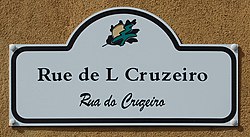
Portuguese is the official language of Portugal. Mirandese is also recognised as a co-official regional language in some municipalities of northeastern Portugal; it is part of the Astur-Leonese group of languages. An estimated 6,000 to 7,000 Mirandese speakers has been documented for Portugal. Furthermore, a particular dialect known as Barranquenho, spoken in Barrancos, is also officially recognised and protected in Portugal since 2021. Minderico, a sociolect of the Portuguese language, is spoken by around 500 people in the town of Minde.
According to the EF English Proficiency Index, as of 2025, Portugal has a very high proficiency level in English, having the sixth-highest proficiency score in the world.
Education

The educational system is divided into preschool (for those under age six), basic education (nine years, in three stages, compulsory), secondary education (three years, compulsory since 2010), and higher education (subdivided into university and polytechnic education). Universities are usually organised into faculties. Institutes and schools are also common designations for autonomous subdivisions of Portuguese higher education institutions.
Portuguese universities have existed since 1290. The University of Coimbra, the oldest Portuguese university, was first established in Lisbon before moving to Coimbra. Historically, within the scope of the Portuguese Empire, the Portuguese founded the oldest engineering school in the Americas (the Real Academia de Artilharia, Fortificação e Desenho of Rio de Janeiro) in 1792, as well as the oldest medical college in Asia (the Escola Médico-Cirúrgica of Goa) in 1842. Presently, the largest university in Portugal is the University of Lisbon.
The Bologna process has been adopted by Portuguese universities and polytechnical institutes in 2006. Higher education in state-run educational establishments is provided on a competitive basis, a system of numerus clausus is enforced through a national database on student admissions. However, every higher education institution offers also a number of additional vacant places through other admission processes for sportsmen, mature applicants (over 23 years old), international students, foreign students from the Lusosphere, degree owners from other institutions, students from other institutions (academic transfer), former students (readmission), and course change, which are subject to specific standards and regulations set by each institution or course department.
Health
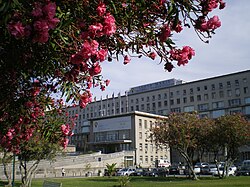
In 2025, Portugal's healthcare system was ranked as the 23rd best in the world. The health system is characterised by three coexisting systems: the National Health Service[pt] (SNS), special social health insurance schemes for certain professions (health subsystems), and voluntary private health insurance. The SNS provides universal coverage. In addition, about 55% of the population is covered by the health subsystems, 43% by private insurance schemes, and another 12% by mutual funds.
Similarly to other Western European countries, most Portuguese die from noncommunicable diseases. Portugal's infant mortality rate stood at 2,25 deaths per 1,000 live births as of 2024. A Eurostat opinion-poll in 2023 found that 55.4% of adults rated their health as good or very good, the third lowest such rating in the European Union. The largest university hospital in the country is Hospital de Santa Maria, in Lisbon.
Despite its economic development, the average Portuguese height is among the shortest in Europe since around 1890. A driving factor was modest real wage growth, given late industrialisation and economic growth compared to the European core, and delayed human capital formation.
Culture

Portugal has developed a specific culture due to, initially before its existence, the influence from various civilisations that have crossed Europe, especially the Mediterranean, and later, during the period of Portugal's engagement in the Age of Discovery, which introduced cultural elements from outside of the European continent.
Portugal is well known for its heritage and architecture, sacred sites, summer festivals, poetry, its music (especially the fado), and cuisine (especially its wine). As of 2026, UNESCO inscribed 17 properties in Portugal on the World Heritage List. There are 13 public holidays in Portugal; 10 June is the national day of Portugal, celebrated as the Dia de Portugal, de Camões e das Comunidades Portuguesas (Portugal, Camões, and Portuguese Communities Day).
Art and architecture

The history of visual art in Portugal dates back into the Paleolithic. The earliest evidence showing an attempt at depicting motion was found at the Prehistoric Rock Art Sites in the Côa Valley and Siega Verde.
Over time, foreign and native influences, together with developments in manufacturing, have led to the creation and development of a number of crafts that are typical of Portugal, the most notable of which being the azulejo, talha dourada, and Portuguese pavement, which formed the basis of some Portuguese architectural styles, such as the Pombaline style. Historically, religion, specifically Christianity, had an influential role in Portuguese art, as it was a recurrent theme widely employed in many art forms, such as in painting.
Throughout the country's history, artwork in Portugal was typically done by local artists who, depending on location, followed different variations in style, giving Portugal a diverse array of artistic styles throughout the country, an example of this being the thatch houses of Santana[pt], in Madeira.
Literature
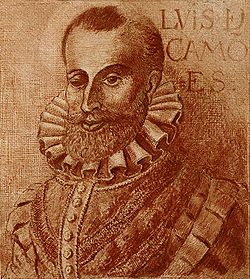
Portuguese literature, one of the earliest Western literatures, developed through song as well as the written page. Until 1350, the Portuguese-Galician troubadours spread their literary influence to most of the Iberian Peninsula, such as King D. Dinis (1261–1325), who became famous for his poetry. Other kings would write and sponsor works of literature across Portuguese history, such as D. Fernando (1367–1383), who supported Pêro Menino in writing Livro da Falcoaria.
Luís de Camões wrote Os Lusíadas, an epic poem, with Virgil's Aeneid as his main influence. Modern Portuguese poetry is rooted in neoclassic and contemporary styles, as exemplified by Bocage (1765–1805), Antero de Quental (1842–1891), and Fernando Pessoa (1888–1935). Modern Portuguese literature is represented by authors such as Almeida Garrett, Camilo Castelo Branco, Eça de Queirós, Fernando Pessoa, Sophia de Mello Breyner Andresen, António Lobo Antunes, Miguel Torga, Agustina Bessa-Luís, and José Saramago, who earned the 1998 Nobel Prize in Literature.
Music

The history of music in Portugal dates back to the 6th century. The earliest record of a singer in Portugal is from the year 525.
Portuguese music initially consisted mostly of liturgical music and troubadorism. Over time, new folk traditions together with the influence of foreign cultures and the creation of new instruments, especially guitars[pt], led to a diverse variety of regional folk music such as the fado, the Coimbra fado, Desgarrada, and Madeira's folk music. Popular music in Portugal after the Carnation Revolution has been heavily influenced by American trends, which has led into the evolution of Hip-hop tuga and popularization of Rock.
Historically, Portugal has been a country of emigration which has heavily influenced the Pimba in the 20th century and led to the introduction of Portuguese music into other cultures such as the ukelele in Hawaii in the 19th century.
Holidays

Officially, Portugal has 13 national, government-recognized holidays. Public holidays in Portugal are regulated by the Labour Code[pt]. Besides the national holidays, there are 3 regional holidays celebrated only in Madeira and the Azores and 2 facultative holidays. The national holidays in Portugal are New Year's Day on January 1, Good Friday on a Friday between March 20 and April 23, Easter on a Sunday between March 22 and April 25, Freedom Day on April 25, International Workers' Day on May 1, Feast of Corpus Christi on a Thursday between May 21 and June 24, Portugal Day on June 10, Assumption Day on August 15, Implementation of the Republic Day on October 5, All Saints' Day on November 1, Restauration of the Independence Day[pt] on December 1, Feast of the Immaculate Conception on December 8, and Christmas Day on December 25. The regional holidays in Madeira are Madeira Day on July 1, and 1st Octave Day on December 26. The Azores celebrates the Azores Day on a Monday between May 11 and June 14. Optional holidays in Portugal are the Entrudo[pt] and municipal holidays celebrated at most once per Concelho.
Cuisine

Portuguese cuisine is influenced by both the Mediterranean diet and the Atlantic diet. Seafood, brassicas, potatoes, bread, dairy, and olive oil are traditional staples. Bacalhau has such broad presence in Portugal that is considered a national dish, along with pastel de nata. Traditional Portuguese sweets are known as conventual sweets. Large quantities of sugar and eggs are used,
Popular Portuguese beverages include its wines a craft that was introduced in Portugal by the Romans and today has some notable examples such as the Port wine and Madeira wine. Beer has been breweed in Portugal beginning in Lusitania. Tea is produced in São Miguel Island since the 19th century.
Sport

Football is the most popular sport in Portugal. There are several football competitions ranging from local amateur to world-class professional level. All-time greats Eusébio, Luís Figo and Cristiano Ronaldo are major symbols of Portuguese football history. The Portugal national football team has won one UEFA European Championship title: the UEFA Euro 2016, with a 1–0 victory in the final over France, the tournament hosts. In addition, Portugal finished first in the 2018–19 and 2024–25 UEFA Nations League, second in the Euro 2004, third in the 1966 FIFA World Cup, and fourth in the 2006 FIFA World Cup. The country's top-level football league, the Primeira Liga, ranks 6th in the UEFA ranking as of 2026.
Road cycling, with Volta a Portugal, is a popular sports event. In motorsport, Portugal is noted for the Rally of Portugal, and the Estoril and Algarve Circuits as well as the revived Porto Street Circuit which held a stage of the WTCC every two years, between 2007 and 2013.
In water, Portugal has three major sports: swimming, water polo and surfing. Annually, the country hosts one of the stages of the World Surf League men's and women's Championship Tour, the MEO Rip Curl Pro Portugal at the Supertubos in Peniche. Northern Portugal has its own original martial art, Jogo do Pau, in which fighters use staffs to confront one or several opponents.
See also
Notes
Sources
External links
- Geographic data related to at OpenStreetMap
- from the Portuguese American Journal
- at UCB Libraries GovPubs
- from the BBC News
- . The World Factbook (2025 ed.). Central Intelligence Agency.
- Prestage, Edgar; Jayne, Kingsley Garland (1911). "Portugal". Encyclopædia Britannica. Vol. 22 (11th ed.). p. 134–163.
- from the
- Wikimedia Atlas of Portugal
Government
- (in English and Portuguese)
Trade
Travel
39°N 8°W/39°N 8°W/ 39; -8