Aita
In-game article clicks load inline without leaving the challenge.

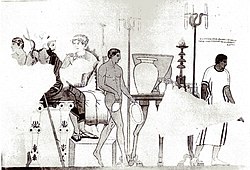
Aita (Etruscan: 𐌀𐌕𐌉𐌀), also spelled Eita (Etruscan: 𐌀𐌕𐌉𐌄), is an epithet of the Etruscan chthonic fire god Śuri as god of the underworld, roughly equivalent to the Greek god Hades (Epic Greek: Ἄϊδης, romanized:Áïdēs).
Images
Aita is a relatively late addition to the Etruscan pantheon, appearing in iconography and in Etruscan texts beginning in the 4th century BC, and is heavily influenced by his Greek counterpart, Hades. Aita is pictured in only a few instances in Etruscan tomb painting, such as in the Golini Tomb from Orvieto and the tomb of Orcus II from Tarquinia. In these tomb paintings, he is shown with his consort Persipnei (Etruscan: 𐌉𐌄𐌍𐌐𐌉𐌔𐌛𐌄𐌐), also spelled Phersipnai (Etruscan: 𐌉𐌀𐌍𐌐𐌉𐌔𐌛𐌄𐌘), the Etruscan equivalent of the Greek Persephone.
Although Aita is very rarely depicted, he may appear enthroned and sometimes wears a wolf cap, borrowing a key attribute from the earlier Etruscan underworld wolf deity, named Calu. Other examples of Aita in Etruscan art depict his abduction of Persipnei. Aside from tomb painting, Aita may be identified in a few examples in other media, including a 4th-century painted vase from Vulci, two 2nd-century alabaster ash urns from Volterra, and a red-figure 4th–3rd century Oinochoe.
Bibliography
- De Grummond, Nancy Thomson (2004). . Hesperia Supplements. 33. The American School of Classical Studies at Athens: 351–370. ISBN 9780876615331. JSTOR .
- De Grummond, Nancy Thomson (2006). Etruscan Myth, Sacred History, and Legend. Philadelphia, PA: University of Pennsylvania Museum of Archaeology and Anthropology. ISBN 9781931707862.
- De Grummond, Nancy Thomson; Simon, Erika, eds. (2006). . Austin: University of Texas Press. ISBN 9780292782334. Bonfante, Larissa. "Etruscan Inscriptions and Etruscan Religion". In De Grummond & Simon (2006). Colonna, Giovanni. "Sacred Architecture and the Religion of the Etruscans". In De Grummond & Simon (2006). Krauskopf, Ingrid. "The Grave and Beyond". In De Grummond & Simon (2006), p. vii, pp. 73–75. Simon, Erika. "Gods in Harmony: The Etruscan Pantheon". In De Grummond & Simon (2006).
- Elliott, John (1995-01-01). "The Etruscan Wolfman in Myth and Ritual". Etruscan Studies. 2 (1): 17–33. doi:. S2CID .
- Jannot, Jean-René (2005). Religion in Ancient Etruria. Translated by Whitehead, J.K. University of Wisconsin Press. ISBN 9780299208448.
- Lecce, Vittoria. (in Italian). Museo Nazionale Etrusco.
- Lexicon Iconographicum Mythologiae Classicae. Vol. I–VIII. Zurich, Munich, Düsseldorf: Artemis & Winkler Verlag. 1981–1999. ISBN 3-7608-8751-1. Krauskopf, Ingrid (1988). "Aita/Calu". InLIMC. Vol. IV. pp. 394–399.
- Maras, Daniele F. (2010). . Archeo (in Italian). No. 305. Archived from on 2014-12-10.
- Servius (380). (in Latin). Vol. I–XII. Georgius Thilo – via Perseus Digital Library. Servius (380a). (in Latin). Vol. X. 199 – via Perseus Digital Library. Servius (380b). (in Latin). Vol. XI. 785 – via Perseus Digital Library.