New Zealand men's national football team
In-game article clicks load inline without leaving the challenge.
The New Zealand men's national football team (Māori: Tīma hoka a-motu o Aotearoa) represents New Zealand in men's international football competitions. The team is governed by the governing body for football in New Zealand, New Zealand Football (NZF), which is currently a member of FIFA and the Oceania Football Confederation (OFC). The team's official nickname is the All Whites (Māori: Ōmā [ɔːmaː]).
The team represented New Zealand at the FIFA World Cup tournaments in 1982 and 2010, and are set to appear in the 2026 FIFA World Cup. It also participated in the FIFA Confederations Cup in 1999, 2003, 2009, and 2017. New Zealand is a six-time OFC Nations Cup champion. New Zealand was the only unbeaten country in the 2010 FIFA World Cup, drawing all three group stage games; nevertheless, they were eliminated in the group stage.
History
Early years

New Zealand's first international football match was played in Dunedin at the old Caledonian Ground on 23 July 1904 against a team representing New South Wales. New Zealand lost by the game's only goal, but drew with the same team 3–3 in a game at Athletic Park, Wellington seven days later. The following year the team played a Wellington representative side on 10 June before embarking on a tour of Australia, during which they played eleven representative sides, including three "test matches" against New South Wales. Of these three matches they won one, lost one, and drew one.
A New Zealand national team did not play again until 1922, when New Zealand played three official full internationals against Australia, played at Carisbrook in Dunedin, Athletic Park in Wellington, and Auckland Domain. The results were two 3–1 wins to New Zealand and a 1–1 draw in Wellington. In 1927, Canada became the second team to play in New Zealand as they played in four official matches with a win and a draw.
New Zealand would become one of the founder members of the Oceania Football Confederation in 1966 which was founded between Charlie Dempsey and his Australian colleague Jim Bayutti in founding the federation.
Success for Spain '82

At the beginning of the 1980s the All Whites were on a run of consecutive victories until the 1980 Oceania Cup in New Caledonia. New Zealand ended up having a disastrous campaign, losing 1–3 and 0–4 to Tahiti and Fiji respectively. In the last round without a possible qualification for the final they beat the Solomon Islands 6–1.
The All Whites later improved when the team advanced to the final phase of the qualifiers for the 1982 World Cup. With zero losses, the team's strength was highlighted by a 3–3 draw and a 1–0 victory against Australia, and a 13–0 victory against Fiji. For the final phase the All Whites, competed against China PR, Saudi Arabia and Kuwait. After a 5–0 victory against the Saudis, they competed in a play-off match against China, winning 2–1, eventually qualifying for the World Cup in Spain.
Up until the 1980s, the All Whites received criticism for having a high number of British players. Of the 22-man squad in their 1982 World Cup campaign, 11 members were born in the United Kingdom. This included the captain Steve Sumner and striker Steve Wooddin, who had both played club football in England before immigrating. They lost all three games conceding 12 goals and scoring just 2. Over the following decades the composition of the national squad changed and "the face of football became increasingly Kiwi".
Consolidation in Oceania

Since the 1990s, United States college soccer has played a significant role in the development of New Zealand players. This influence began when former Scotland international Bobby Clark returned to the US after his 1994–96 stint as New Zealand head coach to take the head coaching job at Stanford University. Clark began recruiting in New Zealand, and former New Zealand national players Ryan Nelsen and Simon Elliott played for him at Stanford. The trend that Clark started has continued to the present; more than two dozen New Zealanders are now playing for NCAA Division I men's programmes in the US. A common next step in these players' career paths is a stint in Major League Soccer; ESPN soccernet journalist Brent Latham speculated in a March 2010 story that New Zealand's 2010 World Cup squad could have more MLS players than the US squad.
However, Latham's speculation did not prove true, as only one MLS player made the New Zealand squad for the World Cup. New Zealand formerly competed against Australia for top honours in the OFC. However, after Australia left to join the AFC in 2006, New Zealand were left as the only seeded team in the OFC. New Zealand qualified for the 2010 World Cup, though exited the competition after the first round despite being the only team not to lose a game during the tournament. They drew 1–1 versus defending champions Italy, along with Slovakia and a scoreless match against Paraguay while eventual champions Spain lost to Switzerland. New Zealand finished above Italy in their group as the Italians lost to Slovakia in their final group match and finished with two points compared to New Zealand's three.
| Pos | Teamvte | Pld | W | D | L | GF | GA | GD | Pts | Qualification |
|---|---|---|---|---|---|---|---|---|---|---|
| 1 | Paraguay | 3 | 1 | 2 | 0 | 3 | 1 | +2 | 5 | Advance to knockout stage |
| 2 | Slovakia | 3 | 1 | 1 | 1 | 4 | 5 | −1 | 4 | |
| 3 | New Zealand | 3 | 0 | 3 | 0 | 2 | 2 | 0 | 3 | |
| 4 | Italy | 3 | 0 | 2 | 1 | 4 | 5 | −1 | 2 |
Horror in Honiara and World Cup misses
After a very positive cycle for the All Whites, the team competed for the 2012 OFC Nations Cup as favourites to win the title winning the first two games by a small margin of victory (1–0 and 2–1), and a 1–1 draw against the Solomonese. In the next round, they faced New Caledonia in the semi-final, where they suffered 2–0 loss, with goals from Bertrand Kaï in the 60th minute, and Georges Gope-Fenepej in the second minute of second-half stoppage time to seal the defeat known as the Horror in Honiara. Ricki Herbert stepped down, but New Zealand would also be eliminated in the intercontinental play-off for the 2014 World Cup by Mexico 9–3 on aggregate.

In August 2014, Anthony Hudson was appointed manager of the All Whites. Hudson's first game in charge of the national team was a 3–1 defeat away to Uzbekistan in September. As a result of the All Whites playing "just three matches" in the previous year, which was "the least of any country in world football", and having "seven months without a match" the All Whites dropped to 161st in the FIFA World Rankings. The All Whites went on to win the 2016 OFC Nations Cup, winning four matches with the final being won via a penalty shootout after a 0–0 draw against Papua New Guinea, conceding only one goal, from a penalty, in the process. New Zealand's victory saw them crowned Oceania champions making New Zealand the most successful national team in the competition's history, having won the tournament five times, and also saw them qualify for the 2017 FIFA Confederations Cup in Russia. The All Whites moved up to 88th in the FIFA World Rankings, the highest ranking in three years, on the back of the OFC Nations Cup victory that qualified them for the 2017 FIFA Confederations Cup.
After a disappointing tournament at the 2017 FIFA Confederations Cup where they finished bottom of their group which featured Russia, Mexico and Portugal, the national team fell 27 places to 122nd. In September 2017, New Zealand won the OFC Final against the Solomon Islands with an aggregate score of 8–3 to qualify for the inter-continental play-off qualifier against Peru, the fifth-ranked nation from South America's qualifiers. After holding Peru off in the first leg, they would go to lose 2–0 in the second leg to be eliminated from competition as Peru became the last team to qualify for the 2018 FIFA World Cup.
After the All Whites' stoppage for almost two years, they returned to play friendlies (in 2021), obtaining positive results in their three (four counting against Algeria A') games played in that year. With the complications caused by the COVID-19 pandemic, the 2022 World Cup qualifiers were held in the host country itself, Qatar, where the Kiwis managed to win all the games, as well as breaking artillery records, when forward Chris Wood became the All Whites' top scorer, after scoring twice against Fiji.

With the continental victory, they qualified for the inter-confederation play-offs, where they disputed the vacancy against Costa Rica. They started by conceding a goal in the 3rd minute of the game to Joel Campbell, but New Zealand began to pressure the game, and in the 39th minute, Chris Wood scored after a poor kick by Yeltsin Tejeda. However, his goal was disallowed when the video assistant referee (VAR) showed that Matthew Garbett had fouled Óscar Duarte before the goal. As the final whistle blew, the New Zealanders failed to qualify for the Cup, which was their third consecutive elimination in the inter-confederation play-offs.
After the qualifiers, the All Whites played a home and away series against the Socceroos to mark the 100th anniversary of the first meeting between the two nations, which was first played in Dunedin in 1922.
Return to the international scene
In June 2023, with Darren Bazeley already having his position as coach for the 2026 cycle, in a friendly against Qatar where the All Whites were winning during the first half, New Zealand defender Michael Boxall claimed to have suffered a racist attack from the Qatari player Yusuf Abdurisag, and in protest by the New Zealand team players against the referee for not acting in this situation, they abandoned the match, not playing the second remaining time.
Shortly afterwards, there was the return of the Soccer Ashes dispute against the Australians after the original urn was found again after almost 70 years of its disappearance. The decisive title match was played in October in England, in which Australia consolidated its superiority after a solid 2–0 victory. Close to the start of qualifying for the 2026 World Cup in North America, the All Whites are looking to play games against the strongest teams possible, aiming to reach the top 50 of the FIFA World Ranking, starting by participating in the ACUD Cup in Egypt, where after organizational problems, the tournament originally called Winsunited Cup (W Cup), had its original venue (in the United Arab Emirates) revoked and transferred to Egypt, and was also added to the new FIFA tournament, called the FIFA Series. With this project in mind, there was discussion about the participation of New Zealanders in the next edition of the OFC Nations Cup in Vanuatu, which was approaching, claiming that this could harm the call for the Olympic Games in Paris that would take place the following month, and there was also discussion about increasing the competitiveness of the competition, since there in the region, New Zealand is sovereign of the Oceania competitions. However, in January 2024 there was confirmation of the All Whites' participation in the competition with the group draw and FIFA's confirmation that the tournament will be part of the FIFA international window, which increased the commitment to participate in the tournament.
Team image
Kit
New Zealand's traditional home colours are white with a black trim, while its away kits are usually reversed, featuring black with a white trim. This reversal of the colour scheme by New Zealand's football team is due to the fact that black (the nation's traditional color in rugby) was traditionally reserved for referees by FIFA.
Since late 2022, with the change of the institutional logo of New Zealand Football, there has been a greater preference for using only a fern leaf, without the name of the institution, which, regardless of the uniform (white or black), presents the leaf in a white color outlined in black.
Kit suppliers
| Kit supplier | Period | Notes |
|---|---|---|
| Adidas | 1972–1983 | |
| Le Coq Sportif | 1984–1986 | |
| Mitre | 1987–1988 | |
| Pony | 1989–1992 | |
| Ribero | 1993–1994 | |
| Mitre | 1995–1996 | |
| Adidas | 1997–2003 | |
| Nike | 2004–2023 | |
| Puma | 2024–present | Debuted in the February 2024 international window |
Nickname
During the qualification for the 1982 FIFA World Cup, the team appeared for the first time in an all white uniform against Taiwan in 1981. This led a commentator to dub them the "All Whites", a play on the traditional name "All Blacks" used for the national rugby team. The name stuck, and was popularised in the song "Marching off to Spain" with its chant refrain "Kiwis! All Whites!". .
Rivalries
New Zealand's long time rivals are Trans-Tasman neighbours Australia. The two teams' history dates back to 1922, where they first met in both their international debuts. The rivalry between the Socceroos (Australia) and the All Whites (New Zealand) is part of a wider friendly rivalry between the geographical neighbours Australia and New Zealand, which applies not only to sport but to the culture of the two countries. The rivalry was intensified when Australia and New Zealand were both members of the OFC, regularly competing in OFC Nations Cup finals and in FIFA World Cup qualification, where only one team from the OFC progressed to the World Cup.
Since Australia left the OFC to join the AFC in 2006, competition between the two teams has been less frequent. However, the rivalry between the two teams is still strong, with the occasional match receiving much media and public attention. The rivalry extends to club football, with New Zealand's only fully professional teams, the Wellington Phoenix and Auckland FC, playing in the Australian A-League.
Supporters
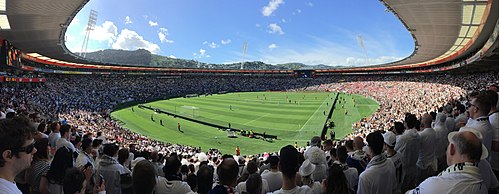
The main supporter group of the New Zealand national team are known as the White Noise. White Noise was formed in November 2007 with the supporters group of the Wellington Phoenix, 'Yellow Fever', rebranding themselves when the national sides play. Additionally, The Flying Kiwis FC founded by Matt Fejos, have been New Zealand's main supporter group for away fixtures. The Flying Kiwis have been synonymous with organizing fan friendly matches with supporters of opposing teams, most notably during the 2017 FIFA Confederations Cup where they organized a friendly match between supporters of the Russian national team.
Home stadium
New Zealand does not have a dedicated national stadium. Instead, the team plays at different venues throughout the country for exhibition or tournament purposes. In recent years, major international matches have usually been rotated around various large grounds, including the Wellington Regional Stadium and the North Harbour Stadium in Auckland. International matches have also been played at the Mount Smart Stadium and Eden Park in Auckland.
Results and fixtures
The following is a list of match results in the last 12 months, as well as any future matches that have been scheduled.
Win Draw Loss Fixture
2025
| 21 March 2026 FIFA World Cup qualification | New Zealand | 7–0 | Fiji | Wellington, New Zealand |
| 19:00 UTC+13 | Wood 6', 56', 60' Singh 16' Bindon 23' Payne 32' Barbarouses 73' | Stadium: Sky Stadium Attendance: 20,947 Referee: Norbert Hauata (Tahiti) |
| 24 March 2026 FIFA World Cup qualification | New Caledonia | 0–3 | New Zealand | Auckland, New Zealand |
| 19:00 UTC+13 | Boxall 61' Barbarouses 66' Just 80' | Stadium: Eden Park Attendance: 25,132 Referee: Ben Aukwai (Solomon Islands) |
| 7 June Canadian Shield | Ivory Coast | 0–1 | New Zealand | Toronto, Canada |
| 19:00 UTC-4 | Just 41' | Stadium: BMO Field Attendance: 26,345 Referee: Pierre-Luc Lauziere (Canada) |
| 10 June Canadian Shield | New Zealand | 1–2 | Ukraine | Toronto, Canada |
| 17:00 UTC-4 | Stamenic 59' | Hutsulyak 54' Zinchenko 75' | Stadium: BMO Field Attendance: 18,489 Referee: Carly Shaw-Maclaren (Canada) |
| 5 September Soccer Ashes | Australia | 1–0 | New Zealand | Canberra, Australia |
| 19:45 UTC+10 | Balard 87' | Stadium: GIO Stadium Attendance: 19,115 Referee: Donald Robertson (Scotland) |
| 9 September Soccer Ashes | New Zealand | 1–3 | Australia | Auckland, New Zealand |
| 19:00 UTC+12 | Wood 57' | Toure 35', 60' Irankunda 54' | Stadium: Mount Smart Stadium Attendance: 18, 213 |
| 9 October Friendly | Poland | 1–0 | New Zealand | Chorzów, Poland |
| 20:45 CEST (UTC+2) | Zieliński 49' | Stadium: Stadion Śląski Attendance: 30,412 Referee: Erik Lambrechts (Belgium) |
| 14 October Friendly | Norway | 1–1 | New Zealand | Oslo, Norway |
| 18:00 UTC+2 | Nusa 63' | Surman 45+1' | Stadium: Ullevaal Stadion Attendance: 17,652 Referee: Horațiu Feșnic (Romania) |
| 15 November Friendly | Colombia | 2–1 | New Zealand | Fort Lauderdale, United States |
| 19:00 UTC−5 | Puerta 3' Carbonero 88' | Old 80' | Stadium: Chase Stadium Referee: Cristian Condori (Bolivia) |
| 18 November Friendly | Ecuador | 2–0 | New Zealand | Harrison, United States |
| 20:30 UTC−5 | Angulo 50' Campana 83' | Stadium: Sports Illustrated Stadium |
2026
| 27 March 2026 FIFA Series | New Zealand | 0–2 | Finland | Auckland, New Zealand |
| 19:15 UTC+13 | Pohjanpalo 25' Oksanen 85' | Stadium: Eden Park Attendance: 17,603 Referee: Casey Reibelt (Australia) |
| 30 March 2026 FIFA Series | New Zealand | 4–1 | Chile | Auckland, New Zealand |
| 19:00 UTC+13 | Barbarouses 31' Just 40' Randall 60' Waine 71' | Osorio 23' 27' Tapia 83' | Stadium: Eden Park Attendance: 14,327 Referee: Jack Morgan (Australia) |
| 7 June Friendly | England | v | New Zealand | Tampa, United States |
| 18:00 UTC−7 | Stadium: Raymond James Stadium |
| 15 June 2026 FIFA World Cup Group G | Iran | v | New Zealand | Inglewood, United States |
| 18:00 UTC−7 | Stadium: SoFi Stadium |
| 21 June 2026 FIFA World Cup Group G | New Zealand | v | Egypt | Vancouver, Canada |
| 18:00 UTC−7 | Stadium: BC Place |
| 26 June 2026 FIFA World Cup Group G | New Zealand | v | Belgium | Vancouver, Canada |
| 20:00 UTC−7 | Stadium: BC Place |
Coaching staff
| Position | Name |
|---|---|
| Technical director | New Zealand Andrew Boyens |
| Head coach | England Darren Bazeley |
| Assistant coach | New Zealand Simon Elliott |
| New Zealand Glen Moss | |
| England Tony Readings | |
| Goalkeeping coach | Scotland Jonathan Gould |
| Performance manager | New Zealand Ryan Nelsen |
| Team manager | New Zealand Simon Hilton |
| Sports scientist | South Africa Sunz Singh |
| Doctor | Scotland Chan Dassanayake |
| Physiotherapist | New Zealand Roland Jeffery |
| New Zealand Adam Crump |
Players
For all past and present players who have appeared for the national team, see New Zealand men's national team players.
Current squad
The following players were called up to the squad for the 2026 FIFA Series matches against Finland and Chile on 27 and 30 March 2026, respectively. Caps and goals updated as of 30 March 2026 after the match against Chile.
Recent call-ups
The following players have been called up within the last 12 months and remain eligible for selection.
| Pos. | Player | Date of birth (age) | Caps | Goals | Club | Latest call-up |
|---|---|---|---|---|---|---|
| GK | Nik Tzanev | (1996-12-23)23 December 1996(age 29) | 2 | 0 | The Football Association Huddersfield Town | v. Ecuador, 18 November 2025 |
| GK | Kees Sims | (2003-03-27)27 March 2003(age 23) | 0 | 0 | Swedish Football Association GAIS | v. Ecuador, 18 November 2025 |
| GK | Oliver Sail | (1996-01-13)13 January 1996(age 30) | 9 | 0 | New Zealand Football Auckland FC | v. Australia, 9 September 2025 |
| GK | Henry Gray | (2005-03-28)28 March 2005(age 21) | 0 | 0 | The Football Association Harrogate Town | v. Australia, 9 September 2025 |
| DF | Michael Boxall INJ | (1988-08-18)18 August 1988(age 37) | 61 | 1 | United States Soccer Federation Minnesota United | v. Ecuador, 18 November 2025 |
| DF | Tommy Smith | (1990-03-31)31 March 1990(age 36) | 56 | 2 | The Football Association Braintree Town | v. Ecuador, 18 November 2025 |
| DF | Storm Roux | (1993-01-13)13 January 1993(age 33) | 18 | 0 | Football Australia Central Coast Mariners | v. Ecuador, 18 November 2025 |
| DF | George Stanger | (2000-08-15)15 August 2000(age 25) | 0 | 0 | Scottish Football Association Kilmarnock | v. Ecuador, 18 November 2025 |
| DF | Liberato Cacace INJ | (2000-09-27)27 September 2000(age 25) | 35 | 1 | Football Association of Wales Wrexham | v. Norway, 14 October 2025 |
| DF | Lukas Kelly-Heald | (2005-03-18)18 March 2005(age 21) | 5 | 0 | New Zealand Football Wellington Phoenix | v. Norway, 14 October 2025 |
| DF | Dalton Wilkins | (1999-04-15)15 April 1999(age 27) | 3 | 0 | Danish Football Association Sønderjyske | v. Poland, 9 October 2025 INJ |
| DF | Nando Pijnaker INJ | (1999-02-25)25 February 1999(age 27) | 23 | 0 | New Zealand Football Auckland FC | v. Ukraine, 10 June 2025 |
| MF | Matthew Garbett INJ | (2002-04-13)13 April 2002(age 24) | 35 | 5 | The Football Association Peterborough United | v. Ecuador, 18 November 2025 |
| MF | Sarpreet Singh INJ | (1999-02-20)20 February 1999(age 27) | 26 | 3 | New Zealand Football Wellington Phoenix | v. Ecuador, 18 November 2025 |
| MF | Owen Parker-Price | (1998-12-10)10 December 1998(age 27) | 3 | 0 | Swedish Football Association Örgryte | v. Ecuador, 18 November 2025 |
| FW | Chris Wood (captain) | (1991-12-07)7 December 1991(age 34) | 88 | 45 | The Football Association Nottingham Forest | v. Norway, 14 October 2025 INJ |
| FW | Luke Brooke-Smith | (2008-06-08)8 June 2008(age 17) | 1 | 0 | New Zealand Football Wellington Phoenix | v. Australia, 9 September 2025 |
| INJ Withdrew due to injury / absent from the national team due to injury PRE Preliminary squad / standby RET Retired from the national team SUS Serving suspension WD Player withdrew from the squad due to non-injury issue. |
Individual records
As of 30 March 2026
Players in bold are still active with New Zealand.
Most appearances
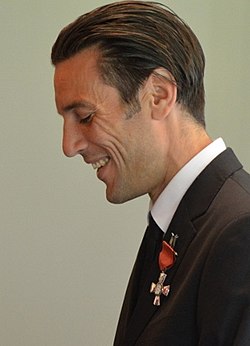
| Rank | Player | Caps | Goals | Career |
|---|---|---|---|---|
| 1 | Ivan Vicelich | 88 | 6 | 1995–2013 |
| Chris Wood | 88 | 45 | 2009–present | |
| 3 | Kosta Barbarouses | 74 | 10 | 2008–present |
| 4 | Simon Elliott | 69 | 6 | 1995–2011 |
| 5 | Vaughan Coveny | 64 | 29 | 1992–2006 |
| 6 | Ricki Herbert | 61 | 7 | 1980–1989 |
| Michael Boxall | 61 | 1 | 2011–present | |
| 8 | Chris Jackson | 60 | 10 | 1992–2003 |
| 9 | Brian Turner | 59 | 21 | 1967–1982 |
| 10 | Duncan Cole | 58 | 4 | 1978–1988 |
| Steve Sumner | 58 | 22 | 1976–1988 |
Top goalscorers

| Rank | Player | Goals | Caps | Ratio | Career |
|---|---|---|---|---|---|
| 1 | Chris Wood (list) | 45 | 88 | 0.51 | 2009–present |
| 2 | Vaughan Coveny | 29 | 64 | 0.45 | 1992–2006 |
| 3 | Shane Smeltz | 24 | 57 | 0.42 | 2003–2017 |
| 4 | Steve Sumner | 22 | 58 | 0.38 | 1976–1988 |
| 5 | Brian Turner | 21 | 59 | 0.36 | 1967–1982 |
| 6 | Jock Newall | 17 | 10 | 1.7 | 1951–1952 |
| 7 | Keith Nelson | 16 | 20 | 0.8 | 1977–1983 |
| Chris Killen | 16 | 48 | 0.33 | 2000–2013 | |
| 9 | Grant Turner | 15 | 42 | 0.36 | 1980–1988 |
| 10 | Wynton Rufer | 12 | 23 | 0.52 | 1980–1997 |
| Darren McClennan | 12 | 43 | 0.28 | 1986–1997 | |
| Michael McGarry | 12 | 54 | 0.22 | 1986–1997 |
Most clean sheets
| Rank | Name | Clean sheets | Caps | Ratio | Career |
|---|---|---|---|---|---|
| 1 | Jason Batty | 16 | 55 | 0.29 | 1994–2003 |
| 2 | Stefan Marinovic | 14 | 30 | 0.47 | 2015–2023 |
| 3 | Mark Paston | 13 | 36 | 0.36 | 1997–2013 |
| 4 | Richard Wilson | 10 | 26 | 0.38 | 1979–1984 |
| 5 | Glen Moss | 8 | 29 | 0.28 | 2006–2017 |
| 6 | Max Crocombe | 7 | 17 | 0.46 | 2018–present |
Centuriate goals
| Rank | Date | Scorer | Opponent | Score |
|---|---|---|---|---|
| 1st | 17 June 1922 | Ted Cook | Australia | 3–1 |
| 100th | 7 September 1958 | unknown | New Caledonia | 5–1 |
| 200th | 20 March 1977 | Keith Nelson | Taiwan | 6–0 |
| 300th | 14 December 1981 | Wynton Rufer | Kuwait | 2–2 |
| 400th | 11 December 1988 | Danny Halligan | Chinese Taipei | 4–0 |
| 500th | 11 June 2001 | Chris Jackson | Solomon Islands | 5–1 |
| 600th | 4 June 2010 | Rory Fallon | Slovenia | 1–3 |
| 700th | 30 March 2022 | Chris Wood | Solomon Islands | 5–0 |
Competitive record
All-time record
For the all-time record of the national team against opposing nations, see the team's all-time record page.
As of 30 March 2026 vs Chile
| Pld | W | D | L | GF | GA | GD |
|---|---|---|---|---|---|---|
| 434 | 180 | 77 | 177 | 765 | 640 | +125 |
FIFA World Cup
| FIFA World Cup record | Qualification record | ||||||||||||||||
|---|---|---|---|---|---|---|---|---|---|---|---|---|---|---|---|---|---|
| Year | Host | Round | Pos | Pld | W | D | L | GF | GA | Squad | Outcome | Pld | W | D | L | GF | GA |
| 1930 to 1938 | Not member of FIFA | Not member of FIFA | |||||||||||||||
| 1950 to 1966 | Did not enter | Did not enter | |||||||||||||||
| 1970 | Mexico | Did not qualify | 2nd round | 2 | 0 | 0 | 2 | 0 | 6 | ||||||||
| 1974 | West Germany | 1st round | 6 | 0 | 3 | 3 | 5 | 12 | |||||||||
| 1978 | Argentina | 1st round | 4 | 2 | 1 | 1 | 14 | 4 | |||||||||
| 1982 | Spain | Group stage | 23rd | 3 | 0 | 0 | 3 | 2 | 12 | Squad | Qualified | 15 | 9 | 5 | 1 | 44 | 10 |
| 1986 | Mexico | Did not qualify | 3rd | 6 | 3 | 1 | 2 | 13 | 7 | ||||||||
| 1990 | Italy | 3rd | 6 | 3 | 1 | 2 | 13 | 8 | |||||||||
| 1994 | United States | 2nd round | 6 | 3 | 1 | 2 | 15 | 5 | |||||||||
| 1998 | France | 3rd round | 6 | 3 | 0 | 3 | 13 | 6 | |||||||||
| 2002 | South Korea Japan | 2nd round | 6 | 4 | 0 | 2 | 20 | 7 | |||||||||
| 2006 | Germany | 3rd | 5 | 3 | 0 | 2 | 17 | 5 | |||||||||
| 2010 | South Africa | Group stage | 22nd | 3 | 0 | 3 | 0 | 2 | 2 | Squad | Qualified | 8 | 6 | 1 | 1 | 15 | 5 |
| 2014 | Brazil | Did not qualify | Play-off | 13 | 9 | 1 | 3 | 28 | 18 | ||||||||
| 2018 | Russia | Play-off | 13 | 8 | 4 | 1 | 24 | 6 | |||||||||
| 2022 | Qatar | Play-off | 6 | 5 | 0 | 1 | 18 | 2 | |||||||||
| 2026 | Canada Mexico United States | Qualified | Qualified | 5 | 5 | 0 | 0 | 29 | 1 | ||||||||
| 2030 | Morocco Portugal Spain | To be determined | To be determined | ||||||||||||||
| 2034 | Saudi Arabia | ||||||||||||||||
| Total | Group stage | 3/23 | 6 | 0 | 3 | 3 | 4 | 14 | 107 | 63 | 18 | 26 | 268 | 102 |
| New Zealand's FIFA World Cup history | |
|---|---|
| First match | Scotland 5–2 New Zealand (Málaga, Spain; 15 June 1982) |
| Biggest win | None |
| Biggest defeat | Brazil 4–0 New Zealand (Seville, Spain; 23 June 1982) |
| Best result | Group stage in 1982, 2010 |
| Worst result |
OFC Nations Cup
| New Zealand's OFC Nations Cup record | ||||||||||
|---|---|---|---|---|---|---|---|---|---|---|
| Year | Hosts | Round | Position | Pld | W | D | L | GF | GA | Squad |
| 1973 | New Zealand | Champions | 1st | 5 | 4 | 1 | 0 | 13 | 4 | Squad |
| 1980 | New Caledonia | Group stage | 5th | 3 | 1 | 0 | 2 | 7 | 8 | —N/a |
| 1996 | Multiple | Semi-finals | 3rd | 2 | 0 | 1 | 1 | 0 | 3 | Squad |
| 1998 | Australia | Champions | 1st | 4 | 4 | 0 | 0 | 11 | 1 | Squad |
| 2000 | Tahiti | Runners-up | 2nd | 4 | 3 | 0 | 1 | 7 | 3 | Squad |
| 2002 | New Zealand | Champions | 1st | 5 | 5 | 0 | 0 | 23 | 2 | Squad |
| 2004 | Australia | Third place | 3rd | 5 | 3 | 0 | 2 | 17 | 5 | Squad |
| 2008 | Multiple | Champions | 1st | 6 | 5 | 0 | 1 | 14 | 5 | Squad |
| 2012 | Solomon Islands | Third place | 3rd | 5 | 3 | 1 | 1 | 8 | 7 | Squad |
| 2016 | Papua New Guinea | Champions | 1st | 5 | 4 | 1 | 0 | 10 | 1 | Squad |
| 2024 | Vanuatu, Fiji | Champions | 1st | 4 | 4 | 0 | 0 | 15 | 0 | Squad |
| Total | 6 titles | 11/11 | 48 | 36 | 4 | 8 | 125 | 39 | ||
| Champions Runners-up Third place | ||||||||||
| Champions Runners-up Third place | ||||||||||
| New Zealand's OFC Nations Cup history | |
|---|---|
| First match | New Zealand 5–1 Fiji (Auckland, New Zealand; 17 February 1973) |
| Biggest win | New Zealand 10–0 Tahiti (Adelaide, Australia; 4 June 2004) |
| Biggest defeat | Fiji 4–0 New Zealand (Nouméa, New Caledonia; 27 February 1980) |
| Best result | Champions in 1973, 1998, 2002, 2008, 2016, 2024 |
| Worst result | Group stage in 1980 |
FIFA Confederations Cup
| FIFA Confederations Cup record | |||||||||
|---|---|---|---|---|---|---|---|---|---|
| Year | Host | Round | Pld | W | D* | L | GF | GA | Squad |
| 1992 | Saudi Arabia | No OFC representative invited | |||||||
| 1995 | Saudi Arabia | ||||||||
| 1997 | Saudi Arabia | Did not qualify | |||||||
| 1999 | Mexico | Group stage | 3 | 0 | 0 | 3 | 1 | 6 | Squad |
| 2001 | South Korea Japan | Did not qualify | |||||||
| 2003 | France | Group stage | 3 | 0 | 0 | 3 | 1 | 11 | Squad |
| 2005 | Germany | Did not qualify | |||||||
| 2009 | South Africa | Group stage | 3 | 0 | 1 | 2 | 0 | 7 | Squad |
| 2013 | Brazil | Did not qualify | |||||||
| 2017 | Russia | Group stage | 3 | 0 | 0 | 3 | 1 | 8 | Squad |
| Total | Group stage | 12 | 0 | 1 | 11 | 3 | 32 | — |
Summer Olympics
| Summer Olympic Games record | Qualification record | |||||||||||||
|---|---|---|---|---|---|---|---|---|---|---|---|---|---|---|
| Year | Host | Round | Pld | W | D | L | GF | GA | Pld | W | D | L | GF | GA |
| 1908 to 1980 | Did not enter | Did not enter | ||||||||||||
| 1984 | United States | Did not qualify | 8 | 3 | 1 | 4 | 8 | 10 | ||||||
| 1988 | South Korea | 8 | 4 | 1 | 3 | 24 | 7 | |||||||
| 1992–present | See New Zealand national under-23 team | |||||||||||||
| Total | Did not qualify to the tournament | 16 | 7 | 2 | 7 | 32 | 17 |
Minor tournaments
| Year | Position | GP | W | D | L | GF | GA |
|---|---|---|---|---|---|---|---|
| New Zealand 1922 Soccer Ashes | 1st | 3 | 2 | 1 | 0 | 7 | 3 |
| Australia 1923 Soccer Ashes | 1st | 3 | 2 | 0 | 1 | 8 | 5 |
| Australia 1933 Soccer Ashes | 2nd | 3 | 0 | 0 | 3 | 8 | 14 |
| New Zealand 1936 Soccer Ashes | 2nd | 3 | 0 | 0 | 3 | 2 | 21 |
| New Zealand 1948 Soccer Ashes | 2nd | 4 | 0 | 0 | 4 | 0 | 17 |
| Australia 1954 Soccer Ashes | 2nd | 3 | 1 | 0 | 2 | 4 | 9 |
| South Vietnam 1967 South Vietnam Independence Cup | 6th | 3 | 1 | 0 | 2 | 7 | 11 |
| South Korea 1976 President's Cup | 4th | 6 | 3 | 1 | 2 | 6 | 4 |
| Malaysia 1980 Merdeka Tournament | 5th | 7 | 2 | 3 | 2 | 9 | 9 |
| Malaysia 1981 Merdeka Tournament | 5th | 5 | 2 | 2 | 1 | 2 | 1 |
| New Zealand Australia 1983 Trans-Tasman Cup | 1st | 2 | 2 | 0 | 0 | 4 | 1 |
| South Korea 1983 President's Cup | 9th | 4 | 1 | 1 | 2 | 3 | 6 |
| New Zealand Australia 1986 Trans-Tasman Cup | 2nd | 2 | 0 | 1 | 1 | 2 | 3 |
| Australia New Zealand 1987 Trans-Tasman Cup | 1st | 2 | 1 | 1 | 0 | 2 | 1 |
| New Zealand Australia 1988 Trans-Tasman Cup | 2nd | 2 | 0 | 0 | 2 | 1 | 4 |
| New Zealand Australia 1991 Trans-Tasman Cup | 2nd | 2 | 0 | 0 | 2 | 1 | 3 |
| Chile Copa Centenario del Fútbol Chileno | 4th | 3 | 0 | 0 | 3 | 4 | 8 |
| New Zealand Australia 1995 Trans-Tasman Cup | 2nd | 2 | 0 | 1 | 1 | 0 | 3 |
| Australia 1997 Four Nations Tournament | 4th | 3 | 0 | 0 | 3 | 1 | 7 |
| Thailand 1999 Four Nations' Cup | 4th | 2 | 0 | 2 | 0 | 2 | 2 |
| China 2000 Four Nations Tournament | 4th | 2 | 0 | 0 | 2 | 1 | 3 |
| Malaysia 2000 Merdeka Tournament | 1st | 4 | 3 | 1 | 0 | 6 | 0 |
| Iran 2003 AFC–OFC Challenge Cup | 2nd | 1 | 0 | 0 | 1 | 0 | 3 |
| Saudi Arabia 2013 OSN Cup | 2nd | 2 | 1 | 0 | 1 | 1 | 2 |
| Japan 2014 Kirin Challenge Cup | 1 | 0 | 0 | 1 | 2 | 4 | |
| Japan 2017 Kirin Challenge Cup | 1 | 0 | 0 | 1 | 1 | 2 | |
| India 2018 Intercontinental Cup | 3rd | 3 | 2 | 0 | 1 | 4 | 3 |
| England 2023 Soccer Ashes | 2nd | 1 | 0 | 0 | 1 | 0 | 2 |
| Egypt 2024 ACUD Cup | 4th | 2 | 0 | 1 | 1 | 0 | 1 |
| Canada 2025 Canadian Shield | 2nd | 2 | 1 | 0 | 1 | 2 | 2 |
| Australia New Zealand 2025 Soccer Ashes | 2nd | 2 | 0 | 0 | 2 | 1 | 4 |
| New Zealand 2026 FIFA Series | 2nd | 2 | 1 | 0 | 1 | 4 | 3 |
| Total | 5 titles | 85 | 25 | 14 | 47 | 95 | 149 |
FIFA Rankings
Honours
Intercontinental
- AFC–OFC Challenge Cup Runners-up (1): 2003
Continental
- OFC Nations Cup Champions (6): 1973, 1998, 2002, 2008, 2016, 2024 Runners-up (1): 2000 Third place (2): 2004, 2012
Friendly
- Soccer Ashes (2): 1922, 1923
- Trans-Tasman Cup (2): 1983, 1987
- Merdeka Tournament (1): 2000
Awards
- FIFA Confederations Cup Fair Play Award (1): 1999
- OFC Nations Cup Fair Play Award (1): 2024
Summary
| Competition | Total | |||
|---|---|---|---|---|
| OFC Nations Cup | 6 | 1 | 2 | 9 |
| AFC–OFC Challenge Cup | 0 | 1 | 0 | 1 |
| Total | 6 | 2 | 2 | 10 |
See also
- New Zealand women's national football team
- Association football in New Zealand
- Trans-Tasman Cup
- New Zealand national futsal team
- New Zealand women's national futsal team