Cytinus
In-game article clicks load inline without leaving the challenge.
Cytinus is a genus of parasitic flowering plants. Species in this genus do not produce chlorophyll, but rely fully on its host plant. Cytinus usually parasitizes Cistus and Halimium, two genera of plants in the family Cistaceae. It has also been found on Ptilostemon chamaepeuce.
Several species are found in the Mediterranean Region, South Africa, with a possibly undescribed species from Madagascar.
Biology
C. capensis and C. sanguineus are dioecious, while C. hypocistis is monoecious.
C. hypocistis has been shown to infect mainly Halimium halimifolium and Cistus monspeliensis in Portugal.
Systematics
The genus Cytinus was previously included in the parasitic family Rafflesiaceae, but is now put into the family Cytinaceae (order Malvales), together with the genus Bdallophytum with four species.
Uses
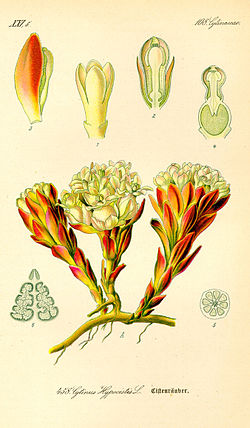
The young C. hypocistis is cooked as an asparagus substitute and an extract has been used in herbal medicine for dysentery, throat tumors and as an astringent. C. ruber is also edible and was used in folk medicine as an emmenagogue.
Species
| Image | Scientific name | Distribution |
|---|---|---|
| Cytinus baronii Baker f. | Madagascar. | |
| Cytinus capensis Marloth | South Africa | |
| Cytinus glandulosus Jum. | Madagascar. | |
| Cytinus hypocistis (L.) L. | Mediterranean from Morocco to southern France and Turkey | |
| Cytinus malagasicus Jum. & H.Perrier | Madagascar. | |
| Cytinus ruber (Fourr.) Fritsch | Mediterranean | |
| Cytinus sanguineus (Thunb.) Fourc. | South Africa | |
| Cytinus visseri Burgoyne | South Africa |
Footnotes
- Govaerts, R. & Nickrent, D.L. (2010): 658. Cytinus ruber Cytinaceae. Bot. Mag. 26(4): 314–321.
- Nickrent, Daniel L; Blarer, Albert; Qiu, Yin-Long; Vidal-Russell, Romina; Anderson, Frank E (2004). . BMC Evolutionary Biology. 4 (1): 40. doi:. PMC . PMID .
- Sanjust, Enrico; Rinaldi, Andrea C. (2021). . Plants. 10 (1): 146. doi:. PMC . PMID .
- Thorogood, C. J.; Hiscock, S. J. (2007). . Research Letters in Ecology. 2007: 1–4. doi:.
Further reading
- Burgoyne, P.M. (2006): A new species of Cytinus (Cytinaceae) from South Africa and Swaziland, with a key to the Southern African species. Novon 16(3): 315–319. 2012-03-14 at the Wayback Machine