Der Hohenfriedberger
In-game article clicks load inline without leaving the challenge.
"Der Hohenfriedberger" (AM I, 21 (Army March I, 1c and Army March III, 1b) (also "(Der) Hohenfriedberger Marsch"), is a well known German military march. It takes its name from the victory of the Prussians over the allied armies of the Archduchy of Austria and the Electorate of Saxony on 4 June 1745 during the Second Silesian War at the Battle of Hohenfriedberg, near Striegau (current day Strzegom in Poland).
History
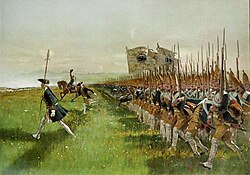
There are many legends surrounding the origins of the march. Supposedly, the Bayreuth dragoon regiment, which was crucial in securing a Prussian victory, reported to its quarters the day after the battle while the march was played. Whether the march was actually played then is just as questionable as the claim that Frederick the Great was the composer of the piece. It is understood that the king issued to the Bayreuther dragoon regiment a Gnadenbrief (letter of grace) that authorized it to play both grenadier marches of the foot soldiers (with flutes and drums) and the cuirassier marches of the cavalry (with kettledrums and trumpet fanfare).
The lyrics were certainly composed later; at the time of the victory of Hohenfriedberg, these Dragoons did not yet bear the title "Ansbach-Bayreuth".
The first outline (piano rendition) was written in 1795. For the first time in 1845, in celebration of the hundredth anniversary of the battle, the march was given lyrics, "Auf, Ansbach-Dragoner! Auf, Ansbach-Bayreuth!" because the regiment by then had been renamed "Ansbach-Bayreuth". In the time of the German Empire the title "Hohenfriedberger" was symbolic because of its connection with the great military victories of Frederick and the House of Hohenzollern.
In commemoration of the victories of Frederick against the Austrians, Johann Gottfried Piefke added "Der Hohenfriedberger" as a trio to his "Königgrätzer Marsch" written after the victorious Battle of Königgrätz in 1866.
The march was formerly in use by the Life Guards Horse Artillery of the Russian Imperial Guard, under the name of "The Double Headed Eagle Soars High".
Music

1845 lyrics

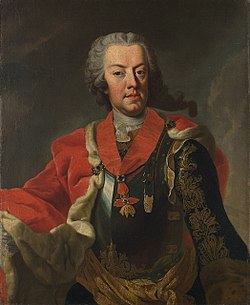
Auf, Ansbach-Dragoner! Auf, Ansbach-Bayreuth! Schnall um deinen Säbel und rüste dich zum Streit! Prinz Karl ist erschienen auf Friedbergs Höh'n, Sich das preußische Heer mal anzusehen. —Refrain: —𝄆 Drum, Kinder, seid lustig —und allesamt bereit: —Auf, Ansbach-Dragoner! —Auf, Ansbach-Bayreuth! 𝄇 Hab'n Sie keine Angst, Herr Oberst von Schwerin, Ein preuß'scher Dragoner tut niemals nicht flieh'n! Und stünd'n sie auch noch so dicht auf Friedbergs Höh'n, Wir reiten sie zusammen wie Frühlingsschnee. —Refrain: —Ob Säbel, ob Kanon', —ob Kleingewehr uns dräut: —Auf, Ansbach-Dragoner! —Auf, Ansbach-Bayreuth! —Drum, Kinder, seid lustig —und allesamt bereit: —Auf, Ansbach-Dragoner! —Auf, Ansbach-Bayreuth! Halt, Ansbach-Dragoner! Halt, Ansbach-Bayreuth! Wisch ab deinen Säbel und laß vom Streit; Denn ringsumher auf Friedbergs Höh'n Ist weit und breit kein Feind mehr zu seh'n. —Refrain: —Und ruft unser König, —zur Stelle sind wir heut': —Auf, Ansbach-Dragoner! —Auf, Ansbach-Bayreuth! —Drum, Kinder, seid lustig —und allesamt bereit: —Auf, Ansbach-Dragoner! —Auf, Ansbach-Bayreuth!
Up, Ansbach-Dragoons! Up, Ansbach-Bayreuth! Buckle on your sabre and brace yourself for battle! Prince Charles has appeared on Friedberg's heights himself to look at the Prussian Army. —Refrain: —𝄆 So, boys, be jolly —and all ready to go. —Up, Ansbach Dragoons! —Up, Ansbach-Bayreuth! 𝄇 Have no worries, Colonel von Schwerin, A Prussian Dragoon does not flee, never! And they also still stand so close together on Friedberg's height, We could ride them down like spring snow. —Refrain —Whether sabre, whether cannon, —whether musket, threaten us: —Up, Ansbach Dragoons! —Up, Ansbach-Bayreuth! —So, boys, be jolly —and all ready to go: —Up, Ansbach Dragoons! —Up, Ansbach-Bayreuth! Halt, Ansbach Dragoons! Halt, Ansbach-Bayreuth! Wipe your saber and leave the battle; For all around on Friedberg's heights Is far and wide seen no more of our Enemy —Refrain: —And calls our King, —to the place we are today: —Up, Ansbach Dragoons! —Up, Ansbach-Bayreuth! —So, boys, be jolly —and all ready to go: —To the Ansbach Dragoons! —To Ansbach-Bayreuth!