House of Hohenzollern
In-game article clicks load inline without leaving the challenge.
The House of Hohenzollern (/ˌhoʊənˈzɒlərn/, US also/-nˈzɔːl-,-ntˈsɔːl-/; German: Haus Hohenzollern, pronounced [ˌhaʊshoːənˈtsɔlɐn] ⓘ; Romanian: Casa de Hohenzollern) is a formerly royal (and from 1871 to 1918, imperial) German dynasty whose members were variously princes, electors, kings and emperors of Hohenzollern, Brandenburg, Prussia, the German Empire, and Romania. The family came from the area around the town of Hechingen in Swabia during the late 11th century and took their name from Hohenzollern Castle. The first ancestors of the Hohenzollerns were mentioned in 1061.
The Hohenzollern family split into two branches, the Catholic Swabian branch and the Protestant Franconian branch, which ruled the Burgraviate of Nuremberg and later became the Brandenburg–Prussian branch. The Swabian branch ruled the principalities of Hohenzollern-Hechingen and Hohenzollern-Sigmaringen until 1849, and also ruled Romania from 1866 to 1947. Members of the Franconian branch became Margrave of Brandenburg in 1415 and Duke of Prussia in 1525.
The Margraviate of Brandenburg and the Duchy of Prussia were ruled in personal union after 1618 and were called Brandenburg-Prussia. From there, the Kingdom of Prussia was created in 1701, eventually leading to the unification of Germany and the creation of the German Empire in 1871, with the Hohenzollerns as hereditary German Emperors and Kings of Prussia.
Germany's defeat in World War I in 1918 led to the German Revolution. The Hohenzollerns were overthrown and the Weimar Republic was established, thus bringing an end to the German and Prussian monarchy. Georg Friedrich, Prince of Prussia, is the current head of the formerly royal Prussian line; while Karl Friedrich, Prince of Hohenzollern, is the head of the formerly princely Swabian line.
County of Zollern


Zollern, from 1218 Hohenzollern, was a county of the Holy Roman Empire. Later its capital was Hechingen.
The Hohenzollerns named their estates after Hohenzollern Castle in the Swabian Alps. The Hohenzollern Castle lies on an 855 meters high mountain called Hohenzollern. It still belongs to the family today.
The dynasty was first mentioned in 1061. According to the medieval chronicler Berthold of Reichenau, Burkhard I, Count of Zollern (de Zolorin) was born before 1025 and died in 1061.
In 1095, Count Adalbert of Zollern founded the Benedictine monastery of Alpirsbach, situated in the Black Forest.
The Zollerns received the Graf title from Emperor Henry V in 1111.
As loyal vassals of the Swabian Hohenstaufen dynasty, they were able to significantly enlarge their territory. Count Frederick III (c.1139 – c.1200) accompanied Emperor Frederick Barbarossa against Henry the Lion in 1180, and through his marriage was granted the Burgraviate of Nuremberg by Emperor Henry VI in 1192. In about 1185, he married Sophia of Raabs, the daughter of Conrad II, Burgrave of Nuremberg. After the death of Conrad II who left no male heirs, Frederick III was granted Nuremberg as Burgrave Frederick I.
In 1218, the burgraviate passed to Frederick's elder son Conrad I; he thereby became the ancestor of the Franconian Hohenzollern branch, which acquired the Electorate of Brandenburg in 1415.
Franconian branch
The senior Franconian branch of the House of Hohenzollern was founded by Conrad I, Burgrave of Nuremberg (1186–1261).
The family supported the Hohenstaufen and Habsburg rulers of the Holy Roman Empire during the 12th to 15th centuries, being rewarded with several territorial grants. Beginning in the 16th century, this branch of the family became Protestant and decided on expansion through marriage and the purchase of surrounding lands.
In the first phase, the family gradually added to their lands, at first with many small acquisitions in the Franconian region of Germany:
In the second phase, the family expanded their lands further with large acquisitions in the Brandenburg and Prussian regions of Germany and present-day Poland:
- Margraviate of Brandenburg in 1417
- Duchy of Prussia in 1525
These acquisitions eventually transformed the Franconian Hohenzollerns from a minor German princely family into one of the most important dynasties in Europe.
From 8 January 1701 the title of Elector of Brandenburg was attached to the title of King in Prussia and, from 13 September 1772, to that of King of Prussia.
Burgraviate of Nuremberg (1192–1427) and the Principalities of Ansbach (1398–1791) and Kulmbach/Bayreuth (1398–1791)
As a burgraviate, Nuremberg was located in the namesake town; almost two centuries later, the burgraviate lost power over the city, which became independent from 1219. The burgraviate was eventually partitioned into Ansbach and Bayreuth. In 1427 Frederick, Elector of Brandenburg sold Nuremberg Castle and his rights as burgrave to the Imperial City of Nuremberg. The territories of Brandenburg-Ansbach and Brandenburg-Kulmbach remained possessions of the family, once parts of the Burgraviate of Nuremberg.
- Nuremberg Castle (the Emperor's castle, left, and the Burgrave's castle, right)
- Cadolzburg Castle near Nuremberg (from 1260 seat of the Burgraves)
- Heilsbronn Abbey, which the Hohenzollerns used as the family burial place
- Region of Nuremberg, Ansbach, Kulmbach and Bayreuth (Franconia)
- Coat of arms of Brandenburg-Kulmbach and Bayreuth


Dukes of Jägerndorf (1523–1622)
The Duchy of Jägerndorf (Krnov) was purchased in 1523, and was confiscated by Emperor Ferdinand III in 1622.
Margraviate of Brandenburg (1415–1619)
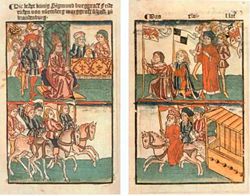
In 1411, Frederick VI, Burgrave of the small but wealthy Nuremberg, was appointed governor of Brandenburg in order to restore order and stability. At the Council of Constance in 1415, King Sigismund elevated Frederick to the rank of Elector and Margrave of Brandenburg as Frederick I. In 1417, Elector Frederick purchased Brandenburg from its then-sovereign, Emperor Sigismund, for 400,000 Hungarian guilders.
- Coat of arms of the Margraviate of Küstrin
- Coat of arms of the Margraviate of Schwedt
Margraviate of Küstrin (1535–1571)
The short-lived Margraviate of Brandenburg-Küstrin was set up as a secundogeniture of the House of Hohenzollern.
Margraviate of Schwedt (1688–1788)
Although recognized as a branch of the dynasty since 1688, the Margraviate of Brandenburg-Schwedt remained subordinate to the electors, and was never an independent principality.
Dukes of Prussia (1525–1701)
In 1525, the Duchy of Prussia was established as a fief of the King of Poland. Albert of Prussia was the last Grand Master of the Teutonic Knights and the first Duke of Prussia. He belonged to the Ansbach branch of the dynasty. The Duchy of Prussia adopted Protestantism as the official state religion.
From 1701, the title of Duke of Prussia was attached to the title of King in and of Prussia.
- Coat of arms of the Dukes of Prussia
- Growth of Brandenburg-Prussia, 1600–1795
Kings in Prussia (1701–1772) and Kingdom of Prussia (1772–1918)
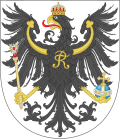
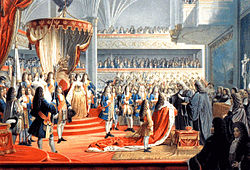
In 1701, the title of King in Prussia was granted, without the Duchy of Prussia being elevated to a Kingdom within Poland but recognized as a kingdom by the Holy Roman Emperor, theoretically the highest sovereign in the West. From 1701 onwards the titles of Duke of Prussia and Elector of Brandenburg were always attached to the title of King in Prussia. The Duke of Prussia adopted the title of king as Frederick I, establishing his status as a monarch whose royal territory lay outside the boundaries of the Holy Roman Empire, with the assent of Emperor Leopold I: Frederick could not be "King of Prussia" because part of Prussia's lands were under the suzerainty of the Crown of the Kingdom of Poland. In Brandenburg and the other Hohenzollern domains within the borders of the empire, he was legally still an elector under the ultimate overlordship of the emperor. By this time, however, the emperor's authority had become purely nominal over the other German princes outside the immediate hereditary lands of the emperor. Brandenburg was still legally part of the empire and ruled in personal union with Prussia, though the two states came to be treated as one de facto. The king was officially Margrave of Brandenburg within the Empire until the Empire's dissolution in 1806. In the age of absolutism, most monarchs were obsessed with the desire to emulate Louis XIV of France with his luxurious palace at Versailles.
In 1772, the Duchy of Prussia was elevated to a kingdom.

Frederick William's successor, Frederick the Great gained Silesia in the Silesian Wars so that Prussia emerged as a great power. The king was strongly influenced by French culture and civilization and preferred the French language.
In the 1772 First Partition of Poland, the Prussian king Frederick the Great annexed neighboring Royal Prussia, i.e., the Polish voivodeships of Pomerania (Gdańsk Pomerania or Pomerelia), Malbork, Chełmno and the Prince-Bishopric of Warmia, thereby connecting his Prussian and Farther Pomeranian lands and cutting off the rest of Poland from the Baltic coast. The territory of Warmia was incorporated into the lands of former Ducal Prussia, which, by administrative deed of 31 January 1772 were named East Prussia. The former Polish Pomerelian lands beyond the Vistula River together with Malbork and Chełmno Land formed the province of West Prussia with its capital at Marienwerder (Kwidzyn) in 1773. The Polish Partition Sejm ratified the cession on 30 September 1772, whereafter Frederick officially went on to call himself King "of" Prussia. From 1772 onwards the titles of Duke of Prussia and Elector of Brandenburg were always attached to the title King of Prussia.
In 1871, the Kingdom of Prussia became a constituent member of the German Empire, and the King of Prussia gained the additional title of German Emperor.
German Empire (1871–1918)


In 1871, the German Empire was proclaimed. With the accession of William I to the newly established imperial German throne, the titles of King of Prussia, Duke of Prussia and Elector of Brandenburg were always attached to the title of German Emperor.
Prussia's Minister President Otto von Bismarck convinced William that German Emperor instead of Emperor of Germany would be appropriate. He became primus inter pares among other German sovereigns.
William II intended to develop a German navy capable of challenging Britain's Royal Navy. The assassination of Archduke Franz Ferdinand of Austria on 28 June 1914 set off the chain of events that led to World War I. As a result of the war, the German, Russian, Austro-Hungarian and Ottoman empires ceased to exist.
The new Hohenzollern crypt (Hohenzollerngruft) in the new Berlin Cathedral was completed in 1905.
In 1918, the German empire was abolished and replaced by the Weimar Republic. After the outbreak of the German revolution in 1918, both Emperor William II and Crown Prince William signed the document of abdication.
- William I (1871–1888)
- Frederick III (1888)
- William II (1888–1918)
Prussian Hohenzollern religion and religious policy
The official religion of the state was "bi-confessional". John Sigismund's most significant action was his conversion from Lutheranism to Calvinism, after he had earlier equalized the rights of Catholics and Protestants in the Duchy of Prussia under pressure from the King of Poland. He was probably won over to Calvinism during a visit to Heidelberg in 1606, but it was not until 25 December 1613 that he publicly took communion according to the Calvinist rite. The vast majority of his subjects in Brandenburg, including his wife Anna of Prussia, remained deeply Lutheran, however. After the Elector and his Calvinist court officials drew up plans for mass conversion of the population to the new faith in February 1614, as provided for by the rule of Cuius regio, eius religio within the Holy Roman Empire, there were serious protests, with his wife backing the Lutherans. This was doubly important as Anna brought with her the duchy of Prussia into the Brandenburg line of the house and the nascent Brandenburg-Prussian state. Resistance was so strong that in 1615, John Sigismund backed down and relinquished all attempts at forcible conversion. Instead, he allowed his subjects to be either Lutheran or Calvinist according to the dictates of their own consciences. Henceforward, Brandenburg-Prussia would be a bi-confessional state, with the ruling Hohenzollern house staying Calvinist.
This situation persisted until Frederick William III of Prussia. Frederick William was determined to unify the Protestant churches to homogenize their liturgy, organization, and architecture. The long-term goal was to have fully centralized royal control of all the Protestant churches in the Prussian Union of Churches. The merging of the Lutheran and Calvinist (Reformed) confessions to form the United Church of Prussia was highly controversial. Angry responses included a large and well-organized opposition. The crown's aggressive efforts to restructure religion were unprecedented in Prussian history. In a series of proclamations over several years, the Church of the Prussian Union was formed, bringing together the majority group of Lutherans and the minority group of Reformed Protestants. The main effect was that the government of Prussia had full control over church affairs, with the king himself recognized as the leading bishop.
Succession tree of the Franconian House of Hohenzollern

Franconian/Brandenburg-Prussian branch since 1918 abdication


In June 1926, a referendum on expropriating the formerly ruling princes of Germany without compensation failed and as a consequence, the financial situation of the Hohenzollern family improved considerably. A settlement between the state and the family made Cecilienhof property of the state but granted a right of residence to Crown Prince Wilhelm and his wife Cecilie. The family also kept the ownership of Monbijou Palace in Berlin, Oleśnica Castle in Silesia, Rheinsberg Palace, Schwedt Palace and other property until 1945.
Since the abolition of the German monarchy, no Hohenzollern claims to imperial or royal prerogatives are recognized by Germany's Basic Law for the Federal Republic of Germany of 1949, which guarantees a republic.
The communist government of the Soviet occupation zone expropriated all landowners and industrialists; the House of Hohenzollern lost almost all of its fortune, retaining a few company shares and Hohenzollern Castle in West Germany. The Polish government appropriated the Silesian property and the Dutch government seized Huis Doorn, the Emperor's seat in exile.
After German reunification, however, the family was legally able to reclaim their portable property, namely art collections and parts of the interior of their former palaces. Negotiations on the return of or compensation for these assets are not yet completed.
The Berlin Palace, home of the German monarchs, was rebuilt in 2020. The Berlin Palace and the Humboldt Forum are located in the middle of Berlin.
Order of succession
| Name | Titular reign | Relation to predecessor |
|---|---|---|
| Wilhelm II | 1918–1941 | Succeeded himself as pretender to the throne. |
| Crown Prince Wilhelm | 1941–1951 | Son of |
| Louis Ferdinand, Prince of Prussia | 1951–1994 | Son of |
| Georg Friedrich, Prince of Prussia | since 1994 | Grandson of |
| Carl Friedrich, Prince of Prussia | (heir apparent) | Son of |
- Wilhelm II, the last incumbent of the throne
- Crown Prinz Wilhelm
- Louis Ferdinand
- Georg Friedrich
The head of the house is the titular King of Prussia and German Emperor. He also bears a historical claim to the title of Prince of Orange. Members of this line style themselves princes of Prussia.
Georg Friedrich, Prince of Prussia, the current head of the royal Prussian House of Hohenzollern, was married to Princess Sophie of Isenburg on 27 August 2011. On 20 January 2013, she gave birth to twin sons, Carl Friedrich Franz Alexander and Louis Ferdinand Christian Albrecht, in Bremen. Carl Friedrich, the elder of the two, is the heir apparent.
Living legitimate members of the Prussian branch
Bold signifies heads of the house and numbers shown indicate the pretense to the kingship of Prussia and the German Empire:
- William I (1797–1888) Frederick III (1831–1888) Wilhelm II (1859–1941) Wilhelm, German Crown Prince (1882–1951) Prince Wilhelm of Prussia (1906–1940) Louis Ferdinand, Prince of Prussia (1907–1994) Prince Friedrich Wilhelm of Prussia (1939–2015), married non-dynastically and had issue Prince Michael of Prussia (1940–2014), twice married non-dynastically and had issue Princess Marie Cécile of Prussia (born 1942), married Duke Friedrich August of Oldenburg (1936–2017) and has issue Princess Kira of Prussia (1943–2004), married Thomas Liepsner and had issue Louis Ferdinand, Hereditary Prince of Prussia (1944–1977), married Countess Donata of Castell-Rüdenhausen and had issue Georg Friedrich, Prince of Prussia (born 1976) (1) Carl Friedrich, Hereditary Prince of Prussia (born 2013) (2) Prince Louis Ferdinand of Prussia (born 2013) Princess Emma Marie of Prussia (born 2015) (3) Prince Heinrich Albert of Prussia (born 2016) Princess Cornelie-Cécile of Prussia (born 1978) (4) Prince Christian-Sigismund of Prussia (born 1946) Princess Isabelle Alexandra of Prussia (born 1969) (5) Prince Christian Ludwig of Prussia (born 1986) Princess Irina of Prussia (born 1988) Princess Xenia of Prussia (1949–1992), married Per-Edvard Lithander and had issue Prince Hubertus of Prussia (1909–1950) Prince Frederick of Prussia (1911–1966) Prince Frederick Nicholas of Prussia (born 1946), married non-dynastically and has issue Prince Andreas of Prussia (born 1947), married non-dynastically and has issue Princess Victoria Marina of Prussia (born 1952), married Philippe Alphonse Achache (born 1945) and has issue Prince Rupert of Prussia (born 1955), married non-dynastically and has issue Princess Antonia of Prussia (born 1955), married Charles Wellesley, 9th Duke of Wellington (born 1945), and has issue Princess Alexandrine of Prussia (1915–1980), unmarried without issue Princess Cecilie of Prussia (1917–1975), married Clyde Kenneth Harris (1918–1958) and had issue Prince Eitel Friedrich of Prussia (1883–1942), married Duchess Sophia Charlotte of Oldenburg (1879–1964) without issue Prince Adalbert of Prussia (1884–1948) Princess Victoria Marina of Prussia (1915) Princess Victoria Marina of Prussia (1917–1981), married Kirby Patterson (1907–1984) and had issue Prince Wilhelm Victor of Prussia (1919–1989) Princess Marie Louise of Prussia (born 1945), married Count Rudolf of Schönburg-Glauchau and has issue (6) Prince Adalbert of Prussia (born 1948) (7) Prince Alexander of Prussia (born 1984) (8) Prince Christian of Prussia (born 1986) (9) Prince Philipp of Prussia (born 1986) Prince August Wilhelm of Prussia (1887–1949) Prince Alexander Ferdinand of Prussia (1912–1985) Prince Stephan Alexander (1939–1993) Prince Oskar of Prussia (1888–1958) Prince Oskar of Prussia (1915–1939) Prince Burchard of Prussia (1917–1988), married Countess Eleonore Fugger von Babenhausen without issue Princess Herzeleide of Prussia (1918–1989), married Karl, Prince Biron von Courland (1907–1982), without issue Prince Wilhelm Karl of Prussia (1922–2007) Princess Donata of Prussia (1952–2026) (10) Prince Wilhelm-Karl of Prussia (born 1955) (11) Prince Oscar of Prussia (born 1959) (12) Prince Oskar of Prussia (born 1993) Princess Wilhelmine of Prussia (born 1995) (13) Prince Albert of Prussia (born 1998) Prince Joachim of Prussia (1890–1920) Prince Karl Franz of Prussia (1916–1975) (14) Prince Franz Wilhelm of Prussia (born 1944), married Grand Duchess Maria Vladimirovna of Russia (born 1953) and had issue and Nadia Nour El Etreby (born 1949) without issue (15) Grand Duke George Mikhailovich of Russia (born 1981) married Rebecca Virginia Bettarini (born 1982) cr. The Princess Romanova (16) Prince Alexander Georgievich Romanov (born 2022) Princess Kira Leonida Georgievna Romanova (born 2025) Prince Friedrich Christian of Prussia (1943) (17) Prince Franz-Friedrich of Prussia (born 1944), married Gudrun Winkler (born 1949) without issue and Susann Genske (born 1964) without issue Princess Alexandra Maria of Prussia (born 1960), married Alberto Reboa and has issue Princess Désirée Anastasia of Prussia (born 1961), married Juan Carlos Gamarra y Skeels (born 1954) and has issue Princess Victoria Louise of Prussia (1892–1980), married Ernest Augustus, Duke of Brunswick (1887–1953), and had issue Princess Charlotte of Prussia (1860–1919), married Bernhard III, Duke of Saxe-Meiningen (1860–1919), and had issue Prince Henry of Prussia (1862–1929) Prince Waldemar of Prussia (1889–1945), married Princess Calixta of Lippe-Biesterfeld (1895–1982) without issue Prince Sigismund of Prussia (1896–1978) Princess Barbara of Prussia (1920–1994), married Duke Christian Louis of Mecklenburg (1912–1996) and had issue Prince Alfred of Prussia (1924–2013), married Maritza Farkas (1929–1996) without issue Prince Henry of Prussia (1900–1904) Prince Sigismund of Prussia (1864–1866) Princess Viktoria of Prussia (1866–1929), married Prince Adolf of Schaumburg-Lippe (1859–1916) without issue and Alexander Zoubkoff without issue Prince Waldemar of Prussia (1868–1879) Princess Sophia of Prussia (1870–1932), married Constantine I of Greece (1868–1923) and had issue Princess Margaret of Prussia (1872–1954), married Prince Frederick Charles of Hesse (1868–1940) and had issue Princess Louise of Prussia (1838–1923), married Frederick I, Grand Duke of Baden (1851–1928), and had issue
Swabian branch

The cadet Swabian branch of the House of Hohenzollern was founded by Frederick IV, Count of Zollern. The family ruled three territories with seats at, respectively, Hechingen, Sigmaringen and Haigerloch. The counts were elevated to princes in 1623. The Swabian branch of the Hohenzollerns is Catholic.
Affected by economic problems and internal feuds, the Hohenzollern counts from the 14th century onwards came under pressure by their neighbors, the Counts of Württemberg and the cities of the Swabian League, whose troops besieged and finally destroyed Hohenzollern Castle in 1423. Nevertheless, the Hohenzollerns retained their estates, backed by their Brandenburg cousins and the Imperial House of Habsburg. In 1535, Count Charles I of Hohenzollern (1512–1576) received the counties of Sigmaringen and Veringen as Imperial fiefs.
In 1576, when Charles I, Count of Hohenzollern died, his county was divided to form the three Swabian branches. Eitel Frederick IV took Hohenzollern with the title of Hohenzollern-Hechingen, Karl II took Sigmaringen and Veringen, and Christopher got Haigerloch. Christopher's family died out in 1634.
- Eitel Frederick IV of Hohenzollern-Hechingen (1545–1605)
- Charles II of Hohenzollern-Sigmaringen (1547–1606)
- Christopher of Hohenzollern-Haigerloch (1552–1592)
In 1695, the remaining two Swabian branches entered into an agreement with the Margrave of Brandenburg, which provided that if both branches became extinct, the principalities should fall to Brandenburg. Because of the Revolutions of 1848, Constantine, Prince of Hohenzollern-Hechingen and Karl Anton, Prince of Hohenzollern-Sigmaringen abdicated their thrones in December 1849. The principalities were ruled by the Kings of Prussia from December 1849 onwards, with the Hechingen and Sigmaringen branches obtaining official treatment as cadets of the Prussian royal family.
The Hohenzollern-Hechingen branch became extinct in 1869. A descendant of this branch was Countess Sophie Chotek, morganatic wife of Archduke Franz Ferdinand of Austria-Lotharingen.
- Sigmaringen Castle
- The New Castle, Hechingen
- Haigerloch Castle
Counts of Hohenzollern (1204–1575)
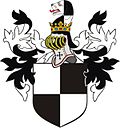

In 1204, the County of Hohenzollern was established out of the fusion of the County of Zollern and the Burgraviate of Nuremberg. The Swabian branch inherited the county of Zollern and, being descended from Frederick I of Nuremberg, were all named "Friedrich" down through the 11th generation. Each one's numeral is counted from the first Friedrich to rule his branch's appanage.
The most senior of these in the 14th century, Count Frederick VIII (d. 1333), had two sons, the elder of whom became Frederick IX (d. 1379), first Count of Hohenzollern, and fathered Friedrich X who left no sons when he died in 1412.
But the younger son of Friedrich VIII, called Friedrich of Strassburg, uniquely, took no numeral of his own, retaining the old title "Count of Zollern" and pre-deceased his brother in 1364/65. Prince Wilhelm Karl zu Isenburg's 1957 genealogical series, Europäische Stammtafeln, says Friedrich of Strassburg shared, rather, in the rule of Zollern with his elder brother until his premature death.
It appears, but is not stated, that Strassburg's son became the recognized co-ruler of his cousin Friedrich X (as compensation for having received no appanage and/or because of incapacity on the part of Friedrich X) and, as such, assumed (or is, historically, attributed) the designation Frederick XI although he actually pre-deceased Friedrich X, dying in 1401.
Friedrich XI, however, left two sons who jointly succeeded their cousin-once-removed, being Count Frederick XII (d. childless 1443) and Count Eitel Friedrich I (d. 1439), the latter becoming the ancestor of all subsequent branches of the Princes of Hohenzollern.
In the 12th century, a son of Frederick I secured the county of Hohenberg. The county remained in the possession of the family until 1486.
The influence of the Swabian line was weakened by several partitions of its lands. In the 16th century, the situation changed completely when Eitel Frederick II, a friend and adviser of the emperor Maximilian I, received the district of Haigerloch. His grandson Charles I was granted the counties of Sigmaringen and Vehringen by Charles V.
Counts, later Princes of Hohenzollern-Hechingen (1576–1849)

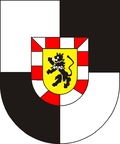
The County of Hohenzollern-Hechingen was established in 1576 with allodial rights. It included the original County of Zollern, with the Hohenzollern Castle and the monastery at Stetten.
In December 1849, the ruling princes of both Hohenzollern-Hechingen and Hohenzollern-Sigmaringen abdicated their thrones, and their principalities were incorporated as the Prussian province of Hohenzollern. The Hechingen branch became extinct in dynastic line with Konstantin's death in 1869.
Counts of Hohenzollern-Haigerloch (1576–1634 and 1681–1767)

The County of Hohenzollern-Haigerloch was established in 1576 without allodial rights.
Between 1634 and 1681, the county was temporarily integrated into the principality of Hohenzollern-Sigmaringen.
Upon the death of Francis Christopher Anton in 1767, the Haigerloch territory was incorporated into the principality of Hohenzollern-Sigmaringen.
Counts, later Princes of Hohenzollern-Sigmaringen (1576–1849)

The County of Hohenzollern-Sigmaringen was established in 1576 with allodial rights and a seat at Sigmaringen Castle.

In December 1849, sovereignty over the principality was yielded to the Franconian branch of the family and incorporated into the Kingdom of Prussia, which accorded status as cadets of the Prussian Royal Family to the Swabian Hohenzollerns. The last ruling Prince of Hohenzollern-Sigmaringen, Karl Anton, would later serve as Minister President of Prussia between 1858 and 1862.
House of Hohenzollern-Sigmaringen after 1849


The family continued to use the title of Prince of Hohenzollern-Sigmaringen. After the Hechingen branch became extinct in 1869, the Sigmaringen branch adopted title of Prince of Hohenzollern.
- 1849–1885: Karl Anton I (1811–1885)
- 1885–1905: Leopold I (1835–1905), son of
- 1905–1927: William I (1864–1927), son of
- 1927–1965: Frederick I (1891–1965), son of
- 1965–2010: Friedrich Wilhelm I (1924–2010), son of
- 2010–present: Karl Friedrich I (1952–), son of
- heir apparent: Alexander
In 1866, Prince Charles of Hohenzollern-Sigmaringen was chosen prince of Romania, becoming King Carol I of Romania in 1881.
Charles's elder brother, Leopold, Prince of Hohenzollern, was offered the Spanish throne in 1870 after a revolt exiled Isabella II in 1868. Although encouraged by Bismarck to accept, Leopold declined in the face of French opposition. Nonetheless, Bismarck altered and then published the Ems telegram to create a casus belli: France declared war, but Bismarck's Germany won the Franco-Prussian War.
The head of the Sigmaringen branch (the only extant line of the Swabian branch of the dynasty) is Karl Friedrich, styled His Highness The Prince of Hohenzollern. His official seat is Sigmaringen Castle.
Kings of the Romanians
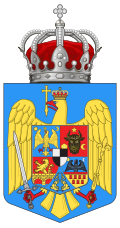
Reigning (1866–1947)


The Principality of Romania was established in 1862, after the Ottoman vassal states of Wallachia and Moldavia had been united in 1859 under Alexandru Ioan Cuza as Prince of Romania in a personal union. He was deposed in 1866 by the Romanian parliament.
Prince Charles of Hohenzollern-Sigmaringen was invited to become reigning Prince of Romania in 1866. In 1881 he became Carol I, King of Romania. Carol I had an only daughter who died young, so the younger son of his brother Leopold, Prince Ferdinand of Hohenzollern-Sigmaringen, would succeed his uncle as King of Romania in 1914, and his descendants, having converted to the Orthodox Church, continued to reign there until the end of the monarchy in 1947.
Succession since 1947
In 1947, the King Michael I abdicated and the country was proclaimed a People's Republic. Michael did not press his claim to the defunct Romanian throne, but he was welcomed back to the country after half a century in exile as a private citizen, with substantial former royal properties being placed at his disposal. However, his dynastic claim was not recognized by post-Communist Romanians.
On 10 May 2011, King Michael I severed the dynastic ties between the Romanian Royal Family and the House of Hohenzollern-Sigmaringen. After that the branch of the Hohenzollerns was dynastically represented only by the last king Michael, and his daughters. Having no sons, he declared that his dynastic heir, instead of being a male member of the Hohenzollern-Sigmaringen princely family to which he formerly belonged patrilineally and in accordance with the last Romanian monarchical constitution, should be his eldest daughter Margareta.
The royal house remains popular in Romania and in 2014 Prime Minister Victor Ponta promised a referendum on whether or not to reinstate the monarchy if he were re-elected.
Rulers of the House of Hohenzollern
House of Hohenzollern
| Divided in Wallachia and Moldavia (1310/46-1859), then United Principalities (1859-1866); under Ottoman vassalage (1417/98-1866) | Part of the Ascanian and Wittelsbach Margraviate of Brandenburg (1157-1356) and late Electorate of Brandenburg (1356-1440) | Part of the State of the Teutonic Order (1226-1525) | |
| County of Hohenberg (1124-1253) | |||
| County of Zollern (1040-1218) | Burgraviate of Nuremberg (1200-1440) | ||
| County of Nagold (1253-1363) | County of Haigerloch (1st creation) (1253-1389) | ||
| County of Wildberg (1318-1397) | |||
| Sold to Württemberg | |||
| Haigerloch sold to the House of Habsburg; Recovered in 1497 from Switzerland | Raised to: County of Hohenzollern (1218-1512) | ||
| Sold to Baden | |||
| Raised to: Electorate of Brandenburg (1440-1701) | |||
| County of Haigerloch (2nd creation) (1512-1558) | County of Hechingen (1st creation) (1512-1558) | Principality of Kulmbach (1515-1557) | Principality of Ansbach (1486-1791) |
| Duchy of Prussia (1525-1618) | |||
| County of Hohenzollern (1558-1575) | |||
| County of Haigerloch (3rd creation) (1575-1634) | County of Sigmaringen (1575-1623) | County of Hechingen (2nd creation) (1575-1623) Raised to: Principality of Hechingen (1623-1849) | |
| Principality of Bayreuth (1603-1769) | |||
| County of Haigerloch (4th creation) (1680-1767) | Raised to: Principality of Sigmaringen (1623-1849) | ||
| Raised to: Kingdom of Prussia (1701-1871) | |||
| March of Schwedt (1692-1788) | |||
| Principality of Romania (Ottoman vassal 1866-1877) (Sigmaringen branch) (1866-1881) | |||
| Raised to: Kingdom of Romania (Sigmaringen branch) (1881-1947) | Raised to: German Empire (1871-1918) | ||
| Weimar Republic |
| Table of rulers | |||||||
|---|---|---|---|---|---|---|---|
| Ruler Born Reign Ruling part Consort Death Notes Burchard I c.1020 Son of Friedrich of Sülichgau and Irmentrud of Nellenburg (disputed) 1040 – 1061 County of Zollern Anastasia of Rheinfelden one child 1061 aged 40–41 First documented member of the family. Frederick I Maute c.1050 Son of Burchard I and Anastasia of Rheinfelden 1061 – 1125 County of Zollern Udehild of Urach eight children 1125 aged 74–75 Frederick II c.1100 First son of Frederick I and Udehild of Urach 1125 – 1155 County of Zollern Unknown two children c.1155 aged 54–55 Children of Frederick I, divided their inheritance. Burchard II[bg] c.1096 Second son of Frederick I and Udehild of Urach 1125 – 1154 County of Hohenberg Helmburgis of Schala-Burghausen (d.c.1155) two children 1154 aged 57–58 Burchard III[bg] c.1130 Son of Burchard II[bg] and Helmburgis of Schala-Burghausen 1154 – July 1193 County of Hohenberg Kunigunde of Grünberg two children July 1193 aged 62–63 Godfrey c.1096 Third son of Frederick I and Udehild of Urach 1155 – 1160 County of Zollern Unmarried 1160 aged 64–65 Brother of Frederick II, left no children. The county passed to his nephews. Frederick III & I c.1130 Son of Frederick II 1160 – 1204 County of Zollern (with Burgraviate of Nuremberg jure uxoris since 1184) Sophie of Raabs 1184 three children 1204 aged 73–74 Burchard IV[bg] c.1150 First son of Burchard III[bg] and Kunigunde of Grünberg July 1193 – 1225 County of Hohenberg Willipurg von Eichelberg two children 1225 aged 74–75? Children of Burchard III, ruled jointly. Albert I c.1150 Second son of Burchard III[bg] and Kunigunde of Grünberg Unmarried 1225? aged 75–75? Conrad I the Pious 1186 First son of Frederick III & I and Sophie of Raabs 1204 – 1218 County of Zollern Clementia four children Unknown two children 10 March 1261 aged 74–75 Children of Frederick III & I, divided their inheritance, but in 1218 exchanged it between themselves. Conrad, who received Zollern and exchanged it for Nuremberg, founded the Franconian branch, which later converted to Protestantism; Frederick received Nuremberg and exchanged it for Zollern, founded the Swabian branch, which remains Catholic. 1218 – 10 March 1261 Burgraviate of Nuremberg Frederick IV & II the Lion 1188 Second son of Frederick III & I and Sophie of Raabs 1204 – 1218 Burgraviate of Nuremberg Elisabeth four children 1255 aged 66-67 1218 – 1255 County of Zollern (until 1218) County of Hohenzollern (from 1218) Burchard V[bg] c.1190 Son of Burchard IV[bg] and Willipurg von Eichelberg 1225 – 14 July 1253 County of Hohenberg Matilda of Tübingen c.1230 five children 14 July 1253 aged 62–63 Died by a lightning strike. Gertrude Anna c.1225 Deilingen Daughter of Burchard V[bg] and Matilda of Tübingen 14 July 1253 – 16 February 1281 County of Hohenberg (at Sélestat) Rudolph I of Habsburg 1251 Alsace eleven children 16 February 1281 Vienna aged 55–56 Children of Burchard V, divided their inheritance. Gertrude's inheritance went to her descendants (the Habsburgs). Burchard associated his son Otto to his rule. Albert II the Troubadour c.1235 First son of Burchard V[bg] and Matilda of Tübingen 14 July 1253 – 17 April 1298 County of Haigerloch (with Hohenberg proper) Unknown two children Margaret of Fürstenberg[bg] 1282 three children Ursula of Oettingen (d.1308) c.1300 two children 17 April 1298 Leinstetten Castle[de] aged 62–63 Burchard VI[bg] c.1240 Second son of Burchard V[bg] and Matilda of Tübingen 14 July 1253 – 24 July 1318 County of Nagold Unknown one child Luitgard of Tübingen c.1275 three children 24 July 1318 aged 77–78 Otto I[bg] c.1275 First son of Burchard VI[bg] and Luitgard of Tübingen c.1290 – 12 July 1299 Maria of Magenheim 1290 two children 12 July 1299 aged 23–24 Frederick V the Illustrious c.1230 Son of Frederick IV & II and Elisabeth 1255 – 24 May 1289 County of Hohenzollern Udehild of Dillingen[bg] 1257 four children 24 May 1289 aged 58–59 Frederick III the Heir 1220 Nuremberg Son of Conrad I and Clementia 10 March 1261 – 14 August 1297 Burgraviate of Nuremberg Elisabeth of Merania[bg] 1246 five children Helene of Saxony (1247-12 June 1309) 10 April 1280 three children 14 August 1297 Cadolzburg aged 76–77 Children of Conrad I, divided their property. Frederick III inherited Bayreuth from his wife, while Conrad, in 1296, sold his property at Abensberg to the Diocese of Eichstätt. Conrad II the Pious[de] 1235 Nuremberg Son of Conrad I 10 March 1261 – 1296 Burgraviate of Nuremberg (at Abenberg[de]) Agnes of Hohenlohe-Uffenheim[bg] c.1250 seven children Agnes of Hirschberg (d.c.1300) 1295 no children 6 July 1314 aged 78–79 Frederick VI the Knight 1258 Son of Frederick V and Udehild of Dillingen[bg] 24 May 1289 – 4 May 1298 County of Hohenzollern Kunigunde of Baden[bg] December 1281 six children 4 May 1298 aged 39–40 John I 1279 Nuremberg First son of Frederick III and Helene of Saxony 14 August 1297 – 25 February 1300 Burgraviate of Nuremberg Agnes of Hesse[de] 1297 no children 25 February 1300 aged 20–21 Died early and without descendants. He was succeeded by his brother. Albert III Rosselmann c.1260 Son of Albert II 17 April 1298 – November 1304 County of Haigerloch Unknown 1 August 1284 Grüningen no children Clara Euphemia of Gorizia February 1296 no children November 1304 aged 43–44 Left no children. He was succeeded by his brother. Frederick VII the Elder c.1285 First son of Frederick VI and Kunigunde of Baden[bg] 4 May 1298 – 6 October 1309 County of Hohenzollern Euphemia of Hohenberg-Haigerloch (d.1333) 1298 six children 6 October 1309 aged 23–24 Frederick IV 1287 Nuremberg Second son of Frederick III and Helene of Saxony 25 February 1300 – 19 May 1332 Burgraviate of Nuremberg Margaret of Gorizia-Tyrol 2 August 1307 ten children 19 May 1332 aged 44–45 In 1331 he purchased the town of Ansbach, nucleus of the later Principality of Ansbach established in 1398. Rudolph I[bg] c.1285 Son of Albert II and Margaret of Fürstenberg[bg] November 1304 – 11 January 1336 County of Haigerloch Agnes of Werdenberg-Heiligenberg (d.1317) c.1305? five children Irmengard of Württemberg (1300-17 May 1329) April 1318 no children Elisabeth of Sponheim-Kreuznach (1310-1349) 20 June 1331 Rottenburg am Neckar no children 11 January 1336 Vienna (?) aged 50–51 Rudolph II seemingly associated his eldest son to power, but he predeceased him. Rudolph II[bg] c.1305 Son of Rudolph I[bg] and Agnes of Werdenberg-Heiligenberg c.1320 – 26 February 1335 Margaret of Nassau-Hadamar (d.30 January 1370) c.1320 three children 26 February 1335 aged 29–30? Regency of Frederick of Hohenzollern and/or Euphemia of Hohenberg-Haigerloch (1309–1314/5) Usually not counted or listed, probably because he died as minor. Nonetheless, he is documented as Lord of Zollern. Frederick Fritzli (I) c.1300 Son of Frederick VII and Euphemia of Hohenberg-Haigerloch 6 October 1309 – 1315 County of Hohenzollern Unmarried c.1315 aged 14–15? Frederick VIII the Easter Sunday c.1285 Second son of Frederick VI and Kunigunde of Baden[bg] 1315 – 1 February 1333 County of Hohenzollern Unknown four children 1 February 1333 aged 39–40 Burchard VII[bg] c.1280 Second son of Burchard VI[bg] and Luitgard of Tübingen 24 July 1318 – 2 September 1355 County of Wildberg Agnes c.1300? seven children 2 September 1355 aged 74–75? Heirs of Burchard VI (son and grandson), divided the inheritance. Burchard VIII[bg] c.1290 Son of Otto I[bg] and Maria of Magenheim 24 July 1318 – 1342 County of Nagold Agnes of Vaihingen 1316 five children 1342 aged 51–52 John II the Acquirer 1309 First son of Frederick IV and Margaret of Gorizia-Tyrol 19 May 1332 – 7 October 1357 Burgraviate of Nuremberg (at Nuremberg proper) Elisabeth of Henneberg-Schleusingen[it] 1333 five children 7 October 1357 aged 44–45 Children of Frederick IV, John and Conrad ruled jointly, until the death of the latter, one year later. By an agreement in 1341, John divided the Burgraviate with his brother Albert. John's cognomen derives from the purchase, in 1340, of the castle Plassenburg in Kulmbach, with its respective county by the contract of inheritance with the counts of Orlamünde. Conrad III[bg] 1309 Second son of Frederick IV and Margaret of Gorizia-Tyrol 19 May 1332 – 3 April 1334 Irmgard of Hohenlohe-Weikersheim[nl] 1332 no children 31 July 1357 aged 44–45 Albert the Beautiful[de] 1319 Third son of Frederick IV and Margaret of Gorizia-Tyrol 10 October 1341 – 4 April 1361 Burgraviate of Nuremberg (at Hildburghausen, Heldburg, Eisfeld, Ermershausen and Ummerstadt) Sophia of Henneberg-Schleusingen[it] c.1330? two children 4 April 1361 aged 44–45 Frederick Fritzli (II) c.1300 First son of Frederick VIII 1 February 1333 – 16 March 1339 County of Hohenzollern Unmarried 16 March 1339 aged 38–39 Usually not counted or listed. Nonetheless, he is documented as Lord of Zollern. Rudolph III[bg] c.1320 Son of Rudolph II[bg] and Margaret of Nassau-Hadamar 11 January 1336 – November 1389 County of Haigerloch (only at Rottenburg am Neckar since 1381) Ida of Toggenburg (d.26 January 1399) May 1360 one child November 1389 aged 50–51 In 1381, he sold Haigerloch to the Habsburgs. He remained in his seat at Rottenburg am Neckar. Haigerloch (with exceptions) was sold to Austria Frederick IX the Black c.1300 Second son of Frederick VIII 16 March 1339 – 1 March 1379 County of Hohenzollern (half 1) Adelaide of Hohenberg-Wildenberg April 1341 five children 1 March 1379 aged 78–79? Younger children of Frederick VIII, divided their inheritance, because Frederick (X), formerly a canon of Strasbourg, returned to secular life. Frederick (X) of Strasbourg[de] c.1300 Third son of Frederick VIII 16 Mach 1339 – March 1365 County of Hohenzollern (half 2) Margaret of Hohenberg-Wildenberg 1343 five children March 1365 aged 64–65? Otto II[bg] c.1320 Son of Burchard VIII[bg] and Agnes of Vaihingen 1342 – 23 June 1363 County of Nagold Kunigunde of Wertheim (d.1358) 27 February 1349 four children Irmgard of Werdenberg (d.24 October 1379) 13 July 1371 no children 6 July 1385 aged 64–655 In 1363 sold Nagold to the Counts of Württemberg. His descendants continued to claim, however, its possession. Nagold sold to Württemberg Burchard IX[bg] c.1310 First son of Burchard VII[bg] and Agnes 2 September 1355 – 14 August 1363 County of Wildberg (in Wildberg half 1) Anna of Brauneck c.1330? two children 10 August 1381 aged 70–71? Divided their inheritance. In 1363, Burchard sold his half of Wildberg plus the town of Bulach to the Electoral Palatinate. Conrad I[bg] c.1310 Second son of Burchard VII[bg] and Agnes 2 September 1355 – 6 September 1356 County of Wildberg (in Altensteig and Wildberg half 2) Margareta van Hewen (d.December 1398) c.1330? two children 6 September 1356 aged 45–46? Rudolph IV c.1330 Son of Conrad I[bg] and Margareta van Hewen 6 September 1356 – 28 December 1397 County of Wildberg (only in Altensteig since 1363) Unknown one child 28 December 1397 aged 66–67 Sold his half of Wildenberg to the Palatinate at the same time of his uncle Burchard. Didn't leave surviving descendants. Altensteig became part of the Margraviate of Baden. Wildberg sold to the Palatinate; Altensteig annexed to Baden Frederick V 1333 Son of John II and Elisabeth of Henneberg-Schleusingen[it] 31 July 1357 – 21 January 1398 Burgraviate of Nuremberg (at Nuremberg proper) Margaret of Gorizia-Tyrol 2 August 1307 ten children 21 January 1398 aged 44–45 Regency of Sophia of Henneberg-Schleusingen[it] (1361-1372) Through her marriage, her inheritance went to the House of Wettin. Margaret[it] 1359 Daughter of Albert[de] and Sophia of Henneberg-Schleusingen[it] 4 April 1361 – 1391 Burgraviate of Nuremberg (at Hildburghausen, Heldburg, Eisfeld, Ermershausen and Ummerstadt) Balthasar, Landgrave of Thuringia 22 July 1374 two children 1391 aged 31–32 Frederick XI the Elder c.1345 Son of Frederick (X)[de] and Margaret of Hohenberg-Wildenberg March 1365 – 26 November 1401 County of Hohenzollern (half 2) Adelaide of Fürstenberg[bg] January 1377 six children 26 November 1401 aged 55–56? Frederick X the Black 1342? Son of Frederick IX and Adelaide of Hohenberg-Wildenberg 1 March 1379 – 21 June 1412 County of Hohenzollern (half 1) Anna of Hohenberg-Nagold (d.1421) c.1350? no children 21 June 1412 aged 69–70? His death with no descendants led to the reunion of the Hohenzollern patrimony. Margaret[bg] c.1360 Daughter of Rudolph III[bg] and Ida of Toggenburg November 1389 – 26 February 1419 County of Haigerloch (at Rottenburg am Neckar) Bernard I, Margrave of Baden 1 September 1384 (annulled 1391) no children Herman VI, Count of Sulz-Klettgau[de] April 1391 three children 26 February 1419 aged 58–59 Through her marriage, Rothenburg was inherited by the Counts of Sulz[de]. Rottenburg was inherited by the County of Sulz[de] John III 1369 First son of Frederick V and Elisabeth of Meissen 21 January 1398 – 11 June 1420 Burgraviate of Nuremberg (at Kulmbach) Margaret of Bohemia 1381 one child 11 June 1420 Plassenburg aged 51–52 Divided their inheritance. Originally Burgrave of Nuremberg as Frederick VI, Frederick was appointed by King Sigismund in 1415 and enfeoffed in 1417. In 1420, with Jon's death with no descendants, he joined his ancestors' Nurembergian lands with Brandenburg. In 1427, he sold Nuremberg to the Free Imperial City of Nuremberg. Frederick VI & I 21 September 1371 Free Imperial City of Nuremberg Second son of Frederick V and Elisabeth of Meissen 21 January 1398 – 20 September 1440 Burgraviate of Nuremberg (at Ansbach; in all Burgraviate since 1420) Electorate of Brandenburg (from 1415; with Burgraviate of Nuremberg until 1427) Elisabeth of Bavaria-Landshut 18 September 1401 ten children 20 September 1440 Cadolzburg aged 68 Frederick XII of Oettingen c.1390 First son of Frederick XI and Adelaide of Fürstenberg[bg] 26 November 1401 – 1428 30 September 1439 – 30 September 1443 County of Hohenzollern (in half 2 until 1412; in all Hohenzollern since 1412) Anna of Sulz (d.1440) c.1405? no children 30 September 1443 Palestine aged 52–53 Children of Frederick XI, ruled jointly. In 1412, they reunited the Hohenzollen patrimony. Between 1429 and 1439, Frederick XII was kept under Henriette, Countess of Montbéliard's custody. Eitel Frederick I[de] c.1390 Second son of Frederick XI and Adelaide of Fürstenberg[bg] 26 November 1401 – 30 September 1439 Ursula of Rhäzüns (d.17 February 1477) 1432 four children 30 September 1439 Hechingen aged 48–49 John the Alchemist 1406 First son of Frederick VI & I and Elisabeth of Bavaria-Landshut 20 September 1440 – 1457 Principality of Kulmbach Barbara of Saxe-Wittenberg 1416 four children 16 November 1464 Baiersdorf aged 57–58 Divided their inheritance. John abdicated in 1457. The second son, Frederick, inherited the electorate, but he didn't have male successors; the inheritance went to their younger brother. Frederick II Irontooth 19 November 1413 Tangermünde Second son of Frederick VI & I and Elisabeth of Bavaria-Landshut 20 September 1440 – 10 February 1471 Electorate of Brandenburg Catherine of Saxony 11 June 1441 Wittenberg three children 10 February 1471 Neustadt an der Aisch aged 57 Albert I Achilles 9 November 1414 Tangermünde Third son of Frederick VI & I and Elisabeth of Bavaria-Landshut 20 September 1440 – 11 March 1486 Principality of Ansbach (with Kulmbach since 1457) Margaret of Baden 1446 four children Anna of Saxony 12 November 1458 Ansbach thirteen children 11 March 1486 Imperial City of Frankfurt aged 71 10 February 1471 – 11 March 1486 Electorate of Brandenburg Jobst Nicholas I 1433 Son of Eitel Frederick I[de] and Ursula of Rhäzüns 30 September 1443 – 9 February 1488 County of Hohenzollern Agnes of Werdenberg-Trochtelfingen 1448 six children 9 February 1488 Zollernalbkreis aged 54–55 Under a succession treaty of 1429 with the House of Württemberg, the county would fall to the Counts of Württemberg if the Swabian branch of the House of Hohenzollern were to die out in the male line. With Jobst Nicholas's birth, this risk was averted. John Cicero 2 August 1455 Ansbach Son of Albert I Achilles and Margaret of Baden 11 March 1486 – 9 January 1499 Electorate of Brandenburg Margaret of Thuringia 15 August 1476 Berlin six children 9 January 1499 Arneburg aged 43 Children of Albert Achilles, divided their inheritance. Once more, as occurred in the previous generation, Kulmbach was annexed to Ansbach. In 1515, after depleting the finances of the march with his lavish lifestyle, Frederick I was deposed by his two sons. Frederick I the Elder 8 May 1460 Ansbach First son of Albert I Achilles and Anna of Saxony 11 March 1486 – 1515 Principality of Ansbach (with Kulmbach since 1495) Sophia of Poland 14 February 1479 Frankfurt (Oder) seventeen children 4 April 1536 Ansbach aged 75 Sigismund 27 September 1468 Ansbach Second son of Albert I Achilles and Anna of Saxony 11 March 1486 – 26 February 1495 Principality of Kulmbach Unmarried 26 February 1495 Ansbach aged 26 Eitel Frederick II 1452 Son of Jobst Nicholas I and Agnes of Werdenberg-Trochtelfingen 9 February 1488 – 18 June 1512 County of Hohenzollern Magdalena of Brandenburg 1482 Berlin six children 18 June 1512 Trier aged 59–60 Joachim I Nestor 21 February 1484 Cölln Son of John Cicero and Margaret of Thuringia 9 January 1499 – 11 July 1535 Electorate of Brandenburg Elizabeth of Denmark 10 April 1502 Berlin five children 11 July 1535 Stendal aged 51 Francis Wolfgang[de] 1483 First son of Eitel Frederick II and Magdalena of Brandenburg 18 June 1512 – 16 June 1517 County of Haigerloch Rosine of Baden[de] 1503 six children 16 June 1517 Hechingen aged 33–34 Children of Eitel Frederick II, divided their inheritance. Eitel Frederick III 1494 Second son of Eitel Frederick II and Magdalena of Brandenburg 18 June 1512 – 15 June 1525 County of Hechingen Johanna van Witthem (d.1544) 1515 six children 15 June 1525 Pavia aged 30–31 Casimir 27 December 1481 Ansbach First son of Frederick I and Sophia of Poland 1515 – 21 September 1527 Principality of Kulmbach Susanna of Bavaria 25 August 1518 Augsburg five children 21 September 1527 Buda aged 45 Children of Frederick I, deprived their father of his possessions and divided the inheritance. George I the Pious 4 March 1484 Ansbach Second son of Frederick I and Sophia of Poland 1515 – 27 December 1543 Principality of Ansbach Beatrice de Frangepan 21 January 1509 Gyula no children Hedwig of Münsterberg-Oels 9 January 1525 Oleśnica two children Emilie of Saxony 25 August 1533 four children 27 December 1543 Ansbach aged 59 Rosine of Baden[de] 5 March 1487 Daughter of Christopher I, Margrave of Baden and Ottilie of Katzenelnbogen 16 June 1517 – 17 December 1526 County of Haigerloch (at Haigerloch Castle) Francis Wolfgang[de] 1503 six children Johann von Ow, Baron of Wachendorf (d.29 October 1571) 17 December 1526 no children 29 October 1554 Wachendorf (Starzach)[de] aged 67 Heirs of Francis Wolfgang. Christopher inherited the county still as a minor, and his mother, who also held the main castle of Haigerloch as widow's seat, also served as his regent. Left no male descendants: Haigerloch was inherited by his uncle Joachim. Regency of Rosine of Baden[de] (1517-1524) Christopher Frederick 1510 Son of Francis Wolfgang[de] and Rosine of Baden[de] 16 June 1517 – 1536 County of Haigerloch Anna Rehlinger von Haltenberg 1530 one child 1536 Marseille aged 25–26 Albert 17 May 1490 Ansbach Third son of Frederick I and Sophia of Poland 10 April 1525 – 20 March 1568 Duchy of Prussia (previously State of the Teutonic Order) Dorothea of Denmark 1 July 1526 Königsberg six children Anna Maria of Brunswick-Calenberg 16 February 1550 Königsberg two children 20 March 1568 Gvardeysk aged 77 Son of Frederick I of Ansbach, and previously Grand Master of the Teutonic Knights, in 1525 he converted to Protestantism, and reformed his territory to be laic, becoming the first Duke of Prussia. Regency of George, Margrave of Brandenburg-Ansbach (1527–1541) Left no descendants, and Kulmbach returned to Ansbach. Albert II Alcibiades the Warlike 28 March 1522 Ansbach Son of Casimir and Susanna of Bavaria 21 September 1527 – 8 January 1557 Principality of Kulmbach Unmarried 8 January 1557 Pforzheim aged 34 Joachim II Hector 13 January 1505 Cölln First son of Joachim I Nestor and Elizabeth of Denmark 11 July 1535 – 3 January 1571 Electorate of Brandenburg Magdalena of Saxony 6 November 1524 Dresden six children Hedwig of Poland 29 August/1 September 1535 Kraków six children 3 January 1571 Köpenick Palace aged 65 Children of Joachim I, divided their inheritance. John was the first and only Margrave at Küstrin, and after his death it was annexed again to the Electorate. Joachim II was the first Protestant Elector of Brandenburg. John the Wise 3 August 1513 Second son of Joachim I Nestor and Elizabeth of Denmark 11 July 1535 – 13 January 1571 March of Küstrin Catherine of Brunswick-Wolfenbüttel 11 November 1537 Wolfenbüttel two children 13 January 1571 Küstrin aged 57 Joachim[bg] 1485 Third son of Eitel Frederick II and Magdalena of Brandenburg 1536 – 2 February 1538 County of Haigerloch Anastasia von Stoffeln (1490 - 16 November 1530) 1513 one child 2 February 1538 Hechingen aged 52–53 Jobst Nicholas II[bg] 1514 Son of Joachim[bg] and Anastasia von Stoffeln 2 February 1538 – 10 June 1558 County of Haigerloch Anna of Zimmern-Wildenstein (29 June 1513 - 28 May 1570) 1531 Meßkirch no children 10 June 1558 Hechingen aged 43–44 Left no children. After his death Haigerloch returned to Hechingen. Regencies of Joachim II Hector, Elector of Brandenburg and Philip I, Landgrave of Hesse (1543–1548), John Frederick I, Elector of Saxony (1543–1547) and Maurice, Elector of Saxony (1547–1548) In 1557, reunited Kulmbach to Ansbach once more. Left no descendants, and the Marches passed to the sons of Elector John George. George Frederick I the Elder 5 April 1539 Ansbach Son of George I and Emilie of Saxony 27 December 1543 – 25 April 1603 Principality of Ansbach (with Kulmbach since 1557) Elisabeth of Brandenburg-Küstrin 26 December 1558 Küstrin no children Sophie of Brunswick-Lüneburg 3 May 1579 Dresden no children 25 April 1603 Ansbach aged 64 Charles I 1516 Brussels Son of Eitel Frederick III and Johanna van Witthem 15 June 1525 – 10 June 1558 County of Hechingen Anna of Baden-Durlach[bg] 11 February 1537 Pforzheim eleven children 18 March 1576 Sigmaringen Castle aged 59–60 In 1558, reunited once again the county of Zollern. 10 June 1558 – 18 March 1576 County of Hohenzollern Council of Regency (1568-1571) In 1572 he began to exhibit signs of mental disorder. He had twice tried to commit suicide and was prone to violent outbursts and held a great fear of " Turks and Muscovites " overrunning Germany. In 1578 he began being overruled by regents. Albert Frederick 7 May 1553 Königsberg Son of Albert and Anna Maria of Brunswick-Calenberg 20 March 1568 – 27 August 1618 Duchy of Prussia Marie Eleonore of Cleves 14 October 1573 Königsberg seven children 27 August 1618 Primorsk aged 65 Regency of George Frederick, Margrave of Brandenburg-Ansbach (1578-1603) Regency of Joachim Frederick, Elector of Brandenburg (1603-1608) Regency of John Sigismund, Elector of Brandenburg (1608-1618) John George 11 September 1525 Cölln Son of Joachim II Hector and Magdalena of Saxony 3 January 1571 – 8 January 1598 Electorate of Brandenburg Sophie of Legnica 15 February 1545 one child Sabina of Brandenburg-Ansbach 12 February 1548 Ansbach eleven children Elisabeth of Anhalt-Zerbst 6 October 1577 Letzlingen eleven children 8 January 1598 Cölln aged 72 Eitel Frederick IV 7 September 1545 Sigmaringen First son of Charles I and Anna of Baden-Durlach[bg] 18 March 1576 – 16 January 1605 County of Hechingen Veronica of Ortenburg (d.23 March 1573) 22 May 1568 Sigmaringen no children Sibylla of Zimmern[bg] 14 November 1574 Meßkirch four children Johanna of Eberstein (d.1633) 1 March 1601 no children 16 January 1605 Hechingen aged 59 Children of Charles I, divided their inheritance. Charles II 22 January 1547 Sigmaringen Second son of Charles I and Anna of Baden-Durlach[bg] 18 March 1576 – 8 April 1606 County of Sigmaringen Euphrosyne of Oettingen-Wallerstein (1552 – 5 October 1590) 18 January 1569 Munich fifteen children Elisabeth of Pallandt-Kulemborg (1567–1620) 13 October 1591 Sigmaringen ten children 8 April 1606 Sigmaringen aged 59 Christopher 10 March 1552 Haigerloch Third son of Charles I and Anna of Baden-Durlach[bg] 18 March 1576 – 21 April 1592 County of Haigerloch Catherine von Welsperg and Primör (d.1610) 1577 Sigmaringen six children 21 April 1592 Haigerloch aged 40 Regency of Eitel Frederick IV, Count of Hechingen and Charles II, Count of Sigmaringen (1592-1604) Left no descendants. He was succeeded by his brother. John Christopher 1586 Haigerloch First son of Christopher and Catherine von Welsperg and Primör 21 April 1592 – 4 December 1620 County of Haigerloch Elisabeth of Hohenzollern-Sigmaringen[bg] 21 September 1608 Sigmaringen no children 4 December 1620 Haigerloch aged 33–34 Joachim Frederick 27 January 1546 Cölln Son of John George and Sophie of Legnica 8 January 1598 – 18 July 1608 Electorate of Brandenburg Catherine of Brandenburg-Küstrin 8 January 1570 Küstrin eleven children Eleanor of Prussia 2 November 1603 Berlin one child 18 July 1608 Köpenick aged 62 Divided the inheritance, mainly after George Frederick I of Ansbach's death with no children. In 1604 moved the capital of the March to Bayreuth. Christian 30 January 1581 Cölln First son of John George and Elisabeth of Anhalt-Zerbst 25 April 1603 – 30 May 1655 Principality of Bayreuth Maria of Prussia 29 April 1604 Kulmbach nine children 30 May 1655 Bayreuth aged 74 Joachim Ernest 22 June 1583 Cölln Second son of John George and Elisabeth of Anhalt-Zerbst 25 April 1603 – 7 March 1625 Principality of Ansbach Sophie of Solms-Laubach 1612 Ansbach three children 7 March 1625 Ansbach aged 41 John George 1577 Sigmaringen Son of Eitel Frederick IV and Sibylla of Zimmern[bg] 16 January 1605 – 28 September 1623 County of Hechingen (until 1623) Principality of Hechingen (from 1623) Franziska of Salm-Neuviller[bg] 11 October 1598 Hechingen fourteen children 28 September 1623 Hechingen aged 45–46 John 17 August 1578 Sigmaringen Son of Charles II and Euphrosyne of Oettingen-Wallerstein 8 April 1606 – 22 March 1638 County of Sigmaringen (until 1623) Principality of Sigmaringen (from 1623) Johanna of Hohenzollern-Hechingen[fr] 30 June 1602 Sigmaringen three children 22 March 1638 Munich aged 59 John Sigismund 8 November 1572 Halle First son of Joachim Frederick and Catherine of Brandenburg-Küstrin 18 July 1608 – 3 November 1619 Electorate of Brandenburg (with Duchy of Prussia jure uxoris since 1618) Anna, Duchess of Prussia 30 October 1594 Königsberg eight children 23 December 1619 Berlin aged 47 Divided their inheritance. In 1618, John Sigismund, with his wife, inherited his father-in-law's Duchy of Prussia. John George left no surviving descendants ad his duchy returned to Brandenburg. In 1622, Ferdinand III, Holy Roman Emperor confiscated Krnov from Brandenburg. John George 16 December 1577 Wolmirstedt Second son of Joachim Frederick and Catherine of Brandenburg-Küstrin 18 July 1608 – 1622 Duchy of Krnov Eva Christina of Württemberg[fr] 13 June 1610 Krnov five children 22 March 1624 Levoča aged 46 Anna 3 July 1576 Königsberg Daughter of Albert Frederick and Marie Eleonore of Cleves 27 August 1618 – 30 August 1625 Duchy of Prussia (suo jure heiress) John Sigismund, Elector of Brandenburg 30 October 1594 Königsberg eight children 30 August 1625 Berlin aged 49 Heiress of her father, she was described as intellectually superior to her spouse, temperamental and strong-willed. Her marriage made possible the unification of the Brandenburg and Prussian branches. George William 13 November 1595 Berlin Son of John Sigismund and Anna 3 November 1619 – 1 December 1640 Electorate of Brandenburg (with Duchy of Prussia, in jure matris until 1625, suo jure since 1625) Elizabeth Charlotte of the Palatinate 24 July 1616 Heidelberg four children 1 December 1640 Königsberg aged 49 Also Duke of Prussia by right of his mother. His reign was marked by ineffective governance during the Thirty Years' War. Charles 1588 Haigerloch Second son of Christopher and Catherine von Welsperg and Primör 4 December 1620 – 9 March 1634 County of Haigerloch Rosamund of Ortenburg (d.1636) 25 March 1618 no children 9 March 1634 Überlingen aged 45–46 Like his brother, he left no descendants. Haigerloch merged in Sigmaringen. Haigerloch briefly merged in Sigmaringen Eitel Frederick V January 1601 Sigmaringen Second son of John George and Franziska of Salm-Neuviller[bg] 28 September 1623 – 11 July 1661 Principality of Hechingen Maria Elisabeth of Berg-s'Herenberg (January 1613 - 29 November 1671) 19 March 1630 Boutersem two children 11 July 1661 Issenheim aged 60 Regency of Sophie of Solms-Laubach (1625-1634) Left no descendants. He was succeeded by his brother. Frederick III 1 May 1616 Ansbach First son of Joachim Ernest and Sophie of Solms-Laubach 7 March 1625 – 6 September 1634 Principality of Ansbach Unmarried 6 September 1634 near Nördlingen aged 18 Regency of Sophie of Solms-Laubach (1634-1639) Albert II 18 September 1620 Ansbach Second son of Joachim Ernest and Sophie of Solms-Laubach 6 September 1634 – 22 October 1667 Principality of Ansbach Henriette Louise of Württemberg-Montbéliard[uk] 31 August 1642 Stuttgart three children Sophie Margarete of Oettingen-Oettingen[fr] 15 October 1651 Oettingen five children Christine of Baden-Durlach 6 August 1665 Durlach no children 22 October 1667 Ansbach aged 47 Meinrad I 1605 Munich Son of John and Johanna of Hohenzollern-Hechingen[fr] 2 March 1638 – 30 January 1681 Principality of Sigmaringen Anna Maria von Thöring-Seefeld (1613 – 12 February 1682) 7 May 1635 Braunau am Inn nineteen children 30 January 1681 Sigmaringen aged 75–76 Frederick William I the Great 16 February 1620 Berlin Palace Son of George William and Elizabeth Charlotte of the Palatinate 1 December 1640 – 29 April 1688 Electorate of Brandenburg Louise Henriette of Orange-Nassau 7 December 1646 The Hague six children Sophia Dorothea of Sonderburg-Glücksburg 13 July 1668 Gröningen seven children 29 April 1688 City Palace, Potsdam aged 68 Also Duke of Prussia. Christian Ernest 6 August 1644 Bayreuth Son of Erdmann August of Brandenburg-Bayreuth and Sophie of Brandenburg-Ansbach 30 May 1655 – 20 May 1712 Principality of Bayreuth Erdmuthe Sophie of Saxony 29 October 1662 Dresden no children Sophie Luise of Württemberg 8 February 1671 Stuttgart six children Elisabeth Sophie of Brandenburg 30 March 1703 Potsdam nine children 20 May 1712 Erlangen aged 67 Grandson of Christian I. Philip 24 June 1616 Hechingen Sixth son of John George and Franziska of Salm-Neuviller[bg] 11 July 1661 – 24 January 1671 Principality of Hechingen Maria Sidonia of Baden-Rodemachern[bg] 12 November 1662 Baden-Baden eight children 24 January 1671 Hechingen aged 54 Heirs of Eitel Frederick V. The lordship of Bergen op Zoom was inherited by Franziska's descendants. Franziska Henriette[fr] 1642 Daughter of Eitel Frederick V and Maria Elisabeth of Berg-s'Herenberg 11 July 1661 – 17 October 1698 Principality of Hechingen (at Bergen op Zoom; jure matris until 1671; suo jure from 1671) Frederick Maurice de la Tour d'Auvergne, Count of Auvergne[fr] May 1662 eight children 17 October 1698 Bergen op Zoom aged 55–56 John Frederick 18 October 1654 Ansbach Son of Albert II and Sophie Margarete of Oettingen-Oettingen[fr] 22 October 1667 – 22 March 1686 Principality of Ansbach Johanna Elisabeth of Baden-Durlach[fr] 26 January 1673 Durlach five children Eleonore Erdmuthe of Saxe-Eisenach 4 November 1681 Eisenach three children 22 March 1686 Ansbach aged 31 Regency of Maria Sidonia of Baden-Rodemachern[bg] (1671-1681) Frederick William 20 September 1663 Hechingen Son of Philip and Maria Sidonia of Baden-Rodemachern[bg] 24 January 1671 – 14 November 1735 Principality of Hechingen Maria Leopoldine von Sinzendorf (1 April 1666 - 18 May 1709) 22 January 1687 Vienna six children Maximiliane Magdalena von Lützau (11 July 1690 - 8 September 1755) 7 September 1710 Hechingen two children 14 November 1735 Hechingen aged 72 Maximilian I 20 January 1636 Munich First son of Meinrad I and Anna Maria von Thöring-Seefeld 30 January 1681 – 13 August 1689 Principality of Sigmaringen Maria Clara of Berg-'s-Heerenberg (27 April 1635 - 15 July 1715) 12 January 1666 Boxmeer twelve children 13 August 1689 Sigmaringen aged 53 Children of Meinrad I, divided their inheritance. Francis Anton 2 December 1657 Sigmaringen Castle Eleventh son of Meinrad I and Anna Maria von Thöring-Seefeld 30 January 1681 – 14 October 1702 County of Haigerloch Anna Maria Eusebia of Königsegg-Aulendorf (1670-1716) 5 February 1687 four children 14 October 1702 Friedlingen aged 44 Council of Regency (1686–1692) Died as a minor; he was succeeded by his brother. Christian Albert 18 September 1675 First son of John Frederick and Johanna Elisabeth of Baden-Durlach[fr] 22 March 1686 – 16 October 1692 Principality of Ansbach Unmarried 16 October 1692 Ansbach aged 17 Frederick III & I the Mercenary 11 July 1657 Königsberg Son of Frederick William I and Louise Henriette of Orange-Nassau 29 April 1688 – 25 February 1713 Electorate of Brandenburg (until 1701) Kingdom of Prussia (with Electorate of Brandenburg; from 1701) Elisabeth Henriette of Hesse-Kassel 13 August 1679 Potsdam one child Sophia Charlotte of Hanover 8 October 1684 Herrenhausen two children Sophia Louise of Mecklenburg-Schwerin 28 November 1708 Berlin no children 25 February 1713 Berlin aged 55 Children of Frederick William, divided their inheritance. In 1701, Frederick became the first King in Prussia, as Frederick I. Philip William 19 May 1669 Königsberg Son of Frederick William I and Sophia Dorothea of Sonderburg-Glücksburg 29 April 1688 – 19 December 1711 March of Schwedt Johanna Charlotte of Anhalt-Dessau 25 January 1699 Oranienbaum six children 19 December 1711 Schwedt aged 42 Regency of Maria Clara of Berg-'s-Heerenberg and Francis Anton, Count of Haigerloch (1689-1691) Meinrad II 1 November 1673 Sigmaringen Son of Maximilian I and Maria Clara of Berg-'s-Heerenberg 13 August 1689 – 20 October 1715 Principality of Sigmaringen Johanna Catharina of Montfort-Tettnang 22 November 1700 Sigmaringen four children 20 October 1715 Sigmaringen aged 41 George Frederick II the Younger 3 May 1678 Ansbach Second son of John Frederick and Johanna Elisabeth of Baden-Durlach[fr] 16 October 1692 – 29 March 1703 Principality of Ansbach Unmarried 29 March 1703 Schmidmühlen aged 24 Died without descendants; he was succeeded by his brother. Ferdinand Leopold 4 December 1692 Sigmaringen Castle First son of Francis Anton and Anna Maria Eusebia of Königsegg-Aulendorf 14 October 1702 – 23 July 1750 County of Haigerloch Unmarried 23 July 1750 Brühl Palace aged 57 Member of the clergy and first minister of the Electorate of Cologne. Left no children. The county passed to his brother. William Frederick 6 January 1686 Ansbach Son of John Frederick and Eleonore Erdmuthe of Saxe-Eisenach 29 March 1703 – 7 January 1723 Principality of Ansbach Christiane Charlotte of Württemberg-Winnental 28 August 1709 Stuttgart three children 7 January 1723 Unterreichenbach aged 36 Regency of Frederick I, King of Prussia (1711-1713) Regency of Frederick William I, King of Prussia (1713-1718) Left no male descendants. The title passed to his brother, Frederick Henry. Frederick William the Mad 17 November 1700 Oranienbaum First son of Philip William and Johanna Charlotte of Anhalt-Dessau 19 December 1711 – 4 March 1771 March of Schwedt Sophia Dorothea of Prussia 10 November 1734 Potsdam five children 4 March 1771 Swobnica aged 70 George William 26 November 1678 Bayreuth Son of Christian Ernest and Sophie Luise of Württemberg 20 May 1712 – 18 December 1726 Principality of Bayreuth Sophie of Saxe-Weissenfels 16 October 1699 Leipzig five children 18 December 1726 Bayreuth aged 48 Frederick William I the Soldier 16 March 1687 Berlin Son of Frederick III & I and Sophia Charlotte of Hanover 25 February 1713 – 28 June 1757 Kingdom of Prussia (with Electorate of Brandenburg) Sophia Dorothea of Hanover 28 November 1706 Hanover (by proxy) 27 December 1706 Berlin (in person) two children 28 June 1757 City Palace, Potsdam aged 70 Regency of Johanna Catharina of Montfort-Tettnang (1715-1720) Joseph Frederick Ernest 24 May 1702 Sigmaringen Son of Meinrad II and Johanna Catharina of Montfort-Tettnang 2 October 1715 – 8 December 1769 Principality of Sigmaringen Maria Franziska of Oettingen-Spielberg[fr] 20 May 1722 Oettingen six children Maria Judith Katharina of Closen[fr] 5 July 1738 three children Maria Theresa of Waldburg-Trachburg[fr] 22 October 1743 no children 8 December 1769 Haigerloch aged 41 Regency of Christiane Charlotte of Württemberg-Winnental (1723–1729) Charles William Frederick the Wild 12 May 1712 Ansbach Son of William Frederick and Christiane Charlotte of Württemberg-Winnental 7 January 1723 – 3 August 1757 Principality of Ansbach Friederike Luise of Prussia 30 May 1729 Berlin two children 3 August 1757 Gunzenhausen aged 45 George Frederick Charles 30 June 1688 near Mühlhausen Son of George William and Sophie of Saxe-Weissenfels 18 December 1726 – 17 May 1735 Principality of Bayreuth Dorothea of Sonderburg-Beck 17 April 1709 Reinfeld five children 17 May 1735 Bayreuth aged 46 Frederick 10 May 1711 Weferlingen Son of George Frederick Charles and Dorothea of Sonderburg-Beck 17 May 1735 – 26 February 1763 Principality of Bayreuth Wilhelmine of Prussia 17 April 1709 Berlin one child Sophie Caroline of Brunswick-Wolfenbüttel 20 September 1759 Brunswick no children 26 February 1763 Bayreuth aged 51 Left no male descendants; the title passed to Frederick Christian, from a collateral Bayreuth line. Frederick Louis 1 September 1688 Strasbourg Son of Frederick William and Maria Leopoldine von Sinzendorf 14 November 1735 – 4 June 1750 Principality of Hechingen Unmarried 4 June 1750 Hechingen aged 61 Left no children. He was succeeded by a cousin. Joseph Frederick William 12 November 1717 Bayreuth Son of Herman Frederick of Hohenzollern-Hechingen[fr] and Maria Josepha of Oettingen 4 June 1750 – 9 April 1798 Principality of Hechingen Maria Teresa Folch de Cardona y Silva (4 September 1732 - 25 September 1750) 2 June 1750 Vienna no children Maria Theresa of Waldburg-Zeil 7 January 1751 Hechingen six children 9 April 1798 Hechingen aged 80 Great-grandson of John George. Left no surviving children. He was succeeded by his nephew. Francis Christopher Anton 1 January 1699 Haigerloch Second son of Francis Anton and Anna Maria Eusebia of Königsegg-Aulendorf 23 July 1750 – 23 November 1767 County of Haigerloch Unmarried 23 November 1767 Cologne aged 68 Also member of the clergy and first minister of the Electorate of Cologne. He also didn't have children. The county returned definitively to Sigmaringen. Haigerloch definitely annexed to Sigmaringen Frederick II the Great 24 January 1712 Berlin Son of Frederick William I and Sophia Dorothea of Hanover 28 June 1757 – 17 August 1786 Kingdom of Prussia (with Electorate of Brandenburg) Elisabeth Christine of Brunswick-Wolfenbüttel 12 June 1733 Castle Salzdahlum no children 17 August 1786 Potsdam aged 74 Charles Alexander 24 February 1736 Son of Charles William Frederick and Friederike Luise of Prussia 3 August 1757 – 16 January 1791 Principality of Ansbach Frederica Caroline of Saxe-Coburg-Saalfeld 22 November 1754 Coburg no children Elizabeth Craven 13/30 October 1791 Lisbon (morganatic) no children 5 January 1806 Speen, Berkshire aged 69 In 1769 reunited both Margraviates of Ansbach and Bayreuth.In 1791 sold both Margraviates to the Kingdom of Prussia. Ansbach sold to Prussia Frederick Christian 17 July 1708 Weferlingen Son of Christian Henry of Brandenburg-Bayreuth and Sophie Christiane of Wolfstein 26 February 1763 – 20 January 1769 Principality of Bayreuth Victoria Charlotte of Anhalt-Zeitz-Hoym 26 April 1732 Schaumburg two children 20 January 1769 Bayreuth aged 60 Great-grandson of Christian I and cousin of his predecessors. Left no male descendants; Bayreuth was reunited to Ansbach. Bayreuth definitively annexed to Ansbach Charles Frederick 9 January 1724 Sigmaringen Son of Joseph Frederick Ernest and Maria Franziska of Oettingen-Spielberg[fr] 8 December 1769 – 20 December 1785 Principality of Sigmaringen Johanna of Hohenzollern-Berg[fr] 2 March 1749 Kail Castle, near Trier twelve children 20 December 1785 Krauchenwies aged 61 Frederick Henry 21 August 1709 Schwedt Second son of Philip William and Johanna Charlotte of Anhalt-Dessau 4 March 1771 – 12 December 1788 March of Schwedt Leopoldine Marie of Anhalt-Dessau 13 February 1739 two children 12 December 1788 Schwedt aged 79 Left no male descendants. Schwedt went back to Prussia. Schwedt definitively annexed to Prussia Anton Aloys 20 June 1762 Sigmaringen Son of Charles Frederick and Johanna of Hohenzollern-Berg[fr] 20 December 1785 – 17 October 1831 Principality of Sigmaringen Amalie Zephyrine of Salm-Kyrburg 13 August 1782 Kirn two children 17 October 1831 Sigmaringen aged 69 Frederick William II 25 September 1744 Berlin Palace Son of Frederick William I and Louise Henriette of Orange-Nassau 17 August 1786 – 16 November 1797 Kingdom of Prussia (with Electorate of Brandenburg) Elisabeth Christine of Brunswick-Wolfenbüttel 14 June 1765 Castle Salzdahlum (annulled 1769) no children Frederica Louisa of Hesse-Darmstadt 14 July 1769 Charlottenburg Palace eight children Julie von Voss 7 April 1787 Charlottenburg Palace (morganatic) one child Sophie von Dönhoff 11 April 1790 Charlottenburg Palace (morganatic, annulled 1792) two children 16 November 1797 Marmorpalais aged 53 Nephew of his predecessor. Frederick William III 3 August 1770 Potsdam Son of Frederick William II and Frederica Louisa of Hesse-Darmstadt 16 November 1797 – 7 June 1840 Kingdom of Prussia (with Electorate of Brandenburg until 1806) Louise of Mecklenburg-Strelitz 24 December 1793 Darmstadt nine children Auguste von Harrach 9 November 1824 Charlottenburg Palace (morganatic) no children 7 June 1840 Berlin aged 69 In 1806, with the dissolving of the Holy Roman Empire, Prussia lost its electoral status. Herman 30 July 1751 Lockenhaus Son of Francis Xavier of Hohenzollern-Hechingen[fr] and Anna von Hoensbroech 9 April 1798 – 2 November 1810 Principality of Hechingen Louise of Merode-Westerloo (28 September 1748 - 14 November 1774) 18 November 1773 Maastricht one child Maximiliane of Gavre (30 November 1753 - 6 August 1778) 15 February 1775 Brussels one child Maria Antonia of Waldburg-Zeil (6 June 1753 - 25 October 1814) 12 June 1779 Dagstuhl five children 2 November 1810 Hechingen aged 59 Nephew of Joseph Frederick William. Frederick Herman Otto 22 July 1776 Namur Son of Herman and Maximiliane of Gavre 2 November 1810 – 13 September 1838 Principality of Hechingen Luise Pauline Maria Biron 26 April 1800 Prague one child 13 September 1838 Hechingen aged 62 Charles 20 February 1785 Sigmaringen Son of Anton Aloys and Amalie Zephyrine of Salm-Kyrburg 17 October 1831 – 27 August 1848 Principality of Sigmaringen Marie Antoinette Murat 4 February 1808 Paris four children Catharina of Hohenlohe-Schillingsfürst 14 March 1848 Kupferzell no children 11 March 1853 Bologna aged 68 During the German revolutions of 1848–1849, he abdicated to his son. Constantine 16 February 1801 Żagań Son of Frederick Herman Otto and Luise Pauline Maria Biron 13 September 1838 – 7 December 1849 Principality of Hechingen Eugénie de Beauharnais 22 May 1826 Eichstätt no children Amalie Schenk von Geyern September 1847 (morganatic) three children 3 September 1889 Zielona Góra aged 68 Pressed by the German Revolution, in 1849 he signed the hand-over of the Principality to Prussia. Hechingen definitely annexed to Prussia Frederick William IV 15 October 1795 Kronprinzenpalais First son of Frederick William III and Louise of Mecklenburg-Strelitz 7 June 1840 – 2 January 1861 Kingdom of Prussia Elisabeth Ludovika of Bavaria 16 November 1823 Munich (by proxy) 29 November 1823 Berlin (in person) no children 2 January 1861 Sanssouci aged 55 Also President of the Erfurt Union (1849–1850). Left no children, and was succeeded by his brother, who already held regency since 1858. Regency of Prince William of Prussia (1858-1861) Charles Anton 7 September 1811 Krauchenwies Son of Charles and Marie Antoinette Murat 27 August 1848 – 7 December 1849 Principality of Sigmaringen Josephine of Baden 21 October 1834 Karlsruhe six children 2 June 1885 Sigmaringen aged 73 Still pressed by the German Revolution, in 1849 he signed the hand-over of the Principality to Prussia. His son Karl would become, in 1881, King of Romania; his daughter Stephanie became Queen of Portugal. Sigmaringen definitely annexed to Prussia William I the Great 22 March 1797 Kronprinzenpalais Second son of Frederick William III and Louise of Mecklenburg-Strelitz 2 January 1861 – 9 March 1888 Kingdom of Prussia (until 1871) German Empire (with Kingdom of Prussia; from 1871) Augusta of Saxe-Weimar-Eisenach 11 June 1829 Charlottenburg Palace two children 9 March 1888 Charlottenburg Palace aged 90 Previously regent on behalf of his ill brother, he inherited his throne. He was also President of the North German Confederation (1867–1871), before becoming German Emperor. Carol I 20 April 1839 Sigmaringen Castle Son of Charles Anton, Prince of Hohenzollern-Sigmaringen and Josephine of Baden 20 April 1866 – 10 October 1914 Principality of Romania (until 1881) Kingdom of Romania (from 1881) (Sigmaringen branch) Elisabeth of Wied 15 November 1869 Neuwied one child 10 October 1914 Peleș Castle aged 75 Karl of Hohenzollern-Sigmaringen was invited to assume the Romanian throne in 1866. Left no male descendants. The throne went to his nephew. Frederick III 18 October 1831 New Palace, Potsdam Son of William I and Augusta of Saxe-Weimar-Eisenach 9 March – 15 June 1888 German Empire (with Kingdom of Prussia) Victoria of the United Kingdom 25 January 1858 St James's Palace eight children 15 June 1888 New Palace, Potsdam aged 56 William II 27 January 1859 Kronprinzenpalais Son of Frederick III and Victoria of the United Kingdom 15 June 1888 – 9 November 1918 German Empire (with Kingdom of Prussia) Augusta Victoria of Schleswig-Holstein 27 February 1881 Berlin seven childrenHermine Reuss of Greiz 5 November 1922 Huis Doorn no children 4 June 1941 Huis Doorn aged 82 In 1918, he abdicated his throne; The monarchy was abolished. Ferdinand 24 August 1865 Sigmaringen Castle Son of Prince Leopold of Hohenzollern-Sigmaringen and Antónia of Portugal 10 October 1914 – 20 July 1927 Kingdom of Romania (Sigmaringen branch) Marie of the United Kingdom 10 January 1893 Sigmaringen Castle six children 20 July 1927 Peleș Castle aged 61 Mihai I 25 October 1921 Peleș Castle Son of Prince Carol of Romania and Helen of Greece and Denmark 20 July 1927 – 8 June 1930 6 September 1940 – 30 December 1947 Kingdom of Romania (Sigmaringen branch) Anne of Bourbon-Parma 10 June 1948 Athens five children 5 December 2017 Aubonne aged 96 Given his father removed himself fom the line of succession, he was the chosen successor of his grandfather. As he was a child, he uled under a Council of Regency. In 1930, Michael's father returned to Romania and took the throne. In 1940, as he abdicated, Michael returned to the throne, but he also abdicated in 1947. The monarchy was abolished. Carol II 15 October 1893 Peleș Castle Son of Ferdinand and Marie of the United Kingdom 8 June 1930 – 6 September 1940 Kingdom of Romania (Sigmaringen branch) Zizi Lambrino 31 August 1918 Transfiguration Cathedral in Odesa (morganatic, annulled 1919) one child Helen of Greece and Denmark 10 March 1921 Metropolitan Cathedral of Athens (divorced 1928)one child Magda Lupescu (morganatic) 3 June/5 July 1947 Rio de Janeiro no children 4 April 1953 Estoril aged 59 After giving up his rights in his father's lifetime, Carol returned to Romania in 1930 and ascended the throne, but abdicated again in 1940. | |||||||
| Ruler | Born | Reign | Ruling part | Consort | Death | Notes | |
| Burchard I | c.1020 Son of Friedrich of Sülichgau and Irmentrud of Nellenburg (disputed) | 1040 – 1061 | County of Zollern | Anastasia of Rheinfelden one child | 1061 aged 40–41 | First documented member of the family. | |
| Frederick I Maute | c.1050 Son of Burchard I and Anastasia of Rheinfelden | 1061 – 1125 | County of Zollern | Udehild of Urach eight children | 1125 aged 74–75 | ||
| Frederick II | c.1100 First son of Frederick I and Udehild of Urach | 1125 – 1155 | County of Zollern | Unknown two children | c.1155 aged 54–55 | Children of Frederick I, divided their inheritance. | |
| Burchard II[bg] | c.1096 Second son of Frederick I and Udehild of Urach | 1125 – 1154 | County of Hohenberg | Helmburgis of Schala-Burghausen (d.c.1155) two children | 1154 aged 57–58 | ||
| Burchard III[bg] | c.1130 Son of Burchard II[bg] and Helmburgis of Schala-Burghausen | 1154 – July 1193 | County of Hohenberg | Kunigunde of Grünberg two children | July 1193 aged 62–63 | ||
| Godfrey | c.1096 Third son of Frederick I and Udehild of Urach | 1155 – 1160 | County of Zollern | Unmarried | 1160 aged 64–65 | Brother of Frederick II, left no children. The county passed to his nephews. | |
| Frederick III & I | c.1130 Son of Frederick II | 1160 – 1204 | County of Zollern (with Burgraviate of Nuremberg jure uxoris since 1184) | Sophie of Raabs 1184 three children | 1204 aged 73–74 | ||
| Burchard IV[bg] | c.1150 First son of Burchard III[bg] and Kunigunde of Grünberg | July 1193 – 1225 | County of Hohenberg | Willipurg von Eichelberg two children | 1225 aged 74–75? | Children of Burchard III, ruled jointly. | |
| Albert I | c.1150 Second son of Burchard III[bg] and Kunigunde of Grünberg | Unmarried | 1225? aged 75–75? | ||||
| Conrad I the Pious | 1186 First son of Frederick III & I and Sophie of Raabs | 1204 – 1218 | County of Zollern | Clementia four children Unknown two children | 10 March 1261 aged 74–75 | Children of Frederick III & I, divided their inheritance, but in 1218 exchanged it between themselves. Conrad, who received Zollern and exchanged it for Nuremberg, founded the Franconian branch, which later converted to Protestantism; Frederick received Nuremberg and exchanged it for Zollern, founded the Swabian branch, which remains Catholic. | |
| 1218 – 10 March 1261 | Burgraviate of Nuremberg | ||||||
| Frederick IV & II the Lion | 1188 Second son of Frederick III & I and Sophie of Raabs | 1204 – 1218 | Burgraviate of Nuremberg | Elisabeth four children | 1255 aged 66-67 | ||
| 1218 – 1255 | County of Zollern (until 1218) County of Hohenzollern (from 1218) | ||||||
| Burchard V[bg] | c.1190 Son of Burchard IV[bg] and Willipurg von Eichelberg | 1225 – 14 July 1253 | County of Hohenberg | Matilda of Tübingen c.1230 five children | 14 July 1253 aged 62–63 | Died by a lightning strike. | |
| Gertrude Anna | c.1225 Deilingen Daughter of Burchard V[bg] and Matilda of Tübingen | 14 July 1253 – 16 February 1281 | County of Hohenberg (at Sélestat) | Rudolph I of Habsburg 1251 Alsace eleven children | 16 February 1281 Vienna aged 55–56 | Children of Burchard V, divided their inheritance. Gertrude's inheritance went to her descendants (the Habsburgs). Burchard associated his son Otto to his rule. | |
| Albert II the Troubadour | c.1235 First son of Burchard V[bg] and Matilda of Tübingen | 14 July 1253 – 17 April 1298 | County of Haigerloch (with Hohenberg proper) | Unknown two children Margaret of Fürstenberg[bg] 1282 three children Ursula of Oettingen (d.1308) c.1300 two children | 17 April 1298 Leinstetten Castle[de] aged 62–63 | ||
| Burchard VI[bg] | c.1240 Second son of Burchard V[bg] and Matilda of Tübingen | 14 July 1253 – 24 July 1318 | County of Nagold | Unknown one child Luitgard of Tübingen c.1275 three children | 24 July 1318 aged 77–78 | ||
| Otto I[bg] | c.1275 First son of Burchard VI[bg] and Luitgard of Tübingen | c.1290 – 12 July 1299 | Maria of Magenheim 1290 two children | 12 July 1299 aged 23–24 | |||
| Frederick V the Illustrious | c.1230 Son of Frederick IV & II and Elisabeth | 1255 – 24 May 1289 | County of Hohenzollern | Udehild of Dillingen[bg] 1257 four children | 24 May 1289 aged 58–59 | ||
| Frederick III the Heir | 1220 Nuremberg Son of Conrad I and Clementia | 10 March 1261 – 14 August 1297 | Burgraviate of Nuremberg | Elisabeth of Merania[bg] 1246 five children Helene of Saxony (1247-12 June 1309) 10 April 1280 three children | 14 August 1297 Cadolzburg aged 76–77 | Children of Conrad I, divided their property. Frederick III inherited Bayreuth from his wife, while Conrad, in 1296, sold his property at Abensberg to the Diocese of Eichstätt. | |
| Conrad II the Pious[de] | 1235 Nuremberg Son of Conrad I | 10 March 1261 – 1296 | Burgraviate of Nuremberg (at Abenberg[de]) | Agnes of Hohenlohe-Uffenheim[bg] c.1250 seven children Agnes of Hirschberg (d.c.1300) 1295 no children | 6 July 1314 aged 78–79 | ||
| Frederick VI the Knight | 1258 Son of Frederick V and Udehild of Dillingen[bg] | 24 May 1289 – 4 May 1298 | County of Hohenzollern | Kunigunde of Baden[bg] December 1281 six children | 4 May 1298 aged 39–40 | ||
| John I | 1279 Nuremberg First son of Frederick III and Helene of Saxony | 14 August 1297 – 25 February 1300 | Burgraviate of Nuremberg | Agnes of Hesse[de] 1297 no children | 25 February 1300 aged 20–21 | Died early and without descendants. He was succeeded by his brother. | |
| Albert III Rosselmann | c.1260 Son of Albert II | 17 April 1298 – November 1304 | County of Haigerloch | Unknown 1 August 1284 Grüningen no children Clara Euphemia of Gorizia February 1296 no children | November 1304 aged 43–44 | Left no children. He was succeeded by his brother. | |
| Frederick VII the Elder | c.1285 First son of Frederick VI and Kunigunde of Baden[bg] | 4 May 1298 – 6 October 1309 | County of Hohenzollern | Euphemia of Hohenberg-Haigerloch (d.1333) 1298 six children | 6 October 1309 aged 23–24 | ||
| Frederick IV | 1287 Nuremberg Second son of Frederick III and Helene of Saxony | 25 February 1300 – 19 May 1332 | Burgraviate of Nuremberg | Margaret of Gorizia-Tyrol 2 August 1307 ten children | 19 May 1332 aged 44–45 | In 1331 he purchased the town of Ansbach, nucleus of the later Principality of Ansbach established in 1398. | |
| Rudolph I[bg] | c.1285 Son of Albert II and Margaret of Fürstenberg[bg] | November 1304 – 11 January 1336 | County of Haigerloch | Agnes of Werdenberg-Heiligenberg (d.1317) c.1305? five children Irmengard of Württemberg (1300-17 May 1329) April 1318 no children Elisabeth of Sponheim-Kreuznach (1310-1349) 20 June 1331 Rottenburg am Neckar no children | 11 January 1336 Vienna (?) aged 50–51 | Rudolph II seemingly associated his eldest son to power, but he predeceased him. | |
| Rudolph II[bg] | c.1305 Son of Rudolph I[bg] and Agnes of Werdenberg-Heiligenberg | c.1320 – 26 February 1335 | Margaret of Nassau-Hadamar (d.30 January 1370) c.1320 three children | 26 February 1335 aged 29–30? | |||
| Regency of Frederick of Hohenzollern and/or Euphemia of Hohenberg-Haigerloch (1309–1314/5) | Usually not counted or listed, probably because he died as minor. Nonetheless, he is documented as Lord of Zollern. | ||||||
| Frederick Fritzli (I) | c.1300 Son of Frederick VII and Euphemia of Hohenberg-Haigerloch | 6 October 1309 – 1315 | County of Hohenzollern | Unmarried | c.1315 aged 14–15? | ||
| Frederick VIII the Easter Sunday | c.1285 Second son of Frederick VI and Kunigunde of Baden[bg] | 1315 – 1 February 1333 | County of Hohenzollern | Unknown four children | 1 February 1333 aged 39–40 | ||
| Burchard VII[bg] | c.1280 Second son of Burchard VI[bg] and Luitgard of Tübingen | 24 July 1318 – 2 September 1355 | County of Wildberg | Agnes c.1300? seven children | 2 September 1355 aged 74–75? | Heirs of Burchard VI (son and grandson), divided the inheritance. | |
| Burchard VIII[bg] | c.1290 Son of Otto I[bg] and Maria of Magenheim | 24 July 1318 – 1342 | County of Nagold | Agnes of Vaihingen 1316 five children | 1342 aged 51–52 | ||
| John II the Acquirer | 1309 First son of Frederick IV and Margaret of Gorizia-Tyrol | 19 May 1332 – 7 October 1357 | Burgraviate of Nuremberg (at Nuremberg proper) | Elisabeth of Henneberg-Schleusingen[it] 1333 five children | 7 October 1357 aged 44–45 | Children of Frederick IV, John and Conrad ruled jointly, until the death of the latter, one year later. By an agreement in 1341, John divided the Burgraviate with his brother Albert. John's cognomen derives from the purchase, in 1340, of the castle Plassenburg in Kulmbach, with its respective county by the contract of inheritance with the counts of Orlamünde. | |
| Conrad III[bg] | 1309 Second son of Frederick IV and Margaret of Gorizia-Tyrol | 19 May 1332 – 3 April 1334 | Irmgard of Hohenlohe-Weikersheim[nl] 1332 no children | 31 July 1357 aged 44–45 | |||
| Albert the Beautiful[de] | 1319 Third son of Frederick IV and Margaret of Gorizia-Tyrol | 10 October 1341 – 4 April 1361 | Burgraviate of Nuremberg (at Hildburghausen, Heldburg, Eisfeld, Ermershausen and Ummerstadt) | Sophia of Henneberg-Schleusingen[it] c.1330? two children | 4 April 1361 aged 44–45 | ||
| Frederick Fritzli (II) | c.1300 First son of Frederick VIII | 1 February 1333 – 16 March 1339 | County of Hohenzollern | Unmarried | 16 March 1339 aged 38–39 | Usually not counted or listed. Nonetheless, he is documented as Lord of Zollern. | |
| Rudolph III[bg] | c.1320 Son of Rudolph II[bg] and Margaret of Nassau-Hadamar | 11 January 1336 – November 1389 | County of Haigerloch (only at Rottenburg am Neckar since 1381) | Ida of Toggenburg (d.26 January 1399) May 1360 one child | November 1389 aged 50–51 | In 1381, he sold Haigerloch to the Habsburgs. He remained in his seat at Rottenburg am Neckar. | |
| Haigerloch (with exceptions) was sold to Austria | |||||||
| Frederick IX the Black | c.1300 Second son of Frederick VIII | 16 March 1339 – 1 March 1379 | County of Hohenzollern (half 1) | Adelaide of Hohenberg-Wildenberg April 1341 five children | 1 March 1379 aged 78–79? | Younger children of Frederick VIII, divided their inheritance, because Frederick (X), formerly a canon of Strasbourg, returned to secular life. | |
| Frederick (X) of Strasbourg[de] | c.1300 Third son of Frederick VIII | 16 Mach 1339 – March 1365 | County of Hohenzollern (half 2) | Margaret of Hohenberg-Wildenberg 1343 five children | March 1365 aged 64–65? | ||
| Otto II[bg] | c.1320 Son of Burchard VIII[bg] and Agnes of Vaihingen | 1342 – 23 June 1363 | County of Nagold | Kunigunde of Wertheim (d.1358) 27 February 1349 four children Irmgard of Werdenberg (d.24 October 1379) 13 July 1371 no children | 6 July 1385 aged 64–655 | In 1363 sold Nagold to the Counts of Württemberg. His descendants continued to claim, however, its possession. | |
| Nagold sold to Württemberg | |||||||
| Burchard IX[bg] | c.1310 First son of Burchard VII[bg] and Agnes | 2 September 1355 – 14 August 1363 | County of Wildberg (in Wildberg half 1) | Anna of Brauneck c.1330? two children | 10 August 1381 aged 70–71? | Divided their inheritance. In 1363, Burchard sold his half of Wildberg plus the town of Bulach to the Electoral Palatinate. | |
| Conrad I[bg] | c.1310 Second son of Burchard VII[bg] and Agnes | 2 September 1355 – 6 September 1356 | County of Wildberg (in Altensteig and Wildberg half 2) | Margareta van Hewen (d.December 1398) c.1330? two children | 6 September 1356 aged 45–46? | ||
| Rudolph IV | c.1330 Son of Conrad I[bg] and Margareta van Hewen | 6 September 1356 – 28 December 1397 | County of Wildberg (only in Altensteig since 1363) | Unknown one child | 28 December 1397 aged 66–67 | Sold his half of Wildenberg to the Palatinate at the same time of his uncle Burchard. Didn't leave surviving descendants. Altensteig became part of the Margraviate of Baden. | |
| Wildberg sold to the Palatinate; Altensteig annexed to Baden | |||||||
| Frederick V | 1333 Son of John II and Elisabeth of Henneberg-Schleusingen[it] | 31 July 1357 – 21 January 1398 | Burgraviate of Nuremberg (at Nuremberg proper) | Margaret of Gorizia-Tyrol 2 August 1307 ten children | 21 January 1398 aged 44–45 | ||
| Regency of Sophia of Henneberg-Schleusingen[it] (1361-1372) | Through her marriage, her inheritance went to the House of Wettin. | ||||||
| Margaret[it] | 1359 Daughter of Albert[de] and Sophia of Henneberg-Schleusingen[it] | 4 April 1361 – 1391 | Burgraviate of Nuremberg (at Hildburghausen, Heldburg, Eisfeld, Ermershausen and Ummerstadt) | Balthasar, Landgrave of Thuringia 22 July 1374 two children | 1391 aged 31–32 | ||
| Frederick XI the Elder | c.1345 Son of Frederick (X)[de] and Margaret of Hohenberg-Wildenberg | March 1365 – 26 November 1401 | County of Hohenzollern (half 2) | Adelaide of Fürstenberg[bg] January 1377 six children | 26 November 1401 aged 55–56? | ||
| Frederick X the Black | 1342? Son of Frederick IX and Adelaide of Hohenberg-Wildenberg | 1 March 1379 – 21 June 1412 | County of Hohenzollern (half 1) | Anna of Hohenberg-Nagold (d.1421) c.1350? no children | 21 June 1412 aged 69–70? | His death with no descendants led to the reunion of the Hohenzollern patrimony. | |
| Margaret[bg] | c.1360 Daughter of Rudolph III[bg] and Ida of Toggenburg | November 1389 – 26 February 1419 | County of Haigerloch (at Rottenburg am Neckar) | Bernard I, Margrave of Baden 1 September 1384 (annulled 1391) no children Herman VI, Count of Sulz-Klettgau[de] April 1391 three children | 26 February 1419 aged 58–59 | Through her marriage, Rothenburg was inherited by the Counts of Sulz[de]. | |
| Rottenburg was inherited by the County of Sulz[de] | |||||||
| John III | 1369 First son of Frederick V and Elisabeth of Meissen | 21 January 1398 – 11 June 1420 | Burgraviate of Nuremberg (at Kulmbach) | Margaret of Bohemia 1381 one child | 11 June 1420 Plassenburg aged 51–52 | Divided their inheritance. Originally Burgrave of Nuremberg as Frederick VI, Frederick was appointed by King Sigismund in 1415 and enfeoffed in 1417. In 1420, with Jon's death with no descendants, he joined his ancestors' Nurembergian lands with Brandenburg. In 1427, he sold Nuremberg to the Free Imperial City of Nuremberg. | |
| Frederick VI & I | 21 September 1371 Free Imperial City of Nuremberg Second son of Frederick V and Elisabeth of Meissen | 21 January 1398 – 20 September 1440 | Burgraviate of Nuremberg (at Ansbach; in all Burgraviate since 1420) Electorate of Brandenburg (from 1415; with Burgraviate of Nuremberg until 1427) | Elisabeth of Bavaria-Landshut 18 September 1401 ten children | 20 September 1440 Cadolzburg aged 68 | ||
| Frederick XII of Oettingen | c.1390 First son of Frederick XI and Adelaide of Fürstenberg[bg] | 26 November 1401 – 1428 30 September 1439 – 30 September 1443 | County of Hohenzollern (in half 2 until 1412; in all Hohenzollern since 1412) | Anna of Sulz (d.1440) c.1405? no children | 30 September 1443 Palestine aged 52–53 | Children of Frederick XI, ruled jointly. In 1412, they reunited the Hohenzollen patrimony. Between 1429 and 1439, Frederick XII was kept under Henriette, Countess of Montbéliard's custody. | |
| Eitel Frederick I[de] | c.1390 Second son of Frederick XI and Adelaide of Fürstenberg[bg] | 26 November 1401 – 30 September 1439 | Ursula of Rhäzüns (d.17 February 1477) 1432 four children | 30 September 1439 Hechingen aged 48–49 | |||
| John the Alchemist | 1406 First son of Frederick VI & I and Elisabeth of Bavaria-Landshut | 20 September 1440 – 1457 | Principality of Kulmbach | Barbara of Saxe-Wittenberg 1416 four children | 16 November 1464 Baiersdorf aged 57–58 | Divided their inheritance. John abdicated in 1457. The second son, Frederick, inherited the electorate, but he didn't have male successors; the inheritance went to their younger brother. | |
| Frederick II Irontooth | 19 November 1413 Tangermünde Second son of Frederick VI & I and Elisabeth of Bavaria-Landshut | 20 September 1440 – 10 February 1471 | Electorate of Brandenburg | Catherine of Saxony 11 June 1441 Wittenberg three children | 10 February 1471 Neustadt an der Aisch aged 57 | ||
| Albert I Achilles | 9 November 1414 Tangermünde Third son of Frederick VI & I and Elisabeth of Bavaria-Landshut | 20 September 1440 – 11 March 1486 | Principality of Ansbach (with Kulmbach since 1457) | Margaret of Baden 1446 four children Anna of Saxony 12 November 1458 Ansbach thirteen children | 11 March 1486 Imperial City of Frankfurt aged 71 | ||
| 10 February 1471 – 11 March 1486 | Electorate of Brandenburg | ||||||
| Jobst Nicholas I | 1433 Son of Eitel Frederick I[de] and Ursula of Rhäzüns | 30 September 1443 – 9 February 1488 | County of Hohenzollern | Agnes of Werdenberg-Trochtelfingen 1448 six children | 9 February 1488 Zollernalbkreis aged 54–55 | Under a succession treaty of 1429 with the House of Württemberg, the county would fall to the Counts of Württemberg if the Swabian branch of the House of Hohenzollern were to die out in the male line. With Jobst Nicholas's birth, this risk was averted. | |
| John Cicero | 2 August 1455 Ansbach Son of Albert I Achilles and Margaret of Baden | 11 March 1486 – 9 January 1499 | Electorate of Brandenburg | Margaret of Thuringia 15 August 1476 Berlin six children | 9 January 1499 Arneburg aged 43 | Children of Albert Achilles, divided their inheritance. Once more, as occurred in the previous generation, Kulmbach was annexed to Ansbach. In 1515, after depleting the finances of the march with his lavish lifestyle, Frederick I was deposed by his two sons. | |
| Frederick I the Elder | 8 May 1460 Ansbach First son of Albert I Achilles and Anna of Saxony | 11 March 1486 – 1515 | Principality of Ansbach (with Kulmbach since 1495) | Sophia of Poland 14 February 1479 Frankfurt (Oder) seventeen children | 4 April 1536 Ansbach aged 75 | ||
| Sigismund | 27 September 1468 Ansbach Second son of Albert I Achilles and Anna of Saxony | 11 March 1486 – 26 February 1495 | Principality of Kulmbach | Unmarried | 26 February 1495 Ansbach aged 26 | ||
| Eitel Frederick II | 1452 Son of Jobst Nicholas I and Agnes of Werdenberg-Trochtelfingen | 9 February 1488 – 18 June 1512 | County of Hohenzollern | Magdalena of Brandenburg 1482 Berlin six children | 18 June 1512 Trier aged 59–60 | ||
| Joachim I Nestor | 21 February 1484 Cölln Son of John Cicero and Margaret of Thuringia | 9 January 1499 – 11 July 1535 | Electorate of Brandenburg | Elizabeth of Denmark 10 April 1502 Berlin five children | 11 July 1535 Stendal aged 51 | ||
| Francis Wolfgang[de] | 1483 First son of Eitel Frederick II and Magdalena of Brandenburg | 18 June 1512 – 16 June 1517 | County of Haigerloch | Rosine of Baden[de] 1503 six children | 16 June 1517 Hechingen aged 33–34 | Children of Eitel Frederick II, divided their inheritance. | |
| Eitel Frederick III | 1494 Second son of Eitel Frederick II and Magdalena of Brandenburg | 18 June 1512 – 15 June 1525 | County of Hechingen | Johanna van Witthem (d.1544) 1515 six children | 15 June 1525 Pavia aged 30–31 | ||
| Casimir | 27 December 1481 Ansbach First son of Frederick I and Sophia of Poland | 1515 – 21 September 1527 | Principality of Kulmbach | Susanna of Bavaria 25 August 1518 Augsburg five children | 21 September 1527 Buda aged 45 | Children of Frederick I, deprived their father of his possessions and divided the inheritance. | |
| George I the Pious | 4 March 1484 Ansbach Second son of Frederick I and Sophia of Poland | 1515 – 27 December 1543 | Principality of Ansbach | Beatrice de Frangepan 21 January 1509 Gyula no children Hedwig of Münsterberg-Oels 9 January 1525 Oleśnica two children Emilie of Saxony 25 August 1533 four children | 27 December 1543 Ansbach aged 59 | ||
| Rosine of Baden[de] | 5 March 1487 Daughter of Christopher I, Margrave of Baden and Ottilie of Katzenelnbogen | 16 June 1517 – 17 December 1526 | County of Haigerloch (at Haigerloch Castle) | Francis Wolfgang[de] 1503 six children Johann von Ow, Baron of Wachendorf (d.29 October 1571) 17 December 1526 no children | 29 October 1554 Wachendorf (Starzach)[de] aged 67 | Heirs of Francis Wolfgang. Christopher inherited the county still as a minor, and his mother, who also held the main castle of Haigerloch as widow's seat, also served as his regent. Left no male descendants: Haigerloch was inherited by his uncle Joachim. | |
| Regency of Rosine of Baden[de] (1517-1524) | |||||||
| Christopher Frederick | 1510 Son of Francis Wolfgang[de] and Rosine of Baden[de] | 16 June 1517 – 1536 | County of Haigerloch | Anna Rehlinger von Haltenberg 1530 one child | 1536 Marseille aged 25–26 | ||
| Albert | 17 May 1490 Ansbach Third son of Frederick I and Sophia of Poland | 10 April 1525 – 20 March 1568 | Duchy of Prussia (previously State of the Teutonic Order) | Dorothea of Denmark 1 July 1526 Königsberg six children Anna Maria of Brunswick-Calenberg 16 February 1550 Königsberg two children | 20 March 1568 Gvardeysk aged 77 | Son of Frederick I of Ansbach, and previously Grand Master of the Teutonic Knights, in 1525 he converted to Protestantism, and reformed his territory to be laic, becoming the first Duke of Prussia. | |
| Regency of George, Margrave of Brandenburg-Ansbach (1527–1541) | Left no descendants, and Kulmbach returned to Ansbach. | ||||||
| Albert II Alcibiades the Warlike | 28 March 1522 Ansbach Son of Casimir and Susanna of Bavaria | 21 September 1527 – 8 January 1557 | Principality of Kulmbach | Unmarried | 8 January 1557 Pforzheim aged 34 | ||
| Joachim II Hector | 13 January 1505 Cölln First son of Joachim I Nestor and Elizabeth of Denmark | 11 July 1535 – 3 January 1571 | Electorate of Brandenburg | Magdalena of Saxony 6 November 1524 Dresden six children Hedwig of Poland 29 August/1 September 1535 Kraków six children | 3 January 1571 Köpenick Palace aged 65 | Children of Joachim I, divided their inheritance. John was the first and only Margrave at Küstrin, and after his death it was annexed again to the Electorate. Joachim II was the first Protestant Elector of Brandenburg. | |
| John the Wise | 3 August 1513 Second son of Joachim I Nestor and Elizabeth of Denmark | 11 July 1535 – 13 January 1571 | March of Küstrin | Catherine of Brunswick-Wolfenbüttel 11 November 1537 Wolfenbüttel two children | 13 January 1571 Küstrin aged 57 | ||
| Joachim[bg] | 1485 Third son of Eitel Frederick II and Magdalena of Brandenburg | 1536 – 2 February 1538 | County of Haigerloch | Anastasia von Stoffeln (1490 - 16 November 1530) 1513 one child | 2 February 1538 Hechingen aged 52–53 | ||
| Jobst Nicholas II[bg] | 1514 Son of Joachim[bg] and Anastasia von Stoffeln | 2 February 1538 – 10 June 1558 | County of Haigerloch | Anna of Zimmern-Wildenstein (29 June 1513 - 28 May 1570) 1531 Meßkirch no children | 10 June 1558 Hechingen aged 43–44 | Left no children. After his death Haigerloch returned to Hechingen. | |
| Regencies of Joachim II Hector, Elector of Brandenburg and Philip I, Landgrave of Hesse (1543–1548), John Frederick I, Elector of Saxony (1543–1547) and Maurice, Elector of Saxony (1547–1548) | In 1557, reunited Kulmbach to Ansbach once more. Left no descendants, and the Marches passed to the sons of Elector John George. | ||||||
| George Frederick I the Elder | 5 April 1539 Ansbach Son of George I and Emilie of Saxony | 27 December 1543 – 25 April 1603 | Principality of Ansbach (with Kulmbach since 1557) | Elisabeth of Brandenburg-Küstrin 26 December 1558 Küstrin no children Sophie of Brunswick-Lüneburg 3 May 1579 Dresden no children | 25 April 1603 Ansbach aged 64 | ||
| Charles I | 1516 Brussels Son of Eitel Frederick III and Johanna van Witthem | 15 June 1525 – 10 June 1558 | County of Hechingen | Anna of Baden-Durlach[bg] 11 February 1537 Pforzheim eleven children | 18 March 1576 Sigmaringen Castle aged 59–60 | In 1558, reunited once again the county of Zollern. | |
| 10 June 1558 – 18 March 1576 | County of Hohenzollern | ||||||
| Council of Regency (1568-1571) | In 1572 he began to exhibit signs of mental disorder. He had twice tried to commit suicide and was prone to violent outbursts and held a great fear of " Turks and Muscovites " overrunning Germany. In 1578 he began being overruled by regents. | ||||||
| Albert Frederick | 7 May 1553 Königsberg Son of Albert and Anna Maria of Brunswick-Calenberg | 20 March 1568 – 27 August 1618 | Duchy of Prussia | Marie Eleonore of Cleves 14 October 1573 Königsberg seven children | 27 August 1618 Primorsk aged 65 | ||
| Regency of George Frederick, Margrave of Brandenburg-Ansbach (1578-1603) Regency of Joachim Frederick, Elector of Brandenburg (1603-1608) Regency of John Sigismund, Elector of Brandenburg (1608-1618) | |||||||
| John George | 11 September 1525 Cölln Son of Joachim II Hector and Magdalena of Saxony | 3 January 1571 – 8 January 1598 | Electorate of Brandenburg | Sophie of Legnica 15 February 1545 one child Sabina of Brandenburg-Ansbach 12 February 1548 Ansbach eleven children Elisabeth of Anhalt-Zerbst 6 October 1577 Letzlingen eleven children | 8 January 1598 Cölln aged 72 | ||
| Eitel Frederick IV | 7 September 1545 Sigmaringen First son of Charles I and Anna of Baden-Durlach[bg] | 18 March 1576 – 16 January 1605 | County of Hechingen | Veronica of Ortenburg (d.23 March 1573) 22 May 1568 Sigmaringen no children Sibylla of Zimmern[bg] 14 November 1574 Meßkirch four children Johanna of Eberstein (d.1633) 1 March 1601 no children | 16 January 1605 Hechingen aged 59 | Children of Charles I, divided their inheritance. | |
| Charles II | 22 January 1547 Sigmaringen Second son of Charles I and Anna of Baden-Durlach[bg] | 18 March 1576 – 8 April 1606 | County of Sigmaringen | Euphrosyne of Oettingen-Wallerstein (1552 – 5 October 1590) 18 January 1569 Munich fifteen children Elisabeth of Pallandt-Kulemborg (1567–1620) 13 October 1591 Sigmaringen ten children | 8 April 1606 Sigmaringen aged 59 | ||
| Christopher | 10 March 1552 Haigerloch Third son of Charles I and Anna of Baden-Durlach[bg] | 18 March 1576 – 21 April 1592 | County of Haigerloch | Catherine von Welsperg and Primör (d.1610) 1577 Sigmaringen six children | 21 April 1592 Haigerloch aged 40 | ||
| Regency of Eitel Frederick IV, Count of Hechingen and Charles II, Count of Sigmaringen (1592-1604) | Left no descendants. He was succeeded by his brother. | ||||||
| John Christopher | 1586 Haigerloch First son of Christopher and Catherine von Welsperg and Primör | 21 April 1592 – 4 December 1620 | County of Haigerloch | Elisabeth of Hohenzollern-Sigmaringen[bg] 21 September 1608 Sigmaringen no children | 4 December 1620 Haigerloch aged 33–34 | ||
| Joachim Frederick | 27 January 1546 Cölln Son of John George and Sophie of Legnica | 8 January 1598 – 18 July 1608 | Electorate of Brandenburg | Catherine of Brandenburg-Küstrin 8 January 1570 Küstrin eleven children Eleanor of Prussia 2 November 1603 Berlin one child | 18 July 1608 Köpenick aged 62 | Divided the inheritance, mainly after George Frederick I of Ansbach's death with no children. In 1604 moved the capital of the March to Bayreuth. | |
| Christian | 30 January 1581 Cölln First son of John George and Elisabeth of Anhalt-Zerbst | 25 April 1603 – 30 May 1655 | Principality of Bayreuth | Maria of Prussia 29 April 1604 Kulmbach nine children | 30 May 1655 Bayreuth aged 74 | ||
| Joachim Ernest | 22 June 1583 Cölln Second son of John George and Elisabeth of Anhalt-Zerbst | 25 April 1603 – 7 March 1625 | Principality of Ansbach | Sophie of Solms-Laubach 1612 Ansbach three children | 7 March 1625 Ansbach aged 41 | ||
| John George | 1577 Sigmaringen Son of Eitel Frederick IV and Sibylla of Zimmern[bg] | 16 January 1605 – 28 September 1623 | County of Hechingen (until 1623) Principality of Hechingen (from 1623) | Franziska of Salm-Neuviller[bg] 11 October 1598 Hechingen fourteen children | 28 September 1623 Hechingen aged 45–46 | ||
| John | 17 August 1578 Sigmaringen Son of Charles II and Euphrosyne of Oettingen-Wallerstein | 8 April 1606 – 22 March 1638 | County of Sigmaringen (until 1623) Principality of Sigmaringen (from 1623) | Johanna of Hohenzollern-Hechingen[fr] 30 June 1602 Sigmaringen three children | 22 March 1638 Munich aged 59 | ||
| John Sigismund | 8 November 1572 Halle First son of Joachim Frederick and Catherine of Brandenburg-Küstrin | 18 July 1608 – 3 November 1619 | Electorate of Brandenburg (with Duchy of Prussia jure uxoris since 1618) | Anna, Duchess of Prussia 30 October 1594 Königsberg eight children | 23 December 1619 Berlin aged 47 | Divided their inheritance. In 1618, John Sigismund, with his wife, inherited his father-in-law's Duchy of Prussia. John George left no surviving descendants ad his duchy returned to Brandenburg. In 1622, Ferdinand III, Holy Roman Emperor confiscated Krnov from Brandenburg. | |
| John George | 16 December 1577 Wolmirstedt Second son of Joachim Frederick and Catherine of Brandenburg-Küstrin | 18 July 1608 – 1622 | Duchy of Krnov | Eva Christina of Württemberg[fr] 13 June 1610 Krnov five children | 22 March 1624 Levoča aged 46 | ||
| Anna | 3 July 1576 Königsberg Daughter of Albert Frederick and Marie Eleonore of Cleves | 27 August 1618 – 30 August 1625 | Duchy of Prussia (suo jure heiress) | John Sigismund, Elector of Brandenburg 30 October 1594 Königsberg eight children | 30 August 1625 Berlin aged 49 | Heiress of her father, she was described as intellectually superior to her spouse, temperamental and strong-willed. Her marriage made possible the unification of the Brandenburg and Prussian branches. | |
| George William | 13 November 1595 Berlin Son of John Sigismund and Anna | 3 November 1619 – 1 December 1640 | Electorate of Brandenburg (with Duchy of Prussia, in jure matris until 1625, suo jure since 1625) | Elizabeth Charlotte of the Palatinate 24 July 1616 Heidelberg four children | 1 December 1640 Königsberg aged 49 | Also Duke of Prussia by right of his mother. His reign was marked by ineffective governance during the Thirty Years' War. | |
| Charles | 1588 Haigerloch Second son of Christopher and Catherine von Welsperg and Primör | 4 December 1620 – 9 March 1634 | County of Haigerloch | Rosamund of Ortenburg (d.1636) 25 March 1618 no children | 9 March 1634 Überlingen aged 45–46 | Like his brother, he left no descendants. Haigerloch merged in Sigmaringen. | |
| Haigerloch briefly merged in Sigmaringen | |||||||
| Eitel Frederick V | January 1601 Sigmaringen Second son of John George and Franziska of Salm-Neuviller[bg] | 28 September 1623 – 11 July 1661 | Principality of Hechingen | Maria Elisabeth of Berg-s'Herenberg (January 1613 - 29 November 1671) 19 March 1630 Boutersem two children | 11 July 1661 Issenheim aged 60 | ||
| Regency of Sophie of Solms-Laubach (1625-1634) | Left no descendants. He was succeeded by his brother. | ||||||
| Frederick III | 1 May 1616 Ansbach First son of Joachim Ernest and Sophie of Solms-Laubach | 7 March 1625 – 6 September 1634 | Principality of Ansbach | Unmarried | 6 September 1634 near Nördlingen aged 18 | ||
| Regency of Sophie of Solms-Laubach (1634-1639) | |||||||
| Albert II | 18 September 1620 Ansbach Second son of Joachim Ernest and Sophie of Solms-Laubach | 6 September 1634 – 22 October 1667 | Principality of Ansbach | Henriette Louise of Württemberg-Montbéliard[uk] 31 August 1642 Stuttgart three children Sophie Margarete of Oettingen-Oettingen[fr] 15 October 1651 Oettingen five children Christine of Baden-Durlach 6 August 1665 Durlach no children | 22 October 1667 Ansbach aged 47 | ||
| Meinrad I | 1605 Munich Son of John and Johanna of Hohenzollern-Hechingen[fr] | 2 March 1638 – 30 January 1681 | Principality of Sigmaringen | Anna Maria von Thöring-Seefeld (1613 – 12 February 1682) 7 May 1635 Braunau am Inn nineteen children | 30 January 1681 Sigmaringen aged 75–76 | ||
| Frederick William I the Great | 16 February 1620 Berlin Palace Son of George William and Elizabeth Charlotte of the Palatinate | 1 December 1640 – 29 April 1688 | Electorate of Brandenburg | Louise Henriette of Orange-Nassau 7 December 1646 The Hague six children Sophia Dorothea of Sonderburg-Glücksburg 13 July 1668 Gröningen seven children | 29 April 1688 City Palace, Potsdam aged 68 | Also Duke of Prussia. | |
| Christian Ernest | 6 August 1644 Bayreuth Son of Erdmann August of Brandenburg-Bayreuth and Sophie of Brandenburg-Ansbach | 30 May 1655 – 20 May 1712 | Principality of Bayreuth | Erdmuthe Sophie of Saxony 29 October 1662 Dresden no children Sophie Luise of Württemberg 8 February 1671 Stuttgart six children Elisabeth Sophie of Brandenburg 30 March 1703 Potsdam nine children | 20 May 1712 Erlangen aged 67 | Grandson of Christian I. | |
| Philip | 24 June 1616 Hechingen Sixth son of John George and Franziska of Salm-Neuviller[bg] | 11 July 1661 – 24 January 1671 | Principality of Hechingen | Maria Sidonia of Baden-Rodemachern[bg] 12 November 1662 Baden-Baden eight children | 24 January 1671 Hechingen aged 54 | Heirs of Eitel Frederick V. The lordship of Bergen op Zoom was inherited by Franziska's descendants. | |
| Franziska Henriette[fr] | 1642 Daughter of Eitel Frederick V and Maria Elisabeth of Berg-s'Herenberg | 11 July 1661 – 17 October 1698 | Principality of Hechingen (at Bergen op Zoom; jure matris until 1671; suo jure from 1671) | Frederick Maurice de la Tour d'Auvergne, Count of Auvergne[fr] May 1662 eight children | 17 October 1698 Bergen op Zoom aged 55–56 | ||
| John Frederick | 18 October 1654 Ansbach Son of Albert II and Sophie Margarete of Oettingen-Oettingen[fr] | 22 October 1667 – 22 March 1686 | Principality of Ansbach | Johanna Elisabeth of Baden-Durlach[fr] 26 January 1673 Durlach five children Eleonore Erdmuthe of Saxe-Eisenach 4 November 1681 Eisenach three children | 22 March 1686 Ansbach aged 31 | ||
| Regency of Maria Sidonia of Baden-Rodemachern[bg] (1671-1681) | |||||||
| Frederick William | 20 September 1663 Hechingen Son of Philip and Maria Sidonia of Baden-Rodemachern[bg] | 24 January 1671 – 14 November 1735 | Principality of Hechingen | Maria Leopoldine von Sinzendorf (1 April 1666 - 18 May 1709) 22 January 1687 Vienna six children Maximiliane Magdalena von Lützau (11 July 1690 - 8 September 1755) 7 September 1710 Hechingen two children | 14 November 1735 Hechingen aged 72 | ||
| Maximilian I | 20 January 1636 Munich First son of Meinrad I and Anna Maria von Thöring-Seefeld | 30 January 1681 – 13 August 1689 | Principality of Sigmaringen | Maria Clara of Berg-'s-Heerenberg (27 April 1635 - 15 July 1715) 12 January 1666 Boxmeer twelve children | 13 August 1689 Sigmaringen aged 53 | Children of Meinrad I, divided their inheritance. | |
| Francis Anton | 2 December 1657 Sigmaringen Castle Eleventh son of Meinrad I and Anna Maria von Thöring-Seefeld | 30 January 1681 – 14 October 1702 | County of Haigerloch | Anna Maria Eusebia of Königsegg-Aulendorf (1670-1716) 5 February 1687 four children | 14 October 1702 Friedlingen aged 44 | ||
| Council of Regency (1686–1692) | Died as a minor; he was succeeded by his brother. | ||||||
| Christian Albert | 18 September 1675 First son of John Frederick and Johanna Elisabeth of Baden-Durlach[fr] | 22 March 1686 – 16 October 1692 | Principality of Ansbach | Unmarried | 16 October 1692 Ansbach aged 17 | ||
| Frederick III & I the Mercenary | 11 July 1657 Königsberg Son of Frederick William I and Louise Henriette of Orange-Nassau | 29 April 1688 – 25 February 1713 | Electorate of Brandenburg (until 1701) Kingdom of Prussia (with Electorate of Brandenburg; from 1701) | Elisabeth Henriette of Hesse-Kassel 13 August 1679 Potsdam one child Sophia Charlotte of Hanover 8 October 1684 Herrenhausen two children Sophia Louise of Mecklenburg-Schwerin 28 November 1708 Berlin no children | 25 February 1713 Berlin aged 55 | Children of Frederick William, divided their inheritance. In 1701, Frederick became the first King in Prussia, as Frederick I. | |
| Philip William | 19 May 1669 Königsberg Son of Frederick William I and Sophia Dorothea of Sonderburg-Glücksburg | 29 April 1688 – 19 December 1711 | March of Schwedt | Johanna Charlotte of Anhalt-Dessau 25 January 1699 Oranienbaum six children | 19 December 1711 Schwedt aged 42 | ||
| Regency of Maria Clara of Berg-'s-Heerenberg and Francis Anton, Count of Haigerloch (1689-1691) | |||||||
| Meinrad II | 1 November 1673 Sigmaringen Son of Maximilian I and Maria Clara of Berg-'s-Heerenberg | 13 August 1689 – 20 October 1715 | Principality of Sigmaringen | Johanna Catharina of Montfort-Tettnang 22 November 1700 Sigmaringen four children | 20 October 1715 Sigmaringen aged 41 | ||
| George Frederick II the Younger | 3 May 1678 Ansbach Second son of John Frederick and Johanna Elisabeth of Baden-Durlach[fr] | 16 October 1692 – 29 March 1703 | Principality of Ansbach | Unmarried | 29 March 1703 Schmidmühlen aged 24 | Died without descendants; he was succeeded by his brother. | |
| Ferdinand Leopold | 4 December 1692 Sigmaringen Castle First son of Francis Anton and Anna Maria Eusebia of Königsegg-Aulendorf | 14 October 1702 – 23 July 1750 | County of Haigerloch | Unmarried | 23 July 1750 Brühl Palace aged 57 | Member of the clergy and first minister of the Electorate of Cologne. Left no children. The county passed to his brother. | |
| William Frederick | 6 January 1686 Ansbach Son of John Frederick and Eleonore Erdmuthe of Saxe-Eisenach | 29 March 1703 – 7 January 1723 | Principality of Ansbach | Christiane Charlotte of Württemberg-Winnental 28 August 1709 Stuttgart three children | 7 January 1723 Unterreichenbach aged 36 | ||
| Regency of Frederick I, King of Prussia (1711-1713) Regency of Frederick William I, King of Prussia (1713-1718) | Left no male descendants. The title passed to his brother, Frederick Henry. | ||||||
| Frederick William the Mad | 17 November 1700 Oranienbaum First son of Philip William and Johanna Charlotte of Anhalt-Dessau | 19 December 1711 – 4 March 1771 | March of Schwedt | Sophia Dorothea of Prussia 10 November 1734 Potsdam five children | 4 March 1771 Swobnica aged 70 | ||
| George William | 26 November 1678 Bayreuth Son of Christian Ernest and Sophie Luise of Württemberg | 20 May 1712 – 18 December 1726 | Principality of Bayreuth | Sophie of Saxe-Weissenfels 16 October 1699 Leipzig five children | 18 December 1726 Bayreuth aged 48 | ||
| Frederick William I the Soldier | 16 March 1687 Berlin Son of Frederick III & I and Sophia Charlotte of Hanover | 25 February 1713 – 28 June 1757 | Kingdom of Prussia (with Electorate of Brandenburg) | Sophia Dorothea of Hanover 28 November 1706 Hanover (by proxy) 27 December 1706 Berlin (in person) two children | 28 June 1757 City Palace, Potsdam aged 70 | ||
| Regency of Johanna Catharina of Montfort-Tettnang (1715-1720) | |||||||
| Joseph Frederick Ernest | 24 May 1702 Sigmaringen Son of Meinrad II and Johanna Catharina of Montfort-Tettnang | 2 October 1715 – 8 December 1769 | Principality of Sigmaringen | Maria Franziska of Oettingen-Spielberg[fr] 20 May 1722 Oettingen six children Maria Judith Katharina of Closen[fr] 5 July 1738 three children Maria Theresa of Waldburg-Trachburg[fr] 22 October 1743 no children | 8 December 1769 Haigerloch aged 41 | ||
| Regency of Christiane Charlotte of Württemberg-Winnental (1723–1729) | |||||||
| Charles William Frederick the Wild | 12 May 1712 Ansbach Son of William Frederick and Christiane Charlotte of Württemberg-Winnental | 7 January 1723 – 3 August 1757 | Principality of Ansbach | Friederike Luise of Prussia 30 May 1729 Berlin two children | 3 August 1757 Gunzenhausen aged 45 | ||
| George Frederick Charles | 30 June 1688 near Mühlhausen Son of George William and Sophie of Saxe-Weissenfels | 18 December 1726 – 17 May 1735 | Principality of Bayreuth | Dorothea of Sonderburg-Beck 17 April 1709 Reinfeld five children | 17 May 1735 Bayreuth aged 46 | ||
| Frederick | 10 May 1711 Weferlingen Son of George Frederick Charles and Dorothea of Sonderburg-Beck | 17 May 1735 – 26 February 1763 | Principality of Bayreuth | Wilhelmine of Prussia 17 April 1709 Berlin one child Sophie Caroline of Brunswick-Wolfenbüttel 20 September 1759 Brunswick no children | 26 February 1763 Bayreuth aged 51 | Left no male descendants; the title passed to Frederick Christian, from a collateral Bayreuth line. | |
| Frederick Louis | 1 September 1688 Strasbourg Son of Frederick William and Maria Leopoldine von Sinzendorf | 14 November 1735 – 4 June 1750 | Principality of Hechingen | Unmarried | 4 June 1750 Hechingen aged 61 | Left no children. He was succeeded by a cousin. | |
| Joseph Frederick William | 12 November 1717 Bayreuth Son of Herman Frederick of Hohenzollern-Hechingen[fr] and Maria Josepha of Oettingen | 4 June 1750 – 9 April 1798 | Principality of Hechingen | Maria Teresa Folch de Cardona y Silva (4 September 1732 - 25 September 1750) 2 June 1750 Vienna no children Maria Theresa of Waldburg-Zeil 7 January 1751 Hechingen six children | 9 April 1798 Hechingen aged 80 | Great-grandson of John George. Left no surviving children. He was succeeded by his nephew. | |
| Francis Christopher Anton | 1 January 1699 Haigerloch Second son of Francis Anton and Anna Maria Eusebia of Königsegg-Aulendorf | 23 July 1750 – 23 November 1767 | County of Haigerloch | Unmarried | 23 November 1767 Cologne aged 68 | Also member of the clergy and first minister of the Electorate of Cologne. He also didn't have children. The county returned definitively to Sigmaringen. | |
| Haigerloch definitely annexed to Sigmaringen | |||||||
| Frederick II the Great | 24 January 1712 Berlin Son of Frederick William I and Sophia Dorothea of Hanover | 28 June 1757 – 17 August 1786 | Kingdom of Prussia (with Electorate of Brandenburg) | Elisabeth Christine of Brunswick-Wolfenbüttel 12 June 1733 Castle Salzdahlum no children | 17 August 1786 Potsdam aged 74 | ||
| Charles Alexander | 24 February 1736 Son of Charles William Frederick and Friederike Luise of Prussia | 3 August 1757 – 16 January 1791 | Principality of Ansbach | Frederica Caroline of Saxe-Coburg-Saalfeld 22 November 1754 Coburg no children Elizabeth Craven 13/30 October 1791 Lisbon (morganatic) no children | 5 January 1806 Speen, Berkshire aged 69 | In 1769 reunited both Margraviates of Ansbach and Bayreuth.In 1791 sold both Margraviates to the Kingdom of Prussia. | |
| Ansbach sold to Prussia | |||||||
| Frederick Christian | 17 July 1708 Weferlingen Son of Christian Henry of Brandenburg-Bayreuth and Sophie Christiane of Wolfstein | 26 February 1763 – 20 January 1769 | Principality of Bayreuth | Victoria Charlotte of Anhalt-Zeitz-Hoym 26 April 1732 Schaumburg two children | 20 January 1769 Bayreuth aged 60 | Great-grandson of Christian I and cousin of his predecessors. Left no male descendants; Bayreuth was reunited to Ansbach. | |
| Bayreuth definitively annexed to Ansbach | |||||||
| Charles Frederick | 9 January 1724 Sigmaringen Son of Joseph Frederick Ernest and Maria Franziska of Oettingen-Spielberg[fr] | 8 December 1769 – 20 December 1785 | Principality of Sigmaringen | Johanna of Hohenzollern-Berg[fr] 2 March 1749 Kail Castle, near Trier twelve children | 20 December 1785 Krauchenwies aged 61 | ||
| Frederick Henry | 21 August 1709 Schwedt Second son of Philip William and Johanna Charlotte of Anhalt-Dessau | 4 March 1771 – 12 December 1788 | March of Schwedt | Leopoldine Marie of Anhalt-Dessau 13 February 1739 two children | 12 December 1788 Schwedt aged 79 | Left no male descendants. Schwedt went back to Prussia. | |
| Schwedt definitively annexed to Prussia | |||||||
| Anton Aloys | 20 June 1762 Sigmaringen Son of Charles Frederick and Johanna of Hohenzollern-Berg[fr] | 20 December 1785 – 17 October 1831 | Principality of Sigmaringen | Amalie Zephyrine of Salm-Kyrburg 13 August 1782 Kirn two children | 17 October 1831 Sigmaringen aged 69 | ||
| Frederick William II | 25 September 1744 Berlin Palace Son of Frederick William I and Louise Henriette of Orange-Nassau | 17 August 1786 – 16 November 1797 | Kingdom of Prussia (with Electorate of Brandenburg) | Elisabeth Christine of Brunswick-Wolfenbüttel 14 June 1765 Castle Salzdahlum (annulled 1769) no children Frederica Louisa of Hesse-Darmstadt 14 July 1769 Charlottenburg Palace eight children Julie von Voss 7 April 1787 Charlottenburg Palace (morganatic) one child Sophie von Dönhoff 11 April 1790 Charlottenburg Palace (morganatic, annulled 1792) two children | 16 November 1797 Marmorpalais aged 53 | Nephew of his predecessor. | |
| Frederick William III | 3 August 1770 Potsdam Son of Frederick William II and Frederica Louisa of Hesse-Darmstadt | 16 November 1797 – 7 June 1840 | Kingdom of Prussia (with Electorate of Brandenburg until 1806) | Louise of Mecklenburg-Strelitz 24 December 1793 Darmstadt nine children Auguste von Harrach 9 November 1824 Charlottenburg Palace (morganatic) no children | 7 June 1840 Berlin aged 69 | In 1806, with the dissolving of the Holy Roman Empire, Prussia lost its electoral status. | |
| Herman | 30 July 1751 Lockenhaus Son of Francis Xavier of Hohenzollern-Hechingen[fr] and Anna von Hoensbroech | 9 April 1798 – 2 November 1810 | Principality of Hechingen | Louise of Merode-Westerloo (28 September 1748 - 14 November 1774) 18 November 1773 Maastricht one child Maximiliane of Gavre (30 November 1753 - 6 August 1778) 15 February 1775 Brussels one child Maria Antonia of Waldburg-Zeil (6 June 1753 - 25 October 1814) 12 June 1779 Dagstuhl five children | 2 November 1810 Hechingen aged 59 | Nephew of Joseph Frederick William. | |
| Frederick Herman Otto | 22 July 1776 Namur Son of Herman and Maximiliane of Gavre | 2 November 1810 – 13 September 1838 | Principality of Hechingen | Luise Pauline Maria Biron 26 April 1800 Prague one child | 13 September 1838 Hechingen aged 62 | ||
| Charles | 20 February 1785 Sigmaringen Son of Anton Aloys and Amalie Zephyrine of Salm-Kyrburg | 17 October 1831 – 27 August 1848 | Principality of Sigmaringen | Marie Antoinette Murat 4 February 1808 Paris four children Catharina of Hohenlohe-Schillingsfürst 14 March 1848 Kupferzell no children | 11 March 1853 Bologna aged 68 | During the German revolutions of 1848–1849, he abdicated to his son. | |
| Constantine | 16 February 1801 Żagań Son of Frederick Herman Otto and Luise Pauline Maria Biron | 13 September 1838 – 7 December 1849 | Principality of Hechingen | Eugénie de Beauharnais 22 May 1826 Eichstätt no children Amalie Schenk von Geyern September 1847 (morganatic) three children | 3 September 1889 Zielona Góra aged 68 | Pressed by the German Revolution, in 1849 he signed the hand-over of the Principality to Prussia. | |
| Hechingen definitely annexed to Prussia | |||||||
| Frederick William IV | 15 October 1795 Kronprinzenpalais First son of Frederick William III and Louise of Mecklenburg-Strelitz | 7 June 1840 – 2 January 1861 | Kingdom of Prussia | Elisabeth Ludovika of Bavaria 16 November 1823 Munich (by proxy) 29 November 1823 Berlin (in person) no children | 2 January 1861 Sanssouci aged 55 | Also President of the Erfurt Union (1849–1850). Left no children, and was succeeded by his brother, who already held regency since 1858. | |
| Regency of Prince William of Prussia (1858-1861) | |||||||
| Charles Anton | 7 September 1811 Krauchenwies Son of Charles and Marie Antoinette Murat | 27 August 1848 – 7 December 1849 | Principality of Sigmaringen | Josephine of Baden 21 October 1834 Karlsruhe six children | 2 June 1885 Sigmaringen aged 73 | Still pressed by the German Revolution, in 1849 he signed the hand-over of the Principality to Prussia. His son Karl would become, in 1881, King of Romania; his daughter Stephanie became Queen of Portugal. | |
| Sigmaringen definitely annexed to Prussia | |||||||
| William I the Great | 22 March 1797 Kronprinzenpalais Second son of Frederick William III and Louise of Mecklenburg-Strelitz | 2 January 1861 – 9 March 1888 | Kingdom of Prussia (until 1871) German Empire (with Kingdom of Prussia; from 1871) | Augusta of Saxe-Weimar-Eisenach 11 June 1829 Charlottenburg Palace two children | 9 March 1888 Charlottenburg Palace aged 90 | Previously regent on behalf of his ill brother, he inherited his throne. He was also President of the North German Confederation (1867–1871), before becoming German Emperor. | |
| Carol I | 20 April 1839 Sigmaringen Castle Son of Charles Anton, Prince of Hohenzollern-Sigmaringen and Josephine of Baden | 20 April 1866 – 10 October 1914 | Principality of Romania (until 1881) Kingdom of Romania (from 1881) (Sigmaringen branch) | Elisabeth of Wied 15 November 1869 Neuwied one child | 10 October 1914 Peleș Castle aged 75 | Karl of Hohenzollern-Sigmaringen was invited to assume the Romanian throne in 1866. Left no male descendants. The throne went to his nephew. | |
| Frederick III | 18 October 1831 New Palace, Potsdam Son of William I and Augusta of Saxe-Weimar-Eisenach | 9 March – 15 June 1888 | German Empire (with Kingdom of Prussia) | Victoria of the United Kingdom 25 January 1858 St James's Palace eight children | 15 June 1888 New Palace, Potsdam aged 56 | ||
| William II | 27 January 1859 Kronprinzenpalais Son of Frederick III and Victoria of the United Kingdom | 15 June 1888 – 9 November 1918 | German Empire (with Kingdom of Prussia) | Augusta Victoria of Schleswig-Holstein 27 February 1881 Berlin seven childrenHermine Reuss of Greiz 5 November 1922 Huis Doorn no children | 4 June 1941 Huis Doorn aged 82 | In 1918, he abdicated his throne; The monarchy was abolished. | |
| Ferdinand | 24 August 1865 Sigmaringen Castle Son of Prince Leopold of Hohenzollern-Sigmaringen and Antónia of Portugal | 10 October 1914 – 20 July 1927 | Kingdom of Romania (Sigmaringen branch) | Marie of the United Kingdom 10 January 1893 Sigmaringen Castle six children | 20 July 1927 Peleș Castle aged 61 | ||
| Mihai I | 25 October 1921 Peleș Castle Son of Prince Carol of Romania and Helen of Greece and Denmark | 20 July 1927 – 8 June 1930 6 September 1940 – 30 December 1947 | Kingdom of Romania (Sigmaringen branch) | Anne of Bourbon-Parma 10 June 1948 Athens five children | 5 December 2017 Aubonne aged 96 | Given his father removed himself fom the line of succession, he was the chosen successor of his grandfather. As he was a child, he uled under a Council of Regency. In 1930, Michael's father returned to Romania and took the throne. In 1940, as he abdicated, Michael returned to the throne, but he also abdicated in 1947. The monarchy was abolished. | |
| Carol II | 15 October 1893 Peleș Castle Son of Ferdinand and Marie of the United Kingdom | 8 June 1930 – 6 September 1940 | Kingdom of Romania (Sigmaringen branch) | Zizi Lambrino 31 August 1918 Transfiguration Cathedral in Odesa (morganatic, annulled 1919) one child Helen of Greece and Denmark 10 March 1921 Metropolitan Cathedral of Athens (divorced 1928)one child Magda Lupescu (morganatic) 3 June/5 July 1947 Rio de Janeiro no children | 4 April 1953 Estoril aged 59 | After giving up his rights in his father's lifetime, Carol returned to Romania in 1930 and ascended the throne, but abdicated again in 1940. |
Family tree of the House of Hohenzollern
| House of Hohenzollern | |||||||||||||||||||||||||||||||||||||||||||||||||||||||||||||
|---|---|---|---|---|---|---|---|---|---|---|---|---|---|---|---|---|---|---|---|---|---|---|---|---|---|---|---|---|---|---|---|---|---|---|---|---|---|---|---|---|---|---|---|---|---|---|---|---|---|---|---|---|---|---|---|---|---|---|---|---|---|
| House of Hohenzollern Burkhard I Count of Zollern r. ?–1061 before 1025–1061 Frederick I Count of Zollern r. ?–before 1125 ?–before 1125 Frederick II Count of Zollern r. c.1125–1145 before 1125–c.1145Burkhard II Count of Zollern r. c.1145–1150/5Gotfried Count of Zollern r. c.1150/5–1160 Frederick I Burgrave of Nuremberg r. c.1192–1200 Frederick III Count of Zollern r. after 1145–c.1200 before 1139–c.1200 Franconian BranchSwabian Branch Conrad I Burgrave of Nuremberg r. 1218–1261 c.1186–1261Frederick IV Count of Hohenzollern r. 1218–1255 Frederick II Burgrave of Nuremberg r. 1204–1218 c. 1188–1255 Frederick III Burgrave of Nuremberg r. 1261–1297 c.1220–1297Frederick V the Illustrious Count of Hohenzollern r. 1255–1289 ?–1289 John I Burgrave of Nuremberg r. 1297–1300 c.1279–1300Frederick IV Burgrave of Nuremberg r. 1300–1332 1287–1332Frederick VI the Knight Count of Hohenzollern r. 1289–1298 ?–1298 John II the Acquirer Burgrave of Nuremberg r. 1332–1357 c. 1309–1357Frederick VII Count of Hohenzollern r. 1298–1309 ?–1309Frederick VIII Easter Sunday Count of Hohenzollern r. 1309–1333 ?–1333 Frederick V Burgrave of Nuremberg r. 1357–1397 1333–1398Frederick IX the Old Count of Hohenzollern r. 1333–1377/9 ?–1377/9Frederick Count of Strasbourg Brandenburg- Prussian Branch John III Burgrave of Nuremberg r. 1397–1420 John I Margrave of Brandenburg- Kulmbach r. 1398–1420 c. 1369–1420Frederick I Elector of Brandenburg r. 1415–1440 Frederick VI Burgrave of Nuremberg r. 1397–1427 1371–1440Frederick X the Younger Count of Hohenzollern r. 1377/9–1412 ?–1412Frederick XI the Elder Count of Hohenzollern r. 1377/9–1401 ?–1401 John II the Alchemist Margrave of Brandenburg- Kulmbach r. 1440–1457 Margrave of Brandenburg r. 1426–1440 1406–1464Frederick II the Iron Elector of Brandenburg r. 1440–1470 1413–1471Albrecht III Achilles Elector of Brandenburg r. 1471–1486 1414–1486Eitel Frederick I Count of Hohenzollern r. 1426–1439 c. 1384–1439Frederick XII Count of Hohenzollern r. 1401–1426 before 1401–1443 John II Cicero Elector of Brandenburg r. 1486–1499 1455–1499Frederick II Margrave of Brandenburg- Ansbach r. 1486–1536 Margrave of Brandenburg- Kulmbach r. 1495–1515 1460–1536Siegmund Margrave of Brandenburg- Kulmbach r. 1486–1495 1468–1495Jobst Nicholas I Count of Hohenzollern r. 1433–1488 1433–1488 Joachim I Nestor Elector of Brandenburg r. 1499–1535 1484–1535Casimir Margrave of Brandenburg- Kulmbach r. 1515–1527 1481–1527George Margrave of Brandenburg- Ansbach r. 1536–1543 1484–1543Albert Duke of Prussia r. 1525–1568 1490–1568Eitel Frederick II Count of Hohenzollern r. 1488–1512 c. 1452–1512 Joachim II Hector Elector of Brandenburg r. 1535–1571 1505–1571John Margrave of Brandenburg- Küstrin r. 1535–1571 1513–1571Albert II Alcibiades Margrave of Brandenburg- Kulmbach r. 1527–1553 1522–1557George Frederick Margrave of Brandenburg- Ansbach r. 1543–1603 Margrave of Brandenburg- Kulmbach r. 1553–1603 1539–1603Albert Frederick Duke of Prussia r. 1568–1618 1553–1618Eitel Frederick III Count of Hohenzollern r. 1512-1525 1494–1525 John George Elector of Brandenburg r. 1571–1598 1525–1598Charles I Count of Hohenzollern r. 1525–1576 1516–1576 House of Hohenzollern- HechingenHouse of Hohenzollern- SigmaringenHouse of Hohenzollern- Haigerloch Joachim Frederick Elector of Brandenburg r. 1598–1608 1546–1608Christian Margrave of Brandenburg- Bayreuth r. 1603–1655 1581–1655Joachim Ernest Margrave of Brandenburg- Ansbach r. 1603–1625 1583–1625Eitel Frederick IV Count of Hohenzollern- Hechingen r. 1576–1605 1545–1605Charles II Count of Hohenzollern- Sigmaringen r. 1576–1606 1547–1606Christopher Count of Hohenzollern- Haigerloch r. 1576–1592 1552-1592 John Sigismund Elector of Brandenburg r. 1608–1619 Duke of Prussia r. 1618–1619 1572–1619Erdman Augustus 1615–1651George Albert 1619–1666Frederick III Margrave of Brandenburg- Ansbach r. 1625–1634 1616–1634Albert II Margrave of Brandenburg- Ansbach r. 1634–1667 1620–1667John George Count of Hohenzollern- Hechingen r. 1605–1623 Prince of Hohenzollern- Hechingen r. 1623 1577–1623John Count of Hohenzollern- Sigmaringen r. 1606–1623 Prince of Hohenzollern- Sigmaringen r. 1623–1638 Count of Hohenzollern- Haigerloch r. 1634–1638 1578–1638John Christopher Count of Hohenzollern- Haigerloch r. 1592–1623 1586–1623 George William Elector of Brandenburg Duke of Prussia r. 1619–1640 1595–1640Christian Ernest Margrave of Brandenburg- Bayreuth r. 1655–1712 1644–1712Christian Henry 1661–1708John Frederick Margrave of Brandenburg- Ansbach r. 1667–1686 1654–1686Eitel Frederick V Prince of Hohenzollern- Hechingen r. 1623–1661 1601–1661Philip Prince of Hohenzollern- Hechingen r. 1661–1671 1616–1671Meinrad I Prince of Hohenzollern- Sigmaringen Count of Hohenzollern- Haigerloch r. 1638–1681 1605–1681Charles Count of Hohenzollern- Haigerloch r. 1623–1634 1588–1634 Frederick William the Great Elector Elector of Brandenburg Duke of Prussia r. 1640–1688 1620–1688George William Margrave of Brandenburg- Bayreuth r. 1712–1726 1678–1726George Frederick Charles Margrave of Brandenburg- Bayreuth r. 1726–1735 1688–1735Frederick Christian Margrave of Brandenburg- Bayreuth r. 1763–1769 1708–1769Frederick William Prince of Hohenzollern- Hechingen r. 1671–1735 1663–1735Herman FrederickMaximilian I Prince of Hohenzollern- Sigmaringen r. 1681–1689 1636–1689Francis Anthony Count of Hohenzollern- Haigerloch r. 1681–1702 1657–1702 Brandenburg- Schwedt Branch Frederick I the Mercenary King Duke of Prussia r. 1688–1701 King in Prussia r. 1701–1713 Frederick III Elector of Brandenburg r. 1688–1713 1657–1713Philip William Margrave of Brandenburg- Schwedt r. 1688–1711 1669–1711Frederick Margrave of Brandenburg- Bayreuth r. 1735–1763 1711–1763Christian Albert Margrave of Brandenburg- Ansbach r. 1686–1692 1675–1692George Frederick II the Younger Margrave of Brandenburg- Ansbach r. 1692–1703 1678–1703William Frederick Margrave of Brandenburg- Ansbach r. 1703–1723 1686–1723Frederick Louis Prince of Hohenzollern- Hechingen r. 1730–1750 1688–1750Joseph Frederick William Prince of Hohenzollern- Hechingen r. 1750–1798 1717–1798Francis XavierMeinrad II Prince of Hohenzollern- Sigmaringen r. 1689–1715 Count of Hohenzollern- Haigerloch r. 1702–1715 1673–1715Ferdinand Leopold Count of Hohenzollern- Haigerloch r. 1702–1750 1692–1750Francis Christopher Anthony Count of Hohenzollern- Haigerloch r. 1750–1767 1699–1767 Frederick William I the Soldier King King in Prussia Elector of Brandenburg r. 1713–1740 1688–1740Frederick William Margrave of Brandenburg- Schwedt r. 1731–1771 1700–1771Frederick Henry Margrave of Brandenburg- Schwedt r. 1771–1788 1709–1788Charles William Frederick Margrave of Brandenburg- Ansbach r. 1723–1757 1712–1757Herman Prince of Hohenzollern- Hechingen r. 1798–1810 1751–1810Joseph Frederick Ernest Prince of Hohenzollern- Sigmaringen r. 1715–1769 Count of Hohenzollern- Haigerloch r. 1767–1769 1702–1769 Frederick II the Great King in Prussia r. 1740–1772 King of Prussia r. 1772–1786 Elector of Brandenburg r. 1740–1786 1712–1786Augustus William 1722–1758Alexander Margrave of Brandenburg- Ansbach r. 1757–1791 Margrave of Brandenburg- Bayreuth r. 1769–1791 1736–1806Frederick Herman Otto Prince of Hohenzollern- Hechingen r. 1810–1838 1776–1838Charles Frederick Prince of Hohenzollern- Sigmaringen r. 1769–1785 1724–1785 Frederick William II King of Prussia Elector of Brandenburg r. 1786–1797 1744–1797Constantine Prince of Hohenzollern- Hechingen r. 1838–1849 1801–1869Anthony Alois Prince of Hohenzollern- Sigmaringen r. 1785–1831 1762–1831 Frederick William III King of Prussia r. 1797–1840 Elector of Brandenburg r. 1797–1806 1770–1840Charles Prince of Hohenzollern- Sigmaringen r. 1831–1848 1785–1853 Frederick William IV King of Prussia r. 1840–1861 1795–1861William I German Emperor r. 1871–1888 King of Prussia r. 1861–1888 1797–1888Charles Anthony Prince of Hohenzollern- Sigmaringen r. 1848–1849 Prince of Hohenzollern r. 1869–1885 1811–1885 Frederick III German Emperor King of Prussia r. 1888 1831–1888Leopold Prince of Hohenzollern r. 1885–1905 1835–1905Charles I Domnitor of Romania r. 1866–1881 King of Romania r. 1881–1914 1839–1914 Romanian Branch William II German Emperor King of Prussia r. 1888–1918 1859–1941William Prince of Hohenzollern r. 1905–1927 1864–1927Ferdinand I King of Romania r. 1914–1927 1865–1927 Frederick Prince of Hohenzollern r. 1927–1965 1891–1965Charles II King of Romania r. 1930–1940 1893–1953 Frederick William Prince of Hohenzollern r. 1965–2010 1924–2010Michael I King of Romania r. 1927–1930, 1940–1947 1921–2017 Charles Frederick Prince of Hohenzollern r. 2010–present 1952–present | |||||||||||||||||||||||||||||||||||||||||||||||||||||||||||||
| House of Hohenzollern | |||||||||||||||||||||||||||||||||||||||||||||||||||||||||||||
| Burkhard I Count of Zollern r. ?–1061 before 1025–1061 | |||||||||||||||||||||||||||||||||||||||||||||||||||||||||||||
| Frederick I Count of Zollern r. ?–before 1125 ?–before 1125 | |||||||||||||||||||||||||||||||||||||||||||||||||||||||||||||
| Frederick II Count of Zollern r. c.1125–1145 before 1125–c.1145 | Burkhard II Count of Zollern r. c.1145–1150/5 | Gotfried Count of Zollern r. c.1150/5–1160 | |||||||||||||||||||||||||||||||||||||||||||||||||||||||||||
| Frederick I Burgrave of Nuremberg r. c.1192–1200 Frederick III Count of Zollern r. after 1145–c.1200 before 1139–c.1200 | |||||||||||||||||||||||||||||||||||||||||||||||||||||||||||||
| Franconian Branch | Swabian Branch | ||||||||||||||||||||||||||||||||||||||||||||||||||||||||||||
| Conrad I Burgrave of Nuremberg r. 1218–1261 c.1186–1261 | Frederick IV Count of Hohenzollern r. 1218–1255 Frederick II Burgrave of Nuremberg r. 1204–1218 c. 1188–1255 | ||||||||||||||||||||||||||||||||||||||||||||||||||||||||||||
| Frederick III Burgrave of Nuremberg r. 1261–1297 c.1220–1297 | Frederick V the Illustrious Count of Hohenzollern r. 1255–1289 ?–1289 | ||||||||||||||||||||||||||||||||||||||||||||||||||||||||||||
| John I Burgrave of Nuremberg r. 1297–1300 c.1279–1300 | Frederick IV Burgrave of Nuremberg r. 1300–1332 1287–1332 | Frederick VI the Knight Count of Hohenzollern r. 1289–1298 ?–1298 | |||||||||||||||||||||||||||||||||||||||||||||||||||||||||||
| John II the Acquirer Burgrave of Nuremberg r. 1332–1357 c. 1309–1357 | Frederick VII Count of Hohenzollern r. 1298–1309 ?–1309 | Frederick VIII Easter Sunday Count of Hohenzollern r. 1309–1333 ?–1333 | |||||||||||||||||||||||||||||||||||||||||||||||||||||||||||
| Frederick V Burgrave of Nuremberg r. 1357–1397 1333–1398 | Frederick IX the Old Count of Hohenzollern r. 1333–1377/9 ?–1377/9 | Frederick Count of Strasbourg | |||||||||||||||||||||||||||||||||||||||||||||||||||||||||||
| Brandenburg- Prussian Branch | |||||||||||||||||||||||||||||||||||||||||||||||||||||||||||||
| John III Burgrave of Nuremberg r. 1397–1420 John I Margrave of Brandenburg- Kulmbach r. 1398–1420 c. 1369–1420 | Frederick I Elector of Brandenburg r. 1415–1440 Frederick VI Burgrave of Nuremberg r. 1397–1427 1371–1440 | Frederick X the Younger Count of Hohenzollern r. 1377/9–1412 ?–1412 | Frederick XI the Elder Count of Hohenzollern r. 1377/9–1401 ?–1401 | ||||||||||||||||||||||||||||||||||||||||||||||||||||||||||
| John II the Alchemist Margrave of Brandenburg- Kulmbach r. 1440–1457 Margrave of Brandenburg r. 1426–1440 1406–1464 | Frederick II the Iron Elector of Brandenburg r. 1440–1470 1413–1471 | Albrecht III Achilles Elector of Brandenburg r. 1471–1486 1414–1486 | Eitel Frederick I Count of Hohenzollern r. 1426–1439 c. 1384–1439 | Frederick XII Count of Hohenzollern r. 1401–1426 before 1401–1443 | |||||||||||||||||||||||||||||||||||||||||||||||||||||||||
| John II Cicero Elector of Brandenburg r. 1486–1499 1455–1499 | Frederick II Margrave of Brandenburg- Ansbach r. 1486–1536 Margrave of Brandenburg- Kulmbach r. 1495–1515 1460–1536 | Siegmund Margrave of Brandenburg- Kulmbach r. 1486–1495 1468–1495 | Jobst Nicholas I Count of Hohenzollern r. 1433–1488 1433–1488 | ||||||||||||||||||||||||||||||||||||||||||||||||||||||||||
| Joachim I Nestor Elector of Brandenburg r. 1499–1535 1484–1535 | Casimir Margrave of Brandenburg- Kulmbach r. 1515–1527 1481–1527 | George Margrave of Brandenburg- Ansbach r. 1536–1543 1484–1543 | Albert Duke of Prussia r. 1525–1568 1490–1568 | Eitel Frederick II Count of Hohenzollern r. 1488–1512 c. 1452–1512 | |||||||||||||||||||||||||||||||||||||||||||||||||||||||||
| Joachim II Hector Elector of Brandenburg r. 1535–1571 1505–1571 | John Margrave of Brandenburg- Küstrin r. 1535–1571 1513–1571 | Albert II Alcibiades Margrave of Brandenburg- Kulmbach r. 1527–1553 1522–1557 | George Frederick Margrave of Brandenburg- Ansbach r. 1543–1603 Margrave of Brandenburg- Kulmbach r. 1553–1603 1539–1603 | Albert Frederick Duke of Prussia r. 1568–1618 1553–1618 | Eitel Frederick III Count of Hohenzollern r. 1512-1525 1494–1525 | ||||||||||||||||||||||||||||||||||||||||||||||||||||||||
| John George Elector of Brandenburg r. 1571–1598 1525–1598 | Charles I Count of Hohenzollern r. 1525–1576 1516–1576 | ||||||||||||||||||||||||||||||||||||||||||||||||||||||||||||
| House of Hohenzollern- Hechingen | House of Hohenzollern- Sigmaringen | House of Hohenzollern- Haigerloch | |||||||||||||||||||||||||||||||||||||||||||||||||||||||||||
| Joachim Frederick Elector of Brandenburg r. 1598–1608 1546–1608 | Christian Margrave of Brandenburg- Bayreuth r. 1603–1655 1581–1655 | Joachim Ernest Margrave of Brandenburg- Ansbach r. 1603–1625 1583–1625 | Eitel Frederick IV Count of Hohenzollern- Hechingen r. 1576–1605 1545–1605 | Charles II Count of Hohenzollern- Sigmaringen r. 1576–1606 1547–1606 | Christopher Count of Hohenzollern- Haigerloch r. 1576–1592 1552-1592 | ||||||||||||||||||||||||||||||||||||||||||||||||||||||||
| John Sigismund Elector of Brandenburg r. 1608–1619 Duke of Prussia r. 1618–1619 1572–1619 | Erdman Augustus 1615–1651 | George Albert 1619–1666 | Frederick III Margrave of Brandenburg- Ansbach r. 1625–1634 1616–1634 | Albert II Margrave of Brandenburg- Ansbach r. 1634–1667 1620–1667 | John George Count of Hohenzollern- Hechingen r. 1605–1623 Prince of Hohenzollern- Hechingen r. 1623 1577–1623 | John Count of Hohenzollern- Sigmaringen r. 1606–1623 Prince of Hohenzollern- Sigmaringen r. 1623–1638 Count of Hohenzollern- Haigerloch r. 1634–1638 1578–1638 | John Christopher Count of Hohenzollern- Haigerloch r. 1592–1623 1586–1623 | ||||||||||||||||||||||||||||||||||||||||||||||||||||||
| George William Elector of Brandenburg Duke of Prussia r. 1619–1640 1595–1640 | Christian Ernest Margrave of Brandenburg- Bayreuth r. 1655–1712 1644–1712 | Christian Henry 1661–1708 | John Frederick Margrave of Brandenburg- Ansbach r. 1667–1686 1654–1686 | Eitel Frederick V Prince of Hohenzollern- Hechingen r. 1623–1661 1601–1661 | Philip Prince of Hohenzollern- Hechingen r. 1661–1671 1616–1671 | Meinrad I Prince of Hohenzollern- Sigmaringen Count of Hohenzollern- Haigerloch r. 1638–1681 1605–1681 | Charles Count of Hohenzollern- Haigerloch r. 1623–1634 1588–1634 | ||||||||||||||||||||||||||||||||||||||||||||||||||||||
| Frederick William the Great Elector Elector of Brandenburg Duke of Prussia r. 1640–1688 1620–1688 | George William Margrave of Brandenburg- Bayreuth r. 1712–1726 1678–1726 | George Frederick Charles Margrave of Brandenburg- Bayreuth r. 1726–1735 1688–1735 | Frederick Christian Margrave of Brandenburg- Bayreuth r. 1763–1769 1708–1769 | Frederick William Prince of Hohenzollern- Hechingen r. 1671–1735 1663–1735 | Herman Frederick | Maximilian I Prince of Hohenzollern- Sigmaringen r. 1681–1689 1636–1689 | Francis Anthony Count of Hohenzollern- Haigerloch r. 1681–1702 1657–1702 | ||||||||||||||||||||||||||||||||||||||||||||||||||||||
| Brandenburg- Schwedt Branch | |||||||||||||||||||||||||||||||||||||||||||||||||||||||||||||
| Frederick I the Mercenary King Duke of Prussia r. 1688–1701 King in Prussia r. 1701–1713 Frederick III Elector of Brandenburg r. 1688–1713 1657–1713 | Philip William Margrave of Brandenburg- Schwedt r. 1688–1711 1669–1711 | Frederick Margrave of Brandenburg- Bayreuth r. 1735–1763 1711–1763 | Christian Albert Margrave of Brandenburg- Ansbach r. 1686–1692 1675–1692 | George Frederick II the Younger Margrave of Brandenburg- Ansbach r. 1692–1703 1678–1703 | William Frederick Margrave of Brandenburg- Ansbach r. 1703–1723 1686–1723 | Frederick Louis Prince of Hohenzollern- Hechingen r. 1730–1750 1688–1750 | Joseph Frederick William Prince of Hohenzollern- Hechingen r. 1750–1798 1717–1798 | Francis Xavier | Meinrad II Prince of Hohenzollern- Sigmaringen r. 1689–1715 Count of Hohenzollern- Haigerloch r. 1702–1715 1673–1715 | Ferdinand Leopold Count of Hohenzollern- Haigerloch r. 1702–1750 1692–1750 | Francis Christopher Anthony Count of Hohenzollern- Haigerloch r. 1750–1767 1699–1767 | ||||||||||||||||||||||||||||||||||||||||||||||||||
| Frederick William I the Soldier King King in Prussia Elector of Brandenburg r. 1713–1740 1688–1740 | Frederick William Margrave of Brandenburg- Schwedt r. 1731–1771 1700–1771 | Frederick Henry Margrave of Brandenburg- Schwedt r. 1771–1788 1709–1788 | Charles William Frederick Margrave of Brandenburg- Ansbach r. 1723–1757 1712–1757 | Herman Prince of Hohenzollern- Hechingen r. 1798–1810 1751–1810 | Joseph Frederick Ernest Prince of Hohenzollern- Sigmaringen r. 1715–1769 Count of Hohenzollern- Haigerloch r. 1767–1769 1702–1769 | ||||||||||||||||||||||||||||||||||||||||||||||||||||||||
| Frederick II the Great King in Prussia r. 1740–1772 King of Prussia r. 1772–1786 Elector of Brandenburg r. 1740–1786 1712–1786 | Augustus William 1722–1758 | Alexander Margrave of Brandenburg- Ansbach r. 1757–1791 Margrave of Brandenburg- Bayreuth r. 1769–1791 1736–1806 | Frederick Herman Otto Prince of Hohenzollern- Hechingen r. 1810–1838 1776–1838 | Charles Frederick Prince of Hohenzollern- Sigmaringen r. 1769–1785 1724–1785 | |||||||||||||||||||||||||||||||||||||||||||||||||||||||||
| Frederick William II King of Prussia Elector of Brandenburg r. 1786–1797 1744–1797 | Constantine Prince of Hohenzollern- Hechingen r. 1838–1849 1801–1869 | Anthony Alois Prince of Hohenzollern- Sigmaringen r. 1785–1831 1762–1831 | |||||||||||||||||||||||||||||||||||||||||||||||||||||||||||
| Frederick William III King of Prussia r. 1797–1840 Elector of Brandenburg r. 1797–1806 1770–1840 | Charles Prince of Hohenzollern- Sigmaringen r. 1831–1848 1785–1853 | ||||||||||||||||||||||||||||||||||||||||||||||||||||||||||||
| Frederick William IV King of Prussia r. 1840–1861 1795–1861 | William I German Emperor r. 1871–1888 King of Prussia r. 1861–1888 1797–1888 | Charles Anthony Prince of Hohenzollern- Sigmaringen r. 1848–1849 Prince of Hohenzollern r. 1869–1885 1811–1885 | |||||||||||||||||||||||||||||||||||||||||||||||||||||||||||
| Frederick III German Emperor King of Prussia r. 1888 1831–1888 | Leopold Prince of Hohenzollern r. 1885–1905 1835–1905 | Charles I Domnitor of Romania r. 1866–1881 King of Romania r. 1881–1914 1839–1914 | |||||||||||||||||||||||||||||||||||||||||||||||||||||||||||
| Romanian Branch | |||||||||||||||||||||||||||||||||||||||||||||||||||||||||||||
| William II German Emperor King of Prussia r. 1888–1918 1859–1941 | William Prince of Hohenzollern r. 1905–1927 1864–1927 | Ferdinand I King of Romania r. 1914–1927 1865–1927 | |||||||||||||||||||||||||||||||||||||||||||||||||||||||||||
| Frederick Prince of Hohenzollern r. 1927–1965 1891–1965 | Charles II King of Romania r. 1930–1940 1893–1953 | ||||||||||||||||||||||||||||||||||||||||||||||||||||||||||||
| Frederick William Prince of Hohenzollern r. 1965–2010 1924–2010 | Michael I King of Romania r. 1927–1930, 1940–1947 1921–2017 | ||||||||||||||||||||||||||||||||||||||||||||||||||||||||||||
| Charles Frederick Prince of Hohenzollern r. 2010–present 1952–present |
Residences
Palaces of the Prussian Hohenzollerns
- Hohenzollern Castle
- Berlin Palace
- Charlottenburg Palace, Berlin
- Königsberg Castle, Prussia
- City Palace, Potsdam
- New Palace, Potsdam
- Sanssouci, Potsdam
- Marmorpalais, Potsdam
- Bellevue Palace, Berlin
- Monbijou Palace, Berlin
- Babelsberg Palace, Potsdam
- Cecilienhof Palace, Potsdam
- Oranienburg Palace
- Rheinsberg Palace
- Wrocław Palace, Silesia
- Oels Castle, Silesia
- Stolzenfels Castle, Koblenz
Palaces of the Franconian branches
- Plassenburg Castle at Kulmbach
- The New Castle at Bayreuth
- Residenz Ansbach
- Erlangen Castle
Palaces of the Swabian Hohenzollerns
- Sigmaringen Castle, Sigmaringen
- Haigerloch Castle, Haigerloch
- The New Castle at Hechingen
- Royal Palace, Bucharest
- Elisabeta Palace, Bucharest
- Săvârșin Castle, Săvârșin
- Peleș Castle, Sinaia
- Pelișor Castle, Sinaia
- Bran Castle, Bran
Property claims
In 2014, Prince Georg Friedrich, Head of the House of Hohenzollern filed a claim on the property of the Huis Doorn, the manor that Kaiser Wilhelm II spent his last time after being abdicated, but this was rejected by Dutch Minister Jet Bussemaker.
In mid-2019, it was revealed that Prince Georg Friedrich had filed claims for permanent right of residency for his family in Cecilienhof, or one of two other Hohenzollern palaces in Potsdam, as well as return of the family library, 266 paintings, an imperial crown and sceptre, and the letters of Empress Augusta Victoria.
Central to the argument was that Monbijou Palace, which had been permanently given to the family following the fall of the Kaiser, was demolished by the East German government in 1959. Lawyers for the German state argued that the involvement of members of the family in National Socialism had voided any such rights.
In June 2019, a claim made by Prince Georg Friedrich that Rheinfels Castle be returned to the Hohenzollern family was dismissed by a court. In 1924, the ruined Castle had been given by the state of Rhineland-Palatinate to the town of St Goar, under the provision it was not sold. In 1998, the town leased the ruins to a nearby hotel. His case made the claim that this constituted a breach of the bequest.
Coats of arms
- Quartered coat of arms of the Hohenzollerns
- Arms of the Hohenzollerns with crest
- Counts of Zollern (1340)
- Achievement of Counts of Zollern
- Burgraves of Nuremberg (1340)
- Burgraves of Nuremberg
- The princely Swabian branch (1605)
- Margraves of Brandenburg (1465)
- Arms of the Duke of Prussia
- Arms of the King of Prussia
- Achievement of the King of Prussia
- Coat of Arms of the German Emperor (1871–1918)
- The greater coat of arms as German Emperor (1871–1918)
- The greater coat of arms of the King of Romania (1922–1947)
For younger sons, to the extent that they did difference arms, the Hohenzollerns tended to use bordures of different colors or combinations of:
- Coat of Arms of the Crown Prince of German Empire, a bordure gules on the arms of the German Emperor.
- Coat of Arms of Prince Henry of Prussia with the Order of the Golden Fleece.
Members of the family after abdication
Royal Brandenburg-Prussian branch
- Prince Franz Wilhelm of Prussia (1943–)
- Prince Frederick of Prussia (1911–1966)
- Georg Friedrich, Prince of Prussia (1976–)
- Prince Hubertus of Prussia (1909–1950)
- Princess Kira of Prussia (1943–2004)
- Louis Ferdinand, Prince of Prussia (1907–1994)
- Prince Louis Ferdinand of Prussia (1944–1977)
- Prince Michael of Prussia (1940–2014)
- Prince Oskar of Prussia (1959–)
- Wilhelm, Prince of Prussia (1882–1951)
- Prince Wilhelm of Prussia (1906–1940)
- Prince Wilhelm-Karl of Prussia (1922–2007)
- Prince Wilhelm-Karl of Prussia (b. 1955) (2007–present)
Princely Swabian branch
- Princess Augusta Victoria of Hohenzollern (1890–1966)
- Prince Ferfried of Hohenzollern (1943–2022)
- Frederick, Prince of Hohenzollern (1891–1965)
- Friedrich Wilhelm, Prince of Hohenzollern (1924–2010)
- Prince Johann Georg of Hohenzollern (1932–2016)
- Karl Friedrich, Prince of Hohenzollern (1952–)
See also
- Coat of arms of Prussia
- Family tree of the German monarchs
- House Order of Hohenzollern
- Iron Cross
- Monarchism in Romania and Nihil sine Deo
- Order of the Black Eagle and Suum cuique
- Order of the Crown (Prussia) and Gott mit uns
- Order of the Red Eagle
- Prussian Army
- Peter Gumpel - Jesuit priest who abandoned the Hohenzollern name
- Wilhelm-Orden
Further reading
- Bogdan, Henry. Les Hohenzollern : La dynastie qui a fait l'Allemagne (1061–1918)
- Carlyle, Thomas. A Short Introduction to the House of Hohenzollern (2014)
- Clark, Christopher. Iron Kingdom: The Rise and Downfall of Prussia, 1600–1947 (2009), standard scholarly history ISBN 978-0-7139-9466-7
- Koch, H. W. History of Prussia (1987), short scholarly history
External links
- of the imperial house of Germany and royal house of Prussia
- of the princely house of Hohenzollern-Sigmaringen (in German)
- of the royal house of Romania (in Romanian)
- 2021-01-24 at the Wayback Machine
- 2018-08-27 at the Wayback Machine
- 2015-07-02 at the Wayback Machine
- in the 20th Century Press Archives of the ZBW
| — Royal house —House of HohenzollernFounding year: 12th century | ||
| German unification | Ruling House of Germany 18 January 1871 – 9 November 1918 | VacantGerman monarchies abolished |
| Prussia established | Ruling House of Prussia 1525 – 9 November 1918 | |
| Romanian unification | Ruling House of Romania 26 March 1881 – 30 December 1947 | VacantRomanian monarchy abolished |