Glendale–Burbank Line
In-game article clicks load inline without leaving the challenge.
Glendale–Burbank is a defunct Pacific Electric railway line that was operational from 1904 to 1955 in Southern California, running from Downtown Los Angeles to Burbank via Glendale. Short lines terminated Downtown and in North Glendale, including the popular Edendale Local.
History

Construction of the Brand Boulevard segment between Arcade Depot and Glendale was begun by the Los Angeles & Glendale Electric Railway in 1903, but the new company sold the rights to the line to the Los Angeles Inter-Urban Railway by the following year. Through service between Glendale and Downtown Los Angeles commenced on April 10, 1904. The line initially terminated at Brand and Broadway, but was quickly extended down Broadway to Glendale Avenue. LAIU acquired Casa Verdugo that year and the line was further extended up Broadway, which became the main terminal.
Los Angeles Inter-Urban went on to be leased then acquired by the Pacific Electric, with the latter assuming service in July 1908. PE suddenly tore up the tracks along Broadway one night in June 1907 and demanded a large subsidy to resume service. Eventually, the Broadway branch would be reopened under a shared trackage agreement with the Glendale and Montrose Railway, with service beginning on May 1, 1914. Service to Burbank began on September 5, 1911, initially originating at Main Street.
| vteLa Crescenta | ||||||
|---|---|---|---|---|---|---|
| PE / G&M | ||||||
| La Crescenta Montrose Verdugo Wash Glendale Heights Verdugo Park Spur Glendale Avenue East GlendaleGlendale and Montrose Glendale Burbank Harvard Colorado (6th) Lomita Maple Chevy Chase Tropico San Fernando Road Southern Pacific RR Richardson Atwater Glenhurst Los Angeles River Monte Sano Fletcher Drive India Street Lakeview Edendale Siding Edendale Whitmore Avenue Baxter Fargo Street Effie Street Hollywood Park Junction Los Angeles Railway Beverly & Glendale Los Angeles Railway Los Angeles Railway Los Angeles Railway Los Angeles Railway Los Angeles Railway Pacific Electric Building | ||||||
| La Crescenta | ||||||
| Montrose | ||||||
| Verdugo Wash | ||||||
| Glendale Heights | ||||||
| Verdugo Park Spur | ||||||
| Glendale Avenue | ||||||
| East GlendaleGlendale and Montrose | ||||||
| East Glendale | ||||||
| Glendale and Montrose | ||||||
| Glendale | ||||||
| Burbank | ||||||
| Harvard | ||||||
| Colorado (6th) | ||||||
| Lomita | ||||||
| Maple | ||||||
| Chevy Chase | ||||||
| Tropico | ||||||
| San Fernando Road | ||||||
| Southern Pacific RR | ||||||
| Richardson | ||||||
| Atwater | ||||||
| Glenhurst | ||||||
| Los Angeles River | ||||||
| Monte Sano | ||||||
| Fletcher Drive | ||||||
| India Street | ||||||
| Lakeview | ||||||
| Edendale Siding | ||||||
| Edendale | ||||||
| Whitmore Avenue | ||||||
| Baxter | ||||||
| Fargo Street | ||||||
| Effie Street | ||||||
| Hollywood | ||||||
| Park Junction | ||||||
| Los Angeles Railway | ||||||
| Beverly & Glendale | ||||||
| Los Angeles Railway | ||||||
| Los Angeles Railway | ||||||
| Los Angeles Railway | ||||||
| Los Angeles Railway | ||||||
| Los Angeles Railway | ||||||
| Pacific Electric Building | ||||||
Pacific Electric briefly established a joint-service with the Glendale and Montrose Railway between 1916 and 1917 — cars ran from the Pacific Electric Building to Glendale Avenue on the East Glendale branch and turned north on the G&M tracks to La Crescenta. The route and partnership were discontinued in less than a year due to low ridership. The extension to Eton Drive, subsidized by local real estate developers, started carrying passengers July 20, 1925. Beginning on December 1 that same year, trains were routed through the Belmont Tunnel ("Hollywood Subway") between the Subway Terminal Building and Glendale Boulevard in Westlake. One early morning trip continued running to Sixth and Los Angeles Streets.
Many trips were replaced with buses starting in 1936, but community feedback from Burbank and Glendale was so great that the California State Railroad Commission pressured the railway to re-expand the service. A full rail schedule was restored in 1940 along with discontinuation of the Eton Drive extension.
The last car on the Broadway section ran on Christmas Eve 1946. On October 1, 1953, the route came under the purview of Metropolitan Coach Lines, who proceeded a series of service reductions. Rail service to North Glendale was discontinued on June 18, 1955, with Burbank runs also ending at the end of the service day. The route was converted to bus operation. A condition of rail abandonment was the sale of 1.8 miles (2.9 km) of the former right of way along Glendale Boulevard and Allesandro Street to the city for $1 — a property which was valued at $100,000 at the time.
All tracks along the route had been removed by 1981. Supports for the Glendale-Hyperion Bridge over the Los Angeles River were reused for a cycling and pedestrian path in Atwater Village which opened in 2020; the Atwater Red Car Pedestrian Bridge is named in honor of the Red Cars which once used the route.
Rolling stock
When PE took over service in 1908, the line was operated by 300 class cars made into trains. 800 class cars were used in 1911 until the great merger and the line was assigned 400 class cars.
To expand service after 1936, Pacific Electric purchased unique double-ended PCC streetcars to run on the line. Cars were formed into trains up to three long. These cars were retired in 1955 along with the service.
Edendale Local

| Edendale Local | ||||||
|---|---|---|---|---|---|---|
| Glendale–Burbank Atwater-Larga Avenue Glenhurst Avenue Los Angeles River Monte Sano Fletcher Drive India Street Lakeview Edendale Siding removed1946 Whitmore Avenue Loma Vista Place Cove Avenue Fargo Street Ewing Street Duane Street Clifford Street Branden Street Aaron Street Effie Street Alvarado Street-Berkeley Avenue Scott Avenue Montana Avenue Sunset Boulevard Hollywood Park Avenue Stop (between Santa Ynez & Park Ave) Santa Ynez Street Kane Street-Kent Street Bellevue Avenue Temple Street A Court-Council-La Veta Colton-Patton I Beverly Boulevard & 1st Street Toluca Substation and Yard Hollywood Subway Edgeware Road Boylston Street-Emerald Street Beaudry Avenue 2nd Street 3rd Street 4th Street 6th Street route abandoned1940 5th Street Figueroa Street Flower Street Hope Street Grand Avenue Olive Street 6th and Hill | Subway Terminal Broadway Spring Street 6th/Main Terminal Los Angeles Street Maple Avenue San Julian Street-Wall Street San Pedro Street Towne Avenue-Crocker Street Stanford Avenue 6th Street Ceres and Central Central Station closed1939 Arcade Depot closed1914 | ||||||
| Glendale–Burbank | ||||||
| Atwater-Larga Avenue | ||||||
| Glenhurst Avenue | ||||||
| Los Angeles River | ||||||
| Monte Sano | ||||||
| Fletcher Drive | ||||||
| India Street | ||||||
| Lakeview | ||||||
| Edendale Siding | removed1946 | |||||
| removed | ||||||
| 1946 | ||||||
| Whitmore Avenue | ||||||
| Loma Vista Place | ||||||
| Cove Avenue | ||||||
| Fargo Street | ||||||
| Ewing Street | ||||||
| Duane Street | ||||||
| Clifford Street | ||||||
| Branden Street | ||||||
| Aaron Street | ||||||
| Effie Street | ||||||
| Alvarado Street-Berkeley Avenue | ||||||
| Scott Avenue | ||||||
| Montana Avenue | ||||||
| Sunset Boulevard | ||||||
| Hollywood | ||||||
| Park Avenue | ||||||
| Stop (between Santa Ynez & Park Ave) | ||||||
| Santa Ynez Street | ||||||
| Kane Street-Kent Street | ||||||
| Bellevue Avenue | ||||||
| Temple Street A | ||||||
| Court-Council-La Veta | ||||||
| Colton-Patton | ||||||
| I | ||||||
| Beverly Boulevard & 1st Street | ||||||
| Toluca Substation and Yard | ||||||
| Hollywood Subway | ||||||
| Edgeware Road | ||||||
| Boylston Street-Emerald Street | ||||||
| Beaudry Avenue | ||||||
| 2nd Street | ||||||
| 3rd Street | ||||||
| 4th Street | ||||||
| 6th Street route | abandoned1940 | |||||
| abandoned | ||||||
| 1940 | ||||||
| 5th Street | ||||||
| Figueroa Street | ||||||
| Flower Street | ||||||
| Hope Street | ||||||
| Grand Avenue | ||||||
| Olive Street | ||||||
| 6th and Hill | Subway Terminal | ||||||
| Broadway | ||||||
| Spring Street | ||||||
| 6th/Main Terminal | ||||||
| Los Angeles Street | ||||||
| Maple Avenue | ||||||
| San Julian Street-Wall Street | ||||||
| San Pedro Street | ||||||
| Towne Avenue-Crocker Street | ||||||
| Stanford Avenue | ||||||
| 6th Street | ||||||
| Ceres and Central | ||||||
| Central Station | closed1939 | |||||
| closed | ||||||
| 1939 | ||||||
| Arcade Depot | closed1914 | |||||
| closed | ||||||
| 1914 | ||||||
| This diagram:viewtalkedit |
Local services also operated over the line, starting at Whitmore Avenue in Edendale and running south — bypassing the Hollywood Subway on surface tracks to terminate at the Southern Pacific Railroad's Arcade Depot (later Central Station). These trips were extended north to Monte Sano in 1936. With the opening of Union Station, tracks leading to the former Southern Pacific depot were removed and Locals were rerouted into the Hollywood Subway starting in September 1940. By that November, Glendale–Burbank trains took over most local duties, with Edendale Local runs relegated to rush hours and going as far as Richardson. The Line saw a resurgence in World War II, but dedicated service was gradually withdrawn. Metropolitan Coach Lines finally dropped the last vestiges of the Edendale Local in June 1955.
Route
The route started at the Subway Terminal Building. Once out of the Hollywood Subway, dual tracks traversed the Toluca yard, crossed under the Beverly Boulevard Viaduct into the center of Glendale Boulevard where they ran northerly across Temple Street, and in the 1950s under the Hollywood Freeway. Following in the pavement of Glendale Boulevard, the tracks ran directly to the west of Park Junction at intersection Park Avenue (one block south of Sunset Boulevard). There was a connection up Park Avenue to the Hollywood Line on Sunset Boulevard.
The Glendale Line crossed under the Sunset Boulevard Bridge where it entered a three-track private way which allowed passing of the Glendale and Edendale cars. The three-track private way extended north, in the center of Glendale Boulevard, past Montana Street, Alvarado Street, and Berkeley Street as far as Effie Street.
Double-track street operation was then resumed and ran to Allesandro Street. Here, the dual tracks left Glendale Boulevard to enter a private way through the Ivanhoe Hills, past Lakeview Avenue and India Street to eventually run parallel to Riverside Drive. A high wooden trestle and steel deck girder bridge carried the dual tracks over Fletcher Drive with a clearance of 40 feet (12 m). The line continued northwesterly, still along the edge of the Hills, to Monte Santo (Glendale Boulevard and Riverside Drive).
From Monte Santo, a series of three bridges carried the tracks northeasterly over Riverside Drive and Los Angeles River. The line then traversed the Atwater district in a private right of way in the center of Glendale Boulevard to the Glendale city limit where the line crossed Southern Pacific's Coast Line at-grade (where Glendale Boulevard becomes Brand Boulevard).
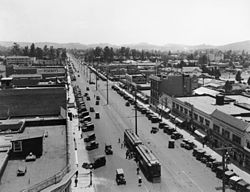
The dual rails then crossed San Fernando Road where the private way ended and the line continued northerly in the pavement of Brand Boulevard, crossing Los Feliz Boulevard, Chevy Chase Boulevard, Colorado Boulevard, Broadway and Lexington Drive. The main line continued north to Verdugo Wash where the line became a single track.
At Arden Junction at Glenoaks Boulevard, the line branched. The old main line continued north in the pavement of Brand Boulevard to a terminus in North Glendale at Mountain Avenue. The Burbank Line diverged westerly as a single-track line on private way in the center of Glenoaks Boulevard, then continued westerly past Central, Pacific, Highland, western, and Alameda Avenues to a terminus in Burbank at Cypress Avenue. From 1925 to 1940 the Burbank Line continued west, following Glenoaks Boulevard, on private way to Ben Mar Hills (Eton Drive).
Stations
The following were stations or stops along the Glendale–Burbank Line:
| Station / stop | Mile | Service | Major connections | Service began | Service ended | City | ||
|---|---|---|---|---|---|---|---|---|
| B | NG | EG | ||||||
| Benmar Hills | 13.32 | ● | July 20, 1925 | November 24, 1940 | Burbank | |||
| Cypress Avenue | ● | September 5, 1911 | June 19, 1955 | |||||
| Burbank | 12.09 | ● | ||||||
| Olive Avenue | ● | |||||||
| Tujunga Avenue | ● | |||||||
| Providencia Avenue | ● | |||||||
| Alameda Avenue | ● | |||||||
| Allen Avenue | ● | Glendale | ||||||
| Western Avenue | ● | |||||||
| Justin Avenue | ● | |||||||
| Senorita–Grover | ● | |||||||
| Grandview Avenue | ● | |||||||
| Graynold Avenue | ● | |||||||
| Highland Avenue | ● | |||||||
| Concord Street | ● | |||||||
| Kenilworth Avenue | ● | |||||||
| Pacific Avenue | ● | |||||||
| Central Avenue | ● | |||||||
| North Glendale | 8.92 | ↑ | ● | 1904 | ||||
| Stocker Street | ● | |||||||
| Dryden Street | ● | |||||||
| Burchett Street (Arden Junction) | ● | ● | ||||||
| Doran Street | ● | ● | ||||||
| Lexington Drive | ● | ● | ||||||
| California Street | ● | ● | ||||||
| Wilson Avenue | ● | ● | ||||||
| East Broadway/Chevy Chase | ↑ | ↑ | ● | c.1916 | December 24, 1946 | |||
| Adams Street | ● | |||||||
| Cedar Street | ● | |||||||
| Glendale Avenue | ● | Glendale and Montrose Railway | 1904 | |||||
| Jackson Street | ● | |||||||
| Kenwood Street | ● | |||||||
| Maryland Avenue | ● | |||||||
| Glendale | 7.48 | ● | ● | ● | April 10, 1904 | June 19, 1955 | ||
| Harvard Street | ● | ● | ● | |||||
| Colorado Street | ● | ● | ● | |||||
| Lomita Avenue | ● | ● | ● | |||||
| Maple Street | ● | ● | ● | |||||
| Garfield Avenue | ● | ● | ● | |||||
| Chevy Chase Drive | ● | ● | ● | |||||
| Magnolia Avenue | ● | ● | ● | |||||
| Los Feliz Road (Tropico) | ● | ● | ● | |||||
| San Fernando/Brand | ● | ● | ● | |||||
| Gardena/Brand | ● | ● | ● | Southern Pacific Railroad at Glendale station | ||||
| Richardson | ● | ● | ● | Los Angeles | ||||
| Atwater | 5.46 | ● | ● | ● | ||||
| Glenhurst Avenue | ● | ● | ● | |||||
| Monte Sano | ● | ● | ● | |||||
| Fletcher Drive | ● | ● | ● | |||||
| India Street | ● | ● | ● | |||||
| Lakeview Avenue | ● | ● | ● | |||||
| Whitmore Avenue | ● | ● | ● | |||||
| Cove Avenue | ● | ● | ● | |||||
| Fargo Street | ● | ● | ● | |||||
| Clifford Street | ● | ● | ● | |||||
| Effie Street | ● | ● | ● | |||||
| Alvarado/Berkeley | ● | ● | ● | |||||
| Scott Avenue | ● | ● | ● | |||||
| Sunset Boulevard | ● | ● | ● | Hollywood, Owensmouth, San Fernando, Sherman, Western and Franklin Avenue, Venice via Hollywood | ||||
| Park Avenue | ● | ● | ● | Hollywood, Owensmouth, San Fernando, Sherman, Western and Franklin Avenue, Venice via Hollywood | ||||
| Santa Ynez Street | ● | ● | ● | Hollywood, Owensmouth, San Fernando, Sherman, Venice via Hollywood | ||||
| Bellevue Avenue | ● | ● | ● | Hollywood, Owensmouth, San Fernando, Sherman, Venice via Hollywood | ||||
| Temple Street | ● | ● | ● | Hollywood, Owensmouth, San Fernando, Sherman, Venice via Hollywood, Los Angeles Railway A | ||||
| Court-Council-La Veta/Colton | ● | ● | ● | Hollywood, Owensmouth, San Fernando, Sherman, Venice via Hollywood | ||||
| Beverly/First | ● | ● | ● | Hollywood, Owensmouth, San Fernando, Sherman, Venice via Hollywood, Los Angeles Railway I | ||||
| Subway Terminal Building | 0 | ● | ● | ● | Echo Park Avenue, Hollywood, Owensmouth, Redondo Beach via Playa del Rey, San Fernando, Sawtelle, Sherman, Venice Short Line, Venice via Hollywood, Western and Franklin Avenue, Westgate | December 1, 1925 | ||
| 6th & Main Street Terminal | — | ● | ● | ● | April 10, 1904 | November 30, 1925 | ||
See also
- Streetcar suburb
- Streetcars in North America
- List of California railroads
- History of rail transportation in California
Notes
This article incorporates text from a free content work. Licensed under the public domain as a work of the State of California. (license statement/permission). Text taken from , California Department of Transportation. Los Angeles County Metropolitan Transportation Authority.
Bibliography
- Swett, Ira & Walker, Jim (1975). Lines of the Pacific Electric Southern and Western Districts, Interurbans Special #60. Glendale, CA: Interurbans Publications. ISBN 0-916374-02-5. OCLC .
- Veysey, Laurence R. (June 1958). (PDF). LACMTA (Report). Los Angeles, California: Interurbans. ASIN . OCLC .
External links
- pictures and documents via Dorothy Peyton Gray Transportation Library and Archive, Los Angeles County Metropolitan Transportation Authority
- . uncanny.net. Archived from on May 24, 2017.
- — Los Angeles Times article concerning development on a portion of the right of way