FC Utrecht
In-game article clicks load inline without leaving the challenge.
Football Club Utrecht (Dutch pronunciation: [ɛfˈseːˈytrɛxt]) is a Dutch professional football club based in Utrecht. The club competes in the Eredivisie, the top tier of Dutch football, and plays its home matches at the Stadion Galgenwaard.
The club was formed in 1970 as a merger between local clubs VV DOS, USV Elinkwijk and Velox. Since then, the club has won three national cup tournaments: in 1985, 2003 and 2004, also winning the Johan Cruyff Shield in 2004 as the first club outside the traditional Dutch Big Three. Utrecht is also the only club outside the Big Three which has never suffered relegation from the top-flight Eredivisie.
Utrecht have competed in 15 European campaigns, reaching the group stages of the 2004–05 UEFA Cup and the 2010–11 UEFA Europa League, their best European results.
History
1970–1979: Merger and early years
In the late 1960s, the municipality of Utrecht initiated talks of a merger between the professional departments of VV DOS, Velox and USV Elinkwijk with the aim of continuing to guarantee professional football at top level in the city. DOS was the largest of the three clubs, and had won a national championship in 1958. With stout defensive tactics, the club had narrowly escaped relegation for three successive years, and mismanagement had left the club on the brink of bankruptcy. A cynical comment from that time was: "The club can do nothing, not even relegate."
Merger plans were experienced less positively at Velox and Elinkwijk. Velox had been promoted to the Eerste Divisie in the early 1960s and had been close to achieving promotion to the Eredivisie a few times. In 1968, however, the team relegated to the third-tier Tweede Divisie again. Elinkwijk had been more successful than Velox. A yo-yo club, Elinkwijk alternated seasons in the bottom of the Eredivisie with seasons in the top of the Eerste Divisie. In addition, there was a sentiment in Elinkwijk that it was not originally an Utrecht-based club, but that it belonged more to the town of Zuilen which was an independent municipality until 1954. The club had no preference for the impending merger, but eventually gave in to pressure from the municipality. During the merger talks, Elinkwijk tried to secure a spot in the highest league of amateur football, but was instead placed in the Tweede Klasse. The following season, the club won the championship and as a result promoted to the Eerste Klasse.
On 1 July 1970, the merger became a fact and FC Utrecht was founded. Since VV DOS had managed to avoid relegation from the Eredivisie in the season before, the new club could immediately play at the highest level in its inaugural season. Utrechts's home ground became Stadion Galgenwaard, which had previously been the VV DOS home ground, the largest stadium of the three parent clubs. Bert Jacobs, the then 29-year-old head coach of Velox, became the first manager of Utrecht; he was joined by 24-year-old Fritz Korbach from USV Elinkwijk as assistant. Their assignment was to forge one club with one culture from its three cores and three different identities.
In the first season, the Utrecht first-team squad consisted almost entirely of former players from DOS, Velox and USV Elinkwijk. Only one outside player was recruited, as defender Co Adriaanse was signed for ƒ 125,000 from De Volewijckers from Amsterdam. The core of the squad also consisted of former DOS players Cor Hildebrand, Ed van Stijn, Piet van Oudenallen, Tom Nieuwenhuys and John Steen Olsen, former Elinkwijk players Joop Leliveld, Jan Blaauw, Dick Teunissen and Jan Groenendijk and former Velox player Marco Cabo. Their first official match was against defending European Cup winners Feyenoord. Groenendijk scored Utrecht's first goal, but despite the 0–1 lead, the team eventually lost 4–1. The club finished in 9th place in its inaugural season, a solid midtable finish.
1980–1990: Near bankruptcy and revival
In the first ten years of its existence, Utrecht grew steadily. Important players from that period were Hans van Breukelen, Leo van Veen and Willem van Hanegem. In the early 1980s, it was decided to construct a new stadium, which was called Nieuw Galgenwaard.
The tide turned in 1981 when the Dutch Fiscal Information and Investigation Service (FIOD) opened an investigation into the club. They could reveal a series of financial malpractices, including transfer and salary costs of various players being financed illegally. Between 1976 and 1980, the club had not paid national insurance contributions and taxes on signing bonuses. In addition, there had been committed fraud with receipts. The club could not meet the stated additional tax and was placed under a debt moratorium. Bankruptcy, at that point, seemed inevitable. Various campaigns were organised by players and supporters, and through a petition, the club managed to collect 66,000 signatures for the retention of the club. Under the leadership of goalkeeper Hans van Breukelen, first-team players went canvassing with FC Utrecht merchandise and recorded a single entitled "We geven het niet op" ("We don't give up"). The municipality of Utrecht eventually decided to respond to the massive local support and covered expenses.
The early 1980s, under the leadership of head coach and former player Han Berger, were successful. The team finished in fifth place in 1980, third in 1981 and fifth place in 1982 of the Eredivisie and in 1982 the club also reached the KNVB Cup final, which was lost to AZ '67. The team also played European football for the first time in club history. The success was in large part due to the large number of youth players that broke through to the first team during these years. Out of eighteen first-team players reaching the cup final in 1982, fourteen were academy players, including van Breukelen, Gert Kruys, Willy Carbo and Ton de Kruijk. Many of these players, such as Leo van Veen, Frans Adelaar, Willem van Hanegem, Ton du Chatinier and Jan Wouters, would later return to the club as managers.
Although the club went through a golden era results-wise, the club was far from healthy financially. To keep the club afloat, key players were let go every season. Van Breukelen left for Nottingham Forest in 1982, Carbo for Club Brugge in 1983 and Rob de Wit for Ajax in 1983. As a result, Utrecht dropped from a near-top side to more mid-table finishes in the Eredivisie table in the mid-1980s.
On 1 April 1985, Utrechts Nieuwsblad published an article about an imminent takeover of the club. A consortium of, among others, the English newspaper magnate Robert Maxwell, Philips, KLM and Johan Cruyff, were said to have plans to invest heavily in Utrecht and acquire a majority shareholding. The supporters of the club were strongly against the takeover, however, especially due to the interference of Ajax legend, Cruyff. Ultimately, the takeover failed.
1991–2005: Troubled 1990s, success and tragedy

After a number of weaker years, Utrecht reached fourth place in the Eredivisie in 1990–91, led by manager Ab Fafié and with players such as Johan de Kock, Jan Willem van Ede and Rob Alflen and top goalscorer of the season, Włodzimierz Smolarek. After this, however, things went downhill for the club. Because Utrecht missed out on European qualification, incomes were lost. Between 1989 and 1996, six managers led the team and there were just as many changes in the board of directors. Quarrels and financial issues arose, which again meant that key players had to be sold to close the holes in the budget. Alflen left for Ajax in 1991, de Kock left for Roda JC in 1994 and Ferdi Vierklau moved to Vitesse in 1996.
Main sponsor AMEV intervened in the dire financial situation in 1996. The club received a financial injection in exchange for a substantial shareholder position. The insurance company appointed Hans Herremans as club chairman. Many investments were made immediately in 1996, as Errol Refos, Rob Witschge and former Utrecht player John van Loen came over from Feyenoord, Reinier Robbemond from Dordrecht, Dick van Burik from NAC and Michael Mols from Twente. Ronald Spelbos was appointed manager with Jan Wouters as assistant. In 1998, a complete renovation of the Stadion Galgenwaard was initiated, designed by ZJA Zwarts & Jansma Architecten.
Despite the capital injection, successes on the pitch failed to materialise during the first years, and a number of managers were hired and fired in rapid succession. In 1993, the team reached a relatively successful eighth place, but for the next eight years, until 2001, the club was unable climb to a higher position than tenth place in the table. In 1994 and 1996, the club even finished 15th, just above the relegation spots. In 1996, the team won only six matches, including an important 1–2 win at Twente, which meant that the promotion/relegation play-offs were avoided. Only in 2001, Utrecht managed to achieve European qualification again with a fifth-place finish, led by former player Frans Adelaar, who had become manager. Utrecht finished with the same number of points as RKC Waalwijk, Roda JC and Vitesse, but secured fifth place on goal difference. In 2002, the team lost the final of the KNVB Cup to Ajax, but in 2003 and 2004, the team, which had come under the leadership of Foeke Booy, managed to win the cup. Important players in this period included Dirk Kuyt, Tom Van Mol, Jean-Paul de Jong, Pascal Bosschaart and Stijn Vreven. In 2004, the Johan Cruyff Shield was also won at the expense of Ajax (2–4), as Hans Somers claimed a key role with two crucial goals.
As a result of, among other things, a new financial crisis and a lack of lucrative transfers, Utrecht was again on the brink of collapse in the spring of 2003. There was no more money to pay Midreth, the company responsible for constructing the renovation of the stadium. At that time, the stadium was largely finished. Since the material for the construction had already been delivered, the construction company advanced the costs, about € 5.5 million. However, this once again left the club with a substantial debt. Bankruptcy was averted with a remediation and the sale of all properties, including the stadium, to, among others, the municipality of Utrecht and Midreth. In the following years, FC Utrecht returned to the mid-table of the Eredivisie.[citation needed]
On 29 November 2005, French defender and fan favourite, David Di Tommaso died suddenly at the age of 26. Di Tommaso had suffered a cardiac arrest in his sleep. The club subsequently retired Di Tommaso's kit number, 4. At the end of each season, the David Di Tommaso Trophy is awarded to the player who was considered of the most valuable that season by fans; the winner is determined by an internet poll. Before his death, Di Tommaso had been the most recent winner of the FC Utrecht Player of the Year, and the award was named after him since then.[citation needed]
2005–2008: Phanos takeover

After the averted bankruptcy of 2003, Utrecht, despite participating in the UEFA Cup in 2003 and 2004, was no longer able to get out of debt. In July 2007, real estate company Phanos first showed interest in taking over the club. For the symbolic amount of €1, Phanos wanted to take over the club, including all outstanding debts. The company then intended to demolish the existing stadium to make the site available for housing. The company would then build a new stadium near the new Leidsche Rijn district. Phanos also wanted the club to become a serious contender in the Eredivisie by means of financial injections. The plan was met with a lot of resistance from supporters, as the Stadion Galgenwaard had seen a radical renovation recently.
Subsequently, a conflict broke out between chairman Jan Willem van Dop, who had come over as director of Feyenoord in 2005, and the supervisory board. The board accused Van Dop of financial mismanagement, poor communication and egotistical behavior, including the recruitment of manager Willem van Hanegem and striker Kevin Vandenbergh. On 3 September 2007, van Dop was relieved from his duties as chairman, but was put back in office three days later after summary proceedings. As a result, the entire supervisory board decided to step down.
2008–present: Van Seumeren era
On 2 April 2008, the Utrecht board announced in a press conference that the club had found a suitable takeover candidate in entrepreneur Frans van Seumeren, former director of the Mammoet logistics company. Van Seumeren acquired 63% of the shares of Utrecht bv for €16 million. He promised to commit to the club for a period of at least ten years and to reinvest any proceeds in the club. He set the goal that the club had to reconnect with the subtop of the league table within a few years, comparable to a club like Heerenveen. Van Seumeren took place in the new supervisory board, of which Jacques van Ek became chairman. Despite the fact that previous takeover candidate Phanos had failed to comply with the agreement between Utrecht and van Seumeren, they remained affiliated with the club as main shirt sponsor until March 2011.
In his role as new owner of the club, van Seumeren was actively involved in the club's footballing policy. In the summer of 2008, against the wishes of head coach van Hanegem, he meddled with the composition of the technical staff by replacing assistant coaches John van Loen and David Nascimento, strength and conditioning coach Rob Druppers and goalkeeping coach Maarten Arts. At the end of 2008, he fired van Hanegem, after he had repeatedly expressed negative opinion on van Seumeren. Technical director Piet Buter also left afterwards. They were replaced by the duo Ton du Chatinier and Foeke Booy as head coach and technical advisor, respectively.
In 2011, chairman van Dop left Utrecht. In the same year, Wilco van Schaik was appointed as new director of the club. The change of function endorsed the conversion of Utrecht from a football association to a vennootschap (private limited company). Du Chatinier was sacked in the summer of 2011 and replaced by assistant Jan Wouters. Despite having a successful resume in terms of player sales and signings, Booy was also let go in 2012 after disappointing results on the pitch. In the 2012–13 season, Utrecht would go on to have one its best seasons historical seasons, finishing fifth in the league table, winning the play-offs for European football and equaling the club points record from 1981 (63 points). The following season, however, turned out to be a setback; Utrecht was eliminated in the second qualifying round of the UEFA Europa League by Differdange 03 from Luxembourg. Utrecht eventually finished tenth in the league.
When Wouters decided not to renew his contract in 2014, after having been head coach for three years, a new direction was taken in terms of technical policy. Co Adriaanse was appointed as technical advisor, a position that has been vacant since Booy's departure in 2012. Adriaanse obtained an advisory, but not binding, voice in player policy, and was given powers in composing the club's coaching staff. Rob Alflen, assistant under Wouters, would provide the training sessions. The pair were hired with the purpose of making Utrecht play more attacking, attractive football.
Alflen disappointed, only leading Utrecht to eleventh place in the league table, and he was let go after only one season in charge in 2015. Erik ten Hag was appointed as his replacement, coming from a position as Bayern Munich II manager. Club icon Jean-Paul de Jong was appointed as his assistant. Adriaanse also left the club, with Ten Hag taking the extra role as technical manager. The 2015–16 season proved to be highly successful, with Utrecht ending in fifth place of the Eredivisie table and reaching the KNVB Cup final, which was lost 2–1 to Feyenoord. Utrecht would also lose the final of the play-offs for European football to Heracles Almelo. The reserves team of the club, Jong Utrecht, however, became champions of the Beloften Eredivisie in the 2015–16 season. With changes made to the Dutch football league system, Jong Utrecht was therefore promoted to the second-tier Eerste Divisie.
In the 2016–17 season, Utrecht secured a fourth-place finish with two match-days left to play. In the final of the play-offs for European football, they beat AZ Alkmaar was after an exciting diptych (0–3, 3–0, 4–3 after penalty shoot-out). As a result of Utrecht's success, Ten Hag was appointed new head coach of Ajax with assistant De Jong taking over as head coach on 1 January 2018.
Stadium
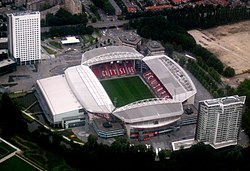
Utrecht's stadium is the Stadion Galgenwaard, previously named the Galgenwaard, then later the Nieuw Galgenwaard. It has a current capacity of 23,750 spectators. The attendance on average was 19,600 people in 2004–05, while the average attendance rose to 20,004 in 2006–07. The 2023–24 season saw an alltime high in average attendance with 20,500 people visiting on average. The stadium also accommodates several shops, offices and the supporters home of the Utrecht fan club (Supporters Vereniging Utrecht), one of the largest of its kind in Europe.
Honours
National
- National champions (highest level of Dutch football) Winners: 1957–58 (as VV DOS) Runners-up: 1953–54 (as VV DOS)
- District champions (highest level of Dutch football before 1956–57) Winners: 1953–54 (as VV DOS), 1955–56 (as USV Elinkwijk)
- Eerste divisie (second highest level of Dutch football) Runners-up: 1964–65 (as USV Elinkwijk)
- Tweede Divisie (third highest level of Dutch football) Winners: 1961–62 (as Velox) Runners-up: 1969–70 (as Velox, joint with FC Wageningen but deciding match was never played because of the merger)
- KNVB Cup Winners: 1984–85, 2002–03, 2003–04 Runners-up: 1981–82, 2001–02, 2015–16 Other: 2019–20 (final was cancelled due to the COVID-19 pandemic)
- Johan Cruijff Schaal Winners: 2004 Runners-up: 2003
European
- Intertoto Cup/Summer Cup Joint Winners: 1978
Utrecht in European competitions
Utrecht's first competitive European match, in the team's current iteration (not as DOS), was on 17 September 1980, in the 1980–81 UEFA Cup, playing FC Argeş Piteşti to a 0–0 draw. Since then, the club has participated in fourteen UEFA competitions, advancing as far as the group stage in the 2004–05 UEFA Cup and the 2010–11 UEFA Europa League
Accurate as of 21 August 2025
| Competition | Played | Won | Drew | Lost | GF | GA | GD | Win % |
|---|---|---|---|---|---|---|---|---|
| Cup Winners' Cup | 2 | 1 | 0 | 1 | 3 | 5 | −2 | 050.00 |
| UEFA Cup / UEFA Europa League | 60 | 21 | 18 | 21 | 83 | 76 | +7 | 035.00 |
| UEFA Intertoto Cup | 2 | 0 | 2 | 0 | 1 | 1 | +0 | 000.00 |
| Total | 64 | 22 | 20 | 22 | 87 | 82 | +5 | 034.38 |
Source: Pld = Matches played; W = Matches won; D = Matches drawn; L = Matches lost; GF = Goals for; GA = Goals against; GD = Goal Difference. Defunct competitions indicated in italics.
UEFA Current ranking
As of 1 December 2023
| Rank | Country | Team | Points |
|---|---|---|---|
| 119 | Netherlands | Willem II | 11.420 |
| 120 | Netherlands | FC Utrecht | 11.420 |
| 121 | France | Lens | 11.266 |
Domestic results

Below is a table with Utrecht's results since the introduction of the Eredivisie in 1956.
| Domestic Results since 1956 | ||||
|---|---|---|---|---|
| Domestic league | League result | Qualification to | KNVB Cup season | Cup result |
| 2024–25 Eredivisie | 4th | UEFA Europa League (Q3) | 2024–25 | quarter final |
| 2023–24 Eredivisie | 7th | Play-offs (losing the final) | 2023–24 | second round |
| 2022–23 Eredivisie | 7th | Play-offs (losing the semi-final) | 2022–23 | quarter final |
| 2021–22 Eredivisie | 7th | Play-offs (losing the semi-final) | 2021–22 | second round |
| 2020–21 Eredivisie | 6th | Play-offs (losing the final) | 2020–21 | second round |
| 2019–20 Eredivisie | 6th | – | 2019–20 | finalist |
| 2018–19 Eredivisie | 6th | UEFA Europa League (after winning EL play-offs) (Q2) | 2018–19 | round of 16 |
| 2017–18 Eredivisie | 5th | – | 2017–18 | second round |
| 2016–17 Eredivisie | 4th | UEFA Europa League (after winning EL play-offs) (Q2) | 2016–17 | quarter final |
| 2015–16 Eredivisie | 5th | – | 2015–16 | final |
| 2014–15 Eredivisie | 11th | – | 2014–15 | second round |
| 2013–14 Eredivisie | 10th | – | 2013–14 | quarter final |
| 2012–13 Eredivisie | 5th | UEFA Europa League (after winning EL play-offs) (Q2) | 2012–13 | second round |
| 2011–12 Eredivisie | 11th | – | 2011–12 | second round |
| 2010–11 Eredivisie | 9th | – | 2010–11 | semi-final |
| 2009–10 Eredivisie | 7th | UEFA Europa League (after winning EL play-offs) (Q2) | 2009–10 | second round |
| 2008–09 Eredivisie | 9th | – (after losing EL play-offs) | 2008–09 | second round |
| 2007–08 Eredivisie | 10th | – (after losing UC play-offs) | 2007–08 | second round |
| 2006–07 Eredivisie | 9th | Intertoto Cup (after losing UC play-offs final) | 2006–07 | quarter final |
| 2005–06 Eredivisie | 6th | – (after losing UC play-offs) | 2005–06 | third round |
| 2004–05 Eredivisie | 11th | – | 2004–05 | round of 16 |
| 2003–04 Eredivisie | 11th | UEFA Cup | 2003–04 | winners |
| 2002–03 Eredivisie | 8th | UEFA Cup | 2002–03 | winners |
| 2001–02 Eredivisie | 7th | UEFA Cup | 2001–02 | final |
| 2000–01 Eredivisie | 5th | UEFA Cup | 2000–01 | round of 16 |
| 1999–2000 Eredivisie | 10th | – | 1999–2000 | quarter final |
| 1998–99 Eredivisie | 12th | – | 1998–99 | round of 16 |
| 1997–98 Eredivisie | 10th | – | 1997–98 | group stage |
| 1996–97 Eredivisie | 12th | – | 1996–97 | group stage |
| 1995–96 Eredivisie | 15th | – | 1995–96 | second round |
| 1994–95 Eredivisie | 12th | – | 1994–95 | semi-final |
| 1993–94 Eredivisie | 15th | – | 1993–94 | third round |
| 1992–93 Eredivisie | 8th | – | 1992–93 | round of 16 |
| 1991–92 Eredivisie | 11th | – | 1991–92 | quarter final |
| 1990–91 Eredivisie | 4th | UEFA Cup | 1990–91 | round of 16 |
| 1989–90 Eredivisie | 14th | – | 1989–90 | second round |
| 1988–89 Eredivisie | 13th | – | 1988–89 | round of 16 |
| 1987–88 Eredivisie | 10th | – | 1987–88 | first round |
| 1986–87 Eredivisie | 6th | UEFA Cup (after winning UC play-offs) | 1986–87 | round of 16 |
| 1985–86 Eredivisie | 12th | – | 1985–86 | second round |
| 1984–85 Eredivisie | 10th | Cup Winners' Cup | 1984–85 | winners |
| 1983–84 Eredivisie | 8th | – | 1983–84 | second round |
| 1982–83 Eredivisie | 10th | – | 1982–83 | second round |
| 1981–82 Eredivisie | 5th | UEFA Cup | 1981–82 | final |
| 1980–81 Eredivisie | 3rd | UEFA Cup | 1980–81 | round of 16 |
| 1979–80 Eredivisie | 5th | UEFA Cup | 1979–80 | round of 16 |
| 1978–79 Eredivisie | 13th | – | 1978–79 | round of 16 |
| 1977–78 Eredivisie | 8th | – | 1977–78 | round of 16 |
| 1976–77 Eredivisie | 6th | – | 1976–77 | round of 16 |
| 1975–76 Eredivisie | 14th | – | 1975–76 | second round |
| 1974–75 Eredivisie | 15th | – | 1974–75 | round of 16 |
| 1973–74 Eredivisie | 9th | – | 1973–74 | semi-final |
| 1972–73 Eredivisie | 8th | – | 1972–73 | second round |
| 1971–72 Eredivisie | 6th | – | 1971–72 | first round |
| 1970–71 Eredivisie | 9th | – | 1970–71 | second round |
| 1969–70 Eredivisie (as DOS) 1969–70 Eerste Divisie (as Elinkwijk) 1969–70 Tweede Divisie (as Velox) | 6th 4th 3rd | – | 1969–70 | second round [citation needed] quarter final [citation needed] second round [citation needed] |
| 1968–69 Eredivisie (as DOS) 1968–69 Eerste Divisie (as Elinkwijk) 1968–69 Tweede Divisie (as Velox) | 17th 12th 10th | – (after surviving promotion/relegation play-off) – – | 1968–69 | first round [citation needed] second round [citation needed] first round [citation needed] |
| 1967–68 Eredivisie (as DOS) 1967–68 Eerste Divisie (as Elinkwijk... ...and Velox) | 16th 8th 19th | Inter-Cities Fairs Cup – Tweede Divisie (relegation) | 1967–68 | group stage [citation needed] quarter final [citation needed] second round [citation needed] |
| 1966–67 Eredivisie (as DOS... ...and Elinkwijk) 1966–67 Eerste Divisie (as Velox) | 15th 17th 16th | Inter-Cities Fairs Cup Eerste Divisie (relegation) – | 1966–67 | first round [citation needed] second round [citation needed] DNC [citation needed] |
| 1965–66 Eredivisie (as DOS... ...and Elinkwijk) 1965–66 Eerste Divisie (as Velox) | 12th 14th 5th | Inter-Cities Fairs Cup – – | 1965–66 | second round [citation needed] group stage [citation needed] group stage [citation needed] |
| 1964–65 Eredivisie (as DOS) 1964–65 Eerste Divisie (as Elinkwijk... ...and Velox) | 12th 2nd 4th | Inter-Cities Fairs Cup Eredivisie (promotion) – | 1964–65 | first round [citation needed] second round [citation needed] round of 16 [citation needed] |
| 1963–64 Eredivisie (as DOS) 1963–64 Eerste Divisie (as Elinkwijk... ...and Velox) | 9th 7th 5th | Inter-Cities Fairs Cup – – | 1963–64 | first round [citation needed] first round [citation needed] round of 16 [citation needed] |
| 1962–63 Eredivisie (as DOS) 1962–63 Eerste Divisie (as Elinkwijk... ...and Velox) | 7th 10th 5th | Inter-Cities Fairs Cup – – | 1962–63 | third round [citation needed] third round [citation needed] second round [citation needed] |
| 1961–62 Eredivisie (as DOS) 1961–62 Eerste Divisie (as Elinkwijk) 1961–62 Tweede Divisie (as Velox) | 10th 3rd (group B) 1st | – – Eerste Divisie (promotion) | 1961–62 | ? [citation needed] |
| 1960–61 Eredivisie (as DOS... ...and Elinkwijk) 1960–61 Tweede Divisie (as Velox) | 5th 16th 8th | – Eerste Divisie (relegation) – | 1960–61 | ? [citation needed] |
| 1959–60 Eredivisie (as DOS... ...and Elinkwijk) 1959–60 Tweede Divisie (as Velox) | 4th 15th 4th (group B) | – – (after surviving promotion/relegation play-off) – | not held | not held |
| 1958–59 Eredivisie (as DOS... ...and Elinkwijk) | 4th 12th | – | 1958–59 | ? [citation needed] |
| 1957–58 Eredivisie (as DOS... ...and Elinkwijk) | 1st 16th | European Cup – | 1957–58 | ? [citation needed] |
| 1956–57 Eredivisie (as DOS... ...and Elinkwijk) | 10th 16th | – | 1956–57 | ? [citation needed] |
Players
Current squad
As of 5 February 2026
Note: Flags indicate national team as defined under FIFA eligibility rules; some limited exceptions apply. Players may hold more than one non-FIFA nationality.
Out on loan
Note: Flags indicate national team as defined under FIFA eligibility rules; some limited exceptions apply. Players may hold more than one non-FIFA nationality.
| No. | Pos. | Nation | Player |
|---|---|---|---|
| No. Pos. Nation Player — MF NED Davy van den Berg (at Luton Town FC until 30 June 2026) — GK NED Tom de Graaff (at PEC Zwolle until 30 June 2026) — FW NED Jesse van de Haar (at SK Beveren until 30 June 2026) — FW IDN Miliano Jonathans (at Excelsior Rotterdam until 30 June 2026) — FW NED Noah Ohio (at Real Valladolid until 30 June 2026) — DF NED Neville Ogidi Nwankwo (at Telstar until 30 June 2026) | |||
| — | MF | NED | Davy van den Berg (at Luton Town FC until 30 June 2026) |
| — | GK | NED | Tom de Graaff (at PEC Zwolle until 30 June 2026) |
| — | FW | NED | Jesse van de Haar (at SK Beveren until 30 June 2026) |
| — | FW | IDN | Miliano Jonathans (at Excelsior Rotterdam until 30 June 2026) |
| — | FW | NED | Noah Ohio (at Real Valladolid until 30 June 2026) |
| — | DF | NED | Neville Ogidi Nwankwo (at Telstar until 30 June 2026) |
Youth squad
Retired numbers
| No. | Pos. | Player | From | Reason |
|---|---|---|---|---|
| No. Pos. Player From Reason 4 DF France David Di Tommaso 2005 Posthumous honour | ||||
| 4 | DF | France David Di Tommaso | 2005 | Posthumous honour |
Records
As of 17 May 2017
Players in bold text are still active.
| No. | Player | Goals | Utrecht career |
|---|---|---|---|
| Top Goalscorers No. Player Goals Utrecht career 1 Leo van Veen 153 1970–1982, 1983–1984 2 John van Loen 52 1983–1988, 1996–1998 3 Dirk Kuyt 51 1998–2003 = Ton de Kruijk 51 1976–1988 5 Michael Mols 50 1996–1999, 2004–2005 6 Sébastien Haller 44 2015–2017, 2025- = Willy Carbo 44 1979–1983 8 Erik Willaarts 42 1986–1990 9 Stefaan Tanghe 40 2000–2005 10 Igor Gluščević 39 2000–2003 | |||
| 1 | Leo van Veen | 153 | 1970–1982, 1983–1984 |
| 2 | John van Loen | 52 | 1983–1988, 1996–1998 |
| 3 | Dirk Kuyt | 51 | 1998–2003 |
| = | Ton de Kruijk | 51 | 1976–1988 |
| 5 | Michael Mols | 50 | 1996–1999, 2004–2005 |
| 6 | Sébastien Haller | 44 | 2015–2017, 2025- |
| = | Willy Carbo | 44 | 1979–1983 |
| 8 | Erik Willaarts | 42 | 1986–1990 |
| 9 | Stefaan Tanghe | 40 | 2000–2005 |
| 10 | Igor Gluščević | 39 | 2000–2003 |
Former players
National team players
The following players were called up to represent their national teams in international football and received caps during their tenure with FC Utrecht:
- Players in bold actively play for FC Utrecht and for their respective national teams. Years in brackets indicate careerspan with Utrecht.
National team players by Confederation
Member associations are listed in order of most to fewest current and former FC Utrecht players represented internationally
| Confederation | Total | (Nation) Association |
|---|---|---|
| AFC | 12 | Australia Australia (3), Indonesia Indonesia (8), Iraq Iraq (1) |
| CAF | 8 | Ghana Ghana (2), Morocco Morocco (2), The Gambia Gambia (1), Mali Mali (1), Nigeria Nigeria (1), Zambia Zambia (1) |
| CONCACAF | 6 | United States United States (3), Guadeloupe Guadeloupe (2), Curaçao Curaçao (1) |
| CONMEBOL | 1 | Paraguay Paraguay (1) |
| OFC | 0 | |
| UEFA | 28 | Netherlands Netherlands (11), Denmark Denmark (4), Belgium Belgium (2), Bosnia and Herzegovina Bosnia and Herzegovina (1), Czech Republic Czech Republic (1), Estonia Estonia (1), Finland Finland (1), Greece Greece (1), Hungary Hungary (1), Iceland Iceland (1), Norway Norway (1), Poland Poland (1), Romania Romania (1), Scotland Scotland (1) |
Players in international tournaments
The following is a list of FC Utrecht players who have competed in international tournaments, including the FIFA World Cup, UEFA European Championship, Africa Cup of Nations, AFC Asian Cup, CONCACAF Gold Cup, and the Caribbean Cup. To this date no FC Utrecht players have participated in the Copa América, or the OFC Nations Cup while playing for FC Utrecht.
Board and staff
Current staff
| Position | Name |
|---|---|
| Head coach | Netherlands Ron Jans |
| Assistant trainer | Netherlands Rob Penders |
| Netherlands Kevin van Veen | |
| Goalkeeper coach | Netherlands Harald Wapenaar |
| Individual trainer | Netherlands Willem Janssen |
| Zambia Jacob Mulenga |
List of FC Utrecht coaches
- Netherlands Bert Jacobs (1 July 1970 – 30 June 1974)
- Netherlands Jan Rab (1974–76)
- Netherlands Han Berger (1 Jan 1976 – 30 June 1983)
- Wales Barry Hughes (1983–84)
- Netherlands Nol de Ruiter (1 July 1984 – 30 June 1987)
- Netherlands Han Berger (1 July 1987 – 30 June 1989)
- Netherlands Cees Loffeld (1989–90)
- Netherlands Ab Fafié (17 Oct 1990 – 17 Feb 1993)
- Netherlands Henk Vonk (caretaker) (17 Feb 1993 – Sept 16, 1993)
- Netherlands Leo van Veen (Sept 17, 1993–30 June 1995)
- Netherlands Ton du Chatinier and Netherlands Henk Vonk (1995)
- Netherlands Simon Kistemaker (1 July 1995 – 30 Nov 1995)
- Netherlands Nol de Ruiter (caretaker) (30 Nov 1995 – 23 Jan 1996)
- Netherlands Ronald Spelbos (18 Jan 1996 – 27 Nov 1997)
- Netherlands Jan Wouters (1997)
- Netherlands Mark Wotte (31 Dec 1997 – 28 March 2000)
- Netherlands Frans Adelaar (29 March 2000 – 30 June 2002)
- Netherlands Foeke Booy (1 July 2002 – 30 June 2007)
- Netherlands Willem van Hanegem (1 July 2007 – 23 Dec 2008)
- Netherlands Ton du Chatinier (24 Dec 2008 – 19 May 2011)
- Netherlands Erwin Koeman (1 July 2011 – 18 Oct 2011)
- Netherlands Jan Wouters (18 Oct 2011 – 30 June 2014)
- Netherlands Rob Alflen (1 July 2014 – 30 June 2015)
- Netherlands Erik ten Hag (1 July 2015 – 27 Dec 2017)
- Netherlands Jean-Paul de Jong (28 Dec 2017 – 4 Sep 2018)
- Netherlands Dick Advocaat (17 Sep 2018 – 30 June 2019)
- Netherlands John van den Brom (1 July 2019 – 6 November 2020)
- Netherlands René Hake (6 November 2020 – 22 March 2022)
- Netherlands Rick Kruys (caretaker) (22 March 2022 – 30 June 2022)
- Netherlands Henk Fraser (1 July 2022 – 14 December 2022)
- Denmark Michael Silberbauer (28 December 2022 – 29 August 2023)
- Netherlands Rob Penders (caretaker) (29 August 2023 – 11 September 2023)
- Netherlands Ron Jans (11 September 2023 – 30 June 2026)
- Netherlands Anthony Correia (1 July 2026 – present)
Kit manufacturers
| Period | Kit Manufacturer |
|---|---|
| Period Kit Manufacturer 1971–1976 Le Coq Sportif 1976–1979 Puma 1979–1981 Pony 1981–1983 Admiral 1983–1989 Puma 1989–1995 Lotto 1995–2001 Reebok 2001–2009 Puma 2009–2012 Kappa 2012–2019 Hummel 2019–2023 Nike 2023–0000 Castore | |
| 1971–1976 | Le Coq Sportif |
| 1976–1979 | Puma |
| 1979–1981 | Pony |
| 1981–1983 | Admiral |
| 1983–1989 | Puma |
| 1989–1995 | Lotto |
| 1995–2001 | Reebok |
| 2001–2009 | Puma |
| 2009–2012 | Kappa |
| 2012–2019 | Hummel |
| 2019–2023 | Nike |
| 2023–0000 | Castore |