Geologic province
In-game article clicks load inline without leaving the challenge.
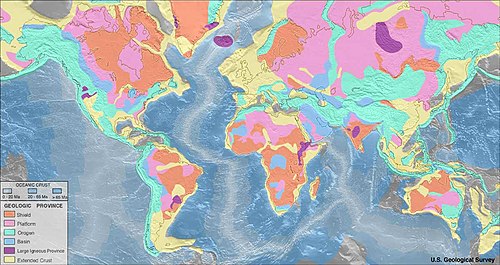
A geologic province or geological province is a spatial entity with common geologic attributes. A province may include a single dominant structural element such as a basin or a fold belt, or a number of contiguous related elements. Adjoining provinces may be similar in structure but be considered separate due to differing histories.
Geologic provinces by origin
| Province | Definition | Subcategories | Examples |
|---|---|---|---|
| Shield | Exposed Precambrian crystalline igneous and metamorphic rocks that form tectonically stable areas | Arabian-Nubian Shield Canadian Shield | |
| Platform | Horizontal or gently-lying sedimentary strata covering a basement of igneous or metamorphic rocks | Carbonate platform | East European Platform |
| Orogen | Linear or arc-shaped formation where continental crust has been folded, deformed and uplifted to form mountain ranges | Island arc Continental arc Forearc | Laramide Orogeny Andean Orogeny |
| Basin | Low-lying formation of rock strata formed by tectonic warping of previously horizontal strata | Cratonic basin Foredeep basin Sedimentary basin | Illinois Basin Paraná Basin |
| Large igneous province | Accumulation of igneous rocks, including liquid rock (intrusive) or volcanic rock formations (extrusive) | North Atlantic Igneous Province Columbia River Basalt Group | |
| Extended crust | Continental crust thinned due to extensional strain | Passive margin Rift | Basin and Range Province Northern Cordilleran Volcanic Province |
Geologic provinces by resources

Some studies classify provinces based upon mineral resources, such as mineral deposits. There are a particularly large number of provinces identified worldwide for petroleum and other mineral fuels, such as the Niger Delta petroleum province.
See also
External links
- (NASA)
- (USGS)
- (USGS)