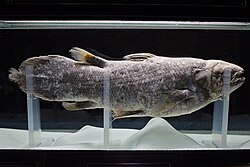
Coelacanths (/ˈsiːləkænθ/ ⓘ SEE-lə-kanth) are an ancient group of lobe-finned fish (Sarcopterygii) in the class Actinistia. As sarcopterygians, they are more closely related to lungfish and tetrapods (the terrestrial vertebrates including living amphibians, reptiles, birds and mammals) than to ray-finned fish.

The name coelacanth originates from the Permian genus Coelacanthus, which was the first scientifically named genus of coelacanths (in 1839), becoming the type genus of Coelacanthiformes as other species were discovered and named. Well-represented in freshwater and marine deposits from as early as the Devonian period (more than 410million years ago), they were thought to have become extinct in the Late Cretaceous, around 66million years ago.

The first living species, Latimeria chalumnae, the West Indian Ocean coelacanth, was described from specimens fished off the coast of South Africa from 1938 onward; they are now also known to inhabit the seas around the Comoro Islands off the east coast of Africa. The second species, Latimeria menadoensis, the Indonesian coelacanth, was discovered in the late 1990s, which inhabits the seas of Eastern Indonesia, from Manado to Papua.

The coelacanth (more accurately, the extant genus Latimeria) is often considered an example of a "living fossil" in popular science because it was considered the sole remaining member of a taxon otherwise known only from fossils (a biological relict), evolving a bodyplan similar to its current form approximately 400million years ago. However, studies of fossil coelacanths have shown that coelacanth body shapes (and their niches) were much more diverse than what was previously thought, and often differed significantly from Latimeria.

Etymology

The word Coelacanth is an adaptation of the Modern Latin Cœlacanthus ('hollow spine'), from the Ancient Greek κοῖλ-ος (koilos, 'hollow') and ἄκανθ-α (akantha, 'spine'), referring to the hollow caudal fin rays of the first fossil specimen described and named by Louis Agassiz in 1839, belonging to the genus Coelacanthus. The genus name Latimeria commemorates Marjorie Courtenay-Latimer, who discovered the first specimen.

Discovery

Fossil of Coelacanthus granulatus, the first described coelacanth, named by Louis Agassiz in 1839
Marjorie Courtenay-Latimer with the type specimen of Latimeria chalumnae

The earliest fossils of coelacanths were discovered in the 19th century. Coelacanths were believed to have become extinct at the end of the Cretaceous period. More closely related to tetrapods than to the ray-finned fish, coelacanths were considered a transitional form between fish and tetrapods.

On 22 December 1938, the first Latimeria specimen was found off the east coast of South Africa, off the Chalumna River (now Tyolomnqa). Museum curator Marjorie Courtenay-Latimer discovered the fish among the catch of a local fisherman. Courtenay-Latimer contacted a Rhodes University ichthyologist, J. L. B. Smith, sending him drawings of the fish, and he confirmed the fish's importance with a famous cable: "Most Important Preserve Skeleton and Gills = Fish Described." Its discovery over 60 million years after its supposed extinction makes the coelacanth the best-known example of a Lazarus taxon, a taxon or an evolutionary line that seems to have disappeared from the fossil record only to reappear much later. Since 1938, West Indian Ocean coelacanth have been found in the Comoros, Kenya, Tanzania, Mozambique, Madagascar, in iSimangaliso Wetland Park, and off the South Coast of Kwazulu-Natal in South Africa.

The Comoro Islands specimen was discovered in December 1952. Between 1938 and 1975, 84 specimens were caught and recorded.

The second extant species, the Indonesian coelacanth, was first recognized in Manado, North Sulawesi, Indonesia, by Mark V. Erdmann and his wife Arnaz Mehta at a local fish market in September 1997, but were only able to take a few photographs of the first specimen of this species before it was sold. After confirming that it was a unique discovery, Erdmann returned to Sulawesi in November 1997 to interview fishermen and look for further examples. A second specimen was caught by a fisherman in July 1998 and was then handed to Erdmann. The species was described in 1999 by Pouyaud et al. based on Erdmann's 1998 specimen and deposited at a facility of the Indonesian Institute of Sciences (LIPI).

Distribution

Geographical distribution of coelacanth

Prehistorically, Actinistians ranged throughout the world, being found in geological formations of Europe, the Americas, Australia, and Greenland.

Some species of Actinistians, especially the Mawsoniids, were found in deposits corresponding to brackish and even freshwater environments, suggesting an anadromous ability.

The two extant Latimeria species, the West Indian Ocean coelacanth and the Indonesian coelacanth, are restricted to a few locales within the Indo-Pacific and are named based on their range.

Description
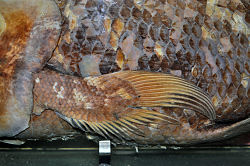
Pectoral fin of a West Indian Ocean coelacanth

Coelacanths are a part of Sarcopterygii or the lobe-finned fishes, the same clade as the lungfish and tetrapods, and they all possess lobed fins as opposed to rayed fins. Externally, several characteristics distinguish coelacanths from other lobe-finned fish: coelacanths have eight fins – two dorsal fins, two pectoral fins, two pelvic fins, one anal fin and one caudal fin. The tail is very nearly equally proportioned and is split by a terminal tuft of fin rays that make up its caudal lobe; this is alternatively termed a trilobate fin (three-lobed) or a diphycercal tail. A secondary tail extending past the primary tail separates the upper and lower halves of the coelacanth.[clarification needed] Ctenoid elasmoid scales act as thick armor to protect the coelacanth's exterior. Several internal traits also aid in differentiating coelacanths from other lobe-finned fish. At the back of the skull, the coelacanth possesses a hinge, the intracranial joint, which allows it to open its mouth extremely wide. Coelacanths also retain an oil-filled notochord, a hollow, pressurized tube which is replaced by a vertebral column early in embryonic development in most other vertebrates.[better source needed] The body is covered in ctenoid elasmoid scales that act as armor.

The soft tissue of coelacanths is mostly known from Latimeria, the relictual extant genus.

Evolution and taxonomy

Specimen of Libys (Latimeriidae) from the Upper Jurassic of Germany
Estimated size of the largest known individual of the Jurassic-Cretaceous freshwater coelacanth Mawsonia compared to a human
Life restoration of the basal coelacanth Allenypterus from the Carboniferous of North America
Coelacanth
Coelacanth at Abdallah Al Salem Cultural Center in Kuwait

Coelacanths are members of the class Actinistia, with many researchers considering the term "coelacanth" to cover all members of Actinistia. The order Coelacanthiformes has been used for a subgroup of actinistians, containing the modern coelacanths, as well as other extinct closely related actinistians spanning from the Permian onwards. Based on the fossil record, the divergence of coelacanths, lungfish, and tetrapods is thought to have occurred during the Silurian. Over 100 fossil species of coelacanth have been described. The oldest identified coelacanth fossils are around 420–410 million years old, dating to the Pragian stage of the early Devonian. These include Eoactinistia from Australia, known only from a fragmentary jaw, as well as Euporosteus yunnanensis from China, known from a partial skull that indicates it to be the earliest anatomically modern coelacanth. Some authors have also suggested that the slightly older onychodont Styloichthys may also be an early coelacanth.

Coelacanths were never a diverse group in comparison to other groups of fish, and reached a peak diversity during the Early Triassic (252–247 million years ago), coinciding with a burst of diversification between the Late Permian and Middle Triassic. Most Mesozoic coelacanths belong to the suborder Latimerioidei, which contains two major subdivisions, the marine Latimeriidae, which contains modern coelacanths, as well as the extinct Mawsoniidae, which were native to brackish, freshwater as well as marine environments.

Paleozoic coelacanths are generally small (~30–40 cm or 12–16 in in length), while Mesozoic forms were larger. Several specimens belonging to the Jurassic and Cretaceous mawsoniid coelacanth genera Trachymetopon and Mawsonia likely reached or exceeded 5 metres (16 feet) in length, making them amongst the largest known fishes of the Mesozoic, and amongst the largest bony fishes of all time.

The most recent fossil latimeriid is Megalocoelacanthus dobiei, whose disarticulated remains are found in late Santonian to middle Campanian, and possibly earliest Maastrichtian-aged marine strata of the Eastern and Central United States, the most recent mawsoniids are Axelrodichthys megadromos from early Campanian to early Maastrichtian freshwater continental deposits of France, as well as an indeterminate marine mawsoniid from Morocco, dating to the late Maastrichtian A small bone fragment from the European Paleocene has been considered the only plausible post-Cretaceous record, but this identification is based on comparative bone histology methods of doubtful reliability.

Living coelacanths have been considered "living fossils" based on their supposedly conservative morphology relative to fossil species; however, recent studies have expressed the view that coelacanth morphologic conservatism is a belief not based on data. Fossils suggest that coelacanths were most morphologically diverse during the Devonian and Carboniferous, while Mesozoic species are generally morphologically similar to each other.

Cladogram showing the relationships of coelacanth genera after Torino, Soto and Perea, 2021.

Mimipiscis (Actinopterygii)
Porolepis (Porolepiformes)
ActinistiaMiguashaia Styloichthys Gavinia Diplocercides Serenichthys Holopterygius Allenypterus Lochmocercus Polyosteorhynchus Rebellatrix Hadronector Rhabdoderma Caridosuctor Sassenia Spermatodus Piveteauia Coccoderma Laugia Coelacanthus Guizhoucoelacanthus Wimania Axelia Whiteia Heptanema Dobrogeria Latimerioidei Mawsoniidae Atacamaia Luopingcoelacanthus Yunnancoelacanthus Chinlea Parnaibaia Trachymetopon Lualabaea Axelrodichthys Mawsonia Latimeriidae Garnbergia Diplurus Megalocoelacanthus Libys Ticinepomis Foreyia Holophagus Undina Macropoma Swenzia Latimeria
Miguashaia
Styloichthys
Gavinia
Diplocercides Serenichthys Holopterygius Allenypterus Lochmocercus Polyosteorhynchus Rebellatrix Hadronector Rhabdoderma Caridosuctor Sassenia Spermatodus Piveteauia Coccoderma Laugia Coelacanthus Guizhoucoelacanthus Wimania Axelia Whiteia Heptanema Dobrogeria Latimerioidei Mawsoniidae Atacamaia Luopingcoelacanthus Yunnancoelacanthus Chinlea Parnaibaia Trachymetopon Lualabaea Axelrodichthys Mawsonia Latimeriidae Garnbergia Diplurus Megalocoelacanthus Libys Ticinepomis Foreyia Holophagus Undina Macropoma Swenzia Latimeria
Diplocercides
Serenichthys Holopterygius Allenypterus Lochmocercus Polyosteorhynchus Rebellatrix Hadronector Rhabdoderma Caridosuctor Sassenia Spermatodus Piveteauia Coccoderma Laugia Coelacanthus Guizhoucoelacanthus Wimania Axelia Whiteia Heptanema Dobrogeria Latimerioidei Mawsoniidae Atacamaia Luopingcoelacanthus Yunnancoelacanthus Chinlea Parnaibaia Trachymetopon Lualabaea Axelrodichthys Mawsonia Latimeriidae Garnbergia Diplurus Megalocoelacanthus Libys Ticinepomis Foreyia Holophagus Undina Macropoma Swenzia Latimeria
Serenichthys
Holopterygius Allenypterus
Holopterygius
Allenypterus
Lochmocercus Polyosteorhynchus Rebellatrix Hadronector Rhabdoderma Caridosuctor Sassenia Spermatodus Piveteauia Coccoderma Laugia Coelacanthus Guizhoucoelacanthus Wimania Axelia Whiteia Heptanema Dobrogeria Latimerioidei Mawsoniidae Atacamaia Luopingcoelacanthus Yunnancoelacanthus Chinlea Parnaibaia Trachymetopon Lualabaea Axelrodichthys Mawsonia Latimeriidae Garnbergia Diplurus Megalocoelacanthus Libys Ticinepomis Foreyia Holophagus Undina Macropoma Swenzia Latimeria
Lochmocercus
Polyosteorhynchus Rebellatrix Hadronector Rhabdoderma Caridosuctor Sassenia Spermatodus Piveteauia Coccoderma Laugia Coelacanthus Guizhoucoelacanthus Wimania Axelia Whiteia Heptanema Dobrogeria Latimerioidei Mawsoniidae Atacamaia Luopingcoelacanthus Yunnancoelacanthus Chinlea Parnaibaia Trachymetopon Lualabaea Axelrodichthys Mawsonia Latimeriidae Garnbergia Diplurus Megalocoelacanthus Libys Ticinepomis Foreyia Holophagus Undina Macropoma Swenzia Latimeria
Polyosteorhynchus Rebellatrix Hadronector
Polyosteorhynchus
Rebellatrix Hadronector
Rebellatrix
Hadronector
Rhabdoderma Caridosuctor Sassenia Spermatodus Piveteauia Coccoderma Laugia Coelacanthus Guizhoucoelacanthus Wimania Axelia Whiteia Heptanema Dobrogeria Latimerioidei Mawsoniidae Atacamaia Luopingcoelacanthus Yunnancoelacanthus Chinlea Parnaibaia Trachymetopon Lualabaea Axelrodichthys Mawsonia Latimeriidae Garnbergia Diplurus Megalocoelacanthus Libys Ticinepomis Foreyia Holophagus Undina Macropoma Swenzia Latimeria
Rhabdoderma
Caridosuctor Sassenia Spermatodus Piveteauia Coccoderma Laugia Coelacanthus Guizhoucoelacanthus Wimania Axelia Whiteia Heptanema Dobrogeria Latimerioidei Mawsoniidae Atacamaia Luopingcoelacanthus Yunnancoelacanthus Chinlea Parnaibaia Trachymetopon Lualabaea Axelrodichthys Mawsonia Latimeriidae Garnbergia Diplurus Megalocoelacanthus Libys Ticinepomis Foreyia Holophagus Undina Macropoma Swenzia Latimeria
Caridosuctor
Sassenia Spermatodus Piveteauia Coccoderma Laugia Coelacanthus Guizhoucoelacanthus Wimania Axelia Whiteia Heptanema Dobrogeria Latimerioidei Mawsoniidae Atacamaia Luopingcoelacanthus Yunnancoelacanthus Chinlea Parnaibaia Trachymetopon Lualabaea Axelrodichthys Mawsonia Latimeriidae Garnbergia Diplurus Megalocoelacanthus Libys Ticinepomis Foreyia Holophagus Undina Macropoma Swenzia Latimeria
Sassenia Spermatodus
Sassenia
Spermatodus
Piveteauia Coccoderma Laugia Coelacanthus Guizhoucoelacanthus Wimania Axelia Whiteia Heptanema Dobrogeria Latimerioidei Mawsoniidae Atacamaia Luopingcoelacanthus Yunnancoelacanthus Chinlea Parnaibaia Trachymetopon Lualabaea Axelrodichthys Mawsonia Latimeriidae Garnbergia Diplurus Megalocoelacanthus Libys Ticinepomis Foreyia Holophagus Undina Macropoma Swenzia Latimeria
Piveteauia Coccoderma Laugia
Piveteauia
Coccoderma Laugia
Coccoderma
Laugia
Coelacanthus Guizhoucoelacanthus Wimania Axelia Whiteia Heptanema Dobrogeria Latimerioidei Mawsoniidae Atacamaia Luopingcoelacanthus Yunnancoelacanthus Chinlea Parnaibaia Trachymetopon Lualabaea Axelrodichthys Mawsonia Latimeriidae Garnbergia Diplurus Megalocoelacanthus Libys Ticinepomis Foreyia Holophagus Undina Macropoma Swenzia Latimeria
Coelacanthus
Guizhoucoelacanthus Wimania Axelia Whiteia Heptanema Dobrogeria Latimerioidei Mawsoniidae Atacamaia Luopingcoelacanthus Yunnancoelacanthus Chinlea Parnaibaia Trachymetopon Lualabaea Axelrodichthys Mawsonia Latimeriidae Garnbergia Diplurus Megalocoelacanthus Libys Ticinepomis Foreyia Holophagus Undina Macropoma Swenzia Latimeria
Guizhoucoelacanthus
Wimania Axelia Whiteia Heptanema Dobrogeria Latimerioidei Mawsoniidae Atacamaia Luopingcoelacanthus Yunnancoelacanthus Chinlea Parnaibaia Trachymetopon Lualabaea Axelrodichthys Mawsonia Latimeriidae Garnbergia Diplurus Megalocoelacanthus Libys Ticinepomis Foreyia Holophagus Undina Macropoma Swenzia Latimeria
Wimania Axelia
Wimania
Axelia
Whiteia Heptanema Dobrogeria Latimerioidei Mawsoniidae Atacamaia Luopingcoelacanthus Yunnancoelacanthus Chinlea Parnaibaia Trachymetopon Lualabaea Axelrodichthys Mawsonia Latimeriidae Garnbergia Diplurus Megalocoelacanthus Libys Ticinepomis Foreyia Holophagus Undina Macropoma Swenzia Latimeria
Whiteia
Heptanema Dobrogeria Latimerioidei Mawsoniidae Atacamaia Luopingcoelacanthus Yunnancoelacanthus Chinlea Parnaibaia Trachymetopon Lualabaea Axelrodichthys Mawsonia Latimeriidae Garnbergia Diplurus Megalocoelacanthus Libys Ticinepomis Foreyia Holophagus Undina Macropoma Swenzia Latimeria
Heptanema
Dobrogeria
LatimerioideiMawsoniidae Atacamaia Luopingcoelacanthus Yunnancoelacanthus Chinlea Parnaibaia Trachymetopon Lualabaea Axelrodichthys Mawsonia Latimeriidae Garnbergia Diplurus Megalocoelacanthus Libys Ticinepomis Foreyia Holophagus Undina Macropoma Swenzia Latimeria
MawsoniidaeAtacamaia Luopingcoelacanthus Yunnancoelacanthus Chinlea Parnaibaia Trachymetopon Lualabaea Axelrodichthys Mawsonia
Atacamaia Luopingcoelacanthus
Atacamaia
Luopingcoelacanthus
Yunnancoelacanthus Chinlea Parnaibaia Trachymetopon Lualabaea Axelrodichthys Mawsonia
Yunnancoelacanthus
Chinlea Parnaibaia Trachymetopon Lualabaea Axelrodichthys Mawsonia
Chinlea
Parnaibaia Trachymetopon Lualabaea Axelrodichthys Mawsonia
Parnaibaia
Trachymetopon Lualabaea Axelrodichthys Mawsonia
Trachymetopon
Lualabaea
Axelrodichthys Mawsonia
Axelrodichthys
Mawsonia
LatimeriidaeGarnbergia Diplurus Megalocoelacanthus Libys Ticinepomis Foreyia Holophagus Undina Macropoma Swenzia Latimeria
Garnbergia
Diplurus Megalocoelacanthus Libys Ticinepomis Foreyia Holophagus Undina Macropoma Swenzia Latimeria
Diplurus
Megalocoelacanthus Libys Ticinepomis Foreyia Holophagus Undina Macropoma Swenzia Latimeria
Megalocoelacanthus Libys
Megalocoelacanthus
Libys
Ticinepomis Foreyia Holophagus Undina Macropoma Swenzia Latimeria
Ticinepomis Foreyia
Ticinepomis
Foreyia
Holophagus Undina Macropoma Swenzia Latimeria
Holophagus
Undina Macropoma Swenzia Latimeria
Undina
Macropoma Swenzia Latimeria
Macropoma
Swenzia Latimeria
Swenzia
Latimeria

After Ferrante and Cavin (2025):

ActinistiaMiguashaiidae Gavinia Miguashaia Diplocercidae Ngamugawi Diplocercides Euporosteus Allenypterus Holopterygius Lochmocercus Serenichthys Hadronectoridae Hadronector Polyosteorhynchus Sassenia Rhabdodermatidae Spermatodus Caridosuctor Rhabdoderma Coelacanthiformes Coelacanthus Rebellatrix Laugiidae Piveteauia Coccoderma Laugia Whiteiidae Whiteia Garnbergia Guizhoucoelacanthus Axeliidae Atacamaia Axelia Wimania Latimerioidei Mawsoniidae Indocoelacanthus Diplurinae Heptanema Diplurus Reidus Mawsoniinae Chinlea Parnaibaia Axelrodichthys Mawsonia Lualabaea Trachymetopon Latimeriidae Dobrogeria Ticinepomiinae Ticinepomis Foreyia Rieppelia Latimeriinae Undina Holophagus Latimeria Swenzia Macropoma Libys Megalocoelacanthus
MiguashaiidaeGavinia Miguashaia
Gavinia
Miguashaia
Diplocercidae Ngamugawi Diplocercides Euporosteus Allenypterus Holopterygius Lochmocercus Serenichthys Hadronectoridae Hadronector Polyosteorhynchus Sassenia Rhabdodermatidae Spermatodus Caridosuctor Rhabdoderma Coelacanthiformes Coelacanthus Rebellatrix Laugiidae Piveteauia Coccoderma Laugia Whiteiidae Whiteia Garnbergia Guizhoucoelacanthus Axeliidae Atacamaia Axelia Wimania Latimerioidei Mawsoniidae Indocoelacanthus Diplurinae Heptanema Diplurus Reidus Mawsoniinae Chinlea Parnaibaia Axelrodichthys Mawsonia Lualabaea Trachymetopon Latimeriidae Dobrogeria Ticinepomiinae Ticinepomis Foreyia Rieppelia Latimeriinae Undina Holophagus Latimeria Swenzia Macropoma Libys Megalocoelacanthus
DiplocercidaeNgamugawi Diplocercides Euporosteus Allenypterus Holopterygius Lochmocercus Serenichthys
Ngamugawi Diplocercides Euporosteus
Ngamugawi
Diplocercides Euporosteus
Diplocercides
Euporosteus
Allenypterus Holopterygius Lochmocercus Serenichthys
Allenypterus Holopterygius
Allenypterus
Holopterygius
Lochmocercus Serenichthys
Lochmocercus
Serenichthys
Hadronectoridae Hadronector Polyosteorhynchus Sassenia Rhabdodermatidae Spermatodus Caridosuctor Rhabdoderma Coelacanthiformes Coelacanthus Rebellatrix Laugiidae Piveteauia Coccoderma Laugia Whiteiidae Whiteia Garnbergia Guizhoucoelacanthus Axeliidae Atacamaia Axelia Wimania Latimerioidei Mawsoniidae Indocoelacanthus Diplurinae Heptanema Diplurus Reidus Mawsoniinae Chinlea Parnaibaia Axelrodichthys Mawsonia Lualabaea Trachymetopon Latimeriidae Dobrogeria Ticinepomiinae Ticinepomis Foreyia Rieppelia Latimeriinae Undina Holophagus Latimeria Swenzia Macropoma Libys Megalocoelacanthus
HadronectoridaeHadronector Polyosteorhynchus
Hadronector
Polyosteorhynchus
Sassenia Rhabdodermatidae Spermatodus Caridosuctor Rhabdoderma Coelacanthiformes Coelacanthus Rebellatrix Laugiidae Piveteauia Coccoderma Laugia Whiteiidae Whiteia Garnbergia Guizhoucoelacanthus Axeliidae Atacamaia Axelia Wimania Latimerioidei Mawsoniidae Indocoelacanthus Diplurinae Heptanema Diplurus Reidus Mawsoniinae Chinlea Parnaibaia Axelrodichthys Mawsonia Lualabaea Trachymetopon Latimeriidae Dobrogeria Ticinepomiinae Ticinepomis Foreyia Rieppelia Latimeriinae Undina Holophagus Latimeria Swenzia Macropoma Libys Megalocoelacanthus
Sassenia
Rhabdodermatidae Spermatodus Caridosuctor Rhabdoderma Coelacanthiformes Coelacanthus Rebellatrix Laugiidae Piveteauia Coccoderma Laugia Whiteiidae Whiteia Garnbergia Guizhoucoelacanthus Axeliidae Atacamaia Axelia Wimania Latimerioidei Mawsoniidae Indocoelacanthus Diplurinae Heptanema Diplurus Reidus Mawsoniinae Chinlea Parnaibaia Axelrodichthys Mawsonia Lualabaea Trachymetopon Latimeriidae Dobrogeria Ticinepomiinae Ticinepomis Foreyia Rieppelia Latimeriinae Undina Holophagus Latimeria Swenzia Macropoma Libys Megalocoelacanthus
RhabdodermatidaeSpermatodus Caridosuctor Rhabdoderma
Spermatodus
Caridosuctor Rhabdoderma
Caridosuctor
Rhabdoderma
CoelacanthiformesCoelacanthus Rebellatrix Laugiidae Piveteauia Coccoderma Laugia Whiteiidae Whiteia Garnbergia Guizhoucoelacanthus Axeliidae Atacamaia Axelia Wimania Latimerioidei Mawsoniidae Indocoelacanthus Diplurinae Heptanema Diplurus Reidus Mawsoniinae Chinlea Parnaibaia Axelrodichthys Mawsonia Lualabaea Trachymetopon Latimeriidae Dobrogeria Ticinepomiinae Ticinepomis Foreyia Rieppelia Latimeriinae Undina Holophagus Latimeria Swenzia Macropoma Libys Megalocoelacanthus
Coelacanthus
Rebellatrix Laugiidae Piveteauia Coccoderma Laugia Whiteiidae Whiteia Garnbergia Guizhoucoelacanthus Axeliidae Atacamaia Axelia Wimania Latimerioidei Mawsoniidae Indocoelacanthus Diplurinae Heptanema Diplurus Reidus Mawsoniinae Chinlea Parnaibaia Axelrodichthys Mawsonia Lualabaea Trachymetopon Latimeriidae Dobrogeria Ticinepomiinae Ticinepomis Foreyia Rieppelia Latimeriinae Undina Holophagus Latimeria Swenzia Macropoma Libys Megalocoelacanthus
Rebellatrix
Laugiidae Piveteauia Coccoderma Laugia Whiteiidae Whiteia Garnbergia Guizhoucoelacanthus Axeliidae Atacamaia Axelia Wimania Latimerioidei Mawsoniidae Indocoelacanthus Diplurinae Heptanema Diplurus Reidus Mawsoniinae Chinlea Parnaibaia Axelrodichthys Mawsonia Lualabaea Trachymetopon Latimeriidae Dobrogeria Ticinepomiinae Ticinepomis Foreyia Rieppelia Latimeriinae Undina Holophagus Latimeria Swenzia Macropoma Libys Megalocoelacanthus
LaugiidaePiveteauia Coccoderma Laugia
Piveteauia
Coccoderma Laugia
Coccoderma
Laugia
Whiteiidae Whiteia Garnbergia Guizhoucoelacanthus Axeliidae Atacamaia Axelia Wimania Latimerioidei Mawsoniidae Indocoelacanthus Diplurinae Heptanema Diplurus Reidus Mawsoniinae Chinlea Parnaibaia Axelrodichthys Mawsonia Lualabaea Trachymetopon Latimeriidae Dobrogeria Ticinepomiinae Ticinepomis Foreyia Rieppelia Latimeriinae Undina Holophagus Latimeria Swenzia Macropoma Libys Megalocoelacanthus
WhiteiidaeWhiteia Garnbergia Guizhoucoelacanthus
Whiteia
Garnbergia Guizhoucoelacanthus
Garnbergia
Guizhoucoelacanthus
Axeliidae Atacamaia Axelia Wimania Latimerioidei Mawsoniidae Indocoelacanthus Diplurinae Heptanema Diplurus Reidus Mawsoniinae Chinlea Parnaibaia Axelrodichthys Mawsonia Lualabaea Trachymetopon Latimeriidae Dobrogeria Ticinepomiinae Ticinepomis Foreyia Rieppelia Latimeriinae Undina Holophagus Latimeria Swenzia Macropoma Libys Megalocoelacanthus
AxeliidaeAtacamaia Axelia Wimania
Atacamaia
Axelia Wimania
Axelia
Wimania
LatimerioideiMawsoniidae Indocoelacanthus Diplurinae Heptanema Diplurus Reidus Mawsoniinae Chinlea Parnaibaia Axelrodichthys Mawsonia Lualabaea Trachymetopon Latimeriidae Dobrogeria Ticinepomiinae Ticinepomis Foreyia Rieppelia Latimeriinae Undina Holophagus Latimeria Swenzia Macropoma Libys Megalocoelacanthus
MawsoniidaeIndocoelacanthus Diplurinae Heptanema Diplurus Reidus Mawsoniinae Chinlea Parnaibaia Axelrodichthys Mawsonia Lualabaea Trachymetopon
Indocoelacanthus
Diplurinae Heptanema Diplurus Reidus Mawsoniinae Chinlea Parnaibaia Axelrodichthys Mawsonia Lualabaea Trachymetopon
DiplurinaeHeptanema Diplurus Reidus
Heptanema
Diplurus Reidus
Diplurus
Reidus
MawsoniinaeChinlea Parnaibaia Axelrodichthys Mawsonia Lualabaea Trachymetopon
Chinlea
Parnaibaia Axelrodichthys Mawsonia Lualabaea Trachymetopon
Parnaibaia
Axelrodichthys Mawsonia Lualabaea Trachymetopon
Axelrodichthys
Mawsonia Lualabaea Trachymetopon
Mawsonia
Lualabaea Trachymetopon
Lualabaea
Trachymetopon
LatimeriidaeDobrogeria Ticinepomiinae Ticinepomis Foreyia Rieppelia Latimeriinae Undina Holophagus Latimeria Swenzia Macropoma Libys Megalocoelacanthus
Dobrogeria
Ticinepomiinae Ticinepomis Foreyia Rieppelia Latimeriinae Undina Holophagus Latimeria Swenzia Macropoma Libys Megalocoelacanthus
TicinepomiinaeTicinepomis Foreyia Rieppelia
Ticinepomis
Foreyia Rieppelia
Foreyia
Rieppelia
LatimeriinaeUndina Holophagus Latimeria Swenzia Macropoma Libys Megalocoelacanthus
Undina
Holophagus Latimeria Swenzia Macropoma Libys Megalocoelacanthus
Holophagus
Latimeria Swenzia Macropoma Libys Megalocoelacanthus
Latimeria Swenzia
Latimeria
Swenzia
Macropoma Libys Megalocoelacanthus
Macropoma
Libys Megalocoelacanthus
Libys
Megalocoelacanthus

Timeline of genera

After Ferrante and Cavin (2025):

Further reading

  • Bruton, Mike (2015). When I Was a Fish: Tales of an Ichthyologist. Jacana Media (Pty) Ltd.
  • Fricke, Han (June 1988). "Coelacanths: The Fish That Time Forgot". National Geographic. Vol. 173, no. 6. pp. 824–838. ISSN . OCLC .
  • Sepkoski, Jack (2002). . Bulletins of American Paleontology. 364: 560. Archived from on 20 February 2009.
  • Thomson, Keith S. (1991). Living Fossil: The Story of the Coelacanth. W. W. Norton.
  • Wade, Nicholas (18 April 2013). . The New York Times. pp. A3.
  • Weinberg, Samantha (1999). A Fish Caught in Time: The Search for the Coelacanth. Fourth Estate.

External links

  • by PBS (Adobe Flash required)
  • (requires a frame-capable browser)
  • Butler, Carolyn (August 2012). [The Coelacanth: A fossil turns up]. National Geographic Deutschland (in German). Archived from on 3 February 2017.
  • BBC News Science & Environment; 17 April 2013