IIHF World Junior Championship
In-game article clicks load inline without leaving the challenge.
The IIHF World Junior Championship (WJC), commonly referred to as the World Juniors, is an annual event organized by the International Ice Hockey Federation (IIHF) for national under-20 ice hockey teams from around the world. It is traditionally held in late December, ending in early January (beginning from Boxing Day to January 5). The tournament usually attracts the top hockey players in this age category.
The main tournament features the top ten ranked hockey nations in the world, comprising the 'Top Division', from which a world champion is crowned. There are also three lower pools—Divisions I, II and III—that each play separate tournaments playing for the right to be promoted to a higher pool, or face relegation to a lower pool.
The competition holds a particularly high profile in Canada, partly for historical reasons. Before NHL players were permitted to compete in the Winter Olympics, this tournament was one of the few opportunities for top Western players to face the best athletes from the Soviet Bloc. The only other event of comparable stature that featured such matchups was the irregularly scheduled Canada Cup for senior national teams. The tournament's stature in Canada can also be credited to Canada's strong performance in the tournament (it has won the gold medal twenty times since its inception), the role of hockey in Canadian culture, along with strong media coverage and fan attendance. As such, in recent years, nearly half of the tournaments have been held in Canadian cities, with the remainder being held in Europe and the United States.
Sweden is the defending champion, having defeated Czechia to win the 2026 edition in Minnesota.
History
The first official tournament was held in 1977, although the first three tournaments were held unofficially from 1974 to 1976. The tournament has been dominated by the teams from Canada and Soviet Union/CIS/Russia, together accounting for 33 of the 49 overall gold medals awarded (through 2025). The USSR won the first four official tournaments, while the Canadians put together five straight championships between 1993 and 1997, and another five straight from 2005 to 2009. Canada leads the all-time gold medal count with 20 golds, while the Soviet Union, the CIS, and Russia combined have 13 golds.
When it began, the World Junior Championship was a relatively obscure tournament. It has since grown in prestige, particularly in Canada, where the tournament ranks as one of the most important events on the sports calendar and during the holiday season. The Globe and Mail writer Bruce Dowbiggin credits TSN, along with Canada's strong performance at the tournament, for turning it from an obscure non-event when it acquired the rights in 1991 (which had started to grow in prominence due to the 1987 Punch-up in Piestany) to one of Canada's most beloved annual sports events, and at the same time cementing the link between Canadian nationalism and hockey, and inspiring the NHL's Winter Classic. Based on increasing attendances for countries repeatedly hosting the event, the popularity of the tournament seems to be growing in other nations as well.
At editions of the tournament held in the country, games involving Team Canada consistently sell out NHL arenas, offering large profit guarantees to Hockey Canada and the IIHF. In the 21st century, Canada has and will continue to host the tournament every second or third year due to the significantly greater following the tournament has in Canada compared to other participating countries. Originally, Switzerland was selected to host the WJHC in 2010, but withdrew. Buffalo, New York, in the United States, hosted the tournament in 2011 and 2018; in both cases, proximity to Canada's population core in Southern Ontario was a key factor to the city winning the bidding rights.
The tournament offers an international stage for young hockey players, which some credit as boosting a player's value for upcoming NHL entry drafts.
Punch-up in Piestany
One of the most infamous incidents in WJC history occurred in 1987 in Piestany, Czechoslovakia (now part of Slovakia), where a bench-clearing brawl occurred between Canada and the Soviet Union. It began when the Soviet Union's Pavel Kostichkin took a two-handed slash at Canadian player Theoren Fleury. The Soviet Union's Evgeny Davydov then came off the bench, eventually leading to both benches emptying. The officials, unable to break up the numerous fights, left the ice and eventually tried shutting off the arena lights, but the brawl lasted for 20 minutes before the IIHF declared the game null and void. A 35-minute emergency meeting was held, resulting in the delegates voting 7–1 (the sole dissenter was Canadian Dennis McDonald) to eject both teams from the tournament. The Canadian team chose to leave rather than stay for the end-of-tournament dinner, from which the Soviet team was banned.
While the Soviets were out of medal contention, Canada was playing for the gold medal and was leading 4–2 at the time of the brawl. The gold medal ultimately went to Finland, hosts Czechoslovakia took the silver and Sweden, who had previously been eliminated from medal contention, was awarded the bronze.
Medalists
The winners by season listed below.
Unofficial tournaments
| Year | Gold | Silver | Bronze | 4th place | Host city (cities) | Host country (countries) |
|---|---|---|---|---|---|---|
| 1974 | Soviet Union | Finland | Canada | Sweden | Leningrad | Soviet Union |
| 1975 | Soviet Union | Canada | Sweden | Czechoslovakia | Winnipeg and Brandon Minneapolis, Bloomington and Fargo | Canada United States |
| 1976 | Soviet Union | Canada | Czechoslovakia | Finland | Tampere, Turku, Pori and Rauma | Finland |
Official tournaments
Key
- (#) Number of tournaments (or 2nd, 3rd or 4th places) won at the time.
In 2024, the IIHF announced that Canada will host the tournament every odd year until their agreement with Hockey Canada runs out in 2034.
Medal table
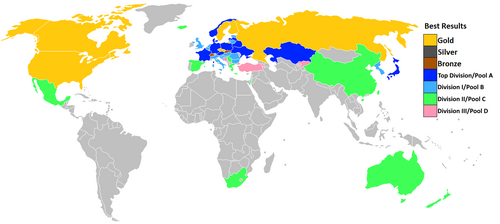
The unofficial tournaments held prior to 1977 are not included in this table.
Countries in italics no longer compete at the World Championships.
| Country | Gold | Silver | Bronze | Medals |
|---|---|---|---|---|
| Canada | 20 | 10 | 6 | 36 |
| Russia Soviet Union CIS Total | 4 8 1 13 | 10 3 0 13 | 9 2 0 11 | 23 13 1 37 |
| United States | 7 | 2 | 7 | 16 |
| Finland | 5 | 6 | 7 | 18 |
| Sweden | 3 | 12 | 7 | 22 |
| Czechia Czechoslovakia Total | 2 0 2 | 2 5 7 | 3 6 9 | 7 11 18 |
| Slovakia | 0 | 0 | 2 | 2 |
| Switzerland | 0 | 0 | 1 | 1 |
| Total | 50 | 50 | 50 | 150 |
Hosting countries
| Host country | Tournaments |
|---|---|
| Canada | 18 |
| United States | 8 |
| Finland | 7 |
| Sweden | 7 |
| Czechia Czechoslovakia Total | 4 2 6 |
| Russia Soviet Union CIS Total | 2 3 0 5 |
| Germany West Germany Total | 1 1 2 |
| Switzerland | 1 |
Note
- 1974 (Soviet Union), 1975 (Canada & USA), and 1976 (Finland) unofficial tournaments are counted.
As of 2026 tournament
Participating countries
Canada, Finland, Sweden, and Czechoslovakia/Czechia have participated in all 50 IIHF Ice Hockey World Junior Championships as well as the three unofficial tournaments. The United States has participated in all except the unofficial tournament in 1976. The USSR/CIS/Russia participated in all tournaments until the 2022 edition (having been suspended by the IIHF in February 2022 as a result of the Russian invasion of Ukraine).
When Czechoslovakia peacefully split in 1993, Czechia remained in Pool A but Slovakia was placed in Pool C (now Division II). Slovakia was promoted to the top division for the 1996 Championships and has remained there since.
When the Soviet Union broke up, Russia remained in Pool A, while all other former Soviet republics started competing in Pool C in 1993.
Starting with the 1996 tournament, the competition was increased from an 8-team round-robin to the current 10-team format, including elimination rounds. Since then, Switzerland has become a regular participant.
Germany has been a frequent participant in the top pool, having played there roughly half the time in the past decade. Belarus, Denmark, Kazakhstan, Latvia, and Norway have also each made a number of top division appearances since the early 1990s. Less frequent top pool appearances have been made by Austria, France, Japan, Poland and Ukraine.
At the most recent championship, held in the United States in 2026, participating teams were Canada, Czechia, Denmark, Finland, Germany, Latvia, Slovakia, Sweden, Switzerland, and the United States.
| Team | Appearances | Most recent year in Top Division |
|---|---|---|
| Canada | 53 | 2026 |
| Czechia / Czechoslovakia | 53 | 2026 |
| Finland | 53 | 2026 |
| Sweden | 53 | 2026 |
| United States | 52 | 2026 |
| Russia / Soviet Union / CIS | 48 | 2021 |
| Switzerland | 39 | 2026 |
| Germany / West Germany | 32 | 2026 |
| Slovakia | 31 | 2026 |
| Latvia | 10 | 2026 |
| Kazakhstan | 9 | 2025 |
| Norway | 9 | 2024 |
| Denmark | 8 | 2026 |
| Belarus | 8 | 2018 |
| Austria | 6 | 2023 |
| Poland | 6 | 1997 |
| Ukraine | 4 | 2004 |
| France | 1 | 2002 |
| Japan | 1 | 1993 |
As of 2026 tournament
Player eligibility
A player is eligible to play in the World Junior Ice Hockey Championships if:
- the player is eligible to compete as a male athlete
- the player has to be no younger than fifteen (15) years old and no older than twenty (20) years old in the year that the tournament ends (e.g. born between 2006 and 2011 for the 2026 tournament)
- the player is a citizen in the country he represents;
- the player is under the jurisdiction of a national association that is a member of the IIHF.
If a player who has never played in IIHF-organized competition wishes to switch national eligibility, he must have played in competitions for two consecutive years in the new country without playing in another country, as well as show his move to the new country's national association with an international transfer card. In case the player has previously played in IIHF-organized competition but wishes to switch national eligibility, he must have played in competitions for four consecutive years in the new country without playing in another country, he must show his move to the new country's national association with an international transfer card, as well as be a citizen of the new country. A player may only switch national eligibility once.
Tournament awards
At the conclusion of each tournament, the Directorate of the IIHF presents awards to the Top Goalie, Forward, and Defenceman of the tournament. The media attending the event select an All-Star team separately from this.
Broadcast coverage
The following television networks and websites broadcast World Junior Championship games on television or online.
| Country | Broadcaster(s) |
|---|---|
| Canada | The Sports Network Réseau des sports |
| Czechia | ČT Sport |
| Europe | Eurosport |
| Finland | TV5 |
| Latvia | TV6 |
| Slovakia | JOJ Šport |
| Sweden | Sveriges Television Viaplay Group |
| Switzerland | UPC Switzerland (MySports) |
| United States | NHL Network ESPN+ |
The Sports Network (TSN) produced by Paul Graham has covered the World Junior Championship annually since 1992, after reaching a broadcast agreement with then Hockey Canada vice-president Bob Nicholson. TSN initially covered only the Team Canada games, then added all games in Team Canada's pool. TSN gradually expanded coverage to include all games of the tournament, when Graham insisted on "a big game feel". As of the 2021 Championships, all pre-tournament and in-tournament games were broadcast. As of the 2025 Championships, coverage exceeded 84 broadcast hours.
TSN is the IIHF's main broadcast partner for this tournament. TSN.ca carries all games excluding relegation games live, as well as most games on demand after their completion. Beginning with 2022 WJC, the international feed produced by TSN as seen on NHL Network's USA Hockey team games and in other countries has the IIHF lettering for game scores instead of TSN's.
Starting with the 2013 tournament, a paywall and geo-block was implemented on TSN's online coverage. The same system applies to Canadian cable subscribers and subscribers of TSN's streaming service – users cannot stream the tournament outside of Canada on TSN Direct.
Norway is currently a 'blackout' zone. Neither Eurosport or Viasat carry the tournament.
See also
- Ice Hockey World Championships
- IIHF World U18 Championship
- IIHF World Ranking
- World Junior A Challenge
- World U-17 Hockey Challenge
- 2007 Super Series
Notes
General references
- .
- . Hockey Canada.
- . tsn.ca.
- Müller, Stephan (2005). International ice hockey encyclopaedia 1904 – 2005. Norderstedt: Books on Demand. ISBN 978-3-8334-4189-9. OCLC . Also OCLC .
Further reading
- Gibson, Kevin (2003), , Trafford, ISBN 1-4120-0162-5
External links
Media related to IIHF World U20 Championship at Wikimedia Commons
- at quanthockey.com
- - 2008 IIHF World U20 Championship - Pardubice, Liberec, Czech republic
- - Full results for men's, women's and junior championships since 1999 and medalists for all tournaments.
- of all IIHF tournaments in French at passionhockey.com.