Kharosthi
In-game article clicks load inline without leaving the challenge.
Kharosthi script (Gāndhārī: 𐨑𐨪𐨆𐨮𐨿𐨛𐨁𐨌 𐨫𐨁𐨤𐨁, romanized:kharoṣṭhī lipi), also known as the Gandhari script (𐨒𐨌𐨣𐨿𐨢𐨌𐨪𐨁𐨌 𐨫𐨁𐨤𐨁, gāndhārī lipi), was an ancient Indic script originally developed in the Gandhara Region of the north-western Indian subcontinent, between the 5th and 3rd century BCE. Primarily used by the people of Gandhara in various parts of South Asia and Central Asia, Kharosthi remained in use until it died out in its homeland around the 5th century CE. It was also in use in Bactria, the Kushan Empire, Sogdia, and along the Silk Road. There is some evidence it may have survived until the 7th century in Khotan and Niya, both cities in Tarim Basin.
History

The name Kharosthi may derive from the Hebrew kharosheth, a Semitic word for writing,[need quotation to verify] or from Old Iranian *xšaθra-pištra, which means "royal writing". The script was earlier also known as Indo-Bactrian script, Kabul script and Arian-Pali.
Scholars are not in agreement as to whether the Kharosthi script evolved gradually, or was the deliberate work of a single inventor. An analysis of the script forms shows a clear dependency on the Aramaic alphabet but with extensive modifications. Kharosthi seems to be derived from a form of Aramaic, which was used in administrative work during the reign of Darius the Great (in contrast with the monumental Old Persian cuneiform used for public inscriptions). One theory suggests that the Aramaic script arrived with the Achaemenid conquest of the Indus Valley in 500 BCE and evolved over the next 200+ years to reach its final form by the 3rd century BCE where it appears in some of the Edicts of Ashoka. However, no intermediate forms have yet been found to confirm this evolutionary model, and rock and coin inscriptions from the 3rd century BCE onward show a unified and standard form. An inscription in Aramaic dating back to the 4th century BCE was found in Sirkap, testifying to the presence of the Aramaic script in present-day Pakistan. According to Sir John Marshall, this seems to confirm that Kharoshthi was later developed from Aramaic.
While the Brahmi script remained in use for centuries, Kharosthi seems to have been abandoned after the 2nd–3rd century AD. Because of the substantial differences between the Semitic-derived Kharosthi script and its successors, knowledge of Kharosthi may have declined rapidly once the script was supplanted by Brahmi-derived scripts, until its re-discovery by Western scholars in the 19th century.
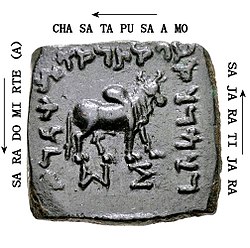
The Kharosthi script was deciphered separately almost concomitantly by James Prinsep (in 1835, published in the Journal of the Asiatic society of Bengal, India) and by Carl Ludwig Grotefend (in 1836, published in Blätter für Münzkunde, Germany), with Grotefend "evidently not aware" of Prinsep's article, followed by Christian Lassen (1838). They all used the bilingual coins of the Indo-Greek Kingdom (obverse in Greek, reverse in Pali, using the Kharosthi script). This in turn led to the reading of the Edicts of Ashoka, some of which were written in the Kharosthi script (the Major Rock Edicts at Mansehra and Shahbazgarhi).
The study of the Kharosthi script was recently invigorated by the discovery of the Gandhāran Buddhist texts, a set of birch bark manuscripts written in Kharosthi, discovered near the Afghan city of Hadda just west of the Khyber Pass in Pakistan. The manuscripts were donated to the British Library in 1994. The entire set of British Library manuscripts are dated to the 1st century CE, although other collections from different institutions contain Kharosthi manuscripts from 1st century BCE to 3rd century CE, making them the oldest Buddhist manuscripts yet discovered.
Alphabet

Kharosthi is mostly written right to left. Some variations in both the number and order of syllables occur in extant texts.[citation needed]
The Kharosthi alphabet is also known as the arapacana alphabet, and follows the order.
a ra pa ca na
la da ba ḍa ṣa
va ta ya ṣṭa
ka sa ma ga stha
ja śva dha śa kha
kṣa sta jñā rtha (orha)
bha cha sma hva tsa
gha ṭha ṇa pha ska
ysa śca ṭa ḍha
This alphabet was used in Gandharan Buddhism as a mnemonic for the Pañcaviṃśatisāhasrikā Prajñāpāramitā Sūtra, a series of verses on the nature of phenomena; this is analogous to the Shiva Sutras of Brahmic scripts. In modern Himalayan and East Asian Buddhism, the first line arapacana is preserved in the mantra of Manjushri, the Bodhisattva of transcendent wisdom.
Consonants
| Unaspirated | Aspirated | Unaspirated | Aspirated | |||||
|---|---|---|---|---|---|---|---|---|
| Unvoiced | Voiced | Nasal | Semivowel | Sibilant | Fricative | |||
| Velar | 𐨐kIPA: /k/ | 𐨑kh | 𐨒gIPA: /ɡ/ | 𐨓gh | 𐨱hIPA: /h/ | |||
| Palatal | 𐨕cIPA: /c/ | 𐨖ch | 𐨗jIPA: /ɟ/ | 𐨙ñIPA: /ɲ/ | 𐨩yIPA: /j/ | 𐨭śIPA: /ɕ/ | ||
| Retroflex | 𐨚ṭIPA: /ʈ/ | 𐨛ṭh | 𐨜ḍIPA: /ɖ/ | 𐨝ḍh | 𐨞ṇIPA: /ɳ/ | 𐨪rIPA: /r/ | 𐨮ṣIPA: /ʂ/ | |
| Dental | 𐨟tIPA: /t/ | 𐨠th | 𐨡dIPA: /d/ | 𐨢dh | 𐨣nIPA: /n/ | 𐨫l | 𐨯s | 𐨰z |
| Labial | 𐨤pIPA: /p/ | 𐨥ph | 𐨦bIPA: /b/ | 𐨧bh | 𐨨mIPA: /m/ | 𐨬v | ||
| Other | 𐨲ḱ | 𐨳ṭ́h |
A bar above a consonant ⟨𐨸⟩ can be used to indicate various modified pronunciations depending on the consonant, such as nasalization or aspiration. It is used with k, ṣ, g, c, j, n, m, ś, ṣ, s, and h.
The cauda ⟨𐨹⟩ changes how consonants are pronounced in various ways, particularly fricativization. It is used with g, j, ḍ, t, d, p, y, v, ś, and s.
The dot below ⟨𐨺⟩ is used with m and h, but its precise phonetic function is unknown.
Vowels and syllables
Kharosthi includes only one standalone vowel character, which is used for initial vowels in words.[citation needed] Other initial vowels use the a character modified by diacritics. Each syllable includes the short /a/ sound by default[citation needed], with other vowels being indicated by diacritic marks.
Long vowels are marked with the diacritic ⟨𐨌⟩. An anusvara ⟨𐨎⟩ indicates nasalization of the vowel or a nasal segment following the vowel. A visarga ⟨𐨏⟩ indicates the unvoiced syllable-final /h/. It can also be used as a vowel length marker. A further diacritic, the double ring below ⟨𐨍⟩ appears with vowels -a and -u in some Central Asian documents, but its precise phonetic function is unknown.
Salomon has established that the vowel order is /a e i o u/, akin to Semitic scripts, rather than the usual vowel order for Indic scripts /a i u e o/.
| Vowels | Other syllable diacritics | |||||||
|---|---|---|---|---|---|---|---|---|
| diacritics | ◌ | ◌𐨅 | ◌𐨁 | ◌𐨆 | ◌𐨂 | ◌𐨃 | 𐨎 | 𐨏 |
| short vowels | 𐨀IPA: /ə/a | 𐨀𐨅IPA: /e/e | 𐨀𐨁IPA: /i/i | 𐨀𐨆IPA: /o/o | 𐨀𐨂IPA: /u/u | 𐨀𐨃IPA: /r̩/r̥ | 𐨀𐨎aṃ | 𐨀𐨏aḥ |
| long vowels | 𐨀𐨌IPA: /aː/ā | 𐨀𐨅𐨌IPA: /ɐi̯/ai | 𐨀𐨁𐨌IPA: /iː/ī | 𐨀𐨆𐨌IPA: /ɐu̯/au | 𐨀𐨂𐨌IPA: /uː/ū | 𐨀𐨃𐨌IPA: /r̩ː/r̥̄ | 𐨀𐨌𐨎āṃ | 𐨀𐨌𐨏āḥ |
| examples with ⟨𐨤⟩ | 𐨤pa | 𐨤𐨅pe | 𐨤𐨁pi | 𐨤𐨆po | 𐨤𐨂pu | 𐨤𐨃pr̥ | 𐨤𐨎paṃ | 𐨤𐨏paḥ |
| examples with ⟨𐨨⟩ | 𐨨ma | 𐨨𐨅me | 𐨨𐨁mi | 𐨨𐨆mo | 𐨨𐨂mu | 𐨨𐨃mr̥ | 𐨨𐨎maṃ | 𐨨𐨏maḥ |
Additional marks
Various additional marks are used to modify vowels and consonants:
| Mark | Trans. | Example | Description |
|---|---|---|---|
| 𐨌 | ◌̄ | 𐨨 + 𐨌 → 𐨨𐨌 | The vowel length mark may be used with -a, -i, -u, and -r̥ to indicate the equivalent long vowel (-ā, -ī, -ū, and r̥̄ respectively). When used with -e it indicates the diphthong -ai. When used with -o it indicates the diphthong -au. |
| 𐨍 | ◌͚ | 𐨯 + 𐨍 → 𐨯𐨍 | The vowel modifier double ring below appears in some Central Asian documents with vowels -a and -u. Its precise phonetic function is unknown. |
| 𐨎 | ṃ | 𐨀 + 𐨎 → 𐨀𐨎 | An anusvara indicates nasalization of the vowel or a nasal segment following the vowel. It can be used with -a, -i, -u, -r̥, -e, and -o. |
| 𐨏 | ḥ | 𐨐 + 𐨏 → 𐨐𐨏 | A visarga indicates the unvoiced syllable-final /h/. It can also be used as a vowel length marker. Visarga is used with -a, -i, -u, -r̥, -e, and -o. |
| 𐨸 | ◌̄ | 𐨗 + 𐨸 → 𐨗𐨸 | A bar above a consonant can be used to indicate various modified pronunciations depending on the consonant, such as nasalization or aspiration. It is used with k, ṣ, g, c, j, n, m, ś, ṣ, s, and h. |
| 𐨹 | ◌́ or ◌̱ | 𐨒 + 𐨹 → 𐨒𐨹 | The cauda changes how consonants are pronounced in various ways, particularly fricativization. It is used with g, j, ḍ, t, d, p, y, v, ś, and s. |
| 𐨺 | ◌̣ | 𐨨 + 𐨺 → 𐨨𐨺 | The precise phonetic function of the dot below is unknown. It is used with m and h. |
| 𐨿 | (n/a) | A virama is used to suppress the inherent vowel that otherwise occurs with every consonant letter. Its effect varies based on situation: | |
| 𐨢 + 𐨁 + 𐨐 + 𐨿 → 𐨢𐨁𐨐𐨿 | When not followed by a consonant the virama causes the preceding consonant to be written as a subscript to the left of the letter before that consonant. | ||
| 𐨐 + 𐨿 + 𐨮 → 𐨐𐨿𐨮 | When the virama is followed by another consonant, it will trigger a combined form consisting of two or more consonants. This may be a ligature, a special combining form, or a combining full form depending on the consonants involved. The result takes into account any other combining marks. | ||
| 𐨯 + 𐨿 + 𐨩 → 𐨯𐨿𐨩 | |||
| 𐨐 + 𐨿 + 𐨟 → 𐨐𐨿𐨟 |
Punctuation
Nine Kharosthi punctuation marks have been identified:
| 𐩐dot | 𐩓crescent bar | 𐩖danda | 𐩑small circle | 𐩔mangalam | 𐩗double danda | 𐩒circle | 𐩕lotus | 𐩘lines |
Numerals
Kharosthi included a set of numerals that are reminiscent of Roman numerals and Psalter Pahlavi Numerals.[citation needed] The system is based on an additive and a multiplicative principle, but does not have the subtractive feature used in the Roman numeral system.
| 𐩀1 | 𐩁2 | 𐩂3 | 𐩃4 | 𐩄10 | 𐩅20 | 𐩆100 | 𐩇1000 |
The numerals, like the letters, are written from right to left. There is no zero and no separate signs for the digits 5–9. Numbers are written additively, so, for example, the number 1996 would be written as 𐩇𐩃𐩃𐩀𐩆𐩅𐩅𐩅𐩅𐩄𐩃𐩁.
𐩅𐩅𐩅𐩅𐩄𐩃𐩁
(2+4+10+20+20+20+20) +
𐩃𐩃𐩀𐩆
100x(1+4+4) +
𐩇
1000
𐩅𐩅𐩅𐩅𐩄𐩃𐩁 𐩃𐩃𐩀𐩆 𐩇
(2+4+10+20+20+20+20) + 100x(1+4+4) + 1000
Unicode
Kharosthi was added to the Unicode Standard in March 2005 with the release of version 4.1.
The Unicode block for Kharosthi is U+10A00–U+10A5F:
| Kharoshthi[1][2] (PDF) | ||||||||||||||||
| 0 | 1 | 2 | 3 | 4 | 5 | 6 | 7 | 8 | 9 | A | B | C | D | E | F | |
| U+10A0x | 𐨀 | 𐨁 | 𐨂 | 𐨃 | 𐨅 | 𐨆 | 𐨌 | 𐨍 | 𐨎 | 𐨏 | ||||||
| U+10A1x | 𐨐 | 𐨑 | 𐨒 | 𐨓 | 𐨕 | 𐨖 | 𐨗 | 𐨙 | 𐨚 | 𐨛 | 𐨜 | 𐨝 | 𐨞 | 𐨟 | ||
| U+10A2x | 𐨠 | 𐨡 | 𐨢 | 𐨣 | 𐨤 | 𐨥 | 𐨦 | 𐨧 | 𐨨 | 𐨩 | 𐨪 | 𐨫 | 𐨬 | 𐨭 | 𐨮 | 𐨯 |
| U+10A3x | 𐨰 | 𐨱 | 𐨲 | 𐨳 | 𐨴 | 𐨵 | 𐨸 | 𐨹 | 𐨺 | 𐨿 | ||||||
| U+10A4x | 𐩀 | 𐩁 | 𐩂 | 𐩃 | 𐩄 | 𐩅 | 𐩆 | 𐩇 | 𐩈 | |||||||
| U+10A5x | 𐩐 | 𐩑 | 𐩒 | 𐩓 | 𐩔 | 𐩕 | 𐩖 | 𐩗 | 𐩘 | |||||||
| Notes 1.^ As of Unicode version 17.0 2.^ Grey areas indicate non-assigned code points |
Gallery
- Kharosthi script on a wooden plate in the National Museum of India in New Delhi
- Kharosthi script on a wooden plate in the National Museum of India in New Delhi
- Kharosthi script on a wooden plate in the National Museum of India in New Delhi
- Kharosthi script on wood from Niya, 3rd century CE
- Double-wedged wooden tablet in Gandhari written in Kharosthi script, 2nd to 4th century CE
- Wooden tablet inscribed with Kharosthi characters (2nd–3rd century CE). Excavated at the Niya ruins in Xinjiang, China. Collection of the Xinjiang Museum.
- Wooden Kharosthi document found at Loulan, China by Aurel Stein
- Fragmentary Kharosthi Buddhist text on birchbark (Part of a group of early manuscripts from Gandhara), first half of 1st century CE. Collection of the British Library in London
- Silver bilingual tetradrachm of Menander I (155-130 BCE). Obverse: Greek legend, ΒΑΣΙΛΕΩΣ ΣΩΤΗΡΟΣ ΜΕΝΑΝΔΡΟΥ (BASILEOS SOTEROS MENANDROU), literally, "Of Saviour King Menander". Reverse: Kharosthi legend: MAHARAJA TRATARASA MENADRASA "Saviour King Menander". Athena advancing right, with thunderbolt and shield. Taxila mint mark.
- Coin of King Gurgamoya of Khotan (1st century CE). Obverse: Kharoshthi legend "Of the great king of kings, king of Khotan, Gurgamoya. Reverse: Chinese legend: "Twenty-four grain copper coin".
- Coin of Menander II Dikaiou Obverse: Menander wearing a diadem. Greek legend: ΒΑΣΙΛΕΩΣ ΔΙΚΑΙΟΥ ΜΕΝΑΝΔΡΟΥ "King Menander the Just". Reverse: Winged figure bearing diadem and palm, with halo, probably Nike. The Kharoshthi legend reads MAHARAJASA DHARMIKASA MENADRASA "Great King, Menander, follower of the Dharma, Menander".
- The Indo-Greek Hashtnagar Pedestal symbolizes bodhisattva and ancient Kharosthi script. Found near Rajar in Gandhara, Pakistan. Exhibited at the British Museum in London.
- Mathura lion capital with addorsed lions and Prakrit inscriptions in Kharoshthi script
- Fragments of stone well railings with a Buddhist inscription written in Kharoshthi script (late Han period to the Three Kingdoms era). Discovered at Luoyang, China in 1924.
- Portion of Emperor Ashoka's Rock Edicts at Shahbaz Garhi
- Portion of Emperor Ashoka's Rock Edicts at Shahbaz Garhi
- Document on Wooden Stick written in Kharoshthi script, 3rd-4th century CE.
See also
Further reading

Further reading
- Dani, Ahmad Hassan (1979). Kharoshthi Primer. Lahore Museum Publication Series. Vol. 16. Lahore Museum. OCLC .
{{cite book}}: CS1 maint: location missing publisher (link) - Daniels, Peter T.; Bright, William, eds. (1996). . Oxford University Press, Inc. pp. . ISBN 978-0195079937.
- Falk, Harry (1993). Schrift im alten Indien: Ein Forschungsbericht mit Anmerkungen. Script Oralia (in German). Vol. 56. Tübingen: Gunter Narr. ISBN 978-3-8233-4271-7.
- Fussman, Gérard. "Les premiers systèmes d'écriture en Inde". Annuaire du Collège de France 1988–1989 (in French). pp. 507–514.
- von Hinüber, Oscar (1990). Der Beginn der Schrift und frühe Schriftlichkeit in Indien (in German). Franz Steiner. ISBN 978-3-515-05627-4.
- Nasim Khan, M., ed. (2009). Kharoshthi Manuscripts from Gandhara (2nd ed.). Higher Education Commission of Pakistan.
- Nasim Khan, M. (2004). "Kharoshthi Manuscripts from Gandhara". Journal of Humanities and Social Sciences. XII (1–2): 9–15.
- Nasim Khan, M. (July 1999). "Two Dated Kharoshthi Inscriptions from Gandhara". Journal of Asian Civilizations. XXII (1): 99–103.
- Nasim Khan, M. (September 1997). "Kharoshthi Inscription from Swabi – Gandhara". The Journal of Humanities and Social Sciences. V (2): 49–52.
- Nasim Khan, M. (March 1997). "An Inscribed Relic-Casket from Dir". The Journal of Humanities and Social Sciences. V (1): 21–33.
- Nasim Khan, M (1997). "Ashokan Inscriptions: A Palaeographical Study". Atthariyyat. Vol. I. Peshawar. pp. 131–150.
{{cite book}}: CS1 maint: location missing publisher (link) - Norman, Kenneth R. (1992). "The development of writing in India and its effect upon the Pāli canon". Wiener Zeitschrift für die Kunde Südasiens. 36: 239–249. JSTOR .
- Salomon, Richard (1990). "New Evidence for a Gāndhārī Origin of the Arapacana Syllabary". Journal of the American Oriental Society. 110 (2): 255–273. doi:. JSTOR .
- Salomon, Richard (1 April 1993). "An additional note on Aracapana". The Journal of the American Oriental Society. 113 (2): 275–277. doi:. JSTOR . Gale .
- Salomon, Richard (1998). Indian Epigraphy: A Guide to the Study of Inscriptions in Sanskrit, Prakrit, and the other Indo-Aryan Languages. Oxford University Press. ISBN 978-0-19-535666-3.
- Salomon, Richard (2006). "Kharoṣṭhī syllables used as location markers in Gāndhāran stūpa architecture". In Faccenna, Domenico (ed.). Architetti, Capomastri, Artigiani: L'organizzazione Dei Cantieri E Della Produzione Artistica Nell'Asia Ellenistica : Studi Offerti a Domenico Faccenna Nel Suo Ottantesimo Compleanno. Istituto italiano per l'Africa e l'Oriente. pp. 181–224. ISBN 978-88-85320-36-9.
- Salomon, Richard (1995). "On the Origin of the Early Indian Scripts". Journal of the American Oriental Society. 115 (2): 271–279. doi:. JSTOR . ProQuest .
External links
- Catalog and Corpus of all known Kharoṣṭhī (Gāndhārī) texts
- 28 May 2022 at the Wayback Machine, a paleographic database of Brahmi and Kharosthi
- by Andrew Glass, University of Washington (2000)