Lamborghini
In-game article clicks load inline without leaving the challenge.
Lamborghini (officially Automobili Lamborghini S.p.A. and colloquially Lambo) is an Italian manufacturer of luxury sports cars and SUVs based in Sant'Agata Bolognese. The company is owned by the Volkswagen Group through its subsidiary Audi.
Ferruccio Lamborghini (1916–1993), an Italian manufacturing magnate, founded Automobili Ferruccio Lamborghini S.p.A. in 1963 to compete with Ferrari. The company was noted for using a rear mid-engine, rear-wheel drive layout. Lamborghini grew rapidly during its first decade, but sales plunged in the wake of the 1973 worldwide financial downturn and the oil crisis. The firm's ownership changed three times after 1973, including a bankruptcy in 1978. American Chrysler Corporation took control of Lamborghini in 1987 and sold it to Malaysian investment group Mycom Setdco and Indonesian group V'Power Corporation in 1994. In 1998, Mycom Setdco and V'Power sold Lamborghini to the Volkswagen Group where it was placed under the control of the group's Audi division.
New products and model lines were introduced to the brand's portfolio and brought to the market and saw an increased productivity for the brand. In the late 2000s, during the Great Recession, Lamborghini's sales dropped nearly 50%.
Lamborghini currently produces the twin-turbo V8 plug-in Hybrid Temerario, the Urus SUV powered by a twin-turbo V8 engine, and the Revuelto, a V12/electric hybrid, as of 2025. In addition, the company produces V12 engines for offshore powerboat racing.
Lamborghini Trattori, founded in 1948 by Ferruccio Lamborghini, is headquartered in Pieve di Cento, Italy, and continues to produce tractors. Since 1973, Lamborghini Trattori has been a separate entity from the Lamborghini's automobile division.
History

Manufacturing magnate Italian Ferruccio Lamborghini founded the company in 1963 with the objective of producing a refined grand touring car to compete with offerings from established marques such as Ferrari. The company's first models, such as the 350 GT, were released in the mid-1960s. Lamborghini was noted for the 1966 Miura sports coupé, which used a rear mid-engine, rear-wheel drive layout.
In 1963, Ferruccio Lamborghini, already an established industrialist who manufactured tractors, boilers, and air conditioners, founded Lamborghini Automobili on 7 May 1963.
The company was headquartered in a purpose-built facility in Sant'Agata Bolognese. He surrounded himself with highly capable engineers and technicians: Giotto Bizzarrini designed the engine, Gian Paolo Dallara and Paolo Stanzani developed the chassis, and Franco Scaglione designed the bodywork. The first model, the 350 GTV, was not a success due to its futuristic style and remained a one-off prototype. The project was then handed over to the Milanese coachbuilder Touring, which created a more classic and sober design. The new car, named the 350 GT, was a fast and elegant two-seater grand tourer (according to Ferruccio's standards) and was the first series-produced car by Lamborghini. It achieved moderate sales success and was followed by the 400 GT (which benefited from an increased engine capacity) and the 400 GT 2+2, both presented in 1966.
Lamborghini grew rapidly during its first ten years, but sales fell in the wake of the 1973 worldwide financial downturn and the oil crisis. Ferruccio Lamborghini sold the company to Georges-Henri Rossetti and René Leimer and retired in 1974. The company went bankrupt in 1978, and was placed in the receivership of brothers Jean-Claude and Patrick Mimran in 1980. The Mimrans purchased the company out of receivership by 1984 and invested heavily in its expansion. Under the Mimrans' management, Lamborghini's model line was expanded from the Countach to include the Jalpa sports car and the LM002 high-performance off-road vehicle.
The Mimrans sold Lamborghini to the Chrysler Corporation in 1987. After replacing the Countach with the Diablo and discontinuing the Jalpa and the LM002, Chrysler sold Lamborghini to Malaysian investment group Mycom Setdco and Indonesian group V'Power Corporation in 1994. In 1998, Mycom Setdco and V'Power sold Lamborghini to the Volkswagen Group where it was placed under the control of the group's Audi division. New products and model lines were introduced to the brand's portfolio and brought to the market and saw an increased productivity for the brand Lamborghini. In the late 2000s, during the Great Recession, Lamborghini's sales dropped nearly 50%.
In 2021, the CEO of Lamborghini said that by 2024 all its models will be hybrid.
| Years | Owner |
|---|---|
| 1963–1972 | Ferruccio Lamborghini |
| 1972–1977 | Georges-Henri Rossetti and René Leimer |
| 1977–1984 | Receivership |
| 1984–1987 | Patrick Mimran |
| 1987–1994 | Chrysler Corporation |
| 1994–1995 | MegaTech |
| 1995–1998 | V'Power and Mycom Sedtco |
| 1998–present | Audi AG |
Products
Automobiles
As of the 2018 model year, Lamborghini's automobile product range consists of three model lines, two of which are mid-engine two-seat sports cars while the third one is a front engined, all-wheel drive SUV.
Models in production
- Revuelto

Production of the new Revuelto began in mid-2023 and was delivered in late 2023 as a 2024 model. A 6.5L naturally aspirated V12 engine and three magnetic motors power the car for a combined output of 1,001 hp (1,015 PS). The Revuelto is the successor to the Aventador.
- Temerario

The Temerario is a mid-engine plug-in hybrid sports car. It was officially unveiled on 16 August 2024 and is the successor to the Huracán.
- Urus

Intending to double its sales volume by 2019, Lamborghini also added an SUV named Urus in its line-up which is powered by a twin-turbo V8 engine and utilizes a front engine, all-wheel drive layout.
Marine engines
Motori Marini Lamborghini produces a large V12 marine engine block for use in World Offshore Series Class 1 powerboats. A Lamborghini branded marine engine displaces approximately 8,171 cc (8.2 L) and outputs approximately 940 hp (700 kW).
Lamborghini motorcycle
In the mid-1980s, Lamborghini produced a limited-production run of a 1,000 cc (61.0 cu in) sports motorcycle. UK weekly newspaper Motor Cycle News reported in 1994—when featuring an example available through an Essex motorcycle retailer—that 24 examples were produced with a Lamborghini alloy frame having adjustable steering head angle, Kawasaki GPz1000RX engine/transmission unit, Ceriani front forks and Marvic wheels. The bodywork was plastic and fully integrated with front fairing merged into fuel tank and seat cover ending in a rear tail-fairing. The motorcycles were designed by Lamborghini stylists and produced by French business Boxer Bikes.
Branded merchandise

Lamborghini licenses its brand to manufacturers that produce a variety of Lamborghini-branded consumer goods including scale models, clothing, accessories, bags, electronics and laptop computers.
Motorsport
Automobiles produced
Lamborghini Motorsport Division Squadra Corse produces GT3 cars and cars for its Super Trofeo events based on the Gallardo and Huracán. Apart from them, the Squadra Corse builds cars upon customer request.
GT3 and Super Trofeo Cars
- Gallardo LP 570-4 Super Trofeo
- Gallardo LP 560-4 Super Trofeo
- Huracán LP 620-2 Super Trofeo
- Huracán LP 620-2 Super Trofeo EVO
- Huracán LP 620-2 Super Trofeo EVO2
- Huracán Super Trofeo GT2
- Huracán GT3
- Huracán GT3 Evo
- Huracán GT3 Evo 2
Special cars
These cars were built by Squadra Corse upon customer request.
Events held
Lamborghini Super Trofeo


The Super Trofeo is a series of Motorsport events held by Squadra corse using its Super Trofeo model vehicles (currently the Huracán Super Trofeo EVO2) which are racing versions of the road-approved models (Huracán and Gallardo models).
The Super Trofeo events are held in three different series, in three continents: America, Asia and Europe. Many private race team participate each of these events.
Every series consists of six rounds, each of which feature free practice sessions, qualifying and two races lasting 50 minutes each. There are four categories of drivers: Pro, Pro-Am, Am and Lamborghini Cup. The season ends in the Lamborghini Super Trofeo World Final.
Lamborghini GT3

The Lamborghini GT3 is a series of Motorsport events held by The Squadra Corse using Huracán GT3 cars that comply with the FIA GT3 regulations. The racing event is open to any Huracán GT3 customer.
Lamborghini currently uses Huracán GT3 Evo 2 cars for these events and more than 60 private race teams participate these events.
Racecars
| Year | Car | Image | Category |
|---|---|---|---|
| 1967 | Lamborghini 350 GT | Group 4 | |
| Lamborghini 400 GT 2+2 | Group 4 | ||
| 1968 | Lamborghini P400 Miura | Group 4 | |
| 1975 | Lamborghini Urraco P250 | Group 4 | |
| 1986 | Lamborghini Countach QVX | Group C1 | |
| 1988 | Lamborghini Countach 5000QV | Group B | |
| 1991 | Lambo 291 | Formula 1 | |
| 1998 | Lamborghini Diablo 132 GT1 | Group GT1 | |
| 2004 | Lamborghini Murciélago R-GT | Group GT | |
| 2005 | Lamborghini Murciélago RG-1 | GT500 GT300 | |
| 2006 | Lamborghini Gallardo LP520 GT3 | Group GT3 | |
| 2007 | Lamborghini Gallardo | GT300 | |
| 2009 | Lamborghini Gallardo LP 560 GT2 | LM GTE | |
| 2010 | Lamborghini Gallardo LP600+ GT3 | Group GT3 | |
| Lamborghini Murciélago LP 670 R-SV | Group GT1 | ||
| 2014 | Lamborghini Huracán LP 620-2 Super Trofeo | Lamborghini Super Trofeo | |
| 2015 | Lamborghini Huracán GT3 | Group GT3 | |
| 2019 | Lamborghini Huracán GT3 Evo | Group GT3 | |
| Lamborghini Huracán LP 620-2 Super Trofeo EVO | Lamborghini Super Trofeo | ||
| 2020 | Lamborghini Huracán Super Trofeo GT2 | SRO GT2 | |
| 2022 | Lamborghini Huracán GT3 Evo 2 | Group GT3 | |
| Lamborghini Huracán LP 620-2 Super Trofeo EVO2 | Lamborghini Super Trofeo | ||
| 2024 | Lamborghini SC63 | LMDh | |
| 2026 | Lamborghini Temerario GT3 | Group GT3 |
Current factory drivers
Factory drivers
- Italy Mirko Bortolotti
- Italy Andrea Caldarelli
- Germany Christian Engelhart
- Germany Luca Engstler
- France Romain Grosjean
- Italy Daniil Kvyat
- Italy Marco Mapelli
- United Kingdom Sandy Mitchell
- Switzerland Edoardo Mortara
- South Africa Jordan Pepper
- France Franck Perera
- Italy Leonardo Pulcini
- Italy Loris Spinelli
Source:
GT3 Junior drivers
- United Kingdom Hugo Cook
- Italy Andrea Frassineti
- Germany Robin Rogalski
- Portugal Rodrigo Testa
Source:
Super Trofeo Junior drivers
- France Hugo Bac
- Sweden Calle Bergman
- Singapore Ethan Brown
- United States Elias De La Torre
- Republic of Ireland Alex Denning
- Italy Patrik Fraboni
- France Enzo Geraci
- Macau Charles Leong Hon Chio
- France Paul Levet
- Italy Guido Luchetti
- United States Al Morey IV
- South Africa Anthony Pretorius
- United States Colin Queen
- Denmark Silas Rytter
- Germany Pablo Schumm
- Poland Jerzy Spinkiewicz
Source:
Lamborghini in Formula One

In contrast to his rival Enzo Ferrari, Ferruccio Lamborghini had decided early on that there would be no factory-supported racing of Lamborghinis, viewing motorsport as too expensive and too draining on company resources. This was unusual for the time, as many sports car manufacturers sought to demonstrate speed, reliability, and technical superiority through motorsport participation. Enzo Ferrari in particular was known for considering his road car business mostly a source of funding for his participation in motor racing. Ferruccio's policy led to tensions between him and his engineers, many of whom were racing enthusiasts; some had previously worked at Ferrari. When Dallara, Stanzani, and Wallace began dedicating their spare time to the development of the P400 prototype, they designed it to be a road car with racing potential, one that could win on the track and also be driven on the road by enthusiasts. When Ferruccio discovered the project, he allowed them to go ahead, seeing it as a potential marketing device for the company, while insisting that it would not be raced. The P400 went on to become the Miura. The closest the company came to building a true race car under Lamborghini's supervision were a few highly modified prototypes, including those built by factory test driver Bob Wallace, such as the Miura SV-based "Jota" and the Jarama S-based "Bob Wallace Special".
In the mid-1970s, while Lamborghini was under the management of Georges-Henri Rossetti, Lamborghini entered into an agreement with BMW to develop, then manufacture 400 cars for BMW in order to meet Group 4 homologation requirements. BMW lacked experience developing a mid-engined vehicle and believed that Lamborghini's experience in that area would make Lamborghini an ideal choice of partner. Due to Lamborghini's shaky finances, Lamborghini fell behind schedule developing the car's structure and running gear. When Lamborghini failed to deliver working prototypes on time, BMW took the program in house, finishing development without Lamborghini. BMW contracted with Baur to produce the car, which BMW named the M1, delivering the first vehicle in October 1978.
In 1985, Lamborghini's British importer developed the Countach QVX, in conjunction with Spice Engineering, for the 1986 Group C championship season. One car was built, but lack of sponsorship caused it to miss the season. The QVX competed in only one race, the non-championship 1986 Southern Suns 500 km race at Kyalami in South Africa, driven by Tiff Needell. Despite the car finishing better than it started, sponsorship could once again not be found and the programme was cancelled.

Lamborghini was an engine supplier in Formula One for the 1989 through 1993 Formula One seasons. It supplied engines to Larrousse (1989–1990, 1992–1993), Lotus (1990), Ligier (1991), Minardi (1992), and to the Modena team in 1991. While the latter is commonly referred to as a factory team, the company saw itself as a supplier, not a backer. The 1992 Larrousse—Lamborghini was largely uncompetitive but noteworthy in its tendency to spew oil from its exhaust system. Cars following closely behind the Larrousse were commonly coloured yellowish-brown by the end of the race. Lamborghini's best result was achieved with Larrousse at the 1990 Japanese Grand Prix, when Aguri Suzuki finished third on home soil.
In 1991, a Lamborghini Formula One motor was used in the Konrad KM-011 Group C sports car, but the car only lasted a few races before the project was cancelled. The same engine, re-badged a Chrysler, Lamborghini's then-parent company, was tested by McLaren towards the end of the 1993 season, with the intent of using it during the 1994 season. Although driver Ayrton Senna was reportedly impressed with the engine's performance, McLaren pulled out of negotiations, choosing a Peugeot engine instead, and Chrysler ended the project.

Two racing versions of the Diablo were built for the Diablo Supertrophy, a single-model racing series held annually from 1996 to 1999. In the first year, the model used in the series was the Diablo SVR, while the Diablo 6.0 GTR was used for the remaining three years. Lamborghini developed the Murciélago R-GT as a production racing car to compete in the FIA GT Championship, the Super GT Championship and the American Le Mans Series in 2004. The car's highest placing in any race that year was the opening round of the FIA GT Championship at Valencia, where the car entered by Reiter Engineering finished third from a fifth-place start. In 2006, during the opening round of the Super GT championship at Suzuka, a car run by the Japan Lamborghini Owners Club garnered the first victory (in class) by an R-GT. A GT3 version of the Gallardo has been developed by Reiter Engineering. A Murciélago R-GT entered by All-Inkl.com racing, driven by Christophe Bouchut and Stefan Mücke, won the opening round of the FIA GT Championship held at Zhuhai International Circuit, achieving the first major international race victory for Lamborghini.
Complete Formula One results
(key) (results in bold indicate pole position)
Marketing
Brand identity

The world of bullfighting is a key part of Lamborghini's identity. In 1962, Ferruccio Lamborghini visited the Seville ranch of Don Eduardo Miura, a renowned breeder of Spanish fighting bulls. Lamborghini was so impressed by the majestic Miura animals that he decided to adopt a raging bull as the emblem for the automaker he would open shortly.
Vehicle nomenclature
After producing two cars with alphanumeric designations, Lamborghini once again turned to the bull breeder for inspiration. Don Eduardo was filled with pride when he learned that Ferruccio had named a car for his family and their line of bulls; the fourth Miura to be produced was unveiled to him at his ranch in Seville.
The automaker would continue to draw upon the bullfighting connection in future years. The Islero was named for the Miura bull that killed the famed bullfighter Manolete in 1947. Espada is the Spanish word for sword, sometimes used to refer to the bullfighter himself. The Jarama's name carried a special double meaning; though it was intended to refer only to the historic bullfighting region in Spain, Ferruccio was concerned about confusion with the also historic Jarama motor racing track.

After christening the Urraco after a bull breed, in 1974, Lamborghini broke from tradition, naming the Countach (/ˈkuːntɑːʃ/ ⓘ KOON-tahsh) not for a bull, but for contacc (pronounced [kʊŋˈtɑtʃ]), a Piedmontese expletive. Legend has it that Nuccio Bertone uttered the word in surprise when he first saw the Countach prototype, "Project 112". The LM002 (LM for Lamborghini Militaire) sport utility vehicle and the Silhouette (named after the popular racing category of the time) were other exceptions to the tradition.
The Jalpa of 1982 was named for a bull breed; Diablo, for the Duke of Veragua's ferocious bull famous for fighting an epic battle against El Chicorro in Madrid in 1869; Murciélago, the legendary bull whose life was spared by El Lagartijo for his performance in 1879; Gallardo, named for one of the five ancestral castes of the Spanish fighting bull breed; and Reventón, the bull that defeated young Mexican torero Félix Guzmán in 1943. The Estoque concept of 2008 was named for the estoc, the sword traditionally used by matadors during bullfights.
Concept vehicles
Throughout its history, Lamborghini has envisioned and presented a variety of concept cars, beginning in 1963 with the first Lamborghini prototype, the 350GTV. Other famous models include Bertone's 1967 Marzal, 1974 Bravo, and 1980 Athon, Chrysler's 1987 Portofino, the Italdesign-styled Cala from 1995, the Zagato-built Raptor from 1996.
A retro-styled Lamborghini Miura concept car, the first creation of chief designer Walter de'Silva, was presented in 2006. President and CEO Stephan Winkelmann denied that the concept would be put into production, saying that the Miura concept was "a celebration of our history, but Lamborghini is about the future. Retro design is not what we are here for. So we won't do the [new] Miura."

At the 2008 Paris Motor Show, Lamborghini revealed the Estoque, a four-door sedan concept. Although there had been much speculation regarding the Estoque's eventual production, Lamborghini management has not made a decision regarding production of what might be the first four-door car to roll out of the Sant'Agata factory.
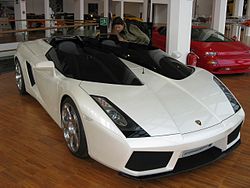
At the 2010 Paris Motor Show, Lamborghini unveiled the Sesto Elemento. The concept car is made almost entirely of carbon fibre making it extremely light, with a weight of 999 kg (2,202 lb). The Sesto Elemento shares the same V10 engine found in the Lamborghini Gallardo. Lamborghini hopes to signal a shift in the company's direction from making super cars focused on top speed to producing more agile, track focused cars with the Sesto Elemento. The concept car can reach 0–62 mph (0–100 km/h) in 2.5 seconds and can reach a top speed of over 180 mph (290 km/h).
At the 2012 Geneva Motor Show, Lamborghini unveiled the Aventador J—a roofless, windowless version of the Lamborghini Aventador. The Aventador J uses the same 700 hp engine and seven-speed transmission as the standard Aventador.
At the 2012 Beijing Motor Show, Lamborghini unveiled the Urus SUV. This is the first SUV built by Lamborghini since the LM002.
As part of the celebration of 50 years of Lamborghini, the company created the Egoista. Egoista is for one person's driving and only one Egoista is to be made.
At the 2014 Paris Motor Show, Lamborghini unveiled the Asterion LPI910-4 hybrid concept car. Named after the half-man, half-bull hybrid (Minotaur) of Greek legend, it is the first hybrid Lamborghini in the history of the company. Utilizing the Huracán's 5.2 litre V10 producing 607 hp (453 kW; 615 PS), along with one electric motor mounted on the transaxle and an additional two on the front axle, developing an additional 300 hp (224 kW; 304 PS). This puts the power at a combined figure of 907 hp (676 kW; 920 PS). The 0–100 km/h (0–62 mph) time is claimed to be just above 3 seconds, with a claimed top speed of 185 mph (298 km/h).
Corporate affairs
Structure
As of 2011[update], Lamborghini is structured as a wholly owned subsidiary of Audi AG named Automobili Lamborghini S.p.A.
Automobili Lamborghini S.p.A. controls five principal subsidiaries: Ducati Motor Holding S.p.A., a manufacturer of motorcycles; Italdesign Giugiaro S.p.A., a design and prototyping firm that provides services to the entire Volkswagen Group; MML S.p.A. (Motori Marini Lamborghini), a manufacturer of marine engine blocks; and Volkswagen Group Italia S.p.A. (formerly Autogerma S.p.A.), which sells Audi and other Volkswagen Group vehicles in Italy.
The Lamborghini headquarters and main production site is located in Sant'Agata Bolognese, Italy. With the launch of its Urus SUV, the production site expanded from 80,000 m2 (8.0 ha) to 160,000 m2 (16 ha).
On 13 November 2020, Stephan Winkelmann, current President of Bugatti, was appointed to be the new CEO of Lamborghini. He took his new position on 1 December 2020.
Sales results

By sales, the most important markets in 2004 for Lamborghini's sports cars were the U.S. (41%), Germany (13%), Great Britain (9%) and Japan (8%). Prior to the launch of the Gallardo in 2003, Lamborghini produced approximately 400 vehicles per year; in 2011 Lamborghini produced 1,711 vehicles.
Annual Lamborghini new car sales
| Year | Sales |
|---|---|
| 1968 | 353 |
| Data missing | |
| 1991 | 673 |
| 1992 | 166 |
| 1993 | 215 |
| Data missing | |
| 1996 | 211 |
| 1997 | 209 |
| Data missing | |
| 1999 | 265 |
| Year | Sales |
|---|---|
| 2000 | 296 |
| 2001 | 297 |
| 2002 | 424 |
| 2003 | 1,305 |
| 2004 | 1,592 |
| 2005 | 1,600 |
| 2006 | 2,087 |
| 2007 | 2,406 |
| 2008 | 2,430 |
| 2009 | 1,515 |
| Year | Sales |
|---|---|
| 2010 | 1,302 |
| 2011 | 1,602 |
| 2012 | 2,083 |
| 2013 | 2,121 |
| 2014 | 2,530 |
| 2015 | 3,245 |
| 2016 | 3,457 |
| 2017 | 3,815 |
| 2018 | 5,750 |
| 2019 | 9,233 |
| Year | Sales |
|---|---|
| 2020 | 7,430 |
| 2021 | 8,405 |
| 2022 | 9,233 |
| 2023 | 10,112 |
| 2024 | 10,687 |
| 2025 | 10,747 |
Licensing
Automóviles Lamborghini Latinoamérica
Automóviles Lamborghini Latinoamérica S.A. de C.V. (Lamborghini Automobiles of Latin America Public Limited Company) is an authorized distributor and manufacturer of Lamborghini-branded vehicles and merchandise in Latin America and South America.
In 1995, Indonesian corporation MegaTech, Lamborghini's owner at the time, entered into distribution and license agreements with Mexican businessman Jorge Antonio Fernández García. The agreements give Automóviles Lamborghini Latinoamérica S.A. de C.V. the exclusive distributorship of Lamborghini vehicles and branded merchandise in Latin America and South America. Under the agreements, Automóviles Lamborghini is also allowed to manufacture Lamborghini vehicles and market them worldwide under the Lamborghini brand.
Automóviles Lamborghini has produced two rebodied versions of the Diablo called the Eros and the Coatl. In 2015, Automóviles Lamborghini transferred the IP-rights to the Coatl foundation (chamber of commerce no. 63393700) in The Netherlands in order to secure these rights and to make them more marketable. The company has announced the production of a speedboat called the Lamborghini Glamour.
Museums
There are two museums in Bologna, Emilia-Romagna, centered around the brand.
Museo Lamborghini

This two-storey museum is attached to the headquarters, and covers the history of Lamborghini cars and sport utility vehicles, showcasing a variety of modern and vintage models. The museum uses displays of cars, engines and photos to provide a history and review important milestones of Lamborghini.
Museo Ferruccio Lamborghini
A 9,000 square-foot museum about Ferruccio Lamborghini houses several cars, industrial prototypes, sketches, personal objects and family photos from Ferruccio's early life.
See also
Notes
Citations
- DeMatio, Joe (May 2003). . Automobile. Ann Arbor, Michigan: Source Interlink Media. ISSN . Archived from on 31 July 2012.
- Henshaw, Peter (2002). (Paperback ed.). London: Salamander Books. ISBN 978-0-7603-1342-8.
- Holusha, John (24 April 1987). . The New York Times. New York. ISSN . from the original on 7 June 2022.
- Ireson, Nelson (12 February 2010). . MotorAuthority. High Gear Media. Archived from on 3 July 2014.
- Jolliffe, David; Willard, Tony (2004). (Hardcover ed.). St. Paul, Minnesota: Motorbooks International. doi:. ISBN 978-0-7603-1945-1. ISSN . from the original on 20 July 2023.
- Lawrence, Mike (1996) [1991]. (Paperback ed.). St. Paul, Minnesota: MBI Publishing Company. ISBN 978-1-870979-81-8.
- Lewin, Tony (2004). (Hardcover ed.). St. Paul, Minnesota: Motorbooks International. ISBN 978-0-7603-1951-2. from the original on 26 September 2023.
- Lyons, Pete (1988). . The Auto Editors of Consumer Guide (Hardcover ed.). Woodstock, New York: Beekman House. ISBN 9780517667156. from the original on 13 February 2023 – via Barbarossa books.
- Mitchel, Doug (2006) [2005-10-20]. Collins, Tom (ed.). (Paperback ed.). Iola, Wisconsin: KP Books. ISBN 978-0-89689-227-9. Archived from on 11 October 2013.
- Neher, Jacques (9 February 1994). . The New York Times. New York. ISSN . from the original on 12 May 2013.
- Sackey, Joe (2008). (Hardcover ed.). Dorchester, England: Veloce Publishing. ISBN 978-1-84584-196-6.[permanent dead link]
- Welsh, Jonathan (5 November 2010). . The Wall Street Journal. New York: Dow Jones & Company, Inc. ISSN . from the original on 26 October 2012.
- Winterbottom, Jo (10 June 2009). . Reuters. New York: Thomson Reuters Corporation. from the original on 2 April 2012.
- Wood, Jonathan (23 February 1993). . The Independent. London: independent.co.uk. ISSN . from the original on 7 November 2012.
- Woodyard, Chris (17 December 2010). . USA Today. New York: Gannett Co. Inc. ISSN . from the original on 6 July 2014.
- [Filippo Perini discusses the design of the Lamborghini Aventador] (Streaming video) (YouTube) (in Italian). Rome: Edimotive S.r.l. 28 April 2011. from the original on 2 May 2020.
- . Museo Storico Gruppo SAME Deutz-Fahr. Gruppo SAME Deutz-Fahr. 2012. from the original on 29 July 2012.
- [Lamborghini Latin America wants to settle in Santiago del Estero]. La Gaceta (in Spanish). San Miguel de Tucumán, Argentina. 11 December 2010. from the original on 12 May 2013.
- [Main Contract Terms between USA and Italy]. lamborghini-latinoamerica.com (in Spanish). Automóviles Lamborghini Latinoamérica S.A. de C.V. 5 August 1995. Archived from (JPG) on 2 October 2013.
Corporate documents
- (PDF). Annual Report. Volkswagen AG. 17 March 2000. ISSN . Archived from (PDF) on 2 October 2013.
- (PDF). Annual Report. Volkswagen AG. 16 March 2001. ISSN . Archived from (PDF) on 2 October 2013.
- (PDF). Annual Report. Volkswagen AG. 1 March 2002. ISSN . Archived from (PDF) on 2 October 2013.
- (PDF). Audi AG. 2003. Archived from (PDF) on 26 August 2014.
- (PDF). Audi AG. 2004. Archived from (PDF) on 3 September 2012.
- (PDF). Audi AG. 2006. Archived from (PDF) on 16 September 2012.
- (PDF). Audi AG. 2007. Archived from (PDF) on 2 April 2012.
- (PDF). Audi AG. 2008. Archived from (PDF) on 3 September 2012.
- (PDF). Audi AG. 2009. Archived from (PDF) on 3 September 2012.
- [Audi Facts and Figures 2009] (PDF) (in German). Audi AG. 2010. Archived from (PDF) on 17 April 2012.
- [Audi Facts and Figures 2010] (PDF) (in German). Audi AG. 2011. Archived from (PDF) on 12 September 2012.
- [Audi Facts and Figures 2011] (PDF) (in German). Audi AG. 2012. Archived from (PDF) on 21 October 2014.
- (PDF). Audi AG. 9 March 2011b. Archived from (PDF) on 12 September 2012.
- (PDF). Audi AG. 1 March 2012b. Archived from (PDF) on 10 October 2014.
- (PDF). Audi AG. 17 February 2012a. Archived from (PDF) on 23 September 2015.
- (PDF). Audi AG. 23 July 2012c. Archived from (PDF) on 3 August 2012.
- (PDF). Volkswagen AG. 10 March 2011. 1158.809.529.00. Archived from (PDF) on 7 May 2012.
- (PDF). Audi AG. 17 February 2011. Archived from (PDF) on 21 September 2019.
- (PDF). Volkswagen AG. 11 June 2012. 1058.809.453.20. Archived from (PDF) on 2 October 2013. Automobili Lamborghini S.p.A. (867 employees, founded in 1963, wholly owned by Audi AG since 1998)
External links
- 17 April 2021 at the Wayback Machine