Light metro
In-game article clicks load inline without leaving the challenge.


Light metro, light rapid transit (LRT) or a medium-capacity system (MCS), is a rail transport system with a capacity greater than light rail, but less than rapid transit. It typically resembles a rapid transit system in terms of infrastructure, but typically features shorter (2–4 car) trains and smaller stations, and may have a differing network topology.
Since ridership determines the scale of a rapid transit system, statistical modeling allows planners to size the rail system for the needs of the area. When the predicted ridership falls between the service requirements of a light rail system and a rapid transit system, a light metro project is indicated. A light metro system may also result when a rapid transit system fails to achieve the requisite ridership due to network inadequacies (e.g. single-tracking) or changing demographics.
In contrast with light rail systems, a light metro system runs on an entirely grade separated exclusive right of way, and is therefore completely separated from other traffic. In some cases, the distance between stations is much longer than typically found on rapid transit systems. A light metro system may also be suitable for branch line connections to another mode of a heavy-capacity transport system, such as an airport or a main route of a metro network. However, despite their smaller trains, some light metro systems can rival rapid transit networks in terms of capacity thanks to automatic train operation allowing extremely high-frequency service.
Definition


Light metro systems typically feature shorter trains and smaller stations than rapid transit; this is typically their defining feature. Automatic train operation is more common on light metro systems than rapid transit systems, which has allowed some systems to achieve extremely high frequency, with headways as close as 90 seconds during peak hours, making them competitive with traditional human-driven metro systems in terms of capacity.
Rubber-tyred metro technology, such as the VAL system used on the Taipei Metro, is sometimes used for light metro systems, due to its low running noise, as well as the ability to climb steeper grades and turn tighter curves, thus allowing more flexible alignments.
Rapid transit systems generally have train headways of 10 minutes or better during peak hours. Some systems that qualify as rapid transit in other technical respects (e.g. are fully grade separated), but which have network inadequacies (e.g. a section of single track rail) which cap headways, resulting in decreased capacity, and thus would be more accurately defined as light metro systems as a result.
Capacity
A report from the World Bank places the capacity of a light metro system at 15,000 to 30,000 p/h/d. For comparison, ridership capacity of more than 30,000 p/h/d has been quoted as the standard for rapid transit systems, while light rail systems have passenger capacity volumes of around 10,000 to 12,000 p/h/d or 12,000 to 18,000 p/h/d. VAL (Véhicule Automatique Léger) systems are categorised as light metro because their manufacturer defines their passenger capacities as being up to 30,000 p/h/d.
However, the capacity boundaries for a line to be categorised as a light metro system varies according to the standard used, sometimes even within a single country. For example, the Taiwan Ministry of Transportation and Communications states that each "medium-capacity system" can board around 6,000 to 20,000 passengers per hour per direction (p/h/d or PPHPD), while the Taiwan Department of Rapid Transit Systems defines a capacity of 20,000 to 30,000 p/h/d, which approaches many rapid transit systems, as "medium-capacity systems".
In Hong Kong, MTR's Ma On Shan line was locally classified as a "medium-capacity system" (as it used shorter 4-car SP1950 trains, compared to 7- to 12-car trains on other MTR lines) but can attain up to 32,000 p/h/d which is comparable to the passenger capacity of some rapid transit systems. However, it was built to the full rapid transit standard as it was designed to be extended. Full-length, 8-car trains were deployed on the line in advance of its extension into the Tuen Ma line in June 2021. Two other lines, the Disneyland Resort line shuttle service since 2005 and the South Island line since December 2016, are also classified as "medium-capacity systems" because of their shorter trains and smaller capacity, however they use the same technology as the other rapid transit lines.
Terminology
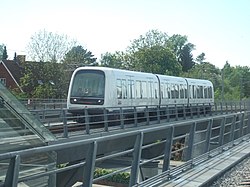
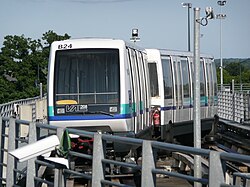
"Light metro" is a common term in European countries, India, and South Korea.

In some countries, however, light metro systems are conflated with light rail. In South Korea, "light rail" is used as the translation for the original Korean term, "경전철" – its literal translation is "light metro", but it actually means "Any railway transit other than heavy rail, which has capacity between heavy rail and bus transit". For example, the U Line in Uijeongbu utilises the VAL system, categorized as a variant of light metro by the LRTA and other organizations, though the operator itself and South Korean sources refer to the U Line as "light rail". Busan–Gimhae Light Rail Transit is also akin to a light metro system in its appearance and features, thought the operator refers it as a "light rail". Likewise, Malaysian officials and media commonly refer to the Kelana Jaya, Ampang and Sri Petaling lines as "light rail transit" systems; when originally opened, the original Malay abbreviations for the lines, PUTRA-LRT (Projek Usahasama Transit Ringan Automatik/Automatic Light Transit Joint Venture Project) and STAR-LRT (Sistem Transit Aliran Ringan/Light Flow Transit System) did not clearly distinguish between light rail and light rapid transit. Some articles in India also refer to some "light metro"-type systems as "light rail". The Light Rail Transit Association (LRTA), a nonprofit organisation, also categorises several public transport systems as "light metro".
Advantages and disadvantages
The main reason to construct a light metro system instead of a rapid transit system is to reduce costs, mainly because this system employs shorter vehicles and shorter stations.
Light metro systems may operate faster than rapid transit systems due to shorter dwell times at stations, and the faster acceleration and braking of lighter trains.[citation needed] For example, express trains on the New York City Subway are about as fast as the Vancouver SkyTrain, but these express trains skip most stops on lines where they operate, while the shorter automated SkyTrains make all stops.
Light metro systems have restricted growth capacities as ridership increases. For example, it is difficult to extend station platforms once a system is in operation, especially for underground railway systems, since this work must be done without interfering with traffic. Some railway systems, like Hong Kong and Wuhan, may make advance provisions for longer platforms, for example, so that they will be able to handle more spacious trains when demand warrants them. The Taipei Metro, for example, constructed extra space for two extra cars in all its Wenhu Line stations. Alternatively, automatic train operation may be introduced, or at least provided for, allowing for very tight headways, increasing capacity through frequency rather than vehicle size.
List of light metro systems
The following is the list of currently-operating light metro systems as categorized by the Light Rail Transit Association (LRTA) as of March 2018[update], unless otherwise indicated. The lists do not include monorails and urban maglev, despite most of them also being "medium-capacity" rail systems.
Currently operating light metro systems
| Country | Location | System | Lines | Year opened | Notes |
|---|---|---|---|---|---|
| Armenia | Yerevan | Yerevan Metro | 1 | 1981 | Rolling stock uses 2 and 3-car trains |
| Austria | Vienna | Vienna U-Bahn – Line 6 | 1 | 1989 | Low-floor trains T and T1 built by Bombardier, 27.3 metres (90 ft) and 26.8 metres (88 ft) long respectively, are operated in 4-car configuration only. The capacity is 776 passengers compared to 882 for the rapid transit lines U1-U5 |
| Bulgaria | Sofia | Sofia Metro – Line 3 | 1 | 2020 | Driverless vehicle system – 60-metre-long (200 ft) trains; Siemens chosen as technology supplier |
| Canada | Ottawa | O-Train | 1 (+1 under construction) | 2019 | While using vehicles typically seen in light rail systems, the line has a higher capacity operating 2-car (100-metre long) Alstom trains. Moreover, the line is fully separated from road traffic. |
| Montreal | Réseau express métropolitain | 1 (+2 branches under construction) | 2023 | Driverless vehicle system. Categorised by itself as a light metro. Trains are 38 metres long. | |
| Vancouver | SkyTrain | 3 | 1985 | While using vehicles typically seen in light metro systems, the Expo line approaches the capacity of a rapid transit system since it operates with longer 4- and 6-car Bombardier trains. However, the Canada Line operates with 2-car Rotem trains. | |
| China | Beijing | Beijing Subway – Capital Airport Express, Yanfang line | 2 | 2008 | Capital Airport Express uses 4-car L-type trains, 60 metres (200 ft) long. Yanfang line uses 4-car B-type trains, 76 metres (249 ft) long. Trains from both lines are driverless. |
| Changchun | Changchun Rail Transit – Line 3, Line 4, Line 8 | 3 | 2002 | All three lines use light rail vehicles, with line 3 also having level crossings. | |
| Dalian | Dalian Metro – Line 3, Line 12, Line 13 | 3 | 2002 | Uses 4-car B-type trains, with some trains on line 3 having 2 cars. | |
| Foshan | Foshan Metro – Line 1 (Nanhai Tram) | 1 | 2021 | The line (also called Nanhai New Transit) uses light rail vehicles, 35 metres (115 ft) long. | |
| Guangzhou | Guangzhou Metro – Line 4, Line 6, Guangfo line, and Zhujiang New Town People Mover | 4 | 2005 | Lines 4 and 6 use 4-car L-type trains, 67m long. Guangfo line uses 4-car B-type trains, 76 metres (249 ft) long. Zhujiang New Town People Mover uses 14 Bombardier's APM 100 cars built in Pittsburgh, Pennsylvania. | |
| Nanjing | Nanjing Metro – Line S6, Line S7, Line S8, Line S9 | 4 | 2014 | Lines S6, S7, and S8 use 4-car B-type trains, 76 metres (249 ft) long, while line S9 uses 3-car B-type trains, 57 m long. | |
| Shanghai | Shanghai Metro – Line 5 (branch), Line 6, and Pujiang Line | 3 | 2003 | Line 5 branch and line 6 use 4-car, 76 metres (249 ft) long, C-type trains. Pujiang line uses 11 Bombardier Transportation's APM 300 cars. | |
| Tianjin | Tianjin Metro – Line 9 | 1 | 2004 | Line 9 uses 4-car B-type trains, 76 metres (249 ft) long. | |
| Wuhan | Wuhan Metro – Line 1 | 1 | 2004 | Line 1 uses 4-car B-type trains, 76 metres (249 ft) long. | |
| Hong Kong | Disneyland Resort Line (Penny's Bay Rail Link) | 1 | 2005 | Trains: 4 compartments without drivers. Some[clarification needed] of the M-Train cars used in the Disneyland Resort line were originally ordered from 1994–1998 as subtype H-Stock train (Phase 3 EMU, A/C 270–291, B/C 486–496). Units A/C274 A/C281 A/C284 A/C289 A/C291 and B/C490 are now used on the Disneyland Resort line. | |
| South Island line | 1 | 2016 | Trains: 3-car S-Trains. Categorised as a "medium-capacity system". | ||
| Macau | Macau Light Rapid Transit | 1 | 2019 | Uses Mitsubishi Heavy Industries Crystal Mover APM vehicles with rubber tyres running on concrete tracks. Mitsubishi supplied 55 two-car trains that are fully automated (driverless) and utilise a rubber-tyred APM system. They have a capacity of up to 476 passengers. | |
| Denmark | Copenhagen | Copenhagen Metro | 4 | 2002 | Driverless vehicle system. Trains: 3-car configuration, 39 metres (128 ft) length. |
| France | Lille | Lille Metro | 2 | 1983 | VAL people mover system. Trains: 2-car configuration, 26 metres (85 ft) in length, with a passenger capacity of 208–240 per train (depending on VAL 206 or VAL 208 train). UrbanRail.net describes it as a "new generation of metro systems". |
| Lyon | Lyon Metro | 4 | 1978 | Trains: Driverless, 2 or 3-car configuration, 36 metres (118 ft) to 54 metres (177 ft) long. Can carry 252 to 325 people in a train. | |
| Marseille | Marseille Metro | 2 | 1977 | Trains: 4-car configuration, 65 metres (213 ft) long. | |
| Paris | Orlyval | 1 | 1991 | VAL people mover system, using VAL 206 vehicles. | |
| Rennes | Rennes Metro | 2 | 2002 | VAL people mover system – while trains have 80 second headways, they can only carry 158 people per train. Described as a "mini-metro line". | |
| Toulouse | Toulouse Metro | 2 | 1993 | Although a VAL system, LRTA defines the system as "Metro". On the other hand, UrbanRail.net describes it as a "light metro VAL system". | |
| Hungary | Budapest | Budapest Metro Line 1 | 1 | 1896 | Trains: The line uses 3-car, 30 metres (98 ft) long trains that can hold up to 190 people. |
| India | Gurgaon | Rapid Metro Gurgaon | 1 | 2013 | Driverless vehicle system. The line is designed to carry up to 30,000 passengers per hour. Several articles define the system as "light metro". |
| Indonesia | Jakarta | Jakarta LRT | 1 | 2019 | Jakarta LRT is the first line in Jakarta to use a third rail system. It uses standard gauge (1435 mm). One trainset can carry 270-278 passengers |
| Jabodebek LRT | 2 | 2023 | The elevated standard-gauge line is electrified at 750V dc third rail. It has moving block signalling designed for headways of 2–3 minutes. | ||
| Palembang | Palembang LRT | 1 | 2018 | Trains uses 3-car configuration | |
| Italy | Brescia | Brescia Metro | 1 | 2013 | Trains: 3-car configuration, 39 metres (128 ft) length. |
| Catania | Catania Metro | 1 | 1999 | Single-tracked at-grade section limits headways to 15 minutes. Currently 4.6 kilometres (2.9 mi) of double track extension are under construction. | |
| Genoa | Genoa Metro | 1 | 1990 | Generally considered to be a "light metro" considering its low frequency, limited hours of operation and reduced transport capacity. It is actually categorised as "light rail" by LRTA. | |
| Milan | MeLA Milan Metro: Line 4 and Line 5 | 3 | 1999, 2013, 2022 | Driverless vehicle system. Trains: 4-car configuration, 50.5 metres (166 ft) length, capacity for 536 passengers. | |
| Naples | Naples Metro | 1 | 1993 | Line 6 is categorised as "light metro" system, with only 16 minute headways. Line 1 has a single-tracked tunnel section. | |
| Perugia | MiniMetro | 1 | 2008 | LRTA defines the system as a "light metro" system, while they regarded the same system in Laon, which ceased in 2016, as a "cable monorail". | |
| Turin | Turin Metro | 1 | 2006 | VAL people mover system. | |
| Japan | Hiroshima | Astram Line | 1 | 1994 | Trains: 6-car configuration, operated manually. A small part of the underground section was built as Metro system. |
| Kobe | Kobe New Transit | 2 | 1981, 1990 | Trains: Port Island Line and Rokkō Island Line. Both are 4-car configuration (300 people per train), driverless. Platforms were built to accommodate 6-car trains. | |
| Osaka | Nankō Port Town Line | 1 | 1981 | Trains: 4-car configuration, driverless vehicle system. Platforms were built to accommodate 6-car trains. | |
| Saitama | New Shuttle | 1 | 1983 | Trains: 6-car configuration, operated manually. | |
| Tokyo | Nippori-Toneri Liner | 1 | 2008 | Trains: 5-car configuration, driverless vehicle system. | |
| Yurikamome | 1 | 1995 | Trains: 6-car configuration, driverless vehicle system. | ||
| Yokohama | Kanazawa Seaside Line | 1 | 1989 | Trains: 5-car configuration, driverless vehicle system. | |
| Malaysia | Kuala Lumpur | Rapid KL – Kelana Jaya Line, Ampang Line, Sri Petaling Line | 4 | 1998, 1996 | KELANA JAYA LINE: Bombardier INNOVIA ART 200 Trains: Mixed 2-car, 4-car configuration fleet Bombardier Innovia Metro 300 Trains: 4-car configuration AMPANG AND SRI PETALING LINES: CRRC Zhuzhou LRV Trains: 6-car configuration |
| Philippines | Manila | LRT Line 1 | 1 | 1984 | Trains: Line began with 2-car configuration, reconfigured to 3-car in 1999, and procured new 4-car trains in 1999, 2006, and 2022. Line was originally designed for 18,000 p/h/d capacity, increased to 40,000 p/h/d in 2006. Categorised as "light rail" by LRTA. |
| MRT Line 3 | 1 | 1999 | Trains: 3-car configuration, with a max. capacity of 1,182 passengers, and running with 3.5–4 minute headways. 4-car trains with a max. capacity of 1,576 passengers were introduced in 2022. However, line is designed for 23,000 p/h/d capacity, expandable to 48,000 p/h/d. | ||
| Russia | Moscow | Moscow Metro: Line 12 – Butovskaya Line | 1 | 2003 | Can carry 6,700 p/h/d.[citation needed] Trains: 3-car configuration, ~85 metres (279 ft) length |
| Singapore | Singapore | Singapore MRT: Circle line, Downtown line | 3 | 2009, 2013, 2027 | The Circle line rolling stock consists of Alstom C830 and C830C trains in 3-car formations with a capacity of 931 passengers. The Downtown line rolling stock consists of Bombardier C951 & C951A trains also in 3-car formations with a capacity of 931 passengers. |
| South Korea | Busan | Busan–Gimhae Light Rail Transit | 1 | 2011 | Driverless vehicle system. Trains: 2-car configuration. Unmentioned by LRTA, but the operator calls the system "light rail". |
| Gimpo | Gimpo Goldline | 1 | 2019 | Each train consists of 2-car trains and runs unmanned. | |
| Incheon | Incheon Subway Line 2 | 1 | 2016 | Each train consists of 2-car trains and runs unmanned. | |
| Seoul | Ui LRT | 1 | 2017 | Each train consists of 2-car trains and runs unmanned. | |
| Sillim Line | 1 | 2022 | Each train consists of 2-car trains and runs unmanned. | ||
| Uijeongbu | U Line | 1 | 2012 | VAL driverless system. Trains: 2-car configuration. Categorised as a "light metro" system by LRTA and elsewhere, though there are also articles categorizing it as "Light Rail". | |
| Yongin | Yongin Everline | 1 | 2013 | Driverless vehicle system applied. | |
| Spain | Barcelona | Barcelona Metro: Line 8 and Line 11 | 2 | 2003 | Driverless vehicle system. Trains: 2-car configuration. LRTA also categorises Line 8 as a "light metro" system. |
| Málaga | Málaga Metro | 1 | 2014 | System contains at-grade intersections on surface section of Line 1. Described as a "light metro" system by at least one rail publication. | |
| Palma, Majorca | Palma Metro: Line M1 | 1 | 2007 | Mostly underground line operates with just 15-minute headways and 2-car trains (306 passengers max.); one reference even categorises line as "light rail". | |
| Seville | Seville Metro | 1 | 2000 | Trains: 31.3 metres (103 ft) length with a max. capacity of 280 passengers. Described as a "light metro" by rolling stock manufacturer, CAF. | |
| Switzerland | Lausanne | Lausanne Métro | 2 | 1991 | Line M1 uses light rail vehicles, 30 metres (98 ft) long. Line M2 has driverless, rubber-tyred trains; 30 metres (98 ft) long.[citation needed] |
| Taiwan | Taipei | Taipei Metro: Wenhu/Brown Line and Circular/Yellow Line | 2 | 1996, 2020 | Brown Line (Line 1) – Trains: Rubber-tire system; 4-car configuration; categorised as a part of the "metro" by LRTA. Yellow Line – 4-car AnsaldoBreda Driverless Metro vehicles, categorised as a "light metro" system by LRTA. |
| Taichung | Taichung MRT: Green line | 1 | 2021 | 2-car EMU. | |
| Thailand | Bangkok | Bangkok MRT: Blue Line and Purple Line | 2 | 2004, 2016 | 3-car configuration |
| Turkey | Ankara | Ankaray Light Metro (A1 Line) | 1 | 1996 | Trains: 3-car configuration, approx. 90 metres (300 ft) length. Categorised as a "light rail" by LRTA, though Current capacity: 27,000 p/h/d. |
| Bursa | Bursaray | 2 | 2002 | Uses light rail cars, similar to Frankfurt U-Bahn | |
| Istanbul | Istanbul Metro: M1 Line (Istanbul Hafif Metro) | 1 | 1989 | Trains: 4-car configuration. "Hafif Metro" literally translates as "Light Metro". Categorised as a "light rail" system by the LRTA. | |
| İzmir | İzmir Metro: M1 Line (İzmir Hafif Rayli Metro Sistemi) | 1 | 2000 | Trains: 5-car configuration, upgraded from former 3- and 4-car configurations | |
| Adana | Adana Metro: M1 Line | 1 | 2010 | Trains: 4-car configuration.It's poorly designed, and it doesn't reach its expected ridership amount. | |
| United Kingdom | Glasgow | Glasgow Subway | 1 | 1896 | Gauge: 4 ft (1,219 mm). Trains: 3-car configuration. |
| London | Docklands Light Railway | 7 | 1987 | Driverless vehicle system. Trains: generally 2- to 3-car configuration. Categorised as a "light rail" by LRTA. | |
| Tyne and Wear | Tyne and Wear Metro | 2 | 1980 | Trains: 2 MU configuration with 7 level crossings. | |
| United States | Detroit | Detroit People Mover | 1 | 1987 | Considered to be a "people mover". |
| Honolulu | Skyline | 1 | 2023 | Trains: 4-car Hitachi Rail Italy Driverless Metro trains, 78m (256ft) long. | |
| Miami | Metromover | 3 | 1986 | Considered to be a "people mover". | |
| Philadelphia | M (part of the SEPTA Metro) | 1 | 1907 | Primarily on a surface-level "right-of-way" with partial triple-tracking, allowing for express services. Has been categorised by APTA as "Light rapid rail transit". While it has high platforms and third rail power, all intermediate stops are flag stops and fares must be paid to the operator upon boarding except at the termini. This makes it difficult to categorise, as it has the infrastructure of a light metro but is operated in many ways like a trolley service. | |
| Venezuela | Maracaibo | Maracaibo Metro | 1 | 2006 | Trains: 3-car trainset configuration, ~58 metres (190 ft) length (originally designed for Prague Metro). Categorised as a "light rail" by LRTA. |
| Valencia | Valencia Metro | 1 | 2007 | Trains: 2-car Siemens SD-460 configuration, ~55 metres (180 ft) length. Categorised as a "light rail" by LRTA. | |
| Vietnam | Hanoi | Hanoi Metro | 2 | 2021 | Trains: 4-car configuration |
| Ho Chi Minh City | HCMC Metro | 1 | 2024 | Trains: 3-car configuration, 61.3 m long, (201 ft) |
Under construction light metro systems
| Country | Location | System | Planned opening | Notes |
|---|---|---|---|---|
| Kazakhstan | Astana | Astana Light Metro | 2025 | Trains will operate at a 4 car configuration, totalling only 60m |
| Malaysia | Kuala Lumpur | Shah Alam Line | 2025 | Trains will operate at a 3 car configuration |
| Singapore | Singapore | Jurong Region Line | 2027 | Hyundai Rotem J151 trains will operate in a 3 car configuration that can carry 600 passengers |
| Romania | Cluj-Napoca | Cluj-Napoca Metro | 2031 | Romania's second mass transit network. Operated as three-car driverless trains. |
| United States | New York City | Interborough Express | Early 2030s | Line will be used to connect Brooklyn and Queens. |
Former light metro systems
The following is the list of former light metro systems that either developed into a rapid transit system, or which are no longer in operation:
- Guangzhou, China Line 3 – began with 3-car configuration, changed to 6-car in 2010.
- Komaki, Japan Peachliner – abandoned on 30 September 2006.
- Seoul, South Korea Line 9 – trains lengthened from 4 cars to 6 cars in 2019.
- Sha Tin and Ma On Shan, Hong Kong Ma On Shan Rail – converted from 4- to 8-car configuration and became part of Tuen Ma line.
- Toronto, Ontario Line 3 Scarborough – Categorised by APTA as being "intermediate rail" (i.e. between "heavy rail" and "light rail"), and categorised as a "light metro" system by LRTA. Scheduled to cease operations in November 2023, service was suspended following a derailment in July 2023 and was not resumed, instead being replaced by an express bus service.
See also
- Automated guideway transit
- Maglev
- Metro
- Passenger rail terminology
- People mover
- Rail transport
- Rubber-tyred metro
- Urban rail
- VAL
Notes
Bibliography
- Taplin, Michael. . lrta.org. Light Rail Transit Association. Archived from on 2019-04-06.
- . uitp.org. International Association of Public Transport (French: L'Union internationale des transports publics (UITP)).
- Schwandl, Robert. . UrbanRail.Net.
External links
- by the US Transportation Research Board and the American Public Transportation Association
- 2014-11-29 at the Wayback Machine