Meibutsu
In-game article clicks load inline without leaving the challenge.
Meibutsu(名物, lit.'famous thing') is a Japanese term most often applied to regional specialties (also known as meisan(名産)).
Meibutsu can also be applied to specialized areas of interest, such as chadō, where it refers to famous tea utensils, or Japanese swords, where it refers to specific named famous blades.
Definition
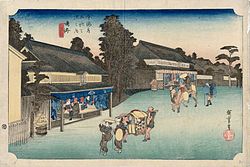

Meibutsu could be classified into the following five categories:
- Tokusanhin, regional Japanese food specialties such as the roasted rice cakes (yakimochi) of Hodogaya, and the yam gruel, toro-jiru of Mariko;
- Japanese crafts as souvenirs such as the swords of Kamakura or the shell-decorated screens of Enoshima;
Historically, meibutsu also included:
- Supernatural souvenirs and wonder-working panaceas, such as the bitter powders of Menoke that supposedly cured a large number of illnesses;
- Bizarre things that added a touch of the "exotic" to the aura of each location such as the fire-resistant salamanders of Hakone; and
- Prostitutes, who made localities such as Shinagawa, Fujisawa, Akasaka, Yoshida and Goyu famous. In some cases these people may have encouraged visits to otherwise impoverished and remote localities, contributing to the local economy and the exchange between people of different backgrounds.[citation needed]
Several prints in various versions of the ukiyo-e series The Fifty-Three Stations of the Tōkaidō depict meibutsu. These include Arimatsu shibori, various tie-dyed fabrics sold at Narumi (station 41), and kanpyō (sliced gourd), a product of Minakuchi (station 51), as well as a famous teahouse at Mariko (station 21) and a famous tateba (rest stop) selling a type of ricecake called ubagamochi at Kusatsu (station 51).
Another category are special tea tools that were historic and precious items of Japanese tea ceremony.
Usage
Evelyn Adam gave the following account of meibutsu in her 1910 book, Behind the Shoji:
The strain of giving would really become unendurable to half the people in Japan were it not for what is known as the "meibutsu" or specialty of each town. This fills in gaps nicely; this provides the answer to vexed questions. "What shall I give to the kind person from whom I have received my twenty-fifth English lesson?" "A meibutsu." "And what shall I send my ailing father-in-law?" "A meibutsu" also, both to be brought back from the next place I happen to visit. The shops there are sure to make a reduction on quantity, well knowing that every person who goes off on a holiday is expected to return with "meibutsu" for everybody he knows, the idea being that a person who has enjoyed himself and had nothing particular to do should try to make up to those left behind in the place where they belong, engaged in the usual dull routine. Help to lift somebody out of the rut by bringing home to him or her some little novelty—that is the kindly spirit—and never mind what the trifle may be. Whether a metal pipe or a bamboo toy, it can be presented with perfect propriety to grandmother or infant grandson. "Meibutsus" vary greatly of course. Some are sticky like the chestnut paste of Nikko, some are bulky and a source of perpetual anxiety like the fragile baskets of Arima, some are pretty like the Ikao cotton cloth dyed in the iron spring water, and some are useless and ugly and impossible to carry, like the fierce fishes of Kamakura—the fishes which blow themselves up into a globe when angry or excited and then remain blown up—as an eternal punishment I suppose—and get turned into lanterns. There are dozens of all varieties, useful and useless, dear and queer, sensible and silly, so that people with much-travelled acquaintances are soon in a fair way to start a museum. Or, to be accurate, they would be if they kept the things. But nobody does keep them all. The provident housekeeper constantly receiving "meibutsus," and constantly requiring things to send back in return, has invented a system to circumvent the expense. It is somewhat like double entry book-keeping. When the need for the return gift arises, she goes, like old Mother Hubbard, to her cupboard and looks over the parcels that have arrived lately. Distinctive things like blown-up fish may be out of the question, but there are sure to be some local or non-committal contributions. Doubtless there will be eggs hardly a month old yet, and cakes that only came week before last. Either of these will do nicely; therefore the lady wraps them up properly and passes them on. Nine times out of ten, she who receives them does the same; also her friend and her friend's friend, till those eggs or cakes are nearly as travelled as a war correspondent.
Examples
| Prefecture | Traditional crafts | Agricultural products | Tokusanhin (specialities) |
|---|---|---|---|
| Aichi | Akazu ware, pottery Arimatsu natsumi shibori Hōraku ware, pottery – Nagoya Fude, calligraphy brush – Toyohashi Kawana ware, blue and white transferware porcelain – Nagoya Sensu, folding fan – Nagoya Onigawara, ogre-faced roof tile Seto ware, pottery Shippō(截金), cloisonné – Ama, Aichi Tokoname ware, pottery – Nagoya | Hatcho miso Nagoya Kochin, chicken Shrimp | Ankake spaghetti Curry udon Doteni, intestines simmered in miso Ebi furai Ebi senbei, shrimp crackers Hitsumabushi Kishimen, flat udon Miso nikomi udon, udon in a miso broth with vegetables Miso katsu Miso oden Moriguchizuke, daikon pickled in sake lees Ogura toast, sandwich of butter and red bean paste Oni manjū, steamed cake with cubes of mochi and sweet potato Taiwan ramen, local version of Tan Tsu Mien Tatami iwashi Tebasaki karaage, deep-fried chicken wings Tenmusu Toriwasu, chicken sashimi Uirō |
| Akita | Akita ginsen-zaiku, silver filigree Akita sugi-okedaru, cedar buckets Honjō-nuri, lacquerware – Yurihonjō Itaya-zaiku, woven maple wood baskets Kabazaiku, cherry bark boxes and tea caddies – Kakunodate Kawatsura-shikki, lacquerware – Kawatsura Kokeshi – Kawatsura Magewappa, bent wood cedar boxes – Ōdate Naraoka-yaki, pottery – Daisen, Akita Noshiro-shunkei, lacquerware – Noshiro, Akita Shiraiwa-yaki, pottery – Kakunodate, Akita | Buri Hatahata, Japanese sandfish Hinai-jidori, chicken Junsai, water lily Otake ichijiku, fig – Nikaho | Damako nabe, rice ball hotpot Iburigakko, smoked pickled daikon Imonokojiru, taro stew Inaniwa udon Junsai nabe Kiritanpo nabe Shottsuru Tonburi Yokote yakisoba |
| Aomori | Kokeshi Tsugaru tako, painted kite Tsugaru-jamisen, shamisen Tsugaru-nuri(津軽塗), lacquerware – Hirosaki Tsugaru no hatobue, clay whistle shaped like a pigeon Yawata uma, carved wooden horse | Apples Black garlic Cassis, blackcurrant Maguro – Ōma Owani onsen moyashi, soybean sprout – Ōwani Jusankosan yamato shijimi, clams – Goshogawara Shimizumori namba, red pepper – Hirosaki Steuben grape – Tsuruta | Apple pie Bara yaki, grilled beef rib meat Hittsumi, roux with chicken and vegetables – Nanbu, Aomori Ichigo-ni, clear soup of thinly sliced sea urchin roe and abalone Ikamenchi, minced squid fritter Jappa-jiru, fish gut and vegetable soup, usually cod or salmon Kaiya or kayaki, scallop boiled with egg and miso in its own shell Keiran, red bean soup with dumplings Senbei jiru, senbei soup |
| Chiba | Bōshu uchiwa, flat fan – Minamibōsō and Tateyama Chiba koshogu, iron artisan's tools such as sickles, hoes, knives and western-style scissors – Bōsō Peninsula | Biwa Hamaguri Ise ebi Peanuts Soy sauce Takenoko | Aji no tataki, chopped horse mackerel Ise-ebi senbei, spiny lobster crackers Namerō Peanut monaka Suzumeyaki, broiled Crucian carp Tai senbei, Teppōzuke, pickles – Narita |
| Ehime | Cultured pearls Tobe ware | Goishicha Iyokan Mikan Tai | Botchan dango Goshiki somen (five-color somen) Imotaki Jakoten Satsuma jiru, miso and pork stew Uwajima Tai-meshi |
| Fukui | Echizen Uchihamono, kitchen knives and scissors – Echizen Echizen ware, pottery Echizen washi – Echizen Wakasa nuri, lacquerware – Wakasa | Miyazaki takenoko, bamboo shoots Sakuradai, "cherry" seabream caught in early spring Yoshikawa nasu, eggplant – Sabae Zuwaigani, snow crab – Echizen | Echizengani-nabe, nabe dish of Echizen snow crab Eihei-ji goma-dofu Funa sashimi Hamayaki saba, mackerel grilled seaside Kodai no sasazuke, preserved sea bream - Obama Oroshi soba Saba no heshiko, grilled rice bran pickled mackerel Satoimo no koroni, soy sauce stewed taro Sauce katsudon Sugo, pickled Yatsugashira taro stalks Volga rice – Echizen |
| Fukuoka | Agano ware, pottery – Fukuchi Amagi no bata-bata, painted pellet drum Hakata doll – Fukuoka City Hakata koma, iron spinning top Hakata-ori, woven fabric – Fukuoka City Hakata magemono, bent wood items Karume kasuri, woven fabric – Kurume Ki uso, carved wooden bird toy Koishiwara ware, pottery – Koshiwara Takatori ware, pottery | Amaou strawberries – Itojima Hakata-jidori, chicken Mentaiko Yamecha | Goma saba Hitokushi gyoza, "one-bite gyoza" Karashi mentaiko Meika Hiyoko, chick-shaped baked buns stuffed with yellow bean jam Menbei, mentaiko and other seafood senbei Mentaisenbei, mentaiko senbei Mizutaki, chicken soup Motsunabe Niwaka-senpei, cookie shaped like Hakata Niwaka mask Takana gohan, fried rice with pickled takana Tonkotsu ramen |
| Fukushima | Aizuhongō ware, pottery – Aizu region Aizu shikki, lacquerware – Aizu region Akabeko, bobblehead red cow toy – Aizu region Kokeshi Miharu-goma, wooden horse – Miharu Ōborisōma ware, pottery Okiagari-koboshi, papier-mâché toy – Aizu region | Fukushima beef Peaches | Awa manjū, steamed millet buns stuffed with red bean paste Dobu-jiru, stewed ankimo and vegetables Ikaninjin, squid and carrot in soy-sauce Kitakata ramen Kozuyu, osechi soup made from dried scallops, mushrooms, and vegetables – Aizu Mamador Namie yakisoba Nishin no sanshouduke, dried Pacific herring pickled with sansho Shirakawa ramen – Shirakawa |
| Gifu | Enako bandori, straw raincoat – Takayama Hida-shunkei, lacquerware – Takayama Japanese kitchen knives – Seki Mino washi, traditional paper used in lanterns (岐阜提灯, Gifu Chōchin), umbrellas (岐阜和傘, Gifu Wagasa) and fans (岐阜うちわ, Gifu Uchiwa) Mino ware, pottery Oribe ware, pottery Shino ware, pottery Sarubobo, monkey amulet – Takayama | Ayu, especially via Cormorant fishing on the Nagara River Fuyu Hida beef Hida beni kabu, red turnip Sayori-meshi, rice cooked with salted sanma – Kani and Mitake | Akakabu-zuke, red turnip pickles – Hida Takayama Chūka soba, Takayama ramen Hoba miso, beef grilled with miso on top of a dried magnolia leaf – Takayama Keichan, sautéed chicken and cabbage Kurikinton Tatami iwashi |
| Gunma | Daruma – Takasaki, Gunma Kiryū ori, brocade – Kiryū, Gunma Takasaki maneki neko, papier-mâché | Hoshi-imo, wind dried sweet potato Joshu beef Konnyaku Pork Rainbow trout Shimonita negi, green onions | Isobe senbei Kamameshi Himokawa udon, extremely wide udon Miso pan Mizusawa udon, udon in sesame sauce Okkirikomi, hand cut noodles in a soy sauce and mirin broth Tōge no kamameshi, mountain pass kettle rice Torimeshi, chicken cooked in tea rice Yakimanju, grilled manjū |
| Hiroshima | Fude, calligraphy brush – Kumano Hariko, papier-mâché masks and dolls – Miyajima Kendama, cup and ball game – Hatsukaichi Otagawa glass Shakushi made from cherry wood – Miyajima | Anago Hiroshimana, a variety of Chinese cabbage Lemons Oysters | Calbee Dote-nabe, nabemono dish of oysters, tofu and vegetables stewed in a miso-based broth Momiji manjū Monaka Okonomiyaki Onomichi ramen Shakushi Senbei, senbei shaped like ladles Tsukemen |
| Hokkaido | Kibori kuma, carved wooden bear – Yakumo, Hokkaido Nibutani bark cloth | Corn Dairy products Kombu Lavender Salmon Yubari King cantaloupe | Butadon Chanchan-yaki, miso grilled salmon with vegetables Ikameshi Ika sōmen Ishikari-nabe, salmon and vegetables cooked in a miso broth Japanese wine Jingisukan Matsumaezuke Muroran curry ramen Sanpei-jiru, a winter vegetable and salmon miso soup Sapporo ramen Shiroi Koibito Rui-be Royce' Uni donburi Zangi, deep fried chicken marinated in soy sauce and ginger |
| Hyōgo | Awaji ware, pottery Banshū kebari, fly fishing ties – Nishiwaki, Hyōgo Incense Izushi ware, pottery – Izushi Tamba ware, pottery | Ako salt Hamo Kobe beef Kuromame, black soybeans Sanda beef Tai | Akashiyaki Botan nabe, wild boar hot pot Butaman – Kobe Castella Fugetsudo Himeji oden Ikanago no kukini, sand lance tsukudani Kakogawa katsumeshi, beef cutlet served on rice with demi-glace – Kakogawa Shiome manju – Akō |
| Ibaraki | Awano shunkei-nuri, lacquerware Kasama-yaki, pottery – Kasama Yūki-tsumugi – Yūki | Anko Edosaki kabocha Hitachi wagyu Hoshi-imo, dried sweet potato Natto Okukuji Shamo chicken | Ankoimo Anko nabe, anglerfish nabe Kenchin jiru Miso peanuts Namegata-don, seafood and vegetables over rice Shishi-nabe, wild boar hotpot |
| Ishikawa | Kaga mizuhaki Kutani ware, glazed porcelain – Kaga, Ishikawa Wajima-nuri – Wajima, Ishikawa Yamanaka-nuri – Kaga, Ishikawa | Japanese amberjack Kaga yasai, traditional vegetables Kukicha, processed either as bancha or hōjicha Noto salt Snow crab | Gori-karaage, deep-fried gori Gori-tsukudani, gori simmered in soy sauce, sometimes with walnuts Hasumushi, steamed lotus root egg dish Ishiru hotpot, hotpot cooked with fish sauce instead of soy sauce Jibu-ni Kaburazushi, turnip sushi Kamifūsen, balloon shaped sweet filled with kingyoku jelly – Kanazawa Kaisendon, seafood rice bowl Kintsuba, red beans and agar wagashi – Kanazawa Rakugan, pressed dry sweets – Kanazawa |
| Iwate | Hidehira-nuri, lacquerware Iwayadotansu (岩谷堂箪笥), wooden chests of drawers – Ōshū, Iwate Johoji lacquerware Kokeshi Tetsubin, cast iron kettle | Abalone (farmed) Kashi gaki, persimmon – Kamaishi Wasabi Wakame (farmed) | Mamebu, wheat dumplings filled with walnut Morioka jajamen Morioka reimen Nambu senbei Wanko soba |
| Kagawa | Kagawa shikki, lacquerware – Takamatsu Marugame uchiwa, flat fan – Marugame Sanuki itto-bori, chisel woodcarving – Kotohira and Mannō Sanukite instruments Takamatsu hariko, papier-mâché dolls –Takamatsu | Cochin chicken Cotton Kagawa mototaka pepper Olives Salt – Seto Inland Sea region Sanuki no yume wheat Sugar | An-mochi zoni, zōni with red bean paste stuffed mochi in a white miso broth Honetsuki tori, fried chicken – Marugame Iriko meshi, iriko cooked with rice Mamba no kenchan, stirfried mustard leaf and tofu Oshinuki sushi, sushi made with spring sawara Sakana no sambai, grilled small fish marinated in vinegar, mirin and soy sauce Sanuki udon Shippoku Udon Shoyumame Teppai, cold dish of carp Teuchi udon Uchikomi jiru, noodle soup Wakagi-ae, Japanese scallion mixed with razor clams or asari clams |
| Kagoshima | Oshima tsumugi Satsuma kiriko, cut glass Satsuma ware, pottery Tai-guruma, toy red snapper on wheels Yoronjima bashōfu, banana fiber cloth | Chiran tea Katsuobushi Kibinago Kurobuta, pork Kurozu, black vinegar Satsuma jidori, chicken Wasanbon | Akumaki Kagoshima ramen Karukan Keihan rice |
| Kanagawa | Hakone yosegi-zaiku (箱根寄木細工), wooden marquetry – Hakone and Odawara Kamakura-bori, carved lacquerware – Kamakura | Salt pickled cherry blossoms Shirasu Shōnan pork | Botan nabe, wild boar hot pot Gyūnabe Hato Sabure, dove-shaped sablé Kaigun kare, Japanese curry Kenchin jiru Misaki maguro ramen, tuna ramen Namashirasu-don, raw shirasu over rice Odawara kamaboko Sanma-men, Yokohama ramen Shutō |
| Kōchi | Tosa uchihamono, hammered cutlery Tosa washi | Goishicha Ginger Skipjack tuna Yuzu | Dorome Katsuo no Tataki |
| Kumamoto | Amakusa pottery Higo zogan, damascene Konohazaru, monkey pottery dolls Shōdai ware, pottery – Arao Tatami | Basashi Karaimo Kensan igusa, rush Majaku, Japanese mud shrimp | Dagojiru Fuga-maki, bean paste wrapped in nori Hitomoji guruguru, boiled green onion with mustard sauce Ikinari dango Jindaiko Karashi renkon, mustard stuffed lotus root Kumamoto ramen Takamori dengaku Yamato croquette – Yamato |
| Kyoto | Asahi ware, pottery – Uji Fushimi ningyo, clay doll Kyō ware, pottery Kiyomizu ware Rengetsu ware Nishijin-ori Sensu, folding fan Tango chirimen Uchiwa, flat fan | Ebi-imo, taro Hōjicha Kyo-yasai, Kyoto traditional vegetables Saikyo miso Shogoin turnip Uji tea | Awafu, namafu made with millet as well as glutinous rice Buri shabu, yellowtail hotpot – Ine Hamo no otoshi, blanched pike conger Konpeitō Nishin soba, soba topped with dried Pacific herring Saba heshiko, spicy nukazuke mackerel – Ine Saikyoyaki, grilled fish pickled in Saikyo miso Tsukemono, including: Semmaizuke, sliced turnip pickled in mirin Shibazuke, eggplant pickled with red perilla Sugukizuke, salt pickled whole turnip Yatsuhashi Yudofu |
| Mie | Banko ware, pottery – Yokkaichi Iga ware, pottery – Iga Ise washi – Ise | Aosa nori Hamaguri Ise tea Matsusaka beef Spiny lobster | Akafuku, mochi covered in red bean paste -Ise Ise udon, thick noodles in a sweet soy sauce Nagamochi, grilled oblong mochi stuffed with red bean paste Sanma-zushi Tatami iwashi Tekone-zushi, soy sauce marinated bonito over sushi rice |
| Miyagi | Kinoshita-goma, carved wooden horse Kokeshi Sendaihira, woven silk fabric for hakama – Sendai Tansu Tsutsumi ningyo, clay doll Tsutsumi-yaki, pottery Yanagiu-washi, paper | Coho salmon (farmed) Hoya, sea pineapple Oysters Seri, Japanese parsley | Aburafu, deep fried wheat gluten – Tome Gyūtan – Sendai Harako-meshi, rice cooked in salmon stock and topped with ikura – Watari Hiyashi chūka Robatayaki – Sendai Sasa-kamaboko, kamaboko shaped like bamboo leaves – Sendai Shiroishi umen, wheat noodles made without oil – Shiroishi Shisho-maki, Deep fried miso walnut paste rolled in perilla leaves – Ōsaki Yubeshi Zundamochi, mochi covered in edamame paste – Sendai |
| Miyazaki | Jindaigoma, spinning top Hyūga go shi – Hyūga | Chestnuts – Suki Hyuganatsu Kumquat Mango | Aoshima senbei Cheese manjū Chicken namban Gobochi, gobo chips Hiyajiru, cold miso soup with cucumber Karukan Miyazaki no sumibiyaki, chicken grilled over charcoal Nanjakorya Daifuku, lit. "What is this?" daifuku stuffed with a strawberry, chestnut paste, cream cheese, and red bean paste Sumibiyaki, charcoal-grilled chicken |
| Nagano | Butsudan – Iiyama Matsushiro ware Mizuhiki – Iida | Common carp – Saku Chestnuts – Obuse Ichida gaki, persimmon – Iida and Iijima Nozawana – Nozawaonsen Walnuts – Tōmi Wasabi | Goheimochi, grilled mochi made from non-glutinous rice Inago no Tsukudani Korimochi, naturally freeze-dried mochi Pickled nozawana Oyaki Soba Sunki, pickled red turnip stalk and leaves Yawataya Isogorō shichimi togarashi |
| Nagasaki | Hasami ware Hirado ware Koga ningyo, clay doll Nagasaki hata, kite Pearls Sasebogoma, spinning top Vidro, blown glass | Camellia oil | Castella Champon Kakuni Karasumi Sara udon Sasebo burger Toruko raisu (Turkish rice), tonkatsu over curry rice and spaghetti |
| Nara | Akahada ware, pottery Nara Fude Nara ittobori (奈良一刀彫), woodcarving Nara uchiwa, carved paper fan Shikamikuji, carved deer with o-mikuji in its mouth Sumi, inkstick Takayama Tea Whisk Tora hariko, papier-mâché tiger | Hōjicha Kuzu Persimmon Strawberries Watermelon Yamato tea | Aburakasu, deep-fried beef intestine Asuka-nabe, hot pot of chicken and vegetables cooked in milk Chagayu[ja], kayu cooked in tea Kakinoha-zushi[ja], salted mackerel sushi wrapped in persimmon leaf Kashiwa no sukiyaki, chicken sukiyaki Kasuzuke, especially narazuke, aged pickles flavored with mirin Kuzumochi Manjū Mikasayaki, a kind of dorayaki Miwa sōmen Momiuri, cucumber sunomono Nyumen, somen noodles in a hot broth Shishi-nabe, wild boar hotpot Wakakusa nabe, spinach hotpot – Nara (city) Yubeshi |
| Niigata | Anchi ware, pottery – Agano Mumyōi ware, pottery – Sado Neko chigura, cat basket Sankaku daruma, conical daruma Tarai-bune, tub boats | Echigohime strawberries Le Lectier pears Rice, especially Koshihikari | Fried half chicken, half of a chicken seasoned with curry powder and salt then deepfried Hegi-soba, soba made with funori Namban miso, chili-infused miso Noko miso ramen, rich miso ramen with side broth to dilute it – Niigata (city) Noppe Sasa dango Tare katsudon Wappa meshi, cooked rice steamed with dashi and seafood in a bentwood box – Niigata (city) |
| Ōita | Bamboo weaving – Beppu Geta – Hita, Ōita Onta ware, pottery | Aji Bungo beef Fugu Japanese horse mackerel Kabosu, citrus Kuruma prawn Marbled flounder Dried shiitake mushrooms Saffron | Buri no atsumeshi, marinated yellowtail over rice Dango-jiru, dumpling miso soup Gomadashi udon, grilled fish ground with sesame seeds and soy sauce served over udon Karaage Karukan Jigokumushi, steamed food cooked by Beppu's hot springs Takanazushi, sushi made with takana and nori Toriten Yuzukoshō |
| Okayama | Bizen ware, pottery Kurashiki hariko, papier-mâché zodiac dolls, most famous is a bobble headed tiger | Muscat grape White peach Sawara | Barazushi, scattered fish and vegetables over sushi rice Demi-katsudon Kakioko, oyster okonomiyaki – Hinase Kasaoka ramen, chicken broth ramen Kusagina meshi, verbena rice – Kurashiki Hiruzen yakisoba Horumon yaki-udon – Tsuyama Kibi dango (Okayama) Mamakari-zushi, pickled sappa over rice Shino udon -Tamashima Takomeshi, steamed octopus rice |
| Okinawa | Bingata Chin-chin uma, papier-mâché toy of Okinawan king on horseback Kumejima-tsumugi Ryukyuan lacquerware, lacquerware inlaid with shells and often red Ryukyuan pottery Tsuboya ware Shisa | Beni imo, ube Goya Hirami lemon Kokuto (黒糖), Okinawan brown sugar Shima rakkyo, island shallot Umi-budō | Awamori Chanpurū Chinsuko Hirayachi Ikasumi, squid ink pasta Kippan Kōrēgusu Mimiga Muchi Okinawa soba Rafute Sata andagi Shima-dōfu, Okinawa tofu Soki Sukugarasu, salt cured rabbit fish on tofu Taco rice Tōfuyō Yagi sashimi, raw goat meat |
| Osaka | Kosobe ware, pottery – Takatsuki Naniwa tinware – Osaka Sakaiuchi chef knives – Sakai | Fugu Naniwa-yasai, Osaka traditional vegetables Genpachi mono, shiso sprouts Kema kyuuri, cucumber Kintoki ninjin, carrot Nanba negi, green onion Kotsuma nankin, pumpkin Osaka shirona, Chinese cabbage Tanabe daikon Tamatsukuri kuromon shirouri, oriental pickling melon Tennōji kabura, turnip | Battera zushi Chinsuko Harihari-nabe Keshimochi, red bean filled mochi covered in poppy seeds – Sakai Kitsune udon Kushikatsu Mojimi no tempura, tempura salt-preserved maple leaves – Minoh Takoyaki Okonomiyaki |
| Saga | Arita ware, porcelain – Arita Kakiemon Karatsu ware, pottery – Karatsu Saga Nishiki | Saga gyu, beef Saga Nori Takezaki crab Yabuko squid | Dagojiru, chicken and noodle soup Kakinoha-zushi[ja], trout sushi wrapped in a persimmon leaf Kuri okowa, sticky rice with chestnuts Mutsugoro no Kabayaki, grilled mudskipper Ogi yōkan Saganishiki, a steamed chestnut cake named after the brocade Sicilian rice, combination of rice, salad, and meat |
| Saitama | Aizome, indigo dyed fabric Chichibu meisen, ikat silk fabric – Chichibu Kimekomi ningyo (Iwatsuki ningyo), molded wood pulp doll covered in fabric – Saitama Kōnosu no akamono, lucky red things – Kōnosu Ogawa washi – Ogawa Oshie hagoita – Kasukabe | Ayu Eel Sayama tea Sweet potato | Chushichi meshi, rice with wasabi, yuzu, green onions, and dashi – Ogawa Fukashi, stick of wheat bran covered in brown sugar – Kawagoe Gokabou Higashimatsuyama yakitori, pork head prepared in the style of yakitori Hiyajiru udon, cold udon in broth with cucumber and sesame seeds Igamanju, red bean paste manjū covered in adzuki beans and rice Miso potato, fried breaded potatoes with miso sauce Niboto udon Zeri furai, deep-fried potato and okara patty |
| Shiga | Amiito tsumugi, recycled silk for obi Hikone butsudan – Hikone Shigaraki ware, pottery, often used for tanuki statues – Shigaraki Zeze ware, pottery – Ōtsu | Aka konnyaku (赤こんにゃく), red konjac – Ōmihachiman Ōmi beef | Funazushi (鮒寿司), Crucian carp pickled in rice Kamo-nabe (鴨鍋), duck hotpot Tsukudani Yaki saba sōmen (焼鯖素麺), grilled mackerel with sōmen – Nagahama |
| Shimane | Anesama ningyo, paper doll Iwami ware – Okuizumo, Shimane Izumo nankin, tōrō – Matsue and Izumo, Shimane Sekishu washi Shimenawa Unshu soraban | Blackthroat seaperch Hikimi wasabi Iwami pork Kojoyu miso – Oki Islands Melon Saijo persimmon Shiji-ko Shitchin, the Seven Delicacies of Lake Shinji: Amasagi, lake smelt whitebait Carp Moroge-ebi, Japanese tiger prawn Shijimi, clams Shirauo, Japanese icefish Suzuki, Japanese sea bass Unagi Shimane grapes Shimane wagyu | Agonoyaki, skewered and grilled flying fish surimi Aka ten, spicy deepfried kamaboko – Hamada Botebotecha, okowa whipped with bancha and other ingredients – Matsue Hekayaki, tilefish sukiyaki Imoni – Tsuwano Izumo soba or wariko soba Kanshimame-zuke don, marinated squid liver rice bowl – Ama Maitake gohan, mushroom rice – Iinan Matsue ramen Shijimi soup Suzuki no houshoyaki, Japanese sea bass grilled in paper Tai-meshi Unnan no yakisaba, grilled mackerel – Unnan Uzume-meshi, ingredients buried under rice with dashi poured overtop – Tsuwano Wani no sashimi, shark meat sashimi Yakimeshi ochazuke, grilled onigiri with kojoyu miso ochazuke |
| Shizuoka | Mishima ware, pottery – Mishima Shitoro ware, pottery – Shimada Suruga hina doll Tatsu-guruma, wheeled dragon toy | Aojiro miso Katsuobushi Mikan Sakura shrimp Sencha Strawberries Wasabi | Abekawa mochi. mochi with kinako – Shizuoka Fujinomiya yakisoba Hamamatsu gyoza Kuro hanpen Shizuoka oden Tatami iwashi Tororo-jiru, grated Chinese yam soup Unagi no kabayaki |
| Tochigi | Mashiko ware, pottery – Mashiko Nikko-bori, woodcarving – Nikkō Tenmyo-imono, cast iron – Sano Yūki-tsumugi, silk – Oyama | Kanpyō Strawberries Yuba | Ashikaga shumai, meatless shumai – Banna-ji Ayu udon Ayumeshi, ayu cooked with rice Chitake soba Funa no kanro-ni, crucian carp simmered in soy sauce Gyōza Imo-kushi, roasted skewered small potatoes Itoko-ni, adzuki with potatoes or pumpkin simmered in soy sauce and miso Kenchin jiru, vegetable soup Konnyaku, often homemade Kanpyo no tamago-toji, soup made with kanpyō Okkirikomi, hand cut udon noodles in a soy sauce or miso broth Rakkyo-zuke, pickled rakkyo – Nikkō Shimotsukare Suiton Tote-yaki, crepe-like pancake filled with sweet or savory ingredients – Shiobara Onsen |
| Tokushima | Awagami, washi Ōtani ware, pottery – Naruto | Awabancha (阿波番茶), fermented tea Buckwheat Naruto kintoki, sweet potato Sudachi Suji aonori Wasanbon | Iya soba, soba in iriko broth Sobagome zosui, buckwheat porridge Tarai udon, udon that is dipped in a sauce and then eaten Tokushima ramen |
| Tokyo | Edo bekkō, tortoiseshell accessories Edo kiriko (江戸切子), cut glass Edo sashimono, wood joinery Edo wazao, bamboo fishing rods Honba kihachijo, dyed silk – Hachijō-jima Imado doll Inu-hariko and zaru-kaburi inu, papier-mâché dogs Murayama oshima tsumugi, woven silk fabric – Musashimurayama Tama ori, brocade Tokyo antimony kogeihin, antimony craft Tokyo ginki, silver craft | Ashitaba – Izu Islands Naito togarashi Tokyo shamo, chicken | Bettarazuke Dojō nabe Fukagawa-don or Fukugawa-meshi, clams and negi cooked in miso over rice Kusaya – Nii-jima Monjayaki Shimazushi – Hachijo-jima Tokyo Banana Unadon Yanagawa nabe, a nabemono dish of loach, burdock, and egg Yokohama Baumkuchen |
| Tottori | Inshū-washi, paper Yodoegasa, paper umbrella – Yodoe, Tottori | Daiei suika, watermelon – Hokuei Daisen broccoli Nashi Sakyu rakkyo Tottori wagyu Snow crab | Gyūkotsu ramen, beef broth ramen Horu soba Kaniju, crab soup Oyama okowa, steamed glutenous rice with vegetables Tofu chikuwa |
| Toyama | Etchū Fukuoka sedge-woven hats Etchu washi – Asahi, Yatsuo, Taira Inami chokoku, woodcarving especially ranma – Inami Shogawa hikimono kiji, zelkova wood bowls or trays Takaoka Doki (高岡銅器), copperware – Takaoka Takaoka shikki, lacquerware – Takaoka | Buri Hakata banno negi, green onion Hotaru ika Kurocha, fermented tea Shiro-ebi, white shrimp Watermelon – Nyūzen | Buri shabu, amberjack shabu shabu Masuzushi Saiku kamaboko, decorative kamaboko Sankaku dorayaki – Toyama (city) Toyama black ramen |
| Wakayama | Kīshū bina, lacquered doll Kīshū lacquerware Shuro tawashi Yatagarasu Daruma, three-legged crow doll | Ginger Jabara (citrus) Mikan Umeboshi Whale meat | Kagero, cream puff Kue nabe Kujira no tatsutaage, deep-fried whale meat Meharizushi[ja] |
| Yamagata | Benibana-zome, safflower dyeing – Kahoku Dantsu (山形緞通), woven wool carpets – Yamagata City Fuku suzume, luck sparrows – Shinjō Hirashimizu-yaki, pottery – Hirashimizu Imono, cast iron ware – Yamagata City Ita shishi (板獅子), lit. flat lions – Tsuruoka Kaminoyama hariko (上山張子), papier mache dolls – Kaminoyama Kasen-dako (花泉凧), kites – Yamagata City Kokeshi Neko ni tako, lit. "octopus on cat" doll Otaka Poppo, toy hawk – Yonezawa Sasano-bori (笹野彫り), Sasano woodcarvings – Yonezawa Shogi koma, Japanese chess pieces – Murayama and Tendō Tetsubin, cast iron kettle | Cherries Common carp – Yonezawa Pacific cod, especially dried Pears Yonezawa beef | Bo-dara ni, simmered dried Pacific cod, served at Obon Dongara-jiru, cod soup Hiyajiru, cold fish soup with mustard spinach, cabbage and cucumber Hyo hoshi, Osechi side dish made from dried purslane simmered with dried soybeans, deep-fried tofu, fish sausage, and carrots Imoni Inago iri, locusts simmered in soy sauce and mirin Karakara senbei, folded triangular sweet rice cracker with a toy inside Kasu-jiru, radish, soybean, and sake lees soup often with salted salmon Koi no umani (鯉の甘煮), carp simmered in salty-sweet soy sauce Kujira-mochi, steamed sweetened rice cake Masu no ankake, trout in thickened sauce Niku soba, cold soba with chicken Sansai nabe, mountain vegetable hotpot Shonai soba Tamago konyaku Yamagata dashi (山形だし), chopped salsa-like condiment containing eggplant, cucumber, okra, myoga and shiso often served as a topping for cold tofu or somen Yuza curry, vegetable curry – Yuza |
| Yamaguchi | Hagi ware, pottery Kingyo Chōchin, goldfish lantern Mishima Oni Yōzu, kite with oni face | Amanatsu Black sesame Fugu Ice goby Mishima beef Uni | Itokoni (いとこ煮), boiled pumpkin with red beans Iwakuni zushi, pressed sushi with lotus root and flaked fish Kawara soba, soba served on a roof tile Mikan nabe Tsuki de hirotta tamago, castella cakes filled with custard |
| Yamanashi | Gemstone Jewelry Koshu Inden, lacquered deer leather – Kōfu Koshu oyako daruma, parent and child daruma doll – Kōfu Kōshū Tebori Insho, hand-carved inkan or hanko seals – Kōfu and Fujiyoshida, Yamanashi | Koshu grape Peaches | Azuki bōtō (小豆ぼうとう), red bean soup with hōtō noodles Awabi no nigai, abalone steamed in soy sauce Horse meat sashimi Hōtō Japanese wine Kofu tori motsuni, stewed chicken offal – Kōfu Koshu koumezuke, pickled small plum Ozara, thick wheat noodles served cold Shingen mochi – Fuefuki Wild boar curry Yamanashi croquette, croquette filled with hōtō, cheese, or other ingredients -Yamanashi, Yamanashi Yoshida no udon – Fujiyoshida, Yamanashi |
In media
Meibutsu are key to the promotion of tourism within Japan, and have been frequently depicted in media since the Edo period (1603–1867).
Ukiyo-e
- Meibutsu in ukiyo-e
- Bijin opening shellfish at Fukagawa by Utagawa Kuniyoshi
- Bijin with pumpkin grown at Sunamura by Utagawa Kuniyoshi
- Narumi: Shop selling famous Arimatsu tie-dyed fabric by Hiroshige
- Imari ware kiln in Hizen Province by Utagawa Kuniyoshi
- Fukuroi: famous kites of Tōtōmi Province by Hiroshige
- Famous products of Yamashiro Province by Keisai Eisen
- Famous product of Fukagawa, Tokyo, yokan by Hokucho Joren
Manga and Anime
- Ekiben Hitoritabi, food and travel manga about ekiben containing tokusanhin
- Golden Kamuy, a Seinen manga and anime that includes many Ainu meibutsu from Hokkaido including salmon and Ainu cuisine
- Ms. Koizumi Loves Ramen Noodles, a food manga and anime devoted to regional ramen
- Oishii Kamishama (Delicious Venus), a food manga devoted to presenting tokusanhin
- Oishinbo, a Seinen manga and anime that helped launch the gourmet anime genre occasionally featured meibutsu like hōtō or Fukugawa nabe and generally championed the idea of eating fresh, organic, and local
- Omae wa Mada Gunma o Shiranai, comedy manga and anime that presents some meibutsu of Gunma including himokawa udon, yakimanju, hoshi-imo (wind dried sweet potato), and miso pan
- Yakunara Mug Cup Mo, a manga and anime promoting Mino ware and other meibutsu of Tajimi, Gifu Prefecture
- Yatogame-chan Kansatsu Nikki, comedy manga and anime that presents some meibutsu of Nagoya
Television
- Japanese Style Originator – variety show that presents meibutsu and traditional craftsman as regular segments