Messapic language
In-game article clicks load inline without leaving the challenge.
Messapic (/mɛˈsæpɪk,mə-,-ˈseɪ-/; also known as Messapian; or as Iapygian) is an extinct Paleo-Balkanic language of the Indo-European language family once spoken by the Iapygian peoples – the Calabri and Salentini (known collectively as the Messapians), the Peucetians, and the Daunians – in an area that roughly coincided with the modern region of Apulia, in the southeastern Italian Peninsula. Messapic was the pre-Roman, non-Italic language of Apulia. It has been preserved in about 600 inscriptions written in an alphabet derived from a Western Greek model and dating from the mid-6th to at least the 2nd century BC, when it went extinct following the Roman conquest of the region.
In current classifications of the Indo-European language family, Messapic is grouped in the same Indo-European branch with Albanian, which is supported by fragmentary evidence that shows common characteristic innovations and notable lexical correspondences, including the partial retention of the Proto-Indo-European three-way dorsal stop contrast, an otherwise rare feature in the Balkan–Adriatic region. Proto-Messapic migration from the opposite Adriatic coast through a trans-Adriatic interaction network is also confirmed by recent archaeological evidence dating to the period between 1700 BCE and 1400 BCE, in the post-Cetina horizon.
Name
The term 'Messapic' or 'Messapian' is traditionally used to refer to a group of languages spoken by the Iapygians, a "relatively homogeneous linguistic community" of non-Italic-speaking tribes (Messapians, Peucetians and Daunians) dwelling in the region of Apulia before the Roman conquest.
However, some scholars have argued that the term 'Iapygian languages' should be preferred for referring to the group of languages spoken in Apulia, with the term 'Messapic' being reserved to the inscriptions found in the Salento peninsula, where the specific tribe of the Messapians had been living in the pre-Roman era.
The name Apulia itself may derive from Iapygia after passing from Greek to Oscan to Latin and undergoing subsequent morphological shifts.
Classification
| Balkanic Armenian Graeco-Albanian Graeco-Phrygian Greek Phrygian (extinct) Illyric Messapic (extinct) Albanian | |
| Balkanic | Armenian Graeco-Albanian Graeco-Phrygian Greek Phrygian (extinct) Illyric Messapic (extinct) Albanian |
| Armenian | |
| Graeco-Albanian | Graeco-Phrygian Greek Phrygian (extinct) Illyric Messapic (extinct) Albanian |
| Graeco-Phrygian | Greek Phrygian (extinct) |
| Greek | |
| Phrygian (extinct) | |
| Illyric | Messapic (extinct) Albanian |
| Messapic (extinct) | |
| Albanian | |
| The Palaeo-Balkanic Indo-European branch based on the chapters "Albanian" (Hyllested & Joseph 2022) and "Armenian" (Olsen & Thorsø 2022) in Olander (ed.) The Indo-European Language Family |
Messapic was a non-Italic and non-Greek Indo-European language of Balkan origin. Modern archeological and linguistic research and some ancient sources hold that the ancestors of the Iapygians came to Southeastern Italy (present-day Apulia) from the Western Balkans across the Adriatic Sea during the early first millennium BC.
Paleo-Balkanic
Messapic forms part of the Paleo-Balkan languages. Based upon lexical similarities with the Illyrian languages, some scholars contend that Messapic may have developed from a dialect of pre-Illyrian, meaning that it would have diverged substantially from the Illyrian language(s) spoken in the Balkans by the 5th century BC, while others considered it a direct dialect of Iron Age Illyrian. Messapic is today considered an independent language and not a dialect of Illyrian. Although the unclear interpretation of Messapic inscriptions cannot warrant the placement of Messapic in any specific Indo-European subfamily, some scholars place Illyrian and Messapic in the same branch. Eric Hamp has grouped them under "Messapo-Illyrian", which is further grouped with Albanian under "Adriatic Indo-European". Other schemes group the three languages under "General Illyrian" and "Western Paleo-Balkan".
A number of shared features between Messapic and Proto-Albanian may have emerged either as a result of linguistic contacts between Proto-Messapic and Pre-Proto-Albanian within the Balkan peninsula in prehistoric times, or of a closer relation as shown by the quality of the correspondences in the lexical area and shared innovations between Messapic and Albanian. Hyllested & Joseph (2022) identify Messapic as the closest language to Albanian, with which it forms a common branch titled Illyric, and Greco-Phrygian as the IE branch closest to the Albanian-Messapic one, in agreement with recent bibliography. These two branches form an areal grouping – which is often called "Balkan IE" – with Armenian.
Illyrian languages
Although the Illyrian languages – and to some extent Messapic itself – are too scarcely attested to allow for an extensive linguistic comparison, the Messapic language is generally regarded as related to, though distinct from, the Illyrian languages. This theory is supported by a series of similar personal and place names from both sides of the Adriatic Sea. Proposed cognates in Illyrian and Messapic, respectively, include: 'Bardyl(l)is/Barzidihi', 'Teuta/Teutā', 'Dazios/Dazes', 'Laidias/Ladi-', 'Platōr/Plator-', 'Iapydes/Iapyges', 'Apulus/Apuli', 'Dalmata/Dalmathus', 'Peucetioe/Peucetii', 'Ana/Ana', 'Beuzas/Bozat', 'Thana/Thana', 'Dei-paturos/Da-matura'.
Albanian
The linguistic data of Albanian can be used to compensate for the lack of fundamental information on Illyrian, since Proto-Albanian (the ancestor language of Albanian) was likewise an Indo-European language certainly spoken in the Balkans in antiquity, and probably since at least the 7th century BC, as suggested by the presence of archaic loanwords from Ancient Greek.
A number of linguistic cognates with Albanian have been proposed, such as Messapic aran and Albanian arë ("field"), biliā and bijë ("daughter"), or menza- and mëz ("foal"). The toponomy points to a link between the two languages, as some towns in Apulia have no etymological forms outside Albanian linguistic sources. Other linguistic elements such as particles, prepositions, suffixes, lexicon, but also toponyms, anthroponyms and theonyms of the Messapic language find singular affinities with Albanian. Some phonological data can also be compared between the two languages, and it seems likely that Messapic belongs, like Albanian, to a specific subgroup of the Indo-European languages that shows distinct reflections of all the three dorsal consonant rows. In the nominal context, both Messapic and Albanian continue, in the masculine terms in -o-, the Indo-European ending *-osyo (Messapic -aihi, Albanian -i / -u).
Regarding the verbal system, both Messapic and Albanian have formally and semantically preserved the two Indo-European subjunctive and optative moods. If the reconstructions are correct, we can find, in the preterital system of Messapic, reflections of a formation in *-s- (which in other Indo-European languages are featured in the suffix of the sigmatic aorist), as in the 3rd sg. hipades/opades ('he dedicated' < *supo-dʰeh₁-s-t) and in the 3rd pl. stahan ('they placed' < *stah₂-s-n°t). In Albanian, this formation was likewise featured in the category of aorists formed with the suffix -v-. However, except for the dorsal consonant rows, these similarities do not provide elements exclusively relating Messapic and Albanian, and only a few morphological data are comparable.
History

The development of a distinct Iapygian culture in southeastern Italy is widely considered to be the result of a confluence of local Apulian material cultures with Balkanic traditions following the cross-Adriatic migrations of proto-Messapic speakers in the early first millennium BC.
The Iapygians most likely left the eastern coasts of the Adriatic for the Italian Peninsula from the 11th century BC onwards, merging with pre-existing Italic and Mycenean cultures and providing a decisive cultural and linguistic imprint. Throughout the second half of the 8th century, contacts between Messapians and Greeks must have been intense and continuous; they began to intensify after the foundation of Taras by Spartan colonists around the end of the century. Despite its geographical proximity with Magna Graecia, however, Iapygia was generally not encompassed in Greek colonial territories, and with the exception of Taras, the inhabitants were evidently able to avoid other Greek colonies in the region. During the 6th century BC Messapia, and more marginally Peucetia, underwent Hellenizing cultural influences, mainly from the nearby Taras. The use of writing systems was introduced during this period, with the acquisition of the Laconian-Tarantine alphabet and its progressive adaptation to the Messapic language. The oldest known Messapic texts date to the 6th century–early 5th century BCE.

The relationship between Messapians and Tarantines deteriorated over time, resulting in a series of clashes between the two peoples from the beginning of the 5th century BC. After two victories of the Tarentines, the Iapygians inflicted a decisive defeat on them, causing the fall of the aristocratic government and the implementation of a democratic one in Taras. It also froze relations between Greeks and the indigenous people for about half a century. Only in the late-5th and 6th centuries did they re-establish relationships. The second great Hellenizing wave occurred during the 4th century BC, this time also involving Daunia and marking the beginning of Peucetian and Daunian epigraphic records, in a local variant of the Hellenistic alphabet that replaced the older Messapic script.
Along with Messapic, Greek and Oscan were spoken and written during the Romanization period all over Apulia, and bilingualism in Greek and Messapic was probably common in southern Apulia at that time. Based upon the legends of the local currencies promoted by Rome, Messapic appears to have been written in the southern zone, Oscan in the northern area, while the central sector was a trilingual area where Messapic, Greek and Oscan co-existed in inscriptions. Messapic epigraphic records seem to have ended by the 2nd century BC. During the 1st century BCE, the language was replaced by Latin, which is the origin of the modern Italian Sallentine dialects of the region.
Phonology
A characteristic feature of Messapic is the absence of the Indo-European phonological opposition between the vowels /u/ and /o/, the language featuring only an o/u phoneme. Consequently, the superfluous letter /u/ (upsilon) was not taken over following the initial period of adaption of the Western ("red") Greek alphabet. The 'o/u' phoneme existed in opposition to an 'a/o' phoneme formed after the phonological distinction between *o and *a was abandoned. The Proto-Indo-European (PIE) vowel /o/ regularly appears as /a/ in inscriptions (e.g., Venas < *Wenos; menza < *mendyo; tabarā < *to-bhorā). The original PIE phonological opposition between ō and o is still perceptible in Messapic. The diphthong *ou, itself reflecting the merged diphthongs *ou and eu, underwent sound change to develop into ao, then into ō (e.g., *Toutor > Taotor > Θōtor).
The dental affricate or spirant written Θ is frequently used before the sounds ao- or o-, where it is most likely a replacement for the older letter . Another special letter, , occurs almost exclusively in Archaic inscriptions from the 6th and 5th centuries BC. Multiple palatalizations have also taken place, as in Zis < *dyēs, Artorres < *Artōryos, or Bla(t)θes < *Blatyos (where '(t)θ' probably denoted a dental affricate or spirant /ts/ or /tš/). Proto-Indo-European *s is generally reflected in Messapic as h in initial and intervocalic positions, evident in forms such as hipa (< *supo-) and klaohi (< *kleu-s-), while final -s is retained, as in Venas (< *Wenos).
The Proto-Indo-European voiced aspirates *bh and *dh are certainly represented by the simple unaspirated voiced obstruents /b/ and /d/ in Messapic (e.g., berain < *bher-; -des < *dʰeh₁). On the other hand, the outcomes of the Indo-European palatal, velar, and labiovelar stops remain unclear, with slender evidence.
Alphabet
The Messapic alphabet is an adaptation of the Western ("red") Greek alphabets, specifically the Laconian-Tarantinian version. The actual Messapic inscriptions are attested from the 6th century BC onward, while the Peucetian and Daunian epigraphic record (written in a local variant of the Hellenistic alphabet rather than in the older Messapic script) only begins in the 4th century BC.
Messapic
The Greek letter Φ (/pʰ/) was not adopted, because it would have been superfluous for Messapic. While zeta "normally" represented the voiced counterpart to /s/, it may have been an affricate in some cases. The value of Θ is unclear, but is clearly dental; it may be an affricate or a spirant. In any case it appears to have arisen partly as the reflex of the segment *ty.
| Messapic | Western Greek | Greek name | Phonetic value |
|---|---|---|---|
| alpha | /a/ | ||
| beta | /b/ | ||
| gamma | /g/ | ||
| delta | /d/ | ||
| epsilon | /e/ | ||
| digamma | /v/ | ||
| zeta | /z/, /dz/, /dš/ | ||
| eta | /h/ | ||
| heta | /h/ | ||
| theta | /θ/ | ||
| iota | /i/ | ||
| kappa | /k/ | ||
| lambda | /l/ | ||
| mu | /m/ | ||
| nu | /n/ | ||
| xi | /š/ | ||
| omicron | /o/, /u/ | ||
| pi | /p/ | ||
| koppa | /k/ (before /o/) | ||
| rho | /r/ | ||
| sigma | /s/ | ||
| tau | /t/ | ||
| chi | /kʰ/ > -h-, -y- (intervocalic before /i/) | ||
| – | – | /tʰ/ > /θ/ | |
| Sources | Marchesini 2009, pp. 144–145; Matzinger 2014, pp. 10–14; De Simone 2017, pp. 1839–1844 | ||
| Note | The letters are arranged in chronological order of appearance. Some letterforms went out of use and were replaced by new shapes (see Matzinger 2014, pp. 10–14). |
Apulian
The script used in northern Apulia was rather peculiar, and some consider it to be a distinct writing system named Apulian. A notable difference between the Apulian alphabet and the Laconian-Tarentinian Messapic alphabet was the use of Η (eta) for /ē/ rather than /h/.
Inscriptions
The Messapic language is a 'fragmentary language' (Trümmersprache), preserved only in about 600 inscriptions from the mid-6th up until the late-2nd century BC. Many of them consist of the personal names of the deceased engraved in burial sites (36% of the total), and only a few inscriptions have been definitely deciphered. Some longer texts are also available, including those recently found in the Grotta della Poesia (Roca Vecchia), although they have not been fully exploited by scholars yet. Most of the Messapic inscriptions are accessible in the Monumenta Linguae Messapicae (MLM), published in print in 2002.
| Messapic inscription | English translation | Source |
|---|---|---|
| Staboos Šonetθihi Dazimaihi beileihi | 'of Stabuas Šonetius, son of Dazimas' | |
| Dazoimihi Balehi Daštas bilihi | 'of Dazimas Bales, son of Dazet' | |
| tabarā Damatras; tabarā Aproditia | 'priestess of Damatira'; 'priestess of Aprodita' | |
| kla(o)hi Zis Venas | 'listen, Zis (and) Venas' | |
| klohi Zis den θavan | 'listen, Zis, the public voice' | |
| θotoria marta pido vastei basta venian aran | 'θotoria Marta handed (gave) her field to the city of Basta' | |
| plastas moldatθehiai bilia etθeta hipades aprod[i]ta | 'Etθeta, the daughter of Plazet Moldatθes, dedicated to Aphrodite' |
Lexicon
Toponymy/Anthroponymy
| Messapic | Modern Italian | Balkan correspondences | Sources |
|---|---|---|---|
| Amantia, settlement | Amantea | Amantia, Amantes, Amantini | |
| (Taotor) Andirabas, god | (Deus) Andinus | ||
| Anxa (Ansha), settlement | - | - | |
| Apsias, river | - | Apsus | |
| Apuli, tribal group Teanum Apulum, settlement | Apulia | Apulus, personal name | |
| Artas, personal name | - | - | |
| Ausculum, settlement | Ascoli Satriano | - | |
| Azetium, settlement | near Rutigliano | Azeta, Dardania | |
| Barium, settlement | Bari | - | |
| Barzidihi, personal name Barduli, settlement | - | Bardyllis | |
| Batas/Baton, deity/personal name | - | Bato | |
| Brendésion/Brentésion, settlement | Brindisi | Brač | |
| Butuntum, settlement | Bitonto | Butua | |
| Calabri, tribal group | Calabria | Galabri | |
| Caelia, settlement | Ceglie del Campo | Čelje | |
| Canusium, settlement | Canosa di Puglia | - | |
| Dazas/Dazimas/ (Latin or ancient Greek forms: Dazos/Dazimos/Dasio/Dassius), personal name | - | Dasius/Dassius, personal name | |
| Dardanos, settlement; Derdensis, region; Dardi, tribal group | - | Dardani | |
| Genusium/ager Genusinus, settlement/district | Ginosa | Genusus (modern Shkumbin) | |
| Gnatia, settlement | - | - | |
| Graiva | - | - | |
| Herdonia, settlement | Ordona | - | |
| Hydruntum, settlement | Otranto | - | |
| Ladi-, personal name component | - | Scerdilaidas | |
| Manduria, toponym | - | Mezēnai, Mëz, Mâz | |
| Peucetii | - | Peucetioe, Liburnia | |
| Rudiae, settlement | - | - | |
| Salapia, settlement Salapitani, tribal group | - | Selepitani | |
| Taotor, deity | - | Teuta, Triteuta, Teutana | |
| Thana, deity | - | Thana | |
| Dauni, tribal group | - | Thunatai | |
| Uria, settlement | Vereto | - | |
| Uxentum, settlement | Ugento/Ušèntu | - |
Inherited
Only Messapic words regarded as 'inherited' from its precursor are hereunder listed, thus excluding loanwords from Greek, Latin or other languages.
| Messapic lexical item | English translation | Proto-Messapic form | Albanoid (Illyric) | Paleo-Balkan | Other Indo-European cognates | Sources |
|---|---|---|---|---|---|---|
| ana | mother | *annā (a nursery word) | Proto-Albanian: *na(n)nā, *amma; Albanian: nënë/nana, ëmë/âmë ('mother') | Greek: ámma ('mother, nurse') | Hittite: annaš ('mother'); Latin: amma ('mother'); | |
| anda | and, as well | Proto-Abanian: *edhō/êndō; Albanian: edhe/ênde ('and', 'yet', 'therefore') | Greek: endha/ΕΝΘΑ; ('and' , 'as well') | Latin: ante ("opposite, in front of"); Hittite: anda | ||
| apa | from | *apo | Proto-Albanian: *apo; Albanian: (për-)apë ('from'); Albanian (Gheg): pi (PI < apa) ('from') or pa (PA < *apa) ('without') | Greek: apó | Sanskrit: ápa | |
| atabulus | sirocco | Proto-Albanian: *abula; Albanian: avull ('steam, vapor') | Proto-Germanic: *nebulaz ('fog') | |||
| aran | field | *h₂r°h₃ā- | Proto-Albanian: *arā: Albanian: arë, ara ('field') | Ancient Greek arura ('earth') | Hittite: arba- ('border, area'); Latvian: ara ('field') | |
| bàrka | belly | Proto-Albanian: *baruka; Albanian: bark ('belly') | ||||
| Barzidihi, Barduli | (personal name) | Illyrian: Bardyl(l)is; Proto-Albanian: *bardza; Albanian: bardhë/bardhi, Bardha ('white', found also in anthroponyms, e.g., Bardh-i, Bardhyl) | ||||
| bennan | (a sort of vehicle) | *benna | Gaulish: benna (a kind of 'carriage') | |||
| biles/bilihi | son | Proto-Albanian: *bira; Albanian: bir, pl. bilj – bij ('son') | Latin: fīlius ('son') | |||
| biliā/bilina | daughter | *bhu-lyā | Proto-Albanian: *birilā; Albanian: bijë – bija ('daughter'); older dialect bilë – bila ('daughter') | Latin: fīlia ('daughter') | ||
| bréndon; bréntion | stag; stag's head. The Messapic word is at the origin of the toponym Brendésion (Βρενδέσιον), Brentḗsion (Βρεντήσιον), modern Brindisi | Proto-Albanian: *brina; Albanian: bri, brî ('horn'; 'antler') | Lithuanian: briedis, ('elk'); Swedish: brinde ('elk') | |||
| Damatura | Mother Earth (goddess) | *dʰǵʰ(e)m- matura | Pre-Proto-Albanian: *dźō > Proto-Albanian ðē(h) > Albanian: dhe ('earth') | Whether the (pre-)Illyrian form is at the origin of the Greek goddess Demeter or the contrary is unclear. | Latvian: Zemes Māte ('Mother Earth') | |
| deiva; dīva | god; goddess | Sanskrit: devá ('heavenly, divine'); Lithuanian Diēvas; Old Norse: Týr | ||||
| den | voice | *ghen | Proto-Albanian: *džana; Albanian: zë/zâ, zër/zân ('voice') | |||
| fli | sleep | Albanian: flê, fli | ||||
| hazavaθi | to offer (sacral) | ha- is a prefix, zav- is the same root as in Greek: χεών | same root in Sanskrit ju-hô-ti and Avestan: zaotar- ('sacrificer') | |||
| hipades | he/she/it offers, dedicates, sets up | *supo dhē-s-t | Proto-Albanian: *skūpa: Albanian: hip ('go up') and dha/dhash ('he gave/I gave') | |||
| hipakaθi | offer, set up | Albanian: hip ('go up') and ka/kam ('he has/I have') > hip-ka- | ||||
| kàrpa | 'tuff (rock), limestone', preserved as càrpë 'tuff' in Bitonto dialect and càrparu 'limestone' in Salentino | Albanian: kárpë/kárpa, pl. kárpa/-t ('rock, stiff') | root of the oronym Karpates (Carpathian Mountains) | Lithuanian kerpù, kir̃pti 'chop, cut' | ||
| klaohi/klohi | hear, listen (invocative) | *kleu-s- | Albanian: kluoj/kluaj/kluhem ('call, hear') | Greek: klythí ('hear') | Sanskrit: śrudhí ('hear'); Slavic: slušati ('hear'); Lithuanian: klausyti ('hear') | |
| kos | someone | *qwo | Proto-Albanian: *kuša; Albanian: kush ('who') | Tocharian A: Kus ('who') | ||
| ma | not | *meh₁ | Albanian: ma, me, mos | Greek: mē | Sanskrit: mā | |
| menza, Manduria (toponym) | foal | *mendyo | Proto-Albanian: *mandja; Albanian: mëz – maz ('foal') (also root of mazrek 'horse breeder'), mend ('to suckle'); Romanian: mînz ('foal') | Thracian: mezēnai 'horseman' | Gaulish: mandus ('foal') | |
| ner | man | *ner- | Proto-Albanian: *nera; Albanian: njeri ('man') | Greek: ανηρ ('man') | Sanskrit: nar- ('man') | |
| penkaheh | five | Proto-Albanian: *pentše; Albanian: pesë ('five') | Lithuanian: penki ('five') | |||
| pi- | on, thereon | MM Gheg Albanian pi, Tosk Albanian mbi ('over, above') | Greek πι | Sanskrit pi- | ||
| rhīnós | fog, mist, cloud | Proto-Albanian: *rina: Albanian: re, rê, rên ('cloud') | ||||
| tabarā; tabaras | priestess; priest (lit. 'offerer') | *to-bhorā; *to-bhoros | Albanian: të bie/të bar, bjer/bar ('bring', 'carry') | Greek: φορός ('bring') | Latin: ferō ('bring') | |
| teutā Taotor | community, people (name of a god) | *Toutor | Illyrian: Teuta(na) ('mistress of the people', 'queen') | Oscan: touto ('community'); Old Irish: túath ('tribe, people'); Lithuanian: tautà ('people'); Gothic þiuda 'folk' | ||
| veinan | his; one's | Albanian: vetë ('himself, oneself') | Sanskrit: svayàm ('himself') | |||
| Vèrnula | toponym (a village near Lecce), from a root meaning 'alder' | Albanoid *u̯irnā: Albanian verrë ('alder') | ||||
| Venas | desire (name of a goddess) | *wenos | Latin: Venus; Old Indic: vánas ('desire') | |||
| Zis | sky-god | *dyēs | Albanian Zojz ('sky-god') | Greek Zeus; Tymphaean: Deipaturos ('daylight-sky-father'), considered a loanword from Illyrian | Hittite: šīuš ('god'); Sanskrit: Dyáuṣ; Latin: Jupiter ('sky-god') |
Language contact
Italic
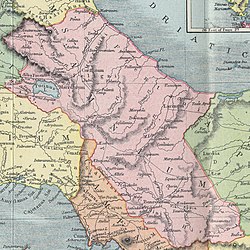
Messapic was in continuous contact with the Italic languages of the region. Prior to the Roman annexation, the frontier between Messapic and Oscan extended across Frentania-Irpinia-Lucania-Apulia. In this broad transitional zone, processes of Oscanization and Samnitization took place, producing communities with dual ethnic or linguistic identities. Contemporary sources reflect this situation: Larinum, for instance, has yielded extensive Oscan onomastic material yet is nevertheless described as a "Daunian city", and Horace—born in Venusia, on the boundary between Daunian and Lucanian territories—famously referred to himself as "Lucanian or Apulian".
A limited corpus of Messapic lexical items passed into Latin. These include baltea (from balta, 'swamp'), deda ('nurse'), gandeia ('sword'), horeia ('small fishing boat'), and mannus ('pony, small horse', from manda). Messapic also appears to have served as an intermediary channel for the transmission of several, mostly archaic, Greek words into Latin. For example, paro ('small ship') is derived via Messapic from Greek paroon. The Latin form Ulixes may likewise represent a Messapic variant of Odysseus, parallel to the ethnonym Graeci, which may reflect an Illyrian term for the Greek populations of Epirus. A Messapic intermediary has also been proposed for Latin lancea ('spear') and balaena (ultimately from Greek phallaina). In literary sources, Horace and Ennius—both natives of the region—are the only Roman authors to preserve the non-Italic word laama ('swamp'), which is plausibly of Messapic origin.
Ancient Greek
The Messapic verbal form eipeigrave ('wrote, incised'; variant ipigrave) is a clear loanword from Greek (with the initial stem eipigra-, ipigra- deriving from epigrá-phō, ἐπιγράφω, 'inscribe, engrave'). Its adoption likely reflects the borrowing of the Messapic alphabet from an Archaic Greek script. Other Greek loanwords include argora-pandes ('coin officials', with the first part deriving from ἄργυρος), and names of deities like Athana and possibly Aprodita. The latter may alternatively represent a native Messapic theonym of an Indo-European goddess, corresponding to Proto-Albanian *apro dītā ('come forth brightness of the day/dawn'), preserved in the Albanian phrase afro dita ('come forth the day/dawn'), referring to the planet Venus, and associated with the dawn goddess Prende.
The origin of the Messapic goddess Damatura/Damatira is debated: scholars like Vladimir I. Georgiev (1937), Eqrem Çabej, Shaban Demiraj (1997), Martin L. West (2007) and Simona Marchesini (2021) have argued that she was an Illyrian or Messapic goddess eventually borrowed into Greek as Demeter, while others like Paul Kretschmer (1939), Robert S. P. Beekes (2009) and Carlo De Simone (2017) have argued for the contrary.
See also
Sources
Footnotes
Citations
Bibliography
Further reading
- Bianconi, Michele; Capano, Marta; Sabattini, Paolo (2025). "A new assessment of Messapic vocalism: Sound change, script adaptation, and synchronic phonology". Indo-European Linguistics. 13 (1): 1–40. doi:.
- Lomas, Kathryn. "Crossing Boundaries: The Inscribed Votives of Southeast Italy." Pallas, no. 86, 2011, pp. 311–329. JSTOR, www.jstor.org/stable/43606696. Accessed 15 Apr. 2020.
- Lombardo, Mario; Boffa, Giovanni (2023). "Contact and Interaction between Greeks and Messapians". In Cassio, Albio Cesare; Kaczko, Sara (eds.). Alloglо̄ssoi: Multilingualism and Minority Languages in Ancient Europe. Berlin, Boston: De Gruyter. pp. 215–250. doi:. ISBN 9783110779684.
- Marchesini, Simona (2023b). "The Messapic Inscription from Grotta Poesia MLM 3 Ro: Analysis with Frame Semantics". In Cassio, Albio Cesare; Kaczko, Sara (eds.). Alloglо̄ssoi: Multilingualism and Minority Languages in Ancient Europe. Berlin, Boston: De Gruyter. pp. 283–298. doi:. ISBN 9783110779684.
- Meudler, Marcel (2003). . Revue des Études Anciennes. 105 (1): 5–15. doi:.
- Messapische Studien. Inschriften mit Kommentar, Skizze einer Laut- und Formenlehre. Von Otto Haas Universitätdozent – Wien. Heidelberg: Carl Winter – Universitätsverlag. 1962.
External links
- (in Italian)
- . Telegraph Newspaper Online, November 19, 2005.