Mongolian script
In-game article clicks load inline without leaving the challenge.
The traditional Mongolian script, also known as the Hudum Mongol bichig, was the first writing system created specifically for the Mongolian language, and was the most widespread until the introduction of Cyrillic in 1946. The script has been a co-official script in Mongolia since 2025, alongside the Cyrillic script for the language. It is also the official written form being taught in schools for Mongolian ethnic students in the Inner Mongolia Autonomous Region of the People's Republic of China. It is traditionally written in vertical lines from top to bottom, flowing in lines from left to right . Derived from the Old Uyghur alphabet, it is a true alphabet, with separate letters for consonants and vowels. It has been adapted for such languages as Oirat and Manchu. Alphabets based on this classical vertical script continue to be used in Mongolia and Inner Mongolia to write Mongolian, Xibe and, experimentally, Evenki.
Computer operating systems have been slow to adopt support for the Mongolian script; almost all have incomplete support or other text rendering difficulties.
History

The Mongolian vertical script developed as an adaptation of the Old Uyghur alphabet for the Mongolian language. Tata-tonga, a 13th-century Uyghur scribe captured by Genghis Khan, was responsible for bringing the Old Uyghur alphabet to the Mongolian Plateau and adapting it to the form of the Mongolian script.
From the seventh and eighth to the fifteenth and sixteenth centuries, the Mongolian language separated into southern, eastern and western dialects. The principal documents from the period of the Middle Mongol language are: in the eastern dialect, the famous text The Secret History of the Mongols, monuments in the Square script, materials of the Chinese–Mongolian glossary of the fourteenth century and materials of the Mongolian language of the middle period in Chinese transcription, etc.; in the western dialect, materials of the Arab–Mongolian and Persian–Mongolian dictionaries, Mongolian texts in Arabic transcription, etc. The main features of the period are that the vowels ï and i had lost their phonemic significance, creating the i phoneme (in the Chakhar dialect, the Standard Mongolian in Inner Mongolia, these vowels are still distinct); inter-vocal consonants ɣ/g, b/w had disappeared and the preliminary process of the formation of Mongolian long vowels had begun; the initial h was preserved in many words; grammatical categories were partially absent, etc. The development over this period explains why the Mongolian script looks like a vertical Arabic script (in particular the presence of the dot system).
Eventually, minor concessions were made to the differences between the Uyghur and Mongol languages: In the 17th and 18th centuries, smoother and more angular versions of the letter tsadi became associated with /dʒ/ and /tʃ/ respectively, and in the 19th century, the Manchu hooked yodh was adopted for initial /j/. Zain was dropped as it was redundant for /s/. Various schools of orthography, some using diacritics, were developed to avoid ambiguity.
Words are written vertically from top to bottom, flowing in lines from left to right. The Old Uyghur script and its descendants, of which traditional Mongolian is one among Oirat Clear, Manchu, and Buryat are the only known vertical scripts written from left to right. This developed because the Uyghurs rotated their Sogdian-derived script, originally written right to left, 90 degrees counterclockwise to emulate Chinese writing, but without changing the relative orientation of the letters.
The reed pen was the writing instrument of choice until the 18th century, when the brush took its place under Chinese influence. Pens were also historically made of wood, bamboo, bone, bronze, or iron. Ink used was black or cinnabar red, and written with on birch bark, paper, cloths made of silk or cotton, and wooden or silver plates.
- Reed pens
- Ink brushes
- Writing implements of the Bogd Khan
Mongols learned their script as a syllabary, dividing the syllables into twelve different classes, based on the final phonemes of the syllables, all of which ended in vowels.
The script remained in continuous use by Mongolian speakers in Inner Mongolia in the People's Republic of China. In the Mongolian People's Republic, it was largely replaced by the Mongolian Cyrillic alphabet, although the vertical script remained in limited use. In March 2020, the Mongolian government announced plans to increase the use of the traditional Mongolian script and to use both Cyrillic and Mongolian script in official documents by 2025. Due to the particularity of the traditional Mongolian script, a large part (40%) of the Sinicized Mongols in China are unable to read or write this script, and in many cases the script is only used symbolically on plaques in many cities.
Names
The script is known by a wide variety of names. As it was derived from the Old Uyghur alphabet, the Mongol script is known as the Uighur(-)Mongol script. From 1941 onwards, it became known as the Old Script, in contrast to the New Script, referring to Cyrillic. The Mongolian script is also known as the Hudum or 'not exact' script, in comparison with the Todo 'clear, exact' script, and also as 'vertical script'.
Overview
The traditional or classical Mongolian alphabet, sometimes called Hudum 'traditional' in Oirat in contrast to the Clear script (Todo 'exact'), is the original form of the Mongolian script used to write the Mongolian language. It does not distinguish several vowels (o/u, ö/ü, final a/e) and consonants (syllable-initial t/d and k/g, sometimes ǰ/y) that were not required for Uyghur, which was the source of the Mongol (or Uyghur-Mongol) script. The result is somewhat comparable to the situation of English, which must represent ten or more vowels with only five letters and uses the digraph th for two distinct sounds. Ambiguity is sometimes prevented by context, as the requirements of vowel harmony and syllable sequence usually indicate the correct sound. Moreover, as there are few words with an exactly identical spelling, actual ambiguities are rare for a reader who knows the orthography.
Letters have different forms depending on their position in a word: initial, medial, or final. In some cases, additional graphic variants are selected for visual harmony with the subsequent character.
The rules for writing below apply specifically for the Mongolian language, unless stated otherwise.
Vowel harmony
Mongolian vowel harmony separates the vowels of words into three groups – two mutually exclusive and one neutral:
- The back, male, masculine, hard, or yang vowels a, o, and u.
- The front, female, feminine, soft, or yin vowels e, ö, and ü.
- The neutral vowel i, able to appear in all words.
Any Mongolian word can contain the neutral vowel i, but only vowels from either of the other two groups. The vowel qualities of visually separated vowels and suffixes must likewise harmonize with those of the preceding word stem. Such suffixes are written with front or neutral vowels when preceded by a word stem containing only neutral vowels. Any of these rules might not apply for foreign words however.
Separated final vowels
A separated final form of vowels a or e (ᠠ⟨?⟩ ‑a/‑e) is common, and can appear at the end of a word stem, or suffix. This form requires a final-shaped preceding letter, and a word-internal gap in between. This gap can be transliterated with a hyphen.

The presence or lack of a separated a or e can also indicate differences in meaning between different words (compare ᠬᠠᠷᠠ⟨?⟩ qar‑a 'black' with ᠬᠠᠷᠠ qara 'to look').
It has the same shape as the traditional dative-locative suffix ‑a/‑e exemplified in the next section. This form of the suffix is, however, more commonly found in older texts, and is restricted in its Post-Classical use.
Separated suffixes
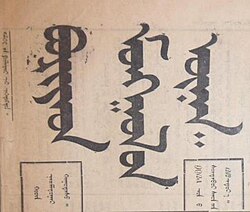
All case suffixes, as well as any plural suffixes consisting of one or two syllables, are likewise separated by a preceding and hyphen-transliterated gap. A maximum of two case suffixes can be added to a stem.
Such single-letter vowel suffixes appear with the final-shaped forms of a/e, i, or u/ü, as in ᠭᠠᠵᠠᠷ ᠠ⟨?⟩ ɣaǰar‑a 'to the country' and ᠡᠳᠦᠷ ᠡ⟨?⟩ edür‑e 'on the day', or ᠤᠯᠤᠰ ᠢ⟨?⟩ ulus‑i 'the state' etc. Multi-letter suffixes most often start with an initial- (consonants), medial- (vowels), or variant-shaped form. Medial-shaped u in the two-letter suffix ᠤᠨ⟨?⟩ ‑un/‑ün is exemplified in the adjacent newspaper logo.
Consonant clusters
Two medial consonants are the most that can come together in original Mongolian words. There are however, a few loanwords that can begin or end with two or more.
Compound names
In the modern language, proper names can usually join two words into graphic compounds (such as those of ᠬᠠᠰᠡᠷᠳᠡᠨᠢ Qas'erdeni 'Jasper-jewel' or ᠬᠥᠬᠡᠬᠣᠲᠠ Kökeqota – the city of Hohhot; as opposed to other compound words). This also allows components of different harmonic classes to be joined together, and vowels of an added suffix will harmonize with those of the latter part of the compound. Orthographic peculiarities are most often retained, as with the short and long teeth of an initial-shaped ⟨ᠥ→᠊ᠥ᠌⟩ ö in ᠮᠤᠤᠥ᠌ᠬᠢᠨ Muu'ökin 'Bad Girl' (protective name). Medial t and d, in contrast, are not affected in this way.
Isolate citation forms
Isolate citation forms for syllables containing o, u, ö, and ü may in dictionaries appear without a final tail as in ⟨ᠪᠣ⟩ bo/bu or ⟨ᠮᠣ᠋⟩ mo/mu, and with a vertical tail as in ⟨ᠪᠥ᠋⟩ bö/bü or ⟨ᠮᠥ᠋⟩ mö/mü (as well as in transcriptions of Chinese syllables).
Letters
Sort orders
Only in a late form can a definite order of signs be established for the alphabet, but can likely be traced back to an earlier Uyghur model.
| South (inner) Mongolian order | a | e | i | o | u | ö | ü | n | b | p | q | k | ɣ | g | m | l | s | š | t | d | č | ǰ | y | r | v | (f) | (ž) | (c) | (k) | (h) |
| 1986 primer, Mongolian Republic | q | k | ɣ | g | ǰ | y | t | d | m | č | r | s | š | l | v | (p) | (z) | |||||||||||||
| Dictionaries after 1924, Mongolian Republic | (f) | (p) | (ž) |
Native Mongolian

| Letters | Contextual forms | Transliteration | International Phonetic Alphabet | |||||
|---|---|---|---|---|---|---|---|---|
| Initial | Medial | Final | Latin | Mongolian Pinyin | Mong. Cyrillic | Khalkha | Chakhar | |
| ᠠ | ᠠ | ᠠ | ᠠ ᠠ᠋ | a | a | а | /a/ | /ɑ/ |
| ᠡ | ᠡ | ᠡ | ᠡ ᠡ᠋ | e | e | э | /ə/ | |
| ᠢ | ᠢ | ᠢ | ᠢ | i | i | и | /i/ | /i/ or /ɪ/ |
| ᠣ | ᠣ | ᠣ | ᠣ | o | ô | о | /ɔ/ | |
| ᠤ | ᠤ | ᠤ | ᠤ | u | û | у | /ʊ/ | |
| ᠥ | ᠥ | ᠥ᠋ ᠥ | ᠥ | ö | o | ө | /ɵ/ | /o/ |
| ᠦ | ᠦ | ᠦ᠋ ᠦ | ᠦ | ü | u | ү | /u/ | |
| ᠨ | ᠨ | ᠨ ᠨ᠋ | ᠨ ᠨ | n | n | н | /n/ | |
| ᠩ | — | ᠩ | ᠩ | ng | ng | нг | /ŋ/ | |
| ᠪ | ᠪ | ᠪ | ᠪ | b | b | б | /p/ and /w/ | /b/ |
| ᠫ | ᠫ | ᠫ | — | p | p | п | /pʰ/ | /p/ |
| ᠬ | ᠬ | ᠬ | ᠬ | q k | h | х | /x/ | |
| ᠭ | ᠭ | ᠭ ᠭ᠋ | ᠭ ᠭ | ɣ g | g | г | /ɢ/ | /ɣ/ |
| ᠮ | ᠮ | ᠮ | ᠮ | m | m | м | /m/ | |
| ᠯ | ᠯ | ᠯ | ᠯ | l | l | л | /ɮ/ | /l/ |
| ᠰ | ᠰ | ᠰ | ᠰ | s | s | с | /s/ or /ʃ/ before i | |
| ᠱ | ᠱ | ᠱ | ᠱ | š | x | ш | /ʃ/ | |
| ᠲ | ᠲ | ᠲ | — | t | t | т | /t/ | |
| ᠳ | ᠳ | ᠳ ᠳ᠋ | ᠳ | d | d | д | /t/ and /tʰ/ | /d/ |
| ᠴ | ᠴ | ᠴ | — | č | q | ч | /t͡ʃʰ/ and /t͡sʰ/ | /t͡ʃ/ |
| ᠵ | ᠵ | ᠵ | — | ǰ | j | ж | /d͡ʒ/ and d͡z | /d͡ʒ/ |
| ᠶ | ᠶ | ᠶ | ᠶ | y | y | й | /j/ | |
| ᠷ | ᠷ | ᠷ | ᠷ | r | r | р | /r/ |
Galik characters
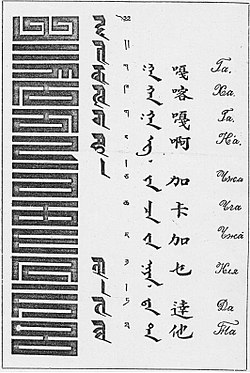
In 1587, the translator and scholar Ayuush Güüsh created the Galik alphabet (Али-гали Ali-gali), inspired by the third Dalai Lama, Sonam Gyatso. It primarily added extra characters for transcribing Tibetan and Sanskrit terms when translating religious texts, and later also from Chinese. Some of those characters are still in use today for writing foreign names (as listed below).
In 1917, the politician and linguist Bayantömöriin Khaisan published the rime dictionary Mongolian-Han Bilingual Original Sounds of the Five Regions, a bilingual edition of the earlier Original Sounds of the Five Regions, to aid Mongolian speakers in learning Mandarin Chinese. To that end, he included transliterations of Mandarin using the Mongolian script, and repurposed three Galik letters to represent the Mandarin retroflex consonants. These letters remain in use in Inner Mongolia for the purpose of transcribing Chinese.
Also Galik alphabet used to create foreign words in Mongolian Script and also Galik Characters were part of Foreign Letters in Mongolian Script.
| Letters | Contextual forms | Transliteration | IPA[citation needed] | |||||
|---|---|---|---|---|---|---|---|---|
| Initial | Medial | Final | Latin | Mong. Cyrillic | Sanskrit | Tibetan | ||
| ᠧ | ᠧ | ᠧ | ᠧ | ē/é | е | ए | ཨེ | /e/ |
| ᠸ | ᠸ | ᠸ | ᠸ | w/v | в | व | ཝ | /w/ |
| ᠹ | ᠹ | ᠹ | ᠹ | f | ф | फ | ཕ | /f/ |
| ᠺ | ᠺ | ᠺ | ᠺ | g/k | к | ग | ག | /k/ |
| ᠻ | ᠻ | ᠻ | ᠻ | k/kh | к | ख | ཁ | /kʰ/ |
| ᠼ | ᠼ | ᠼ | ᠼ | c | ц | छ | ཚ | /t͡s/ |
| ᠽ | ᠽ | ᠽ | ᠽ | z | з | च | ཙ ཛ | /d͡z/ |
| ᠾ | ᠾ | ᠾ | ᠾ | h | х | ह | ཧ | /h/ |
| ᠿ | ᠿ | — | — | ž | ж | ཞ | /ʐ/, /ɻ/ | |
| ᡀ | ᡀ | ᡀ | — | lh | лх | ལྷ | /ɬ/ | |
| ᡁ | ᡁ | — | — | zh | з | /d͡ʐ/ | ||
| ᡂ | ᡂ | — | — | ch | ч | ཋ | /t͡ʂ/ |
Punctuation and numerals
Punctuation


When written between words, punctuation marks use space on both sides of them. They can also appear at the very end of a line, regardless of where the preceding word ends. Red (cinnabar) ink is used in many manuscripts, to either symbolize emphasis or respect. Modern punctuation incorporates Western marks: parentheses; quotation, question, and exclamation marks; including precomposed ⁈ and ⁉.
| Form(s) | Name | Function(s) |
|---|---|---|
| ᠀ | Birga | Marks start of a book, chapter, passage, or first line |
| ᠀᠋ | ||
| ᠀᠌ | ||
| ᠀᠍ | ||
| [...] | ||
| ᠂ | 'Dot' | Comma |
| ᠃ | 'Double-dot' | Period / full stop |
| ᠅ | 'Four-fold dot' | Marks end of a passage, paragraph, or chapter |
| ᠁ | 'Dotted line' | Ellipsis |
| ᠄ | 'Parallel dots' 'Pair of dots'[citation needed] | Colon |
| ᠆ | 'Spine, backbone' | Mongolian soft hyphen (wikt:᠆) |
| ᠊ | Mongolian non-breaking hyphen, or stem extender (wikt:᠊) |
Numerals
| Text | Image | |
|---|---|---|
| 15 on 'year of 15' on a 1925 tögrög coin, with the number written across the baseline. | ᠑᠕ ᠣᠨ | |
| 89 (top) written vertically on a hillside, with the number written along the baseline. | ᠘ ᠙ | |
| Printed numeral 3, written along the baseline and rotated 90 degrees clockwise. | ᠁ᠤᠢ ᠓ ᠬᠡ᠁ |
| 0 | 1 | 2 | 3 | 4 | 5 | 6 | 7 | 8 | 9 |
|---|---|---|---|---|---|---|---|---|---|
| ᠐ | ᠑ | ᠒ | ᠓ | ᠔ | ᠕ | ᠖ | ᠗ | ᠘ | ᠙ |
Mongolian numerals are either written from left to right, or from top to bottom. For typographical reasons, they are rotated 90° in modern books to fit on the line.
Components and writing styles
Components
Listed in the table below are letter components (graphemes) commonly used across the script. Some of these are used with several letters, and others to contrast between them. As their forms and usage may differ between writing styles, however, examples of these can be found under this section below.
| Form | Name(s) | Use |
|---|---|---|
| ᠊ᠡ | 'Tooth' | A main part of letters a/e (from Old Uyghur aleph), n (nun, also part of the digraph ng), q/ɣ (gimel-heth), m (mem), l (hooked resh), initial t/d (taw), etc. Historically also part of k/g (kaph), as well as r (resh). |
| ᠡ | 'Crown' | An exaggerated initial (swash) tooth. Used for the leading aleph of initial vowels (a, e, i, o, u, ö, ü, ē), and with some initial consonants (n, m, l, h = nun, mem, hooked resh, ha etc.). Historically unused. |
| ᠊᠊ | 'Spine, backbone' | The vertical line running through words. |
| ᠊ᠠ | 'Tail' | The swash final of a/e, n, d, etc. |
| ᠊ᠰ᠋ | 'Short tail' | The swash final of q/ɣ, m, and s (samekh-shin or zayin). |
| ᠠ⟨?⟩ ⟨⟩ | Crook | The separated final a/e. |
| Crook, 'Sprinkling, dusting' | The connected lower part of final a/e; the lower part of final g (kaph). | |
| ᡳ᠌ | 'Hook' | The final part of final i (after bow-shaped b, k/g) and some galik letters. |
| ᠵ | 'Shin, stick' | A main part of i, ǰ, and y, and final part of initial ö/ü (yodh). Also the upper part of final g (kaph). |
| 'Straight shin' | ||
| 'Long tooth' | ||
| ᠶ | 'Shin with upturn' | Initial and medial y (yodh). |
| ᠸ | Shin with downturn | The letters ē and w (bet). |
| ᠷ | Horned shin | The letter r (resh). Historically also the upper part of final g and separated a/e. |
| ᠳ᠋ | 'Looped shin' | A medial t/d (lamedh). Historically with its enclosed (counter) endpoint varying in shape: as open/closed, hook-shaped, pointy/round etc. |
| ᡁ | 'Hollow shin' | The letters h and zh (from the Tibetan script). |
| ᠢ | 'Bow' | Final i, o/u/ö/ü, and r; ng, b/p (pe), k/g, etc. |
| ᠊ᠣ | 'Belly, stomach,' loop, contour | The counter of o/u/ö/ü (waw), b, p, initial t/d, etc. |
| ᠲ | 'Hind-gut' | An initial t/d (taw). |
| ᠬ | [...] | An initial q/ɣ (gimel-heth). |
| ᠊ᠮ | 'Braid, pigtail' and 'Horn' | The letters m (mem) and l (hooked resh). |
| ᠊ᠯ | ||
| ᠊ᠰ | 'Corner of the mouth' | The letters s/š (samekh-shin). |
| ᠴ | [...] | The letter č (angular tsade). |
| 'Fork' | ||
| ᠵ | [...] | The letter ǰ (smooth tsade). |
| 'Tusk, fang' | ||
| ᠊ᠹ | Flaglet, tuft | The left-side diacritic of f, z, etc. These names are only used for such components created for words of foreign origin. |
| ᠽ |
Writing styles
As exemplified in this section, the shapes of glyphs may vary widely between different styles of writing and choice of medium with which to produce them. The development of written Mongolian can be divided into the three periods of pre-classical (beginning – 17th century), classical (16/17th century – 20th century), and modern (20th century onward):

Rounded letterforms
- Rounded letterforms tend to be more prevalent with handwritten styles (compare printed and handwritten arban 'ten').
| Block‑printed | 1604 Pen-written form | Modern brush‑written form | Transliteration(s) & 'translation' | |
|---|---|---|---|---|
| 1312 Uyghur Mong. form | semi-modern forms | |||
| arban 'ten' | ||||
Tail
- Final letterforms with a right-pointing tail (such as those of a, e, n, q, ɣ, m, l, s, š, and d) may have the notch preceding it in printed form, written in a span between two extremes: from as a more or less tapered point, to a fully rounded curve in handwriting.
- The long final tails of a, e, n, and d in the texts of pre-classical Mongolian can become elongated vertically to fill up the remainder of a line. Such tails are used consistently for these letters in the earliest 13th to 15th century Uyghur Mongolian style of texts.

| Block‑printed | Pen-written forms | Modern brush‑written forms | Transliteration(s) & 'translation' | |
|---|---|---|---|---|
| Uyghur Mong. forms | semi-modern forms | |||
| ‑ača/‑eče | ||||
| ‑un/‑ün | ||||
| ‑ud/‑üd | ||||
| ba 'and' |
Yodh
- A hooked form of yodh was borrowed from the Manchu alphabet in the 19th century to distinguish initial y from ǰ. The handwritten form of final-shaped yodh (i, ǰ, y), can be greatly shortened in comparison with its initial and medial forms.
| Block‑printed | Pen-written forms | Modern brush‑written forms | Transliteration(s) & 'translation' | |
|---|---|---|---|---|
| Uyghur Mong. forms | semi-modern forms | |||
| ‑i | ||||
| ‑yi | ||||
| ‑yin | ||||
| sain/sayin 'good' | ||||
| yeke 'great' |
Diacritics
- The definite status or function of diacritics was not established prior to classical Mongolian. As such, the dotted letters n, ɣ, and š, can be found sporadically dotted or altogether lacking them. Additionally, both q and ɣ could be (double-)dotted to identify them regardless of their sound values. Final dotted n is also found in modern Mongolian words. Any diacritical dots of ɣ and n can be offset downward from their respective letters (as in ᠭᠣᠣᠯ ɣool and ᠭᠦᠨ ᠢ⟨?⟩ gün‑i).
Bow
- When a bow-shaped consonant is followed by a vowel in Uyghur style text, said bow can be found to notably overlap it (see bi). A final b has, in its final pre-modern form, a bow-less final form as opposed to the common modern one:
| Block‑printed | Pen-written forms | Modern brush‑written forms | Transliteration(s) & 'translation' | |
|---|---|---|---|---|
| Uyghur Mong. forms | semi-modern forms | |||
| ‑u/‑ü | ||||
| bi 'I' | ||||
| ab (intensifying particle) |
Gimel-heth and kaph
- As in kü, köke, ǰüg and separated a/e, two teeth can also make up the top-left part of a kaph (k/g) or aleph (a/e) in pre-classical texts. In back-vocalic words of Uyghur Mongolian, qi was used in place of ki, and can therefore be used to identify this stage of the written language. An example of this appears in the suffix ‑taqi/‑daqi.
| Block‑printed | Pen-written forms | Modern brush‑written forms | Transliteration(s) & 'translation' | |
|---|---|---|---|---|
| Uyghur Mong. forms | semi-modern forms | |||
| ‑a/‑e | ||||
| ‑luɣ‑a | ||||
| [...] | kü (emphatic particle) | |||
| köke 'blue' | ||||
| köge 'soot' | ||||
| ǰüg 'direction' |
Ligatures
- In pre-modern Mongolian, medial ml (ᠮᠯ) forms a ligature: .

Short tail
- A pre-modern variant form for final s appears in the shape of a short final n ⟨ᠰ᠋⟩, derived from Old Uyghur zayin (𐽴). It tended to be replaced by the mouth-shaped form and is no longer used. An early example of it is found in the name of Gengis Khan on the Stele of Yisüngge: ᠴᠢᠩᠭᠢᠰ᠋ Činggis. A zayin-shaped final can also appear as part of final m and ɣ.
| Block‑printed | Pen-written forms | Transliteration(s) & 'translation' | |
|---|---|---|---|
| Uyghur Mong. forms | semi-modern forms | ||
| es(‑)e 'not, no', (negation) | |||
| ulus 'nation' | |||
| nom 'book' | |||
| čaɣ 'time' | |||
Taw and lamedh
- Initial taw (t/d) can, akin to final mem (m), be found written quite explicitly loopy (as in nom 'book' and toli 'mirror'). The lamedh (t or d) may appear simply as an oval loop or looped shin, or as more angular, with an either closed or open counter (as in ‑daki/‑deki or ‑dur/‑dür). As in metü, a Uyghur style word-medial t can sometimes be written with the pre-consonantal form otherwise used for d. Taw was applied to both initial t and d from the outset of the script's adoption. This was done in imitation of Old Uyghur which, however, had lacked the phoneme d in this position.
| Block‑printed | Pen-written forms | Modern brush‑written forms | Transliteration(s) & 'translation' | |
|---|---|---|---|---|
| Uyghur Mong. forms | semi-modern forms | |||
| [...] | toli 'mirror' | |||
| [...] | ‑daki/‑deki | |||
| [...] | ‑tur/‑tür | |||
| ‑dur/‑dür | ||||
| [...] | metü 'as' |
Tsade
- Following the late classical Mongolian orthography of the 17th and 18th centuries, a smooth and angular tsade (ᠵ and ᠴ) has come to represent ǰ and č respectively. The tsade before this was used for both these phonemes, regardless of graphical variants, as no ǰ had existed in Old Uyghur:
| Block‑printed | Transliteration(s) & 'translation' | |
|---|---|---|
| Uyghur Mong. form | semi-modern form | |
| čečeg 'flower' |
| Block-printed semi-modern form | Pen-written form | Transliteration(s) & 'translation' |
|---|---|---|
| qačar/ɣaǰar 'cheek/place' |
Resh
- As in sara and ‑dur/‑dür, a resh (of r, and sometimes of l) can appear as two teeth or crossed shins; adjacent, angled, attached to a shin and/or overlapping.
| Block‑printed | Pen-written form | Modern brush‑written form | Transliteration(s) & 'translation' | |
|---|---|---|---|---|
| Uyghur Mong. form | semi-modern forms | |||
| sar(‑)a 'moon/month' | ||||
Example
| Manuscript | Type | Unicode | Transliteration (first word) |
|---|---|---|---|
| ᠸᠢᠺᠢᠫᠧᠳᠢᠶᠠ᠂ ᠴᠢᠯᠦᠭᠡᠲᠦ ᠨᠡᠪᠲᠡᠷᠬᠡᠢ ᠲᠣᠯᠢ ᠪᠢᠴᠢᠭ ᠪᠣᠯᠠᠢ᠃ | ᠸᠢ wi/vi | ||
| ᠺᠢ gi/ki | |||
| ᠫᠧ pē/pé | |||
| ᠳᠢ di | |||
| ᠶᠠ⟨?⟩ y‑a or ᠶᠠ ya | |||
| Transliteration: Wikipēdiya čilügetü nebterkei toli bičig bolai. Cyrillic: Википедиа чөлөөт нэвтэрхий толь бичиг болой. Transcription: Vikipedia chölööt nevterkhii toli bichig boloi. Translation: Wikipedia is the free encyclopedia. |
Gallery
- Decorative 'wrapped/folded' letters on a 2023 passport.
- Mongolian calligraphy of the 13th century work Оюун Түлхүүр (Key of Intelligence)
- Imperial seal of the Bogd Khan, ca 1911.
- Mixed Manchu–Mongolian text on a Paiza.
- Brush-written Čoyijod Dagini manuscript, 19th century
- Book of Jeremiah, printed 1840 at Khodon in Siberia.
Unicode
The Mongolian script was added to the Unicode standard in September 1999 with the release of version 3.0. However, several design issues have been pointed out.
- The 1999 Mongolian script Unicode codes are duplicated and not searchable. For example, a 2016 corpus study found that the homographic misspelling "mun̅g̅g1ul" was more common than "Mon̅g̅gol" 'mongolia' since o and u are visually identical but encoded separately.
- The 1999 Mongolian script Unicode model has multiple layers of FVS (free variation selectors), MVS, ZWJ, NNBSP, and those variation selections conflict with each other, which create incorrect results. Furthermore, different vendors understood the definition of each FVS differently, and developed multiple applications in different standards.
- The characters themselves are typed left to right, flowing in lines from top to bottom, instead of the correct direction of up to down, flowing in lines from left to right; as a result, the characters are sometimes rotated 90° counterclockwise when displayed in horizontal lines.
Blocks
The Unicode block for Mongolian is U+1800–U+18AF. It includes letters, digits and various punctuation marks for Hudum Mongolian, Todo Mongolian, Xibe (Manchu), Manchu proper, and Ali Gali, as well as extensions for transcribing Sanskrit and Tibetan.
| Mongolian[1][2][3] (PDF) | ||||||||||||||||
| 0 | 1 | 2 | 3 | 4 | 5 | 6 | 7 | 8 | 9 | A | B | C | D | E | F | |
| U+180x | ᠀ | ᠁ | ᠂ | ᠃ | ᠄ | ᠅ | ᠆ | ᠇ | ᠈ | ᠉ | ᠊ | FVS 1 | FVS 2 | FVS 3 | MVS | FVS 4 |
| U+181x | ᠐ | ᠑ | ᠒ | ᠓ | ᠔ | ᠕ | ᠖ | ᠗ | ᠘ | ᠙ | ||||||
| U+182x | ᠠ | ᠡ | ᠢ | ᠣ | ᠤ | ᠥ | ᠦ | ᠧ | ᠨ | ᠩ | ᠪ | ᠫ | ᠬ | ᠭ | ᠮ | ᠯ |
| U+183x | ᠰ | ᠱ | ᠲ | ᠳ | ᠴ | ᠵ | ᠶ | ᠷ | ᠸ | ᠹ | ᠺ | ᠻ | ᠼ | ᠽ | ᠾ | ᠿ |
| U+184x | ᡀ | ᡁ | ᡂ | ᡃ | ᡄ | ᡅ | ᡆ | ᡇ | ᡈ | ᡉ | ᡊ | ᡋ | ᡌ | ᡍ | ᡎ | ᡏ |
| U+185x | ᡐ | ᡑ | ᡒ | ᡓ | ᡔ | ᡕ | ᡖ | ᡗ | ᡘ | ᡙ | ᡚ | ᡛ | ᡜ | ᡝ | ᡞ | ᡟ |
| U+186x | ᡠ | ᡡ | ᡢ | ᡣ | ᡤ | ᡥ | ᡦ | ᡧ | ᡨ | ᡩ | ᡪ | ᡫ | ᡬ | ᡭ | ᡮ | ᡯ |
| U+187x | ᡰ | ᡱ | ᡲ | ᡳ | ᡴ | ᡵ | ᡶ | ᡷ | ᡸ | |||||||
| U+188x | ᢀ | ᢁ | ᢂ | ᢃ | ᢄ | ᢅ | ᢆ | ᢇ | ᢈ | ᢉ | ᢊ | ᢋ | ᢌ | ᢍ | ᢎ | ᢏ |
| U+189x | ᢐ | ᢑ | ᢒ | ᢓ | ᢔ | ᢕ | ᢖ | ᢗ | ᢘ | ᢙ | ᢚ | ᢛ | ᢜ | ᢝ | ᢞ | ᢟ |
| U+18Ax | ᢠ | ᢡ | ᢢ | ᢣ | ᢤ | ᢥ | ᢦ | ᢧ | ᢨ | ᢩ | ᢪ | |||||
| Notes 1.^ As of Unicode version 17.0 2.^ Grey areas indicate non-assigned code points 3.^ The Unicode presentation form of U+1824 MONGOLIAN LETTER U is U+1824 FVS1 ᠤ᠋ Second Isolate Form, to distinguish it from the visually identical U+1823 MONGOLIAN LETTER O. For the same reason, the Unicode presentation form of U+1826 MONGOLIAN LETTER UE is U+1826 FVS2 ᠦ᠌ Third Isolate Form. See document N4752R2. |
The Mongolian Supplement block (U+11660–U+1167F) was added to the Unicode Standard in June 2016 with the release of version 9.0:
| Mongolian Supplement[1][2] (PDF) | ||||||||||||||||
| 0 | 1 | 2 | 3 | 4 | 5 | 6 | 7 | 8 | 9 | A | B | C | D | E | F | |
| U+1166x | 𑙠 | 𑙡 | 𑙢 | 𑙣 | 𑙤 | 𑙥 | 𑙦 | 𑙧 | 𑙨 | 𑙩 | 𑙪 | 𑙫 | 𑙬 | |||
| U+1167x | ||||||||||||||||
| Notes 1.^ As of Unicode version 17.0 2.^ Grey areas indicate non-assigned code points |
Keyboard layout
The Windows Mongolian traditional script keyboard layout for personal computers is as follows:
Unshifted layout
| FVS3 | 1 ᠑ | 2 ᠒ | 3 ᠓ | 4 ᠔ | 5 ᠕ | 6 ᠖ | 7 ᠗ | 8 ᠘ | 9 ᠙ | 0 ᠐ | NNBSP | = | Backspace |
| Tab | Q ᠴ č | W ᠣ o | E ᠡ e | R ᠷ r | T ᠲ t | Y ᠶ y | U ᠦ ü | I ᠢ i | O ᠥ ö | P ᠫ p | (...) 〔 | (...) 〕 | (...) ᠁ |
| Caps | A ᠠ a | S ᠰ s | D ᠳ d | F ᠹ f | G ᠭ ɣ/g | H ᠬ q/k | J ᠵ ǰ | K ᠺ g | L ᠯ l | ; ︔ | FVS1 | Enter | |
| Shift | \ | Z ᠽ z | X ᠱ š | C ᠼ c | V ᠤ u | B ᠪ b | N ᠨ n | M ᠮ m | , ᠂ | . ᠃ | . | Shift | |
| Ctrl | Alt | Alt | Ctrl |
Shifted layout
| ~ | 1 ! | 2 ⁈ | 3 ⁉ | 4 — | 5 % | 6 ZWNJ | 7 ᠊ | 8 ZWJ | 9 ( | 0 ) | MVS | + | Backspace |
| Tab | W ᠸ w | E ᠧ ē | R ᠿ ž | (...) 〈 | (...) 〉 | (...) | | |||||||
| Caps | H ᠾ h | K ᠻ kh | L ᡀ lh | : ᠄ | FVS2 | Enter | |||||||
| Shift | Z ᡁ zh | C ᡂ ch | N ᠩ ng | , 《 | . 》 | ? | Shift | ||||||
| Ctrl | Alt | Alt | Ctrl |
See also
- Mongolian writing systems Mongolian script Mongolian script multigraphs Galik alphabet Todo alphabet ʼPhags-pa script Horizontal square script Soyombo script Mongolian Latin alphabet SASM/GNC romanization § Mongolian Mongolian Cyrillic alphabet Mongolian transliteration of Chinese characters Mongolian Braille
- Mongolian Sign Language
- Mongolian name
Notes
External links
Keyboards Mongolian script layout online
Summaries
- 2022-03-19 at the Wayback Machine
- (contains several table inaccuracies regarding glyphs and transliterations)
Studies
- (fr) Rémusat, Abel , Paris, 1820
Grammars
- (ru) Schmidt, Isaak Jakob, , Saint-Petersburg, 1832
- (ru) Bobrovnikov, Aleksieĭ Aleksandrovich , Kazan, 1849
- (de) Schmidt, Isaak Jakob, , St. Petersburg, 1831
- (fr) Soulié, Charles Georges, , Paris, 1903
- (it) Puini, Carlo, , Firenze, 1878
Dictionaries
- (fr, ru) Kovalevskiĭ, Osip Mikhaĭlovich, , Volumes 1–3, Kazan 1844-46-49
- (sometimes uses galik characters for rendering purposes)
Transliteration
- 2020-08-04 at the Wayback Machine
Manuscripts
- , National Library of Denmark
- , the Berlin-Brandenburg Academy of Sciences and Humanities
Other
- website in Mongolian script
- Tang, Didi (20 March 2020). . The Times.