Nano-
In-game article clicks load inline without leaving the challenge.
Nano (symbol n) is a unit prefix meaning one billionth. Used primarily with the metric system, this prefix denotes a factor of 10−9 or 0.000000001. It is frequently encountered in science and electronics for prefixing units of time and length.
The prefix derives from the Greek νᾶνος (Latin nanus), meaning "dwarf". The General Conference on Weights and Measures (CGPM) officially endorsed the usage of nano as a standard prefix in 1960.
When used as a prefix for something other than a unit of measure (as for example in words like "nanoscience"), nano refers to nanotechnology, or means "on a scale of nanometres" (nanoscale).
Nanometre (Nanometer)
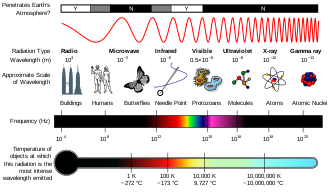
The nanometre (international spelling as used by the International Bureau of Weights and Measures; SI symbol: nm), or nanometer (American spelling), is a unit of length in the International System of Units (SI), equal to one billionth (short scale) or one thousand millionth (long scale) of a metre (0.000000001m) and to 1000picometres. One nanometre can be expressed in scientific notation as 1 × 10⁻⁹m and as 1/1000000000m.
X-rays have a wavelength ranging from the size of 0.01 nm to 10 nm.
Three gold atoms lined up are about one nanometer (nm) long.
Human fingernails grow at approximately one nanometer per second.
Nanosecond
A nanosecond (ns) is a unit of time in the International System of Units (SI) equal to one billionth of a second, that is, 1/1000000000 of a second, or 10−9 seconds.
The term combines the SI prefix nano- indicating a 1 billionth submultiple of an SI unit (e.g. nanogram, nanometre, etc.) and second, the primary unit of time in the SI.
A nanosecond is to one second, as one second is to approximately 31.69 years.
A nanosecond is equal to 1000picoseconds or 1/1000microsecond. Time units ranging between 10−8 and 10−7 seconds are typically expressed as tens or hundreds of nanoseconds.
Time units of this granularity are commonly found in telecommunications, pulsed lasers, and related aspects of electronics.
One nanosecond (ns) is about the time required for light to travel 30 cm in air, or 20 cm in an optical fiber.
See also
| Prefix | Base 10 | Decimal | Adoption | |
|---|---|---|---|---|
| Name | Symbol | |||
| quetta | Q | 1030 | 1000000000000000000000000000000 | 2022 |
| ronna | R | 1027 | 1000000000000000000000000000 | |
| yotta | Y | 1024 | 1000000000000000000000000 | 1991 |
| zetta | Z | 1021 | 1000000000000000000000 | |
| exa | E | 1018 | 1000000000000000000 | 1975 |
| peta | P | 1015 | 1000000000000000 | |
| tera | T | 1012 | 1000000000000 | 1960 |
| giga | G | 109 | 1000000000 | |
| mega | M | 106 | 1000000 | 1873 |
| kilo | k | 103 | 1000 | 1795 |
| hecto | h | 102 | 100 | |
| deca | da | 101 | 10 | |
| — | — | 100 | 1 | — |
| deci | d | 10−1 | 0.1 | 1795 |
| centi | c | 10−2 | 0.01 | |
| milli | m | 10−3 | 0.001 | |
| micro | μ | 10−6 | 0.000001 | 1873 |
| nano | n | 10−9 | 0.000000001 | 1960 |
| pico | p | 10−12 | 0.000000000001 | |
| femto | f | 10−15 | 0.000000000000001 | 1964 |
| atto | a | 10−18 | 0.000000000000000001 | |
| zepto | z | 10−21 | 0.000000000000000000001 | 1991 |
| yocto | y | 10−24 | 0.000000000000000000000001 | |
| ronto | r | 10−27 | 0.000000000000000000000000001 | 2022 |
| quecto | q | 10−30 | 0.000000000000000000000000000001 | |
| Notes |