National Assembly (Bulgaria)
In-game article clicks load inline without leaving the challenge.
42°41′40″N 23°19′58″E/42.694456°N 23.332893°E/ 42.694456; 23.332893 The National Assembly (Народно събрание, Narodno săbraniе) is the unicameral parliament and legislative body of Bulgaria.
History
The Bulgarian National Assembly was established in 1879 with the Tarnovo Constitution. During 1881-1883, under the Regime of Full Powers of Prince Alexander I, it was replaced by an appointed State Council. The unicameral legislature provided by the Tarnovo Constitution, while favored by the historical liberals, drew the ire of the conservatives who proposed to replace it with a bicameral parliament.
During the communist period between 1946 and 1989, the National Assembly was characterized as a rubber stamp for the Bulgarian Communist Party (BKP) or as only being able to affect issues of low sensitivity and salience to the Bulgarian communist regime. The BCP controlled nomination and election processes at every level in its political system, allowing it to stamp out any opposition. As a legacy of the communist-era system of government, where the National Assembly was constitutionally defined as the supreme organ of state power and only branch of government, government ministers are formally appointed and dismissed by the Assembly on prime ministerial advice (rather than the President on prime ministerial advice, as in other parliamentary systems) even after the transition to democracy.
Elections
Three types of candidates participate in the elections: parties, coalitions and independent candidates. Every citizen who has the right to vote can do so for one candidate. The ratio of the number of valid votes for the candidate relative to the total number of valid votes gives the candidate the support of voters. The Central Election Commission is the institution responsible for all elections in the country.
The National Assembly is composed of parliamentary groups and independent members, with parliamentary groups representing a political party, and they, in turn, represent their voters.
Ordinary National Assembly
By the Constitution (Art. 62 to 91), The National Assembly consists of 240 members elected for a four-year term, elected by proportional representation in multi-seat constituencies. Political parties must garner a minimum of 4% of the national vote in order to enter the Assembly. Bulgaria has a multi-party system. In order to be eligible as an MP, one must be a Bulgarian citizen over the age of 21 years who is neither interdicted nor is serving a custodial sentence. Bulgarian citizens with dual nationality must be resident in Bulgaria during the last eighteen months before their election; this residency requirement does not apply to Bulgarian citizens without dual nationality.
The National Assembly is responsible for enactment of laws, approval of the state budget, scheduling of presidential elections, selection and dismissal of the Prime Minister and other ministers, declaration of war, concluding peace and deployment of troops outside Bulgaria, declares a state of war or other state of emergency on the proposal of the President or the Cabinet, grants amnesty, and ratification of international treaties and agreements. It is headed and presided by the Chairperson of the National Assembly of Bulgaria.
The Assembly administers the publication of the State Gazette, Bulgaria's gazette of record.
Procedure
The National Assembly is inaugurated by the eldest attending elected attending member of Parliament. On the first day of sitting, they preside over the election of the Speaker (Chairperson) and Deputy speakers, form the parliamentary groups, and appoint the secretaries of the Assembly.
Once elected, the Speakers retain their party allegiances, which means that they remain as MPs and are allowed to take part in debates and voting.
More than 121 MPs must be present in order for any session to commence, and 50%+1 of those present must vote "for" any point of order or bill to be approved, unless the specific matter of the vote requires another majority.
Parliament sits Wednesday to Friday, and sessions begin at 9 am. Parliamentary committees sit in the afternoons.
Electing a government
In order to elect a government, the National Assembly must have formed the parliamentary groups and have secured a majority. The President of the Republic calls to consultations for electing a government the parliamentary groups. Per article 99 of the Constitution, the President gives out the first mandate to the candidate for a Prime Minister of the largest parliamentary group in order to elect a government. If after 7-days, the candidate fails to propose a government, the second mandate goes to the PM candidate of the second largest parliamentary group. If the second mandate fails as well, the President gives out the third and last mandate to the candidate of one of the other parliamentary groups. If the mandate is delivered, the President signs it and propose to the National Assembly to elect that government. In order for the government to be elected, there need to be present more than 121 votes "for".
Ministers may be chosen from among the MPs, or they may be experts outside Parliament. All MPs picked to be Cabinet ministers lose their MP status, and the next candidate from the party list of the constituency takes his place.
Layout
Old Parliament House
In 2020-2021, the old Parliament House was only used for special occasions, such as the opening and closing of the legislative session or the inauguration of a new president. Following the April 2021 parliamentary elections, the legislature returned to the old parliament building.
The Chamber is made up of 286 seats, all facing the 5-seat speaker's bench in a 26 x 11 arrangement. In front of the Speaker, also facing the chamber, is the pulpit, in front of which is the stenographers' desk.
Parties sit in parliamentary groups, loosely following the rule that the political left sits to the Speaker's left and the political right to his right. Generally, the largest parties choose the chamber's left, right or centre wings, with smaller blocks accommodating themselves wherever convenient. Individual MPs will sometimes sit entirely outside their block or stand, and, since compulsory electronic registration was implemented, may even vote from any seat in the house.
To the speaker's right, also facing the chamber, is a section with 17 seats reserved for the Cabinet, any of whom may or may not be present at any time during a parliamentary session. Any of them may, however, be called up by Parliament at any time if needed.
Largo Parliament House
Located in the former Bulgarian Communist Party headquarters building in the Largo, The Chamber is made up of 270 seats arranged in a hemicycle of twelve rows, all facing the 7-seat speaker's bench. In front of the Speaker, also facing the chamber, is the pulpit containing a stenographer's desk at the center and two sections reserved for the Cabinet, each with 13 seats, at the sides.
The new plenary hall, which is located under a glass roof, is larger than the old one and can be easily remodeled to fit the 400-member Grand National Assembly. It was used briefly in 2020-2021 during the end of GERB's third government. Following the April 2021 parliamentary elections, the legislature returned to the old parliament building.
Grand National Assembly
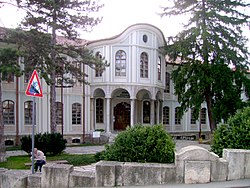
In addition to the ordinary National Assembly, a Grand National Assembly (Велико народно събрание, Veliko narodno sabranie) may be convened for matters of special jurisdiction, such as: 1) Adoption of a new Constitution; 2) Amendment of certain articles of the Constitution, e.g. those related with the basic civil rights; 3) Changes in the territory (gain or loss) of the Republic, etc. Before the World War II the Grand National Assembly was also competent in electing the Regency of the Bulgarian Kingdom if the tzar had not come to age. The First and the Third Grand National Assemblies also elected the first two Bulgarian monarchs after the liberation from Ottoman rule – Prince (Knjaz) Alexander Battenberg and Prince (Knjaz) Ferdinand Saxe Coburg-Gotha.
As an organ, the Grand National Assembly was introduced with the Tarnovo Constitution of 1879, abolished in 1947 and reintroduced with the 1991 constitution. In different constitutional provisions, it was constituted by a different number of representatives. According to the 1991 Constitution, it consists of 400 deputies (as opposed to 240 in the ordinary one). The 1991 Constitution was adopted by the Seventh Grand National Assembly and was composed of 200 members being elected by proportional representation and the other 200 under a first-past-the-post voting system. The Constitution provides that the elections for Grand National Assembly shall be conducted in the same manner as those for the Ordinary National Assembly.
A qualified majority of 2/3 during three voting procedures on separate dates is required for a decision to be made. The Grand National Assembly can also serve as an ordinary National Assembly, taking care of regular legislative activities in urgent cases only. After it has concluded its work on the matter for which it was elected, the Grand National Assembly is dissolved ex lege and the President of the Republic shall appoint elections for an ordinary National Assembly.
A total of seven Grand National Assemblies have been in operation in Bulgaria, the last one from 10 July 1990 to 12 July 1991 adopting the current constitution.
Building

The National Assembly's main building has been proclaimed a monument of culture for its historic significance. Situated in downtown Sofia, it was designed in the Neo-Renaissance style by Konstantin Jovanović.

Due to insufficient space in the main building at Parliament Square, the National Assembly is now housed by the former headquarters of the Bulgarian Communist Party, located at the Largo - the so-called Party House. Initially, only administrative offices have been relocated, but proposals to convert it into an interior space for the plenary chamber have been made since 1996, with the relocation taking place in 2020. After the April 2021 Bulgarian parliamentary election, the National Assembly moved again to the old Parliament House because ITN, Democratic Bulgaria, ISMV, and DPS viewed the Party House building as a symbol of Bulgaria's communist past.
List of National Assemblies
| Parliament | Term | Term length (days) | Seats |
|---|---|---|---|
| Constituent National Assembly | 10 February 1879 – 16 April 1879 | 66 | 231 |
| 1st Grand National Assembly | 17 April 1879 – 26 June 1879 | 71 | 231 |
| 1st Ordinary National Assembly | 21 October 1879 – 24 November 1879 | 35 | 158 |
| 2nd Ordinary National Assembly | 23 March 1880 – 18 December 1880 | 271 | 172 |
| 2nd Grand National Assembly | 7 January 1881 | 307 | |
| 3rd Ordinary National Assembly | 10 December 1882 – 25 December 1883 | 381 | 47 |
| 4th Ordinary National Assembly | 27 June 1884 – 6 September 1886 | 802 | 195/286 |
| 3rd Grand National Assembly | 19 October 1886 – 3 August 1887 | 289 | 493 |
| 5th Ordinary National Assembly | 15 October 1887 – 17 December 1889 | 795 | 285 |
| 6th Ordinary National Assembly | 15 October 1890 – 15 December 1892 | 793 | 276 |
| 4th Grand National Assembly | 3 May 1893 – 17 May 1893 | 15 | 577 |
| 7th Ordinary National Assembly | 15 October 1893 – 21 December 1893 | 68 | 145 |
| 8th Ordinary National Assembly | 15 October 1894 – 4 February 1896 | 478 | 149 |
| 9th Ordinary National Assembly | 1 December 1896 – 19 December 1898 | 749 | 159 |
| 10th Ordinary National Assembly | 16 May 1899 – 29 November 1900 | 563 | 169 |
| 11th Ordinary National Assembly | 22 February 1901 – 23 December 1901 | 305 | 166 |
| 12th Ordinary National Assembly | 22 April 1902 – 31 March 1903 | 344 | 188 |
| 13th Ordinary National Assembly | 2 November 1903 – 22 December 1907 | 1512 | 189 |
| 14th Ordinary National Assembly | 15 June 1908 – 15 February 1911 | 976 | 203 |
| 5th Grand National Assembly | 9 June 1911 – 9 July 1911 | 31 | 414 |
| 15th Ordinary National Assembly | 15 October 1911 – 23 July 1913 | 648 | 213 |
| 16th Ordinary National Assembly | 19 December 1913 – 31 December 1913 | 13 | 204 |
| 17th Ordinary National Assembly | 20 March 1914 – 15 April 1919 | 1853 | 257 |
| 18th Ordinary National Assembly | 2 October 1919 – 20 February 1920 | 142 | 237 |
| 19th Ordinary National Assembly | 15 April 1920 – 11 March 1923 | 1061 | 232 |
| 20th Ordinary National Assembly | 21 May 1923 – 11 June 1923 | 22 | 245 |
| 21st Ordinary National Assembly | 9 December 1923 – 15 April 1927 | 1224 | 267 |
| 22nd Ordinary National Assembly | 19 June 1927 – 18 April 1931 | 1400 | 275 |
| 23rd Ordinary National Assembly | 20 August 1931 – 19 May 1934 | 1004 | 283 |
| 24th Ordinary National Assembly | 22 May 1938 – 27 April 1939 | 341 | 160 |
| 25th Ordinary National Assembly | 24 February 1940 – 23 August 1944 | 1643 | 160 |
| 26th Ordinary National Assembly | 15 December 1945 – 28 September 1946 | 288 | 276 |
| 6th Grand National Assembly | 7 November 1946 – 21 October 1949 | 1080 | 465(375) |
| 1st National Assembly | 17 January 1950 – 2 November 1953 | 1386 | 239 |
| 2nd National Assembly | 14 January 1954 – 11 December 1957 | 1428 | 249 |
| 3rd National Assembly | 13 January 1958 – 4 November 1961 | 1392 | 254 |
| 4th National Assembly | 15 March 1962 – 8 December 1965 | 1365 | 321 |
| 5th National Assembly | 11 March 1966 – 18 May 1971 | 1895 | 416 |
| 6th National Assembly | 7 July 1971 – 9 March 1976 | 1708 | 400 |
| 7th National Assembly | 15 June 1976 – 7 April 1981 | 1758 | 400 |
| 8th National Assembly | 16 June 1981 – 21 March 1986 | 1740 | 400 |
| 9th National Assembly | 17 June 1986 – 3 April 1990 | 1387 | 400 |
| 7th Grand National Assembly | 10 July 1990 – 2 October 1991 | 450 | 400 |
| 36th National Assembly | 4 November 1991 – 17 October 1994 | 1079 | 240 |
| 37th National Assembly | 12 January 1995 – 13 February 1997 | 764 | 240 |
| 38th National Assembly | 7 May 1997 – 19 April 2001 | 1444 | 240 |
| 39th National Assembly | 5 July 2001 – 17 June 2005 | 1444 | 240 |
| 40th National Assembly | 11 July 2005 – 25 June 2009 | 1446 | 240 |
| 41st National Assembly | 14 July 2009 – 13 March 2013 | 1339 | 240 |
| 42nd National Assembly | 21 May 2013 – 6 August 2014 | 443 | 240 |
| 43rd National Assembly | 27 October 2014 – 27 January 2017 | 824 | 240 |
| 44th National Assembly | 19 April 2017 – 26 March 2021 | 1438 | 240 |
| 45th National Assembly | 15 April 2021 – 12 May 2021 | 28 | 240 |
| 46th National Assembly | 21 July 2021 – 16 September 2021 | 58 | 240 |
| 47th National Assembly | 3 December 2021 – 2 August 2022 | 243 | 240 |
| 48th National Assembly | 19 October 2022 – 3 February 2023 | 108 | 240 |
| 49th National Assembly | 12 April 2023 – 19 June 2024 | 435 | 240 |
| 50th National Assembly | 19 June 2024 – 10 November 2024 | 145 | 240 |
| 51st National Assembly | 11 November 2024 – | 240 |

Historical composition of the National Assembly
1990-2005
| BSP DPS NDSV BZNS SDS DSB BBB Ataka Others | Total seats | ||||||||
| BSP | DPS | NDSV | BZNS | SDS | DSB | BBB | Ataka | Others | |
| 1990 | 211 23 16 144 | 400 | |||||||
| 211 | 23 | 16 | 144 | ||||||
| 1991 | 106 24 110 | 240 | |||||||
| 106 | 24 | 110 | |||||||
| 1995 | 125 15 18 69 13 | 240 | |||||||
| 125 | 15 | 18 | 69 | 13 | |||||
| 1997 | 58 19 137 12 14 | 240 | |||||||
| 58 | 19 | 137 | 12 | 14 | |||||
| 2001 | 48 21 120 51 | 240 | |||||||
| 48 | 21 | 120 | 51 | ||||||
| 2005 | 82 34 53 20 17 21 13 | 240 | |||||||
| 82 | 34 | 53 | 20 | 17 | 21 | 13 |
2009-2017
| BSP DPS Blue Coalition/Reformist Bloc GERB PF Ataka Others | Total seats | ||||||
| BSP | DPS | Blue Coalition/Reformist Bloc | GERB | PF | Ataka | Others | |
| 2009 | 40 38 15 116 21 10 | 240 | |||||
| 40 | 38 | 15 | 116 | 21 | 10 | ||
| 2013 | 84 36 97 23 | 240 | |||||
| 84 | 36 | 97 | 23 | ||||
| 2014 | 39 38 23 84 19 11 26 | 240 | |||||
| 39 | 38 | 23 | 84 | 19 | 11 | 26 | |
| 2017 | 80 26 95 27 12 | 240 | |||||
| 80 | 26 | 95 | 27 | 12 |
Since 2021
| IBG BSP DPS APS PP PP-DB DB GERB–SDS ITN Revival Others | Total seats | ||||||||||
| IBG | BSP | DPS | APS | PP | PP-DB | DB | GERB–SDS | ITN | Revival | Others | |
| April 2021 | 14 43 30 27 75 51 | 240 | |||||||||
| 14 | 43 | 30 | 27 | 75 | 51 | ||||||
| July 2021 | 13 36 29 34 63 65 | 240 | |||||||||
| 13 | 36 | 29 | 34 | 63 | 65 | ||||||
| November 2021 | 26 34 67 16 59 25 13 | 240 | |||||||||
| 26 | 34 | 67 | 16 | 59 | 25 | 13 | |||||
| 2022 | 25 36 53 20 67 27 12 | 240 | |||||||||
| 25 | 36 | 53 | 20 | 67 | 27 | 12 | |||||
| 2023 | 23 36 64 69 11 37 | 240 | |||||||||
| 23 | 36 | 64 | 69 | 11 | 37 | ||||||
| June 2024 | 19 47 39 68 16 38 13 | 240 | |||||||||
| 19 | 47 | 39 | 68 | 16 | 38 | 13 | |||||
| October 2024 | 19 29 19 36 66 17 33 21 | 240 | |||||||||
| 19 | 29 | 19 | 36 | 66 | 17 | 33 | 21 |